What to look for in nature in Pennsylvania this March
Pennsylvania’s March is the month the state thaws in public. Snow still falls in Erie and Bradford, yet by the middle of the month wood frogs are quacking in forest pools, male woodcock are spiralling up over old fields at dusk, and the last of the snow geese are leaving Middle Creek. Golden eagles slide along the ridges, bald eagles sit on eggs, and the first skunk cabbage hoods push through cold mud. The days gain nearly an hour and a half, daylight saving time begins March 14 and spring officially starts March 20, and the Worm Moon rises on the 21st. What follows is a month-long guide to the state.
Other months in Pennsylvania: October, November, December, January, February, April.
Start here
- Wait for a warm, rainy night. On the first mild, wet evening, stand quietly at the edge of a wooded pond or flooded field with a dim flashlight and listen for wood frogs quacking and peepers whistling. Slow down on roads that pass wetlands.
- Stand at a field edge at dusk. A few minutes after sunset, find a brushy clearing and listen for the woodcock’s nasal peent, then watch for the bird to spiral up and tumble back down. Calm, above-freezing evenings are best.
- Go to Middle Creek early in March. The Wildlife Drive opens March 1 and the Game Commission suggests the first weekend of March for the snow geese. Check its migration update first, because the flock can shrink overnight.
In the Naturalist’s Field Journal, put the first peeper, phoebe and woodcock on the birds I have seen plate, give a dusk by a field edge to the dusk and dawn watch plate, let reading the signs keep a skunk cabbage hood and a thinning goose flock, use nest observed for an eagle on its eggs, and return to one pond all month for the same place twice plate.
Regions used below: Northwest and Lake Erie; Allegheny National Forest and the Northern Tier; Laurel Highlands and Pittsburgh; Central Ridge and Valley and State College; Poconos and the Northeast; Susquehanna Valley and Harrisburg; Southeast and Philadelphia.
When do spring peepers and wood frogs start calling in Pennsylvania?
The first warm, rainy nights of March are the night shift of the year. Pennsylvania’s Amphibian and Reptile Survey describes the late-winter breeding season as already underway in some springs, with amphibians “trickling” into forest pools since January and migrations at their peak in the northern tier by March. Cold snaps then freeze the pool surfaces between bouts, so on many outings you will find egg masses rather than adults. A Lebanon County news report put the usual big migration at mid-March to mid-April, on rainy nights when temperatures rise.
-
Wood frogs: the quacking pools
First warm rains of March; the season runs through May · Fishless vernal pools in forest
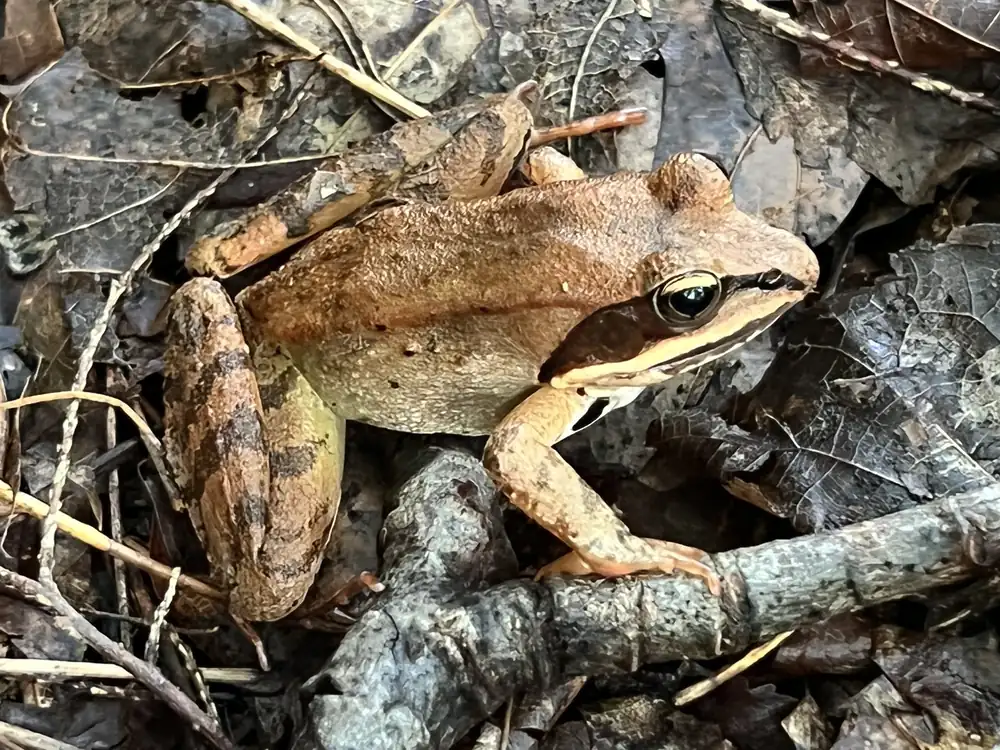
Wood frogs are among the first to move. The Chesapeake Bay Program’s field guide says their mating season starts with the first warm spring rain and runs from March through May, and that the males make quacking or chuckling calls. Listen for something like distant ducks over a flooded patch of woods. Their winter trick is the real marvel: the same guide notes that a wood frog can freeze nearly half its body, ice crystals stopping the heartbeat, and thaw back to life. Look for a tan frog with a dark mask.
-
Spring peepers and upland chorus frogs
Peepers from mid-to-late March in warm years; April is the full chorus · Wooded pond edges, swamps, beaver ponds and flooded fields
A peeper is only about an inch long, with a dark X on its back. The National Park Service describes the call as a single clear, high whistle repeated about once a second, and says peepers breed from March to June in northern parts of their range. The upland chorus frog is the other early singer, whose raspy, rising trill sounds a little like a comb being strummed.
-
Spotted and Jefferson salamanders
Mid-March through April on warm, rainy nights · Forest vernal pools, crossing roads at the base of wooded slopes
The survey lists spotted and Jefferson salamanders alongside wood frogs and peepers among the species that breed in fishless seasonal ponds. Spotted salamander eggs are laid in jelly-like clusters that look like fluffy cotton balls, and a single female may lay as many as 5,000 eggs, a Lebanon County reptile rescue told reporters. Many cross roads to reach the pool, so if your drive passes a wooded pond on a rainy night in March, slow down. A local expert’s advice was “slow down, save a life.” If you stop to help one, carry it a few steps in the direction it was already heading.
Every sighting helps the survey, which collects records from volunteers across the state; see the families section below. All you need is a dim flashlight, rain gear and quiet feet. Keep to the edge of the pool, never wade in, and leave egg masses where they are.
Where can you see the woodcock’s sky dance, and which birds return in March?
March is when songbirds and shorebird-like oddities return together, and it is the month for one of the best free shows in the state: the courtship flight of the American woodcock. The Game Commission says most woodcock arrive in March, with migration largely finished by mid-April, and that some turn up as early as late February.
-
The woodcock sky dance
Display season early March to mid-May; best at dusk and dawn on calm, above-freezing evenings · Young forest, shrubby old fields and clearings of a quarter-acre or more; DCNR woodcock walks at state parks and forests
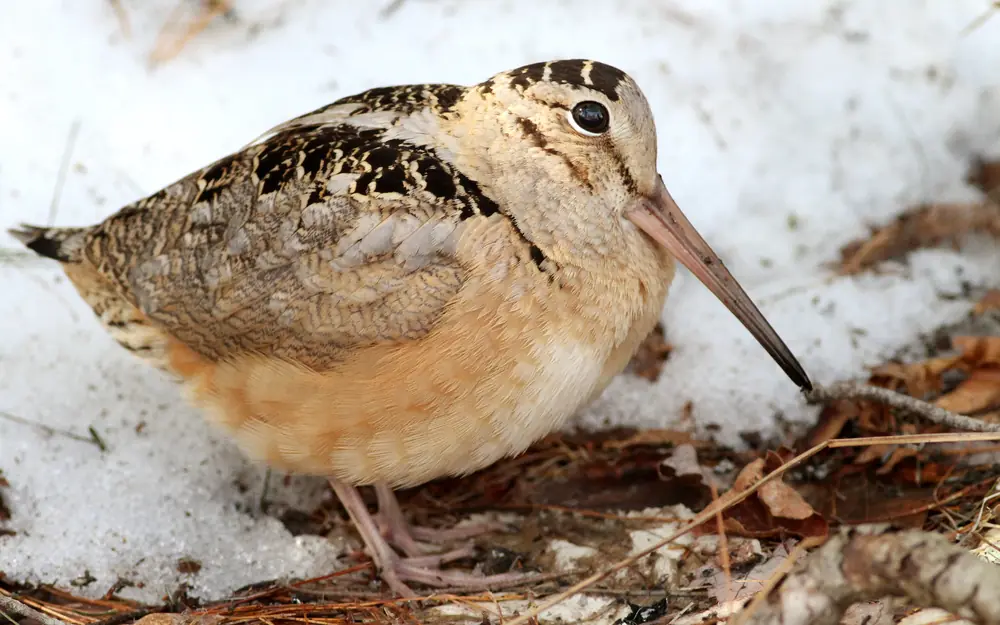
The Game Commission explains that males defend small clearings called singing grounds and display in short bursts at dawn and dusk. A male calls a nasal “peent” from the ground, then climbs 200 to 300 feet on twittering wings and spirals back down. It is most active when temperatures are above freezing and winds are calm. Past DCNR programs include a Sky Dance evening at Clear Creek State Forest and a woodcock walk at Swatara State Park, both in late March; 2027 dates are not yet posted, so watch DCNR’s events calendar. On your own, stand at the edge of an overgrown field a few minutes after sunset, face the open ground and listen. Bring a flashlight for the walk out, and keep it off while you watch.
-
Fox sparrows, juncos and phoebes
Fox sparrows from early March; song sparrows and juncos pick up mid-month; phoebes by mid-to-late March · Hedgerows, brushy backyards and stream edges
Powdermill Nature Reserve in Westmoreland County keeps a banding diary of spring arrivals. In the spring of 2005, a slow one, the first fox sparrow was caught on March 5, a real push of song sparrows, fox sparrows and dark-eyed juncos came on March 19, an eastern phoebe sang on March 21 and the first red-winged blackbird, an adult male, was banded on March 26. Years differ with the weather, but the order is a good one to follow: rusty fox sparrows scratching in leaf litter under feeders, then the tail-bobbing phoebe calling its own name from a bridge or porch rail.
-
Red-winged blackbirds and grackles
Arriving since late February; peak numbers in March and April · Cattail marshes, wet meadows and farm fields
The Game Commission says red-winged blackbirds arrive on their breeding grounds from late February into March, with the males well ahead of the females, and that common grackles are among the first spring arrivals.
Keep your Naturalist’s Field Journal by the door: write the date of the first phoebe, grackle or peent and you will have your own calendar by next year.
What happens to the snow geese at Middle Creek in March?
The February visitors do not stay. The Game Commission says snow geese at Middle Creek Wildlife Management Area, in Lancaster and Lebanon counties, usually push north with the spring thaw and typically arrive in late February or early March, and it recommends the first weekend in March for visitors. The Wildlife Drive normally opens on March 1 and runs through September, which means March is the first month you can drive the loop around the lake.
-
A flock that comes and goes overnight
Early to mid-March, shifting day to day with the weather · Willow Point at dawn or dusk; the Wildlife Drive from March 1
The agency’s counts in March 2026 show how quickly a flock can change: 8,000 snow geese on March 3, then 65,000 on March 6, then just 600 on March 10. By mid-month staff described the count as the smallest yet. If you want the spectacle, go on a still, mild morning in the first week or two and check the Game Commission’s update page or the snow goose cam first.
-
Tundra swans and ducks
March · Middle Creek’s lake, and open water on larger lakes and rivers
Tundra swans are often the last of the big waterfowl to go. The Middle Creek count topped out at 1,350 in late February of 2025 and 825 on March 1 in 2024, and the March 2026 counts hovered between 500 and 1,000.
-
Presque Isle and Lake Erie’s open water
Ice melts as early as late February; thousands of ducks along the bay as March goes on · Head of the Bay, Leo’s Landing and Thompson Bay at Presque Isle State Park
Presque Isle Audubon’s birding guide says that when the ice in Presque Isle Bay begins to melt, concentrations of waterfowl gather in the open water, with thousands of ducks on the bay side as March goes on and the highest variety where the water has mixed depths. The Tom Ridge Environmental Center notes that waterfowl migration at the peninsula runs through March. Songbirds and shorebirds come later: the same guide puts the songbird peak in mid-May and the shorebird peak in the third week of May.
| Winter | Snow geese | Tundra swans | Canada geese |
|---|---|---|---|
| 2025 | 100,000 (Feb 18) | 1,350 (Feb 28) | 965 (Mar 7) |
| 2024 | 70,000 (Feb 24) | 825 (Mar 1) | 2,300 (Feb 9) |
The Game Commission also notes that the regular season for snow and Ross’s geese ends on March 10 and that, when the seasons were set, it had not yet decided whether to hold a spring conservation season, so look for its announcement. Sunday remains closed to migratory bird hunting.
Where can you watch golden eagles and hawks pass in March, and when do eagle eggs hatch?
Fall brings the famous hawk counts; March has a quieter encore. The Game Commission lists at least 16 species of hawks, eagles, falcons and vultures passing through the state, and two ridges stand out in spring.
-
Golden eagles at Tussey Mountain
February and March; Shaver’s Creek’s 2023 summary says the peak came in March · Tussey Mountain in Centre County, a counted hawk watch supported by the State College Bird Club and Shaver’s Creek Environmental Center
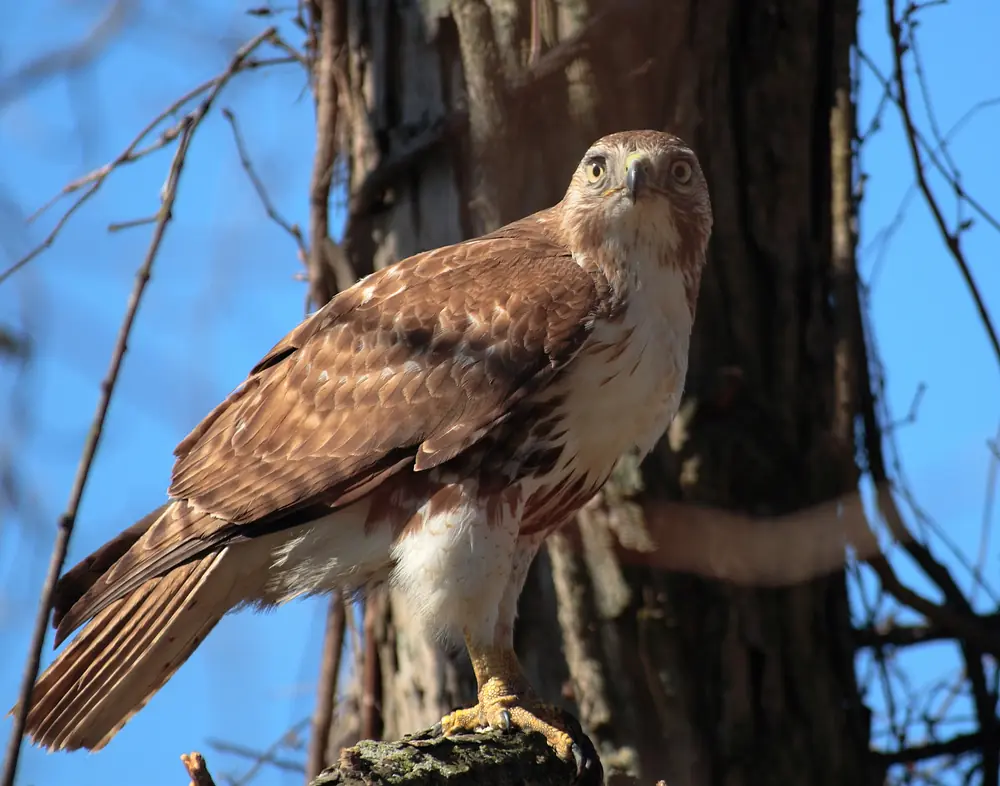
The Game Commission says Tussey is best known for the golden eagles that pass in February and March, more than 170 a year on average, with daily records above 60. Totals swing with the weather. In 2023 the counter logged 118 golden eagles against a 10-year average of 179, and Shaver’s Creek blamed a warm, low-snow winter that kept eagles and other raptors farther north. The same year’s count included 240 red-tailed hawks, below the 315 average, and 61 bald eagles. Look for a big, dark, long-winged raptor gliding along the ridge on a day with a light east wind; daily counts post at hawkcount.org.
-
The Allegheny Front at Shaffer Mountain
Golden eagles peak in March and again in November; bald eagles and ospreys pass in spring · Summit of Shaffer Mountain, Bedford County, run by the Allegheny Plateau Audubon Society
The Game Commission says more than 18,000 raptors a year pass this lookout, including over 200 golden eagles, and that strong east winds lift migrants along the ridge, often bringing them past at eye level. The regulars it lists include red-tailed and red-shouldered hawks, ospreys, kestrels and peregrine falcons.
-
Bald eagle eggs and eaglets
Eggs laid mid-February to mid-March, mostly early March; hatching starts around late March and runs through April · Nests along the Susquehanna, Delaware and Allegheny rivers and their lakes; the Hanover and Farm Country cams
According to the Game Commission, most clutches appear from mid-February to mid-March and the busiest stretch is early March; incubation takes about 35 days and the eaglets hatch over several days. The Hanover nest’s 2026 eggs came on March 2, 5 and 8, according to the camera’s log. Adults will be sitting low in the nest for most of the month. Stay a thousand feet or more from active nests, roosts and feeding spots, and watch through binoculars or a scope. The agency recommends Middle Creek, the Heinz refuge at Tinicum and Bald Eagle State Park.
-
Ospreys come home
Late March and early April · Rivers, reservoirs and lakes, usually on man-made platforms
According to the Game Commission’s raptor fact sheet, ospreys return to Pennsylvania in late March and early April to nest, and most known nests are on man-made structures such as poles and towers. Look for a white-headed bird carrying a stick.
-
Great horned owls on eggs
February and early March; hatching follows · Mixed woods and farmland edges
The Game Commission’s owl guide says incubating great horned owl females sit on eggs through February and into early March, sometimes under a dusting of snow. Eastern screech-owls lay four or five eggs in March or April.
How does Pennsylvania go from mud season to its last freeze?
March is the thaw. Streams run high and brown, roads go soft and the ground freezes at night and melts by afternoon. That same cycle is the engine behind two of the month’s best-known signs, skunk cabbage and maple sap, and it ends when the last freeze arrives, which is later than most people expect.
-
Skunk cabbage
March and April · Seeps, swamps and the wet edges of streams
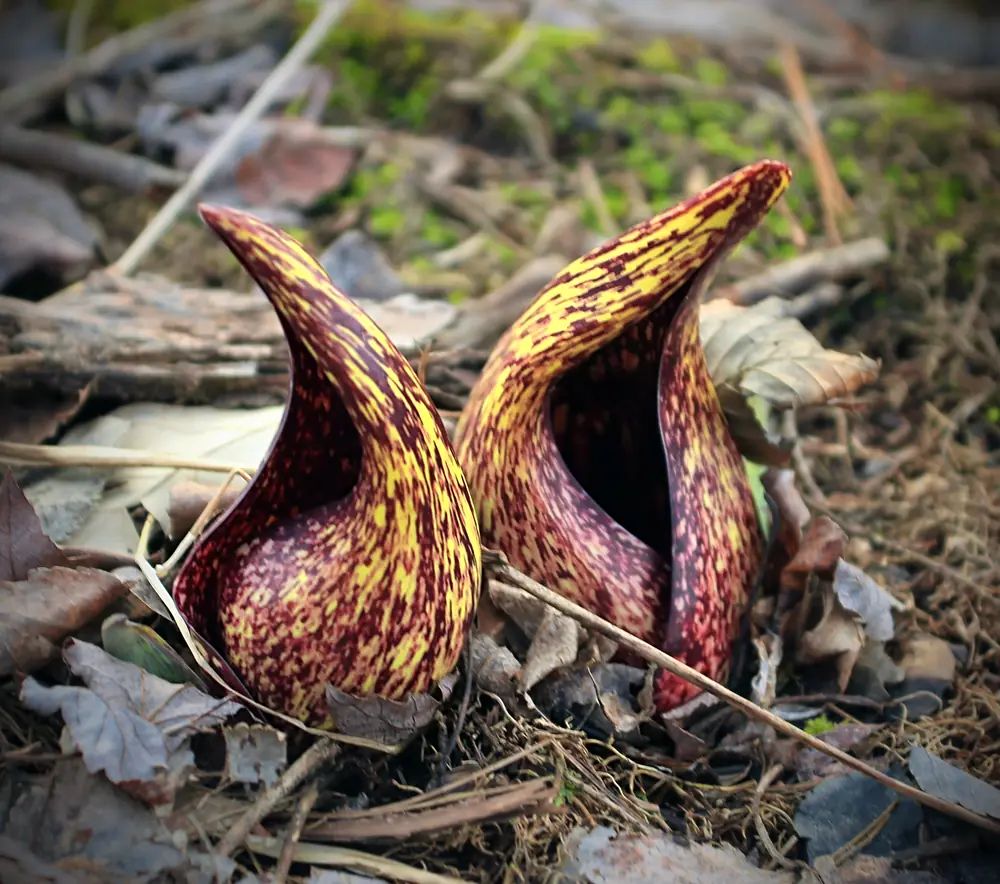
The Pennsylvania Native Plant Society lists March and April for the bloom, which often comes with snow still on the ground. The plant can warm itself above the air temperature, enough to melt ice around the hood, and the smell that gives it its name draws flies, stoneflies and early bees. The hood is a maroon, mottled cup with a knob of tiny flowers inside; the big leaves come afterward. Despite the odor the society says it is not poisonous.
-
Maple sap and the end of the season
Mid-February through March in a typical year; ends when the buds swell · Sugar bushes (stands of sugar maples) across the state
Penn State Extension explains that the best sap runs come on warm days above 40 °F followed by nights below freezing, and that producers stop collecting before the buds swell because late sap makes off-flavored syrup. It takes roughly 43 gallons of sap for a gallon of syrup. The state’s tourism office listed Maple Weekend events around the state for March 2026, among them Somerset County’s Taste and Tour in two March weekends and the Potter and Tioga weekend on March 21-22. No March 2027 weekends are posted yet, so check with the organizers, and expect the Pennsylvania Maple Festival in Meyersdale in April; its own site still shows only the 2026 dates.
-
Streams, ice and meltwater
Whenever a warm rain falls on snow · Creeks and rivers statewide, especially the northern tier
The National Weather Service’s State College office issues winter and spring flood outlooks, and its March 6, 2026 outlook noted that its forecast considers natural flow only and does not account for ice jams. It also flagged spots with a 25 percent or greater chance of reaching flood stage.
| Station | One year in ten | Median | Nine years in ten |
|---|---|---|---|
| Bradford | Apr 30 | May 18 | May 31 |
| Wilkes-Barre/Scranton | Apr 9 | Apr 23 | May 10 |
| Johnstown | Apr 14 | Apr 29 | May 17 |
| Williamsport | Apr 12 | Apr 24 | May 11 |
| Harrisburg | Apr 1 | Apr 15 | May 2 |
| Pittsburgh | Apr 9 | Apr 23 | May 12 |
| State College | Apr 7 | Apr 20 | May 6 |
| Erie | Apr 10 | Apr 26 | May 13 |
| Philadelphia (Northeast Airport) | Mar 21 | Apr 4 | Apr 17 |
The table gives the typical last 32 °F night at one main station per city. Stations sit at different elevations, so your own town can differ by several days; our frost page covers more places. Gardeners should note that the median is not a safe date: one spring in ten still freezes after the right-hand column.
Which wildflowers bloom first in Pennsylvania in March?
The woodland wildflower show starts slowly. Penn State Extension and DCNR’s state parks and forests staff describe a wave of early-spring native plants that bloom before the trees leaf out, and the show fades by mid-May as the canopy fills in. In March itself you are mostly looking for the first of them in the warmest, lowest places.
-
Spring beauty
March and April; each plant blooms up to about three weeks · Rich, moist woods and lawns near woods
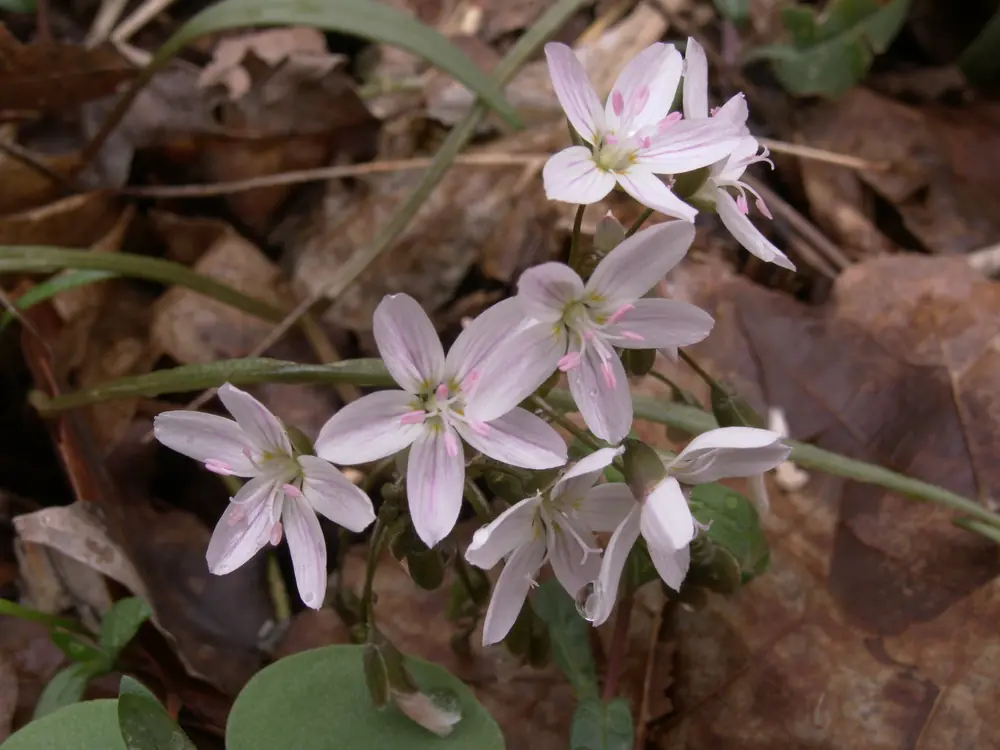
Penn State Extension notes spring beauty’s pink-and-white striped flowers and that it blooms for up to three weeks, providing nectar and pollen for native bees.
-
Bloodroot
Very early spring; each bloom lasts only a few days · Rich, shaded hillsides
The Extension fact sheet describes a white flower with yellow center, six inches tall, over a lobed blue-green leaf that unfolds after flowering and an orange-red sap in the rhizome. The petals fall within days, so a single sunny day can be the whole show.
-
Look, do not pick
All spring · Parks, preserves and state forests
The Delaware Nature Society stresses that you should be careful not to disturb the plants or soil around them, since these plants have a narrow window to flower, be pollinated and set seed. Dutchman’s breeches, toothwort, trillium and bluebells mostly follow in April, so note where their leaves appear and return.
What are bears, elk, woodchucks and bats doing in March?
Pennsylvania’s mammals wake in a staggered way over March and April, and some are hard to miss.
-
Woodchucks
Mating late February to March; young born in April and early May · Field edges, roadsides and meadows
The Game Commission says males emerge from hibernation before females and fight aggressively during February and March, living off leftover fat while green food is scarce. After a 28-day gestation, females bear young in April and early May.
-
Big brown and small-footed bats
March and April · Barns, bridges, caves and old mines
The Game Commission’s bat guide says big brown bats leave hibernation in March and April and the small-footed bat emerges in March, whereas little brown bats follow in April and May. Never enter a hibernation cave, and do not handle a bat found on the ground.
-
Black bears
Late winter and early spring · Forests and wooded hills; keep an eye out near bird feeders
The Game Commission says sows give birth in the den in early January and the cubs come out at about three months old, and that the statewide population is about 19,000. In March a hungry bear may find your bird feeder first: the agency’s advice is to remove bird feeders, garbage and grills that draw bears.
-
Elk antlers
Bulls shed from late winter into spring · Benezette and the Elk Country Visitor Center, in Elk County
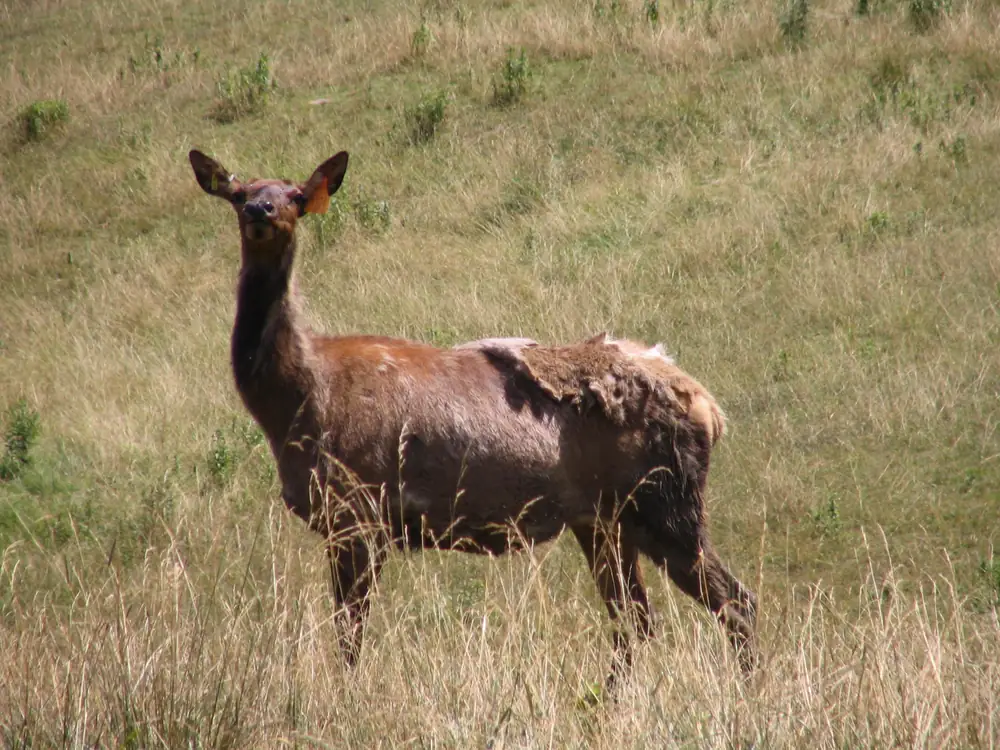
Bulls keep their antlers through late winter and drop them in early spring, so an elk you see now may be missing one or both. The herd ranges across five north-central counties: Elk, Cameron, Clinton, Clearfield and Potter. Cows give birth in May or June.
How much daylight does Pennsylvania gain in March?
March is the fastest month of the year for new daylight. Erie gains about 86 minutes between March 1 and March 31, and Philadelphia about 79, which is roughly three minutes a day around the equinox. Spring officially begins with the equinox at 4:25 p.m. on Saturday, March 20, and on that day the sun is up for about twelve hours everywhere in Pennsylvania.
The day-length table is for the sun alone, so it does not change when the clocks do. On Sunday, March 14, at 2 a.m., clocks spring forward an hour under federal law, so sunrise and sunset suddenly sit an hour later on the clock. In the east of the state sunset jumps from just after 6 p.m. to just after 7 p.m. overnight and sunrise from just after 6 a.m. to just after 7 a.m., so evening walks gain an hour of light while morning commutes lose one.
| City | Mar 1 | Mar 31 | Gained | Per day |
|---|---|---|---|---|
| Erie | 11 h 14 m | 12 h 40 m | 86 min | 2.9 min |
| Scranton | 11 h 16 m | 12 h 39 m | 83 min | 2.8 min |
| Williamsport | 11 h 16 m | 12 h 39 m | 83 min | 2.8 min |
| State College | 11 h 16 m | 12 h 38 m | 82 min | 2.7 min |
| Pittsburgh | 11 h 17 m | 12 h 37 m | 80 min | 2.7 min |
| Harrisburg | 11 h 18 m | 12 h 38 m | 80 min | 2.7 min |
| Philadelphia | 11 h 18 m | 12 h 37 m | 79 min | 2.6 min |
Use the daylight page for your exact town, and the cloud page and moon page to go with it.
What is March weather like in Pennsylvania, and what hazards should you expect?
March in Pennsylvania runs from winter to spring in weeks. Using NOAA’s 1991 to 2020 normals, afternoon highs reach about 53 °F at Philadelphia and only 42 °F at Bradford, and nights still fall to or below freezing on about seven March nights in ten at Erie and about two in five at Philadelphia. Erie still averages 14.5 inches of snow in March from lake effect, the highest of any station listed.
| Station | High | Low | Nights ≤ 32 °F | Precipitation | Snowfall | Days with 1 in.+ snowfall |
|---|---|---|---|---|---|---|
| Erie | 44.3 | 27.9 | 21.8 | 3.08 | 14.5 | 3.7 |
| Bradford | 42.4 | 23.6 | 25.2 | 3.04 | n/a | n/a |
| Pittsburgh | 49.1 | 30.3 | 18.9 | 3.15 | 7.6 | 2.3 |
| State College | 45.6 | 28.3 | 21.1 | 3.38 | 9.4 | 2.3 |
| Williamsport | 48.4 | 29.0 | 20.5 | 3.13 | 7.3 | 1.7 |
| Wilkes-Barre | 47.6 | 28.9 | 21.0 | 2.77 | 10.1 | 2.4 |
| Harrisburg (Middletown) | 51.3 | 32.3 | 16.2 | 3.70 | 5.6 | 1.3 |
| Philadelphia | 52.8 | 34.3 | 11.8 | 3.96 | 3.6 | 0.9 |
What to watch. Late-season snow is possible anywhere and is a real hazard in the northwest and the northern mountains. Rain on snow with thick ice in the streams is the combination that raises flood risk, and the State College forecast office’s March flood outlook says ice jams are not part of its forecast numbers. The Weather Service’s safety campaign warns that half a foot of moving water is enough to topple a grown adult and a foot of it floats most cars, so turn around at any flooded road. A warm week can start buds swelling well before the last freeze shown in the table above. Check the current NOAA three-month outlook, which is updated each month near mid-month, and our weather page for the days ahead.
What can you see in the Pennsylvania night sky in March 2027?
Everything here is Eastern. The March 8 new moon falls before the clocks change; every later time is daylight time, an hour ahead of what Standard Time would read.
-
The Worm Moon
Full at 6:44 a.m. Monday, March 22; best evening is Sunday, March 21 · Rising in the east around sunset
The name refers to ground softening and worms reappearing. The full moment comes before sunrise Monday, so the moon looks full both Sunday and Monday evening. Moonrise on Sunday is about 6:36 p.m. at New York City, so expect a rise close to that time in the east of the state and a little later in the west.
-
Mercury in the morning
Best roughly March 8 to March 25; greatest elongation March 17 · Low in the east-southeast before sunrise
On March 17 Mercury stands at its widest dawn angle from the sun, near 28 degrees, and comes up some 60 minutes ahead of the sun through mid-March. Brilliant Venus hangs much higher above it. Spring mornings give a poor angle on Mercury, so find a clear low horizon.
-
Jupiter and Mars after dark
All month; the moon passes Jupiter on March 18 and 19, and by our own figures Mars and Jupiter are about 4.3 degrees apart on the evening of March 30 · High in the south and east in the evening, in Leo and Cancer
Jupiter is up almost all night. A bright gibbous moon glides past it on the 18th and 19th. Mars, a little fainter, shares Leo with it, and the two are a few finger-widths apart at arm’s length on March 30. Saturn sinks into the sunset glow during the month.
| Phase | Date | Time |
|---|---|---|
| New moon | Monday, Mar 8 | 4:29 a.m. EST |
| First quarter | Monday, Mar 15 | 12:25 p.m. EDT |
| Full moon, the Worm Moon | Monday, Mar 22 | 6:44 a.m. EDT |
| Last quarter | Monday, Mar 29 | 8:54 p.m. EDT |
The planet pairings come from our own computations, and only Mercury’s date also appears in the Sea and Sky calendar, so treat the exact hours as approximate.
What are good March nature outings for families in Pennsylvania?
- Listen for peepers on a warm rainy night. Go with a flashlight to the edge of a pond or flooded field. Count how many different calls you can pick out, then log them with the Pennsylvania Amphibian and Reptile Survey.
- Join a woodcock evening. DCNR parks and forests have offered woodcock walks in late March in recent years. Ask the park office for 2027 dates; see our nature index for the other months.
- Visit Middle Creek early in the month. The visitor center runs Tuesday to Sunday, 8 a.m. to 4 p.m., and the Wildlife Drive opens March 1.
- Watch an eagle cam. The Game Commission lists Hanover, Farm Country, elk and snow goose cams. Write down the day you first see an egg turned.
- Tour a sugar shack. Regional maple producers host open weekends in March in the Somerset, Potter-Tioga and northwest counties in recent years; ask the organizers for 2027 dates.
- Try FrogWatch USA. Local chapters at zoos and nature centers train volunteers to count frog and toad calls from evenings in February through August.
- Keep counting. Project FeederWatch continues through April 30.
- Find one skunk cabbage hood and one phoebe, and mark them in your journal.
The DCNR calendar for March 2027 listed only a few general programs when we checked in early October 2026, so most outings above are things to do on your own. Programs change, so confirm with the host.
Safety notes for March in Pennsylvania
- Seasons still open. According to the Game Commission’s 2026-27 table, crow hunting runs through March 21 on Thursdays through Sundays, snow and Ross’s geese through March 10, beaver trapping through March 31, coyotes all year, and woodchucks through June 30, 2027. The Game Commission lists no fluorescent orange requirement for the crow, woodchuck or spring turkey seasons, but a bright hat is cheap insurance when you hear shooting.
- Spring turkey is next. The Youth Spring Gobbler Day is April 24 and 25, 2027, and the regular season starts May 1.
- Traps near the water. Dogs belong on a leash around creeks and beaver ponds while trapping season is open.
- Trout opening. The statewide opener in 2026 was Saturday, April 4, at 8 a.m.; the Fish and Boat Commission announces each year’s date, so check fishandboat.com for 2027. Its cold-weather life jacket rule for small boats, canoes and kayaks runs through April 30.
- Cold water. Swollen March creeks are cold enough to take a swimmer’s breath away, so stay on the bank.
- Floods. Never drive through flooded roads.
- Ticks. Penn State Extension says adult ticks are active in fall and winter whenever temperatures are above freezing, so a March walk in leaf litter can pick one up. Tuck pants into socks, use permethrin-treated clothing and a repellent such as DEET, picaridin or IR3535, and check yourself afterward.
- Bears and wildlife. Remove bird feeders and other food when bears are about. Stay 1,000 feet from eagle nests.
- Sick or dead birds. Report them to the Game Commission at 1-833-PGC-WILD and do not touch them.
- Gull Point. The Gull Point Natural Area at Presque Isle is closed east of the tree line from April 1 through October 31, except the marked trail to the observation platform.
Sources (53)
- Pennsylvania Amphibian and Reptile Survey: seasonal pond amphibian migration news (northern tier peak, eggs versus adults)
- Pennsylvania Amphibian and Reptile Survey: seasonal pond species and egg identification
- ABC27 News: amphibian spring migration underway (Lebanon County, mid-March to mid-April, road crossings)
- Chesapeake Bay Program field guide: wood frog (breeding season, calls, freeze tolerance)
- National Park Service: spring peeper (size, call, breeding season)
- Akron Zoo: how FrogWatch USA works (February through August)
- Pennsylvania Game Commission: American woodcock (arrival, singing grounds, sky dance)
- PA DCNR events: Sky Dance of the American Woodcock (Clear Creek State Forest, a past program)
- PA DCNR events: Woodcock Watch (Swatara State Park, a past program)
- PA DCNR calendar of events: March 2027
- Powdermill Nature Reserve: pictorial highlights, March 2005 (spring arrival banding diary)
- Pennsylvania Game Commission: blackbirds (red-winged blackbird, grackle and cowbird arrival)
- Pennsylvania Game Commission: Middle Creek snow goose and waterfowl migration update (2026 counts, peaks, timing)
- Pennsylvania Game Commission: Middle Creek Wildlife Management Area (Wildlife Drive, visitor center hours)
- Pennsylvania Game Commission: wildlife cams (Hanover and Farm Country eagle cams, elk cam, snow goose cam)
- Presque Isle Audubon: birding at Presque Isle State Park (seasonal highlights, Gull Point closure)
- Tom Ridge Environmental Center Foundation: wildlife watching at Presque Isle by month
- Pennsylvania Game Commission: raptor migration (Tussey Mountain, Allegheny Front)
- Shaver’s Creek Environmental Center: retrospective of the 2023 Tussey Mountain spring hawkwatch
- Shaver’s Creek Environmental Center: hawk watching on Tussey Mountain (2014 spring season)
- Shaver’s Creek Environmental Center: Tussey Mountain spring hawkwatch overview
- Pennsylvania Game Commission: bald eagles (egg laying, incubation, hatching, viewing distance)
- Pennsylvania Game Commission: bald eagle watching (public viewing sites)
- HDOnTap: Hanover eagles nest live cam (nest log, 2026 egg dates)
- Pennsylvania Game Commission: eagles and osprey (wildlife note, PDF; osprey return)
- Pennsylvania Game Commission: owls (wildlife note, PDF; great horned and screech-owl nesting)
- Pennsylvania Game Commission: woodchuck (wildlife note, PDF; mating and young)
- Pennsylvania Game Commission: bats (wildlife note, PDF; emergence from hibernation)
- Pennsylvania Game Commission: black bear (cubs, population, attractants)
- Pennsylvania Game Commission: elk (antlers, range, calving)
- Pennsylvania Native Plant Society: skunk cabbage (bloom time, heat, pollinators)
- Penn State Extension: maple syrup production (sap temperatures, season end, production)
- Visit PA: maple experiences and festivals (March 2026 maple weekends)
- Pennsylvania Maple Festival, Meyersdale (site still shows 2026 dates)
- Potter-Tioga Maple Producers: Pennsylvania Maple (Maple Weekend)
- Penn State Extension: spring ephemerals for residential gardens (spring beauty, bloodroot)
- PA Parks and Forests Foundation: native plants through the seasons
- Delaware Nature Society: observing spring ephemeral wildflowers
- NOAA NCEI: 1991–2020 monthly normals for Pennsylvania stations (data API, March)
- NOAA NCEI: U.S. Climate Normals, 1991–2020
- National Weather Service State College: winter and spring flood outlook, March 6, 2026
- National Weather Service: Turn Around Don’t Drown
- Climate Prediction Center: seasonal outlooks (issued monthly near mid-month)
- U.S. Naval Observatory: 2027 moon phases (data API)
- Sea and Sky: astronomy calendar of celestial events 2027
- 15 U.S.C. § 260a: daylight saving time
- Pennsylvania Game Commission: seasons and bag limits, 2026–27
- Pennsylvania Game Commission: 2026–27 migratory game bird seasons
- Pennsylvania Fish and Boat Commission: opening day of trout season, April 5, 2025 (life jacket rule, rules)
- Explore Clarion: opening day of trout season set for Saturday, April 4, 2026
- Penn State Extension: ticks and tickborne disease
- Project FeederWatch: how to participate (November 1 to April 30)
- Photos via Wikimedia Commons; licenses and photographers are credited under each picture
