What to look for in nature in Pennsylvania this October
October is Pennsylvania’s month of color and bugling. The northern counties peak in the first ten days, the Laurel Highlands and the Ridge and Valley follow, and the southeast is still bright at Halloween. Bull elk bugle in the meadows above Benezette, sharp-shinned hawks pour past Hawk Mountain on the first northwest wind, steelhead push into the Erie creeks with the first hard rain, and the first freeze reaches the Allegheny Plateau six weeks before it reaches Philadelphia. The guide below goes region by region, with the dates worth planning around.
Start here
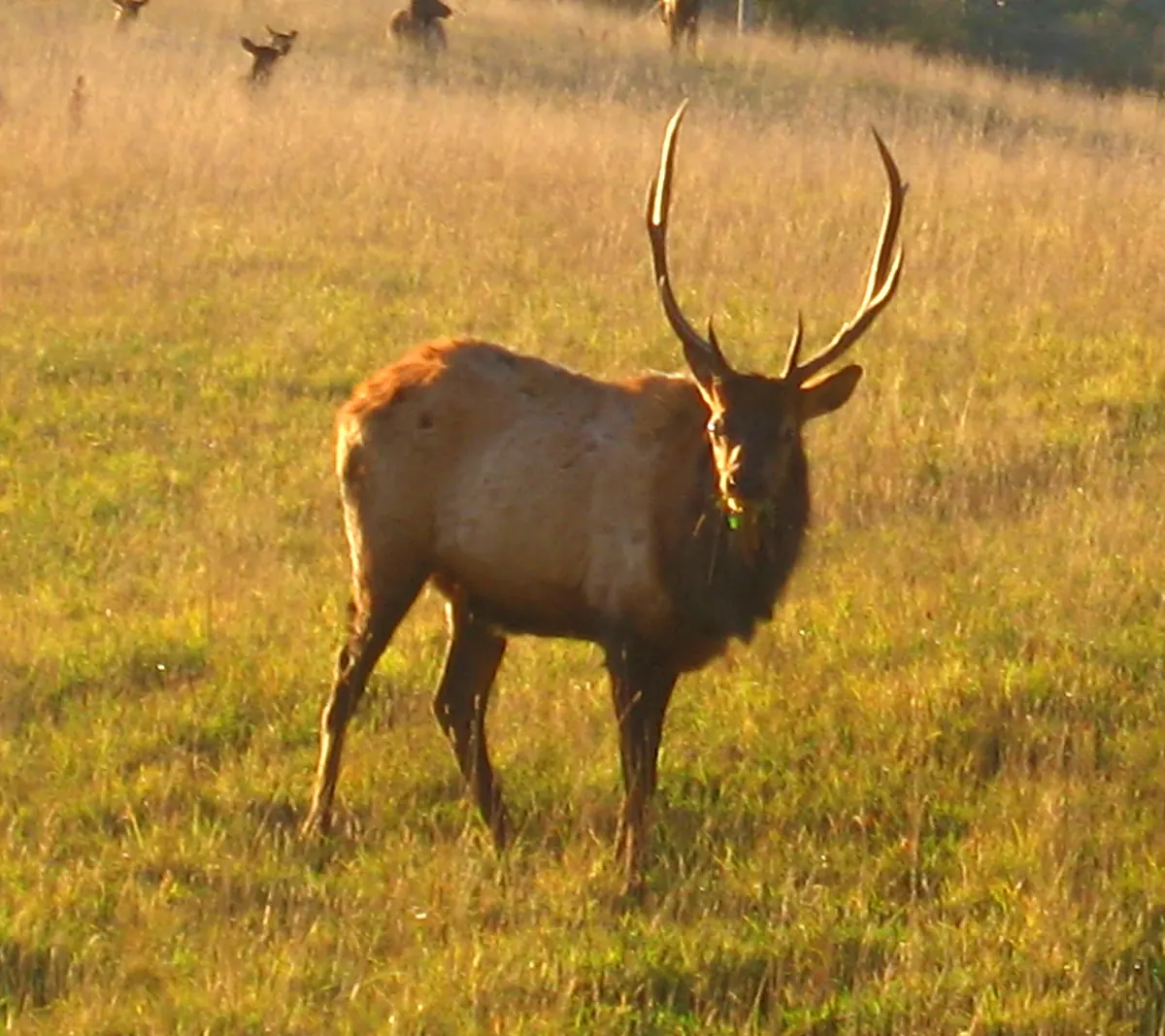
- The elk rut at Benezette. The Game Commission puts the mating season in September and October, and the bugling fades by about the middle of the month. Go in the first hour after sunrise or the last before dusk, when the bulls and their harems are in the open meadows on Winslow Hill; keep 100 yards away and expect traffic on weekends. The Elk Country Visitor Center is open 8 a.m. to dusk.
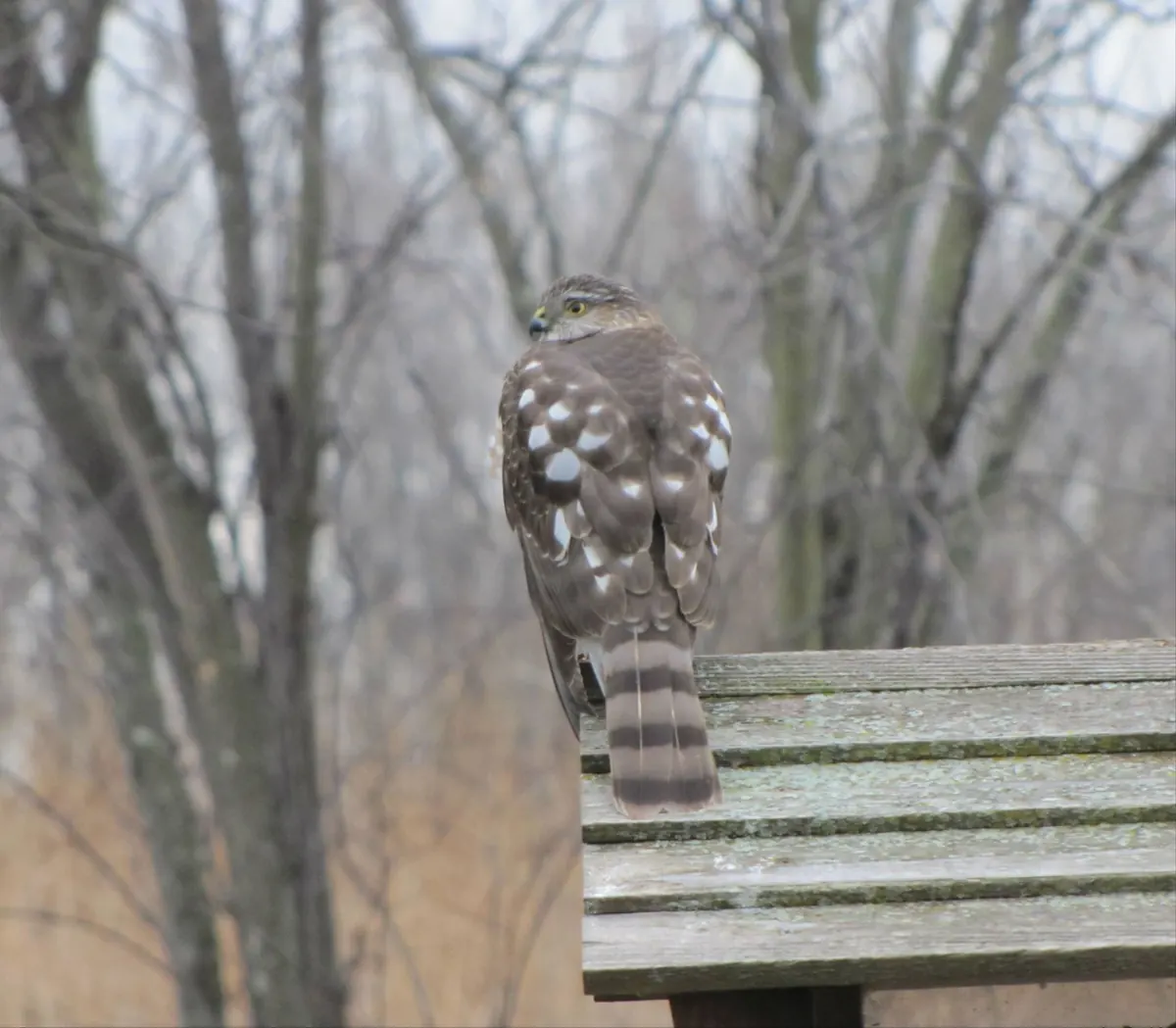
- Hawk Mountain after a cold front. The sharp-shinned hawk flight peaks in early to mid-October, with Cooper’s hawks, kestrels and merlins mixed in; red-tails and the first golden eagles build through the end of the month. The flight is strongest on northwest winds in the day or two after a front. Weekend crowds can reach 3,000 people, so the weekday after a front is the day.
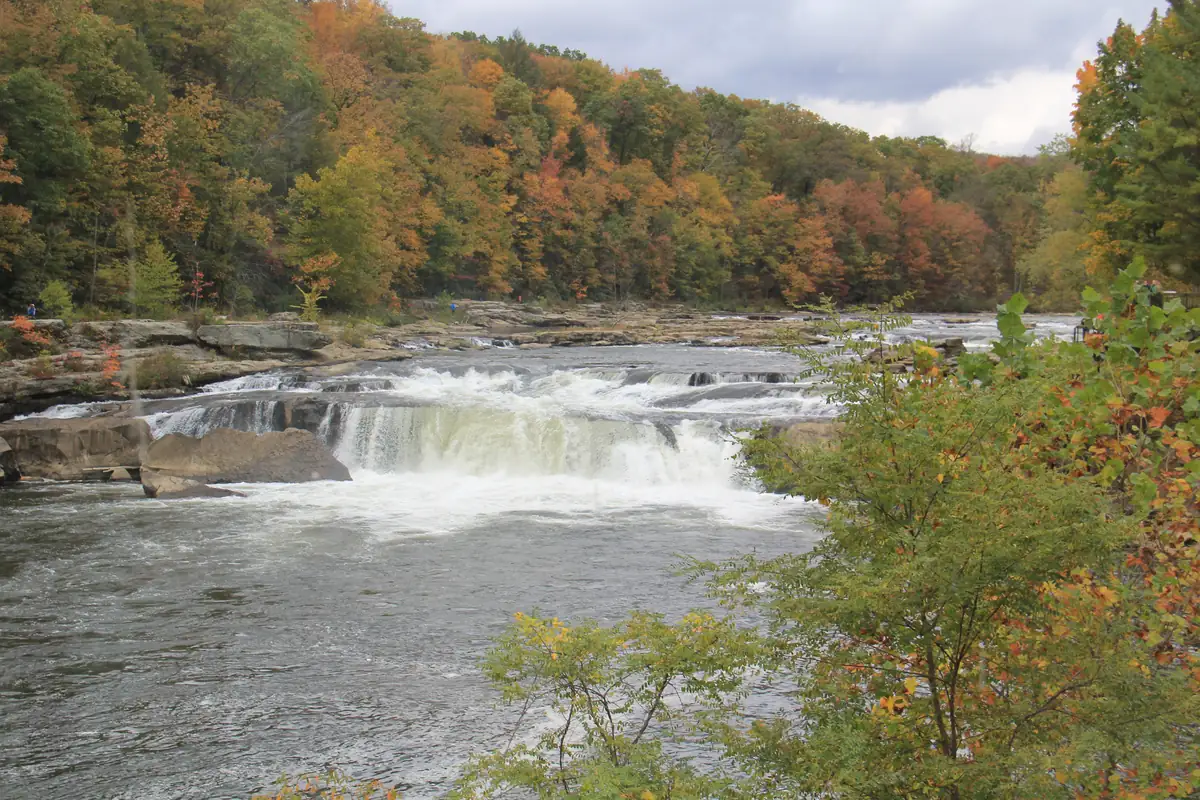
- The color, the freeze and the Hunter’s Moon. DCNR’s weekly foliage report starts Thursday, October 1. Northern counties peak October 1–10, central counties 10–20, the southeast 20–31. The median first freeze is October 14 at Wilkes-Barre/Scranton and October 23 at Pittsburgh, Harrisburg and Williamsport. The Hunter’s Moon is full just after midnight on Monday, October 26, so watch it rise a little before sunset on Sunday the 25th.
Keep a record: a hawk-watch tally belongs on the “birds I have seen” list in the Naturalist’s Field Journal, the dusk-and-dawn watch page suits the elk meadows, the tree-through-the-seasons plate is for the maple you pass every day, and the map-of-sounds page could have been drawn in a bugling valley. One observation at a time.
Regions used below: Northwest and Lake Erie; Allegheny National Forest and the Northern Tier; Laurel Highlands and Pittsburgh; Central Ridge and Valley and State College; Poconos and the Northeast; Susquehanna Valley and Harrisburg; Southeast and Philadelphia.
When does fall color peak in Pennsylvania, region by region?
The Bureau of Forestry in the Department of Conservation and Natural Resources publishes a fall foliage report every Thursday during the season, and the first 2026 report posts on October 1. Its rule of thumb is simple: “In most years, northern PA counties reach their best autumn color October 1–10. Central counties are at their peak October 10–20 and south central and southeastern PA have the most color October 20–31.” For the Laurel Highlands the foresters give a peak of about October 15–20. The report is the place to check before you drive.
| Region | Reference places | Typical peak |
|---|---|---|
| Allegheny National Forest and the Northern Tier | Kinzua Bridge, Pine Creek Gorge, Cook Forest, Bradford | Oct 1–10, often running into the second week |
| Poconos and the Northeast | Promised Land, Ricketts Glen, Lackawanna, Scranton | Oct 1–15, counted with the northern counties |
| Northwest and Lake Erie | Presque Isle, Erie, Oil Creek | Second week of October at Presque Isle; Oct 1–10 in the inland northern counties |
| Laurel Highlands and Pittsburgh | Ohiopyle, Laurel Ridge, Linn Run; Pittsburgh’s river valleys | Oct 15–20 in the Highlands; Oct 10–20 for the central counties around them |
| Central Ridge and Valley and State College | Bald Eagle State Park, Poe Paddy, Rothrock State Forest | Oct 10–20 |
| Susquehanna Valley and Harrisburg | Kings Gap, Pine Grove Furnace, Swatara, Little Buffalo | Oct 20–31 |
| Southeast and Philadelphia | Ridley Creek, Nolde Forest, Delaware Canal, Ralph Stover | Oct 20–31, the last of the state |
What turns when, in the foresters’ Laurel Highlands sequence: black gum and some red maples October 1–10; most red and sugar maples, black cherry and sweet birch October 10–20; the red, white and chestnut oaks, tulip poplar and beech October 20–30. To see what satellites say about green-up and leaf-drop near you, drop a pin in the Field almanac; the tree-through-the-seasons plate in the journal is for one tree you pass every day.
When is the best time to watch hawks at Hawk Mountain?
The count at Hawk Mountain Sanctuary, on the Kittatinny Ridge near Kempton, is the longest-running raptor count anywhere: it runs each fall from August 15 to December 15 and averages about 18,000 raptors a season. September belongs to the broad-winged hawks; by the end of September 2026 the North Lookout had already logged about 11,400 of them, with 2,953 raptors on September 22 alone. October is the month of variety: sharp-shinned hawks peak in early to mid-October, with Cooper’s hawks, kestrels, merlins and peregrines mixed in; red-tailed hawks build through late October toward an early-November peak; golden eagles begin to show in the second half of the month ahead of their November peak. The rule for timing a visit does not change: “Migration is most pronounced on northwest winds, especially on the several days following the passage of a cold front.”
| Raptor | Peak at Hawk Mountain | Notes |
|---|---|---|
| Broad-winged hawk | Mid-September | Mostly gone by October; about 11,400 counted in September 2026 |
| Sharp-shinned hawk | Early to mid-October | 98% of the flight Sept 9 – Nov 5; record day 2,475 on Oct 8, 1979 |
| Cooper’s hawk, American kestrel, merlin, peregrine | October, with the sharp-shins | Kestrels lean earlier, peregrines and merlins into mid-month |
| Red-tailed hawk | Late October into November; peak early November | Record day 1,144 on Oct 24, 1939 |
| Golden eagle | Late October into November; peak in November | Average 73 a season; record day 48 on Nov 3, 2012 |
| Bald eagle | September, and again in November | 235 counted in September 2026 |
More than forty Pennsylvania watches report to HawkCount, where the day’s totals post each evening, among them Waggoner’s Gap above Carlisle, Bake Oven Knob on the same ridge as Hawk Mountain, and Militia Hill and Rose Tree Park outside Philadelphia. The Allegheny Front watch on the Bedford–Somerset line, at about 2,700 feet, is the state’s golden eagle post: it averages 226 a season, its record day is 74 on October 24, 2015, and its best winds are from the east. The Presque Isle watch at Erie is a spring count only. Write the wind direction beside every hawk in the journal.
When do the elk bugle at Benezette?
Pennsylvania’s elk live across parts of Elk, Cameron, Clinton, Clearfield and Potter counties, a herd restored from reintroductions that began in 1913 and numbering about 950 at the restoration’s centennial. The Game Commission is plain about the season: “The mating season is September and October.” Bulls “bugle invitations to cows and challenges to other bulls,” and mature bulls gather harems of 15 to 20 cows. By the middle of October the bugling is fading; in past seasons the PA Wilds elk camera at Benezette has run until the bugling ends, “likely sometime in mid-October.” Go in the first hour after sunrise or the last before dusk, when the herds are in the open meadows on Winslow Hill; stay at least 100 yards away, never call to a bull, and expect traffic and full lots on October weekends. The Elk Country Visitor Center is open 8 a.m. to dusk through October; its rut and antler talks are in the family list below. The licensed elk firearms season runs October 3–11, and everyone on state game lands is in fluorescent orange from October 1 (see the safety notes).
Which birds are arriving, leaving or passing through?
-
Ruby-throated hummingbirds: the last stragglers
Most gone by early September; stragglers into October · Feeders statewide
The Game Commission’s note says males may start leaving in early August and females and young stay until late August or early September, “with occasional stragglers into October or later.” A feeder left up through October does no harm and feeds the late ones; any hummingbird after mid-October is worth a dated note in the journal.
-
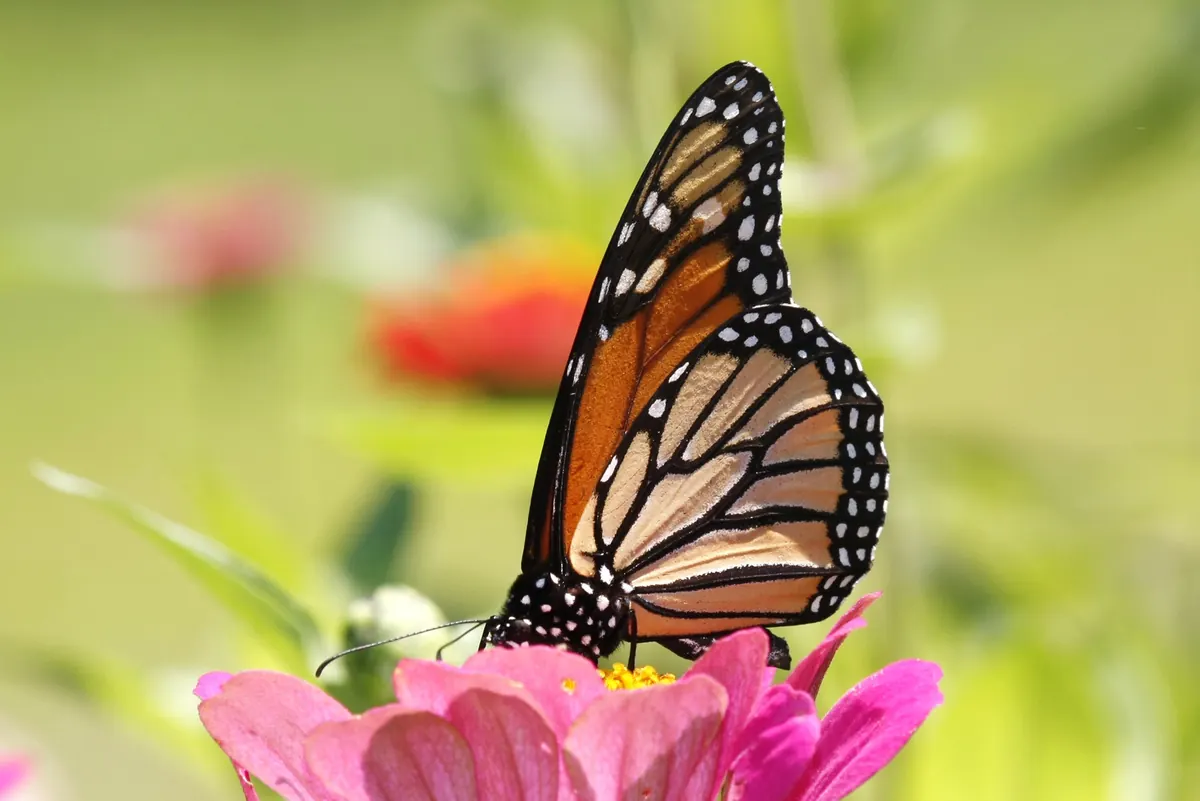
Monarchs: the tail of the migration at Presque Isle
Peak passed in mid-September; the tail runs through October · Presque Isle State Park at Erie; lakeshores and ridge tops
Monarch Watch’s timetable runs from September 3–15 at 43° north to September 8–20 at 41° and September 14–26 at 39°, so Erie’s peak falls in the first half of September and Philadelphia’s about a week later. October is the tail. The Presque Isle peninsula concentrates what is left: monarchs are reluctant to cross open water, so they build up along the Lake Erie shore and follow it southwest, crossing on calm mornings and blowing back on a south wind. The Tom Ridge Environmental Center lists monarch migration among the park’s October sights, and the park has tagged monarchs for several years; check its DCNR events page for any October sessions. Report any October roost to Journey North.
-
Juncos, white-throated sparrows and kinglets
Arriving from mid-September into November · Statewide; feeders, hedgerows, woods edges
Dark-eyed juncos, the “snowbirds,” reach their winter grounds between mid-September and November; white-throated sparrows come late and gradually, moving at night; the two kinglets are in the hedgerows through the month. The first junco under the feeder is a date worth keeping; Project FeederWatch opens on November 1.
-
Waterfowl at Presque Isle and Erie National Wildlife Refuge; swans later
October into early winter; tundra swans from mid-November · Presque Isle; Erie National Wildlife Refuge at Guys Mills; Middle Creek later
Presque Isle’s October list is waterfowl migration, monarchs and foliage; the tip of Gull Point is closed to walkers until November 30 to protect shorebirds, so look from the platform on the Gull Point trail. At Erie National Wildlife Refuge in Crawford County, where more than 40 percent of the land is wetland, the migrations run September through November. Tundra swans are not an October bird: the Game Commission says the flocks head south from late September and reach the wintering grounds from mid-November to mid-December, most of them on the lower Susquehanna and at Middle Creek. Middle Creek itself is quiet in October: its Wildlife Drive is open March 1 to September 30, and the famous flights, more than 100,000 snow geese in recent years and a record 200,000 in 2018, come in February and March.
The day after a cold front is the day to look: hawks on the ridges, sparrows in the hedgerows, geese overhead. The fall World Migratory Bird Day and eBird’s October Big Day share Saturday, October 10; the family list below has the walks.
When is the first freeze, and where does the first snow fall?
The first freeze comes first to the high Allegheny Plateau of the northwest and north-central counties, then to the valleys of the northeast and center, and last to the lakeshore at Erie and to Philadelphia, both kept warm by water. At the Bradford airport, 2,100 feet up in McKean County, the median first 32 °F night is September 22, and nine years in ten have frozen by October 5; at the Wilkes-Barre/Scranton airport the median is October 14; at Erie it is early November; Philadelphia’s is November 7. Frost, which needs only about 36 °F on a clear, calm night in a hollow, comes a week or two ahead of the freeze.
| Station | One year in ten | Median | Nine years in ten |
|---|---|---|---|
| Bradford | Sept 1 | Sept 22 | Oct 5 |
| Wilkes-Barre/Scranton | Oct 1 | Oct 14 | Nov 1 |
| Johnstown | Oct 5 | Oct 21 | Nov 5 |
| Williamsport | Oct 6 | Oct 23 | Nov 5 |
| Harrisburg | Oct 7 | Oct 23 | Nov 7 |
| Pittsburgh | Oct 9 | Oct 23 | Nov 6 |
| State College | Oct 10 | Oct 26 | Nov 9 |
| Erie | Oct 21 | Nov 4 | Nov 17 |
| Philadelphia | Oct 24 | Nov 7 | Nov 22 |
For a town not in the table, the Pennsylvania frost dates page lists stations across the state. Snow follows the same map. Erie’s normal October snowfall is a tenth of an inch, and its earliest measurable snow on record fell on October 1, 2003; then November brings 9.6 inches on average as the lake-effect season opens. Pittsburgh and State College average 0.4 inch in October, Wilkes-Barre 0.7, Philadelphia none.
How much daylight does Pennsylvania lose in October?
About an hour and a quarter, and more the farther north you are: 82 minutes at Erie, 76 at Philadelphia, roughly two and a half minutes a day. In Pittsburgh the sun rises at 7:22 a.m. on October 6 and 7:42 on the 25th, and sets at 6:54 and 6:26. Daylight saving time ends at 2 a.m. on Sunday, November 1, and the evenings go dark an hour sooner.
| City | Oct 1 | Oct 31 | Lost | Per day |
|---|---|---|---|---|
| Erie | 11 h 45 m | 10 h 23 m | 82 min | 2.7 min |
| Williamsport | 11 h 45 m | 10 h 26 m | 79 min | 2.6 min |
| State College | 11 h 45 m | 10 h 28 m | 77 min | 2.6 min |
| Pittsburgh | 11 h 45 m | 10 h 29 m | 76 min | 2.5 min |
| Johnstown | 11 h 46 m | 10 h 30 m | 76 min | 2.5 min |
| Harrisburg | 11 h 46 m | 10 h 30 m | 76 min | 2.5 min |
| Philadelphia | 11 h 46 m | 10 h 30 m | 76 min | 2.5 min |
Put in your own location at the Field almanac for sunrise, sunset, twilight and how many minutes you lose this week.
Is October a wet month in Pennsylvania, and what will El Niño do to the winter?
October is a middling month for rain across most of the state and a wet one only on the Lake Erie shore. Normal October rainfall is 2.8 inches at Pittsburgh, 3.5 at Philadelphia and State College, 3.7 at Williamsport and Wilkes-Barre, 3.8 at Harrisburg and 4.4 at Erie. Mean October highs run from about 58 °F at Bradford to 67 °F at Philadelphia.
| Station | High | Low | Rain | Snow |
|---|---|---|---|---|
| Erie | 62.3 | 46.3 | 4.38 | 0.1 |
| Bradford | 58.4 | 38.3 | 3.99 | n/a |
| Pittsburgh | 63.1 | 43.7 | 2.83 | 0.4 |
| State College | 60.7 | 43.0 | 3.46 | 0.4 |
| Williamsport | 63.1 | 42.8 | 3.70 | 0.1 |
| Wilkes-Barre/Scranton | 63.1 | 43.3 | 3.71 | 0.7 |
| Harrisburg | 65.7 | 46.0 | 3.81 | 0.2 |
| Philadelphia | 67.2 | 49.2 | 3.47 | 0.0 |
The bigger question is the winter, and it belongs to El Niño: the Climate Prediction Center’s September 10 discussion put the odds of a very strong event this fall and winter above 90 percent. What that means for Pennsylvania is less settled than the headlines suggest. Summaries of a Northeast Regional Climate Center review of past strong events report mostly near- or above-normal winter temperatures and a split in snowfall: below average across northern Pennsylvania toward New England, above average from eastern West Virginia across the southern counties to central New Jersey. The State College forecast office finds little correlation between El Niño and snowfall at Harrisburg since 1949, though five of the ten snowiest seasons were El Niño winters, and NOAA’s ENSO writers see a tendency toward snowier El Niño winters in the mid-Atlantic while warning that the relationship is weak. The honest summary: milder more often than not, the northern tier’s snow at risk, the southern counties’ snow a little more likely to run above normal, and no two events alike. NOAA issues its winter outlook on October 15, and we will summarize it here in plain terms once it is out.
What is in the sky over Pennsylvania this October?
-
The Hunter’s Moon
Full at 12:12 a.m. Monday, October 26; rises before sunset on Sunday the 25th · Everywhere; find a low eastern horizon
The full moon after the Harvest Moon. In Pittsburgh on Sunday, October 25 the moon rises at 5:51 p.m. and the sun sets at 6:26; in Philadelphia, moonrise is 5:32 and sunset 6:07. Watch it come up big and orange over the eastern ridges. Whatever some almanacs say, it is not a supermoon: this full moon does not fall near perigee.
-
Orionid meteors
Pre-dawn, October 21 and 22 · Anywhere dark; face south-southeast
The American Meteor Society lists the shower from October 2 through November 7, peaking on the mornings of October 21 and 22 at 10 to 20 meteors an hour in a normal year. In Pittsburgh the waxing gibbous moon is down by 2:33 a.m. on the 21st and 3:38 on the 22nd (2:13 and 3:18 in Philadelphia; 3:37 in Erie and 3:29 in State College on the 22nd), which leaves a few dark hours before the sky starts to brighten, well ahead of civil twilight at about 7:10 a.m. in Pittsburgh and 6:50 in Philadelphia.
-
Draconid meteors and the darkest weekend
Evening of Thursday, October 8; new moon Saturday, October 10 · Look north after dark
EarthSky expects about 10 an hour at best under a dark sky, and unlike most showers this one is richest in the evening, when its radiant in the Dragon stands highest; the peak falls on the night of October 8, and the waning crescent moon does not come up until the small hours. The new moon two days later makes the weekend of October 9–11 the darkest of the month, at Cherry Springs State Park in Potter County or on any hilltop away from town.
-
Saturn all night
Opposition October 4; the Moon beside it October 23–24 · Rising in the east at sunset
Saturn reaches opposition on October 4: it comes up in the east as the sun goes down, stays up all night, and outshines everything around it in the faint star fields where Pisces meets Cetus. Its rings are tilted about 12 degrees toward us this fall. On the evenings of October 23 and 24 the waxing gibbous moon passes close by.
-
Venus leaves, Jupiter and Mars take the morning
Venus gone after the first days; Jupiter and Mars before dawn · West at dusk; east at dawn
Venus is sinking into the western twilight and, this far north, is lost after the first few evenings of October; it reaches inferior conjunction, between us and the sun, on October 23. The mornings belong to Jupiter, bright and high in the east before dawn, with Mars above it; on the morning of October 11 Mars crosses the Beehive cluster in Cancer, a fine binocular view.
-
The moon hides Jupiter
About 4:21 to 5:26 a.m. EDT, Tuesday, October 6 · Low in the east, 15 to 30 degrees up
A rare event, and the whole state is inside the zone. The waning crescent moon rises at about 2:30 a.m. in Philadelphia and 2:50 in Pittsburgh. Its bright edge covers Jupiter at 4:21 to 4:23 a.m. everywhere in Pennsylvania, with the moon 15 to 19 degrees up; Jupiter comes back out from the dark edge about an hour later, at 5:22 in Pittsburgh and Erie, 5:25 in Harrisburg and 5:26 in Philadelphia, with the moon 27 to 31 degrees up in a sky still fully dark. Those are the International Occultation Timing Association’s predictions for each city; your own minute depends on where you stand, so be watching ten minutes early. The reappearance at the dark edge is the show, and binoculars are enough.
| Phase | Date | Time |
|---|---|---|
| Last quarter | Saturday, Oct 3 | 9:25 a.m. |
| New moon | Saturday, Oct 10 | 11:50 a.m. |
| First quarter | Sunday, Oct 18 | 12:12 p.m. |
| Full moon, the Hunter’s Moon | Monday, Oct 26 | 12:12 a.m. (looks full the evenings of Oct 25 and 26) |
| Last quarter | Sunday, Nov 1 | 3:28 p.m. EST |
Before a late night out, check the Today’s sky page for your town’s cloud forecast and the moon page for local moonrise and moonset.
What is blooming, turning and dropping?
-
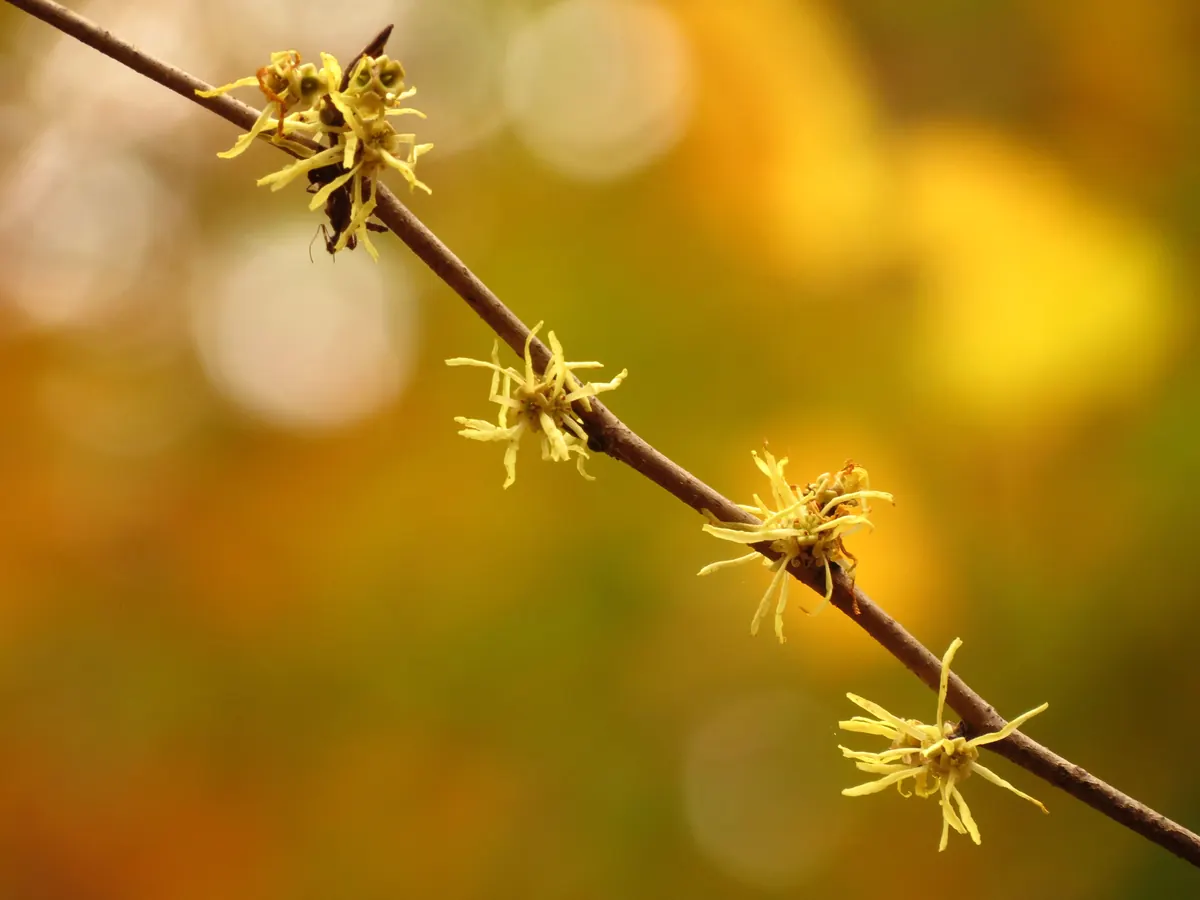
Witch hazel, the last flower of the year
Mid-October to mid-November · Every county; the understory of moist woods, ravines and streambanks
Common witch hazel opens its ragged yellow flowers as its own leaves turn and fall, from October into December with a peak from mid-October to mid-November. Penn State’s Arboretum calls it the last native Pennsylvania plant to flower each year, and it grows in every county. The flowers smell faintly of citrus on a mild afternoon and curl up in the cold without dying, and last year’s capsules on the same branch shoot their two black seeds several yards.
-
Asters and goldenrod to the frost
Through October to the first hard freeze · Roadsides, meadows, woods edges
New England aster, white wood aster, heath aster and the goldenrods carry the late bees and the last monarchs to the first hard freeze; the Pennsylvania Native Plant Society’s pick for the season, white wood aster, flowers from July through October and feeds the winter sparrows in seed. Ragweed, not goldenrod, is the sneeze: goldenrod pollen is heavy and carried by insects.
-
Acorns, beechnuts and hickories: the mast
Dropping now · Oak and beech woods statewide
The Game Commission lists acorns, hickory nuts and beechnuts among the foods bears eat heavily in autumn, deer add acorns and apples to their diet in fall, and squirrels, jays, turkeys and mice take the rest. A heavy mast year keeps bears in the woods; a poor one sends them to bird feeders. Tally the acorns beneath a single oak and date the note; the seeds-pods-and-cones plate in the journal is for exactly this.
-
Apples and pumpkins
Harvest through October · Adams County orchards; farms statewide
Adams County’s orchards around Biglerville and Arendtsville are the center of Pennsylvania apple country, and the National Apple Harvest Festival runs the first two weekends of October, October 3–4 and 10–11, at the South Mountain Fairgrounds, 8 a.m. to 6 p.m. Saturdays and to 5 p.m. Sundays. Pumpkins are ready across the state; Bald Eagle State Park’s Punkin’ Chunkin’ festival is Saturday, October 17, and Little Buffalo State Park holds its apple festival the same day.
What are the bears, deer, trout and bugs doing?
-
Black bears eating for winter
Heavy feeding through October; pregnant females den in mid- to late November · Statewide, about 19,000 of them
“In autumn, bears eat heavily to fatten themselves for winter,” the Game Commission says, on acorns, hickory nuts, beechnuts, late berries, corn and whatever a yard offers; pregnant females den first, in mid- to late November, and males a few weeks later. Bird feeders, garbage cans and grills draw them, and with about 19,000 bears in the state, October is the month to take the feeder down in bear country and put it back after Thanksgiving.
-
Deer: the rut is coming, not here
Rubs and scrapes from mid-October; breeding peaks in mid-November · Statewide, suburbs included
Breeding “begins as early as September and can last into late January,” the Game Commission says, but “reaches its peak in mid-November.” October is the rubs-and-scrapes month, when bucks strip bark from saplings and paw the ground under an overhanging branch they mark with their facial glands. Deer move more as the breeding season approaches and road collisions rise with them; dawn and dusk on wooded roads are the hours to slow down. Archery deer season is open statewide from October 3 (see the safety notes).
-
Steelhead into the Erie creeks
From mid-September with the first big rains; strong through October · Elk, Walnut and Twenty Mile creeks and ten other Erie County tributaries
Lake Erie’s steelhead school off the creek mouths from about mid-September and run up the tributaries whenever a rain lifts the flow, so the fall run is only as good as the fall rain: a dry October keeps them in the lake, and a soaking storm fills Elk and Walnut creeks with fish and, soon after, anglers. The Fish and Boat Commission lists thirteen steelhead tributaries and requires a Lake Erie permit; Trout Run at Fairview is a nursery water, closed to fishing, where the fish can be watched from the bank.
-
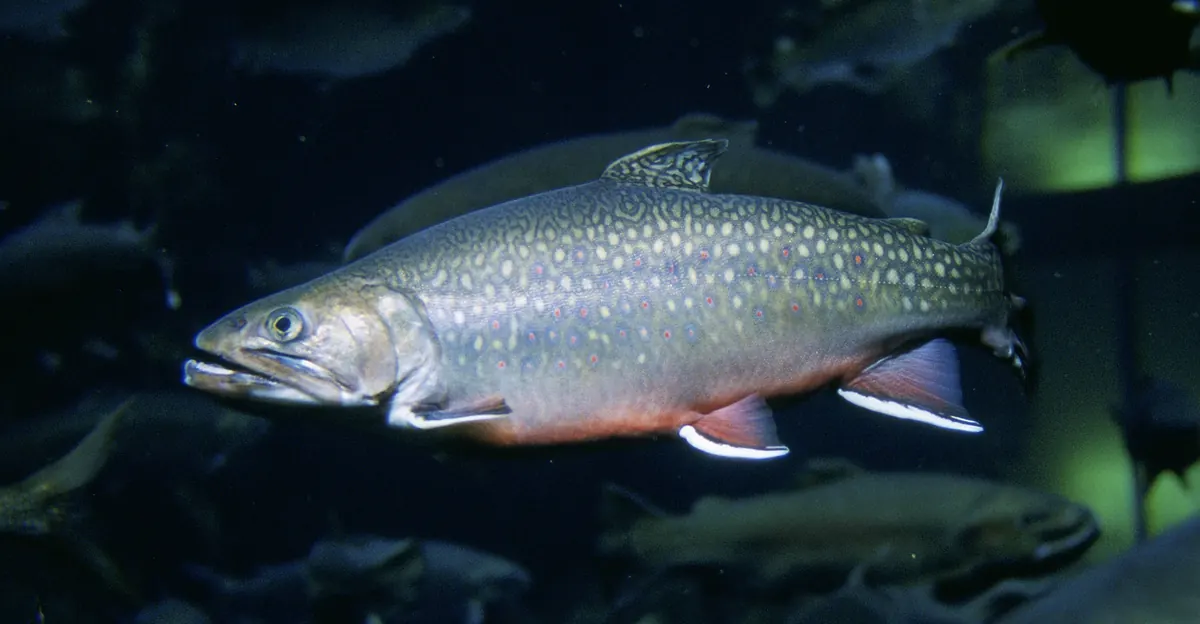
Brook trout on the redds, and 114,700 stocked trout
Spawning from mid-September into November; stocking from October 1 · Headwater streams; 92 stocked waters in October
Pennsylvania’s state fish spawns in fall, from mid-September through November, and in October the small mountain streams show it: males in orange bellies and white-edged fins, females digging redds, pale cleared patches of gravel in riffles six to eighteen inches deep. Cross at bedrock or dark cobble, keep the dog out of the riffle, and fish from the bank; one boot in a redd kills the eggs. The Fish and Boat Commission’s fall stocking starts Thursday, October 1: about 114,700 adult rainbow, brown and brook trout into 117 stream sections and lakes through mid-December, 86,100 of them in October into 92 waters; the county schedules are on fishandboat.com.
-
Spotted lanternflies laying eggs
Late September until a hard freeze · Southeast and spreading; tree of heaven and any flat surface
The females are laying now: masses of 30 to 50 eggs under a gray, mud-like coating on trees, rocks, fence posts, cars and lawn furniture, from September until the hard freezes kill the adults, with hatch in late April to June. Penn State Extension’s advice for October is to scrape the masses into a bag of rubbing alcohol, check the car and the outdoor gear before driving out of the quarantine, and report sightings beyond it to the hotline, 1-888-422-3359.
-
Woolly bears crossing the road
October afternoons · Roads, trails, sidewalks
The banded woolly bear, larva of the Isabella tiger moth, crosses roads in October looking for a place under bark or a log to spend the winter; it overwinters as a caterpillar, freezes with a glycerol antifreeze, thaws in spring, feeds a little and pupates. The folklore that a wide brown band means a mild winter does not hold up: the band reflects the caterpillar’s age and how good its growing season was. Count the bands anyway and write the number down; that is data even when the prophecy is not.
What can families do outside in Pennsylvania this month?
- Walk in Penn’s Woods, Saturday, October 3. DCNR’s calendar lists guided walks at Clear Creek State Forest at 8:30 a.m. and at Cook Forest State Park and the Quebec Run Wild Area in Forbes State Forest (preregistration) at 10; Raccoon Creek State Park adds a forest-bathing foliage walk at 9.
- Find the elk, then the antlers. Elk Country Visitor Center: “Learn About the Rut,” Sunday, October 18, 2 p.m.; “All About Antlers,” Saturday, October 24, 2 p.m.; Halloween Elkstravaganza, Sunday, October 25, 1–4 p.m. Sinnemahoning State Park runs a kayak wildlife-watching paddle on October 24 at 9 a.m.
- Do a hawk watch. Pick any ridge on the first northwest wind after a front and post your count to HawkCount. Hawk Mountain’s Moon Glow Trick or Treat Trail is Saturday, October 24, 6–7:30 p.m., ticketed through the Sanctuary.
- Chase the color with a forester. Guided foliage walks: Promised Land, Saturday, October 10, 10:30 a.m.; Poe Paddy, October 17, 10 a.m.; Ralph Stover and Delaware Canal tree-identification hikes, October 17, 9:30 a.m.; “Why Leaves Change Color” at Frances Slocum, October 24, 9:30 a.m.; Cowans Gap, October 31, 11 a.m., registration required.
- Bird the second Saturday. World Migratory Bird Day’s fall date is October 10 (Fort Washington State Park at 10 a.m., a birding hike at Pine Grove Furnace the same morning), and eBird runs its October Big Day the same day. Audubon Mid-Atlantic’s Philly Birding Weekend lists a Sunday, October 11 walk at John Heinz National Wildlife Refuge, 8 to 10 a.m.; register through Audubon.
- Owls and the dark. Kings Gap’s “Owls of Pennsylvania,” Saturday, October 31, 8–9:30 p.m., in person or online; Raymond B. Winter State Park’s “Owl Outlaws” the same afternoon at 1.
- Start the journal. Bald Eagle State Park’s nature journaling club meets Saturday, October 31, 10 a.m. to noon, free; Project FeederWatch opens November 1.
The Pennsylvania Native Plant Society’s annual meeting is Saturday, October 24.
Safety notes for October in Pennsylvania
- Orange on state game lands. Under 58 Pa. Code § 135.41, anyone on state game lands who is not lawfully hunting, trapping or fishing must wear, from October 1 through January 31 (and April 20 through May 31), at least 250 square inches of daylight fluorescent orange on the head, chest and back combined, visible all round, or a fluorescent orange hat instead; only people using the shooting ranges are exempt. That covers hikers, birders and dog walkers on more than 1.5 million acres of game lands. Most state parks and forests are open to hunting outside posted areas, so wear orange on those trails too.
- Seasons open in October: archery deer statewide October 3 – November 20 (September 19 – November 27 in the suburban units 2B, 5C and 5D); muzzleloader antlerless deer October 17–25 and the special firearms antlerless season October 22–25; archery bear October 17–25 in most units, muzzleloader and special firearms bear October 22–25; squirrel since September 12; ruffed grouse and rabbit from October 17; pheasant from October 24 (juniors October 10–18); fall turkey from October 31 in most units; elk firearms October 3–11. The rifle deer season opens November 28.
- Bears are at their hungriest: take feeders down in bear country, keep garbage in, and if you meet one, talk calmly and back away.
- Ticks. Adult blacklegged ticks are active from October to May on any day above freezing; treat clothing with permethrin, tuck pants into socks, and check after every walk.
- Elk in rut: keep 100 yards and do not stop in the road on Winslow Hill.
- Cold, wet and early snow. A freeze is normal on the Plateau by late September and in the northern and central valleys by the third week of October; Erie’s lake-effect season begins in November, but the first flakes have come as early as October 1. Carry a layer and a light on ridge walks.
- Lanternflies are harmless to people; scrape the eggs and skip the sprays.
Sources
- PA DCNR: fall foliage reports (typical peak by region; Laurel Highlands sequence; Thursday schedule)
- PA DCNR news release, September 24, 2026: weekly fall foliage report returns October 1
- HawkCount: Hawk Mountain Sanctuary site profile (peak periods, winds, visitors)
- HawkCount: Hawk Mountain Sanctuary monthly summary (September 2026 counts)
- HawkCount: Allegheny Front site profile (golden eagles)
- HawkCount: Pennsylvania hawk watch sites
- Hawk Mountain Sanctuary: sharp-shinned hawk
- Hawk Mountain Sanctuary: golden eagle
- Lehigh Valley Public Media: Hawk Mountain’s autumn migration count (season dates, 18,000 average)
- Hawk Mountain Sanctuary: events and trail admission (Ticketleap)
- Pennsylvania Game Commission: elk (wildlife note)
- PA Wilds: the Benezette elk cam and the bugling season
- Elk Country Visitor Center: programs, tours and hours
- Pennsylvania Game Commission: ruby-throated hummingbird (wildlife note)
- Monarch Watch: peak migration dates by latitude
- Monarch Watch: monarchs over Lake Erie waters
- Journey North: monarch sightings and roost reports
- Tom Ridge Environmental Center Foundation: wildlife watching at Presque Isle by month
- Wikipedia: dark-eyed junco (arrival on winter range, citing Birds of the World)
- Audubon field guide: white-throated sparrow (fall migration)
- U.S. Fish and Wildlife Service: Erie National Wildlife Refuge activities
- Pennsylvania Game Commission: tundra swan (wildlife note)
- Pennsylvania Game Commission: Middle Creek Wildlife Management Area (Wildlife Drive dates, hours)
- Pennsylvania Game Commission: Middle Creek snow goose and waterfowl migration update
- NOAA NCEI: 1991–2020 first-freeze probability normals (data API; Erie, Pittsburgh, Johnstown, State College, Williamsport, Harrisburg, Philadelphia, Wilkes-Barre/Scranton, Bradford)
- NOAA NCEI: 1991–2020 monthly normals, temperature, precipitation and snow (data API)
- NWS Cleveland: first and last snow, season length (Erie earliest October 1, 2003)
- Climate Prediction Center: ENSO diagnostic discussion, September 10, 2026
- NWS State College: ENSO (ONI) versus snowfall at Harrisburg
- Northeast Regional Climate Center: El Niño impacts in the Northeast (2018 report, PDF)
- NOAA Climate.gov: United States El Niño impacts
- U.S. Naval Observatory: moon phases 2026 and sunrise/sunset (data API)
- NIST: daylight saving time
- EarthSky: meteor shower guide (Draconids, Orionids 2026)
- American Meteor Society: 2026 meteor shower calendar
- International Occultation Timing Association: lunar occultation of Jupiter, October 6, 2026
- When the Curves Line Up: the October 6 occultation, city times
- Fred Espenak: full moons at perigee, 2001–2100
- Universe Today: the October 6 occultation of Jupiter and Saturn at opposition (ring tilt)
- The Arboretum at Penn State: blooming now, witch hazel
- Penn State Extension: fall-blooming common witch hazel
- Pennsylvania Native Plant Society: in bloom, annual meeting October 24, 2026
- National Apple Harvest Festival: 2026 dates and hours
- Pennsylvania Game Commission: black bear (wildlife note)
- Pennsylvania Game Commission: white-tailed deer (wildlife note)
- Fisherie: steelhead streams of the Pennsylvania Lake Erie watershed (run timing)
- Pennsylvania Fish and Boat Commission: steelhead
- PA Steelhead Association: northwest Pennsylvania steelhead waters (Trout Run nursery)
- Mountain Watershed Association: brook trout spawning season
- National Park Service, Shenandoah: brook trout (spawning, colors)
- exploreVenango, September 30, 2026: Fish and Boat Commission fall stocking begins October 1
- Penn State Extension: spotted lanternfly management guide
- NWS La Crosse: the woolly bear caterpillar
- Pennsylvania Game Commission: final 2026–27 hunting seasons
- 58 Pa. Code § 135.41: state game lands, fluorescent orange for persons not hunting
- Pennsylvania Game Commission: state game lands (more than 1.5 million acres)
- WNEP, September 24, 2026: Game Commission extends wear-orange dates for non-hunters
- University of Rhode Island TickEncounter: blacklegged tick (adults active October–May)
- PA DCNR calendar of events: October 2026 state park and forest programs
- Audubon Mid-Atlantic: Philly Birding Weekend at John Heinz National Wildlife Refuge
- eBird: October Big Day, October 10, 2026
- Project FeederWatch: how to participate (season opens November 1)
- Photos via Wikimedia Commons; licenses and photographers are credited under each picture
