What to look for in nature in Texas this March
In Texas, March is the month spring turns real. On the coast the last whooping cranes lift off for Canada, and in the Hill Country a yellow-faced warbler comes back to the junipers where it nests. A rare grouse still booms at dawn on the prairie west of Houston, and mountain laurel, redbuds and the first bluebonnets color the roadsides. Bats resettle under an Austin bridge, monarchs drift north from Mexico, and tornado season begins. This guide follows the month from the Panhandle to the Rio Grande.
Other months in Texas: October, November, December, January, February, April.
Start here
- Listen for a warbler in the junipers. Pick a calm dawn after mid-March, walk into an old oak and juniper canyon in the Hill Country and stand still. A buzzy, rising song from the treetops may be a male golden-cheeked warbler, back from Mexico to claim a territory.
- Book a seat on the prairie. Attwater Prairie Chicken National Wildlife Refuge offers reservation tours twice a month this spring. Reserve ahead, arrive before sunrise and listen for the booming of males on their display ground.
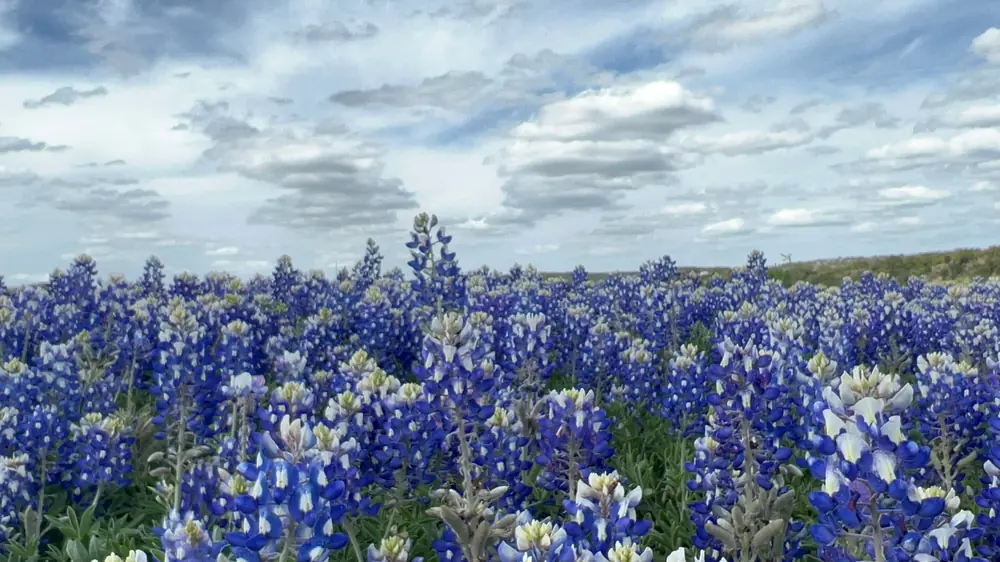
- Follow the flowers. Watch for the purple, grape-scented blooms of mountain laurel in town and on hillsides, then for bluebonnets as the month ends. Photograph from the shoulder of the road, not in it, and log your first bloom of each kind.
In the Naturalist’s Field Journal, a morning in warbler country fits “dusk and dawn watch,” noting the minute of the first song and the weather. Prairie-chicken booming and dusk bats can go on “a map of sounds,” marking where each call came from. A bluebonnet roadside or a purple mountain laurel makes a good “colours of the day” page, and a spot you sketched in January or February deserves “the same place twice.” A first monarch, hummingbird or swallow belongs on “birds I have seen,” a bat can go on “mammal watch,” and a snake or alligator sighting belongs on “reading the signs.”
Regions used below: Panhandle and North Texas; Central Texas and the Hill Country; East Texas and the Piney Woods; Gulf Coast; South Texas and the Rio Grande Valley; Trans-Pecos and Big Bend.
Are Attwater’s prairie-chickens still booming in March?
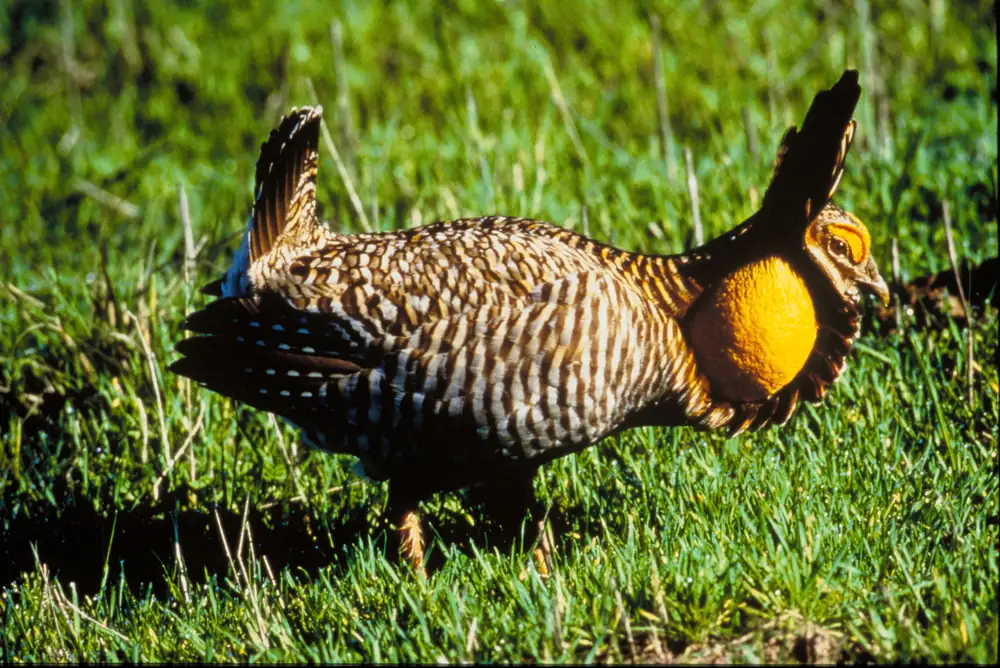
Yes, and March is the heart of the show. On the last big remnant of native coastal prairie west of Houston, male Attwater’s prairie-chickens return at first light to patches of bare ground or short grass, where they stamp, fan their tails, inflate orange neck sacs and boom. Texas Parks and Wildlife says the sound can carry up to half a mile. The refuge that protects the birds puts the mating season from late February into early April, with the most activity soon after sunrise.
-
A dance floor in the grass
Late February to early April, best in the first hours after sunrise · Attwater Prairie Chicken National Wildlife Refuge, about 60 miles west of Houston
The display grounds are called booming grounds, or leks. Hens come to watch and choose, then leave to nest in tall grass. Texas Parks and Wildlife reports about a dozen eggs per nest, hatching in April or May, so a disturbed hen can lose a whole season. Watch from a vehicle or a guided tour, never on foot across the prairie.
-
Tours twice a month in spring
March and April, on the refuge’s first and third Saturdays · Meets at the refuge; reservation required
The refuge runs reservation-only van tours of roughly 90 minutes to two hours with room for 11 passengers. Outside spring the tours are monthly, so March and April are the easiest seats to get. Sign up through the form on the refuge website, and confirm the 2027 tour dates there, since we have not seen a 2027 calendar. On your own, the Auto Tour Loop and the Sycamore and Horseshoe Lake trails stay open from sunrise to sunset, and the refuge advises driving slowly and scanning low or bare ground.
-
The April festival
Annually in April; check the refuge for the 2027 date · Attwater Prairie Chicken National Wildlife Refuge
The Boomin’ and Bloomin’ Festival, held every April, adds guided tours, live animal displays and discovery stations. The pages we read do not give a 2027 date, so check the refuge’s events page or call before planning a trip.
When do whooping cranes leave Texas for Canada?
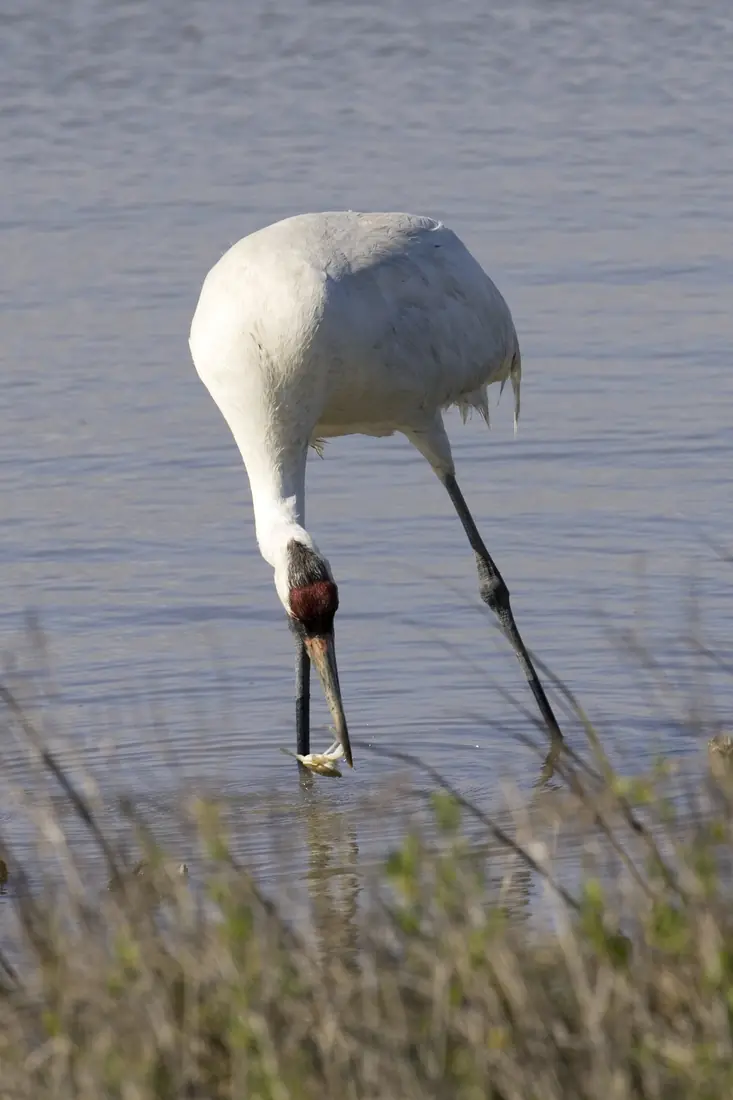
Texas Parks and Wildlife says whooping cranes start their spring migration north in late March or early April, and Aransas National Wildlife Refuge says they typically arrive in late October and are gone by mid-April. So late March is when family groups and pairs begin lifting off the salt marsh for a flight of roughly 2,500 miles to nesting grounds in northern Canada. The weather decides much of the timing.
-
Leaving in bursts, on a south wind
Late March into mid-April, set by the weather · Aransas National Wildlife Refuge and the nearby salt marsh
There is no single departure date. The refuge says the cranes are typically gone by mid-April, and the weather sets the pace within that window, so a stretch of favorable weather can send many birds off at once and the last ones can seem to vanish overnight.
-
Sandhill cranes and the last waterfowl
March · Central Texas skies, the Panhandle and South Plains lakes, and the upper coast
Travis Audubon’s March forecast for Austin says sandhill cranes are heading north toward Nebraska and wintering ducks such as bufflehead and northern pintail are dwindling. Houston Audubon says snow geese stay on the upper coast until around the end of February, so by March most of the geese have gone. For a last look at winter waterbirds, go early in the month.
Which songbirds come back to the Hill Country in March?
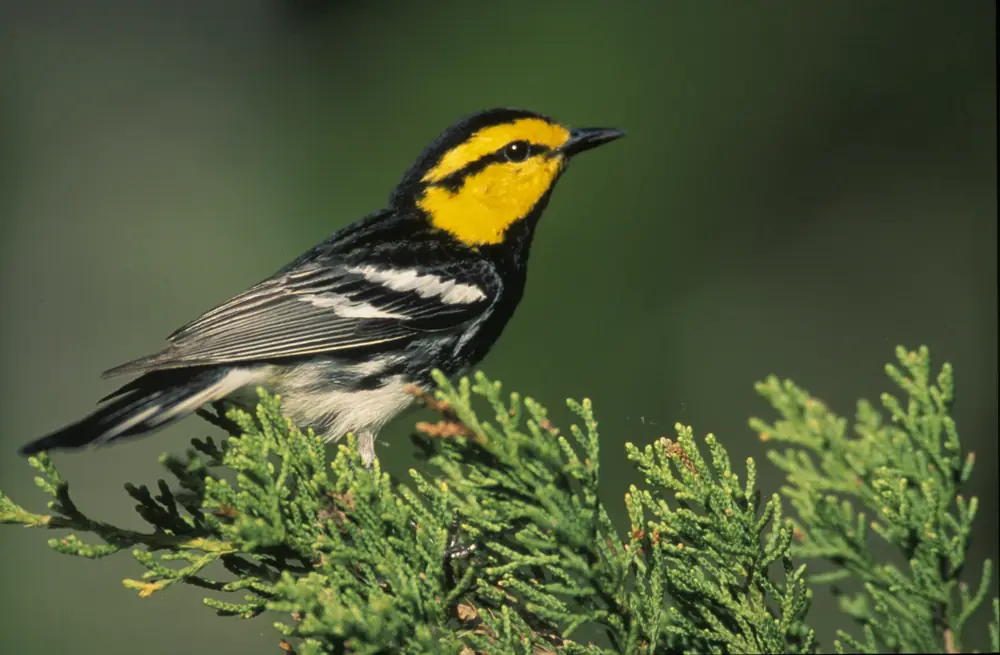
On the Edwards Plateau, two prized nesting birds return each spring to the same oak and juniper country. Their arrival depends on warm weather, so early in the window is luck and later is patience.
-
Golden-cheeked warblers
Males about mid-March, females a week or so later; song peaks in April · Old Ashe juniper and oak woods of the Hill Country, including Balcones Canyonlands National Wildlife Refuge near Austin
The Texas Breeding Bird Atlas says the warblers are back from their wintering grounds by the middle of March, with song at its height in April, and Travis Audubon says males usually beat females by about a week. The nest is a small cup woven of Ashe juniper bark strips and cobwebs, and the earliest egg date in the atlas is April 1. Balcones Canyonlands National Wildlife Refuge was set up to protect the nesting grounds of the warbler and the black-capped vireo, and it has about ten miles of foot trails. Go early on a calm morning, stand still and listen for a buzzy, rising song. Many warblers nest on private ranches, so stay on public land.
-
Black-capped vireos
Late March to mid-April · Limestone outcrops with oak clumps and open grass, mainly on the Edwards Plateau
The vireo likes scrubby, patchy habitat rather than tall woods. The atlas describes its home as limestone outcrops where soil, fire history and climate leave oak clumps with open grass between. Birds arrive from late March to mid-April, a little after the warblers, so mid-April is the safer time to look.
-
Black-and-white and yellow-throated warblers
Black-and-white about mid-March; yellow-throated breeders from mid-March to early April · Wooded canyons; tall cypress along rivers and lakes
Travis Audubon says black-and-white warblers appear around the same time as golden-cheeks, though many only pass through. Yellow-throated warblers begin moving through Central Texas in late February, and the breeders arrive from mid-March to early April, in Austin among cypresses along Lake Austin.
When does spring migration begin on the Texas coast?
Texas lies under a great funnel of bird migration, and in March the funnel is only starting to fill. Houston Audubon says some migrants are already passing the upper coast in early March, with the surge by mid-April and the traditional peak in the last week of April.
-
The first warblers and swallows
Early to late March · Wooded parks and sanctuaries on the upper coast, High Island, Galveston Island and Bolivar Peninsula
Texas Parks and Wildlife’s migration calendar starts northern parula, yellow-throated and black-and-white warblers and barn swallows in early March, with black-throated green warblers from late March. The showier Blackburnian and bay-breasted warblers are not due until late April. A March trip is for patient birders who like a few early arrivals, not a rush of color.
-
Hummingbirds on the move
Late March to mid-May for ruby-throated hummingbirds · Gardens and feeders statewide, earliest on the coast
Texas Parks and Wildlife gives late March to mid-May for ruby-throats passing through, and Houston Audubon calls March to May the spring window. Some ruby-throats stay all winter around Houston, so a feeder may already have a visitor. Keep feeders clean and full.
-
Fronts and fallouts
March, and above all April · Beaches, groves and any green patch near the Gulf
Cornell’s BirdCast explains that birds crossing the Gulf from the Yucatan face a flight of many hours, and a cold front stalled offshore can force them down at the first land they reach, a fallout. In its account of late April 2013, thrushes, grosbeaks, orioles and warblers poured ashore along the Texas coast. Events that big are more an April story, but the setup to watch for is the same: northerly wind and rain after a spell of southerly flow.
Which Texas wildflowers and shrubs bloom in March?
March opens the Texas flower season. The state’s most famous bloom is only starting in most places, while a few shrubs and desert plants are already near their best.
-
Bluebonnets, early and then everywhere
Late March to mid-April or later in Central and East Texas; the peak is often early April · Roadsides and prairies from the Hill Country to the Blackland Prairie
The Lady Bird Johnson Wildflower Center says Central and East Texas bluebonnets typically bloom from late March through mid- to late April, peaking in early April. Texas A&M AgriLife’s Larry Stein says the plants need plenty of moisture in the preceding months, because rain softens the hard seed coats. Five lupines share the state-flower title: Texas, sandyland, Big Bend and dune bluebonnets and the annual lupine. Picking is legal, but the center asks you to leave the flowers for others. The Texas Department of Transportation sows about 30,000 pounds of wildflower seed a year, a big reason the roadside displays are so thick.
-
Big Bend bluebonnets
February through March · Paved roads in Big Bend National Park
The National Park Service lists February through March as the time for the Big Bend bluebonnet, the tallest of the Texas species, thick along the paved roads in a typical year and covering hillsides in an exceptional one.
-
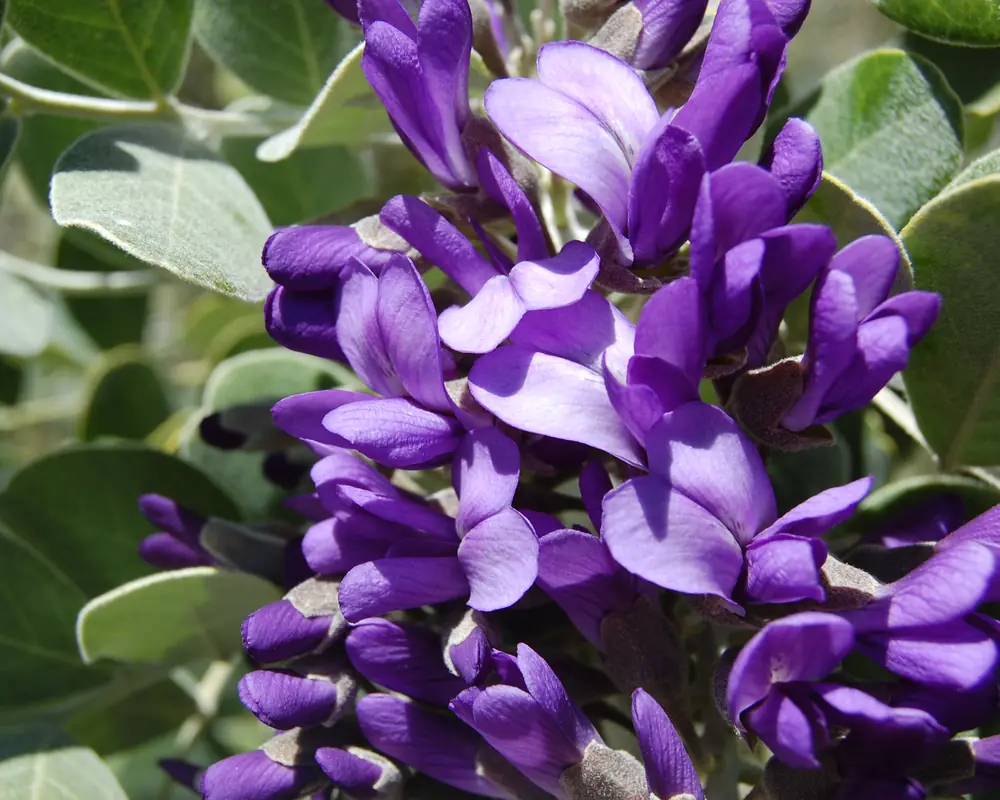
Texas mountain laurel
February to April · Hill Country slopes and town gardens west to the Chihuahuan Desert
The Native Plant Society of Texas describes a multi-trunked shrub or small tree 12 to 20 feet tall, with drooping clusters of purple flowers and a strong grape bubble gum fragrance. It feeds butterflies, hummingbirds and moths. All parts are poisonous to people, especially the red seeds in the pods that follow.
-
Texas redbud
March or early April · Rocky, limestone soils from southern Oklahoma through Central Texas
The Wildflower Center says Texas redbud blooms in March or early April, with rose-purple flowers before the glossy, heart-shaped leaves. It is a host plant for Henry’s elfin butterfly, and bees and moths visit for nectar.
-
Ocotillo
Late March or April · Gravelly slopes in Big Bend National Park, such as Old Maverick Road
An ocotillo looks like a bundle of dead sticks until each stem is tipped with red-orange tubes. The National Park Service notes that it is not a cactus, that it leafs out after good rains, and that carpenter bees do most of the pollinating despite the hummingbirds’ reputation. It suggests late March or April on Old Maverick Road.
What is waking up across Texas in March?
Warm afternoons bring out animals that spent the winter hidden, torpid or in Mexico.
-
Bats under the Congress Avenue Bridge
In residence every evening from March to October · Congress Avenue Bridge, downtown Austin
The Austin Bat Refuge says the Mexican free-tailed bat colony is present every evening from March to October, that females return in spring and give birth in June, and that the colony numbers about 1.5 million. July and August bring the biggest crowds, since the pups are flying then. Texas Parks and Wildlife says boat viewing runs seven nights a week from March through October. Bracken Cave near San Antonio holds bat flights only from May to September, and Bat Conservation International posts its schedule each March.
-
The first monarchs
From early March · South Texas first, then north wherever milkweed is up
Texas Parks and Wildlife says overwintering monarchs begin arriving from Mexico early in March and look for new milkweed on which to lay eggs. Journey North collects first sightings, and the Texas Milkweeds and Monarchs project on iNaturalist maps milkweed across the state.
-
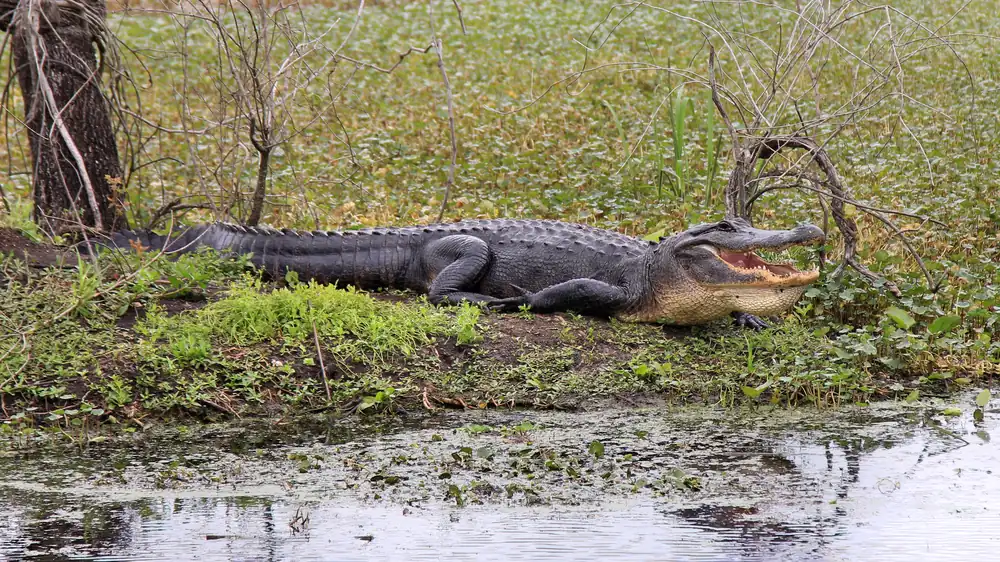
Alligators coming out of the cold
March to May for breeding · Swamps, bayous and marshes of the eastern third of Texas
Texas Parks and Wildlife says March through May is peak breeding season. Females stay near home; males may range over as much as ten square miles. Alligators are quick over short distances on land, so keep your distance and never feed one.
-
Snakes warming on logs
February and March, earlier in the south · Woodlands, creek banks, rock piles and yards
Texas A&M AgriLife says snakes leave winter dormancy in February and March, sun themselves on rocks and logs, then turn to dusk and night activity as it warms. Texas has roughly 75 species and about a dozen are venomous.
-
Sea turtles beginning to nest
Nesting season starts in late March or April · Padre Island National Seashore and other Gulf beaches
Federal wildlife officials date the start of Kemp’s ridley nesting on the Texas coast to late March, with beach monitoring through September. If you find a turtle on the beach, keep your distance and call 1-866-TURTLE-5 (1-866-887-8535).
How warm is March in Texas, and when does severe weather start?
In March the Texas thermometer finally tips toward warmth. NOAA’s 1991 to 2020 normals, in the table below, put the average afternoon high at 70 °F or more at every station except Amarillo, Lubbock and Dallas–Fort Worth, and Amarillo’s 34.8 °F is the coolest average overnight low. Snow is rare but possible: Amarillo averages 1.9 inches in March and Dallas–Fort Worth 0.3 inch. The big contrast is rain, much heavier in the east and on the coast than in the west.
The warmth that coaxes out flowers also feeds storms. The National Weather Service in Fort Worth counts 215 tornadoes in March, 555 in April and 525 in May in its North and Central Texas area from 1950 through 2025, or about 3, 7 and 7 a year. March is the start of the season, not the peak.
| Station | Average high | Average low | Snowfall | Precipitation |
|---|---|---|---|---|
| Amarillo | 64.8 °F | 34.8 °F | 1.9 in | 1.27 in |
| Lubbock | 67.8 °F | 38.3 °F | 0.4 in | 1.10 in |
| El Paso | 71.9 °F | 45.5 °F | 0.0 in | 0.24 in |
| Midland | 71.9 °F | 44.2 °F | 0.0 in | 0.68 in |
| Dallas–Fort Worth | 68.6 °F | 47.8 °F | 0.3 in | 3.30 in |
| Austin (Camp Mabry) | 73.3 °F | 52.2 °F | 0.0 in | 2.88 in |
| San Antonio | 73.8 °F | 51.8 °F | 0.0 in | 2.31 in |
| Houston (IAH) | 74.0 °F | 53.6 °F | 0.0 in | 3.47 in |
| Corpus Christi | 76.7 °F | 58.1 °F | 0.0 in | 2.28 in |
| Brownsville | 80.6 °F | 62.0 °F | 0.0 in | 1.45 in |
West Texas has its own March hazard, wind and dust. The National Weather Service in Lubbock recalls March 18, 2025, when a strong storm brought a 78 mph gust at Lubbock’s airport, closed Interstate 27 between Canyon and Happy in blowing dust and sparked a significant wildfire at Plainview. NOAA’s Climate Prediction Center posts new seasonal outlooks each month, and the latest is on its three-month outlook page. Our local weather forecast covers the days ahead, and the cloud guide helps you read a storm as it builds.
When is the last freeze in Texas?
By March the question is where the cold is over, not whether. For each of eight stations, NOAA’s 1991 to 2020 normals below list an early date for the final 32 °F night (reached or beaten in about one spring of every ten), the median date, and a late date that all but one spring in ten has already passed. In the southern half of the state the median has usually passed before March begins: February 13 at Houston, February 20 at Austin and January 6 at Brownsville. Midland’s median is March 18 and Amarillo’s April 13, so the High Plains can see frost after the bluebonnets open.
| Station | One year in ten | Median | Nine years in ten |
|---|---|---|---|
| Amarillo | Mar 29 | Apr 13 | Apr 29 |
| El Paso | Feb 12 | Mar 2 | Mar 19 |
| Midland | Feb 28 | Mar 18 | Apr 8 |
| Dallas–Fort Worth | Feb 17 | Mar 8 | Mar 26 |
| Austin (Camp Mabry) | Jan 23 | Feb 20 | Mar 14 |
| San Antonio | Jan 29 | Feb 26 | Mar 17 |
| Houston (IAH) | Jan 12 | Feb 13 | Mar 12 |
| Brownsville | Dec 11 | Jan 6 | Feb 1 |
Treat these as odds, not promises: a late freeze after a warm week can still nip tender buds and new tomato plants. To find the dates for your own town, use our Texas frost dates page.
How much daylight do Texas cities gain in March, and when do the clocks change?
March lengthens the day by 45 minutes in Brownsville and 66 in Amarillo, as the table shows for March 1 and March 31, sunrise to sunset. These are day lengths, so the clock change does not alter them.
| City | Mar 1 | Mar 31 | Gained | Per day |
|---|---|---|---|---|
| Amarillo | 11 h 26 m | 12 h 32 m | 66 min | 2.2 min |
| Lubbock | 11 h 28 m | 12 h 31 m | 63 min | 2.1 min |
| Dallas | 11 h 29 m | 12 h 30 m | 61 min | 2.0 min |
| El Paso | 11 h 31 m | 12 h 29 m | 58 min | 1.9 min |
| Austin | 11 h 33 m | 12 h 27 m | 54 min | 1.8 min |
| Houston | 11 h 34 m | 12 h 27 m | 53 min | 1.8 min |
| Corpus Christi | 11 h 36 m | 12 h 26 m | 50 min | 1.7 min |
| Brownsville | 11 h 39 m | 12 h 24 m | 45 min | 1.5 min |
NIST sets daylight saving time to begin on the second Sunday of March, so Texans lose an hour of sleep that Sunday and gain an hour of evening light that stays all the way into November. NOAA’s solar equations put Houston’s sunset at 6:29 p.m. standard time on Saturday, March 13, and 7:29 p.m. daylight time on Sunday, March 14. Spring officially arrives with the equinox at 3:25 p.m. CDT on March 20 (2:25 p.m. in El Paso), per the U.S. Naval Observatory. The daylight tool has times for your own town.
What is in the Texas night sky in March 2027?
March nights are mild, and the sky offers two bright planets after dark, Venus and Mercury before dawn, and a full moon that comes at daybreak. Our moon phases tool has times for your town. Planet rise and set minutes below are our own figures for the middle of the country, and they shift by up to half an hour between the Panhandle and the Gulf coast.
-
Venus and Mercury before dawn
Venus all month; Mercury best March 8 to 25 · Low in the east before sunrise
Venus is the brilliant morning star, clearing the eastern horizon a couple of hours before dawn in the first days of March. By our own computation a thin crescent moon sits near it on the mornings of Thursday, March 4, and Friday, March 5. Mercury is farthest from the Sun, 27.6 degrees to its west, at 11:20 p.m. CDT on Tuesday, March 16. It rises roughly an hour before sunrise in early and mid March and is far fainter than Venus, so scan the east-southeast horizon with binoculars.
-
Jupiter and Mars in the evening
Moon beside Jupiter March 18 and 19; Mars and Jupiter about 4 degrees apart March 30 · High in the south and southwest after dark
Jupiter, in Leo, is still brilliant after its February opposition. By our own computation a bright gibbous moon passes within a degree of it at 4:26 a.m. CDT on Friday, March 19, so the evenings of the 18th and 19th show the pair. Orange Mars is dimmer. By the same computation, Mars closes to within about 4.3 degrees of Jupiter late on Tuesday, March 30, a pairing easy to pick out without optics. Saturn, in Pisces, sinks into the evening twilight over the course of the month and is gone by April.
-
The Worm Moon at dawn
Full at 5:44 a.m. CDT on Monday, March 22 (4:44 a.m. MDT in El Paso) · A clear western horizon before sunrise
Sea and Sky links the name Worm Moon to the time when softening soil brings earthworms back to the surface. This moon is exactly full before sunrise, so the best moonrise is Sunday evening, March 21 (about 7:05 p.m. in Houston by our computation), and it looks full the evenings before and after. It is not a supermoon.
-
The Milky Way before dawn
Best about March 3 to 17, and March 31 · Dark sites in the southern half of the state, such as Big Bend and the Hill Country
By our own calculation, near 30 degrees north latitude (Austin and Houston), the bright core of the Milky Way climbs at least 10 degrees above the horizon in a dark, moonless sky for up to 2.4 hours before dawn on those nights. The March 8 new moon sits in the middle of that stretch. Go out in the last hours of the night.
| Phase | Date | Time |
|---|---|---|
| New moon | Monday, Mar 8 | 3:29 a.m. CST (2:29 a.m. MST) |
| First quarter | Monday, Mar 15 | 11:25 a.m. CDT (10:25 a.m. MDT) |
| Full moon, the Worm Moon | Monday, Mar 22 | 5:44 a.m. CDT (4:44 a.m. MDT) |
| Last quarter | Monday, Mar 29 | 7:54 p.m. CDT (6:54 p.m. MDT) |
March has no meteor shower worth a special trip; the Lyrids arrive in April.
What can Texas families do outdoors in March 2027?
- Hear the booming at Attwater. The refuge’s spring tours run twice a month. Reserve through the refuge’s sign-up form and bring layers for a cool prairie dawn.
- Ride the tram at Santa Ana. In the Rio Grande Valley, Santa Ana National Wildlife Refuge runs its tram Wednesday through Saturday at 11 a.m. and 2 p.m. from November through March. The trails are open daily, with chachalacas, great kiskadees and cactus wrens, and entry is free on the first Sunday of each month.
- Join a ranger walk. State parks offer spring bird walks and wildflower hikes. In 2026 Galveston Island State Park led a spring migration walk on March 21 and Lake Brownwood State Park a wildflower hike on March 11. The 2027 listings are not posted yet.
- Watch the bats at dusk. Austin’s Congress Avenue Bridge has a free viewing area, and Bracken Cave’s May to September flights need advance reservations.
- Report a monarch. Log first sightings with Journey North, and add milkweed to the Texas Milkweeds and Monarchs project on iNaturalist.
- Plan for FeatherFest. Houston Audubon notes that Galveston FeatherFest is held annually in April; check its website for 2027 dates.
Programs change, so check each listing a few days ahead. Our Naturalist’s Field Journal includes plates suited to a first-flower log or a tally of spring arrivals. For the weeks just past, visit the Texas February page, and the nature guides index lists every state and month.
Safety notes for March in Texas
- Spring turkey (TPWD, 2027). The South Zone season runs March 20 to May 2, with a youth-only weekend March 13 and 14. The North Zone youth-only weekend is March 27 and 28, and its main season begins April 3. The one-turkey counties open April 1 and the Eastern turkey counties April 22. Confirm counties and bag limits on the TPWD page.
- Hunter orange. TPWD requires 400 square inches of orange plus orange headgear, with 144 square inches showing front and back, for anyone on public hunting land during daylight firearm hunting. Turkey and migratory bird hunters, alligator hunters and desert bighorn sheep hunters are exempt, so a hiker on a wildlife management area in turkey season should wear orange anyway, since hunters in camouflage may be calling close by.
- Severe storms. Tornado season opens, especially in North and Central Texas. Pick your shelter ahead of time, keep weather alerts switched on and treat a watch as a cue to plan.
- Wind, dust and fire. Dry, windy days in the Panhandle and West Texas bring blowing dust and quick grass fires. Slow down or stop if visibility falls, and never park on dry grass.
- Snakes and alligators. Both are active. Walk on marked trails, check ledges and logs before putting a hand or foot there, leash dogs and never feed or approach an alligator.
- Poisonous plants. Every part of Texas mountain laurel is poisonous, and the seeds especially so. Keep children and pets away from the pods.
- Nests and display grounds. Prairie-chickens, warblers and vireos need space. Keep dogs leashed and skip recorded calls near a nest, a display ground or protected habitat.
- Roadside flowers. Pull fully off the road to photograph bluebonnets, stay out of private fields and watch for fire ant mounds and snakes.
Sources (46)
- U.S. Fish and Wildlife Service: Attwater Prairie Chicken National Wildlife Refuge
- U.S. Fish and Wildlife Service: Attwater Prairie Chicken National Wildlife Refuge, events
- Texas Parks and Wildlife: Attwater’s prairie chicken
- U.S. Fish and Wildlife Service: Aransas National Wildlife Refuge birding
- Texas Parks and Wildlife: whooping crane
- Journey North: whooping crane migration update, April 16, 2004 (Tom Stehn)
- Travis Audubon: March bird forecast, the changing of the guard
- Houston Audubon: snow goose
- Texas Breeding Bird Atlas (Texas A&M): golden-cheeked warbler
- Texas Breeding Bird Atlas (Texas A&M): black-capped vireo
- U.S. Fish and Wildlife Service: Balcones Canyonlands National Wildlife Refuge
- Houston Audubon: spring migration on the upper Texas coast
- Texas Parks and Wildlife: bird migration times in Texas
- Houston Audubon: hummingbirds of the upper Texas coast
- Cornell BirdCast: Focus on Texas, April 2013, migration and the Big Day
- Lady Bird Johnson Wildflower Center: bluebonnet FAQ
- Lady Bird Johnson Wildflower Center: Texas bluebonnet (Lupinus texensis)
- Lady Bird Johnson Wildflower Center: Texas redbud (Cercis canadensis var. texensis)
- Texas A&M AgriLife Today: bluebonnets in bloom, a Texas tradition
- National Park Service, Big Bend: blue to purple wildflowers
- National Park Service: the unusual ocotillo
- Native Plant Society of Texas: Texas mountain laurel
- Austin Bat Refuge: Congress Avenue Bridge
- Texas Parks and Wildlife: Congress Avenue Bridge bat viewing
- Bat Conservation International: visit Bracken Cave Preserve
- Texas Parks and Wildlife: Texas Monarch Watch
- Journey North: monarch butterflies
- Texas Parks and Wildlife: American alligator
- Texas A&M AgriLife Today: five ways to prevent negative encounters with snakes this spring
- U.S. Fish and Wildlife Service: sea turtle nesting season begins on the Texas coast
- NOAA NCEI: 1991–2020 monthly climate normals (data API)
- National Weather Service Fort Worth: tornadoes by month, 1950–2025
- National Weather Service Lubbock: March 18, 2025 wind and dust event
- Climate Prediction Center: official 90-day outlooks
- NIST: daylight saving time
- NOAA Global Monitoring Laboratory: solar calculator (the equations behind the daylight table)
- U.S. Naval Observatory: moon phases, 2027 (data API)
- U.S. Naval Observatory: Earth’s seasons and apsides, 2027 (data API)
- Fred Espenak: Sky Event Almanac 2027
- Sea and Sky: astronomy calendar of celestial events, 2027
- Texas Parks and Wildlife: 2026–27 hunting season dates (spring turkey 2027)
- Texas Parks and Wildlife: hunter orange requirements
- TPWD calendar: Spring Migration Bird Walk, Galveston Island State Park, March 21, 2026
- TPWD calendar: Wildflower Hike, Lake Brownwood State Park, March 11, 2026
- U.S. Fish and Wildlife Service: visiting Santa Ana National Wildlife Refuge
- Photos via Wikimedia Commons; licenses and photographers are credited under each picture