What to look for in nature in Vermont this May
May is when Vermont turns green from the bottom up. On the first, the sun rises about 5:44 a.m. and sets about 7:57 p.m. in Burlington; by the thirty-first it is up at 5:12 and down at 8:30 (all times here are daylight time). Early in the month the maples are still bare on the hills while the warblers are already in the valley trees, and by the end the canopy has closed over the trilliums. Bobolinks return to the hayfields, loons take to their nests, lake sturgeon crowd the rivers that feed Lake Champlain, snapping turtles climb out of the ponds to lay eggs, and cow moose give birth in the woods of the northeast. The last spring freeze arrives in the second half of the month in most places and not until early June on the Mount Mansfield summit, so the garden can wait. The ticks and the biting insects arrive too. Dates worth marking: Green Up Day on May 1 (the first Saturday in May, by state law), World Migratory Bird Day (check the organizers for the 2027 date), the Eta Aquariid meteors on the mornings of May 6 and 7, a Flower Moon, called a seasonal Blue Moon by one definition, on May 19 and 20, and Memorial Day on May 31.
Other months in Vermont: October, November, December, January, February, March, April.
Start here
- Get up for the dawn chorus. In early May the chorus is just warming up, and by the time June arrives it is a full concert, according to the Vermont Center for Ecostudies. Pick a spot where a pasture meets the woods, arrive about thirty minutes before sunrise, and keep a running list of every voice you can tell apart.
- Find a bobolink in a hayfield. Walk the edge of a large hayfield or pasture on a calm morning and listen for a bubbling, tumbling song. Stay out of the grass, because the nests are on the ground.
- Look up before dawn on May 6 or 7. The Eta Aquariid meteor shower peaks at new moon this year. Settle into a reclining chair in a dark yard, face southeast, and spend the last two hours of the night looking up.
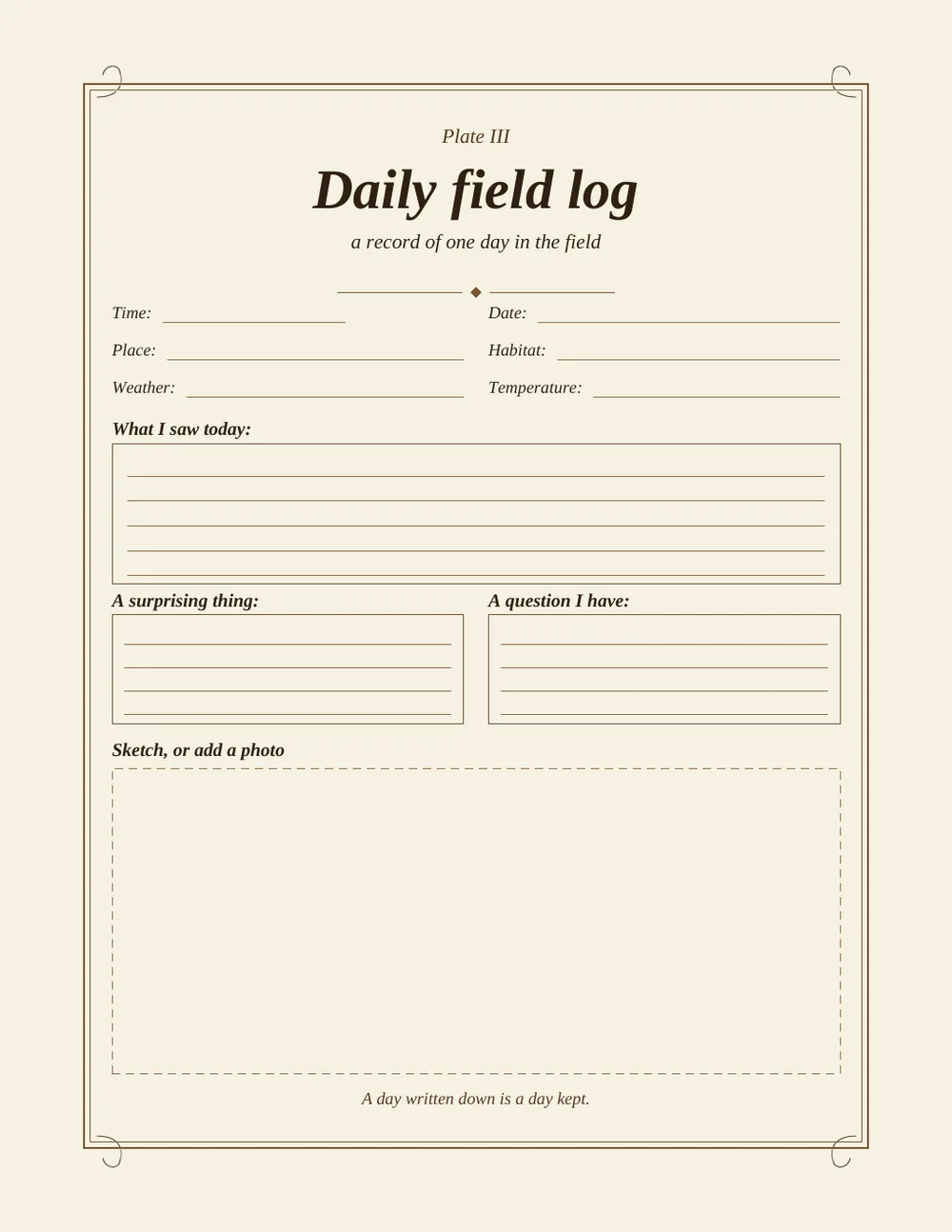
May fills a notebook quickly. Write down the first morning each warbler sings and the day the bobolinks show up (daily field log, birds I have seen), then sketch where the loudest singers sit in a map of sounds. Choose a lilac or a maple and watch it through the seasons from bud to full leaf. A moose, bear or garter snake belongs under mammal watch or tracks to know, a robin or phoebe family under nest observed from a polite distance, and the Flower Moon and the meteors under dusk and dawn watch.
Regions used below: Champlain Valley and the Islands; Northeast Kingdom; Green Mountains; Central Vermont and the Capital Region; Southern Vermont and the Connecticut River Valley.
Which warblers and other songbirds arrive in Vermont in May?
The birds of April were the early and the hardy. May brings the insect eaters that follow the leaf buds north, and it brings them in waves. The Vermont Center for Ecostudies says in its May field guides that the dawn chorus warms up in early May and is a full concert by the time June arrives. The April guide covers the thrushes, swallows and kinglets that come before this.
-
Blackpoll warblers
Arrive in large numbers through May · Backyards and street trees in the valleys; spruce-fir forest on the highest peaks later
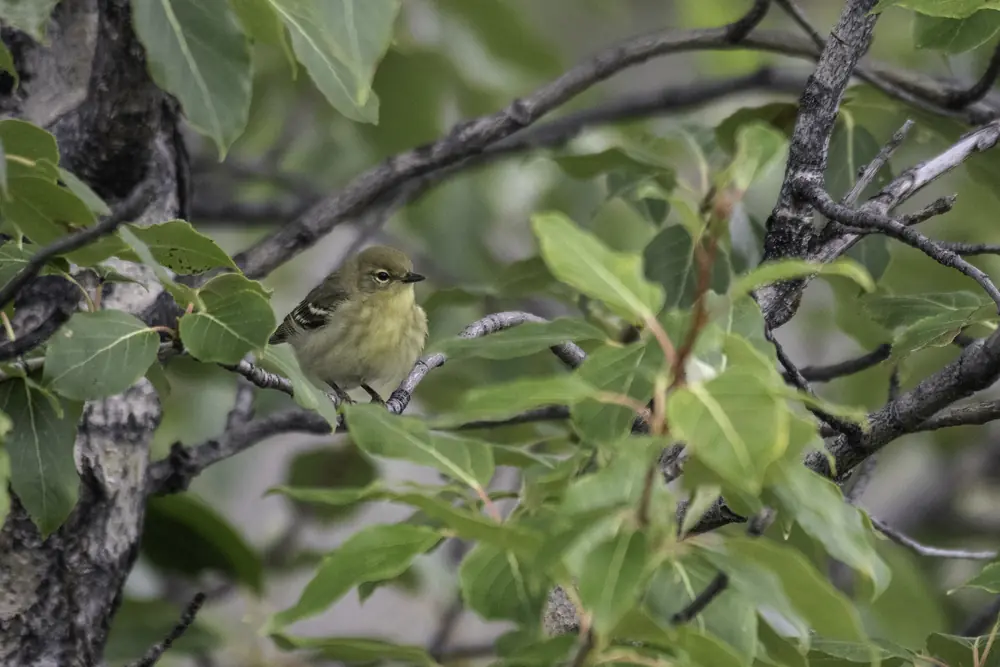
The Center’s May 2025 field guide says blackpoll warblers pass through Vermont in vast numbers in May and often turn up in backyards and street trees. The ones that breed here go to the montane spruce-fir zone on the highest peaks, the same habitat that holds Bicknell’s thrush. In a cool spring such as 2025, males settle at lower elevations because leaf-out is delayed higher up. During the breeding season a blackpoll averages about 12 grams, roughly the weight of two nickels, and by early September it has nearly doubled that.
-
Bicknell’s thrush and the mountain birds
High-elevation arrival late in spring; volunteer listening surveys are in June · High-elevation balsam fir forest
The Vermont Breeding Bird Atlas calls Bicknell’s thrush a habitat specialist confined to high-elevation balsam fir forest, at the southern edge of its range in Vermont. It is globally rare, with fewer than 126,000 individuals, and the state ranks it S2B. The Center’s Mountain Birdwatch program sends about 100 volunteers to roughly 800 listening points in the spruce-fir zone each year, in June, and the 2023 State of the Mountain Birds Report found the blackpoll population in the surveyed areas falling about 4.5 percent a year, a 45 percent decline from 2010 to 2023.
-
Early warblers, vireos and towhees
Early May · Woodland edges and shrubby fields
The Center’s May guides name palm, pine and yellow-rumped warblers as already in the state in early May, with black-and-white, blackburnian and black-throated green warblers arriving soon after. Its 2022 guide recorded pine, black-and-white and yellow warblers, common yellowthroats, blue-headed and warbling vireos, and eastern towhees near its Norwich office on a single early-May outing.
-
Ruby-throated hummingbirds
Soon after the yellow-bellied sapsuckers arrive · Woodland edges, gardens and feeders
A Vermont eBird chart in the Center’s 2019 guide shows hummingbirds arriving shortly after sapsuckers, and the Vermont Atlas of Life explains why: early arrivals drink from sapsucker sap wells. Before they cross the Gulf of Mexico in migration, many hummingbirds nearly double their weight to 6 or 7 grams. The breeding atlas found them in 169 blocks, against 166 in the first atlas.
-
Wood thrushes, scarlet tanagers and orioles
Mid-May onward · Mature forest; orioles in open woodland and village trees
Three bright voices reach the forests and edges as the leaves expand. The wood thrush dropped from 176 to 167 atlas blocks, and the atlas lists forest maturation, acid rain, nest predation and loss of wintering habitat as possible causes. The scarlet tanager nests in the canopy of large, mature forest and avoids edges; the atlas notes that late cold snaps and cold, wet weather that cuts its insect prey have caused die-offs in the Northeast. Baltimore orioles fell from 165 to 149 blocks between atlases, with the largest decline in the Northeastern Highlands.
When do bobolinks return to Vermont, and why does the hay-cutting date matter?
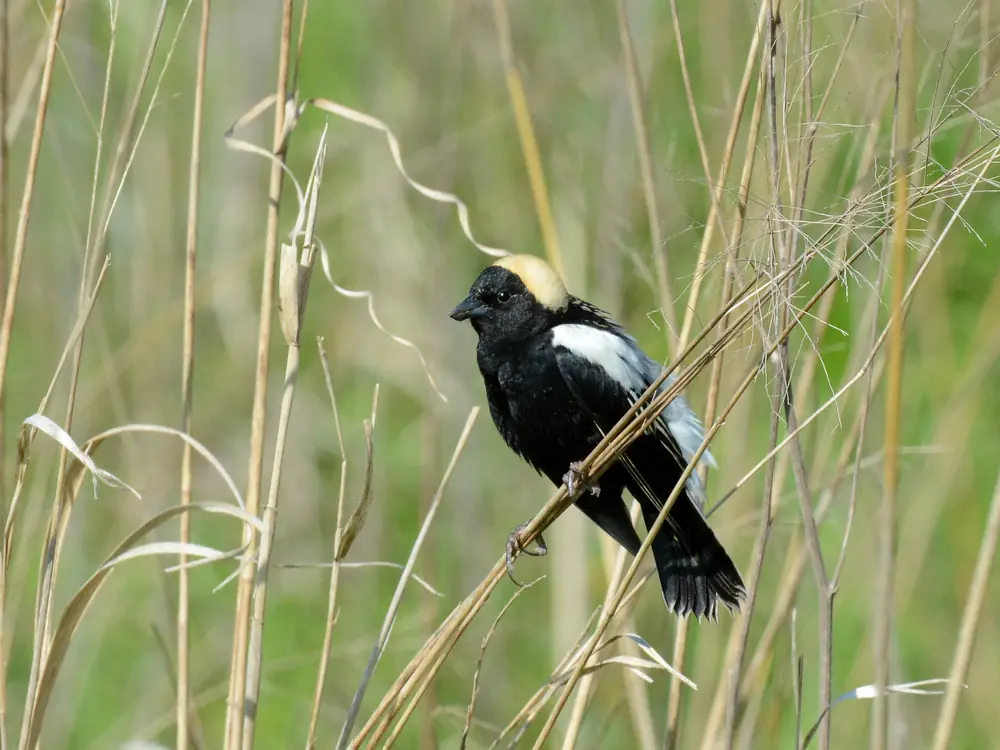
Bobolinks are the bird of the Vermont hayfield, and May is when they settle in. The Vermont Center for Ecostudies reported in 2020 that the first males arrive in early May after a journey of about 6,000 miles, and that females follow within a week. Northern Woodlands puts the whole round trip, to southern South America and back, at about 12,500 miles.
-
A song over the grass
Early May onward; singing is in the larger hayfields · Hayfields, pastures and grassy fields statewide
The Vermont Breeding Bird Atlas says bobolinks reached Vermont after the 18th-century clearing of forest created grassland, and they can nest at up to three times the density found in the remaining native prairie. Their bubbling song is easiest to hear on a still morning. The atlas found them in 147 blocks in the second period, down from 156 in the first, with the largest declines in the Northeastern Highlands and Northern Green Mountains.
-
Mowing and the nest
First cut in late May or June is the danger · Working hayfields
The atlas cites a Vermont study in which fields mowed in early June produced almost no surviving young, while waiting until late July or August raised output to nearly three fledglings per pair. It recommends delaying the first cut until at least July 7, or cutting before June 1 and then waiting at least 65 days. The Center’s 2026 guide adds that Champlain Valley farmers moved their first haying date about 10 days earlier between 2002 and 2019, while bobolinks still nest on their old schedule. Northern Woodlands counts the species as down an estimated 63 percent since 1966, and reports an incubation period of about 13 days. If you own or manage a large field, the Center asks you to write to grasslands@vtecostudies.org.
-
World Migratory Bird Day
Not yet posted for 2027; check the organizers · Anywhere with birds
The international campaign’s own site places the U.S. and Canadian celebration on a Saturday in May, but nothing about 2027 had been posted on its page when we last looked, so ask the organizers. The simplest way to take part is to go out for an hour and submit an eBird checklist.
What is happening on Vermont lakes and rivers in May: loons and lake sturgeon?
By May the ice is gone from every lake and the fishing and nesting seasons are running. Two of the state’s most closely watched animals are at their annual turning points: the common loon on its nest, and the lake sturgeon in the tributaries of Lake Champlain.
-
Common loons on the nest
Nesting under way; the Center’s volunteers watch nests from mid-May through August · Lakes and ponds, strongest in the Northeast Kingdom
The Center’s loon project counts 115 nesting pairs in Vermont, up from seven about four decades ago, and its volunteers record nesting success and chick survival through LoonCount and LoonMonitor. On lakes where water levels rise and fall, staff build floating rafts that act like islands, and floating signs mark nest areas. The Vermont Breeding Bird Atlas found loons in 27 blocks, up from 11, and lists ingested lead fishing gear as the leading cause of adult loon mortality in New England. Keep your boat well back from a loon sitting low on a nest.
-
Lake sturgeon spawning
Mid-April to mid-June, males first · Tributaries of Lake Champlain
The Center’s May guide describes the lake sturgeon as Lake Champlain’s living fossil. Fish that prefer shallow water no deeper than 30 feet move up tributaries to spawn from mid-April to mid-June. Males spawn every two to three years and females every four to nine, males mature at 12 to 15 years and females at 20 to 25, and the fish can live up to 150 years. The species is on Vermont’s endangered list, and state biologists estimate it will take another 25 to 50 years before the population is considered restored.
Are turtles and snakes on the move in Vermont in May?
Warm, wet May evenings bring reptiles out, often onto roads. The Vermont Reptile and Amphibian Atlas is a statewide volunteer record, and it asks for reports of any species not yet logged from a place in the last five years. A photo is especially useful for a town’s first record.
-
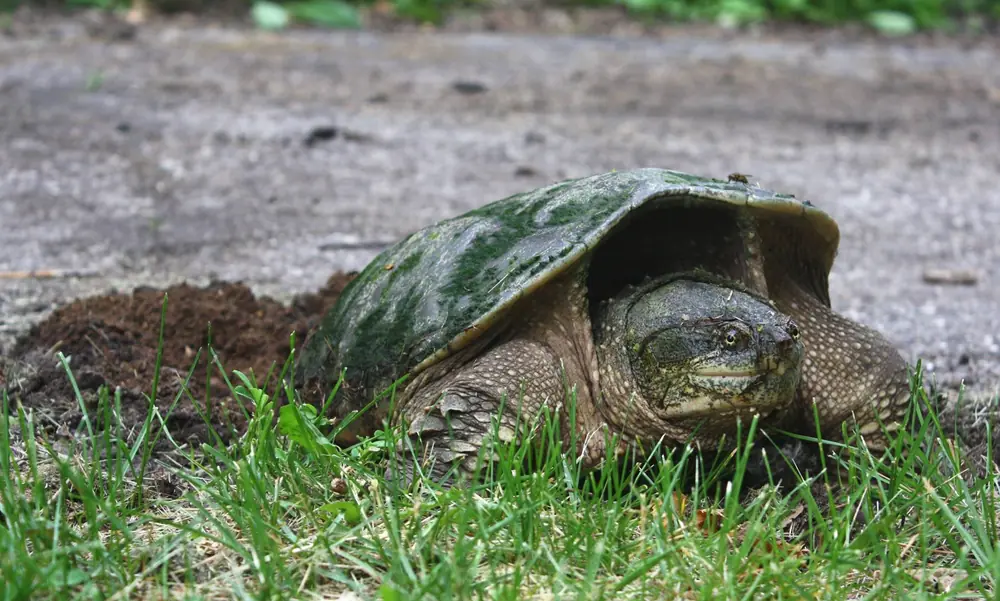
Snapping turtles laying eggs
May and June · Soft ground near still or slow water, including sand and gravel shoulders
The atlas says females come ashore in those two months to bury their eggs. It calls the snapping turtle probably the most common turtle in Vermont, with large adults averaging about 16.5 inches long. If a turtle must be moved across a road, the atlas describes approaching from behind and wrapping your hands around the base of the hind legs, with the animal facing up and away from you, and warns that the neck reaches nearly the length of the shell. Always move a turtle in the direction it was heading.
-
Wood turtles and painted turtles
Active along streams and in ponds; basking on logs in sun · Moderate-gradient streams (wood turtle); soft-bottomed ponds and lakes (painted turtle)
The wood turtle is ranked S2/S3 (uncommon and localized) and is a Species of Greatest Conservation Need, with illegal collection named as a problem. It can travel 1,000 feet or more from its stream to feed in fields. The painted turtle, by contrast, is common (rank S5) and is the one you will see basking in a row on a log. Report wood turtles and leave them where they are.
-
Garter snakes and their relatives
May, when nine of Vermont’s 12 snake species have been recorded on iNaturalist · Sunny edges, fields and stone walls
The Center’s May guides call the common garter snake the most numerous and familiar, and note that it overwinters in underground dens. Dekay’s, ring-necked and redbelly snakes make their first appearances in May, and redbellies sometimes cross roads on warm, wet nights. Northern watersnakes and milksnakes are nonvenomous and rather common.
What are moose, bears and bats doing in Vermont in May?
May is a month of babies and hungry animals. Wildlife agencies generally advise people to leave a young animal alone if it appears abandoned, because a parent is usually nearby and waiting for you to leave.
-
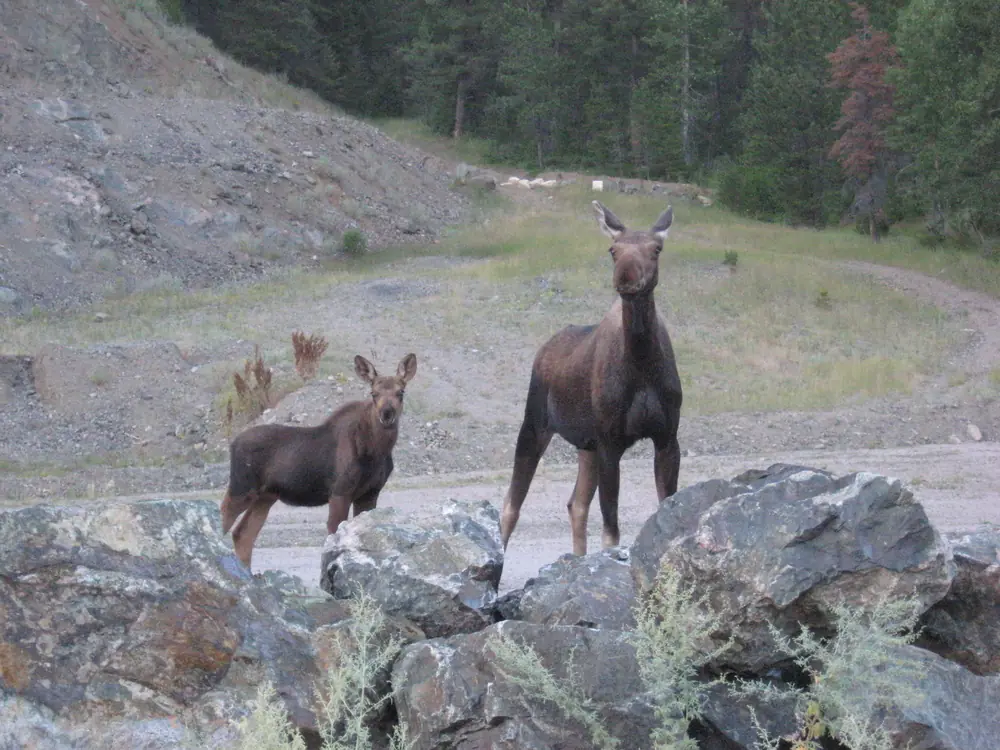
Moose calves
Most calves are born in mid- to late May · Northeast Kingdom (about half the state’s moose, in Essex County) and along the Green Mountains
Vermont Fish & Wildlife says calves weigh 25 to 35 pounds at birth, after a pregnancy of about 243 days, and that the cow and calf stay bonded until the next spring. The department describes the moose population as relatively stable at around 2,000 animals. Give a cow with a calf generous room, on foot or on the road.
-
Black bears in the wet woods
Through the month; cubs were born in winter · Forested wetlands, beaver ponds and stream banks
The department says bears stay mostly near forested wetlands, beaver dams and rivers from den emergence through July, eating wetland grasses and green leafy plants, which have limited nutritional value. The cubs arrived in the den in winter, litters average two, and they stay with their mother about 16 months. The department’s population goal is 4,500 to 6,000 bears. Natural food is thin this time of year, so a bird feeder or open garbage can becomes a target.
-
Bats returning
Eastern red bats arrive in northern New England in May · Evening skies over fields and water
The Center’s 2023 May guide notes that eastern red bats arrive back in northern New England in May. Watch the sky above a pond or field at dusk once the evenings are mild, and note what you see.
Which wildflowers, butterflies and bees can you find in Vermont in May?
The Vermont Land Trust calls late April into May the peak of spring wildflower season, and the show moves from the sunny slopes to the rich, shaded woods as the month goes on. The canopy closes in late May and the forest floor goes quiet. The April guide covers the first wave of bloodroot and hepatica.
-
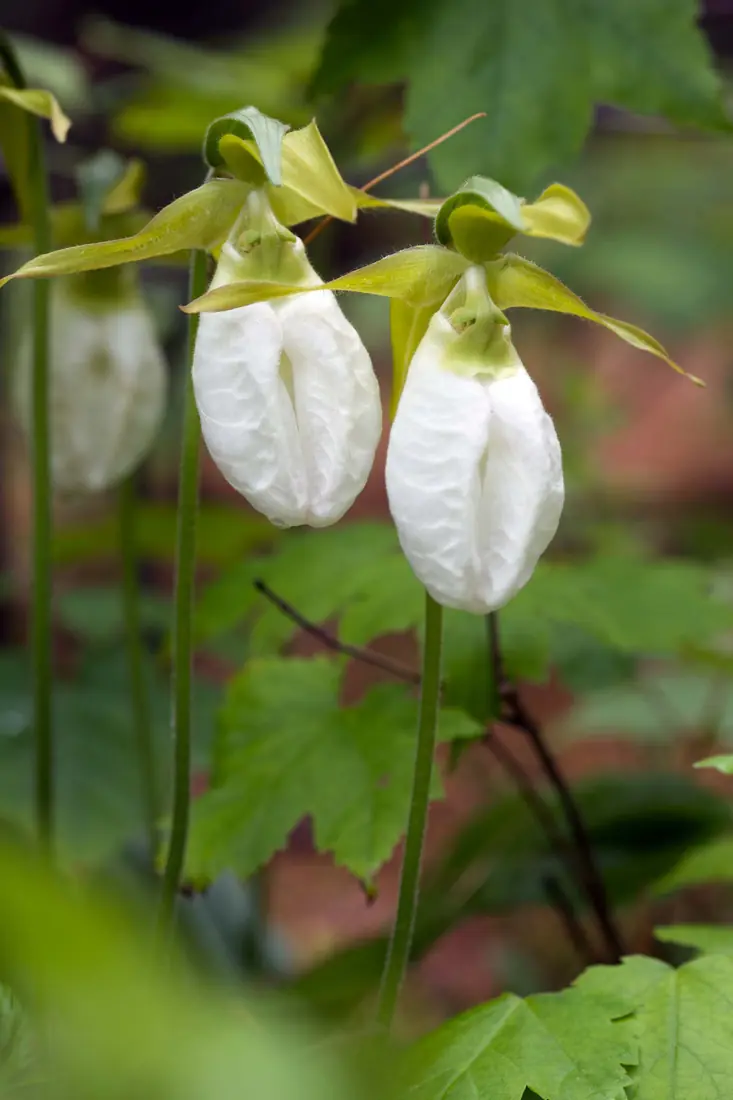
Trilliums, columbine and foamflower
Late April into May, and for a short time in each place · Rich woods, cool moist edges and seeps, warm rocky ledges
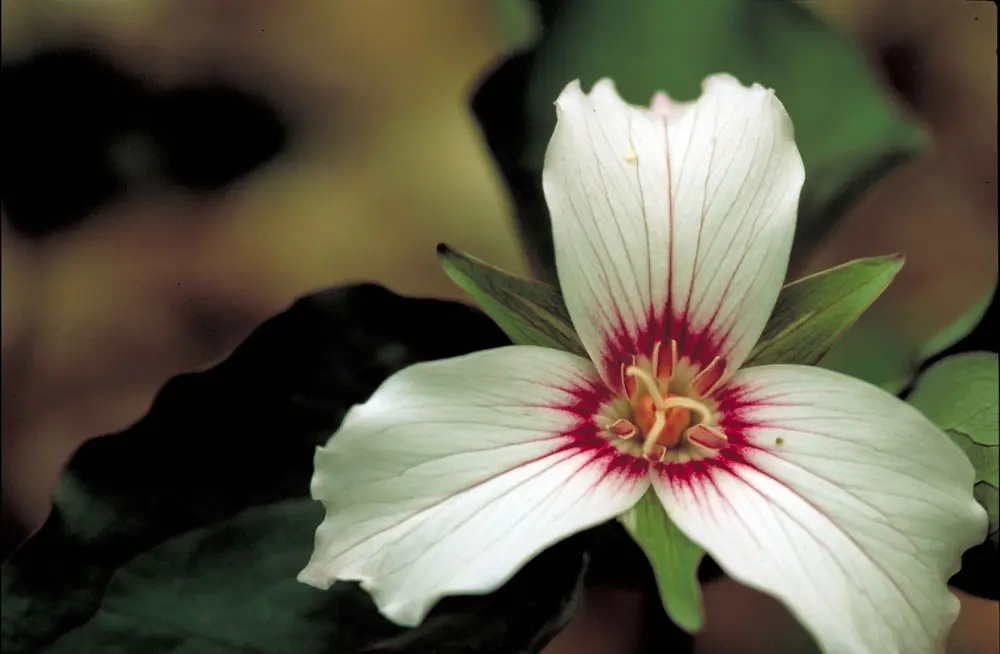
The Land Trust lists white, red and painted trillium, columbine, foamflower, trout lily, spring beauty, golden saxifrage, early meadow rue and blue cohosh for this window. Columbine often grows on warm, rocky ledges and foamflower in cool, moist edges. Take photographs and leave the plants, because red trillium and lady’s slipper can take many years to produce a first flower. The Land Trust suggests the Hinesburg Town Forest and Catamount Community Forest as places to look.
-
Lilacs and the maples
Lilac leaf-out is now about three days earlier per decade than in 1965 · Gardens and yards statewide
The Center’s 2021 guide reports lilacs in Vermont leafing out about three days earlier per decade since tracking began in 1965, and the sugar maple season shortened by about three days over the past 50 years. Its 2022 guide invites readers to report sugar maple leaf-out on iNaturalist using the Plant Phenology field.
-
Fiddleheads at the tail end
Harvest usually starts about April 20 in central Vermont and lasts three to four weeks · River banks and floodplains
Northern Woodlands says stems can grow six inches in a day and turn bitter, so the best picking is early. By mid-May the season is ending in the valleys. If you pick, boil or steam the fiddleheads for ten minutes, never strip a crown bare, and ask the landowner first.
-
Mourning cloaks, azures and the West Virginia white
Early spring butterflies fly in May; the bog elfin only in late May · Woodland edges, wet woods, bogs and fens
The Center’s 2026 guide says 2026 is year four of the five-year Vermont Second Butterfly Atlas and that observations can be logged on eButterfly. Mourning cloaks and eastern commas overwinter as adults, so they are among the first on the wing, with azures and elfins close behind. The West Virginia white is a Species of Greatest Conservation Need that lays eggs on toothwort. The bog elfin has never been recorded in Vermont, though late May is the only realistic window to find one, perhaps on black spruce in a Northeast Kingdom bog.
-
Bumble bees and blueberry bees
Only queens are out in May · Fields, blueberry plantings and sandy banks
The Center’s 2020 guide says Vermont has 13 bumble bee species, three of them extirpated, and that only queens fly in May. The rusty-patched bumble bee has not been seen in Vermont since 1999. University of Vermont research reported by the Center found that more wild bees meant bigger, more abundant and earlier blueberries on commercial farms, while the first ripe berries do not come until late June. Ground-nesting bees dig in sunny, sandy, disturbed spots and are mostly harmless.
What is May weather like in Vermont, and when is the last freeze?
Vermont’s May is a month of swings. In the NOAA 1991–2020 normals the average high runs from the low 60s °F in the northeast hills to about 70 °F at St. Johnsbury and Burlington, and the average low is in the 40s in the valleys. Snow is a rare visitor except on the Mount Mansfield summit, where the normal May snowfall is 5.5 inches. The summit also gets the month’s highest precipitation in the table, 6.88 inches.
-
Frost after the buds open
Any clear, calm night through the third week; see the freeze table below · River valleys and cold hollows especially
A warm April can lure plants out before the median last freeze. A clear, still night after a cold front is when frost settles in low spots. Look up your own town on the Vermont frost dates page.
-
Dry fuel and burn permits
Spring wildfire season before green-up · Fields and woods with last year’s grass
The Center’s 2015 and 2019 May guides both mention spring wildfires in Vermont. The Department of Forests, Parks and Recreation requires a Permit to Kindle Fire from your town’s fire warden for any open burn, and wardens ban burning when conditions are hazardous. The department and the National Weather Service in Burlington run a fire weather awareness campaign each spring.
-
Thunderstorms and the trail season
Thunderstorms begin to build in May; high trails open around Memorial Day · Statewide; the Green Mountains and Mount Mansfield
The National Weather Service office in Burlington publishes local storm reports, spotter reports and past event summaries on its website. The Green Mountain Club says mud season runs through late May and hikers should stay off high-elevation trails until they dry out, typically by Memorial Day. Its closures are updated weekly on TrailFinder, so check before a high hike.
| Station | Average high | Average low | Snowfall | Precipitation |
|---|---|---|---|---|
| Burlington International Airport (Champlain Valley) | 69.0 °F | 47.8 °F | 0.0 in | 3.76 in |
| St. Albans (Franklin County) | 65.7 °F | 46.2 °F | 0.1 in | 3.24 in |
| Rutland | 67.9 °F | 42.2 °F | 0.0 in | 3.63 in |
| St. Johnsbury (Northeast Kingdom) | 69.8 °F | 43.6 °F | 0.1 in | 3.76 in |
| Newport (Lake Memphremagog) | 64.8 °F | 41.9 °F | 0.0 in | 3.94 in |
| Island Pond (Northeast Kingdom) | 63.5 °F | 40.9 °F | 0.4 in | 4.12 in |
| Sutton (Northeast Kingdom) | 63.1 °F | 41.9 °F | 0.6 in | 4.28 in |
| Mount Mansfield (summit) | 57.0 °F | 40.8 °F | 5.5 in | 6.88 in |
Each month NOAA publishes an updated 90-day outlook, which you can read at its source; this page leaves its contents out.
When is Vermont’s last spring freeze?
The median last freeze at the main Burlington station is April 29 and at Montpelier it is May 5, and Bennington, St. Johnsbury, Newport and Rutland sit between May 11 and 15. On the Mount Mansfield summit it is May 23. Half of all springs freeze later than the median, and the nine-in-ten column runs to May 31 at Rutland and June 8 on the summit. Treat the median as a warning, not a promise: tender plants are safest after the nine-in-ten date. For other towns, use the Vermont frost page.
| Station | One year in ten | Median | Nine years in ten |
|---|---|---|---|
| Burlington International Airport (Champlain Valley) | Apr 17 | Apr 29 | May 11 |
| Vergennes (Addison County) | Apr 20 | Apr 30 | May 11 |
| Montpelier (Capital Region) | Apr 23 | May 5 | May 21 |
| St. Johnsbury (Northeast Kingdom) | Apr 30 | May 13 | May 25 |
| Newport (Lake Memphremagog) | May 1 | May 14 | May 28 |
| Rutland | May 1 | May 15 | May 31 |
| Bennington (southwest) | Apr 26 | May 11 | May 28 |
| Mount Mansfield (summit, about 3,950 feet) | May 5 | May 23 | Jun 8 |
Before a clear, still night in a month with frost risk, the weather guide helps you read the forecast.
How much daylight does Vermont gain in May?
Burlington’s day lengthens from 14 h 13 m on May 1 to 15 h 18 m on May 31, a gain of about an hour a month. The Sun rises at 5:44 a.m. and sets at 7:57 p.m. on May 1, and rises at 5:12 a.m. and sets at 8:30 p.m. on May 31 (daylight time, U.S. Naval Observatory). Civil twilight, when you can still see without a light, ends at 9:05 p.m. on the last day.
| City | May 1 | May 31 | Gained | Per day |
|---|---|---|---|---|
| Burlington | 14 h 13 m | 15 h 18 m | 65 min | 2.2 min |
| St. Albans | 14 h 15 m | 15 h 20 m | 65 min | 2.2 min |
| Newport | 14 h 15 m | 15 h 21 m | 66 min | 2.2 min |
| St. Johnsbury | 14 h 13 m | 15 h 18 m | 65 min | 2.2 min |
| Montpelier | 14 h 12 m | 15 h 16 m | 64 min | 2.1 min |
| Rutland | 14 h 09 m | 15 h 12 m | 63 min | 2.1 min |
| Brattleboro | 14 h 06 m | 15 h 06 m | 60 min | 2.0 min |
| Bennington | 14 h 06 m | 15 h 07 m | 61 min | 2.0 min |
For a town that is not listed, the daylight guide works it out.
What can you see in Vermont’s night sky in May 2027?
Nights are short in Vermont in May, and cool rather than cold. Two events stand out, one at each end of the dark: Halley’s comet debris at the start and a very bright full moon in the third week. Times below are Eastern daylight time.
-
Eta Aquariid meteors, an excellent year
Peak nights May 5 to 6 and 6 to 7; best in the last hours before dawn · Southeast sky, toward Aquarius
These meteors are grains shed by Halley’s comet, and they fall between roughly April 19 and May 28. Because the Moon is new on May 6, no moonlight hides the faint ones. The American Meteor Society expects medium rates in the final stretch of darkness, and SeaSky puts the Northern Hemisphere at about 30 an hour at best. In Vermont the shower’s constellation, Aquarius, rises only shortly ahead of dawn, so expect to see fewer than observers farther south.
-
Flower Moon and a seasonal Blue Moon
Full at 6:59 a.m. EDT on Thursday, May 20; look on the evening of Wednesday, May 19 · Eastern horizon at dusk
Burlington’s Moon comes up at 8:03 p.m. on May 19, a quarter of an hour before sunset at 8:18 p.m., and it is 99 percent lit (U.S. Naval Observatory). Nearly full on the 19th and exactly full the next morning, it is the Flower Moon. SeaSky also labels it a Blue Moon, using the older seasonal count in which the third of the four full moons of one astronomical spring gets that name (the fourth, on June 19, closes out the season). No month in 2027 holds two full moons, and the Moon will look its usual color.
-
Mercury after sunset
Easiest from mid-May to early June; farthest from the Sun on May 28 · Low in the northwest, roughly an hour after sunset
For the northern states this is the planet’s best evening appearance of the year. Sunset in Burlington is at 8:26 p.m. on May 27, so the window runs from roughly 9:10 to 9:55 p.m., and you need an open view toward the northwest. The planet is at its brightest in mid-May and dims through early June.
-
Moon with Jupiter and Mars
The Moon visits Jupiter on May 12 and Mars on May 13 · Southwest to south after sunset
Wednesday evening, May 12, finds a half-lit Moon about a degree from Jupiter. Twenty-four hours later it has moved on and stands roughly 3 degrees from Mars.
-
Venus and Saturn at dawn
Nearest each other at dawn on May 7 · Hugging the eastern horizon before sunrise
The pair draw within about 0.6 degrees, but both hug the eastern horizon and Venus gets up barely an hour before sunrise. Bring binoculars and a clear low view, and count it a bonus. Saturn has just returned to the dawn after passing behind the Sun in April.
-
Milky Way season begins
Short moonless windows early and late in the month (our own calculation) · Low in the south, before dawn
The brightest stretch of the galaxy starts rising before dawn in spring. At Vermont’s latitude our own calculation gives only short moonless windows, in about the first ten days of May and again in the last few days of the month. Use the cloud guide to pick a clear night.
| Phase | Date | Time |
|---|---|---|
| New moon | Thursday, May 6 | 6:58 a.m. EDT |
| First quarter | Thursday, May 13 | 12:44 a.m. EDT |
| Full moon (Flower Moon, seasonal Blue Moon) | Thursday, May 20 | 6:59 a.m. EDT; rises 8:03 p.m. May 19 in Burlington |
| Last quarter | Friday, May 28 | 9:58 a.m. EDT |
| New moon | Friday, Jun 4 | 3:40 p.m. EDT |
The moon phases guide explains why the phases cycle.
What can Vermont families do outdoors in May 2027?
- Saturday, May 1: Green Up Day. Vermont law names the first Saturday in May for it. Pick up litter along a road near you.
- Early morning, any day: the dawn chorus. Count how many voices you can separate before the sun is above the trees.
- Thursday and Friday, May 6 and 7, before dawn: Eta Aquariids. Find a dark spot and look to the southeast.
- May, date to be confirmed: World Migratory Bird Day. Go for an hour and enter your list on eBird.
- Early to mid-May: listen for bobolinks. Stay on the edge of the field.
- Wednesday, May 12: the Moon next to Jupiter. Look up after dark.
- Wednesday, May 19: the Flower Moon comes up. Watch the east at 8:03 p.m. in Burlington.
- All month: help the record. Log butterflies on eButterfly, bees on the Vermont Wild Bee Survey, snakes and turtles with the Reptile and Amphibian Atlas, and sugar maple leaf-out on iNaturalist. Loon volunteers watch nests from mid-May through August.
- Monday, May 31: Memorial Day. The Green Mountain Club says high-elevation trails typically reopen about now, but check TrailFinder first.
- Plan ahead: June. Mountain Birdwatch volunteers listen on the high peaks.
Browse other states from the nature hub; for the thaw that came first, see Vermont in April and March. The Naturalist’s Field Journal is where May’s first sightings go.
Safety notes for May in Vermont
- Turkey hunting. Dates for the 2027 spring turkey season had not been published at the time of writing. The regular season covered all of May in both 2025 and 2026, with May shooting hours in 2025 from half an hour before sunrise until noon. Look at the Fish & Wildlife seasons page before an early walk in the woods.
- Hunter orange. The regulations say it is not required by law in Vermont, though they recommend an orange hat and vest.
- Ticks. According to the state Department of Health, blacklegged ticks are usually most active in May and June, when nymphs smaller than 2 mm are seeking a meal. Do a tick check after each outing.
- Fire. Burn nothing without a Permit to Kindle Fire from your town’s fire warden.
- Moose and mother animals. Give a moose with a calf, and any adult near young, plenty of room, and leave apparently abandoned young animals alone.
- Turtles and snapping turtles. Move a turtle across a road only when safe, in the direction it was heading, and stay out of reach of a snapper’s neck.
- Bears. Fish & Wildlife notes bears may be attracted to bird feeders and garbage cans when natural food is low. Take feeders down.
- Cold water and trails. Rivers run high and cold in spring. High-elevation trails stay muddy and fragile until about Memorial Day.
Sources (46)
- U.S. Naval Observatory: Sun and moon rise and set, Burlington, May 1, 2027
- U.S. Naval Observatory: Sun and moon rise and set, Burlington, May 19, 2027
- U.S. Naval Observatory: Sun and moon rise and set, Burlington, May 20, 2027
- U.S. Naval Observatory: Sun and moon rise and set, Burlington, May 27, 2027
- U.S. Naval Observatory: Sun and moon rise and set, Burlington, May 31, 2027
- U.S. Naval Observatory: Moon phases 2027
- SeaSky: Astronomy calendar 2027
- Vermont Center for Ecostudies: A field guide to May (2015)
- Vermont Center for Ecostudies: Field Guide to May 2019
- Vermont Center for Ecostudies: Field Guide to May 2020
- Vermont Center for Ecostudies: Field Guide to May 2021
- Vermont Center for Ecostudies: Field Guide to May 2022
- Vermont Center for Ecostudies: Field Guide to May 2023
- Vermont Center for Ecostudies: Field Guide to May 2024
- Vermont Center for Ecostudies: Field Guide to May 2025
- Vermont Center for Ecostudies: Field Guide to May 2026
- Vermont Center for Ecostudies: Mountain Birdwatch
- Vermont Center for Ecostudies: Loon conservation
- Vermont Atlas of Life: Bicknell’s thrush (Vermont Breeding Bird Atlas)
- Vermont Atlas of Life: Wood thrush (Vermont Breeding Bird Atlas)
- Vermont Atlas of Life: Scarlet tanager (Vermont Breeding Bird Atlas)
- Vermont Atlas of Life: Ruby-throated hummingbird (Vermont Breeding Bird Atlas)
- Vermont Atlas of Life: Baltimore oriole (Vermont Breeding Bird Atlas)
- Vermont Atlas of Life: Bobolink (Vermont Breeding Bird Atlas)
- Vermont Atlas of Life: Common loon (Vermont Breeding Bird Atlas)
- Northern Woodlands: Bobolink, the grassland bird in a reverse tuxedo (May 26, 2026)
- Northern Woodlands: Fiddlehead season
- World Migratory Bird Day
- Vermont Reptile and Amphibian Atlas
- Vermont Reptile and Amphibian Atlas: Snapping turtle
- Vermont Reptile and Amphibian Atlas: Painted turtle
- Vermont Reptile and Amphibian Atlas: Wood turtle
- Vermont Fish & Wildlife: Moose
- Vermont Fish & Wildlife: Black bear
- Vermont Land Trust: Spring wildflowers and ephemerals (April 2026)
- Vermont Forests, Parks and Recreation: Prevent forest fires
- National Weather Service Burlington
- Green Mountain Club: Mud season
- NOAA NCEI: Monthly climate normals 1991–2020, Vermont stations
- NOAA Climate Prediction Center: 90-day outlooks
- Vermont Fish & Wildlife: Hunting and trapping seasons
- Vermont Fish & Wildlife: Spring turkey hunting begins soon (April 2025)
- Vermont Hunting Regulations: General hunting information (hunter orange)
- Vermont Department of Health: Tick activity in Vermont
- Vermont Statutes: 1 V.S.A. § 377, Green Up Day
- Photos via Wikimedia Commons; licenses and photographers are credited under each
