What to look for in nature in Vermont this October
Vermont’s October starts with the Northeast Kingdom already in full color and ends with snow on the high summits. In between, snow geese settle into the fields at Dead Creek, landlocked salmon nose up the Winooski and into Hatchery Brook, red-tailed hawks ride the ridges past Putney Mountain, and moose and bears feed hard before winter. This guide gives the places and the typical dates.
Start here
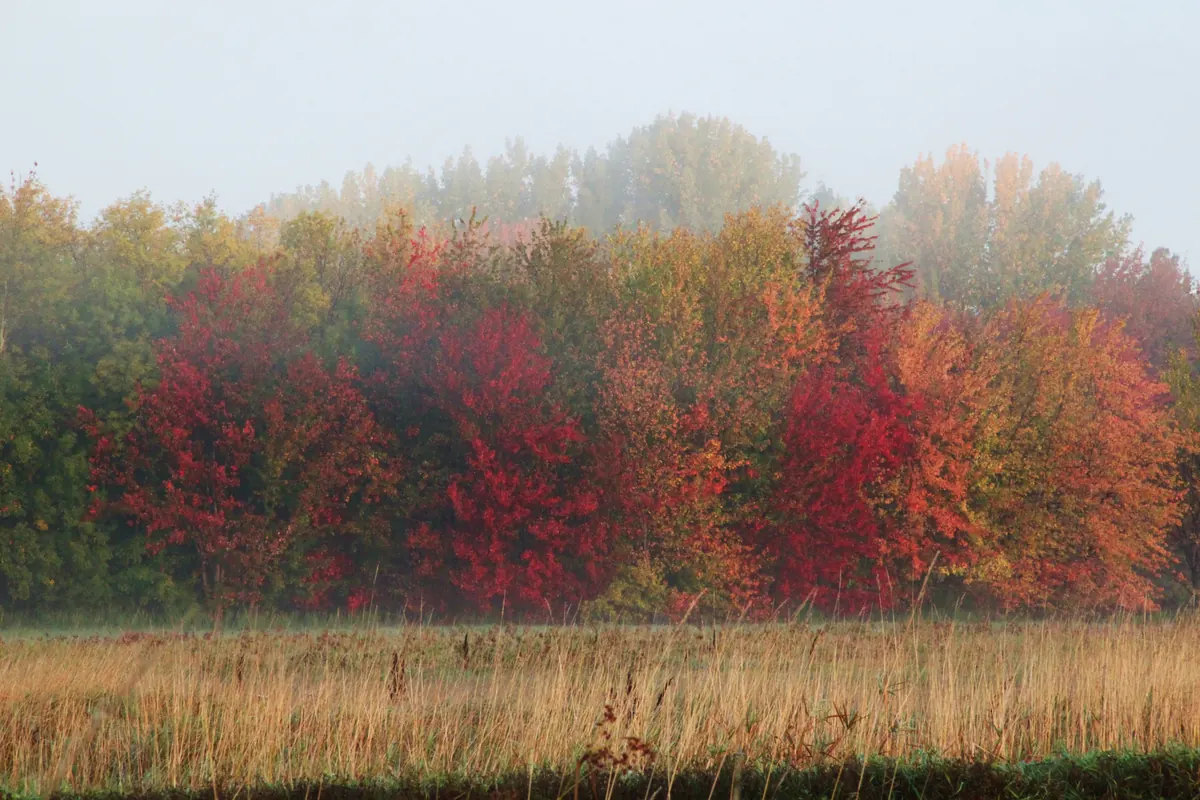
- Color, north to south and summit to valley. The state’s weekly foliage tracker had the Northeast Kingdom at peak on September 30, with the Green Mountains and the Capital Region close behind. The Champlain Valley and southern Vermont come later in October. After last year’s drought-browned leaves, foresters report trees in far better shape this fall.
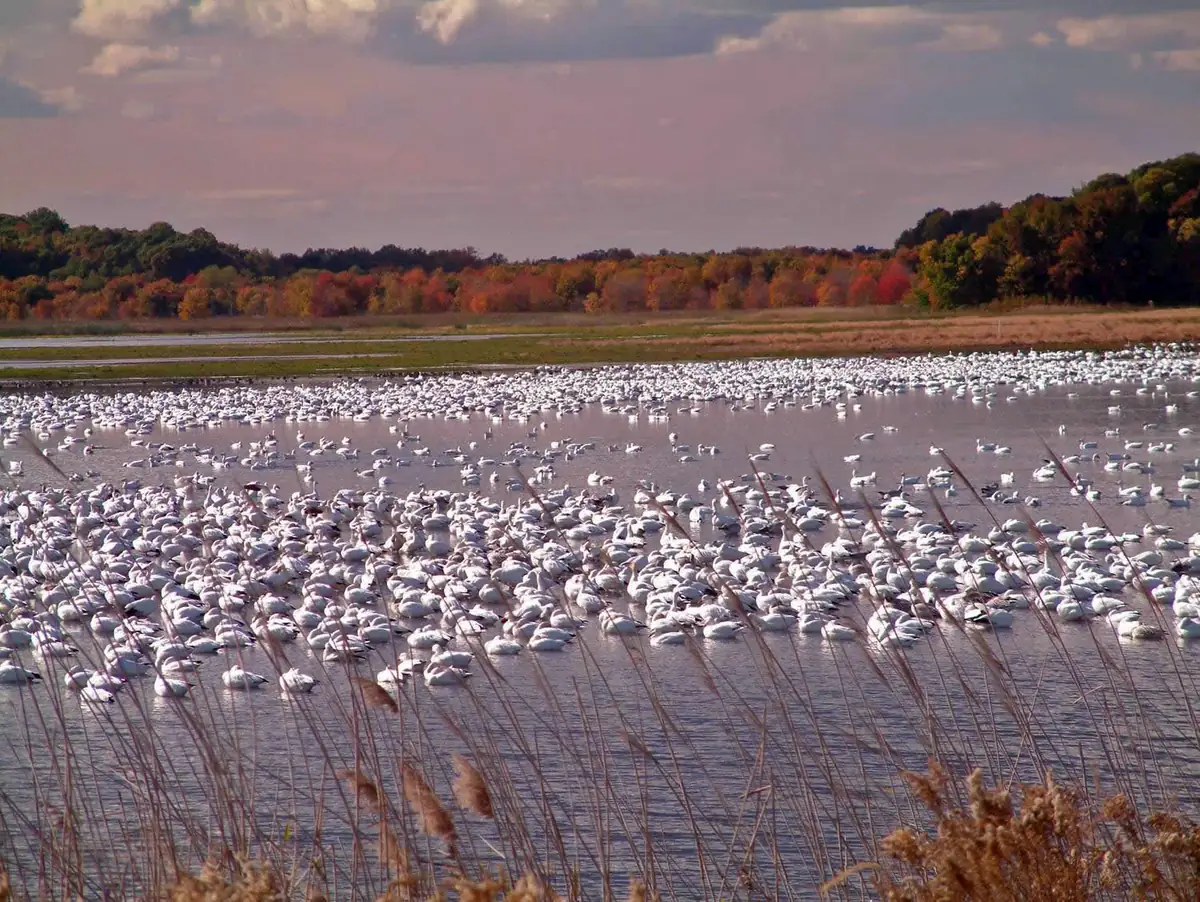
- Snow geese at Dead Creek. The flocks build in the Addison fields through October and usually peak from late October into early November; watch them from the Route 17 viewing area. Dead Creek Wildlife Day, free, is Saturday, October 3, with bird banding at 7 a.m.
- The moon covers Jupiter before dawn on October 6. From Burlington, Jupiter vanishes behind the bright edge of the crescent moon at about 4:29 a.m. EDT and comes back into view on the unlit side at about 5:27, a full hour before twilight begins. Look low in the east; binoculars are plenty.
The Naturalist’s Field Journal has a page for each of these. Give the “birds I have seen” list the first snow geese and the red-tails over the ridge, let the tree-through-the-seasons page follow one sugar maple or a tamarack in a bog until it is bare, sketch any moose track in the mud on the tracks-to-know plate, and put witch hazel capsules and beechnuts on the seeds, pods and cones page. The colours-of-the-day plate was made for a Vermont hillside in October. Date every entry.
Regions used below: Champlain Valley and the Islands; Northeast Kingdom; Green Mountains; Central Vermont and the Capital Region; Southern Vermont and the Connecticut River Valley.
When is peak fall foliage in Vermont in 2026?
Vermont colors from the top down and from the north down. The cold hollows of the Northeast Kingdom and the high Green Mountains turn first, usually in the last days of September; the lower valleys and the south follow over the next two to three weeks, and the Champlain Valley, warmed by the lake, is often last. VTDigger’s September 16 report put it simply: the coldest parts of the state typically peak in late September, and each zone to the south follows about a week behind.
-
A comeback year
All of October · Statewide
In 2025 drought damaged the foliage on more than 64,000 acres, and many trees had browned or dropped their leaves by late September. This year foresters with the Department of Forests, Parks and Recreation report little browning; one told VTDigger that nothing they are seeing comes “even close” to last year’s damage.
-
Northeast Kingdom and the northern Greens
At or near peak in the first days of October · Groton, Worcester, Belvidere, US 302 east of Barre
The state tourism department’s tracker for September 30 had the Kingdom at peak and the Green Mountains and their foothills “fast approaching the same,” and pointed drivers toward Worcester, Belvidere and Groton and along US 302 from Barre to the New Hampshire line. WCAX found bright reds along Route 17 in Fayston and Route 100 in Waitsfield the same week.
-
The Champlain Valley and the south
Mid- to late October · Addison and Chittenden counties, the islands, Bennington and Windham counties
The broad valley along the lake and the southern hills are the late show. Oaks and the last sugar maples color here after the northern hills are bare.
-
The last gold: tamaracks
Late October, after the maples · Bogs and wet lowlands, especially in the Northeast Kingdom
Tamarack, or American larch, is the only New England conifer that drops its needles in autumn, as the Native Plant Trust’s Go Botany points out. The needles turn a soft yellow-gold well after the hardwoods, so a bog that looked finished in mid-October can glow again near the end of the month.
Sunny, dry days and cold nights bring out the reds; one wind-driven rain can clear a hillside overnight. Choose one tree near home, photograph it from the same spot every Saturday, and note the date its last leaf lets go. To compare your street with the long-term pattern, our Field almanac estimates when leaves come out and fall at any address, from satellite data.
When do snow geese come to Dead Creek, and what else is on Lake Champlain?
The Champlain Valley is Vermont’s flyway. Its farm fields, marshes and river deltas pull in geese, ducks and hawks every fall, and October is when they arrive in numbers.
-
Snow geese in the Addison fields
Arriving through October; typical peak late October to early November · Dead Creek Wildlife Management Area, Route 17 west of Route 22A, Addison
Dead Creek is the state’s best-known goose stop. Vermont Fish & Wildlife’s brochure says the area once drew around 20,000 snow geese each autumn, but shifts in migration routes have cut that to about 5,000 in recent years, with numbers typically peaking from late October to early November. Part of the area is a refuge closed to people at all times, and hunting on the goose management area is by permit; the viewing pavilion on Route 17 is the place to watch from.
-
Dead Creek Wildlife Day
Saturday, October 3, 9:30 a.m. to 4 p.m.; banding demonstration at 7 a.m. · Dead Creek WMA, Addison
The 25th annual Wildlife Day is free. The department’s September 9 announcement lists a bird-banding demonstration for early risers, live animals, working-dog demonstrations, a waterfowl-calling contest, bluebird-box building and crafts, a NatureQuest scavenger hunt, a guided walk through the clayplain forest, a Big Sit bird tally and a story walk. The visitor center is open 10 to 4.
-
Ducks, and the October 10 opener
Building all month; duck season opens October 10 in the Lake Champlain and Interior zones · Missisquoi delta, Dead Creek, the Lake Champlain bays
Hunting starts on Saturday, October 10, so birders on the marshes will share them with hunters from then on; the Missisquoi National Wildlife Refuge in Swanton is the other big wetland to know. The Friends of Missisquoi hold their Big Sit that same day at the Stephen J. Young Marsh on Tabor Road.
Crossbills, pine siskins and purple finches should be around this winter too: the Finch Research Network’s 2026–27 forecast rates the Northeast’s white pine, cedar, oak and beech crops good to very good, so expect them in the conifers rather than at feeders. Write the first snow goose of the fall, and the last swallow, onto your “birds I have seen” list.
Where can you watch hawks migrate in Vermont in October?
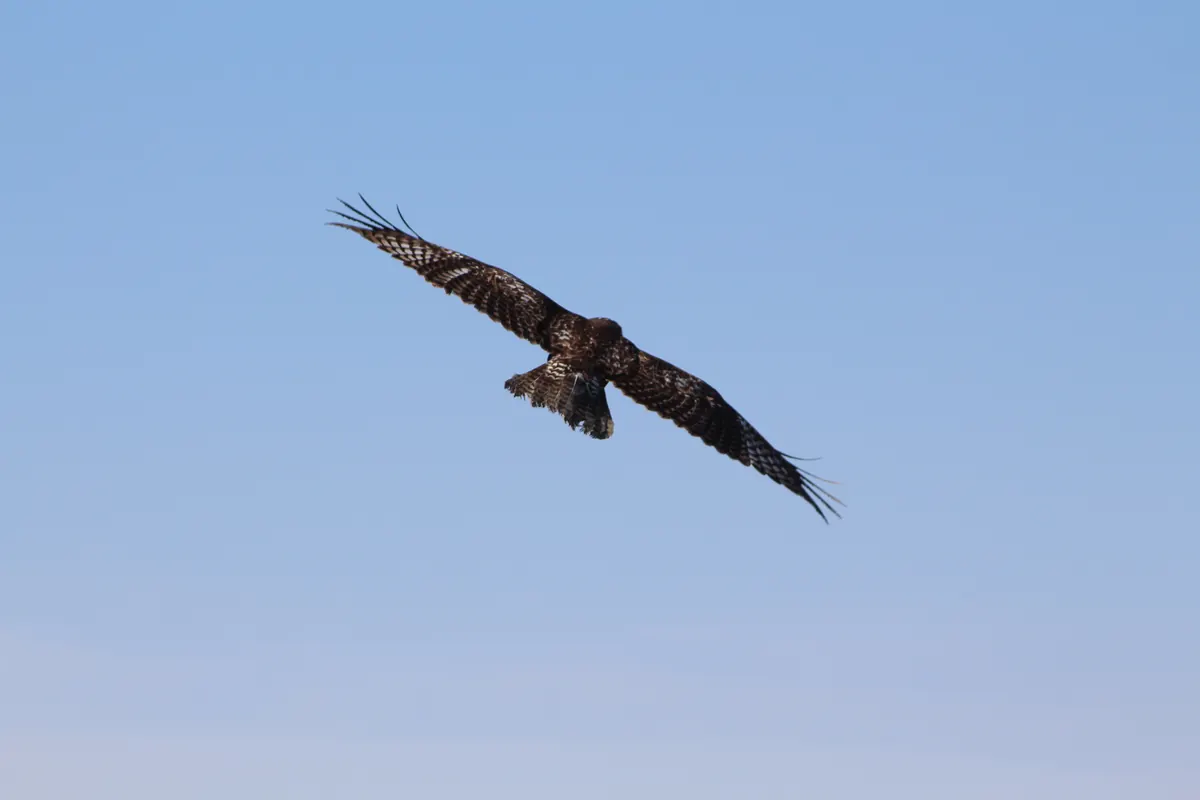
The big broad-winged hawk kettles of mid-September are over by October, but the month brings a heavier, slower cast: red-tailed hawks, sharp-shins and Cooper’s hawks, harriers, the first rough-legs, and a chance at a golden eagle on a northwest wind behind a cold front.
-
Putney Mountain
Daily count from September 1 to the second Saturday of November; best 10 a.m. to 3 p.m. · Putney, Windham County; a 0.7-mile walk from the parking area to the summit clearing
Volunteers have counted hawks from Putney Mountain every fall since 1974, for years the state’s only full-time autumn watch. The site list runs from ospreys and both eagles to goshawks, merlins and peregrines; October flights lean toward red-tails and accipiters, the usual late-season mix in the Northeast. The summit is free, the trail steep and ledgy in places, and HawkCount posts the daily totals.
-
Mount Philo and Mount Ascutney
Fall counts reporting in 2026 · Mount Philo State Park, Charlotte; Mount Ascutney State Park, Windsor
Two state-park summits also report fall counts to HawkCount this season: Mount Philo, above the Champlain Valley with the Adirondacks beyond, and Ascutney, a lone peak over the Connecticut River. Check park season dates before driving up.
-
The last monarchs
Stragglers only in October · Aster patches and sunny field edges
Vermont spans roughly 43° to 45° north, where Monarch Watch puts peak monarch abundance between late August and mid-September. An October monarch is a straggler, often on a warm south-wind day. Report it to Journey North; late sightings help show when the migration really ends.
Summits are windy and cold by late October, so pack an extra layer. Before you drive up, the Weather now page will show the wind direction; northwest after a front is the classic hawk day.
When do landlocked salmon run up Vermont rivers?
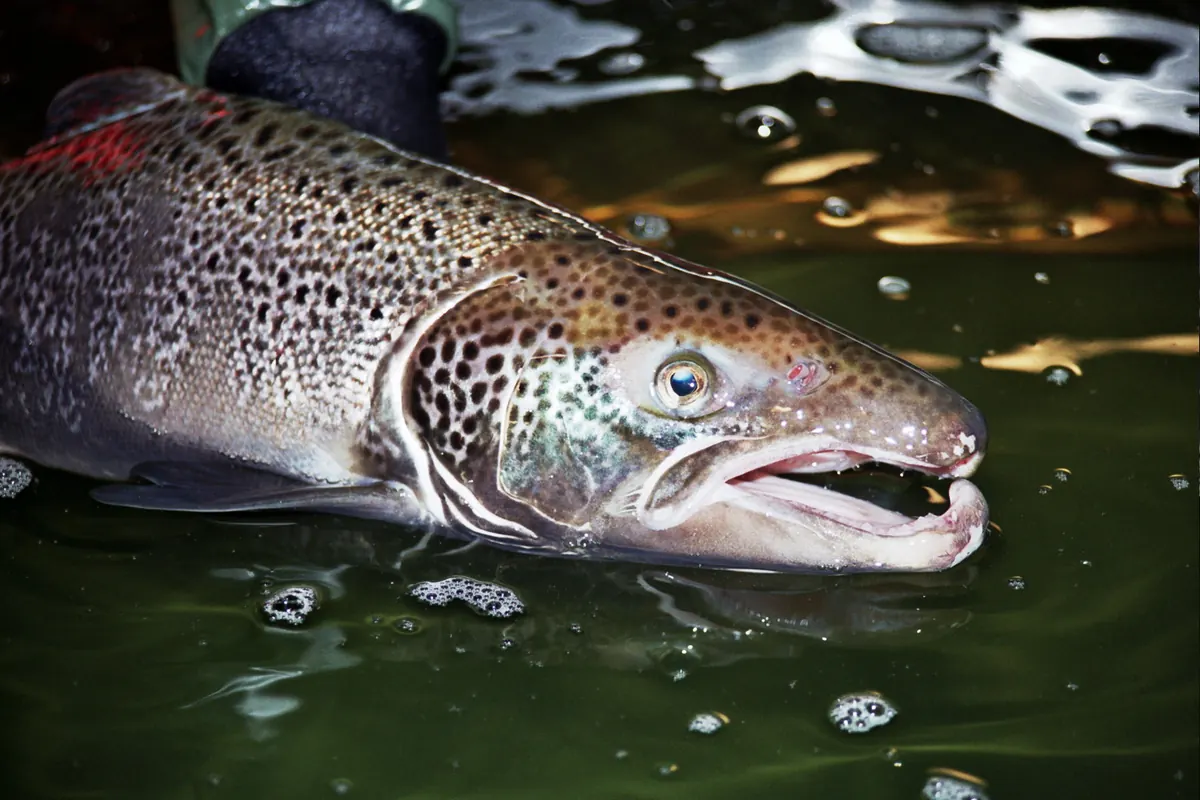
October is spawning month for Lake Champlain’s landlocked Atlantic salmon, and for the brook and brown trout in the streams. As the water cools, fish that spent the summer deep in the lake head for the tributaries where they were stocked.
-
The Winooski fish lift
Lift operates October 1 to November 15 (and in spring) · Winooski One dam, above the Salmon Hole in Winooski
The dam at Winooski blocks the river, so a fish lift in the hydro plant catches salmon heading upstream. The Low Impact Hydropower Institute’s certificate gives the fall season as October 1 through November 15. The fish are then trucked past the dams to a release point upstream in Richmond. Vermont Public reported a record 190 salmon at the lift by early October 2023, credited in part to sea lamprey control that has cut wounding on salmon and lake trout.
-
Hatchery Cove
Closed to fishing in a small corridor October 1 to November 30, 2026 · Hatchery Cove and Hatchery Brook, Grand Isle
Salmon gather in Hatchery Cove before running up Hatchery Brook, where hatchery staff collect eggs to raise the next generation for the lake. Because anglers crowded the brook mouth day and night, the department has closed a marked strip 20 feet wide and 100 feet long in front of the brook this fall. Egg collection there “has been lower than we’d hoped,” a department fish biologist said on September 25.
-
Fall fishing for everyone else
October into November · Lake Champlain, the Connecticut River, ponds statewide
The department’s September 16 fishing release says bass, pike, perch, walleye, trout and salmon all feed harder as the water cools. Its biologist’s tip is to fish the outside edges of dying weed beds in 6 to 8 feet of water, and not to rush out at dawn: late in the season, midmorning to midafternoon is prime time.
Brook trout put on their best colors now, the males with orange bellies and white-edged fins. If you find fish spawning over clean gravel in a small stream, stay off the gravel; the eggs spend the winter there.
What are moose, bears and deer doing in Vermont in October?
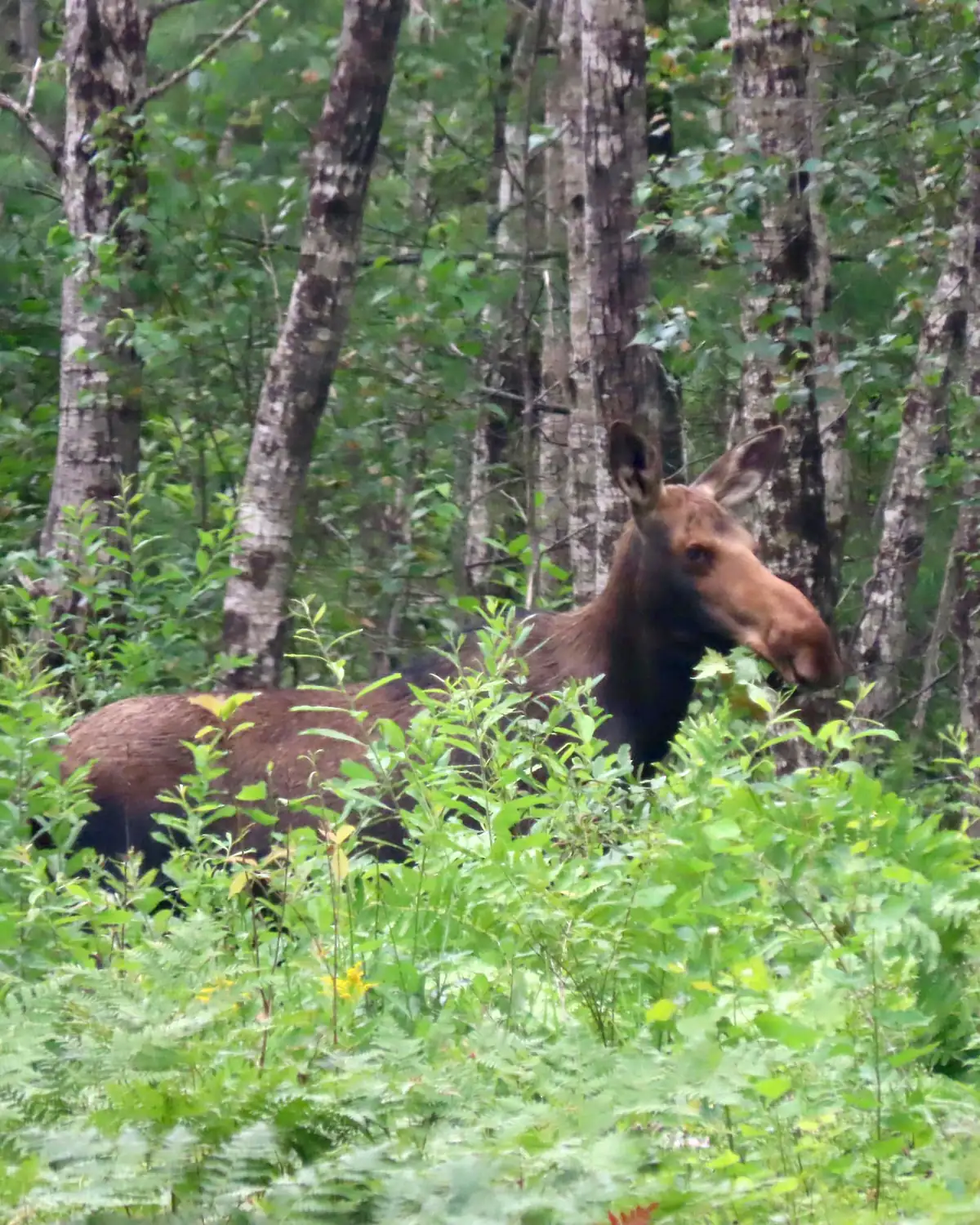
The big mammals are busy. Bears are eating as much as they can before denning, bull moose are in rut, and deer are moving more as the days shorten.
-
Moose, and the tick that shapes their year
Archery hunt October 1–7 and regular hunt October 17–25, by permit · The Northeast Kingdom, especially Essex County
Vermont’s densest moose herd lives in wildlife management unit E, in the far northeast corner. In its February 2026 recommendation the department proposed 85 permits, all in the two halves of that unit and none in the other 19 units, a 53 percent cut from recent years. The reason is the winter tick. Its larvae climb vegetation in fall and wait for a passing moose, and that questing period usually ends only when persistent snow or hard freezes kill them. An early lasting snow in the Kingdom is good news for next spring’s moose calves.
-
Bears, lots of them
Feeding hard all month · Beech and oak stands, old orchards, cornfields, power lines
The department estimates 7,500 to 8,900 black bears in Vermont, the fifth straight year above its goal of 3,500 to 5,500, with hunters taking over 1,000 bears in both 2024 and 2025. Its bear biologist says bears are feeding in berry patches, wild apples and beech and oak stands and in standing corn, and the finch forecasters rate this year’s eastern beech and oak crops quite good. The department asks everyone to keep bird feeders down until there is consistent snow on the ground, secure trash, and protect chickens with electric fence.
-
Deer rubs and scrapes
Increasing through the month · Field edges and woods roads statewide
Watch the edges of hayfields for signs of bucks: young trees with bark stripped from the trunk and for pawed ovals of bare soil below an overhanging branch. The dusk-and-dawn watch plate is the place for a buck crossing a hayfield at first light.
Mud and the first snow are the best track-reading surfaces of the year. A moose track is a split heart the length of your hand or longer, a deer track about half that; put both on the tracks-to-know page with the date and place.
When is the first frost and freeze in Vermont?
For much of Vermont the median first freeze has already come and gone by October 1. The exceptions are the Champlain Valley and the islands, where the lake holds off the cold into mid-October: Burlington’s median first 32 °F night is October 15 and South Hero’s is October 20. At the other extreme, Rutland’s median is September 27, and cold-air hollows in the Kingdom freeze earlier still. Frost on the car windshield can come on clear, still nights with the thermometer a few degrees above freezing.
| Station | One year in ten | Median | Nine years in ten |
|---|---|---|---|
| Burlington International Airport (Champlain Valley) | Oct 2 | Oct 15 | Nov 1 |
| S Hero (Champlain Islands) | Oct 4 | Oct 20 | Nov 2 |
| Vergennes (Addison County) | Oct 2 | Oct 17 | Nov 1 |
| Montpelier 2 (Capital Region) | Sep 28 | Oct 9 | Oct 24 |
| Saint Johnsbury (Northeast Kingdom) | Sep 21 | Oct 3 | Oct 16 |
| Newport (Lake Memphremagog) | Sep 17 | Sep 30 | Oct 13 |
| Mount Mansfield (summit, about 3,950 feet) | Sep 16 | Sep 30 | Oct 12 |
| Rutland | Sep 13 | Sep 27 | Oct 8 |
| Bennington Morse St Airport (southwest) | Sep 19 | Oct 2 | Oct 17 |
Every other Vermont station, including the ones nearest your garden, is listed on our Vermont frost dates page. If your tomatoes have survived this long, a clear, calm night after a cold front is the one that ends them. Pick the green ones to ripen indoors, dig the dahlias after the first frost blackens their leaves, and note in your journal the morning the pumpkins wear frost.
How much daylight does Vermont lose in October?
Close to an hour and a half. Burlington goes from 11 hours 42 minutes on October 1 to 10 hours 14 minutes on the 31st, a loss of 88 minutes, and Newport and St. Albans near the border lose 90. In Burlington, sunrise moves from 6:51 to 7:29 a.m. EDT and sunset from 6:33 to 5:43 p.m. Standard time resumes overnight into Sunday, November 1; that evening Burlington’s sun sets at about 4:40, well before most people leave work.
| City | Oct 1 | Oct 31 | Lost | Per day |
|---|---|---|---|---|
| Burlington | 11 h 42 m | 10 h 14 m | 88 min | 2.9 min |
| St. Albans | 11 h 43 m | 10 h 13 m | 90 min | 3.0 min |
| Newport | 11 h 42 m | 10 h 12 m | 90 min | 3.0 min |
| St. Johnsbury | 11 h 43 m | 10 h 15 m | 88 min | 2.9 min |
| Montpelier | 11 h 43 m | 10 h 15 m | 88 min | 2.9 min |
| Rutland | 11 h 43 m | 10 h 18 m | 85 min | 2.8 min |
| Brattleboro | 11 h 43 m | 10 h 21 m | 82 min | 2.7 min |
| Bennington | 11 h 44 m | 10 h 20 m | 84 min | 2.8 min |
Local sunrise, sunset and twilight for any Vermont town, with the minutes lost each week, are one search away in our Field almanac.
What is October weather like in Vermont, and what could El Niño mean for the winter?
October in Burlington averages a high near 59 °F and a low near 42 °F by NOAA’s 1991–2020 normals, with about 3.8 inches of rain. Up at the Barre–Montpelier airport the normal high is about 55 °F and the low about 36 °F. Normal October snowfall in Burlington is only 0.3 inch, rising to 5.7 inches in November.
Snow comes first to the summits. At the old Mount Mansfield summit station, which reported from the 1950s to 2017, half of all Octobers brought 6 inches of snow or more, and the first measurable snow usually came in the first half of the month; so the high peaks often turn white above valleys still in color. In the valleys October snow is unusual but not rare. The earliest measurable snow in Burlington’s airport records fell on September 30, 1992, and the biggest October storm, on October 22, 1969, left 5.1 inches in Burlington and 8 inches at the Barre–Montpelier airport.
Then there is the Pacific. NOAA’s seasonal forecasters, in their September 10 El Niño discussion, called a very strong event this winter more likely than not by a wide margin: over 90 percent. Vermont sits far from the Pacific, and the Burlington weather office has written that past El Niños, strong or weak, have brought the North Country a mix of outcomes, with some hint that strong ones run near or above normal in temperature, though with only six strong events on record it could not call that a trend. The last one is the warning: meteorological winter 2015–16 was Burlington’s warmest on record at a mean of 30.1 °F, beating the old mark of 28.7 °F, and the snow season was the third-least snowy since records began in 1894. The weather office named the strong El Niño as the main cause. On September 25 the North Star Monthly quoted the head of the Climate Prediction Center’s operational branch saying El Niño’s overall winter effect in Vermont is small compared with other regions, and that a stronger event does not necessarily mean stronger impacts. The fair reading: better odds of a mild winter, less certainty about snow, and almost nothing to do with this month’s weather. NOAA’s winter outlook comes out in mid-October.
What can you see in Vermont’s night sky in October?
Away from Burlington’s glow, Vermont nights are genuinely dark, and by October they are long. The dark weekend is around the new moon on the 10th.
-
The moon hides Jupiter
Tuesday, October 6, about 4:29 to 5:27 a.m. EDT · Low in the east; the moon 22 degrees up at the start, 32 at the end
Moonrise in Burlington is 2:11 a.m., a thin waning crescent with Jupiter close by. IOTA, the occultation timing association, predicts the planet will slip behind the moon’s sunlit edge at 4:28:50 a.m. in Burlington and 4:28:37 in Montpelier, and emerge again on the unlit side at 5:27:11 in Burlington and 5:27:49 in Montpelier. Civil twilight does not begin until 6:28, so both halves happen in full darkness. Binoculars are enough; in a small telescope the planet’s disk fades out over a minute or more.
-
Saturn at its best
Opposition October 4; the moon alongside October 23 and 24 · East after dusk, south by midnight
On October 4 Saturn is opposite the sun, so it rises around sunset and stays up all night, shining with a steady, pale gold light. The fattening moon sits close to Saturn on the 23rd and is still nearby on the 24th.
-
Draconid meteors
Evening of Thursday, October 8 · Anywhere dark; face north
This modest shower is best in the early evening, a good one for children, and in 2026 the waning crescent stays below the horizon until about 4:40 a.m. on the 9th. Expect a handful per hour; outbursts are rare and cannot be predicted well.
-
Orionid meteors
Before dawn, October 21 and 22; active October 2 to November 7 · Anywhere dark; the radiant is in the southeast after midnight
The Orionids, dust from Halley’s Comet, are fast and sometimes leave glowing trails. EarthSky suggests expecting 10 to 20 an hour under a dark sky. The gibbous moon is the problem in the evening, but in Burlington it is gone by 1:57 a.m. on Wednesday the 21st and by 3:06 a.m. on Thursday the 22nd, which leaves about three moonless hours before the east pales around 6. Dress for frost.
-
Venus leaves, Jupiter and Mars before sunrise
Venus only in the first days of October; Mars at the Beehive October 11 · West at dusk for Venus; east before dawn for Jupiter and Mars
Venus can be glimpsed just above the western horizon in bright twilight for only a few evenings at the start of the month; on October 23 it goes between us and the sun. Before sunrise the dazzling light in the east is Jupiter, with dimmer, orange-red Mars higher up. Aim binoculars at Mars before dawn on Sunday the 11th and you will find it parked in the Beehive cluster, the misty patch of stars in Cancer.
-
The Hunter’s Moon
Evenings of Sunday, October 25 and Monday, October 26 · Low in the east at dusk
The moon turns full just after midnight, 12:12 a.m. EDT on the 26th, which is why both Sunday and Monday evenings show a round moon. Burlington sees it come up at 5:15 p.m. on Sunday, 37 minutes ahead of sunset, and at 5:44 p.m. on Monday, seven minutes ahead. Despite some headlines, this one is no supermoon.
| Phase | Date | Time |
|---|---|---|
| Last quarter | Saturday, Oct 3 | 9:25 a.m. EDT |
| New moon | Saturday, Oct 10 | 11:50 a.m. EDT |
| First quarter | Sunday, Oct 18 | 12:12 p.m. EDT |
| Full moon (Hunter’s Moon) | Monday, Oct 26 | 12:12 a.m. EDT; looks full the evenings of Oct 25 and 26 |
| Last quarter | Sunday, Nov 1 | 3:28 p.m. EST |
Check the Today’s sky cloud forecast before you set an alarm for 4 a.m., and look up moonrise and moonset for your town on our moon phases page.
What is blooming and fruiting in Vermont in October?
By October the wildflower season is nearly done, but a few plants keep going, and the woods are full of nuts, berries and mushrooms.
-
Witch hazel
October into November · Understory of hardwood forests, stream banks
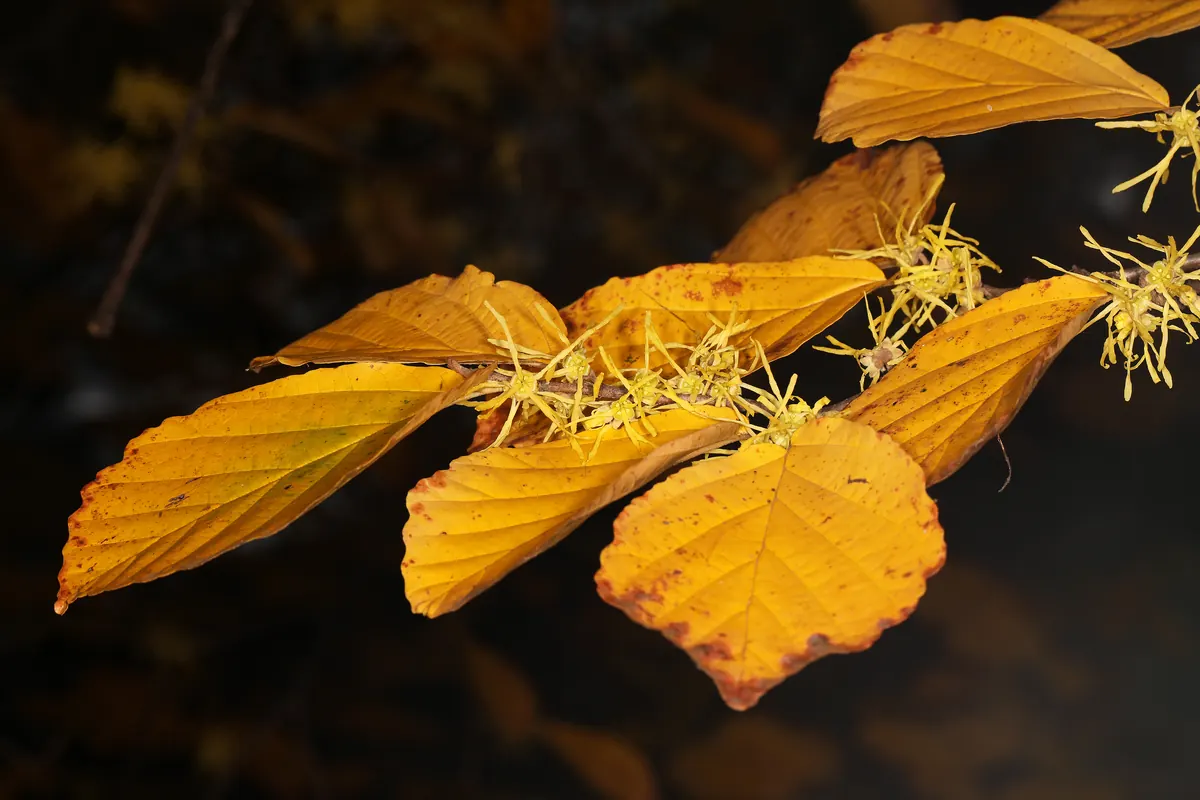
Witch hazel flowers after its leaves have yellowed or fallen: crinkly yellow ribbons along bare twigs. Go Botany notes that the ripe capsules fling their small black seeds as far as 30 feet. On a dry, sunny day, sit near one for a while and listen for the tiny snap.
-
Beechnuts and acorns
Dropping through October · Beech and red oak stands
This is a good mast year in the East by the finch forecasters’ reckoning, which matters to bears, deer, turkeys, blue jays and squirrels alike.
-
Winterberry
Red berries from October on · Wetland edges, swamps, beaver meadows
Winterberry holly drops its leaves and keeps its bright red berries, which Go Botany calls critical winter food for birds. A leafless shrub dotted red along a swamp edge in late October is almost always this one.
-
Mushrooms
Wet spells in September and October · Hardwood forests and old logs
Audubon Vermont’s Green Mountain Audubon Center in Huntington runs an October Mushroom Walk on Saturday, October 17. Photograph and draw what you find, but eat nothing picked in the wild unless an expert has confirmed it in hand.
Sugar maple seeds, ash seeds and the cones of white pine and cedar are all on the ground or on the branch now; the seeds, pods and cones plate can hold a whole walk’s worth.
What are the best nature outings for Vermont families in October 2026?
- Saturday, October 3: Dead Creek Wildlife Day in Addison, free, 9:30 a.m. to 4 p.m., with banding at 7 a.m. That same day, Green Mountain Audubon Center in Huntington hosts a free family BioBlitz from 10 a.m. to 3 p.m.
- Tuesday, October 6, 4:15 a.m.: Jupiter disappears. Older children can watch the occultation from any window with a low view east.
- Thursday, October 8, after dark: the Draconids. A moonless early-evening meteor watch that suits a school night.
- Saturday, October 10: count birds. The Friends of Missisquoi hold their Big Sit from 6 a.m. to 6 p.m. at the Stephen J. Young Marsh on Tabor Road in Swanton (rain date October 11); eBird’s October Big Day is the same Saturday; and Green Mountain Audubon leads all-levels birding on the Winooski River Walk from 9 to 10:30 a.m.
- Monday, October 12: last day in many state parks. Most Vermont State Parks close for the season after Labor Day or on the second Monday in October; a few stay open later, so check your park before you go.
- Saturday, October 17: a bird walk and a mushroom walk. The monthly bird-monitoring walk on the Missisquoi refuge’s Discovery Trail starts at 8 a.m., and Green Mountain Audubon’s mushroom walk in Huntington runs 9:30 to 11:30 a.m.
- Any day: VINS in Quechee. The Vermont Institute of Natural Science runs daily raptor programs, a Forest Canopy Walk, and early-learner storytimes for children 5 and under.
- Citizen science. Send any October monarch to Journey North, enter hawk-watch or backyard bird lists in eBird, and sign up for Project FeederWatch, which runs from November 1 to April 30; just remember the bear rule and keep feeders down until snow stays on the ground.
Neighboring states and later months sit on our nature hub; the field journal has a plate for nearly everything above, from the tree you are following to the tracks by the pond.
Safety notes for October in Vermont
- Hunting seasons are open. Deer archery runs October 1 to December 15. Fall turkey archery runs October 1 to November 13, and the fall shotgun-or-archery season opens October 24 (through November 1 in most units, November 8 in units F, K and N). Moose hunting is by permit only, October 1–7 for archery and October 17–25 for the regular season, and the department proposed confining this year’s permits to the Northeast Kingdom. The first gun season for deer is the October muzzleloader antlerless hunt, October 29 to November 1, by permit. Bear early season runs through November 13, with the late season November 14–22. Ruffed grouse is open through December 31, woodcock through November 9 and gray squirrel all month. Ducks and Canada geese open October 10 in the Lake Champlain and Interior zones and October 13 in the Connecticut River zone. Rifle season follows on November 14–29, after the youth and novice weekend of November 7–8.
- Orange is advised, not required. Vermont has no hunter-orange law. The department’s regulations say plainly that orange “is not required by law in Vermont, but wearing it might save your life,” and it urges hunters to wear at least an orange hat and vest. Hikers, dog walkers and mountain bikers on wildlife management areas and in the woods should wear orange too, and put a vest on the dog. Waterfowl and turkey hunters stay camouflaged while hunting, so expect people you cannot see around the marshes after October 10.
- Bears. With the population well above goal, take feeders down, lock up trash and compost, and never leave pet food outside.
- Ticks. The Vermont Department of Health says ticks can be found anywhere in the state whenever the temperature is above freezing. Tuck pants into socks, use repellent, and do a full tick check on every person and pet once you are home.
- Moose on the road. In the Kingdom, slow down after dark; a moose stands taller than your headlight beam.
- Early winter up high. A trail that starts in fall color can end in ice and snow above treeline on Mansfield or Camel’s Hump. Carry a warm layer, a hat, gloves and a light, and turn around if the rocks are glazed.
- Cold water. Wear a life jacket in any canoe or kayak; the lake and rivers are cooling fast.
Sources
- Vermont Department of Tourism: weekly foliage tracker (Week 3, September 30, 2026)
- VTDigger: fall foliage varies from year to year, for leaf-peepers and trees (September 16, 2026)
- WCAX: Vermont foliage rebounds with vibrant colors after last year’s drought (September 29, 2026)
- Vermont Fish & Wildlife: enjoy Dead Creek Wildlife Day on October 3 (September 9, 2026)
- Vermont Fish & Wildlife: Dead Creek Wildlife Management Area brochure (snow geese, refuge, viewing area)
- Friends of Missisquoi National Wildlife Refuge: events calendar (Big Sit October 10, bird walk October 17)
- Finch Research Network: winter finch forecast 2026–2027
- BirdWatching: Putney Mountain Hawk Watch, Putney, Vermont
- HawkCount (Hawk Migration Association of North America): Vermont sites reporting in fall 2026
- Vermont State Parks: day use, hours and operating schedule
- Monarch Watch: peak migration dates by latitude
- Journey North: monarch sightings
- Low Impact Hydropower Institute: Winooski One certificate (fish lift operating dates)
- Vermont Public: salmon reach Winooski’s fish lift in record numbers (October 25, 2023)
- Vermont Fish & Wildlife: fishing restricted in part of Hatchery Cove to protect spawning salmon (September 25, 2026)
- Vermont Fish & Wildlife: Vermont fall fishing heats up as waters cool (September 16, 2026)
- Vermont Fish & Wildlife: moose hunting seasons and permits
- Vermont Fish & Wildlife: 2026 moose harvest recommendation (February 18, 2026)
- Vermont Fish & Wildlife: bear population estimate above goal for fifth consecutive year (August 6, 2026)
- Vermont Fish & Wildlife: Vermont bear hunting starts in September (August 24, 2026)
- Vermont Fish & Wildlife: grouse and woodcock hunting starts September 26 (September 22, 2026)
- Vermont Fish & Wildlife: 2026–27 hunting and trapping seasons
- Vermont Fish & Wildlife: 2026 migratory game bird season recommendations
- The Herald (Randolph): 2026–27 migratory game bird seasons announced (August 13, 2026)
- Vermont hunting regulations (eRegulations): general hunting information, fluorescent orange
- Vermont Business Magazine: Vermont Fish & Wildlife urges hunters to wear orange (November 14, 2024)
- Vermont Fish & Wildlife: urges hunters to help keep deer healthy (September 29, 2026)
- NOAA Regional Climate Centers (ACIS): 1991–2020 normals and daily snowfall for Burlington, Barre–Montpelier and Mount Mansfield
- National Weather Service Burlington: The Four Seasons newsletter, winter 2015–16 (El Niño and the winter outlook)
- National Weather Service Burlington: The Four Seasons newsletter, winter 2016–17 (looking back at winter 2015–16)
- Climate Prediction Center: ENSO diagnostic discussion, September 10, 2026
- North Star Monthly: what a “super” El Niño could mean for Vermont this winter (September 25, 2026)
- International Occultation Timing Association: lunar occultation of Jupiter, October 6, 2026 (Burlington and Montpelier timings)
- U.S. Naval Observatory: moon phases 2026
- U.S. Naval Observatory: sun and moon rise, set and twilight (data API), Burlington
- EarthSky: meteor shower guide 2026 (Draconids, Orionids)
- EarthSky: visible planets and night sky guide
- Native Plant Trust, Go Botany: American witch-hazel
- Native Plant Trust, Go Botany: American larch (tamarack)
- Native Plant Trust, Go Botany: winterberry holly
- Audubon Vermont: events (Huntington BioBlitz October 3, Winooski River Walk birding October 10, Mushroom Walk October 17)
- Vermont Institute of Natural Science (VINS): programs and events, Quechee
- The Big Sit! 2026 (October 10–11)
- eBird: October Big Day, October 10, 2026
- Project FeederWatch: how to participate (November 1 to April 30)
- Vermont Department of Health: tickborne diseases
- Photos via Wikimedia Commons; licenses and photographers are credited under each picture
