What to look for in nature in Vermont this February
Meteorological winter closes with February, though few Vermonters would call it an ending: snow keeps piling up in the north and on the summits, and the broad lake may finally ice over. But the light has changed. Burlington passes ten hours of daylight in the first week, sugarmakers watch the forecast for the first freeze and thaw, and the sap begins to drip. Bald eagles return to their stick nests along the Connecticut River, coyotes howl through their mating season, and barred and screech owls start courting. On mild afternoons, specks of life appear on the snow itself. By late in the month the first red-winged blackbirds call from the cattails, decades earlier in the calendar than a century ago. Overhead, Jupiter and Mars reach opposition a little over a week apart, and the Snow Moon rises in a faint eclipse.
Other months in Vermont: October, November, December, January.
Start here
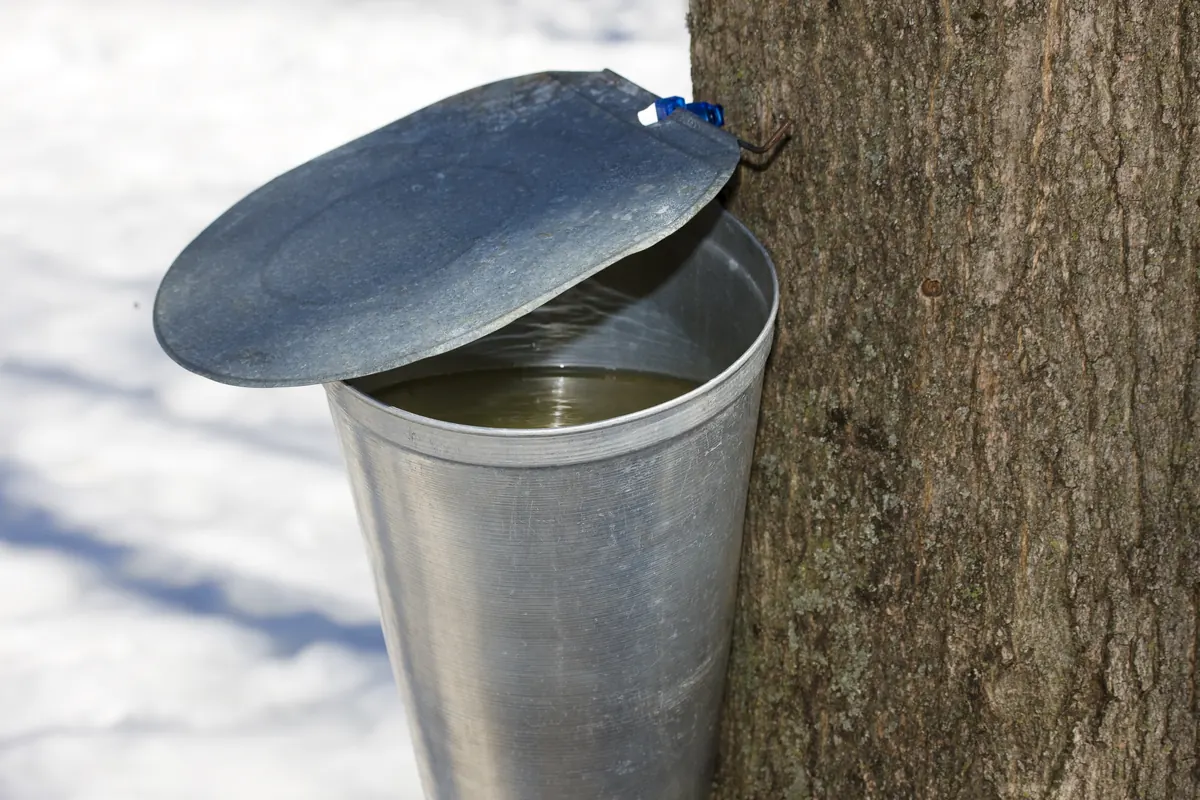
- Walk a sugarbush on a thawing afternoon. When the thermometer drops below freezing overnight and climbs into the 40s the next afternoon, maple sap can run. The trails through Audubon Vermont’s sugarbush in Huntington stay open all year, and sugarhouses across the state may be boiling by late February in an early season.
- Count birds for the Great Backyard Bird Count. Audubon lists the 2027 dates as February 12 to 15, over Presidents’ Day weekend. Even a short session at the kitchen window counts, and February is a good time to log chickadees singing their spring song and the first blackbirds.
- Watch the Snow Moon rise on February 20. On Saturday evening the full moon comes up over the eastern hills at about 5:24 p.m. in Burlington, a few minutes before sunset, already inside a faint penumbral eclipse. Jupiter and orange Mars, both just past opposition, shine nearby.
Some of the year’s first spring entries belong to February. Put the date of your first red-winged blackbird or turkey vulture on birds I have seen, and log the first sap drip from a tapped maple on the daily field log. On the map of sounds, mark where a coyote chorus or a barred owl came from and the hour. Use tracks to know for a coyote’s straight line of prints, and add a sketch of a snow flea or winter stonefly to reading the signs. Check whether the buds have swelled on the twig you drew last month for a tree through the seasons, and time the Snow Moon rise on the dusk and dawn watch.
Regions used below: Champlain Valley and the Islands; Northeast Kingdom; Green Mountains; Central Vermont and the Capital Region; Southern Vermont and the Connecticut River Valley.
When does maple sugaring season start in Vermont, and why does sap run?
Vermont makes more maple syrup than any other state, and February is when the season can begin. A run depends less on the calendar than on a particular kind of weather, so sugarmakers watch forecasts for nights below freezing followed by days that climb well above it.
-
The weather that makes sap flow
Any stretch of frosty nights and thawing days, from February into April · Sugar and red maples statewide
The Vermont Maple Sugar Makers’ Association describes the recipe: a night below freezing and a day of at least 40 to 45 °F, a swing that builds pressure in the tree and pushes sap out of a taphole. Northern Woodlands explains why maples behave this way. Many of the fibers in maple wood hold gas instead of water. On a freezing night, sap is drawn into those fibers and freezes along their walls; when the wood warms, the trapped gas expands and drives the sap back into the vessels and down the trunk. A slow freeze stores more sap than a sudden one, which is why some cold snaps are followed by poor runs.
-
An earlier start than it used to be
First boils now often in early to mid-February in a warm winter · Sugarhouses across the state
Shelburne Farms, citing UVM’s Proctor Maple Research Center, reports that the Vermont season now opens about 8 days earlier than it did 50 years ago and closes about 12 days earlier, a net loss of more than three days. The farm’s own first boils over the last eight years came mostly in early to mid-February, while the old rule of thumb was to have every tap in by Town Meeting Day, the first Tuesday in March (March 2 in 2027). A cold winter can still hold everything back: in 2026, after the coldest December through February since 2014–15, most of the sugaring happened from mid-March into April, Vermont Business Magazine reported.
-
How much sap makes a gallon
A typical season lasts four to six weeks · Statewide
Because sap carries only about 2 percent sugar, the sugarmakers’ association says, roughly 40 gallons boil down to one gallon of syrup. In 2026, USDA figures summarized by UVM Extension put Vermont’s crop at 3,091,000 gallons from 8.2 million taps, 53 percent of the national total.
-
A sugarbush you can walk
Trails open all year, dawn to dusk · Green Mountain Audubon Center, Huntington
Audubon Vermont has made syrup in Huntington since 1972, hanging buckets on about 600 trees and boiling the sap over a wood fire for close to 100 gallons a season. Its trails pass through what it manages as a bird-friendly sugarbush, a forest that also feeds and shelters scarlet tanagers and wood thrushes in summer. Its sugar-on-snow parties come later, during Maple Open House Weekend, which the sugarmakers’ association has set for Saturday and Sunday, March 20 and 21, 2027.
Watch for blue tubing strung between trunks, buckets on roadside maples and steam rising from a sugarhouse cupola: the surest February sign that spring is coming.
When do bald eagles start nesting in Vermont?
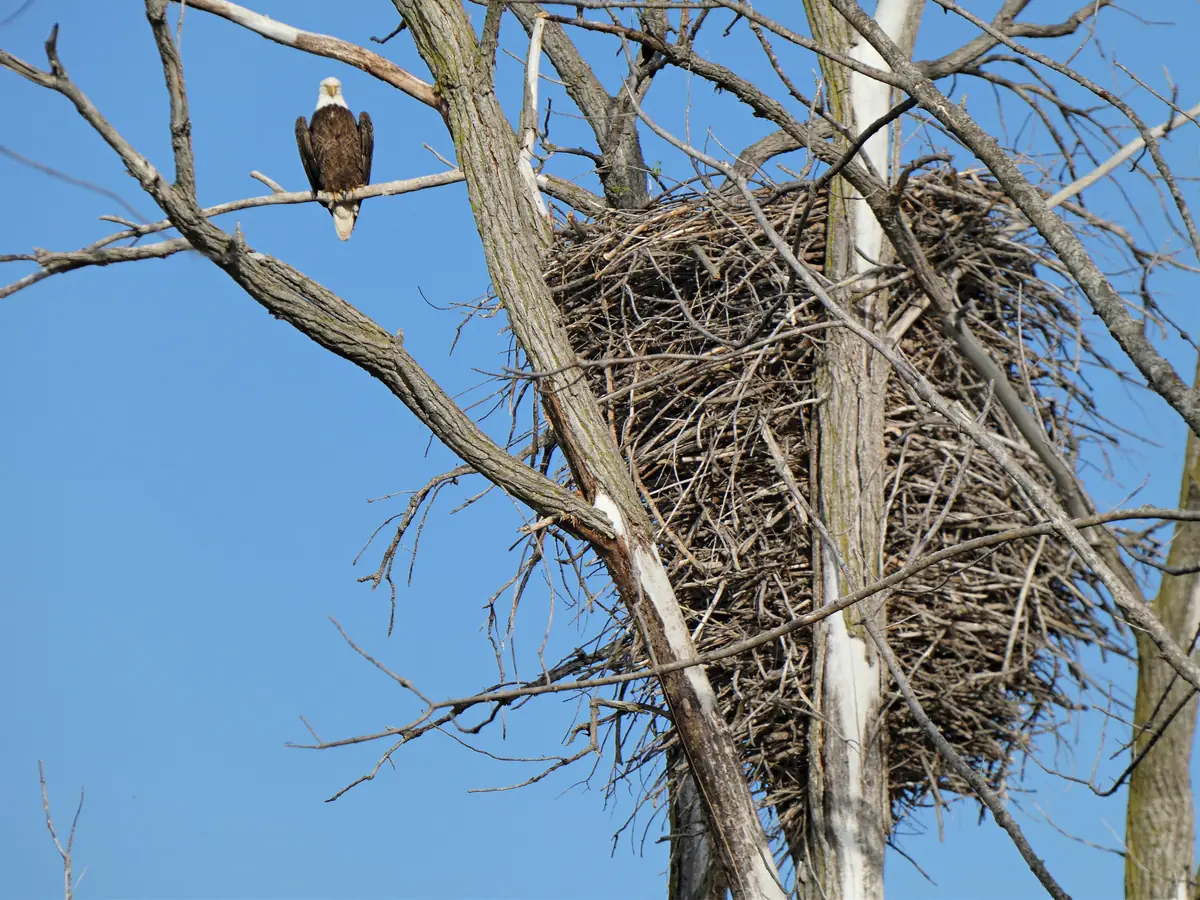
In January the eagle story was about open water. In February it moves to the nest. Resident pairs return to the same big stick nests, add fresh branches and lining, and get ready to lay eggs while the snow is still deep.
-
Back at the nest
Pairs repair nests from January; eggs late February into March · Tall trees near rivers and lakes, especially along the Connecticut River
A volunteer who watches 13 nests on the Connecticut River between Vernon and North Windsor told VTDigger in April 2026 that the pairs come back to their nests in January to rebuild and breed toward the end of February, with about 35 days of incubation and young that leave the nest in late June. The Vermont Breeding Bird Atlas gives a slightly later start, with eggs as early as March, so the first eggs may come anywhere from late February into March. The atlas describes the nests as massive piles of sticks set below the forest canopy near water.
-
A recovery story
First nest in 2002; removed from the state endangered list February 10, 2022 · The Connecticut River valley, Lake Memphremagog and the Champlain Valley
Vermont had gone roughly 60 years without a nesting pair when the first nest turned up in 2002, the Vermont Center for Ecostudies reports; the first young bird fledged in Concord in 2008. By 2020 the state had 37 breeding pairs that raised 64 chicks, VTDigger reported when Vermont Fish & Wildlife took the species off the state’s endangered list in February 2022. In 2026 the same paper, citing the Connecticut River Conservancy, put the 2025 count near 38 nesting pairs, concentrated on the Connecticut.
Watch nests from a few hundred feet away, as Audubon Vermont asks, and report eagles to eBird. Eagles still gather at open water too, so the spots in the January guide remain worth checking on a cold morning.
Why do coyotes howl and owls call on February nights in Vermont?
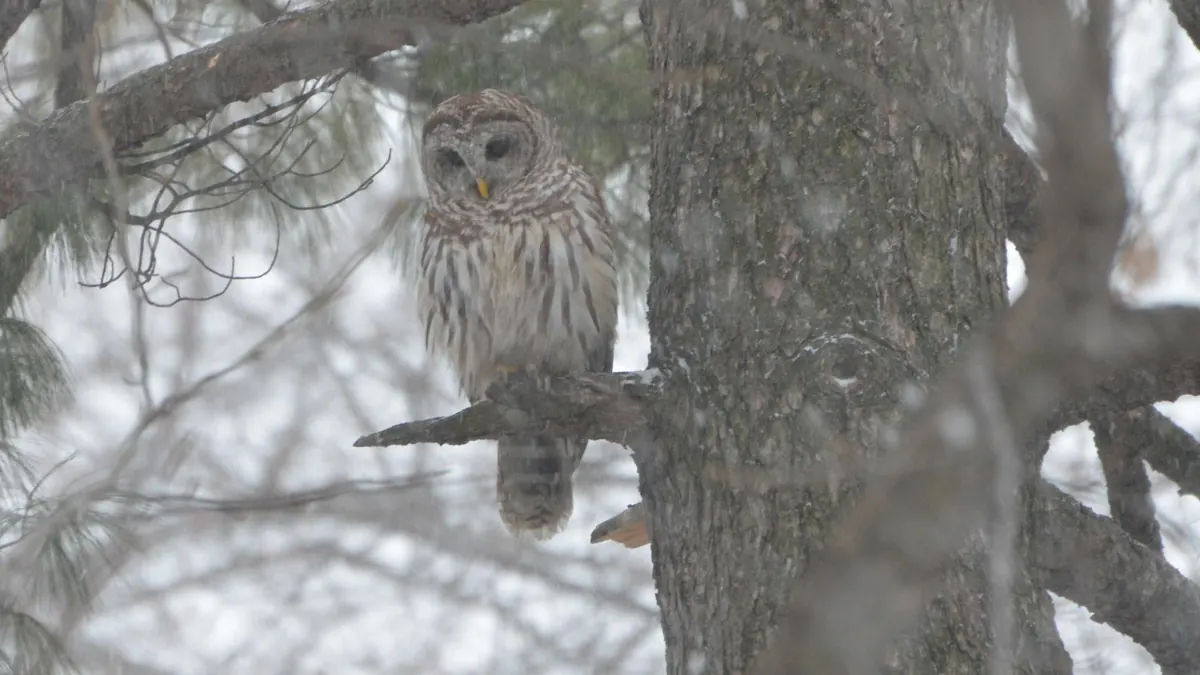
February is mating season for several of Vermont’s predators, and the long nights carry their voices. A still evening at the edge of farmland or woods is the time to listen.
-
Eastern coyotes
Mating peaks around mid-February; pups born in late April or May · Farm country and forest edges statewide, most numerous in agricultural areas
Vermont Fish & Wildlife says coyotes mate in February and that their high howl ending in a burst of yips is heard most on winter nights in that mating season. Pairs usually start breeding at two years old and may stay together for life, and the average litter is six pups. The department puts the state’s population somewhere between 4,500 and 8,000, lowest in winter. The Vermont Center for Ecostudies notes that a pair defends its territory with this calling, and that gestation lasts about nine weeks.
-
Barred owls
Most vocal from late February into early April · Mature mixed forest, swamps and beaver ponds
The barred owl’s rhythmic phrase, often written “who cooks for you?”, carries far through bare woods, and the Center for Ecostudies says these owls are especially talkative from late February through early April. When two get going they can break into a wild duet of cackles and hoots that sounds like a fight.
-
Eastern screech-owls
Courtship from mid-February; nesting March to May · Woodlots and old shade trees with cavities
This small owl’s song is a soft whinny or a long, even trill, nothing like a screech. The Center for Ecostudies describes a courting male swiveling his head, bobbing and winking at a female, and says pairs usually stay together for life and lay eggs in a tree cavity or nest box, which hatch after about 26 days.
Red foxes are still screaming in February too; the January page covers them and the great horned owls already on eggs.
Which birds come back to Vermont first in late winter?
Spring migration starts in February in Vermont, with a handful of hardy birds that arrive while the fields are still white. At the same time, the birds that never left begin to sing.
-
Red-winged blackbirds
Late February; the eBird average arrival is about February 23 · Cattail marshes and wet fields, earliest in the Champlain Valley
Males come first to claim territories, singing a gurgling “conk-la-ree” from a cattail before any females arrive. Their timing has shifted a great deal. The Vermont Center for Ecostudies compared old records with modern ones: one observer’s first blackbird in 1902 came on March 27, another’s in 1950 on February 26, and Vermont eBird reports from 2015 to 2020 put the typical arrival around the 54th day of the year, about February 23. That is 32½ days earlier over 117 years.
-
Turkey vultures and other early arrivals
From late February · Over ridges and river valleys
The Center for Ecostudies lists turkey vultures, brown-headed cowbirds and red-winged blackbirds among February’s first northbound migrants. A big dark bird rocking on wings held in a shallow V is a vulture. American woodcock may appear in the last days of February when spring comes early.
-
Horned larks on bare fields
Breeding birds return from mid-February · Plowed and grazed farmland and rural roadsides, especially in the Champlain Valley
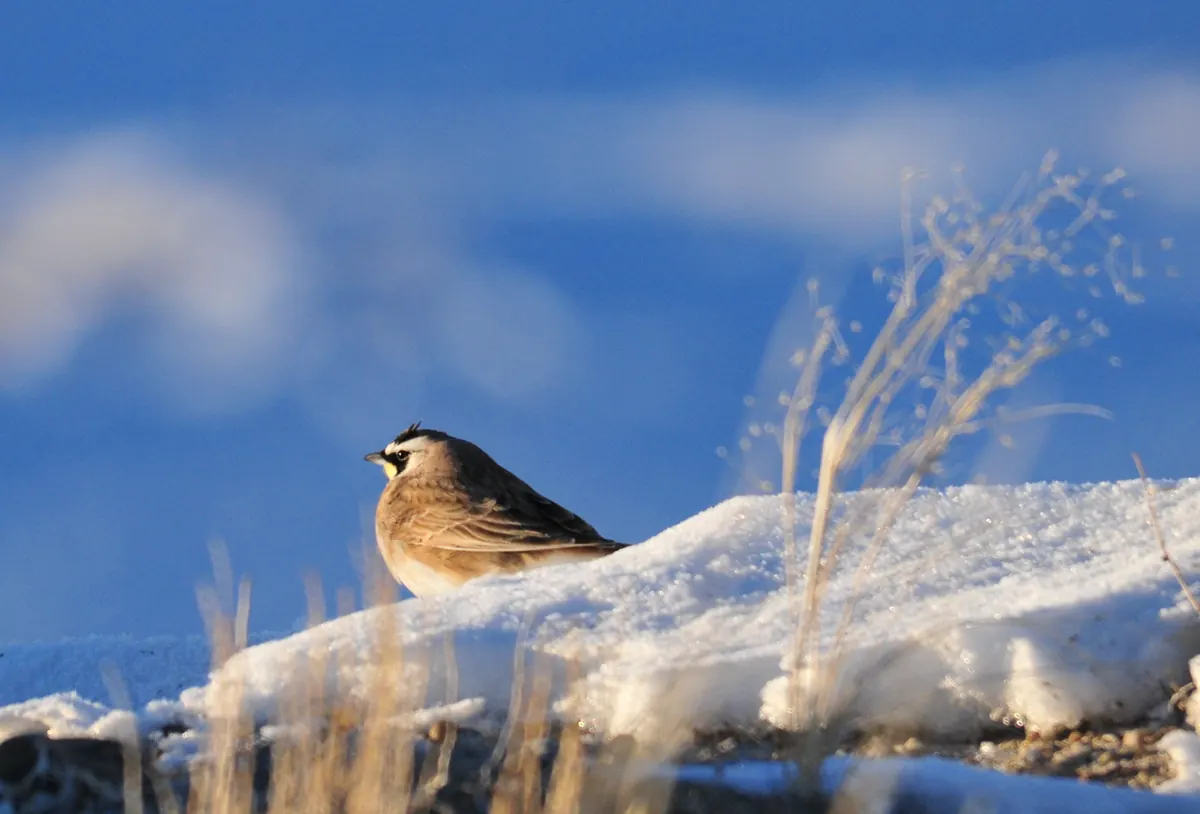
The Vermont Breeding Bird Atlas calls the horned lark one of the state’s earliest nesters, with birds on bare fields as early as mid-February, setting up territories with brief aerial chases before dropping back to sing. Look for a sandy brown bird with a black mask and tiny feather “horns” walking, not hopping, across a snowy field. The species depends on open working farmland and has declined: the second atlas found it in 7 survey blocks, down from 12.
-
Songs and drumming
Building through the month · Backyards and woods statewide
As days pass ten hours long, the Center for Ecostudies notes, black-capped chickadees, northern cardinals and house finches start singing, and hairy and downy woodpeckers drum on hollow limbs. The chickadee’s whistled “fee-bee,” two clear notes stepping down, is its spring song and quite different from the chick-a-dee call.
Every first-of-year date you log in eBird adds to the record that shows these shifts.
What are the tiny bugs crawling on the snow in Vermont?
On a mild, sunny February afternoon, look closely at the snow near trees, logs and streams. Several insects and their relatives are active on it, using the snow as a highway where few predators hunt.
-
Snow fleas (springtails)
Warm winter days into early spring · In footprints, ski tracks and around tree trunks in the woods
Snow fleas are not fleas at all but springtails, tiny relatives of insects that usually live by the hundreds of thousands in leaf litter and the top inch of soil. Northern Woodlands describes them on snow as “animated pepper grains,” dark gray to blue-black, that gather in depressions and footprints. A forked tail-like lever, held cocked under the body by a catch, flings them up to 300 body lengths. Those on the snow are thought to feed on wind-blown pollen and spores.
-
Winter stoneflies
Sunny afternoons from January through April; most egg-laying in March · Snowy banks of clean, rocky streams
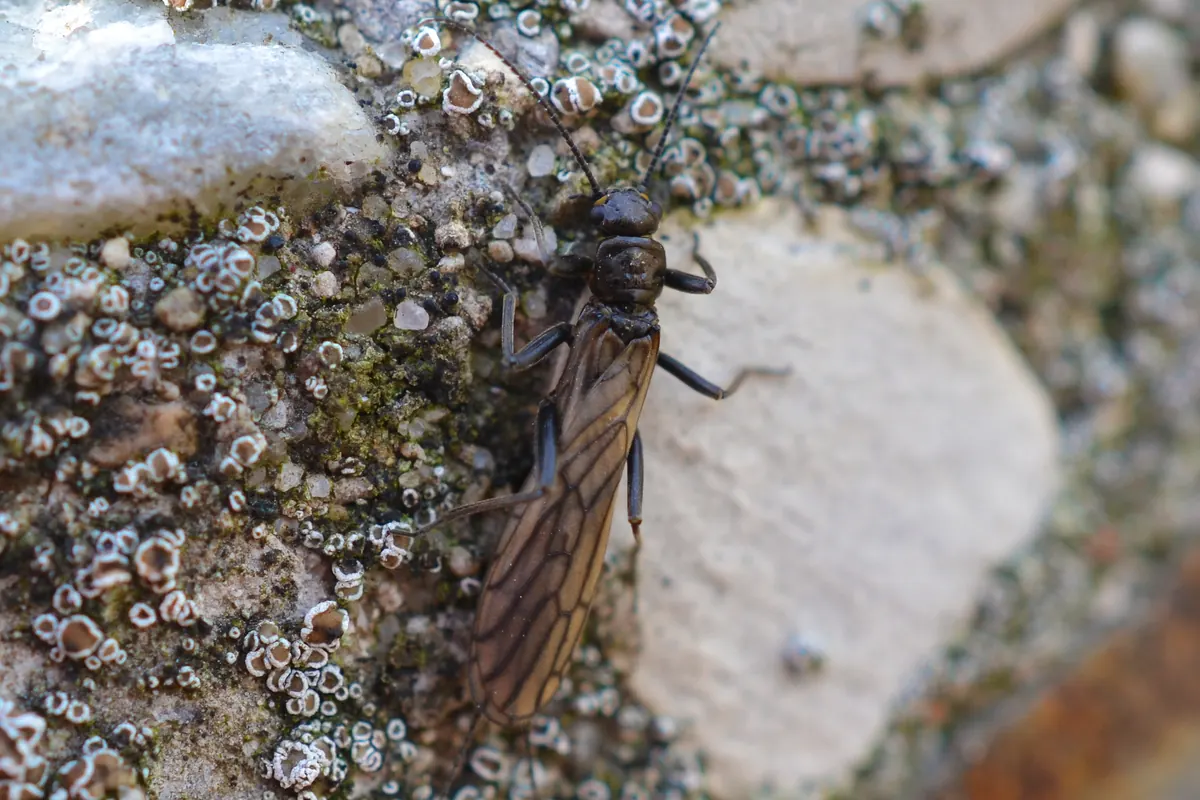
These slim, dark insects, a half inch to two-thirds of an inch long, crawl out of stream water as nymphs and become adults in the cold. Northern Woodlands says males find mates by drumming their abdomens on stems and branches, a signal people cannot hear. The adults do not feed; they mate, and the females return to the stream to lay eggs. Their presence is a sign of clean water.
-
Snow scorpionflies
November through March, most often on mild days after fresh snow · Mossy forest floors and snow near moss-covered rocks and logs
Wingless or nearly so, these small dark insects walk across the snow on long legs that keep their bodies off the cold surface. Northern Woodlands reports that sunlight on their dark bodies can keep them as much as six degrees warmer than the air.
A hand lens and a white card turn a snow walk into a field session, and the reading-the-signs plate of the field journal has room for a sketch.
Do Vermont groundhogs really wake up on February 2?
The groundhog gets its day on Tuesday, February 2, 2027, slightly ahead of the season’s actual midpoint: the astronomical season, solstice to equinox, reaches its halfway mark on February 3 or 4. In Vermont the animal itself usually sleeps through both.
-
Groundhogs, still hibernating
Males emerge in late February or early March; females later · Burrows in field edges, hedgerows and stone walls
Groundhogs are true hibernators. The Vermont Center for Ecostudies says a sleeping groundhog’s heart can slow to about 5 beats a minute for the four to six months of hibernation, and that males lose about 30 percent of their weight over the winter. Males come up first, in late February or early March, to look for females, then often return underground for a while.
-
Opossum litters
First litters born in February · Dens under sheds, in brush piles and woodpiles, mostly in the lowlands
The Center for Ecostudies says the Virginia opossum has its first litter of 5 to 13 young in February, each weighing about a fifth of a gram at birth, and the young stay in the pouch for about 60 days. Opossums do not hibernate, though they may stay in a den through the coldest spells.
Whatever any groundhog forecasts, about six weeks of winter typically remain after February 2 in Vermont, since the spring equinox comes on March 20.
Does Lake Champlain freeze over in February?
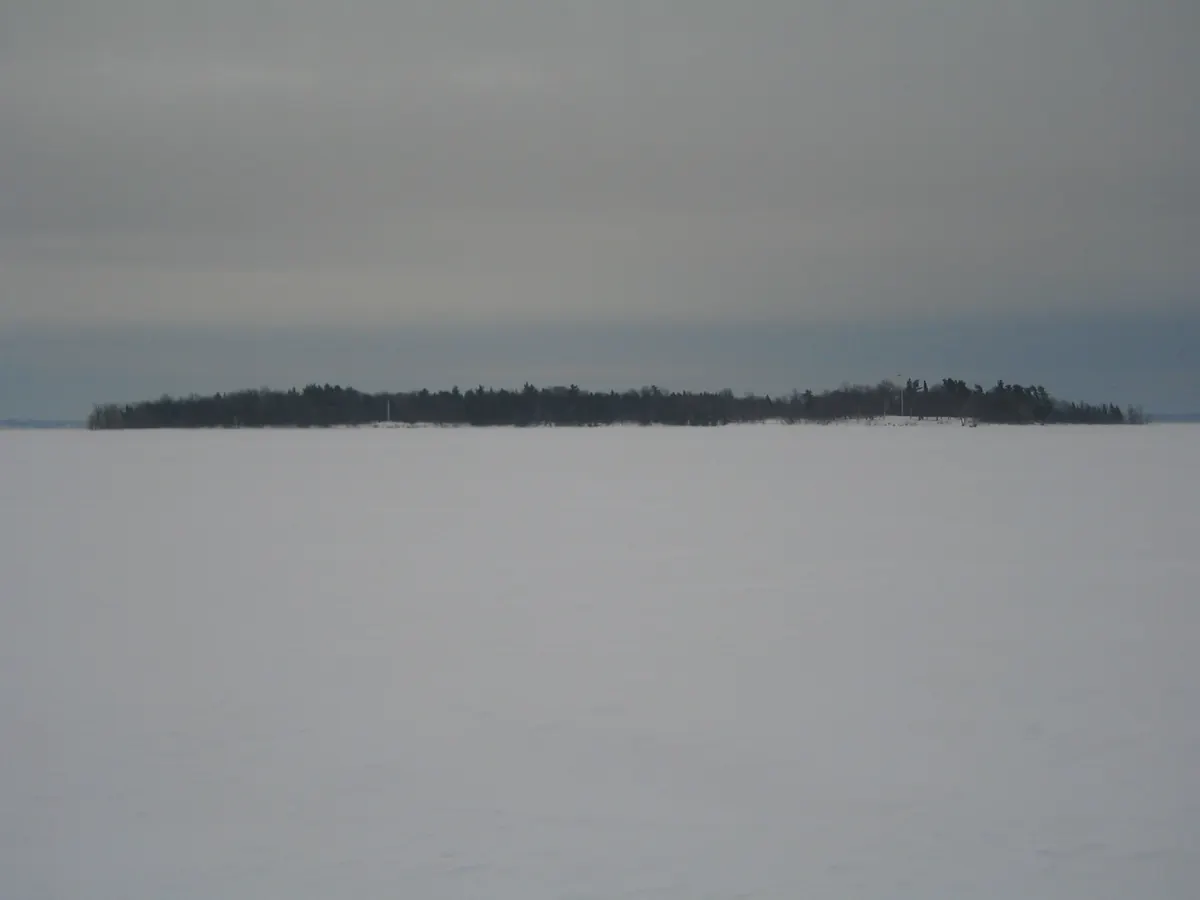
February is when the broad lake is most likely to freeze, if it freezes at all. The National Weather Service in Burlington calls the lake “closed” when ice reaches across the wide stretch between Burlington and Port Kent, New York. Since 1990–91 the main lake has stayed open far more winters than it has closed, and the closings that do come fall most often in February. The most recent was February 13, 2026, after six winters in a row that stayed open.
-
Great Ice in North Hero
Usually Presidents’ Day weekend; the 2026 festival ran February 13–15 · City Bay, North Hero, in the Champlain Islands
Since 2007 the town of North Hero has turned its frozen City Bay into a winter festival grounds, with fireworks and bonfires, dog sled rides, skating rinks, cook-offs and the Over N’ Back Trek. The 2027 schedule was not yet out as of early October; check with the Town of North Hero and the Great Ice organizers in the new year, since events on the ice depend on the ice.
| Winter | Closing date |
|---|---|
| 2025–26 | February 13 |
| 2018–19 | March 8 |
| 2014–15 | February 16 |
| 2013–14 | February 12 |
| 2006–07 | March 2 |
| 2004–05 | March 8 |
| 2003–04 | January 27 |
| 2002–03 | February 15 |
| 2000–01 | March 2 |
| 1995–96 | February 5 |
| 1993–94 | January 23 |
| 1992–93 | February 7 |
A “closed” lake is not a safe lake. Cracks, open leads and thin ice over currents remain, so follow the ice guidance in the safety notes below.
Is February Vermont’s snowiest month, and what could El Niño bring?
In much of the state it is. In NOAA’s 1991–2020 normals, the shortest month averages more snow than January at Mount Mansfield’s summit (44.6 inches), Sutton (35.8), Island Pond, St. Albans and South Hero, and ties January at St. Johnsbury. Burlington is the exception, with 19.3 inches in February against 21.1 in January.
-
The Valentine’s Day storm of 2007
February 14, 2007 · Central and northern Vermont and northern New York
The Burlington weather office counts this nor’easter among the most significant snowstorms in the region’s history. It spread 20 to 30 inches from the Adirondacks across much of central and northern Vermont, with isolated totals near 3 feet, and dropped 25.3 inches on Burlington in 24 hours, beating a one-day record that had stood since January 14, 1934.
| Station | Average high | Average low | Snowfall | Days with snow cover |
|---|---|---|---|---|
| Burlington International Airport (Champlain Valley) | 31.5 °F | 14.3 °F | 19.3 in | 23.9 |
| South Hero (Champlain Islands) | 30.7 °F | 12.4 °F | 11.6 in | 21.6 |
| St. Albans (Franklin County) | 28.5 °F | 10.4 °F | 18.3 in | 21.8 |
| Cornwall (Addison County) | 30.3 °F | 10.3 °F | 13.3 in | 20.2 |
| Rutland | 32.1 °F | 8.8 °F | 16.0 in | 22.2 |
| Northfield (central Vermont) | 32.4 °F | 7.4 °F | 15.0 in | 27.6 |
| St. Johnsbury (Northeast Kingdom) | 32.5 °F | 10.3 °F | 19.9 in | 27.2 |
| Newport (Lake Memphremagog) | 27.1 °F | 5.0 °F | 20.2 in | 28.0 |
| Island Pond (Northeast Kingdom) | 26.6 °F | 4.0 °F | 26.1 in | 28.4 |
| Sutton (Northeast Kingdom) | 27.3 °F | 5.8 °F | 35.8 in | 28.6 |
| Mount Mansfield (summit) | 22.7 °F | 7.3 °F | 44.6 in | 28.5 |
A strong El Niño and late winter. Vermont’s sugarmakers and skiers alike should note NOAA’s September 10 call: its forecasters reckon it all but certain, past the 90 percent mark, that this Pacific warm event lands in the topmost tier while the Green Mountains lie under snow. The official NOAA outlook for February is refreshed each month on the 90-day outlook page, which is the place to see the latest call.
History suggests caution in both directions. Writing on NOAA’s climate blog, L’Heureux and Brettschneider mapped snowfall in past El Niño winters and found interior New England usually comes up short, with the deficit more dependable when the event is moderate or strong. Yet the regional climate center’s El Niño briefing for NOAA points to more coastal storms in such winters, and counts the Presidents’ Day storm of February 2003 among the big snows that came with El Niño conditions. And even the very strong 2015–16 event, which left most of that winter mild and thin on snow, could not keep February tame: the Burlington office recorded wind chills of 30 to 50 below zero around Valentine’s Day 2016, and an ice storm hit eastern Vermont that February. So plan for a February that could swing from sugaring thaws to a bitter week. Check our weather page before heading out, and look up the spring planting odds for your town on the Vermont frost dates page.
How much daylight does Vermont gain in February?
Daylight grows quickly now. Burlington goes from 9 hours 50 minutes on February 1 to 11 hours 7 minutes on February 28, a gain of 77 minutes, and the U.S. Naval Observatory’s tables put its sunset at 5:02 p.m. on the 1st and 5:39 p.m. on the 28th, with sunrise moving from 7:12 to 6:32 a.m. The ten-hour mark that the Vermont Center for Ecostudies links to the first birdsong arrives around February 5 in Burlington.
| City | Feb 1 | Feb 28 | Gained | Per day |
|---|---|---|---|---|
| Burlington | 9 h 50 m | 11 h 07 m | 77 min | 2.9 min |
| St. Albans | 9 h 49 m | 11 h 06 m | 77 min | 2.9 min |
| Newport | 9 h 48 m | 11 h 06 m | 78 min | 2.9 min |
| St. Johnsbury | 9 h 50 m | 11 h 07 m | 77 min | 2.9 min |
| Montpelier | 9 h 52 m | 11 h 08 m | 76 min | 2.8 min |
| Rutland | 9 h 54 m | 11 h 09 m | 75 min | 2.8 min |
| Brattleboro | 9 h 58 m | 11 h 10 m | 72 min | 2.7 min |
| Bennington | 9 h 58 m | 11 h 10 m | 72 min | 2.7 min |
Daylight saving time begins on March 14 and moves sunsets an hour later, to around 7 p.m. For sunrise, sunset and twilight in any Vermont town, use our daylight calculator.
What can you see in Vermont’s night sky in February 2027?
Clear February nights over Vermont offer a lot this year: the two bright planets of Leo at their best, the elusive innermost planet low after sunset, and a full moon brushed by Earth’s outer shadow. Times are Eastern Standard Time.
-
Mercury and a thin crescent
Greatest elongation February 3; crescent nearby on the evening of Sunday, February 7 · Low in the west-southwest, 30 to 45 minutes after sunset
Mercury reaches greatest eastern elongation at 1 a.m. on February 3 and remains findable until about the 10th. On Sunday the 7th, a hair-thin moon one day old keeps Mercury company in the fading glow; in Burlington the sun sets at 5:10 p.m. and the moon follows at 6:24 p.m., so look soon after dusk with binoculars and a clear view to the southwest.
-
Jupiter at opposition
Wednesday, February 10, at 7:21 p.m. · Rising in the east at sunset, high in the south around midnight, in Leo
Jupiter, facing the sun across Earth’s sky, lifts over the eastern hills at twilight and stays up until dawn, at magnitude −2.5 outshining every star. Steady binoculars can pick out as many as four moons strung beside it.
-
Mars at opposition
Friday, February 19, about 10 a.m.; nearest Earth February 20 · In Leo, not far from Jupiter and the star Regulus
This is a small, distant opposition, since Mars is close to the far point of its own orbit, but it is still the closest Mars comes until 2029: about 63 million miles on February 20. On February 22 it passes about 4 degrees north of Regulus.
-
The Snow Moon and a penumbral eclipse
Full at 6:23 p.m. Saturday, February 20; eclipse from 4:12 to 8:13 p.m., deepest at 6:13 p.m. · Rising in the east around sunset
In Burlington the full moon clears the horizon at 5:24 p.m. with the sun still up until 5:28, and the penumbral eclipse is already under way. Because the moon only grazes Earth’s pale outer shadow, the most anyone may see is a slight gray dimming on one limb near 6:13, with the moon barely above the hills, and plenty of watchers will see no change at all. On Friday night, February 19, Jupiter sits extremely close to the moon, which is just shy of full. No part of the country sees the annular solar eclipse of February 6, which crosses South America and the South Atlantic.
| Phase | Date | Time |
|---|---|---|
| New moon | Saturday, Feb 6 | 10:56 a.m. EST |
| First quarter | Sunday, Feb 14 | 2:58 a.m. EST |
| Full moon (Snow Moon) | Saturday, Feb 20 | 6:23 p.m. EST; penumbral eclipse at moonrise |
| Last quarter | Sunday, Feb 28 | 12:16 a.m. EST |
| New moon | Monday, Mar 8 | 4:29 a.m. EST |
Moonless evenings, best for faint objects, fall roughly between February 2 and 11. The sun peaked in its 11-year cycle in late 2024 and is quieting, but northern lights over Vermont are not ruled out; the federal Space Weather Prediction Center keeps a short-range aurora outlook. See whether clouds will cooperate on our cloud forecast, and find moonrise for any date on the moon phase calendar.
What can Vermont families do outdoors in February 2027?
- Tuesday, February 2: Groundhog Day. Talk about why a Vermont groundhog is still asleep, then mark February 3 and 4, the real middle of winter, on the calendar.
- Sunday, February 7: Mercury and the crescent. Head to a spot with a low southwestern horizon about half an hour after sunset.
- Wednesday, February 10: Jupiter at opposition. Steady your binoculars against a car roof; the tiny dots in a row are its moons.
- February 12 to 15, over the long weekend: count birds for the GBBC. Thirty years on, the count still needs only fifteen minutes of watching, on one day or all four, to make a checklist worth sending.
- Presidents’ Day weekend: Great Ice in North Hero. Usually held that weekend; confirm 2027 dates with the town.
- Saturday, February 20: moonrise. Find an eastern view by about 5:20 p.m. and see the full moon come up, with Jupiter and Mars nearby.
- Any thawing afternoon: a sugarbush walk. The Green Mountain Audubon Center trails in Huntington are open dawn to dusk year-round; count the buckets and listen for the drip.
- A raptor visit at VINS in Quechee. Open every day, 10 a.m. to 5 p.m., with hawks and owls that cannot be released.
- Plan ahead: Maple Open House Weekend. Sugarhouses open their doors on March 20 and 21, 2027.
Project FeederWatch continues through April for families who want to keep counting. Every other Vermont month, and every other state, is linked from the nature hub.
Safety notes for February in Vermont
- Hunting and trapping. Vermont Fish & Wildlife’s 2026–27 season list keeps hare and cottontail hunting open through March 14, 2027, in most wildlife management units and through March 31 in units D and E. Red and gray fox hunting closes February 14, 2027. Coyotes may be hunted year-round. Trapping of beaver, otter and muskrat goes on through March 31, so expect traps along streams and ponds and keep dogs close near water.
- Hunter orange. Vermont law does not require it. The regulations nonetheless recommend fluorescent orange, a hat and vest at the very least, noting New York findings that nearly all victims of mistaken-for-game shootings there, 94 out of every 100, wore none. Hikers in the woods with hare hunters can wear orange too.
- Ice. Before anyone fishes on it, Vermont Fish & Wildlife looks for a minimum of 3 to 4 inches if the ice is clear and black, or 6 inches of the cloudy gray kind. Test as you go with a spud bar, wear ice picks, tell someone where you are going, and never go alone. Late-month thaws weaken ice quickly, especially near inlets, outlets and pressure cracks.
- Cold and wind chill. A February cold wave can still bring dangerous wind chills, as in mid-February 2016. Cover skin, dress children in layers, and turn back early on exposed summits and open lake ice.
- Ice storms and heavy snow. Freezing rain and big nor’easters both happen this month. Allow extra time on back roads, carry blankets and a shovel in the car, and stay off woodland trails during ice storms, when limbs can fall.
Sources
- Vermont Maple Sugar Makers’ Association: How it’s made
- Vermont Maple Sugar Makers’ Association: Maple Open House Weekend
- Northern Woodlands: Why does sap run?
- Shelburne Farms: Maple sugaring as the climate changes
- UVM Extension: Maple statistics
- Vermont Business Magazine: 2026 Vermont maple season production leads nation
- UVM Proctor Maple Research Center
- Audubon Vermont: Maple sugaring at Green Mountain Audubon Center
- VTDigger: Bald eagle population soars in the region (April 19, 2026)
- VTDigger: Bald eagle removed from state endangered list (February 10, 2022)
- Vermont Center for Ecostudies: Outdoor Radio, nesting bald eagles
- Vermont Atlas of Life: Bald eagle (Vermont Breeding Bird Atlas)
- Audubon Vermont: Peregrine falcon and bald eagle monitoring
- Vermont Fish & Wildlife: Coyote
- Vermont Center for Ecostudies: Field Guide to February 2019
- Vermont Center for Ecostudies: Field Guide to February 2020
- Vermont Center for Ecostudies: Field Guide to February 2021
- Vermont Center for Ecostudies: Field Guide to February 2022
- Vermont Center for Ecostudies: Field Guide to February 2024
- Vermont Center for Ecostudies: February 2025 Field Guide
- Vermont Atlas of Life: Horned lark (Vermont Breeding Bird Atlas)
- Northern Woodlands: Springtails, Tiggers of the invertebrate world
- Northern Woodlands: If winter comes, can springtails be far behind?
- Northern Woodlands: Winter stoneflies
- Northern Woodlands: Snow scorpionflies
- National Weather Service Burlington: Lake Champlain closing dates
- Lake Effect Vermont: Great Ice winter festival 2026
- Town of North Hero
- NOAA NCEI: Monthly climate normals 1991–2020, Vermont stations
- National Weather Service Burlington: The Four Seasons, Winter 2016–17 (Valentine’s Day 2007 storm; winter 2015–16 review)
- NOAA Climate.gov: Snow pain, snow gain, how does El Niño affect snowfall over North America?
- NOAA and Northeast Regional Climate Center: El Niño impacts and outlook, Northeast region
- NOAA Climate Prediction Center: ENSO Diagnostic Discussion, September 10, 2026
- NOAA Climate Prediction Center: 90-day outlooks
- U.S. Naval Observatory: Moon phases
- U.S. Naval Observatory: Sun and moon rise and set, Burlington, February 20, 2027
- U.S. Naval Observatory: Earth’s seasons and apsides, 2027
- Fred Espenak: Sky Event Almanac 2027
- NASA: Lunar eclipses 2021–2030
- NASA: Solar eclipses 2021–2030
- Old Farmer’s Almanac: Eclipses
- EarthSky: Jupiter at opposition
- SEDS: Mars in 2027
- SeaSky: Astronomy calendar 2027
- NOAA Space Weather Prediction Center: Aurora dashboard
- National Audubon Society: Great Backyard Bird Count
- Birds Canada: Great Backyard Bird Count
- Project FeederWatch: How to participate
- eBird
- VINS Nature Center
- Vermont Fish & Wildlife: Hunting and trapping seasons
- Vermont Hunting Regulations: General hunting information (hunter orange)
- Vermont Fish & Wildlife: Ice fishing fun and safety
- Cornell Law School: 15 U.S.C. 260a, daylight saving time
- Photos via Wikimedia Commons; licenses and photographers are credited under each picture
