What to look for in nature in Vermont this January
January is the deep end of a Vermont winter. NOAA’s normals rank it below every other month for temperature across the state, the snowpack keeps building in the Northeast Kingdom and on the high ridges, and ponds freeze hard enough for ice shanties. Yet plenty is happening. Bald eagles crowd whatever water stays open, and volunteers count them early in the month. Great horned owls start incubating, red foxes scream through the cold nights, and mother bears give birth under the snow. Deer retreat into hemlock and spruce yards, grouse sleep inside snowdrifts, and porcupines strew clipped hemlock twigs below their feeding trees. Overhead come the Quadrantids, on a moonless night, and a supermoon.
Other months in Vermont: October, November, December, February.
Start here
- Scan the open water for eagles. Pick a stretch the ice has not sealed: the Connecticut River below Wilder Dam in Hartford, or the ice edge on Lake Champlain near Chimney Point and Fort Cassin Point. These are the kinds of spots Audubon Vermont’s survey volunteers check in early January.
- Stay up for the Quadrantids. The brief Quadrantid maximum comes overnight from Sunday, January 3, to Monday, January 4, and the thin crescent stays below the horizon until the last hours of night. Try from about 3 a.m. Monday, once the radiant has swung high in the northeast.
- Fish for free on January 30. Vermont’s fishing regulations make the last Saturday in January a Free Fishing Day, so in 2027 anyone may ice fish on Saturday, January 30, without a license, on any water open to ice fishing. Check the ice before you step out.
January snow is a page that writes itself. On the tracks to know plate, draw a porcupine’s plowed trail or the hollow and wing brushes where a grouse burst from its snow roost, and tape a hemlock nip twig to reading the signs. Eagles and goldeneyes from the ice edge go on birds I have seen. Begin a tree through the seasons by sketching the red buds on a single red maple twig, then return in April when they open. Mark the hour a fox screams or an owl hoots on the map of sounds, and use the dusk and dawn watch to time the Wolf Moon rising over the snow.
Regions used below: Champlain Valley and the Islands; Northeast Kingdom; Green Mountains; Central Vermont and the Capital Region; Southern Vermont and the Connecticut River Valley.
Where can you see bald eagles in Vermont in January?
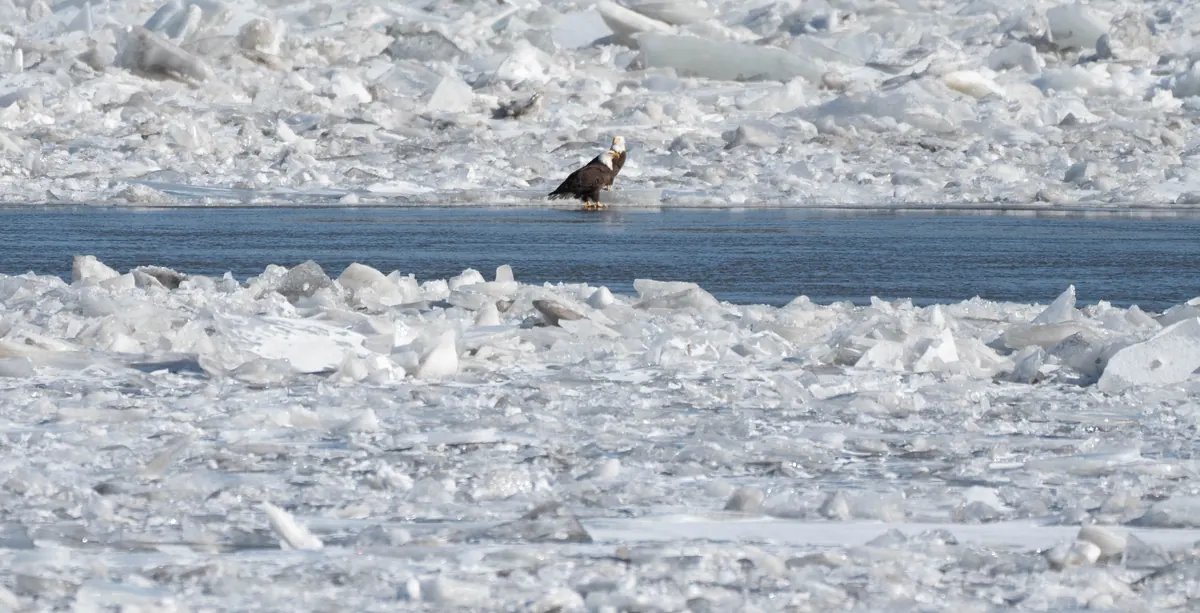
Wintering bald eagles follow the open water, where fish can still be caught. The more ice, the tighter they bunch up, so a hard freeze makes several eagles at once more likely.
-
The Midwinter Bald Eagle Survey
A two-week window in early January; the 2025 count ran January 3 to 17 · Standard routes and known hotspots statewide, coordinated by Audubon Vermont
Since 1979, volunteers in 43 states have run fixed, non-overlapping routes in early January to tally wintering eagles, according to the Vermont Center for Ecostudies, and Audubon Vermont coordinates the Vermont count. In 2025, 55 volunteers covered 33 routes and found 99 eagles, fewer than the 127 of 2024; Audubon thought the cold and the frozen lakes had kept birds away from their usual gathering places. The 2027 window had not been announced in early October.
-
Below Wilder Dam
All winter, best on cold mornings when the river above is frozen · The Connecticut River at Wilder, in the town of Hartford
Moving water below a dam stays open in the coldest weather, long after the river above has frozen. The Vermont Center for Ecostudies names this reach as one of the state’s well-known spots for wintering eagles. Check the tall trees on both banks for a white head, and the ice shelves beside the current, where eagles stand to eat.
-
Along the Champlain ice edge
Through January and into March, wherever the lake is still open · Chimney Point and the Champlain Bridge in Addison; Fort Cassin Point near Ferrisburgh; the Burlington waterfront
As the bays freeze, the line where ice meets open lake becomes the hunting ground. The Center for Ecostudies points to that edge near the Chimney Point Bridge and at Fort Cassin Point near Ferrisburgh. Young eagles, mottled brown without the white head, count too, so give every big dark bird on the ice a second look.
An eagle on the ice is usually eating; watch from a distance so it does not waste energy flying off.
What is screaming and hooting in the Vermont woods on January nights?
Two Vermont predators begin their breeding year in the dead of winter, and neither is quiet about it. Stand outside on a still night where woods meet fields and listen.
-
Great horned owls, already nesting
Courtship hooting in early January; incubation can begin this month · Woodlots beside open farmland, especially in the Champlain Valley
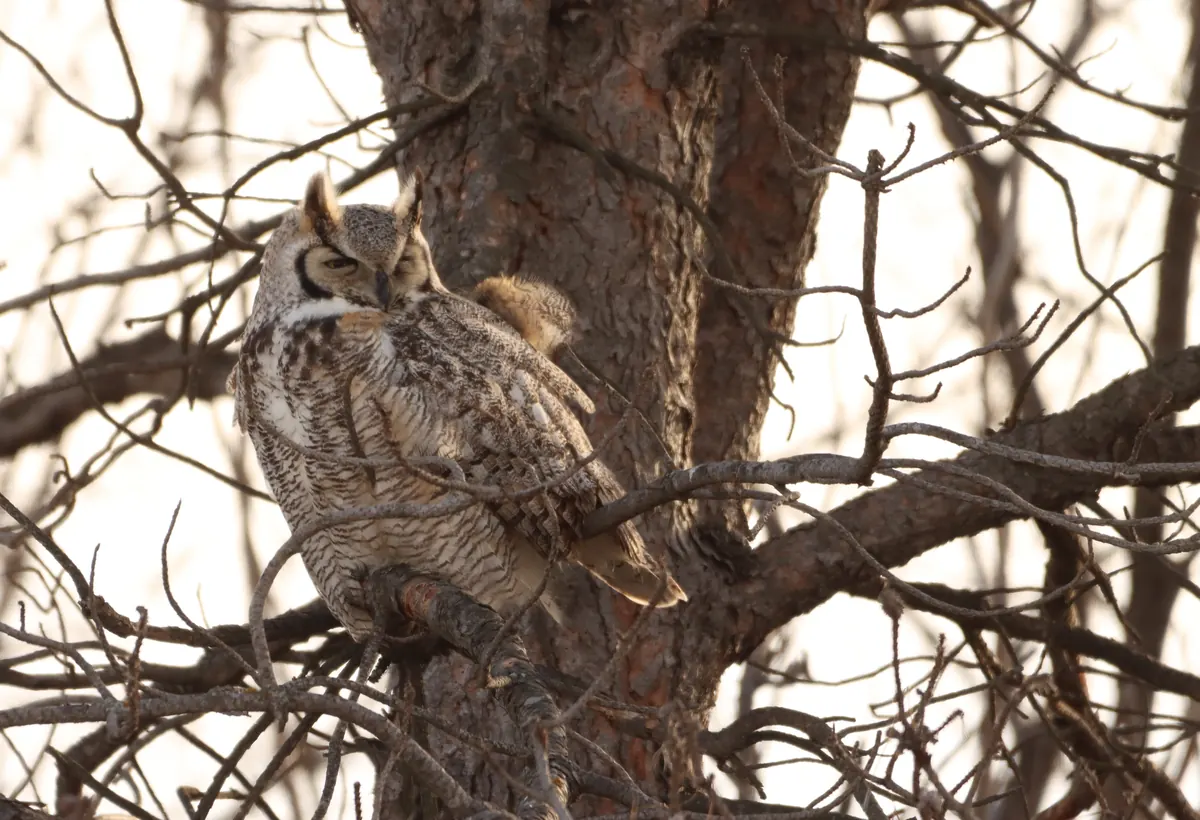
The Vermont Center for Ecostudies ranks this owl with the Northeast’s earliest nesters: females may be brooding eggs as early as January. Pairs move into an old hawk or crow nest, a squirrel’s leaf nest, a hollow trunk or a ledge instead of building, and lay one to four eggs. The deep, stuttering hoots carry more than a mile; when a pair calls back and forth, the female’s is the higher voice. The species has declined here: the second Vermont Breeding Bird Atlas found it in 38 survey blocks, down from 57 in the first.
-
Red foxes in mating season
January into early March, mostly at night · Field edges, hedgerows, orchards and back roads statewide
A high, ragged scream in the dark is usually a red fox. The Vermont Center for Ecostudies says foxes scream and bark to find mates from January into early March, calls often pinned on fishers, which are generally quiet. Northern Woodlands counts more than 20 distinct fox calls and notes that a foraging fox may leave as many as 70 urine marks in an hour; after fresh snow you can smell those skunky scent posts along its route. In a storm a fox simply curls up in the open, tail over its nose, and lets the snow cover it.
-
Bear cubs born in the den
Late January into early February · Brush piles, rock ledges, hollow trees and fallen logs, mostly in the mountains and the Kingdom
Nobody hears this one. Vermont Fish & Wildlife says black bear cubs arrive in late January or in the first days of February, while the mother is still denned. Each newborn weighs 8 to 10 ounces, about as much as a chipmunk, and a litter can run from one to five, usually two.
Near swamps and beaver ponds, listen also for barred owls, whose calls come in a rounder, rolling rhythm.
Where do Vermont’s deer go when the snow gets deep?
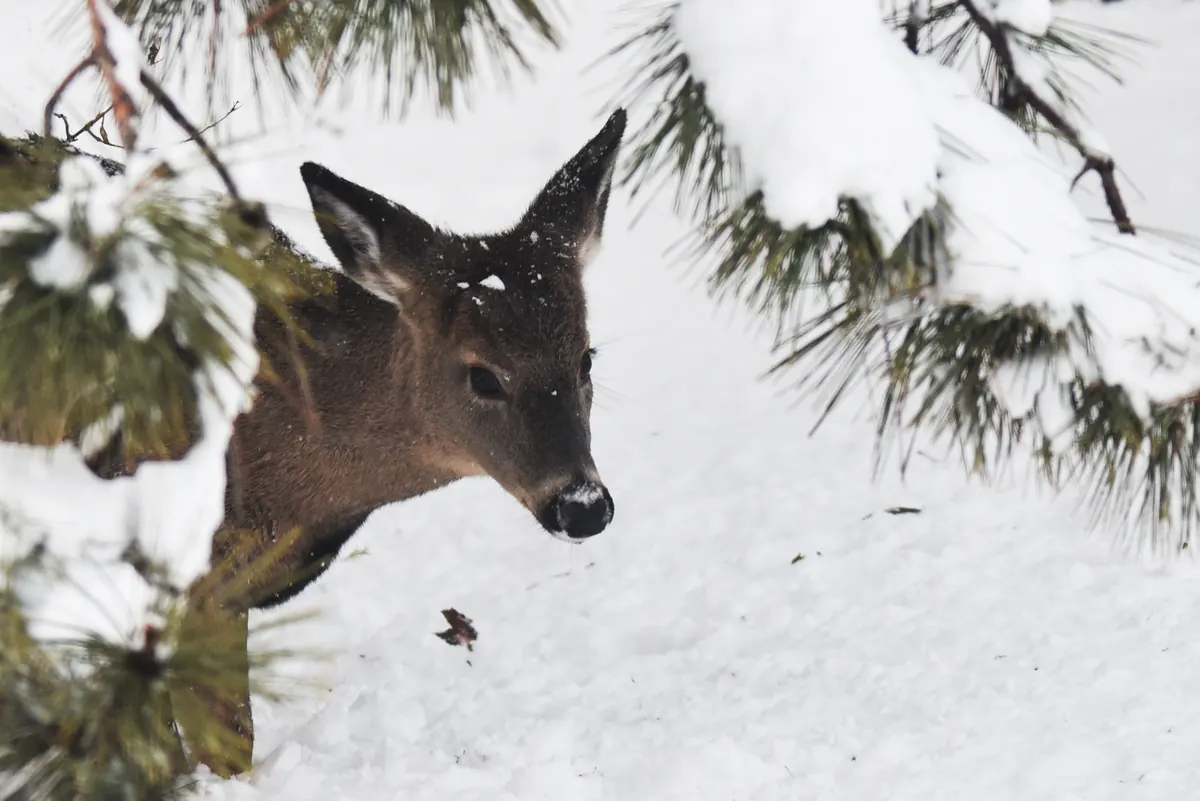
Vermont lies near the northern edge of the white-tailed deer’s range, and deep snow is the hardest thing these deer face. Their answer is to crowd into the same patches of dense softwood forest every winter: the deer yards.
-
Deer wintering areas
Potentially from December 1 to April 15, whenever the snow is deep · Dense hemlock and cedar stands in the south; spruce and fir in the north; steep south-facing slopes in southern Vermont
Vermont Fish & Wildlife’s landowner guide calls wintering areas the single most important habitat a deer uses here, though they cover less than 10 percent of the state’s forest. Under a closed canopy of mature softwoods the snow lies shallower, the wind is weaker and the air slightly milder. In order of value the department lists eastern hemlock, northern white cedar, red and white spruce, balsam fir and white pine. Deer return to the same yards year after year, sometimes walking many miles to get there.
-
How a deer gets through it
Midwinter · Inside and at the edges of the yard
A winter deer runs mostly on stored fat. The department explains that deer move only as much as they must and cut back on eating, close to semi-hibernation. What they do eat is browse: buds and twigs of young trees and shrubs, plus cedar and hemlock needles. Hobblebush, striped maple, dogwood, witch-hazel and young yellow birch in small openings near the softwoods are the yard’s pantry.
-
Signs to look for
After a few weeks with more than 18 inches of snow · Hemlock and spruce stands near brooks and on sheltered slopes
After snow has been deep for a few weeks, the department says, packed trails, heaps of pellets and oval beds melted into the snow are easy to see. Deer cannot afford to run in deep snow, so if you find a yard, back away and keep dogs leashed or at home.
Town clerks and regional planning commissions keep deer wintering area maps, and the state’s Agency of Natural Resources Atlas has them online.
What lives in and under the snow in a Vermont January?
Soft, deep snow is a blanket as much as a burden. Some animals live under it all winter, one bird dives into it to sleep, and others leave a clear record of their nights on its surface.
-
Mice, voles and shrews in the subnivean zone
Whenever there are 6 inches or more of snow on the ground · Fields, meadows and forest floors statewide
The layer of air and tunnels at the base of the snowpack has a name, the subnivean zone. Northern Woodlands explains that about six inches of snow gives small mammals a sturdy roof, and a couple more inches holds the space underneath within a degree or two of freezing whatever the night is doing above. Look on the surface for small holes, their air shafts; an ermine in its white coat may slip down one to hunt. Owls can hear a vole under the snow from 30 yards away and smash through feet first, and foxes and coyotes pounce nose down after the same prey.
-
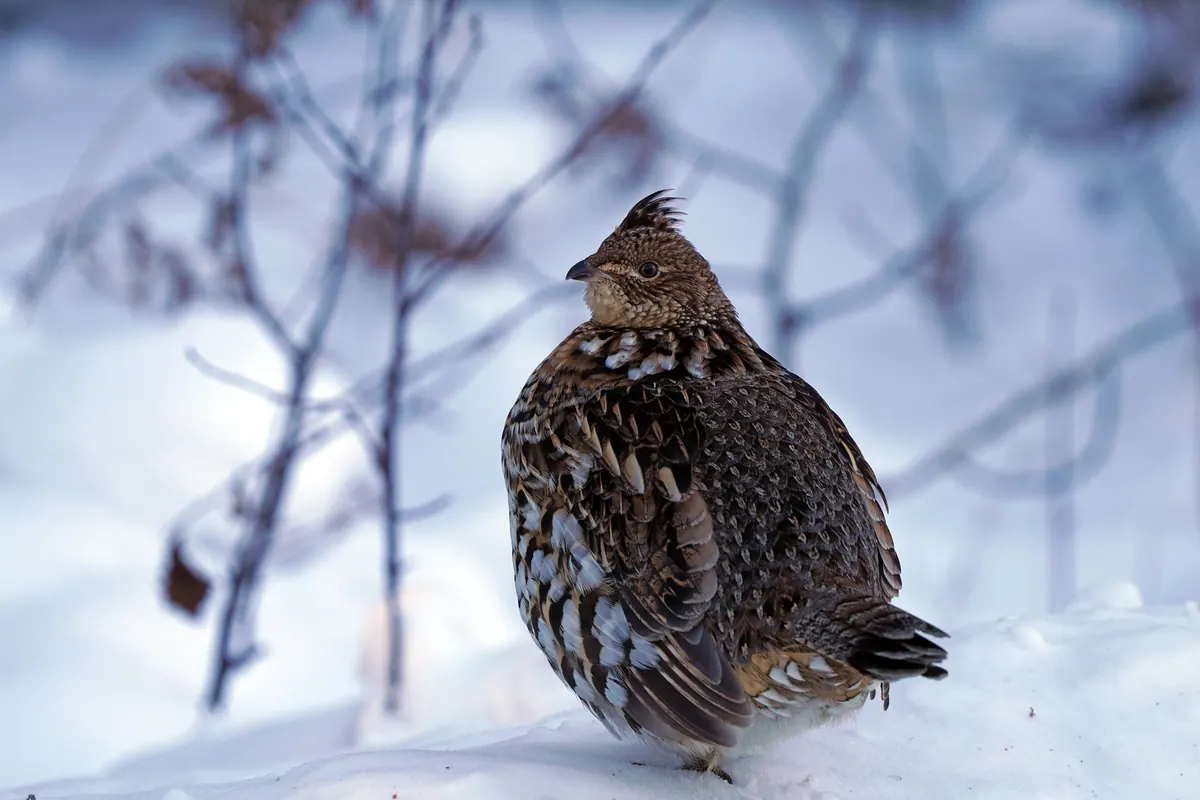
Ruffed grouse in snow roosts
Nights when the snow is soft and a foot or more deep · Young hardwoods and aspen stands, often next to conifers
A grouse that finds deep powder flies straight into it, burrows a short way and sleeps insulated. Northern Woodlands reports that the air in a snow roost may reach 32 °F and seldom falls below 20 °F in bitter cold, and that some tunnels stretch 10 feet. In the morning the bird explodes out, leaving a burrow, a small pile of droppings and the brush marks of its wingtips.
-
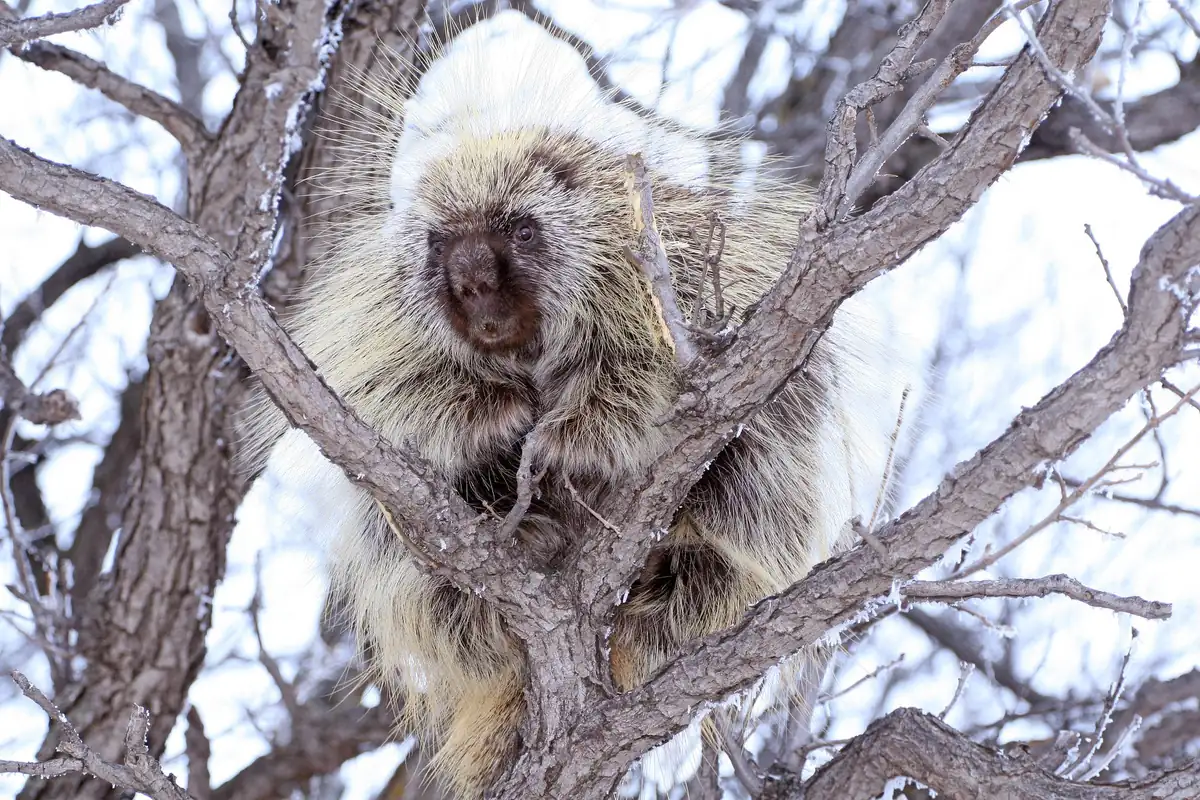
Porcupines in the hemlocks
All winter · Hemlock stands near rocky ledges
Porcupines winter close to a den, usually a rock crevice, and Northern Woodlands notes that one may use the same den for its whole 10 to 12 year life, marked by a big heap of droppings at the door. Their winter range shrinks by 80 to 90 percent, much of it the commute between den and a favorite hemlock, which becomes a deep plowed trough. Under the feeding tree lie hemlock sprigs cut cleanly at a 45 degree angle, the porcupine’s nip twigs.
-
Otters on the move
Mostly in midwinter, when ponds have frozen over · Streams and rivers that stay open, beaver ponds and their outlets
Vermont Fish & Wildlife says otters may leave frozen ponds and lakes for the open water of rivers and streams in winter. On land an otter bounds and then slides on its belly, so a trail of short hops broken by long smooth grooves, especially heading downhill to water, is almost surely an otter’s.
A single snowy Vermont walk can fill two plates of the Naturalist’s Field Journal.
How do you identify Vermont’s hardwood trees in winter?
Bare hardwoods can look like a wall of gray sticks, but bark, buds and twig pattern sort out the common trees quickly, and January, with nothing hiding the twigs, is the month to learn them. Ask first whether buds sit in pairs across from each other (opposite) or stagger along the twig (alternate). Among Vermont’s common trees, only maples and ashes have opposite branching.
-
Sugar maple
All winter · Rich upland slopes and sugarbushes statewide
Opposite branching, brown twigs and slim, sharp-pointed buds wrapped in several overlapping scales, per the Native Plant Trust’s Go Botany guide. Old trees have gray bark broken into long ridges and plates. In six or eight weeks the sap will run.
-
Red maple
All winter; buds swell in March · Swamps, wet edges, roadsides and dry ridges alike
Also opposite, but with red to gray twigs and plumper, blunter buds that are plainly red, often clustered at the tips. Go Botany notes those buds swell early in spring, and the red flowers open before the leaves. Young bark is smooth and pale gray.
-
American beech
All winter · Northern hardwood forests on the lower slopes
Smooth, light gray bark and long, cigar-shaped buds up to three-quarters of an inch make beech the easiest hardwood in the January woods, and young beeches often keep their papery leaves all winter. Bark that is pitted and cankered shows beech bark disease, which Go Botany describes as a fungus that blisters the bark after an introduced scale insect has attacked it.
-
Yellow birch and paper birch
All winter · Cool, moist forests and ravines; paper birch on old burns, clearings and higher slopes
Paper birch is the chalky tree with bark peeling in sheets. Yellow birch has shiny bronze to silvery bark curling off in thin ribbons, and Go Botany’s test is to scratch a young twig: yellow birch smells of wintergreen. Both birches alternate their buds.
Which winter birds can you find in Vermont in January?
Vermont’s January bird list is short, which makes each bird easier to study. Two habitats repay a visit: the open water of Lake Champlain and the cone-laden softwoods.
-
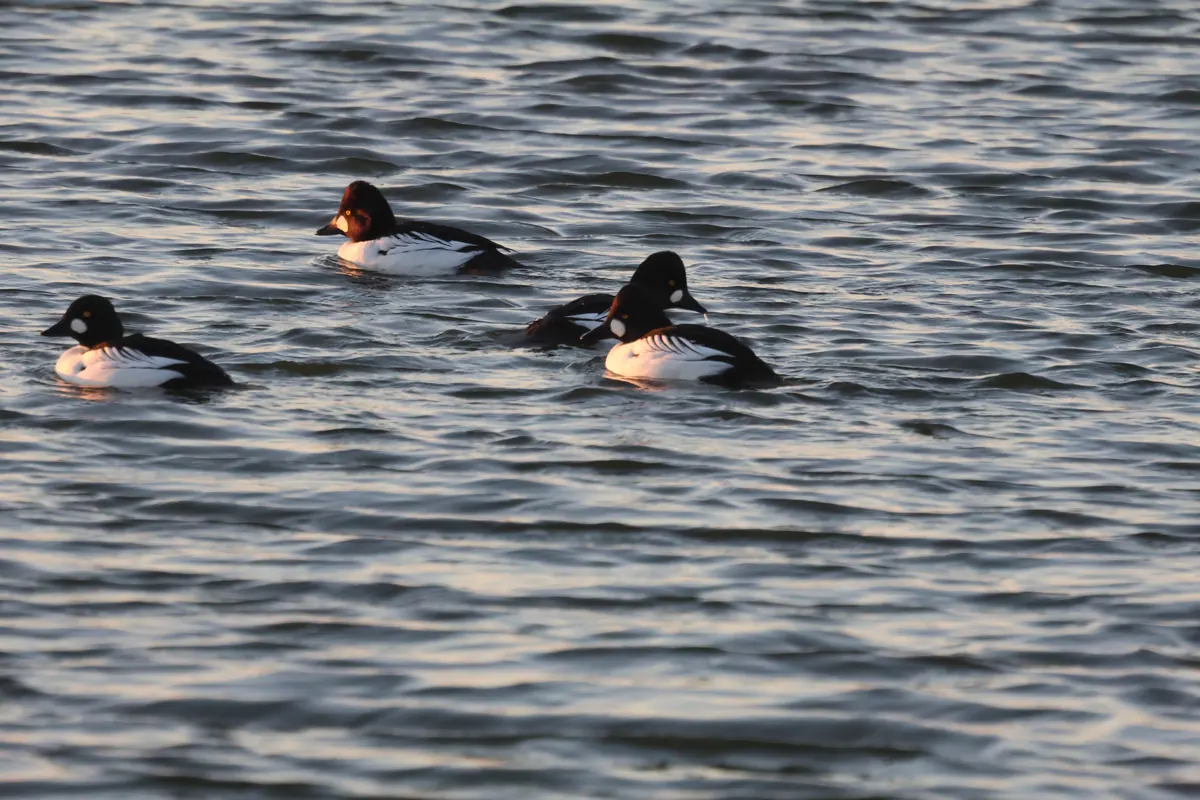
Common goldeneyes on the lake
All winter, wherever the lake is open; displays build toward spring · Protected bays and the ice edge on Lake Champlain; the Burlington waterfront
The Lake Champlain Committee calls the common goldeneye the lake’s most common winter duck. Drakes are bright white with a glossy dark head and a round white spot by the bill. On calm days, watch for a drake flinging his head back onto his spine, a courtship move that grows more frequent toward spring. Sort through the flocks: the committee says a rare Barrow’s goldeneye shows up each winter, and rafts of greater and lesser scaup gather near the Champlain Bridge, sometimes with a European tufted duck mixed in.
-
Crossbills and siskins in the softwoods
All winter · White pine, spruce, hemlock and cedar stands; less often at feeders
The Finch Research Network’s 2026–27 forecast reports very good cone crops on Northeast white pines, northern white cedars and red spruces. It expects good numbers of red crossbills, a sizable pine siskin flight and scattered white-winged crossbills, with many birds staying in the forest instead of visiting feeders. Scan the tops of heavily coned spruces and pines, and listen for small flocks calling as they pass over. Evening grosbeaks may reach the region in small groups, the forecast says, while pine grosbeaks and Bohemian waxwings will probably remain farther north.
-
Feeder regulars, counted
All winter; FeederWatch runs to the end of April · Backyards statewide
Chickadees, nuthatches, woodpeckers, titmice and juncos carry the January feeder. The Vermont Center for Ecostudies notes that junco flocks keep a pecking order with adult males on top. Count yours for Project FeederWatch or post an eBird checklist.
If this turns out to be a snowy owl winter, check the Addison County farm fields, as the December guide describes.
Does Lake Champlain freeze in January, and when is ice safe to walk on?
Small ponds and the sheltered bays freeze early, and January is when ice fishing gets going in earnest. The broad lake is another matter. The National Weather Service office in Burlington counts Lake Champlain as “closed” when ice spans the wide part from Burlington to Port Kent, New York, and its list shows how rarely that now happens: no closing at all from 2019–20 through 2024–25, then a closing on February 13 in 2025–26. Since 2000 the earliest closing on the list came on January 27, 2004, so expect open water on the main lake through January.
-
What the anglers are after
Once the bays have safe ice, usually from January · South Bay and Keeler Bay, Knight Point, the mouth of the Winooski, and many inland ponds
The Lake Champlain Committee lists northern pike in South Bay and Keeler Bay, yellow perch off Knight Point and a mix of species at the mouth of the Winooski River. Shanties must be off the ice by the last Sunday in March, or sooner if it weakens.
-
Free Fishing Day, January 30
Saturday, January 30, 2027 · Any Vermont water open to ice fishing
Vermont’s fishing rules set aside the last Saturday in January and the second Saturday in June as Free Fishing Days, when residents and nonresidents may fish without a license under the usual methods and limits. Vermont Fish & Wildlife has paired the winter date with a free Ice Fishing Festival at Elmore State Park, most recently on January 31, 2026, with loaner gear, lessons and a fish fry. Look for 2027 festival details on the department’s Free Ice Fishing Day page.
Vermont Fish & Wildlife asks for at least 3 to 4 inches of clear black ice before anyone fishes on it, and at least 6 inches of the cloudy gray kind that forms after a thaw and refreeze. The Lake Champlain Committee warns that ice near currents, streams, bridges and culverts can stay thin when the ice around it is thick. Test with a spud bar as you walk, wear ice picks, and bring a partner.
How cold and snowy is January in Vermont, and how might El Niño change it?
No month is colder at any station in the table below, according to NOAA’s 1991–2020 normals. Burlington averages a high of 28.9 °F and a low of 12.9 °F, with 21.1 inches of snowfall and snow cover on about 25 days. The Northeast Kingdom runs colder and snowier: Island Pond’s average low is 3.4 °F, and Sutton gets more than 31 inches of snow. The summit of Mount Mansfield, with nearly 41 inches in an average January, tops the list.
| Station | Average high | Average low | Snowfall | Days with snow cover |
|---|---|---|---|---|
| Burlington International Airport (Champlain Valley) | 28.9 °F | 12.9 °F | 21.1 in | 25.3 |
| South Hero (Champlain Islands) | 27.8 °F | 11.3 °F | 11.4 in | 23.7 |
| St. Albans (Franklin County) | 25.1 °F | 8.2 °F | 16.9 in | 23.1 |
| Cornwall (Addison County) | 27.1 °F | 9.2 °F | 13.3 in | 22.2 |
| Rutland | 29.4 °F | 8.0 °F | 18.3 in | 25.0 |
| Northfield (central Vermont) | 28.7 °F | 6.3 °F | 17.9 in | 29.4 |
| St. Johnsbury (Northeast Kingdom) | 28.4 °F | 9.0 °F | 19.9 in | 28.6 |
| Newport (Lake Memphremagog) | 23.4 °F | 3.9 °F | 21.5 in | 30.1 |
| Island Pond (Northeast Kingdom) | 23.5 °F | 3.4 °F | 25.3 in | 30.4 |
| Sutton (Northeast Kingdom) | 22.6 °F | 4.2 °F | 31.3 in | 31.0 |
| Mount Mansfield (summit) | 21.1 °F | 5.7 °F | 40.9 in | 31.0 |
What a very strong El Niño could mean. Pacific waters are running warm, and Climate Prediction Center forecasters, writing in mid-September, put the chance of this El Niño staying very strong all winter above 90 percent. NOAA’s seasonal outlook, first issued October 15, is refreshed monthly, so check the 90-day outlook maps for its current January call.
During the strong 2015–16 event, the Burlington forecast office wrote that El Niño winters of every strength have brought a mix of outcomes to Vermont and northern New York, with some sign that strong events lean to near or above normal temperatures, but too few strong cases to be sure. A NOAA briefing prepared with the Northeast Regional Climate Center adds that El Niño winters tend to send storms up the East Coast, citing research that finds roughly two more classic nor’easters than in other winters. Whether they bring Vermont snow or rain hangs on track and temperature, and on the North Atlantic Oscillation, which can override El Niño and cannot be predicted months out.
A January example shows what a blocked Atlantic can do. On January 2 and 3, 2010, an ocean storm trapped by a strong ridge over Greenland drifted back toward New England, and the weather office measured 33.1 inches at Burlington, the city’s largest snowfall on record, while Plattsburgh, across the lake, got 7. Our weather page has the current forecast, and spring’s last-frost odds for your town are on the Vermont frost dates page.
How much daylight does Vermont gain in January?
The year’s latest sunrises come around New Year’s Day, but evenings have been lengthening since mid-December, and by month’s end the light is growing at both ends. Burlington goes from 8 hours 55 minutes on January 1 to 9 hours 47 minutes on January 31, a gain of 52 minutes; St. Albans and Newport, farther north, gain 54, while Brattleboro and Bennington gain 50.
| City | Jan 1 | Jan 31 | Gained | Per day |
|---|---|---|---|---|
| Burlington | 8 h 55 m | 9 h 47 m | 52 min | 1.7 min |
| St. Albans | 8 h 52 m | 9 h 46 m | 54 min | 1.8 min |
| Newport | 8 h 51 m | 9 h 45 m | 54 min | 1.8 min |
| St. Johnsbury | 8 h 55 m | 9 h 48 m | 53 min | 1.8 min |
| Montpelier | 8 h 56 m | 9 h 48 m | 52 min | 1.7 min |
| Rutland | 9 h 01 m | 9 h 52 m | 51 min | 1.7 min |
| Brattleboro | 9 h 06 m | 9 h 56 m | 50 min | 1.7 min |
| Bennington | 9 h 05 m | 9 h 55 m | 50 min | 1.7 min |
February adds daylight faster still. Look up any Vermont town’s sun times, twilight included, with our daylight calculator.
What can you see in Vermont’s night sky in January 2027?
Dry, frigid air can make a Vermont January night extraordinarily clear. The month opens with a well-timed meteor shower and Venus at its best for the season. Times are Eastern Standard Time.
-
The Quadrantids
Night of Sunday, January 3, into Monday, January 4; active December 28 to January 12 · A dark spot with an open view to the northeast
The Quadrantid maximum is brief, and in 2027 it falls in North American darkness: near 10:30 p.m. on Sunday by the American Meteor Society’s reckoning, or close to 12:47 a.m. Monday by EarthSky’s. The radiant, between the Big Dipper’s handle and Boötes, climbs all night, so the predawn hours of Monday are best, and the waning crescent, less than a fifth lit, rises only near dawn. A rural Vermont sky might give a few dozen meteors in an hour; a lit town, far fewer.
-
Perihelion, and Venus at its farthest from the sun
Perihelion at 9:33 p.m. Saturday, January 2; Venus at greatest elongation Sunday, January 3 · Venus in the southeast before dawn
Saturday evening brings perihelion, Earth’s nearest point to the sun all year, at about 91.4 million miles: proof that Vermont’s cold comes from the low sun and short days, not distance. On Sunday Venus reaches greatest western elongation, 47 degrees from the sun; it blazes low in the southeast before dawn all month.
-
The Wolf Moon, a supermoon
Full at 7:17 a.m. Friday, January 22; best on the evening of Thursday, January 21 · Rising in the northeast around sunset
Perigee, the moon’s nearest approach, comes late on the afternoon of January 21, roughly 14 hours ahead of full phase, so this is 2027’s nearest full moon, roughly 222,000 miles off. Because it turns full around sunrise on Friday, Thursday evening’s moonrise is the one to catch, with the moon over the snow all night. On Saturday evening, the 23rd, Jupiter sits just beside it.
-
Planets in the evening
All month · Saturn in the southwest after dark; Jupiter and Mars in the east later in the evening
Saturn is low in the southwest at dusk, lower each week. Jupiter, heading for opposition on February 10, rises in the east during the evening and outshines every star, and Mars, a fainter orange point in the same eastern sky, gains brightness ahead of its own opposition later in February. By late January Mercury starts its best evening showing of the winter, low in the west-southwest after sunset.
| Phase | Date | Time |
|---|---|---|
| New moon | Thursday, Jan 7 | 3:24 p.m. EST |
| First quarter | Friday, Jan 15 | 3:34 p.m. EST |
| Full moon (Wolf Moon) | Friday, Jan 22 | 7:17 a.m. EST; closest full moon of 2027 |
| Last quarter | Friday, Jan 29 | 5:55 a.m. EST |
| New moon | Saturday, Feb 6 | 10:56 a.m. EST |
For the Milky Way and faint objects, the moonless evenings from about the 3rd to the 12th are best. Aurora is still possible this winter on a lucky night; NOAA’s Space Weather Prediction Center tracks it. Our cloud forecast shows whether a given night will be clear, and the moon phase calendar lists moonrise for each date.
What can Vermont families do outdoors in January 2027?
- Friday, January 1: a First Day Hike. Vermont State Parks and partners lead free guided New Year’s Day walks each year; for January 1, 2025, hikes were scheduled at places including Woodford, Allis, Bomoseen, Brighton and Button Bay state parks and Mount Mansfield, Groton and Willoughby state forests. Check the Vermont State Parks events listing in December for the 2027 hikes.
- Through Tuesday, January 5: Christmas Bird Count. Audubon’s 127th season ends on the 5th; its count map shows whether a nearby circle still has a count day left.
- Sunday night, January 3: Quadrantids.
- Early January: help count eagles. Audubon Vermont recruits volunteers for the Midwinter Bald Eagle Survey; 2027 dates were not yet set in early October.
- Saturday, January 30: Free Fishing Day. No license needed on any water open to ice fishing.
- Monthly: Missisquoi bird monitoring. The refuge’s Friends group runs a survey walk on the third Saturday of most months; check its calendar for the January date.
- Any day: VINS. The nature center in Quechee is open daily, 10 to 5, with owls and hawks that cannot return to the wild.
- Any snowy weekend: a tracking walk. Check Vermont State Parks’ winter day-use fees and gate status before you go; many park roads are closed to cars, so you may need to park at the gate and walk or ski in.
The nature hub covers other states and months; for evergreens and the Christmas counts, read the Vermont December guide.
Safety notes for January in Vermont
- Hunting and trapping. Vermont Fish & Wildlife’s 2026–27 calendar keeps the late Canada goose season open through January 4 in the Lake Champlain, Interior and Connecticut River zones. Hare and cottontail hunting continues to March 14 in most wildlife management units (March 31 in units D and E), coyote has no closed season, and beaver, otter and muskrat trapping runs through March 31. Deer, grouse and squirrel seasons are closed.
- Hunter orange. No law requires it here. Even so, Vermont’s hunting guide recommends an orange hat and vest at minimum, pointing to New York figures in which almost every victim of a mistaken-for-game accident was wearing none.
- Ice. Use the thickness guide above, and remember thickness changes within a few steps. Keep off ice near inlets, outlets, bridges and springs, off the open leads of Lake Champlain, and off river ice altogether. If you break through, turn back toward the ice that held you and use your picks.
- Cold and wind. Subzero lows are routine in the Kingdom and the mountain valleys, and wind on open ice or a ridge makes them feel far colder. Layer up, cover face and fingers, and check children for pale, waxy patches, an early sign of frostbite.
- The mountains. Above treeline on Mansfield and Camel’s Hump, expect hard ice, drifts and fierce wind. Carry traction and a spare layer, set a turnaround time, and retreat when the visibility goes.
- Short days and storms. No Vermont town gets ten hours of daylight this month; start early and pack a headlamp. Nor’easters and squalls can close back roads fast, so look at the forecast before heading to a trailhead.
Sources
- Vermont Center for Ecostudies: Field Guide to January (2018)
- Vermont Center for Ecostudies: Field Guide to January (2024)
- Audubon Vermont: A Glimpse into the 2025 Mid-Winter Bald Eagle Survey
- Audubon Vermont: Peregrine Falcon and Bald Eagle Monitoring
- Vermont Atlas of Life: Bald Eagle (Vermont Breeding Bird Atlas)
- Northern Woodlands: From Yips to Shrieks, Fox Talk Runs the Gamut
- Vermont Fish & Wildlife: Black Bear
- Vermont Fish & Wildlife: A Landowner’s Guide, White-tailed Deer
- Vermont Agency of Natural Resources: Deer Wintering Areas map layer
- Northern Woodlands: The Subnivean Zone, Shelter in the Snow
- Northern Woodlands: Why Ruffed Grouse Take Winter in Stride
- Northern Woodlands: Porcupines, Waddling Through Winter
- Vermont Fish & Wildlife: River Otter
- Go Botany (Native Plant Trust): Sugar maple
- Go Botany (Native Plant Trust): Red maple
- Go Botany (Native Plant Trust): American beech
- Go Botany (Native Plant Trust): Yellow birch
- Lake Champlain Committee: Nature Note, Winter Ducks
- Finch Research Network: Winter Finch Forecast 2026–2027
- Project FeederWatch: How to participate
- eBird
- National Weather Service Burlington: Lake Champlain closing dates
- Lake Champlain Committee: The Basics of Ice Fishing on Lake Champlain
- Vermont Fishing Regulations: License Information (Free Fishing Days)
- Vermont Fish & Wildlife: Free Ice Fishing Day
- Vermont Agency of Natural Resources: Vermont’s Free Ice Fishing Day (2024 festival)
- Vermont Fish & Wildlife: Ice Fishing Fun and Safety
- NOAA NCEI: Monthly climate normals 1991–2020, Vermont stations
- NOAA Climate Prediction Center: ENSO Diagnostic Discussion, September 10, 2026
- NOAA Climate Prediction Center: 90-day outlooks
- National Weather Service Burlington: The Four Seasons, Winter 2015–2016 (El Niño and the Winter Outlook)
- NOAA and Northeast Regional Climate Center: El Niño Impacts and Outlook, Northeast Region
- National Weather Service Burlington: Champlain Powder, the historic snowfall of January 2–3, 2010
- U.S. Naval Observatory: Moon phases
- U.S. Naval Observatory: Earth’s seasons and apsides, 2027
- Fred Espenak: Sky Event Almanac 2027
- American Meteor Society: Meteor shower calendar
- EarthSky: Quadrantid meteor shower
- EarthSky: What is a supermoon?
- NOAA Space Weather Prediction Center: Aurora forecast
- Vermont State Parks: Park events
- America’s State Parks: First Day Hikes
- Manchester Journal: Vermont State Parks host First Day Hikes (January 1, 2025)
- Vermont State Parks: Winter activities
- National Audubon Society: Join the Christmas Bird Count
- Friends of Missisquoi National Wildlife Refuge: Calendar
- VINS Nature Center
- Vermont Fish & Wildlife: Hunting and trapping seasons
- Vermont Fish & Wildlife: Vermont’s migratory game bird seasons are announced (2026–27)
- Vermont Hunting Regulations: General hunting information (hunter orange)
- Photos via Wikimedia Commons; licenses and photographers are credited under each picture
