What to look for in nature in Washington this May
May is when Washington's quiet arrivals show up. Rhinoceros auklets and a few endangered tufted puffins settle into burrows on offshore islands, nighthawks start their booming dives over open ground, and Swainson's thrushes fill the dusk with flute notes. The Pacific dogwood opens its white bracts in the western woods, and the Cascade passes inch toward their opening dates. The tide drops lowest around the new and full Moons, the Eta Aquariids streak the dawn, and the May 20 full Moon, the Flower Moon, doubles as a seasonal Blue Moon. Seattle gains 73 minutes of daylight across the month, and this guide sorts the month by what you can see.
Other months in Washington: October, November, December, January, February, March, April.
Start here
- Walk a very low tide. Pick a day in the May 5 to 11 or May 18 to 24 runs, look up your beach's tide time and arrive an hour early. Look, do not collect, and keep an eye on the water behind you.
- Listen at dusk for the late arrivals. On a warm evening stand near a thicket or an open field and listen for a Swainson's thrush's flute song, and look up for a nighthawk's booming dive. Note the date of your first.
- Find a dogwood bloom. West of the Cascades, look in forest openings for the white bracts of Pacific dogwood, and check its leaves for brown blotches. Leave the flowers on the tree.
Keep a record: add the first nighthawk dive or Swainson's thrush song to birds I have seen, follow one dogwood through the seasons, put the dusk voices on a map of sounds, log every low-tide walk in the daily field log, tally bats over water at dusk, and visit one thicket twice for the same place twice.
Regions used below: Puget Sound and Seattle; Olympic Peninsula and the coast; Southwest and the lower Columbia; North Cascades and the Methow; Central Washington and the Yakima Valley; Columbia Basin and the Tri-Cities; Spokane and the Palouse.
Where can you see puffins and auklets in Washington in May?
May is the month when Washington's burrow-nesting seabirds are settled on their islands, and the birds are worth knowing even if you never see one up close. The nesting colonies sit on a handful of small islands along the northern outer coast, around the Strait of Juan de Fuca and in the Salish Sea, and most are closed to visitors on purpose. What most of us can do is watch from a ferry, a headland or a licensed tour boat, and learn what these birds are doing while we are not looking.
-
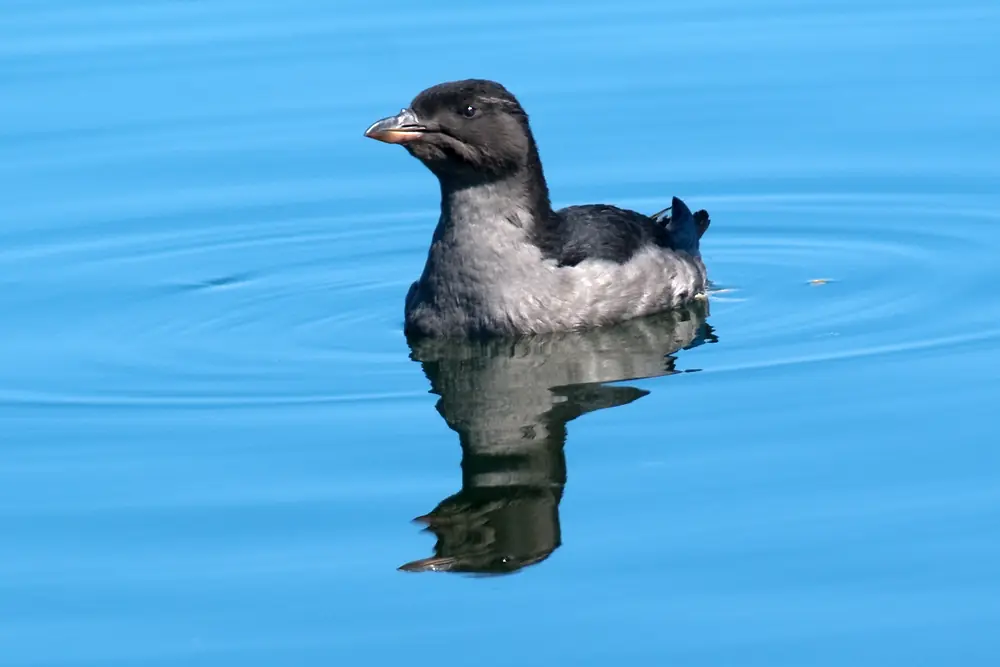
Rhinoceros auklets on Protection Island
Seattle Audubon's BirdWeb rates it common on inland marine waters April through August and on the outer coast May through August · Protection Island National Wildlife Refuge in the Strait of Juan de Fuca, and the water around the Salish Sea
The refuge describes Protection Island as holding the third largest rhinoceros auklet colony in North America, and says about 70 percent of the Salish Sea's breeding seabirds nest there. BirdWeb adds that Washington has over 60,000 of these birds, concentrated in three colonies: Protection, Destruction and Smith islands. The birds dig burrows that can run 20 feet, lay a single egg at the end, and are nocturnal around the colony, which is why you rarely see them on land. On the water they are chunky, dark diving birds that can stay under for up to two minutes. A good May plan is a slow scan of calm water from a ferry rail or a shoreline pullout, looking for small dark divers with a pale bill and a horn at its base.
-
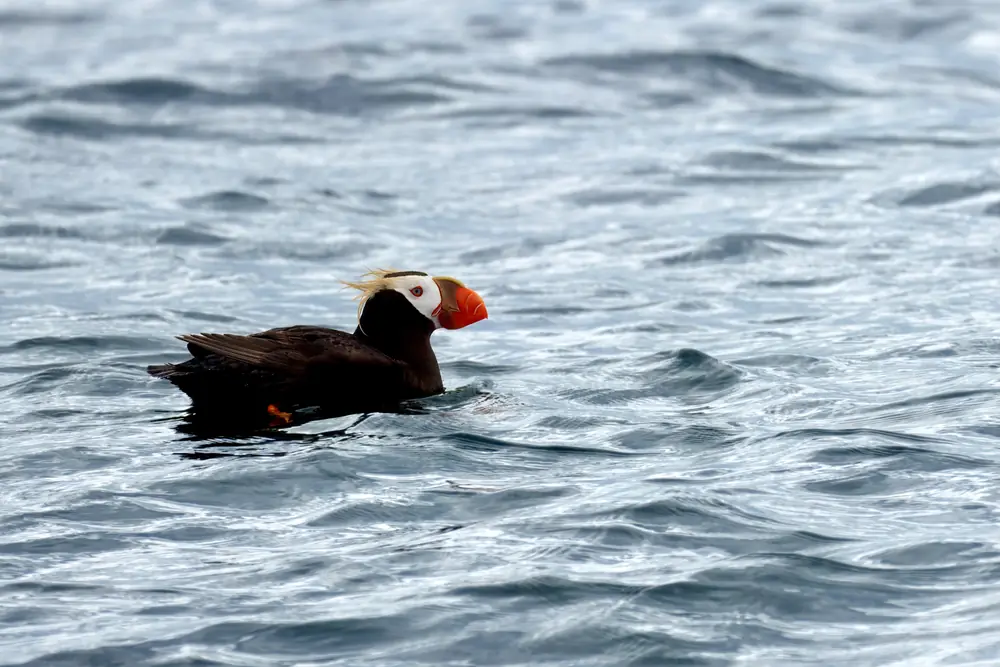
Tufted puffins, rare and endangered
The state's page puts the breeding season at mid-April to early September · Island colonies off the northern outer coast and in the eastern strait
WDFW lists the tufted puffin as endangered in Washington. The minimum population estimate fell from 23,342 birds in 1978 to 1982 to 2,958 birds in 2009, and only 19 of 44 historical breeding sites were still occupied. The agency says the cause is uncertain, with reduced prey, predators at nesting colonies, disturbance and climate change all on its list of possible factors. Puffins also nest in burrows, again with a single egg. A puffin sighting in Washington is a record worth reporting: WDFW asks for a photo and exact coordinates through its wildlife observation form.
-
Watching without disturbing
Year-round rules, but they matter most in the nesting season · Boats near Protection Island and anywhere seals, sea lions or whales are present
Protection Island is closed to visitors, and the refuge says the waters within 200 yards are closed to all watercraft so adult birds are not flushed from their nests. Be Whale Wise, the regional boating guidance program, asks boaters to stay 100 yards from seals, sea lions, gray whales and humpbacks, 200 yards from Bigg's (transient) killer whales and 1,000 yards from the endangered Southern Resident killer whales, and to slow to under 7 knots within half a mile of the Southern Residents. If you cannot tell which kind of orca you are looking at, the program says to follow the stricter rule.
A seabird log works best when you record where you were and what the water was doing, because auklets and puffins move with the fish. Last month's April guide covers the shorebirds that are leaving the coast as these seabirds settle in.
Which birds are the last to arrive in Washington?
By May the early migrants are already singing, so the interesting arrivals are the late ones. These birds wait for flying insects to build up, and many of them are not here until the second half of the month. If you have a backyard, a willow thicket or a patch of sagebrush within reach, May is the month to learn five new voices.
-
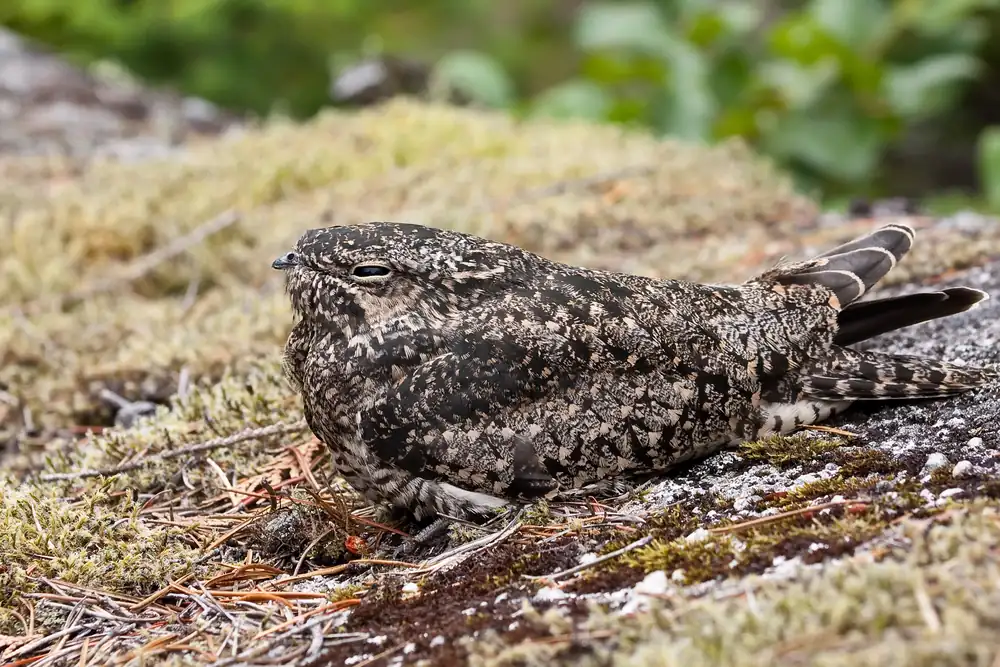
Common nighthawks
Mid-May through August, among the latest spring arrivals · Open ground: shrub-steppe and farmland in the Columbia Basin, cities, clear-cuts and burns, and a few places in western Washington
BirdWeb puts nighthawks in Washington from mid-May and notes that they are among the latest spring arrivals to turn up. Look up at dusk and dawn for a long-winged, narrow bird with white wing patches flying erratically after insects. Males climb and then dive, and the rush of air at the bottom of the dive makes a booming sound. Females lay two eggs on bare sand or gravel and build no nest. In western Washington small numbers breed in the Puget Trough and out to Ocean Shores, but BirdWeb dates that nesting to June and later, so May is for watching the flight displays.
-
Swainson's thrushes
Late spring; spring migrants appear in eastern Washington in late May, per BirdWeb · Dense hardwood and mixed forest at low and middle elevations, and salmonberry thickets
This is the thrush whose flute-like song drifts out of the understory at dusk. BirdWeb says none winter in Washington, and that the nest is an open cup on a horizontal branch, typically 2 to 10 feet up, often in a salmonberry stand. Because the bird stays hidden, the song is the way to find it. Add its first song to your log, then go back the same evening a week later and note whether the chorus has grown.
-
Western tanagers
Widespread between May and September; a relatively late spring migrant · Open conifer and mixed forests, and in migration yards, orchards and shrub-steppe
BirdWeb calls the western tanager a late-spring and early-fall migrant, and common in the Puget Trough lowlands during migration. A male is a bright yellow bird with a red face, and it can turn up in a suburban yard in May. The nest is a shallow cup well out on a horizontal fork, and the young leave after about 11 days. In breeding season the diet is mostly insects.
-
Yellow warblers and the cowbird problem
Common from May through mid-August · Willow, alder and cottonwood thickets near water, most common in eastern lowland stream corridors
Males arrive first and females follow about ten days later, according to BirdWeb, so a bush full of singing males in early May can mean the nesting season has not really started. Yellow warblers are a favorite target of brown-headed cowbirds, the species that leaves its eggs in other birds' nests, and a warbler that finds a cowbird egg sometimes builds a new nest right over it. It is one of the stranger things you can learn about from a thicket.
-
Sage thrashers
Present in sagebrush from the end of March to mid-August · Open big sagebrush and bitterbrush shrub-steppe in eastern Washington
BirdWeb lists the sage thrasher as a Species of Concern and a candidate for state endangered listing, with habitat loss and cheatgrass as major threats. Pairs build a bulky nest in or under a big sagebrush and incubate four or five eggs, with both adults feeding nestlings that fledge roughly 10 days after hatching. The bird is a casual to rare spring migrant west of the Cascades, so go east to look, keep to roads and trails, and treat each sagebrush stand as someone's nursery.
Late arrivals are a good test of a bird log. Note the date, the place and the weather for each first, and the pattern across a few Mays will tell you more than any chart. Your field journal has plates for exactly this.
What blooms, flies and leafs out on Washington's prairies and woodlands in May?
West of the Cascades, May belongs to the open prairies of the south Puget Sound and to dogwood in the understory. The prairies are rare and fragile, and a few of them shelter butterflies found almost nowhere else.
-
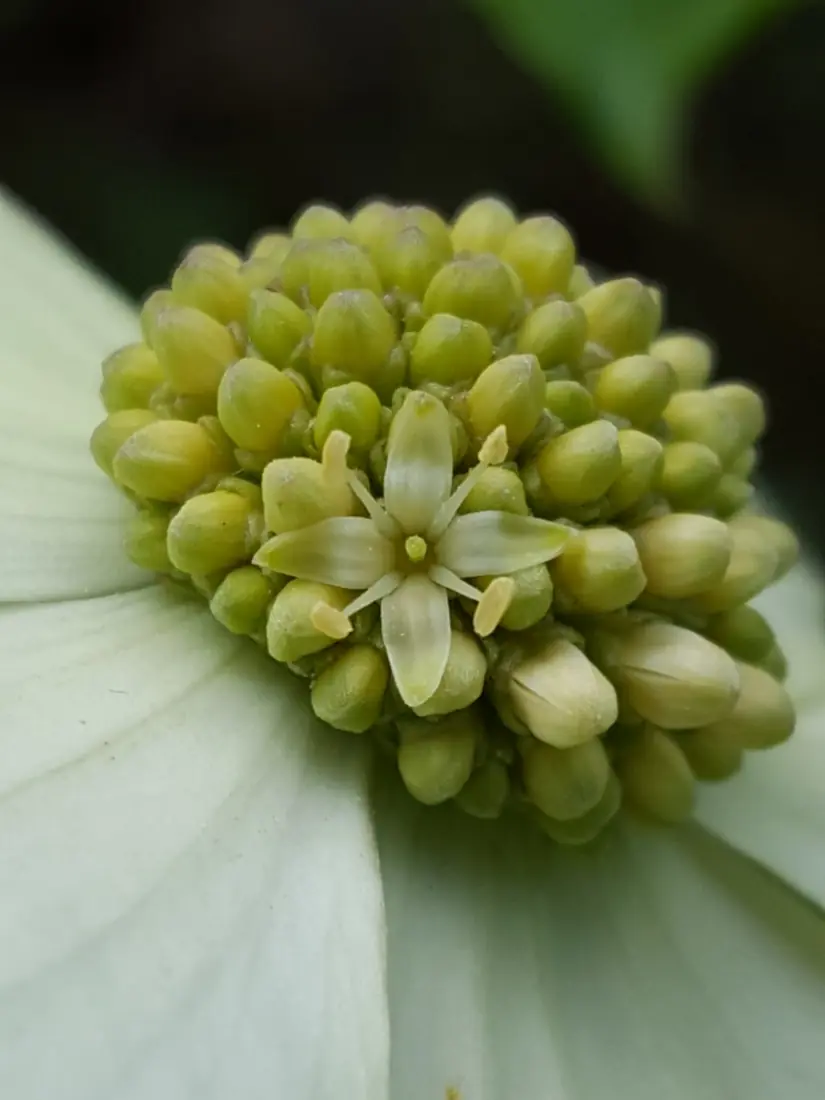
Pacific dogwood in bloom
Flowers from April through June, per Native Plants PNW · Moist, well-drained understory in fairly open mixed forest in western Washington
What looks like a single large white flower on a Pacific dogwood is a tight cluster of tiny greenish flowers surrounded by four to six white bracts, sometimes tinged with pink. The tree ranges from southwestern British Columbia through western Washington and Oregon. It is highly susceptible to dogwood anthracnose, a fungus that leaves large brown blotches on the leaves and can kill twigs, so a healthy bloom is something to note. Look for the white flush in forest openings along trails and creeks, and check the leaves while you are there.
-
Mima Mounds Natural Area Preserve
Hours are 7 a.m. to dusk daily; the state page gives no bloom dates · South of Olympia in Thurston County, managed by the Department of Natural Resources
The preserve protects a prairie community of Roemer's fescue and white-topped aster on the unusual low mounds that give the place its name. DNR describes it as home to a variety of prairie-dependent butterflies and birds, and its restoration work aims to help rare plants, butterflies and birds of prairie and oak habitats. A Discover Pass is required for parking, dogs are not allowed except service dogs, and hunting and shooting are prohibited. DNR's page does not say when the flowers peak, so ask the preserve or a local native plant chapter before a long drive. Stay on the trail: the prairie is slow to recover from trampling.
-
Taylor's checkerspot
Adults fly in spring; cool, wet weather limits their activity, per WDFW · Prairie, coastal bluff and dune habitats in Clallam, Pierce and Thurston counties and on Joint Base Lewis-McChord
This butterfly carries endangered status under both state and federal listings. WDFW says it once lived from the San Juan Islands south to the Cowlitz River and survives now in only eight Washington populations. Females lay eggs on host plants such as harsh paintbrush and other low prairie plants. WDFW lists no public viewing sites, and asks anyone who sees one to report it with a photo and exact coordinates. The right move for most of us is to learn what a restored prairie looks like and to keep the habitat intact.
Prairies and forests are quieter than the coast in May, which makes them good places for your sky and weather notes and for the slow kind of looking that a journal rewards.
What should you do about baby animals in Washington in May?
Late spring is the season when well-meaning people pick up animals that are not in trouble. The rule from the wildlife agencies is simple, and it is the same for most species: watch from a distance, and leave the animal where it is.
-
Deer fawns
Late spring and early summer; WDFW gives no fixed dates · Fields, road edges, yards and woodlands statewide
WDFW's guidance is blunt: leave deer fawns alone unless you are certain the mother is dead or the fawn is clearly sick or injured. A fawn lying still in grass is doing what it was built to do, and the doe is usually feeding nearby. The agency says the only time to consider stepping in is when an animal is clearly sick or injured, or when you are certain the parent has died. If you are in doubt, call a licensed wildlife rehabilitator or WDFW rather than moving the animal.
-
Roosevelt elk calves
Late spring; the park does not give a calving date · Hoh Rain Forest and other valley bottoms in Olympic National Park
Olympic National Park calls the Hoh Rain Forest an excellent place to see elk, with herds of about 20, mostly females and calves, staying in the area all year. The park asks visitors to stay at least 100 feet, about three bus lengths, from all elk, and to leave any calf alone, because the mother is close by. If an elk looks anxious or follows you, back away slowly.
-
Bats at dusk
Feeding is most active in the two to three hours after dusk; births occur in June in western Washington · Rivers, lakes, orchards and the edges of buildings
WDFW's page on the little brown myotis says reproductive females gather in warm maternity roosts of a dozen to more than a thousand bats, and that births are delayed or reduced in cool, wet years. The page puts the end of hibernation in March or April, so May evenings are a good time to watch them hunt over water. If bats roost in your building, the agency says damage is usually minimal, and that exclusion methods and nearby bat houses are the recommended approach. Ask WDFW about timing before closing any opening.
-
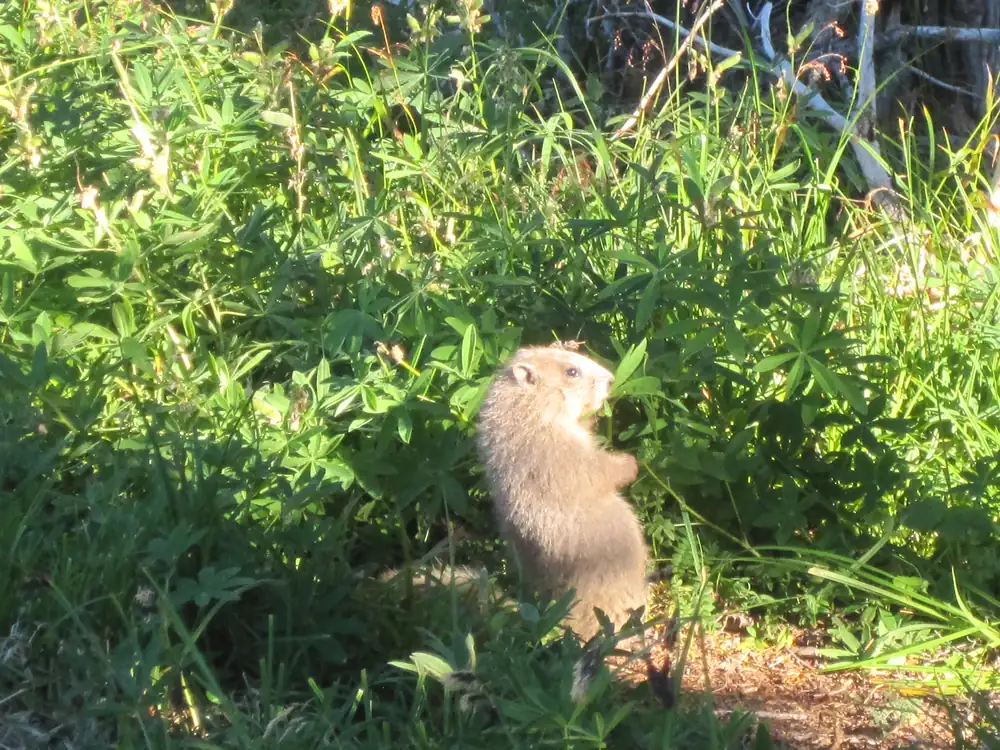
Olympic marmots, out of hibernation
Emerging in spring; litters first appear above ground in late July or early August · Mountain meadows above about 4,000 feet in the Olympic Mountains
The Olympic marmot lives only in the Olympic Mountains, and the park says about 90 percent of its habitat is inside Olympic National Park. Numbers fell in the 1990s and early 2000s, at least partly because of predation by non-native coyotes, and a volunteer monitoring program began in 2010. In May much of the high country is still under snow, so this is a month to learn the whistle and to remember that the pups will not appear until late summer.
The same logic applies to baby birds. A feathered young bird hopping along the ground with a stubby tail is normally practicing flight, not abandoned. Watch from a distance and let it be.
When are the lowest tides in Washington in May?
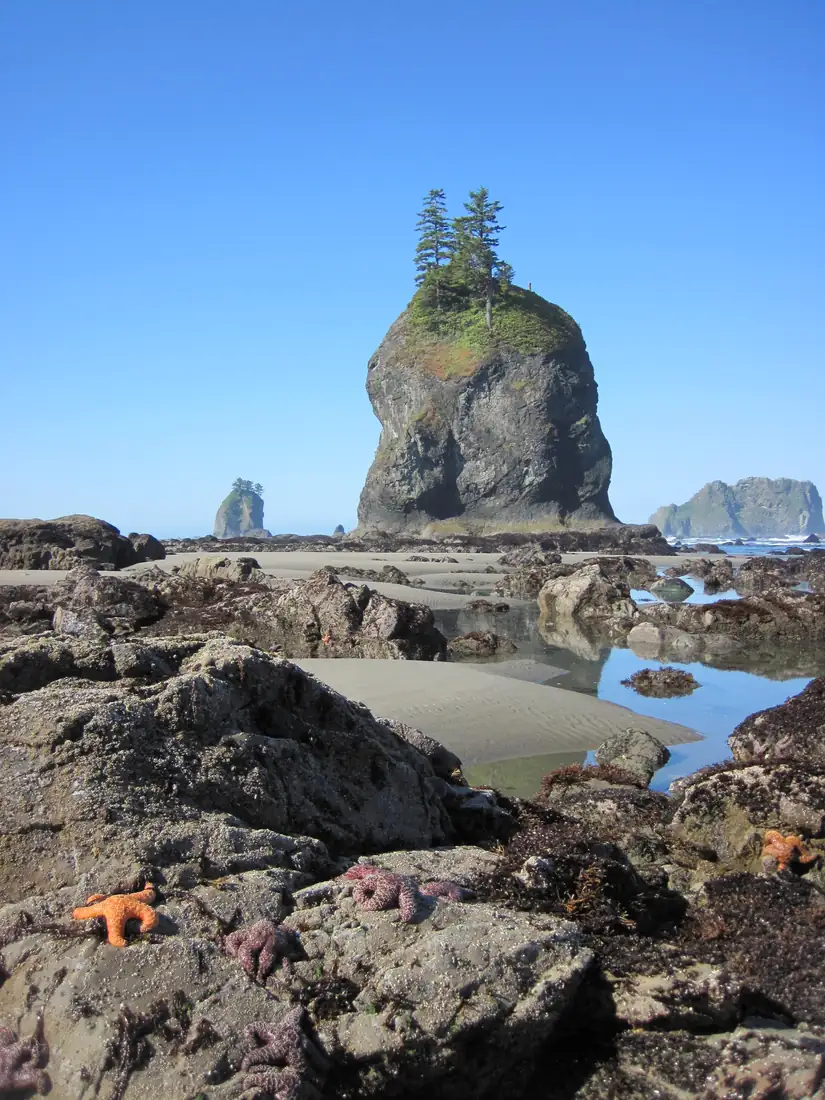
Beach walkers get their best chances at the creatures of the shore when the tide drops well below its usual low, and the greatest drops follow the new and full moons. In May 2027 the new moon comes on the 6th and the full moon on the 20th, and NOAA's predictions for Seattle show daytime lows of minus 1 foot or lower on 14 days, grouped in two runs. The first runs from May 5 to May 11 and the second from May 18 to May 24, each peaking a day or two after the moon phase. The lowest of the month is minus 3.2 feet at 12:55 p.m. on Saturday, May 8.
| Date | Low tide | Height (feet) |
|---|---|---|
| Wednesday, May 5 | 10:55 a.m. PDT | -1.1 |
| Thursday, May 6 | 11:31 a.m. PDT | -2.1 |
| Friday, May 7 | 12:11 p.m. PDT | -2.9 |
| Saturday, May 8 | 12:55 p.m. PDT | -3.2 |
| Sunday, May 9 | 1:42 p.m. PDT | -3.1 |
| Monday, May 10 | 2:33 p.m. PDT | -2.6 |
| Tuesday, May 11 | 3:28 p.m. PDT | -1.7 |
| Tuesday, May 18 | 10:23 a.m. PDT | -1.2 |
| Wednesday, May 19 | 10:57 a.m. PDT | -1.9 |
| Thursday, May 20 | 11:31 a.m. PDT | -2.2 |
| Friday, May 21 | 12:06 p.m. PDT | -2.3 |
| Saturday, May 22 | 12:43 p.m. PDT | -2.1 |
| Sunday, May 23 | 1:21 p.m. PDT | -1.7 |
| Monday, May 24 | 2:02 p.m. PDT | -1.1 |
These are predictions for Seattle only. Tide times and heights on the outer coast, in the San Juan Islands and in Hood Canal differ from Seattle's by up to hours, so look up your own beach under the subordinate stations on NOAA's tide predictions site. Weather and wind can push a real tide above or below the prediction. Arrive an hour before the low, work with the tide as it turns, and keep an eye on the water behind you. Look at the animals without picking them up, return any rock you turn over, and stay 100 yards from seals resting on the sand.
When do Washington's mountain roads open in May, and what is the snow doing?
May is the month the high country starts to open, and the road dates vary with the winter. The Washington State Department of Transportation keeps records of when each pass opened and closed, and the recent years show how much room the calendar has.
-
North Cascades Highway (State Route 20)
Opened April 19 in 2024, April 22 in 2025, May 11 in 2023 and May 10 in 2022 · Across the North Cascades between Newhalem and Mazama
WSDOT's table lists May 5 in 2021 and May 12 in 2020 as well, so a May opening is normal and an April one is early. For 2026 the table lists only a partial reopening on April 30, so a single year can break the pattern. Check WSDOT's mountain pass page and the live road cameras before you plan a loop.
-
Chinook and Cayuse passes near Mount Rainier
Chinook Pass opened May 23 in 2025, May 31 in 2024 and May 26 in both 2023 and 2022; Cayuse Pass opened May 23, May 24, May 26 and May 27 in those years · State Routes 410 and 123 on the east side of Mount Rainier National Park
The pattern is a late-May opening in recent years, and June 4 in 2020, so if you plan a Memorial Day trip over either pass, have a plan for staying on the west or the east side. Mount Rainier National Park's road page says tire chains are required from November 1 to May 1, and that the road between Longmire and Paradise may close at any time depending on weather and road conditions.
-
A thin snowpack year, for context
As of early May 2026 · Across the Cascades and Olympics
The state climatologist's office reported that statewide snowpack in early May 2026 stood at 33 percent of median, with many central and southern Cascade basins below 20 percent, and that the snowpack had peaked two to three weeks early. That is one year. A deep or thin winter changes everything about when meadows clear, when creeks peak and how cold and fast they run, so look at current snowpack before you commit to a high trail.
Whatever the winter, snowmelt makes streams and lakes very cold in May and the water is fast. Cross only where you can see the other side, and keep children well back from banks. Northwest Avalanche Center forecasts and the National Weather Service river pages are the places to check.
When is the last spring freeze in Washington?
By May the last freeze has already passed in most of the state, but a few places still have a chance. Normals for 1991 to 2020 put the typical final freeze at Seattle-Tacoma on March 2 and at Bellingham on March 31. Wenatchee comes next on April 8, then the coast at Quillayute (April 20), Spokane (April 26), Pasco (April 27), Olympia (April 29) and finally Yakima (May 8). The right-hand column is the one May gardeners watch: the last freeze is over in nine springs of ten by May 10 at Quillayute, Spokane and Pasco, and the same holds by May 15 at Olympia and May 27 at Yakima.
| Station | One year in ten | Median | Nine years in ten |
|---|---|---|---|
| Bellingham Intl Ap | Mar 10 | Mar 31 | Apr 18 |
| Seattle Tacoma Intl Ap | Feb 5 | Mar 2 | Mar 23 |
| Olympia Ap | Apr 11 | Apr 29 | May 15 |
| Quillayute State Ap | Mar 29 | Apr 20 | May 10 |
| Wenatchee Pangborn Ap | Mar 20 | Apr 8 | Apr 23 |
| Yakima Air Terminal | Apr 24 | May 8 | May 27 |
| Pasco Tri Cities Ap | Apr 8 | Apr 27 | May 10 |
| Spokane Intl Ap | Apr 9 | Apr 26 | May 10 |
The table gives one main station per place, so a valley floor, a river bottom or a hillside can differ by weeks, and higher elevations run later still. To check your own town, use our page of last spring frost dates for Washington. Tender plants that went out in late April are the ones a late cold night takes.
What is May weather like in Washington, and what hazards come with it?
May warms the whole state, though it still looks like two different countries. In NOAA's 1991 to 2020 normals, Paradise on Mount Rainier collects 5.08 inches of precipitation and Quillayute on the coast 4.25, while Yakima gets 0.74 and Wenatchee 0.77. Yakima's average high is 74.1 degrees, against 66.3 at Seattle-Tacoma and 48.2 at Paradise, where May is still a snow-country month.
| Station | Average high | Average low | Precipitation | Snowfall |
|---|---|---|---|---|
| Seattle-Tacoma airport | 66.3 | 48.7 | 1.88 | 0.0 |
| Olympia airport | 66.1 | 43.0 | 2.26 | 0.0 |
| Quillayute (coast, near Forks) | 60.0 | 43.4 | 4.25 | not published |
| Paradise, Mount Rainier | 48.2 | 33.0 | 5.08 | not published |
| Winthrop (Methow Valley) | 71.1 | 39.7 | 1.13 | 0.0 |
| Wenatchee airport | 71.6 | 48.7 | 0.77 | not published |
| Yakima airport | 74.1 | 43.5 | 0.74 | 0.0 |
| Walla Walla airport | 71.4 | 49.3 | 2.07 | 0.0 |
| Spokane airport | 67.1 | 44.9 | 1.55 | 0.1 |
The hazards of May are mostly about water and cold. Mountain streams run high and cold with snowmelt, even in a low-snow year, and a warm spell can melt snow fast. The 2026 snowpack summary from the state climatologist's office noted that warm weather in late April and early May melted snow faster than normal, and the drought monitor already showed moderate drought along the Okanogan and Columbia rivers. Late freezes are rare but possible in the later columns of the freeze table. Keep an eye on the Washington forecasts for your own town and the National Weather Service river forecasts, and NOAA's monthly-updated 90-day outlooks.
How much daylight does Washington gain in May?
Seattle's days run from 14 hours 29 minutes on May 1 to 15 hours 42 minutes on May 31, a gain of 73 minutes, or about 2.4 minutes a day. Bellingham adds 77 minutes and Vancouver, in the south, 68. Every time here is on daylight time. By our own calculation, Seattle's sun comes up at 5:52 a.m. and sets at 8:21 p.m. on May 1, and rises at 5:16 a.m. and sets at 8:58 p.m. on May 31.
| City | May 1 | May 31 | Gained | Per day |
|---|---|---|---|---|
| Bellingham | 14 h 35 m | 15 h 52 m | 77 min | 2.6 min |
| Seattle | 14 h 29 m | 15 h 42 m | 73 min | 2.4 min |
| Aberdeen | 14 h 26 m | 15 h 37 m | 71 min | 2.4 min |
| Vancouver | 14 h 19 m | 15 h 27 m | 68 min | 2.3 min |
| Wenatchee | 14 h 28 m | 15 h 40 m | 72 min | 2.4 min |
| Yakima | 14 h 24 m | 15 h 34 m | 70 min | 2.3 min |
| Kennewick | 14 h 22 m | 15 h 31 m | 69 min | 2.3 min |
| Spokane | 14 h 29 m | 15 h 42 m | 73 min | 2.4 min |
The gain slows from here, because the days stop growing at the June solstice. Use the sunrise and day length calculator for your own town; the long evening light suits a trail walk or a dusk watch.
What can you see in Washington's night sky in May 2027?
Three things stand out in May: dark-sky meteors before dawn, a full Moon that wears two names, and a long-awaited evening appearance by Mercury. All times here are Pacific Daylight Time. Planet rise and set figures here are for a spot in mid-America; allow Washington up to 30 minutes either way. Late-May twilight lingers at this latitude, and real darkness comes late.
-
Eta Aquariid meteors, a dark-sky year
Active about April 19 to May 28; peak night May 5 to 6, so look before dawn on May 5, 6 and 7 · The eastern sky in the last hours before dawn, with the radiant in Aquarius
The Moon is a thin crescent at only about 1 to 2 percent lit, which makes this a very good year for the shower. The AMS meteor calendar gives a best-hour range of 10 to 30, in the last dark stretch before daybreak. Aquarius, where the streaks seem to start, clears the eastern horizon barely ahead of sunrise here. Fewer will show than in the southern states, so count on a handful per hour. Seattle's sun rises about 5:45 a.m. in the first week, so the best window is roughly 4 to 5 a.m. Give your eyes 20 minutes to adjust.
-
Venus and Saturn, close but low
Morning of May 7; about 1 degree apart on the mornings of May 6 and 8 · Very low in the east before sunrise
Venus, at about magnitude -3.9, and Saturn, a much fainter point, separate by only 0.6 degrees at their nearest approach, a moment that comes during the day. Both lie in Pisces, hanging a few degrees above the eastern skyline some 30 minutes before sunup if you stand at 40 degrees north, and Washington's higher latitude sinks them further. A clear eastern horizon and a pair of binoculars will help, because hills or trees may hide them. It is a challenge target rather than an easy one.
-
Jupiter, Mars and the first-quarter Moon
Evenings of May 12 and 13 · High in the south and southwest after dark
On May 12 the Moon, at first quarter that night, slides to within roughly 1.2 degrees of Jupiter. The tightest moment arrives in daylight, so look after dark for the pair high in the sky. Jupiter is the brightest steady light up there and stays out until the small hours, setting around 7 hours after dusk on May 1 by our calculations. On May 13 the Moon sits about 3 degrees from Mars, which has faded since winter and keeps dimming toward summer.
-
Mercury in the evening sky
Greatest eastern elongation on Friday, May 28, at 6:14 a.m. PDT (22.8 degrees from the Sun); look on the evenings of May 27 and 28 · Low in the west-northwest, about 45 to 90 minutes after sunset
This is the best evening view of the planet this year in the northern United States. Plan on any clear evening between roughly May 12 and June 5. Mercury is brightest, near magnitude -0.6, around mid-month. Find a spot with a clear northwest horizon, and use binoculars to pick it out of the twilight, then look with your eyes. It fades quickly in early June.
-
The Flower Moon and a seasonal Blue Moon
Full at 3:59 a.m. PDT on Thursday, May 20; best evening is Wednesday, May 19 · Rising in the east in Seattle about 8:42 p.m. on May 19, close to sunset
Flower Moon is the traditional almanac name for May's full Moon. Under an older seasonal rule, a spring holding four full Moons names the third one a Blue Moon, and the spring's Moons fall in March, April, May and June, which puts May's in third place. Sky calendars therefore list May 20 as a seasonal Blue Moon. No calendar-month Blue Moon occurs this year, and the Moon keeps its usual color.
| Phase | Date | Time |
|---|---|---|
| New moon | Thursday, May 6 | 3:58 a.m. PDT |
| First quarter | Wednesday, May 12 | 9:44 p.m. PDT |
| Full moon, the Flower Moon | Thursday, May 20 | 3:59 a.m. PDT |
| Last quarter | Friday, May 28 | 6:58 a.m. PDT |
Calculations for 48 degrees north say the Milky Way's bright center clears the horizon in true darkness only during the first eleven days of the month and the last four, and for less than two hours, because the nights are so short. Check the cloud forecast before you head out, and check the moon phase calendar for local moonrise. For aurora, the Space Weather Prediction Center has short-term forecasts.
What can Washington families do outside in May?
- Walk a very low tide. The lowest daytime tides of the month fall from May 5 to 11 and May 18 to 24. Pick a beach, look up its tide times and bring boots.
- Join the City Nature Challenge. The 2027 observation period runs April 30 through May 3, followed by an identification period of May 4 to 16, and the results are announced on May 20. Check the organizers' page to see whether your area takes part.
- Watch for meteors before dawn. The Eta Aquariids peak on May 5 to 6, and a thin Moon leaves the sky dark. Take a blanket and a thermos.
- Spend a morning at Nisqually. The refuge near Olympia lists a Wednesday birding session and a Saturday nature walk on its events page. That listing reflects 2026, so confirm the 2027 times.
- Count pond life with the zoo. Woodland Park Zoo runs a volunteer program in western Washington that teaches egg-mass identification. Ask the zoo how to join.
- Mark Memorial Day, May 31. Plan early if you want a pass or campground, and check road dates first.
- World Migratory Bird Day. The organizers hold it in May and October, and the 2026 date was May 9. The organizers had posted only 2026 dates when we checked, so confirm the 2027 day with them.
- Look for free-park days. The Discover Pass free-day list for 2027 is not posted yet.
Any nighthawk, dogwood or low-tide sea star is worth an iNaturalist upload, and your bird lists can go to eBird. Traveling soon? Browse the guides for other states.
Safety notes for May in Washington
- Spring turkey hunting. WDFW's 2026 spring pamphlet, which runs from April 1, 2026 through March 31, 2027, ran the general season from April 15 through May 31, with hunting hours starting a half hour ahead of dawn. Legal birds are males or turkeys showing a visible beard. A new pamphlet covers 2027 from April 1, 2027, so use it for the dates. The pamphlet text we read named no blaze-orange rule for spring turkey, but check the current one.
- Spring bear hunting. The state rule lists a special-permit season of April 15 to June 15. Confirm the current season and permit numbers with WDFW before hunting.
- Bears. WDFW notes that bears emerge hungry in spring, and that reports often involve dog food, garbage and bird feeders. Lock up garbage, store pet food, clean grills and take down feeders.
- Rattlesnakes. Across most of the Columbia Basin, WDFW says the snakes leave their winter dens in April and linger two to three weeks nearby before spreading to summer ground, so May is a month of snakes on the move. A bite usually follows a snake being provoked, grabbed or stepped on.
- Ticks. The state health department says the western blacklegged tick favors thick forest and brush, that the few locally caught Lyme cases come mostly from west of the Cascades, and that a tick probably must stay attached for 24 hours or more to infect you. Use repellent and check your body after hikes.
- Cold, fast water. Snowmelt keeps rivers and lakes cold, so wear a life jacket and keep children back from banks.
- Young animals. Leave fawns and fledglings alone, and keep 100 feet from elk.
- Marine mammals. Stay 100 yards from seals and sea lions on beaches and at sea, and farther from orcas.
- Mountain roads and trails. Passes can open late and snow can linger on high trails, so check WSDOT and the Northwest Avalanche Center.
Sources (38)
- Seattle Audubon BirdWeb: Rhinoceros auklet
- WDFW: Tufted puffin
- U.S. Fish and Wildlife Service: Protection Island National Wildlife Refuge
- Be Whale Wise: viewing distances for boaters
- Seattle Audubon BirdWeb: Common nighthawk
- Seattle Audubon BirdWeb: Swainson's thrush
- Seattle Audubon BirdWeb: Western tanager
- Seattle Audubon BirdWeb: Yellow warbler
- Seattle Audubon BirdWeb: Sage thrasher
- Native Plants PNW: Pacific dogwood
- Washington DNR: Mima Mounds Natural Area Preserve
- WDFW: Taylor's checkerspot
- WDFW: Injured, orphaned and young wildlife
- National Park Service: Roosevelt elk, Olympic National Park
- WDFW: Little brown myotis
- National Park Service: Olympic marmot
- NOAA CO-OPS tide predictions: Seattle, May 2027
- Washington State Department of Transportation: Mountain pass closure and opening dates
- National Park Service: Mount Rainier road status
- Office of the Washington State Climatologist: April 2026 snowpack and drought summary
- NOAA NCEI data service: May monthly normals for the Washington stations in the table
- NOAA Climate Prediction Center: seasonal (90-day) outlooks
- National Weather Service Seattle
- U.S. Naval Observatory: Moon phases, 2027
- American Meteor Society: 2027 meteor shower calendar
- Sea and Sky: Astronomy calendar 2027
- NOAA Space Weather Prediction Center
- City Nature Challenge (2027 dates)
- World Migratory Bird Day
- U.S. Fish and Wildlife Service: Billy Frank Jr. Nisqually NWR events
- Woodland Park Zoo: Amphibian monitoring
- Discover Pass: Free parking days
- WDFW 2026 Spring Wild Turkey Season pamphlet
- WAC 220-415-080: Spring black bear special permits
- WDFW: Prevent conflicts with hungry bears this spring
- WDFW: Western rattlesnake
- Washington State Department of Health: Lyme disease
- Photos via Wikimedia Commons; licenses and photographers are credited under each picture
