What to look for in nature in Washington this December
Meteorological winter starts on December 1, and Washington leans into it. Bald eagles crowd the gravel bars of the upper Skagit to feed on spent chum, owls hunt the open farmland at dusk, and elk drift down toward the feed grounds west of Yakima. Spokane’s sun is gone before 4 p.m., the solstice falls on the 21st, and two nights before Christmas the moon turns full at its nearest of the year. Here is what is worth stepping out for, region by region.
Other months in Washington: October, November.
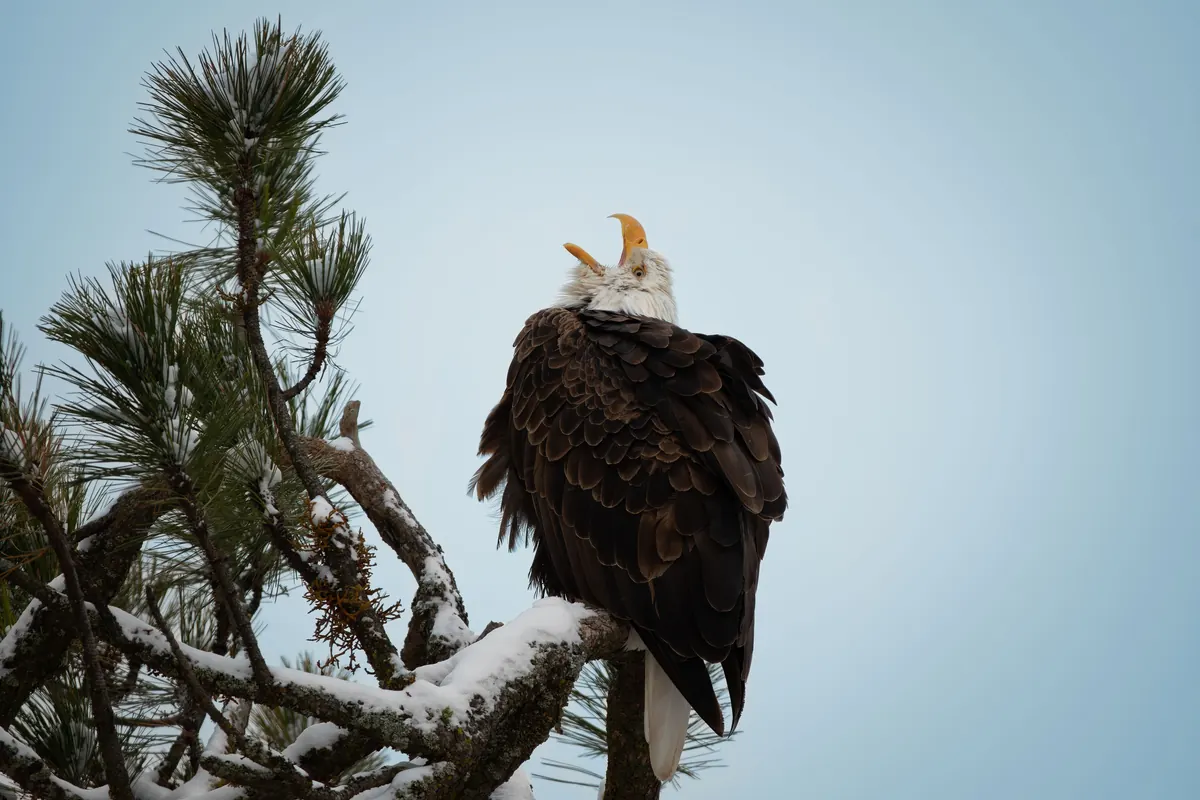
Start here
- Eagles on the upper Skagit. Wintering bald eagles gather along the Skagit between Rockport and Marblemount from late fall into March, and the interpretive center’s volunteer counts have peaked in mid to late December in past seasons. Go early in the morning, pull fully off State Route 20, and watch from the bank.
- Count birds for Christmas. The national window this season is December 14 to January 5, and each Washington circle settles on one date within it. Edmonds and Cheney count on Saturday, December 19, Seattle on Sunday the 20th, and Spokane on Sunday, January 3. New birders can join a field team or tally a backyard feeder.
- The year’s biggest full moon. The Cold Moon is full at 5:28 p.m. Pacific time on Wednesday, December 23, only hours from its nearest approach to Earth, which makes it the closest full moon of 2026. Watch it rise in the east-northeast that evening, and again on Christmas Eve.
Keep a record: tally the eagles on one stretch of the Skagit or Nooksack in the Naturalist’s Field Journal’s daily field log, copy your count-day species onto the bird list, draw a hemlock cone and a Douglas-fir cone side by side on the seeds-pods-and-cones plate, draw a hare or deer print on the tracks-to-know page, and use the dusk-and-dawn watch for the earliest sunset of the year.
Regions used below: Puget Sound and Seattle; Olympic Peninsula and the coast; Southwest and the lower Columbia; North Cascades and the Methow; Central Washington and the Yakima Valley; Columbia Basin and the Tri-Cities; Spokane and the Palouse.
When is the best time to see bald eagles on the Skagit River?
December is when the upper Skagit fills up. Bald eagles have been on the river since late fall, but their numbers build through the month as more chum and coho finish spawning and their bodies wash up on the bars. A 1997 WDFW study describes the Skagit as one of the key wintering areas for bald eagles in the Pacific Northwest, with as many as 500 counted on the upper river in the past, present from late October through March. Satellite tags put on adults in that study showed the wintering birds came from a huge area: breeding sites from southern British Columbia north to the Yukon and east to the Mackenzie River in the Northwest Territories.
-
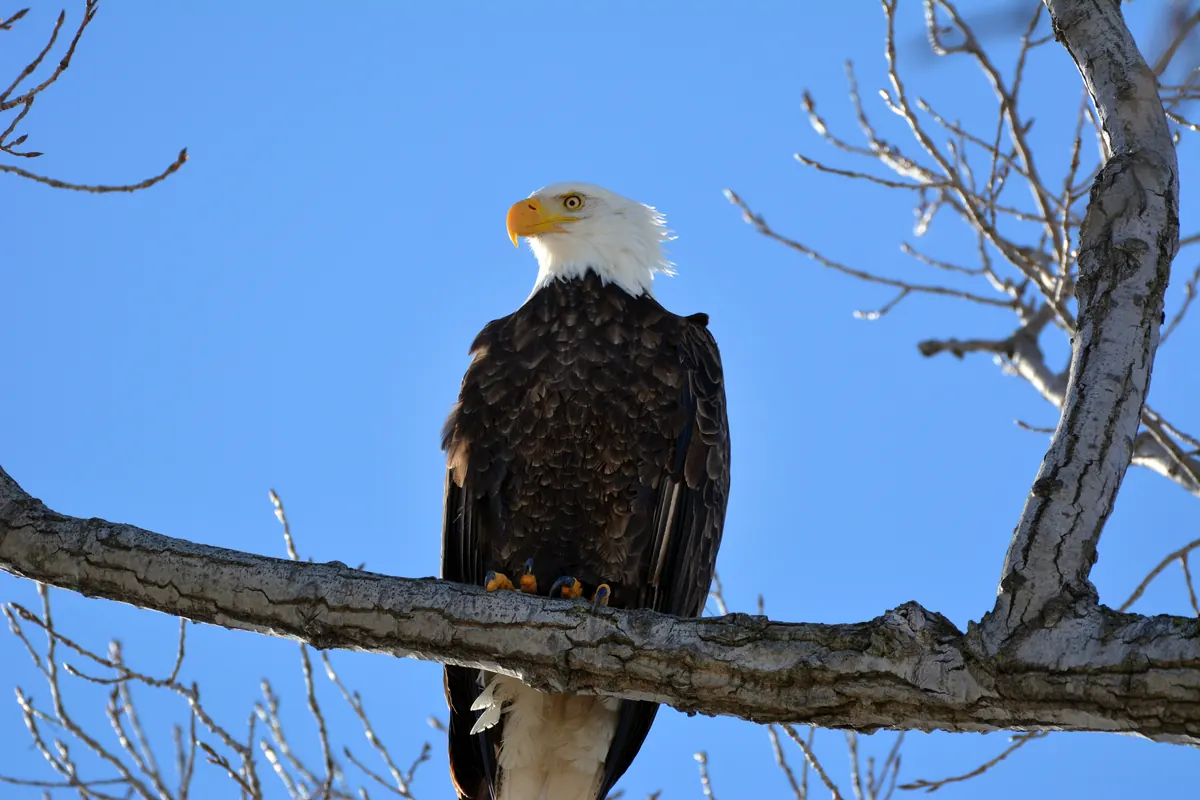
Rockport to Marblemount
Building through December; volunteer counts have often peaked from mid-December into January · State Route 20 along the Skagit, Skagit County; Howard Miller Steelhead Park in Rockport
The Skagit River Bald Eagle Interpretive Center, at Howard Miller Steelhead Park, says you may see as many as 100 eagles from the highway at the height of the season, which it puts between mid-December and late January. Its volunteer counts give a feel for the curve: in the 2018–19 winter the weekly tally reached 99 on December 15 and 111 on December 29. Last season the center opened on Saturday, December 6, and ran weekends through mid-February; this winter’s schedule was not yet online at the start of October, so call or check the center’s site before you drive.
-
The Nooksack at Deming
December through March · Deming Homestead Eagle Park and the Welcome Bridge on Mosquito Lake Road, Whatcom County
Whatcom County Parks runs a small riverside park on the North Fork Nooksack built around eagle watching, and names December through March as the season. Local watchers find the birds most active in the early morning and again just before dusk. A spotting scope helps: many birds sit far out on the bars and in the snags.
An eagle chased off a carcass may not eat again that day. Watch from turnouts and parks, use your car as a blind on the highway, and leave the gravel bars to the birds. If you count white heads on one stretch each visit, a few winters of dates will show your river’s own peak.
When is the Christmas Bird Count in Washington, and how can you join?
Audubon’s winter census dates to 1900, which makes it North America’s oldest volunteer science project still running. Teams split up a circle fifteen miles wide and, on their one day, try to log every wild bird inside it. The Washington Ornithological Society keeps a statewide list of circles with their compilers; last season it listed about 40 active counts, from the Columbia estuary to Colville and from Neah Bay to Walla Walla. Many are run by local Audubon chapters and bird alliances.
-
Seattle
Sunday, December 20 (confirm when registration opens) · A circle 15 miles across centered on downtown Seattle
Birds Connect Seattle, the group long known as Seattle Audubon, has run the Seattle count for more than 95 years and lists this year’s count for Sunday, December 20. Last year’s count found 130 species, a little above the ten-year average of 127. Teams cover 14 sections of the city, usually from 8 a.m. to 4 p.m., and at-home counters within the circle watch their yards for an hour or so.
-
Edmonds and Everett-Marysville
Saturday, December 19, and Saturday, January 2, 2027 · South Snohomish County; Everett and Marysville
Pilchuck Audubon Society runs both circles and takes field-team volunteers of every skill level, backyard feeder counters, and helpers for the data and logistics. Registration forms are on the chapter’s site.
-
Spokane, Cheney and the northeast
Cheney on Saturday, December 19; Spokane on Sunday, January 3, 2027 · Spokane County; Colville and Chewelah circles farther north
Spokane Audubon Society says new birders are always welcome. Colville and Chewelah, up in Stevens County, count in the same window. Anyone whose home sits inside a circle may count yard birds instead.
Last winter the state list also included Olympia, Tacoma, Kitsap, Bellingham, the Tri-Cities, Walla Walla, Padilla Bay and Grays Harbor, among many others. Most circles keep to a similar weekend each year, so check the society’s list for this season’s dates. Copy your count-day species into the journal’s bird list.
Where can you see owls and winter hawks in Washington in December?
Short days and open fields make December a good month for raptors. Voles and other small rodents are busy in the grass, and predators from the far north spend the winter on Washington’s farm flats and shorelines.
-
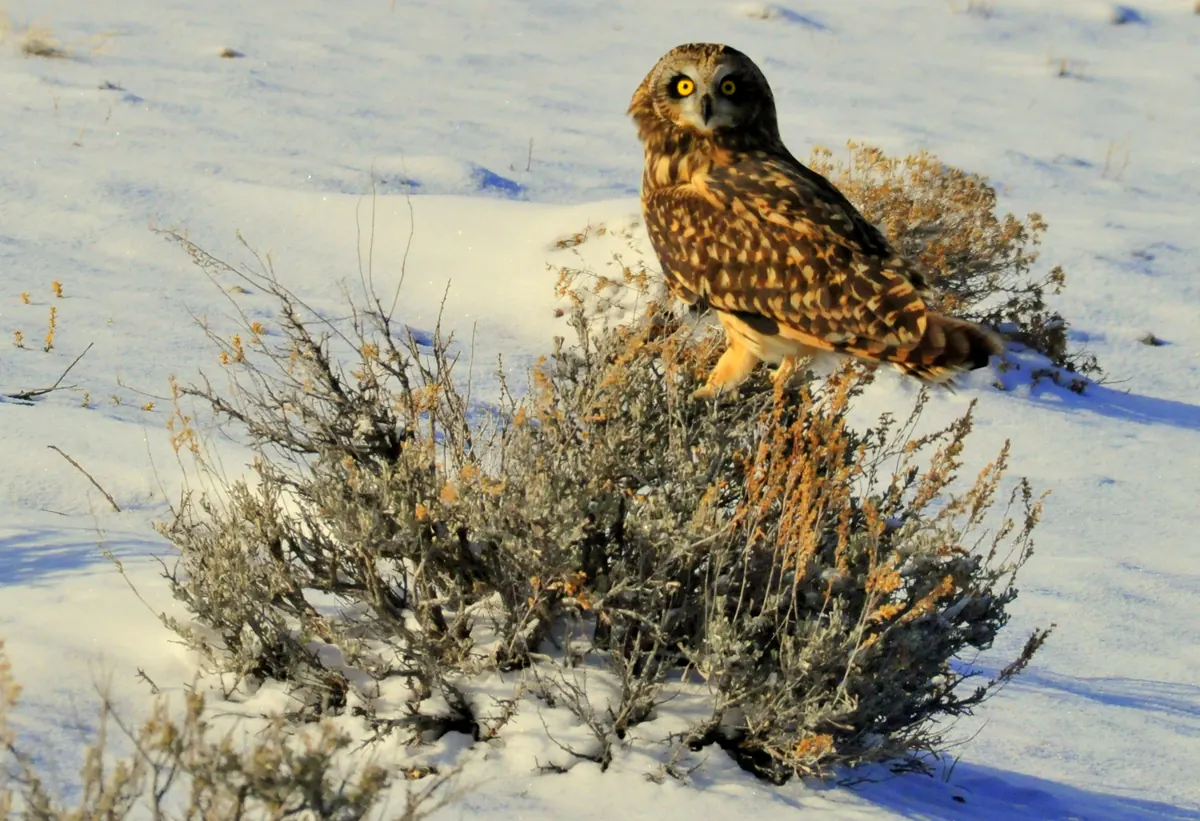
Short-eared owls at dusk
All winter; best in the last hour of daylight · Samish River Unit (the “East 90”), Samish Flats, Skagit County; coastal marshes; the Vancouver lowlands in Clark County
Seattle Audubon’s BirdWeb calls the short-eared owl fairly common in winter west of the Cascades, mostly near the coast and around Vancouver. These owls hunt low over open grass with a loose, moth-like wingbeat, and they are out at dawn and dusk, so you can see them without a flashlight. WDFW says its Samish River Unit is frequented by them in winter, hunting the voles in the grass fields; in recent seasons part of the property has been set aside for wildlife viewing and part for waterfowl hunters, and a Discover Pass is required. The species is listed as at risk because so much of its open habitat has been lost.
-
Rough-legged hawks from the Arctic
Winter · Large open farmland and grassland on both sides of the Cascades
If a big hawk hovers above a pasture like a kite on a string, think rough-legged hawk. BirdWeb notes that they come into eastern and western Washington every winter and hunt by hovering high, then dropping feet first. Look for a pale head, dark patches at the bend of each wing from below, and a white tail with a dark band at the tip.
-
Snowy owls, some winters
Early November to mid-March, in irregular numbers · Coastal flats and jetties in Whatcom, Skagit, Grays Harbor and Pacific counties; wheatland in northern Lincoln County; near Potholes Reservoir
BirdWeb sums up the snowy owl’s visits plainly: none in some winters, more than 100 in others, a handful in most. Big invasions, called irruptions, come at least once a decade. If you find one resting on a driftwood log, admire it from a distance and never flush it for a photograph.
Most of the flats are private farmland, so watch from road shoulders and public trails. A hawk that uses the same fence post day after day suits the journal’s “same place twice” page.
Where can you see elk and bighorn sheep in winter in Washington?
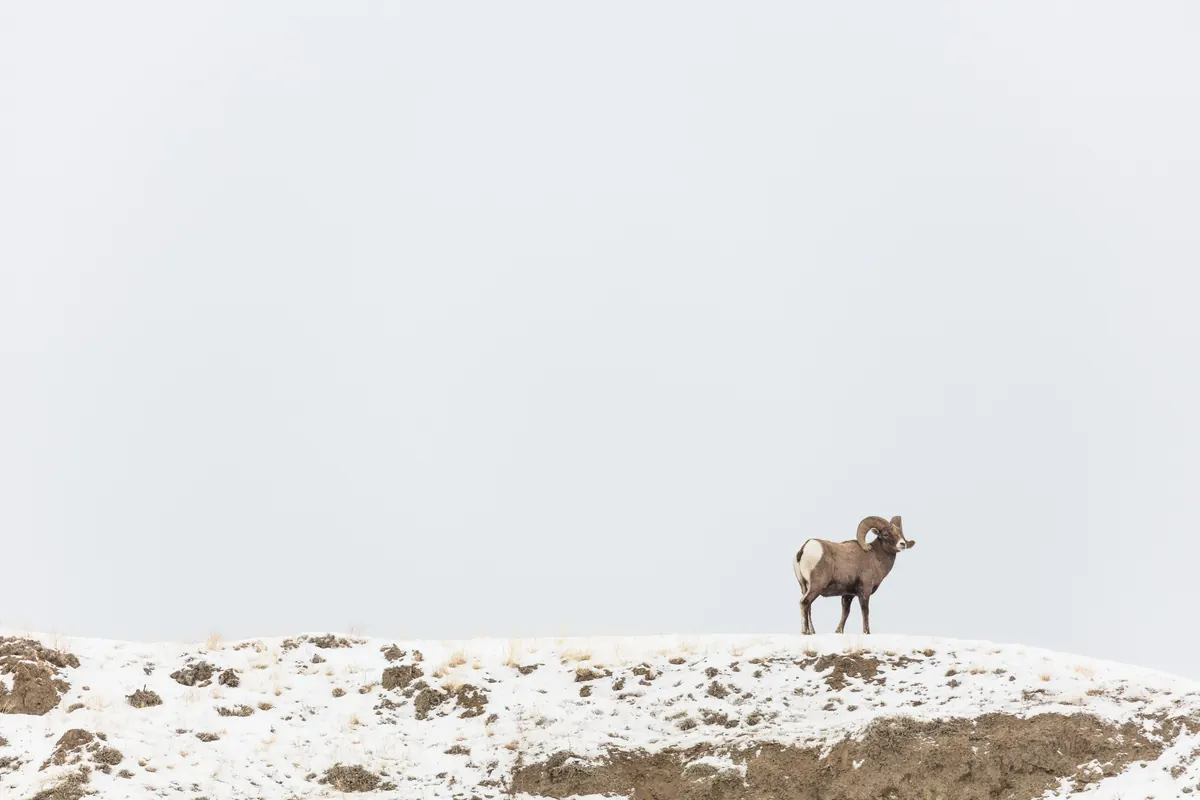
On the dry east slope of the Cascades, snow pushes elk and bighorn sheep down out of the high country in December, and WDFW feeds some of them through the winter. The feeding keeps the herds off orchards and ranches and away from diseases they could catch from domestic animals, and it has turned into one of the state’s easiest big-wildlife sights.
-
Elk at Oak Creek
Feeding starts once the elk come down in numbers, often in December, and runs through the winter · Oak Creek Wildlife Area headquarters, 16601 U.S. Highway 12, Naches, west of Yakima
Supplemental feeding at Oak Creek began in the record winter of 1955 and became a yearly program by the mid-1960s. WDFW’s 2006 management plan said that in an average winter between 4,000 and 5,000 elk were fed daily at several sites in the foothills west of Yakima, and that more than 100,000 visitors passed through the wildlife area each year. During feeding, staff run daily guided truck tours of the feed site, about 30 minutes long; WDFW asks that reservations be made at least 24 hours ahead, with spare seats filled first come, first served, and donations support the feed. In 2023 the seasonal winter-range closures went into effect on December 15, a sign of when the season usually gets going. A Discover Pass is required.
-
California bighorn on Cleman Mountain
Winter · Bighorn viewing site, 14300 Old Naches Highway, Naches
A few miles east of the elk, WDFW says California bighorn sheep can be seen through the winter on the slopes of Cleman Mountain along the Old Naches Highway. Each year from December 30 until May 1, the Cleman Mountain and Sanford Pasture roads are closed to motor vehicles so the animals can winter in peace.
Large parts of the upland range close to all entry once feeding begins, so stay in the parking and viewing areas, and check the White Pass report before driving U.S. 12. The first morning you see the sheep on the cliffs is a good note for the mammal-watch pages.
How do Washington animals survive the winter, and what tracks do they leave?
Each animal handles the cold its own way: it sleeps through it, stores food ahead of time, changes its coat, or simply keeps moving. Washington’s mountains hold examples of all of them, and a little snow on a trail lets you read what happened overnight.
-
Marmots: the long sleep
From September or October until spring · Subalpine meadows of the Olympics (Olympic marmot) and the Cascades (hoary marmot)
The Olympic marmot lives in the Olympic Mountains and nowhere else, and in 2009 it became Washington’s official endemic mammal. The Park Service says it goes underground in September or early October for seven or eight months; its body temperature falls below 40 °F, and its heart can slow to about three beats a minute. Hoary marmots at Mount Rainier lean on summer fat to get through eight or nine months of hibernation.
-
Pikas: the stored hay
All winter, under the snow · Talus slopes and rockslides in the Cascades
The pika, a small round relative of the rabbit, does not hibernate. All summer it carries grass, ferns and twigs into “haypiles” tucked under rocks, and in winter it tunnels under the snow from one pile to the next. Rangers say to listen for its short, high call.
-
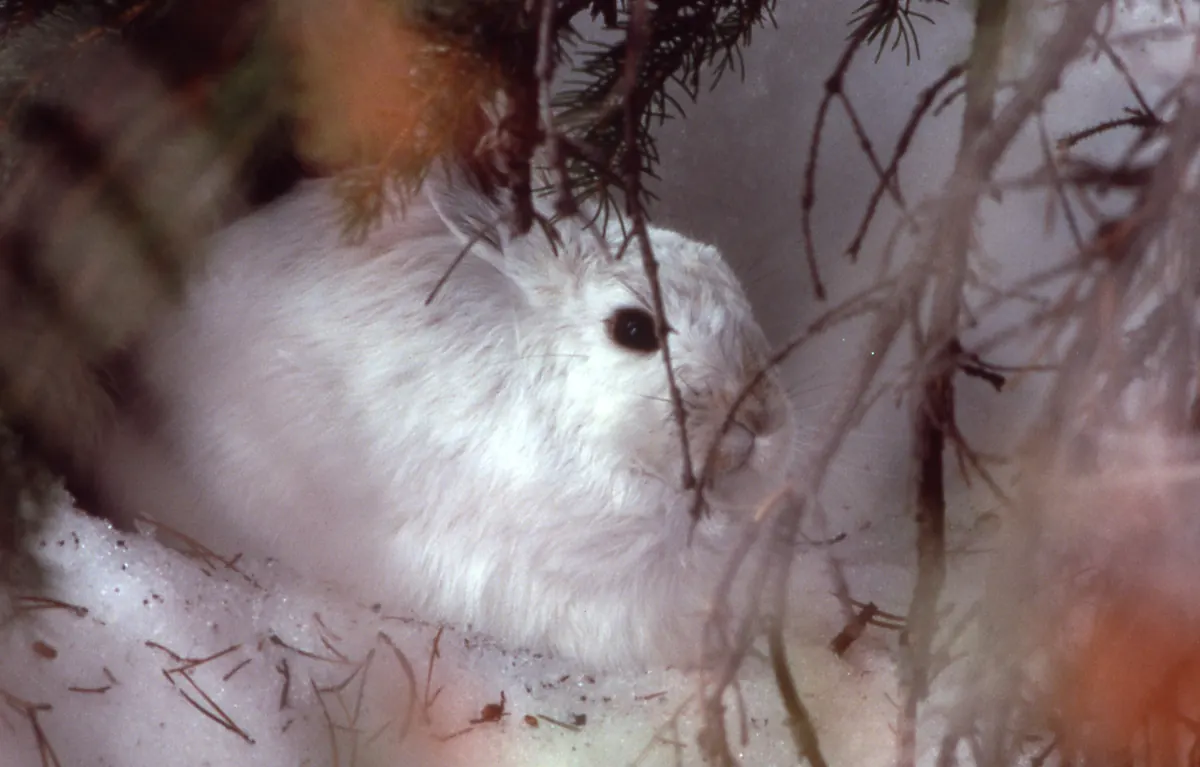
Snowshoe hares: the white coat
White through the snow season · Mountain forests on both sides of the Cascades and in the northeast
Mount Rainier’s naturalists note that the hare’s winter fur turns white at the tips while the base stays gray-brown, and the ear tips stay black. Its huge, furry hind feet let it run on top of fresh snow where other animals sink, and in winter it lives mostly on the buds, twigs and bark of willow and alder.
-
Reading tracks
Any morning after fresh snow, or on soft mud by a creek · Trails, woodland edges, field margins
WDFW points out that rabbit and hare tracks show four toes, with the hind print about two and a half times as long as the front. A hopping hare leaves its two big hind feet ahead of the small front pair, so the pattern seems backward at first.
Sketch the best track you find, with a coin for scale, on the journal’s tracks-to-know page.
How do you tell Washington’s evergreen trees apart in winter?
With the maples and alders bare, the conifers take over the view. WSU Extension’s bulletin Trees of Washington gives the details; here are the quick field marks for the common ones.
-
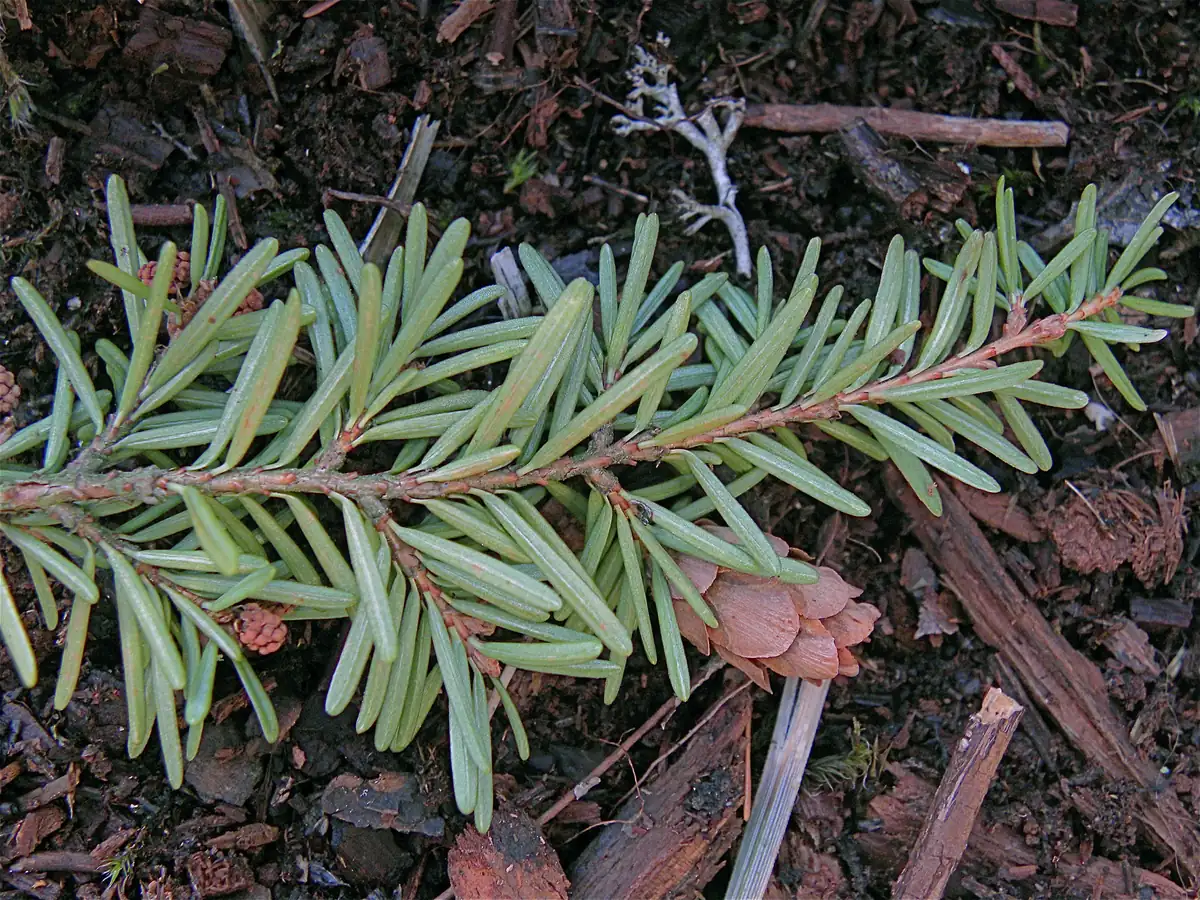
Western hemlock, the state tree
Year round · Wet forests west of the Cascades; scattered in the northeast
Look at the top first: a hemlock’s leader droops over like a fishing rod. The needles are short and flat, of mixed lengths, with two white bands underneath, and they lie in flat sprays. The small cones, about half an inch to three-quarters of an inch long, hang from the twig tips.
-
Douglas-fir
Year round · Statewide, from the Puget lowlands to the east-side forests
Pick up a cone. Douglas-fir is the only one in the woods with three-pointed bracts poking out between the scales; children like to say a mouse has hidden in each one, leaving its feet and tail sticking out. Its bark grows thick and corky on old trees.
-
Western redcedar and Sitka spruce
Year round · Redcedar in moist lowland forests; Sitka spruce mainly along the coast
Redcedar has no needles at all, but tiny overlapping scales in flat, drooping fans, and stringy bark. Sitka spruce is the coast’s tree of the fog belt: its needles are stiff, sharp and stand out at nearly right angles, so grabbing a branch hurts.
-
Bare conifers and a red berry
Winter · East-side forests; forest understory statewide
Some “evergreens” are not. Western larch drops its soft needles every fall, so the bare, spiky trees among the pines east of the crest are alive and well. Pacific yew, a shade-loving understory tree, has flat needles with yellowish stalks; its seed sits in a scarlet, cup-shaped aril that looks like a berry with its bottom open.
If you want to bring a tree home, most national forests in Washington sell Christmas tree permits through recreation.gov, recently $5 a tree and $10 on the Mt. Baker-Snoqualmie, with free permits for fourth graders through Every Kid Outdoors. Before you cut, take a twig and a cone for the seeds-pods-and-cones plate.
What is December weather like in Washington, and what could a strong El Niño bring?
Weather scientists group December with January and February as winter since those three months run coldest on average; astronomers wait for the solstice, three weeks later. In Washington, December shows two faces. The coast is drenched, with nearly 14 inches of precipitation in a normal December at Quillayute, and Paradise on Mount Rainier gets almost 19, most of it as snow. East of the crest it is cold and much drier: in a normal December, snow covers the ground on about 28 days at Winthrop and 13 at Spokane.
| Station | Average high | Average low | Precipitation | Snowfall | Days with 1 in or more of snow on the ground |
|---|---|---|---|---|---|
| Seattle-Tacoma airport | 47 | 37 | 5.72 | 1.7 | 1.3 |
| Olympia airport | 45 | 33 | 7.85 | 1.2 | 0.4 |
| Quillayute (coast, near Forks) | 47 | 35 | 13.84 | not published | not published |
| Paradise, Mount Rainier | 33 | 22 | 18.92 | not published | not published |
| Winthrop (Methow Valley) | 29 | 15 | 2.57 | 21.8 | 28.0 |
| Wenatchee airport | 33 | 25 | 1.31 | not published | not published |
| Yakima airport | 38 | 23 | 1.44 | 7.7 | 9.4 |
| Walla Walla airport | 41 | 30 | 2.23 | 2.7 | 2.6 |
| Spokane airport | 34 | 24 | 2.34 | 13.8 | 13.2 |
December storms can be wild. Last year a warm atmospheric river soaked the state from December 8 to 11: the state climate office reports that 10 rivers, the Skagit, Nooksack and Snohomish among them, set all-time record crests, and that two mountain snow-monitoring (SNOTEL) sites recorded 21.80 and 19.70 inches of precipitation. A windstorm followed on December 15–18, with gusts of 112 mph just above Snoqualmie Pass. The warmth also hurt the snowpack: rain fell where snow should have, and the state went into April 2026 with about half its usual snowpack, and on April 8 the Department of Ecology declared a statewide drought emergency.
This winter adds El Niño to the mix. In the Climate Prediction Center’s mid-September ENSO bulletin, a very strong episode carrying on through fall and winter is judged better than nine-in-ten likely. Washington’s state climate office has gone back through the seven biggest El Niño events since 1950, and finds that warmth is the most consistent signal here, and that warmth, even with normal rain and snow, tends to mean a thinner snowpack. Rain and snow totals are a coin toss with a slight lean toward dry; 1957–58, 1982–83 and 2015–16 were all wet. Once NOAA posts its December-to-February maps in mid-October (the 15th), Washington readers can find them on the CPC seasonal outlook page; for the next few days, before a pass crossing or a snowy hike, use our Washington forecast page.
One more December event: the year’s highest tides. Washington Sea Grant predicts a king tide window around Christmas, peaking at 13.01 feet in Seattle at 7:22 a.m. on Saturday, December 26, 13.30 feet in Tacoma at the same time, and 11.27 feet at Westport at 12:12 p.m. on Christmas Eve. Strong El Niño winters also raise coastal sea level, so a storm on top of these tides could push water higher still. Inland, the Washington frost and freeze dates list the typical last spring frost for 154 places, worth a look before you order seeds.
When is the earliest sunset and the shortest day in Washington?
The solstice arrives at 12:50 p.m. Pacific time on Monday, December 21. Bellingham gets just 8 hours 16 minutes of daylight that day, Seattle 8 hours 25 minutes, and Vancouver, the longest in the table, 8 hours 41 minutes. Oddly, the solstice does not bring the earliest sunset. In Seattle it comes about ten days sooner, at 4:18 p.m. on December 11; Spokane, near the east edge of the Pacific time zone, bottoms out at 3:58 p.m. the same day. By December 31 Seattle’s sun already sets ten minutes later, at 4:28, while sunrise keeps sliding until about New Year’s Day, when it reaches 7:58 a.m.
| City | Dec 1 | Dec 21 | Dec 31 | Earliest sunset |
|---|---|---|---|---|
| Bellingham | 8 h 34 m | 8 h 16 m | 8 h 20 m | 4:13 p.m., Dec 11 |
| Seattle | 8 h 43 m | 8 h 25 m | 8 h 30 m | 4:18 p.m., Dec 11 |
| Aberdeen | 8 h 48 m | 8 h 31 m | 8 h 35 m | 4:26 p.m., Dec 11 |
| Vancouver | 8 h 57 m | 8 h 41 m | 8 h 46 m | 4:27 p.m., Dec 10 |
| Wenatchee | 8 h 44 m | 8 h 27 m | 8 h 31 m | 4:10 p.m., Dec 11 |
| Yakima | 8 h 50 m | 8 h 34 m | 8 h 38 m | 4:14 p.m., Dec 10 |
| Kennewick | 8 h 53 m | 8 h 37 m | 8 h 41 m | 4:10 p.m., Dec 10 |
| Spokane | 8 h 43 m | 8 h 25 m | 8 h 30 m | 3:58 p.m., Dec 11 |
The reason: Earth’s tilt and its elliptical path around the sun push the clock time of solar noon later each day this month. For your own town’s numbers, try the sunrise and sunset calculator; then mark the solstice in the journal’s daily field log and watch the evenings stretch out again.
What can you see in Washington’s night sky in December?
December nights are the longest of the year. The trouble on the west side is cloud, so watch for the clear, cold nights that follow a front, or head east of the mountains, where the odds are better. All times are Pacific Standard Time.
-
The Geminids
Active December 4–20; best on the night of Sunday, December 13, into Monday the 14th · Anywhere dark, after the crescent moon sets in mid-evening
December’s big shower gets a nearly moonless peak this time. The International Meteor Organization lists its ideal rate as about 150 per hour, a best-case number that assumes pitch dark and the radiant straight up; Washington watchers will see fewer. Only a thin crescent is up, and it sets by mid-evening. Watching is good from late evening until dawn, and rates are usually highest around 2 a.m., when the radiant is high in the sky. Dress for an hour of sitting still in the cold.
-
The Cold Moon, the year’s closest
Full at 5:28 p.m. on Wednesday, December 23; nearly as full on Christmas Eve · Rising in the east-northeast around sunset
Only about seven hours separate the moment of full moon from perigee, the moon’s nearest swing toward Earth, which is why EarthSky ranks it as 2026’s closest full supermoon; BBC Sky at Night also lists it as a supermoon. On solstice evening the fat, almost-full moon also passes close to the Pleiades, washing the cluster out in moonlight. Its pull, combined with the sun’s, is also behind the Christmas king tides.
-
Planets: one at dusk, three at dawn
All month · Saturn in the south and southwest after dark; Venus, Jupiter and Mars before sunrise
Saturn has the evening to itself and by New Year’s Eve sets roughly four hours behind the sun. The morning sky is livelier: Venus blazes low in the southeast before sunrise, Mars brightens through the month, and Jupiter, in Leo, rises earlier each night until it clears the horizon by mid-evening in late December. Early risers on the 4th and 5th get a bonus: a slender old moon near Venus, with the star Spica sitting between the two.
| Phase | Date | Time |
|---|---|---|
| Last quarter | Monday, Nov 30 | 10:08 p.m. |
| New moon | Tuesday, Dec 8 | 4:52 p.m. |
| First quarter | Wednesday, Dec 16 | 9:42 p.m. |
| Full moon, the Cold Moon | Wednesday, Dec 23 | 5:28 p.m. |
| Last quarter | Wednesday, Dec 30 | 10:59 a.m. |
Solar maximum is behind us, yet strong solar storms still happen, and Washington’s long nights and northern latitude give it a fair shot at an aurora if one comes; NOAA’s Space Weather Prediction Center posts alerts. For the cloud picture tonight, see our sky page, and for moonrise times where you live, the moon phase calendar.
What can Washington families do outside in December?
- Weekends from early December: eagles at Rockport. The Skagit River Bald Eagle Interpretive Center opened on December 6 last season with weekend programs; check its 2026–27 dates, then walk the riverside trails at Howard Miller Steelhead Park and Rockport State Park.
- Saturday mornings at Nisqually. The refuge’s weekly guided walk, free, at 10 a.m., roughly a mile in two hours, should land on December 5, 12, 19 and 26. Confirm on the refuge’s calendar, especially around the holidays.
- Sunday night, December 13: the Geminids. Put the kids to bed early, wake them at 4 or 5 a.m. on Monday the 14th, and lie back on a tarp in sleeping bags for twenty minutes.
- December 19 and 20: count weekend. Edmonds and Cheney count on Saturday and Seattle on Sunday; a family can count from home within any circle after signing up.
- Late December weekends: snowshoeing at Paradise. Mount Rainier’s ranger-guided snowshoe walks usually start in late December and run on weekends and holidays into March, meeting at the Jackson Visitor Center; snowshoes are provided, groups are capped at 25, and sign-up opens an hour ahead. In Olympic National Park, Hurricane Ridge Road is typically open Friday through Sunday and some holidays in winter, weather permitting, and every vehicle must carry chains.
- Monday, December 21: solstice walk. Walk at lunchtime, the warmest and brightest part of the shortest day, and note where the sun stands at noon.
- Wednesday, December 23: Cold Moon rise. Find a spot with a low eastern horizon and see the largest-looking full moon of 2026 clear the hills around sunset.
- Saturday, December 26: the king tide. Seattle’s highest water of the year is predicted for 7:22 a.m.; photograph a familiar seawall for Washington Sea Grant’s project.
- New Year’s Day 2027: hike with a ranger. More than 30 Washington state parks hosted First Day Hikes and rides on January 1, 2026, and New Year’s Day was a Discover Pass free day. Look for the 2027 list in December, and register early; parks that turn into Sno-Parks in winter, such as Mount Spokane, have also required a Sno-Park permit.
For citizen science, keep up Project FeederWatch through the winter, post track and eagle photos to iNaturalist, and enter bird lists in eBird. Families who want to look back can open the Washington November guide or see what is happening across the border on our other state pages. For a small gift that gets used all winter, consider our field journal for naturalists.
Safety notes for December in Washington
- Hunting seasons and hunter orange. Washington’s general modern firearm seasons for deer and elk have closed by December, but late archery and muzzleloader seasons run in many units: late archery deer into mid-December in most areas (November 25 to December 15 for most black-tailed units) and to December 31 in some western units, late muzzleloader deer to December 8 or December 15 depending on the unit, and late archery elk to December 15, with a western muzzleloader elk hunt in GMU 407 from December 16–31. Duck season is open statewide through January 31, and goose hunting in the Skagit and Snohomish area (Goose Management Area 1) reopens December 12. Pheasant, quail and gray partridge stay open in eastern Washington into mid-January, chukar through January 31, forest grouse through January 15, and western Washington’s release sites have an extended pheasant season from December 1–15. Washington’s blaze rule (WAC 220-414-080) still applies to pheasant, quail, grouse and rabbit hunters who carry a shotgun or rifle: a patch of fluorescent orange or pink (or a mix) totaling at least 400 square inches, on the outermost layer, above the waist and unblocked by a pack. Muzzleloader users and duck and goose hunters are exempt. In the field you may meet hunters who are not required to wear orange, so wear a bright layer yourself.
- Avalanches. Once the snowpack builds, any steep, open slope in the Cascades or Olympics can slide. Read the Northwest Avalanche Center forecast before a mountain trip, and carry the gear and training to use it.
- Floods, wind and falling trees. December atmospheric rivers can bring rivers up in hours, as the record floods of December 2025 showed. Stay off riverbanks in high water, never drive into a flooded road, and stay out of the woods in a windstorm.
- Ice. WDFW says you should not walk on ice unless you can confirm it is at least four inches thick, and it does not monitor ice conditions. Ice fishing is popular on lakes near Winthrop such as Patterson Lake; check thickness yourself with an auger in several places, and carry ice picks.
- Passes and short days. Chains may be required on Snoqualmie, Stevens and White passes; check WSDOT before you go. With sunset between 3:58 and 4:27 p.m. in the table’s cities, turn around early enough to finish in daylight, bring a light even on a short walk, add a dry warm layer to the pack, and leave word of your route.
Sources
- WDFW: Skagit River Bald Eagles: Movements, Origins, and Breeding Population Status (1997)
- Skagit River Bald Eagle Interpretive Center
- Skagit River Bald Eagle Interpretive Center: Eagle counts
- North Cascades Institute: Bald eagle winter migration
- Whatcom County Parks: Deming Homestead Eagle Park
- Cascadia Daily News: An eagle feast awaits those with patience (Jan. 25, 2026)
- National Audubon Society: Join the Christmas Bird Count
- Washington Ornithological Society: Christmas Bird Counts in Washington
- Birds Connect Seattle: Christmas Bird Count
- Birds Connect Seattle: 2025 Christmas Bird Count report
- Pilchuck Audubon Society: Christmas Bird Count
- Spokane Audubon Society: Christmas Bird Count
- Seattle Audubon BirdWeb: Short-eared owl
- Seattle Audubon BirdWeb: Rough-legged hawk
- Seattle Audubon BirdWeb: Snowy owl
- WDFW: Samish River Wildlife Area Unit
- WDFW: Oak Creek Wildlife Area Unit
- WDFW: Oak Creek Wildlife Area Management Plan (2006)
- WDFW: Wildlife feeding
- WDFW Wildlife Program report, December 1–15, 2023 (Oak Creek winter closures)
- Olympic National Park: Olympic marmot
- Mount Rainier National Park: Rodents
- Mount Rainier National Park: Rabbits, hares, and pika
- WDFW: Living with wildlife, rabbits (tracks)
- WSU Extension: Trees of Washington (EB0440)
- Washington Trails Association: Christmas tree permits
- NOAA NCEI: U.S. Climate Normals 1991–2020, monthly station normals
- NOAA NCEI data service: December normals for the Washington stations in the table
- Office of the Washington State Climatologist: December 2025 notable weather events
- NASA Earth Observatory: Pacific moisture drenches the U.S. Northwest (December 2025)
- Washington State Department of Ecology: Statewide drought declared due to dismal snowpack (Apr. 8, 2026)
- NOAA Climate Prediction Center: ENSO diagnostic discussion, September 10, 2026
- NOAA Climate Prediction Center: seasonal (90-day) outlooks
- Office of the Washington State Climatologist: How might El Niño affect Washington this winter? (Sept. 10, 2026)
- Washington Sea Grant: King tides calendar 2026–27
- U.S. Naval Observatory: Moon phases, 2026
- U.S. Naval Observatory: Earth’s seasons, 2026
- International Meteor Organization: 2026 Meteor Shower Calendar
- EarthSky: What is a supermoon?
- BBC Sky at Night: Supermoons in 2026
- NOAA Space Weather Prediction Center: Solar cycle progression
- U.S. Fish and Wildlife Service: Billy Frank Jr. Nisqually NWR events
- Mount Rainier National Park: Ranger-led programs
- Olympic National Park: Hurricane Ridge in winter
- Washington State Parks: No Discover Pass required on these 2026 days
- Project FeederWatch (Cornell Lab of Ornithology and Birds Canada)
- WDFW 2026 Big Game Hunting Seasons and Regulations (official pamphlet): deer general seasons
- WDFW 2026 Big Game Hunting Seasons and Regulations (official pamphlet): elk general seasons
- WDFW 2026–27 Migratory Waterfowl and Upland Game Seasons (official pamphlet): migratory game bird seasons
- WDFW 2026–27 Migratory Waterfowl and Upland Game Seasons (official pamphlet): western Washington goose management areas
- WDFW 2026–27 Migratory Waterfowl and Upland Game Seasons (official pamphlet): resident game bird seasons
- WAC 220-414-080: Hunter orange and hunter pink clothing requirements
- Northwest Avalanche Center
- WDFW: Washington winter ice fishing (ice safety)
- WSDOT: Mountain pass reports
- Photos via Wikimedia Commons; licenses and photographers are credited under each picture
