What to look for in nature in Wisconsin this May
May is when Wisconsin turns green. Warblers pour through in the second and third weeks, the refuges are full of nesting cranes and swans, and the last freeze finally clears even the north. NOAA’s 1991 to 2020 normals put May’s average high at 57 °F on the Lake Superior shore and 72 °F at La Crosse, and the Northwoods can still see a frost. In the sky, the Eta Aquariid meteors peak at new moon, Mercury is at its widest evening angle of the year just before June, and the Flower Moon on May 20 is also called a seasonal Blue Moon. Every claim below traces to an agency or observatory source, and dates that organizers have not yet published are left for you to confirm.
Other months in Wisconsin: October, November, December, January, February, March, April.
Start here
- Spend a morning in migration. Pick a marsh, river bottom or lakeshore park in the second or third week of the month, arrive near dawn and listen first. Warbler songs tell you more than the leaves will let you see.
- Look for Karner blues and whooping cranes at Necedah. Late May is the time for Karner blue butterflies on the refuge’s Lupine Loop, and the visitor center grounds have scopes aimed at the wetland. Call ahead about road conditions.
- Go out before dawn on May 5, 6 or 7. The Eta Aquariid meteors peak with almost no Moon. Face east and give your eyes twenty minutes. Expect a modest show this far north.
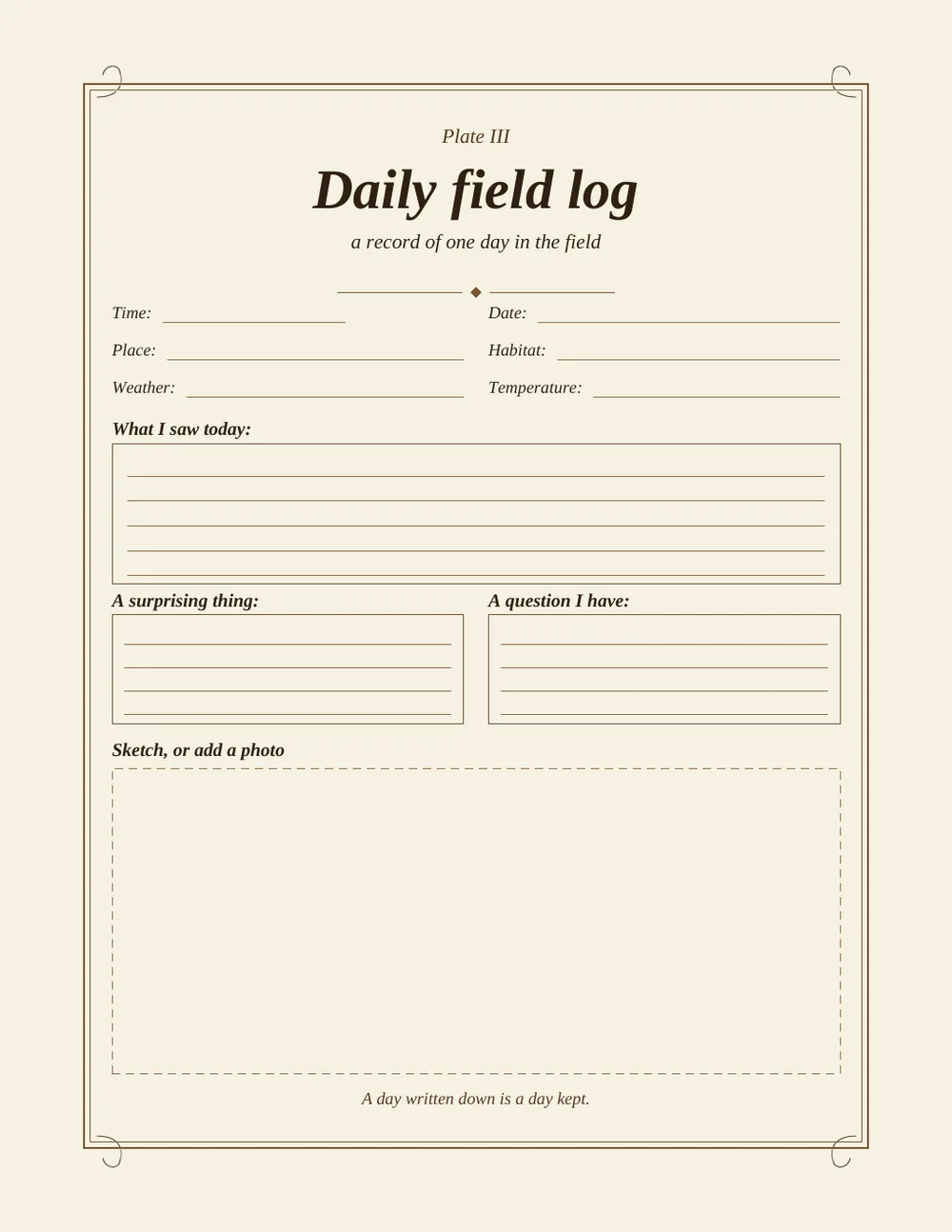
Keep a record: the daily field log suits first-of-year dates for warblers and the last frost, birds I have seen is where the migrants go, and nest observed fits a swan or crane you watch from a distance. Dusk and dawn watch covers the Eta Aquariid morning, a tree through the seasons tracks leaf-out, and the same place twice makes a May-to-June comparison easy.
Regions used below: Northwoods and the Lake Superior shore; Northwest and the St. Croix; Central Sands and the Wisconsin River; Fox Valley, Green Bay and Door County; Southeast and the Lake Michigan shore; South Central and the Driftless Area.
When do warblers and other songbirds peak in Wisconsin in May?
May is the month when the state’s woods, marshes and river bottoms fill with small birds that wintered far to the south. Many of them travel at night, drop out of the sky at dawn, and feed hard for a day or two before moving on, so the same patch of trees can look empty on Tuesday and alive on Wednesday. Weather decides which morning that is: a warm south wind lets birds fly through, while a cold front or rain pins them in place.
-
Horicon Marsh in the second and third weeks
Peak variety tends to come in mid-month · Horicon Marsh (Dodge County and Fond du Lac County)
The DNR’s account of the marsh calls late April to the third week of May the best time for spring songbirds, and says many warbler species arrive in the second and third weeks of the month. It also warns that once nesting begins, waterfowl are seen less often because females are on nests, and that nearly half the birds known to the marsh stay to raise young. The federal refuge keeps its three-mile auto tour open from March 16 until the day before the late-November gun deer season, and says the eastern gravel part of the Main Dike Road opens for driving to the fishing pier by May 15. Old Marsh Road is closed to hikers and bikers in spring and fall migration, so do not plan a May walk there.
-
Floodplain forest on the Mississippi
April and May are the best months for songbirds, per the refuge · Mississippi River floodplain refuge near La Crosse
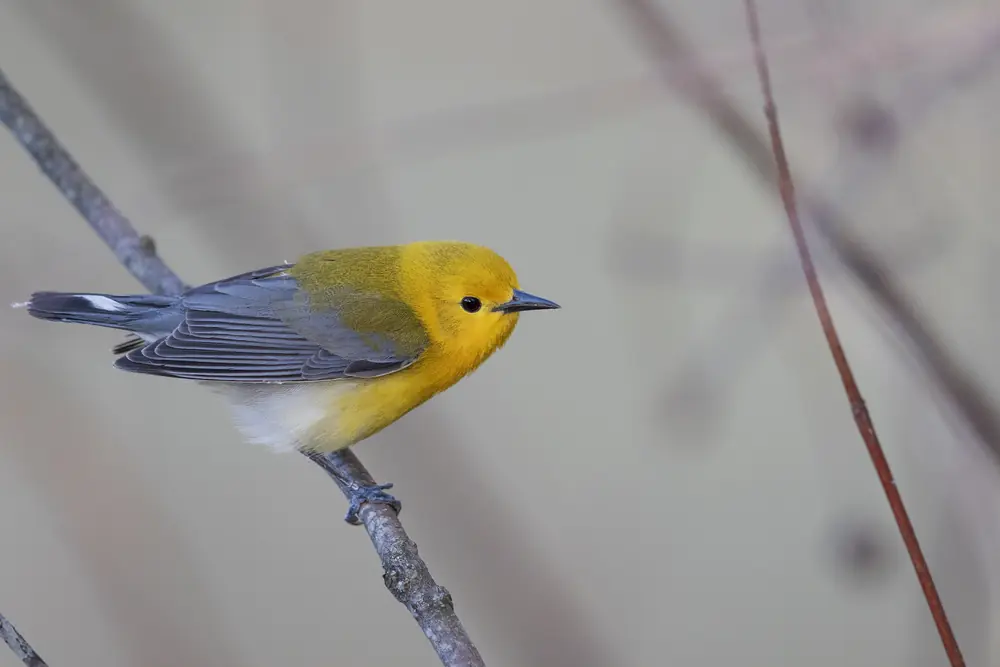
The refuge’s birding page says April and May give the best views of songbirds in the floodplain forest and marshes. Chestnut-sided, black-and-white and Cape May warblers and ruby-crowned kinglets pass through briefly, while prothonotary warblers and American redstarts stay to nest. It suggests scanning treetops from a boat landing or walking a floodplain trail, and listening at dusk for chimney swifts and common nighthawks over the river.
Farther up the valley, Trempealeau National Wildlife Refuge notes that warbler watching is great in late April or early May from its observation deck, so a trip there in the first days of the month can catch the early wave.
-
The Apostle Islands flyway
Spring migration, with numbers that swing from year to year · Apostle Islands National Lakeshore, Lake Superior
The National Park Service describes the islands as one of the heavily traveled migratory flyways of the Great Lakes region, because they shorten the open-water crossing for birds heading north of Lake Superior. Outer and Long Islands are important spring habitat for songbirds, hawks, falcons, waterfowl and shorebirds, and the park says counts swing widely between seasons, especially on Outer Island, and it suspects weather. Migrants make up more than 89 percent of the park’s breeding birds. Piping plovers nest on Long Island, with three to five successful nests a year from 2006 to 2020. The park advises that conditions on the lake are hard to predict and can change fast, so check current conditions before any crossing.
-
Reading the migration forecast
Tools run March 1 to June 15 · Anywhere in the state
Cornell Lab’s BirdCast posts forecast maps of how much migration to expect and live maps of what radar sees in the air. Its spring tools are switched on from March 1 through June 15, and it names light and glass as dangers to birds flying at night. A calm, clear night with a south wind usually means birds overhead; the morning after a front is the one to spend in a park. Turning off unneeded outdoor lights on forecast nights is a small way to help.
Log each species and the date in your journal. Spring birds are hardest to see once the leaves open, which is why the early part of the month is often better than the end.
What are whooping cranes, sandhill cranes and trumpeter swans doing in May?
Nesting is under way for Wisconsin’s big wetland birds. Most of it happens out of sight, though refuges allow decent views from afar, and staying back is the kindest thing a visitor can do.
-
Whooping cranes at Necedah
Eggs are normally laid from late April to mid-May · Necedah National Wildlife Refuge, Juneau County
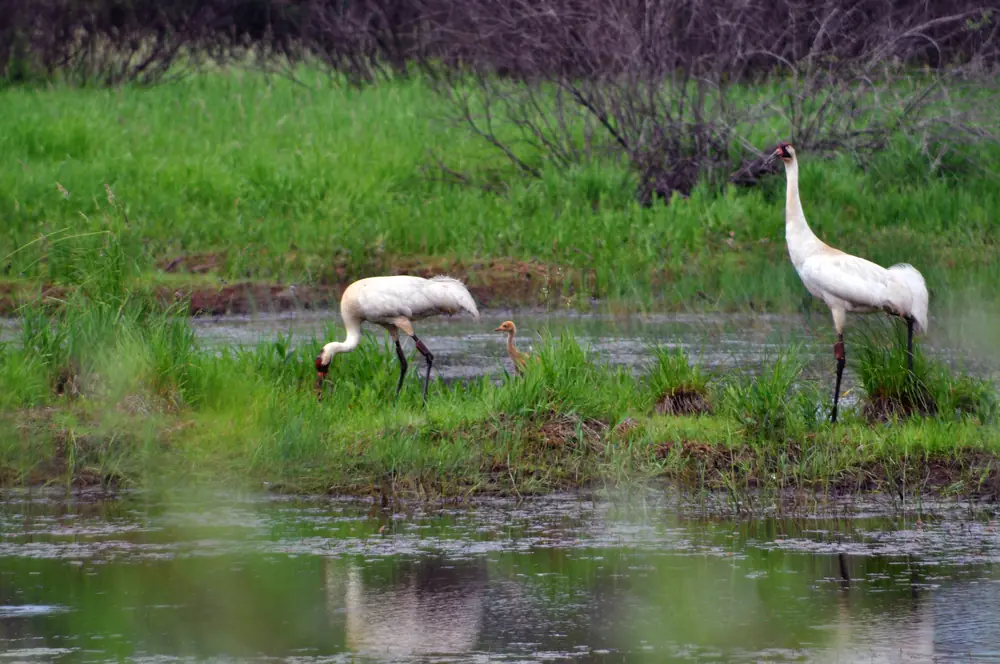
The Fish and Wildlife Service says whooping crane eggs are normally laid from late April to mid-May, usually two to a clutch, and that a pair may re-nest if the first clutch is lost early in incubation, though that has been documented only a few times. The Eastern Migratory Population was reintroduced from 2001 to 2010 and migrates between Wisconsin and Florida; the agency’s 2011 review found that none of the reintroduced populations were self-sustaining. Necedah’s visitor page says whooping cranes are often seen from the visitor center grounds and the Muskrat Loop, where scopes face the wetland, and that Goose and Sprague Pools offer drive-through viewing for loons, whooping cranes, sandhill cranes and trumpeter swans. Dawn and dusk are best. Many township roads on the refuge are seasonal or under construction, so call the visitor center at 608-565-2551 first.
-
Sandhill crane colts
Eggs hatch about a month after incubation begins; colts appear from late spring · Wetlands statewide, including Crex Meadows
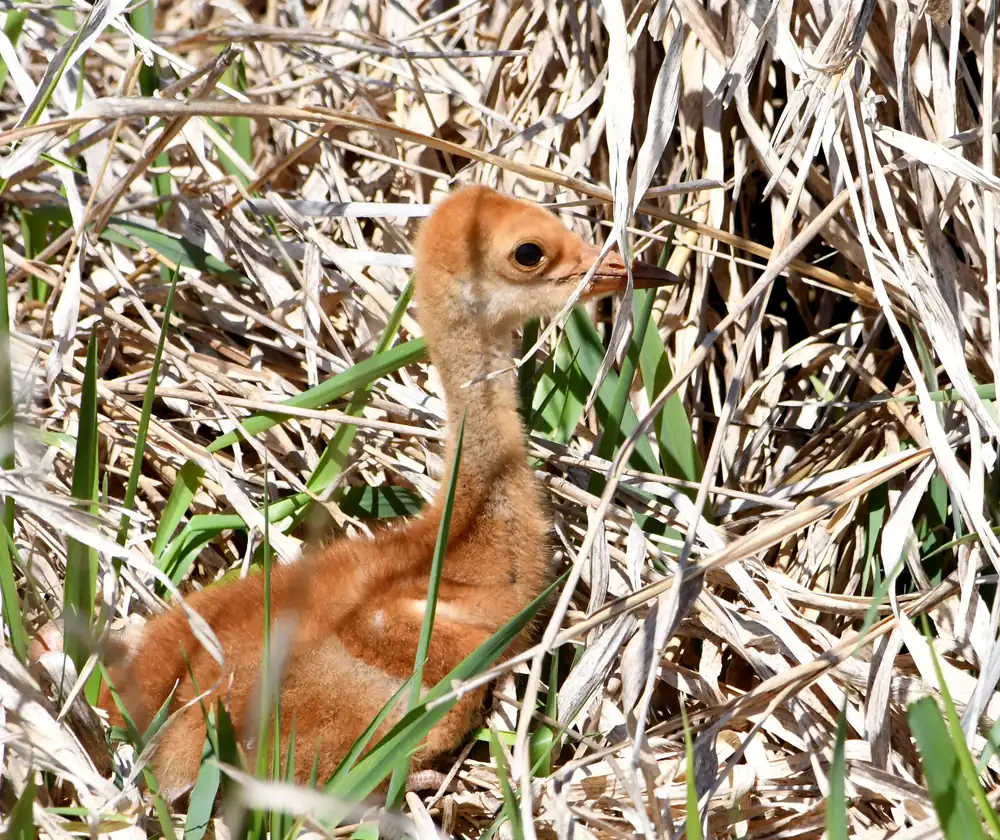
The DNR says sandhill cranes are back by March, build mound-shaped nests in wetlands with standing water, and usually lay two eggs. A colt that is still covered in down is too young to survive on its own, but colts leave the nest with their parents within a day of hatching, so a parent is probably close. Watch and listen for several hours before concluding anything, and call the DNR or a licensed rehabilitator for advice before touching it. At Crex Meadows, cranes return from mid-March to early April to build nests, and many pairs nest there each summer. The wildlife area asks that dogs be leashed from April 15 to July 31 and discourages motorized boats from April to June.
-
Trumpeter swans on nests
Egg laying runs from late April into June · Northwest, central and southeast wetlands
According to the DNR, trumpeters arrive soon after ice-out and start nest building around mid-April. Egg laying runs from late April into June, with one egg every other day and a typical clutch of five. Incubation takes about 32 to 34 days, and cygnets hatch around June. The agency says water levels in suitable habitat matter in May through August, and the state population now exceeds 5,000. A swan sitting low on a muskrat house or a cattail island is on eggs; leave her be and use binoculars.
-
Bald eagles raising young
Nests active through the month · Every county
DNR aerial surveys in 2019 found 1,684 occupied bald eagle nests, up from 108 in the 1970s, with active nests documented in every county. When you watch eagles, the agency says to heed closed-area signs and not to come so close that you flush them. A car makes a good blind.
Nest watching for the big birds is a patience sport: pick a spot, stay in the vehicle if you can, and let the birds ignore you.
Where can you see Karner blue butterflies and rusty patched bumble bees in Wisconsin?
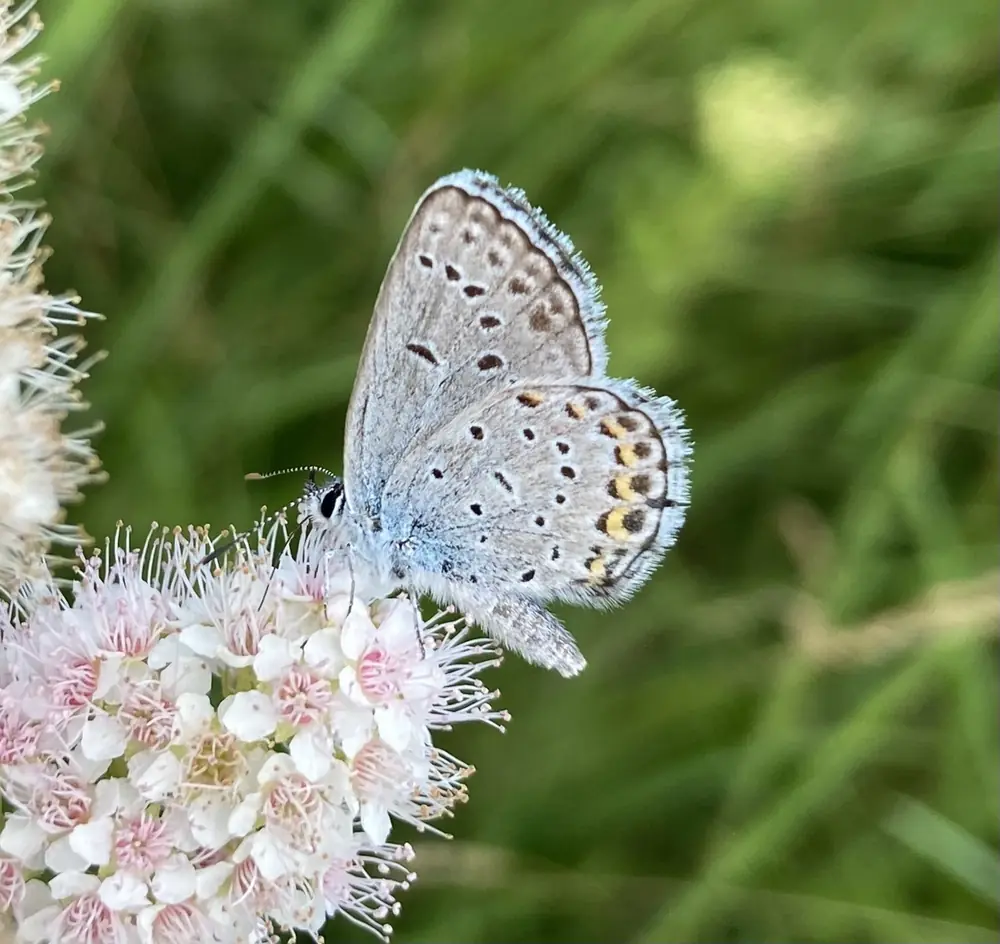
Two endangered insects are on the move in late spring, and Wisconsin holds important populations of both.
-
Karner blues on the lupine loop
Late May is the first flight at Necedah · Necedah National Wildlife Refuge
The DNR says Wisconsin habitats support the world’s largest populations of the federally endangered Karner blue butterfly. Necedah’s visitor page says the best time to look on its Lupine Loop, a walk of about 0.8 mile north of Goose and Sprague Pools, is late May and late July, matching the butterfly’s two broods. Karner blues can also turn up around the visitor center grounds, and the Karner Loop there is about 0.75 mile and accessible. These are small butterflies, about the size of a thumbnail, and they stay near wild lupine, so look low on sunny, still mornings and stay on the trail.
-
Rusty patched bumble bee queens
In southern Wisconsin queens typically fly from about April through May · Prairies, woodlands, marshes, farmland and gardens in the south
The Fish and Wildlife Service listed the rusty patched bumble bee as endangered in 2017 and finalized a recovery plan in 2021. Queens leave their overwintering chambers in spring to start colonies, and the only documented overwintering queen in Wisconsin was found in 2016, under leaf litter in a maple-oak woodland. The agency suggests planting a mix of flowers that bloom from early spring through fall, leaving leaf litter and rodent burrows undisturbed, and uploading clear photos to BumbleBeeWatch, BeeSpotter or iNaturalist if you think you have found one.
For tracking these small visitors, a map of sounds and a daily field log work well alongside the Naturalist’s Field Journal.
Which spring visitors can you watch from a feeder or garden in May?
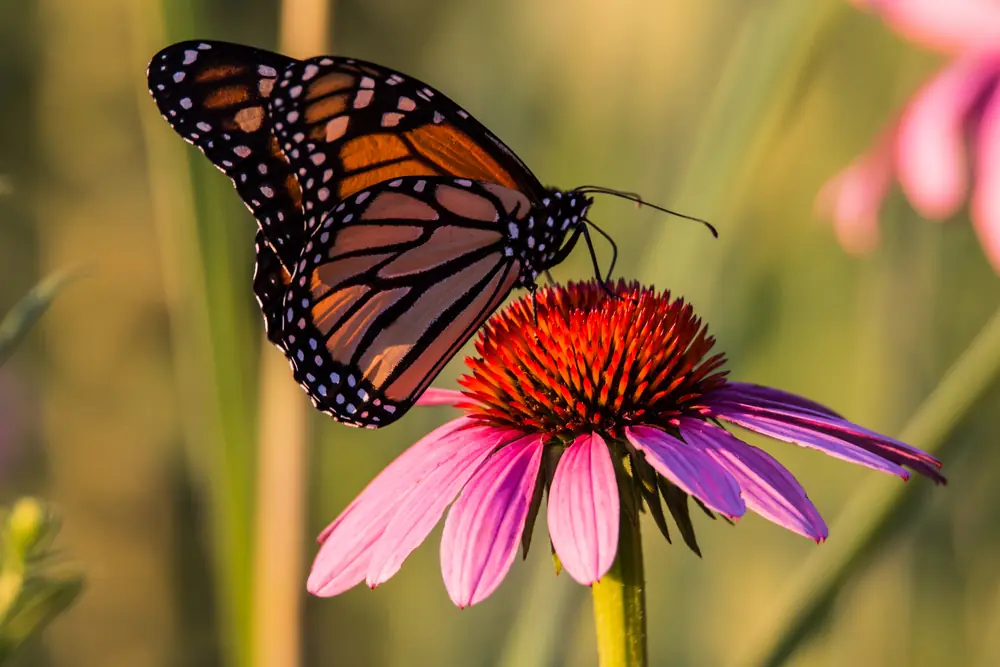
Two long-distance travelers are easy to follow from a backyard.
-
Monarchs and hummingbirds returning
First sightings are what volunteers report · Gardens and woodland edges
Journey North asks volunteers for the first monarch adult, egg or caterpillar they find each season, and its hummingbird pages show how far north the ruby-throated hummingbird has come. We could not confirm a Wisconsin arrival date from an agency source, so use the maps instead of a calendar and report what you see. A feeder with plain sugar water is enough; change it often as the weather warms.
Reports from many yards add up to the maps, so a few minutes with a notebook helps science.
When do bats come back to Wisconsin, and when can you go into caves?
Eight bat species live in the state. Half of them winter in caves and mines, and the other half are tree bats that fly south for the winter.
-
Staying out of hibernation sites until May 15
October 1 through May 15 · Caves and mines with bats
Visitors are asked by the DNR bat program to avoid caves and mines housing bats from October 1 until May 15, so that hibernating animals are left to sleep. White-nose syndrome reached Wisconsin in 2014 and cave bat populations have declined significantly since then, though many little brown bat colonies have stabilized and some are increasing. Wisconsin holds a significant share of the surviving little brown bats in North America.
-
Maternity season starts June 1
Bat counts in early June and late July · Barns, attics, bat houses
Bats should not be shut out of buildings from June 1 through July 31, while young are being raised. The program’s Great Wisconsin Bat Count asks volunteers for at least two counts of bats leaving a roost, one in early June and one in late July, beginning just after sunset and continuing about 40 minutes. May is a good time to find out where your roost is and plan the counts.
A sick or dead bat should be reported on the DNR form, and picked up, if at all, only with gloves.
What changes at a Wisconsin marsh or woodland in May?
The green-up is the main event. The State Climatology Office defines meteorological spring as March, April and May, and by May the weather and the plants have mostly caught up with each other. The Aldo Leopold Foundation has logged seasonal events at the Shack since 1935, a reminder that dates for leaf-out and bloom vary a lot from year to year.
-
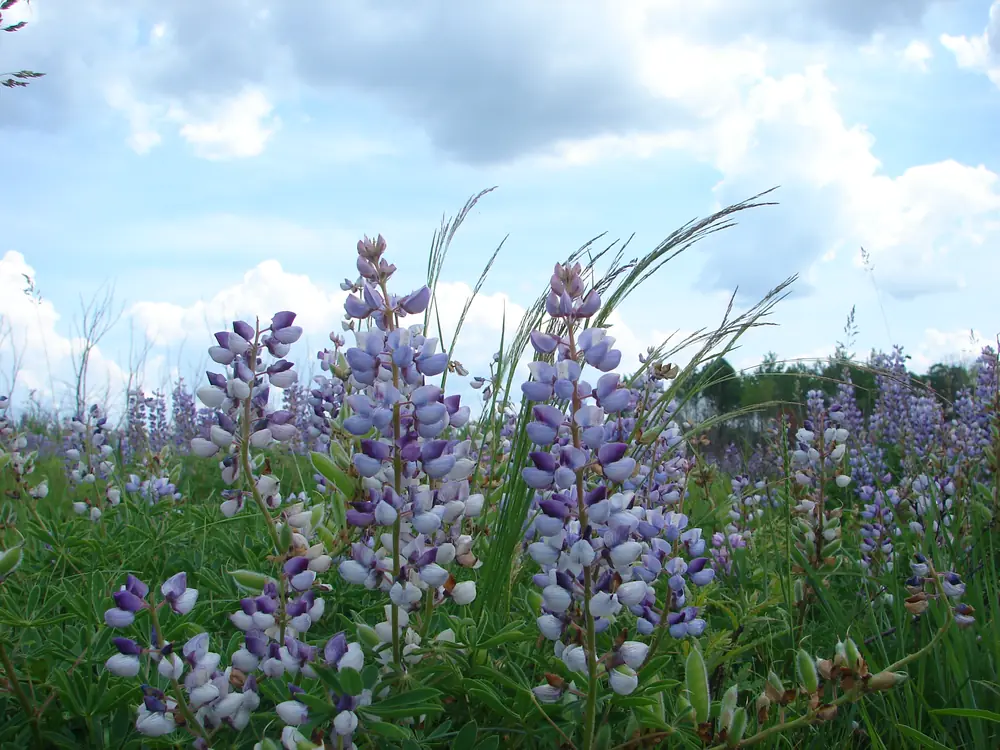
Quiet water, busy edges
Through the month · Marshes and ponds
At Horicon, the DNR says waterfowl become harder to see once nesting begins, while songbirds, herons and others take over the foreground. Take binoculars and look for activity along the cattail edge at dawn. The refuge reports more than 300 bird species recorded at Horicon, with spring migration bringing a variety of waterbirds and songbirds.
-
Hiking trails and wildlife areas
Check before you go · Ice Age Trail and state lands
The Ice Age National Scenic Trail runs 1,200 miles and is maintained largely by volunteers and partners including the DNR. The Park Service points hikers to its alerts page for conditions, so check there before a long hike. Trails near wetlands can be wet and buggy in May.
For a repeat visit, the field journal plate called the same place twice makes the green-up easy to compare.
What can you see in the Wisconsin night sky in May 2027?
Central Daylight Time applies for the whole month, and every clock reading here uses it. Our planet figures were computed for the center of the country, so allow extra margin for Wisconsin’s own horizon.
-
Eta Aquariids
The final dark hours of May 5, 6 and 7 · Aquarius, low in the east before dawn
In 2027 this shower peaks right as the Moon goes new, so no moonlight interferes. For the peak, the American Meteor Society names the night of May 5 into 6, while SeaSky names May 6 into 7 and mentions up to 60 an hour, mostly for observers in the Southern Hemisphere. Since Aquarius, the radiant, clears the horizon just before sunrise this far north, Wisconsin watchers should plan on fewer meteors than the ten to thirty an hour quoted for the southern two-thirds of the nation. Choose a dark site with a clear view east and stay out until the sky starts to brighten. The Moon is a sliver, between 1 and 2 percent lit.
-
Venus and Saturn before sunrise
Around Friday, May 7 · Very low in the east before sunrise
Venus and Saturn close to about 0.6 degrees on May 7, with roughly a degree between them the mornings before and after. They lie in Pisces, hugging the eastern horizon: at 40 degrees north they stand just 3 to 6 degrees high thirty minutes ahead of sunrise, and Wisconsin’s higher latitude puts them lower yet. A flat horizon and binoculars are essential. Venus is magnitude -3.9 and Saturn about +0.7. Think of it as a bonus for early risers.
-
Flower Moon, with a Blue Moon label
Full early Thursday, May 20; the Wednesday-evening rise looks round · Rising in the east at dusk
By our calculations moonrise on the 19th comes near 7:53 p.m. at Chicago and 8:29 p.m. at Minneapolis, a span that covers the state. SeaSky also labels it a Blue Moon, as the third of four full moons squeezed between the first day of spring and the first day of summer. A tally by calendar month, which needs two fulls inside one month, finds none this year, so the label rests on the seasonal count alone. The full Moon is at 5:59 a.m. CDT, and its older name is the Flower Moon.
-
Jupiter and Mars in the evening, the Moon beside them
Quarter Moon beside Jupiter on Wednesday evening, May 12, and near Mars the next day · Southern and southwestern sky after dark
Jupiter, among the stars of Leo close to Cancer, should, by our calculations, stay up late into the night at the start of the month, which makes it an easy target. The half-lit Moon sits closest to it on May 12 at about 4:52 p.m. CDT by our calculations, still daytime, so look that evening. About 3 degrees separate the Moon and Mars on the 13th. Mars has faded since winter and, by our calculations, sets near 2 a.m. on May 1.
-
Mercury in the evening
Evenings of May 12 to June 5, widest on Friday, May 28 · West-northwest horizon, 45 to 90 minutes after sunset
For northern observers, this is Mercury’s finest evening showing of 2027. Mercury stands farthest east of the Sun, 22.8 degrees, at 8:14 a.m. CDT on May 28 (SeaSky says 22.9), which makes the 27th and 28th both fine evenings. In mid-May, at the center of the country, our calculations have Mercury going down about 97 minutes after the Sun at magnitude -0.6; it dims quickly once June begins. Choose a spot with an open western horizon.
-
Dark-sky nights and the Milky Way
Early and late in the month, away from moonlight · Low in the south before dawn
From Wisconsin the galaxy’s brightest hub sits low over the southern horizon before dawn. Our calculations find moonless darkness with the hub up on the first fourteen days and the last seven at latitude 40 north. Up at latitude 48 north the windows shrink to the first eleven days and the last four, under two hours each, because nights are short. The state falls in between, so favor the first days of the month and the final few.
-
Aurora
Any clear dark night · Low in the north
NOAA’s Space Weather Prediction Center keeps a 30-minute aurora forecast. Storms are possible on any night, but short May nights leave less darkness to see them in.
| Phase | Date | Time |
|---|---|---|
| New moon | Thursday, May 6 | 5:58 a.m. |
| First quarter | Wednesday, May 12 | 11:44 p.m. |
| Full moon, the Flower Moon | Thursday, May 20 | 5:59 a.m. |
| Last quarter | Friday, May 28 | 8:58 a.m. |
The moon page has the phases for other months, and the cloud page helps with judging whether a night will be clear.
How mild, wet and thundery is May in Wisconsin?
May is the month Wisconsin finally warms. By NOAA’s 1991 to 2020 normals, May highs average about 57 °F at Superior on the Lake Superior shore, 62 to 65 °F in the Northwoods and Door County, 66 to 70 °F around Green Bay, Milwaukee, Madison and Eau Claire, and 72 °F at La Crosse. Cold lake water still holds the shoreline back, and a freeze is not unusual in the north: Minocqua averages 8.5 freezing nights in May, against 0.2 at Milwaukee.
-
Severe weather season
The peak tornado months are May through August · Statewide
The Milwaukee-area forecast office reports about 23 tornadoes in a typical Wisconsin year, with activity centered on May through August and June the busiest. Most come between 3 and 9 p.m. The office adds that Wisconsin gets a few storms every year with hurricane-force straight-line winds, which prompt severe thunderstorm warnings, not tornado warnings. Know your county, know where your shelter is, and treat any warning in the afternoon seriously.
-
Lightning outdoors
Any afternoon thunderstorm · Trails, lakes, open fields
The National Weather Service notes that anyone outside near a strike can be a victim of ground current, and that people who shelter under a tree to avoid rain risk side flash. Leave the trail or water when thunder is audible, and do not wait for rain.
-
Late frosts
Median last freeze runs from April 19 to late May · Garden and orchard
The table below shows when the last freeze usually comes at the main stations. In the Northwoods the median falls in late May, and in about one year in ten the last freeze comes as late as the first week of June. Check the Wisconsin frost page for your own town before you put out tender plants.
| Station | Snowfall | Average high | Average low | Precipitation | Nights at or below 32 °F |
|---|---|---|---|---|---|
| Hurley (Iron County snowbelt) | 1.4 in | 64 °F | 41 °F | 3.56 in | 5.8 |
| Minocqua (Northwoods) | 0.7 in | 64 °F | 39 °F | 3.76 in | 8.5 |
| Superior (Lake Superior shore) | 0.0 in | 57 °F | 41 °F | 3.37 in | 1.9 |
| Sturgeon Bay (Door County) | 0.0 in | 62 °F | 43 °F | 3.32 in | 1.7 |
| Green Bay | 0.0 in | 67 °F | 46 °F | 3.35 in | 1.3 |
| Eau Claire (Chippewa Valley) | 0.4 in | 70 °F | 45 °F | 3.91 in | 2.2 |
| La Crosse (Mississippi valley) | 0.0 in | 72 °F | 50 °F | 4.33 in | 0.5 |
| Madison (south central) | 0.1 in | 69 °F | 47 °F | 4.10 in | 1.5 |
| Milwaukee (Lake Michigan shore) | 0.0 in | 67 °F | 48 °F | 3.54 in | 0.2 |
NOAA posts its latest three-month outlook at cpc.ncep.noaa.gov, where the current outlook is posted, and we do not restate it. The weather page explains forecasts.
How much daylight does Wisconsin gain in May?
Days lengthen all month, but the gains per day are smaller than in April. Clocks remain on Central Daylight Time. The Sun reaches its highest point of the year at the June 21 solstice, at 9:11 a.m. CDT, according to the Naval Observatory’s 2027 table, so May is the last full month of fast-growing days.
| City | May 1 | May 31 | Gained | Per day |
|---|---|---|---|---|
| Superior | 14 h 24 m | 15 h 35 m | 71 min | 2.4 min |
| Rhinelander | 14 h 19 m | 15 h 26 m | 67 min | 2.2 min |
| Eau Claire | 14 h 15 m | 15 h 20 m | 65 min | 2.2 min |
| Wausau | 14 h 16 m | 15 h 21 m | 65 min | 2.2 min |
| Green Bay | 14 h 13 m | 15 h 18 m | 65 min | 2.2 min |
| La Crosse | 14 h 11 m | 15 h 13 m | 62 min | 2.1 min |
| Madison | 14 h 08 m | 15 h 07 m | 59 min | 2.0 min |
| Milwaukee | 14 h 07 m | 15 h 07 m | 60 min | 2.0 min |
Your own town is on the daylight page too.
When is the last spring freeze in Wisconsin?
Gardeners and orchard owners watch this table more than any other. At the main NOAA stations the typical last freeze lands in late April or early May across the southern third and close to the end of May in the Northwoods. Even in the latest tenth of years, the south is freeze-free by mid-May, while Hayward and Rhinelander can see frost into the first week of June.
| Station | One year in ten | Median | Nine years in ten |
|---|---|---|---|
| Superior (Lake Superior shore) | Apr 24 | May 6 | May 25 |
| Hayward (Northwoods) | May 5 | May 23 | Jun 6 |
| Rhinelander (Northwoods) | May 6 | May 22 | Jun 4 |
| Eau Claire (Chippewa Valley) | Apr 24 | May 8 | May 21 |
| Wausau (central) | Apr 24 | May 6 | May 21 |
| Sturgeon Bay (Door County) | Apr 25 | May 8 | May 21 |
| La Crosse (Mississippi valley) | Apr 9 | Apr 23 | May 6 |
| Madison (south central) | Apr 16 | May 1 | May 16 |
| Milwaukee (Lake Michigan shore) | Apr 6 | Apr 19 | May 2 |
Use the Wisconsin frost page for a station near you.
What can Wisconsin families do outdoors in May?
May is a good month for short, quiet outings with a purpose: a morning on a refuge deck, an evening listening beside a pond, a night of counting bats leaving a barn.
-
World Migratory Bird Day
Held in May and October; check the organizer for 2027 dates · Local events and your own backyard
At last look the organizers had listed just their 2026 events, one in each of the two migration seasons. The 2027 dates were not out yet. Watch the site, and ask local nature centers about events.
-
Frog and toad listening
Volunteers start in April · Ponds and flooded fields near you
The DNR’s Frog and Toad Survey has run since 1984, with volunteers driving set routes and listening. A separate phenology survey asks anyone near water to listen at night for about five minutes and log what they hear. Sign up at the DNR survey page or by email to WFTS@wisconsin.gov.
-
Bat counts and birdathons
Early June and late July for bats · Barns, attics and bat houses
Find a roost this month and plan to count in early June. The DNR lists the Great Wisconsin Birdathon as a way to support bird conservation; ask for its dates and format. The Wisconsin Society for Ornithology also runs field trips and lists them in its calendar.
-
Log what you see
All month · Home
Journey North takes first sightings of monarchs and hummingbirds, and the DNR points birders to Wisconsin eBird for logging sightings and seeing recent ones. A notebook works too; many birders find their first-of-year dates drift by a week or two between years.
The field journal at our Naturalist plates suits these outings, and the nature pages cover other places and months. Last month’s page, Wisconsin in April, covers the frogs and early flowers.
Safety notes for May in Wisconsin
May’s hazards are ticks, storms, cold lake water, and, for hunters and anglers, the busiest weeks of the spring seasons.
-
Spring turkey season
Periods run April 21 to June 1, 2027 · Statewide, by zone
The DNR lists the 2027 periods as the youth hunt April 17 to 18, then A: April 21 to 27, B: April 28 to May 4, C: May 5 to 11, D: May 12 to 18, E: May 19 to 25 and F: May 25 to June 1. Hunters need a license, a wild turkey stamp and a harvest authorization, and must register a bird by 5 p.m. the day after harvest. The DNR page does not list 2027 shooting hours and does not state a spring blaze orange rule; its only orange advice is general safety wording about wearing an orange cap or gloves on foot. If you hike in public hunting areas in early May, wear bright colors.
-
Trout and other fishing seasons
General inland trout season opens the first Saturday in May · Streams and lakes
By DNR rule the general inland trout season opens at 5 a.m. on the first Saturday in May, which is May 1 in 2027, and runs through October 15. Wisconsin-Michigan boundary waters have been open since the last Saturday in April. The 2026-27 fishing year, effective April 1, 2026, listed walleye, northern pike and bass openers on May 2, 2026; the 2027 dates are not yet posted, so check the regulations pamphlet. Local rules can change dates for specific waters.
-
Ticks
Active through the month · Woods, brush, tall grass
The CDC recommends repellent with an EPA registration number, boots and clothing treated with permethrin, and staying in the middle of trails. Afterward, shower within two hours, check your whole body, and run clothes through a hot dryer for ten minutes.
-
Young animals
Late spring · Yards and trails
The DNR says a young wild animal’s best chance of survival is with its parents; many spend the day alone while the mother feeds or stays away to protect them. Contact a licensed rehabilitator if the parent is dead, a predator has attacked, or the animal is bleeding, thin, or covered in flies. Do not try to rehabilitate wildlife yourself.
-
Cold water and weather
All month · Lake Superior and the Great Lakes
May air can feel warm while lake water remains dangerously cold. The Park Service says Apostle Islands weather is hard to predict and can change fast. Wear a life jacket, and check conditions before crossing.
-
Memorial Day weekend
Monday, May 31 · Lakes, campgrounds and trails
Memorial Day falls on May 31, 2027, and the weekend usually draws the first big crowds. Book campsites and ferries early and leave wetlands and nests undisturbed.
When in doubt about a season or a closure, the agency page beats any summary here. See the nature pages for other months.
Sources (44)
- Wisconsin DNR: spring turkey
- Wisconsin DNR: hunting season dates
- World Migratory Bird Day
- Wisconsin DNR: inland trout seasons
- Wisconsin DNR: fishing seasons
- Wisconsin DNR: injured and young wildlife
- Wisconsin DNR: sandhill crane colts
- Wisconsin DNR: Horicon Marsh wildlife
- Horicon National Wildlife Refuge
- Journey North: hummingbirds
- Journey North: monarchs
- Apostle Islands National Lakeshore: birds
- Apostle Islands National Lakeshore: plan your visit
- NOAA NCEI monthly normals, main stations
- NOAA NCEI monthly normals, cooperative stations
- Necedah National Wildlife Refuge
- Necedah NWR: visit
- Wisconsin DNR: bats
- Wisconsin DNR: birding and bird conservation
- Wisconsin DNR: eagles
- WXPR: DNR seeks frog and toad survey volunteers
- Aldo Leopold Foundation: 2027 phenology calendar
- NWS Milwaukee: severe weather awareness
- U.S. Fish and Wildlife Service: rusty patched bumble bee
- U.S. Fish and Wildlife Service: whooping crane
- BirdCast
- Ice Age National Scenic Trail
- Wisconsin State Climatology Office
- Wisconsin State Climatology Office: seasons
- Trempealeau NWR: birding
- Upper Mississippi River NWR: birding
- Crex Meadows Wildlife Area
- Wisconsin DNR: trumpeter swans
- International Crane Foundation: Midwest Crane Count
- SeaSky: astronomy calendar 2027
- U.S. Naval Observatory: moon phases 2027
- U.S. Naval Observatory: seasons 2027
- CDC: preventing tick bites
- NWS: lightning, struck
- NOAA Climate Prediction Center: 90-day outlooks
- NOAA SWPC: 30-minute aurora forecast
- Wisconsin Society for Ornithology
- Wisconsin DNR: wood frog
- Photos via Wikimedia Commons; licenses and photographers are credited under each picture
