What to look for in nature in Wisconsin this December
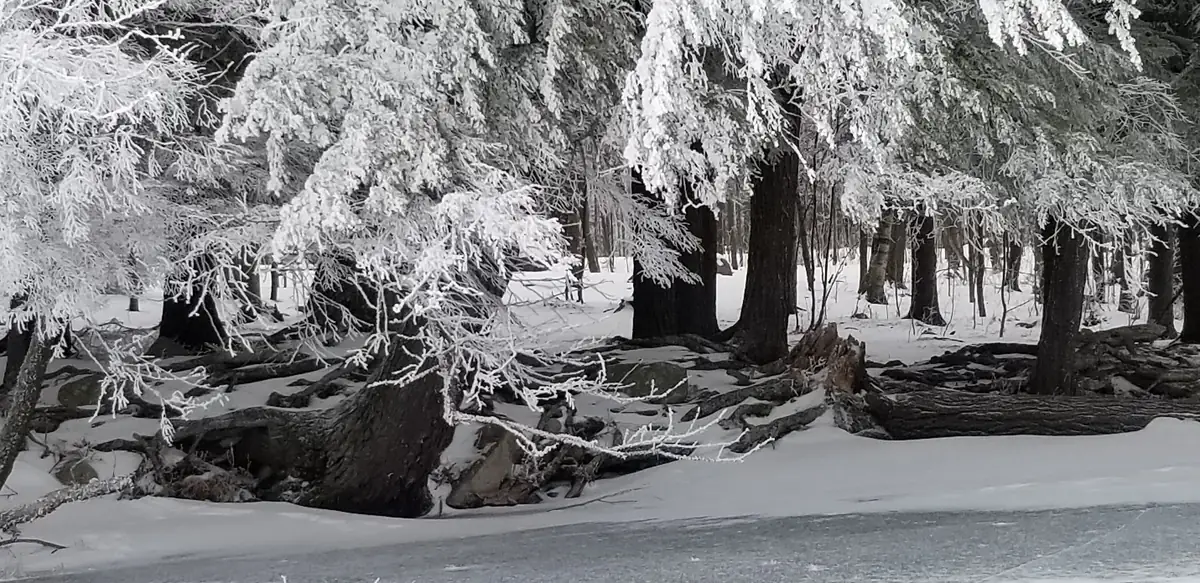
Meteorological winter starts on December 1, and Wisconsin usually takes it at its word. Lakes close one after another, the snowbelt south of Lake Superior begins to pile up, and eagles from farther north crowd the open water below the dams on the Wisconsin and Mississippi rivers. Great horned owls start their courtship duets in the long nights, wood frogs lie frozen in the leaf litter, and each new snowfall keeps a record of who passed by. This year a very strong El Niño may keep the season mild. The sections below give the places and the likely dates.
Other months in Wisconsin: October, November.
Start here
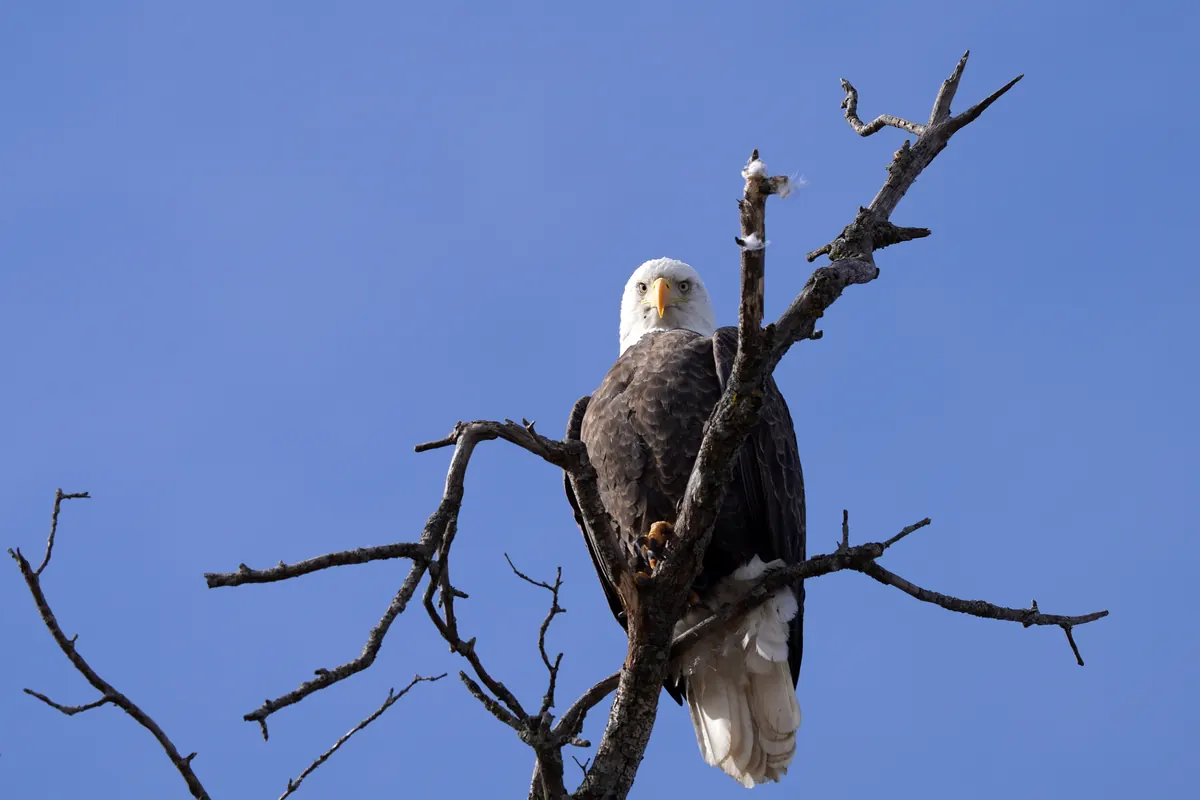
- Eagles at the Prairie du Sac dam. Open water below the dam draws bald eagles to Sauk Prairie each winter; the Ferry Bluff Eagle Council has found them crowding the roosts there at some point between early December and late February. Watch from the overlook at 490 Water Street between 8 and 10 a.m., when they leave the night roosts to fish.
- Join a Christmas Bird Count. Wisconsin has about 110 count circles, and the 127th count runs December 14 to January 5. Find your nearest circle on Audubon’s map and email the compiler; feeder watchers inside a circle can count from the kitchen window.
- Geminids on a moonless night. Sunday night, December 13, into Monday morning is the peak of the year’s best meteor shower. A thin crescent moon sets early in the evening, and the hours around 2 a.m. are usually the richest.
Keep a record: sketch a white pine bundle and a balsam fir cone spike on the Field Journal’s seeds, pods and cones page, draw the first clear hare or fox prints on tracks to know, and log the earliest sunset of the year on the dusk and dawn watch page. List every eagle and owl in birds I have seen, put a grouse roost hole on reading the signs, and return to one frozen pond for the same place twice.
Regions used below: Northwoods and the Lake Superior shore; Northwest and the St. Croix; Central Sands and the Wisconsin River; Fox Valley, Green Bay and Door County; Southeast and the Lake Michigan shore; South Central and the Driftless Area.
Where can you see bald eagles in Wisconsin in December?
Below the dams. Once marshes and backwaters lock up, a fish-eating eagle needs moving water, and the churn below a hydroelectric dam keeps a stretch of river open all winter. The DNR says wintering eagles collect below dams on the Wisconsin, Mississippi and Fox rivers, including birds that come down from northern Wisconsin, Canada, northern Michigan and Minnesota. Breeding pairs have climbed from 107 in 1974 to about 1,700, now nesting in all 72 counties.
-
Sauk Prairie and the Prairie du Sac dam
Roosts fill at some point between early December and late February · The overlook at 490 Water Street, Prairie du Sac, and the Wisconsin River through Sauk City
Ferry Bluff Eagle Council volunteers count the birds through the winter at six to eight traditional night roosts on the lower Wisconsin River, from early December to late February. The Sauk Prairie roosts, Sugar Loaf and Black Hawk, can fill at any point in that span, but the heavy use in any one winter lasts only three to six weeks, so a hard freeze in early December can bring the crowd before Christmas. Go between 8 and 10 a.m., when eagles leave the roosts to fish, or in the two hours before dark, when they return. Farther downstream, the northern unit of Ferry Bluff State Natural Area is shut to all visitors from December 1 to March 31 to protect the roost.
-
The Mississippi and the Fox
As the backwaters freeze, and on into late winter · Below the Mississippi River locks and dams along Highway 35; the lower Fox River
On the big rivers, eagles gather in the open tailwater under each lock and dam once the sloughs skin over. The Upper Mississippi refuge says its biggest gatherings, hundreds of birds, come around mid-March as the river ice begins to melt, so think of a December trip as a preview. Scan both banks; the young eagles, still brown, are easy to miss.
Watch from your car unless you are at a staffed site, the DNR asks, since each time an eagle flushes it burns energy it needs. Sauk Prairie holds Bald Eagle Watching Days every January (January 17 and 18 in 2026); the council’s website will post the 2027 dates.
When is the Christmas Bird Count in Wisconsin, and how can you take part?
Each Wisconsin circle picks its own day for the 127th Christmas Bird Count, anywhere from December 14 through January 5. Every count covers one circle 15 miles in diameter on one day, with a volunteer compiler dividing it into sections and sending out field teams. The Wisconsin Society for Ornithology helped found many of the state’s roughly 110 circles and describes the count as the nation’s longest-running citizen science project.
-
Find a circle and its compiler
Sign up from late November; counts run December 14 to January 5 · Audubon’s online Circle Finder
Pick the nearest circle on Audubon’s Circle Finder map and email its compiler. Beginners are usually teamed with veterans. Anyone whose home lies inside a circle can also report a feeder tally for count day, the warmest way for families with young children to take part.
-
A string of counts around Madison
Mid-December to New Year’s Day; 2026 dates still to be posted · Dane County and its neighbors
The Southern Wisconsin Bird Alliance, formerly Madison Audubon, runs the Madison count and lists about ten others nearby. Last season they began with Waterloo on December 16, Madison and Richland Center counted on the 20th, Poynette, Mount Horeb, Baraboo and Green Lake filled the week after Christmas, and Cooksville closed the season on January 1. Check its page for the 2026 dates, not posted as of early October.
Copy the day’s list into “birds I have seen” in your Naturalist’s Field Journal, with the temperature and snow depth beside it.
Which owls can you hear or find in Wisconsin in December?
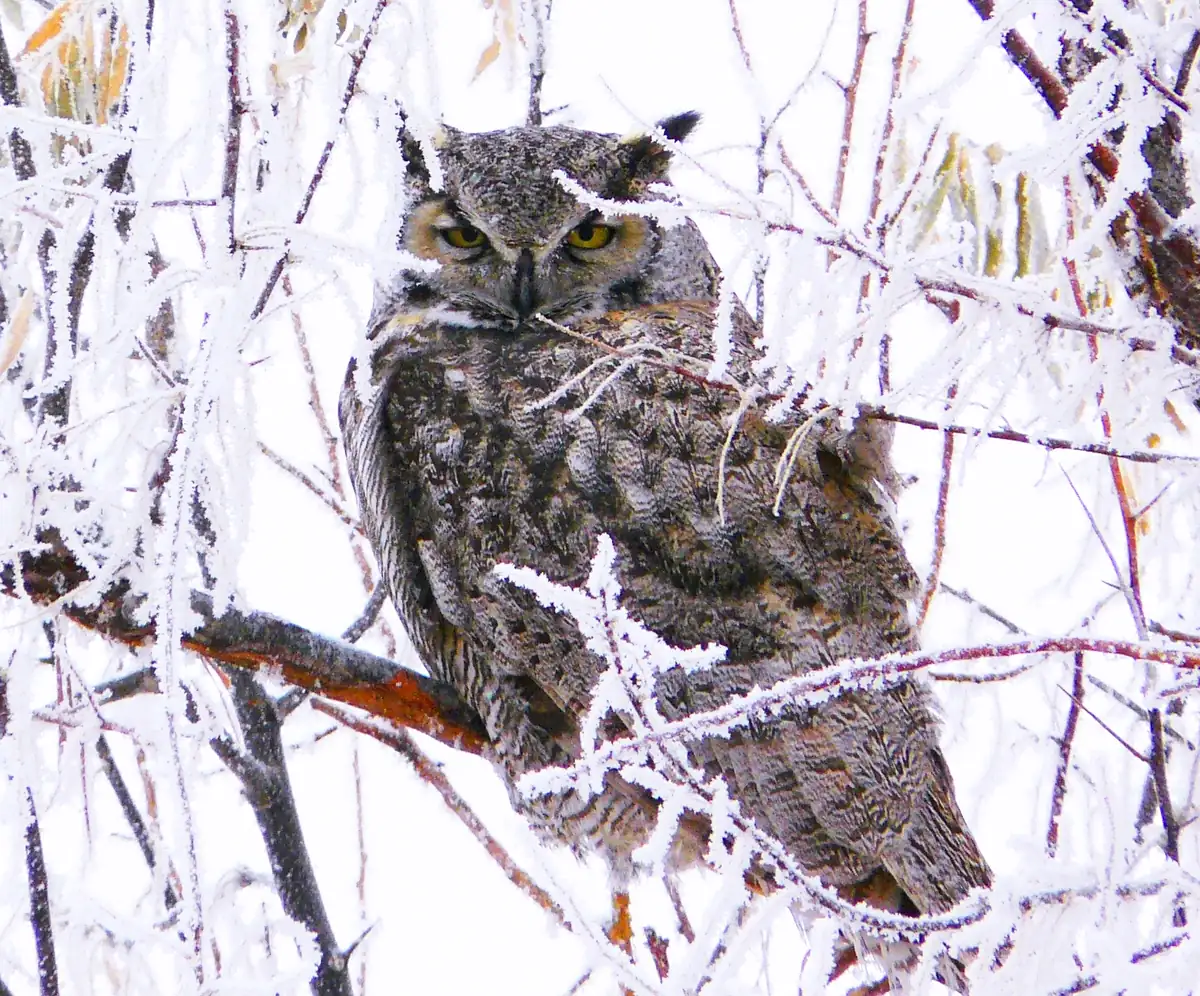
Schlitz Audubon Nature Center, on the lakeshore north of Milwaukee, lists great horned, barred and eastern screech owls as the state’s most common owls, and all three spend the winter here, insulated by feathers that run to the tips of their toes. Long nights and bare woods make this a good month to hear them.
-
Great horned owls begin to court
Duets from late December; nesting in late January and February · Woodlots, parks, cemeteries and farm windbreaks statewide
No Wisconsin owl nests earlier. Schlitz Audubon’s raptor staff describe the courtship: the male booms a low, stuttering string of hoots, and a female nearby replies a step higher. Pairs lay one to five eggs and share incubation for up to five weeks, often in an old hawk or squirrel nest, so the calls you hear around the solstice lead straight into nesting while the snow is deep. Listen on a windless evening an hour after sunset.
-
Snowy owls from the Arctic
On winter territories through March · Large open fields, airports and the Great Lakes shores
Big southward flights, called irruptions, follow Arctic summers with plenty of lemmings and other prey and many young raised, Schlitz Audubon explains. By December most of the owls that came south have chosen a field or stretch of shore and can often be found there day after day. Keep well back; if the owl keeps swiveling its head toward you, you are too close.
On the solstice, the longest night of the year, note each owl call you hear and the direction it came from on the map of sounds page.
Which evergreens are native to Wisconsin, and how can you tell them apart?
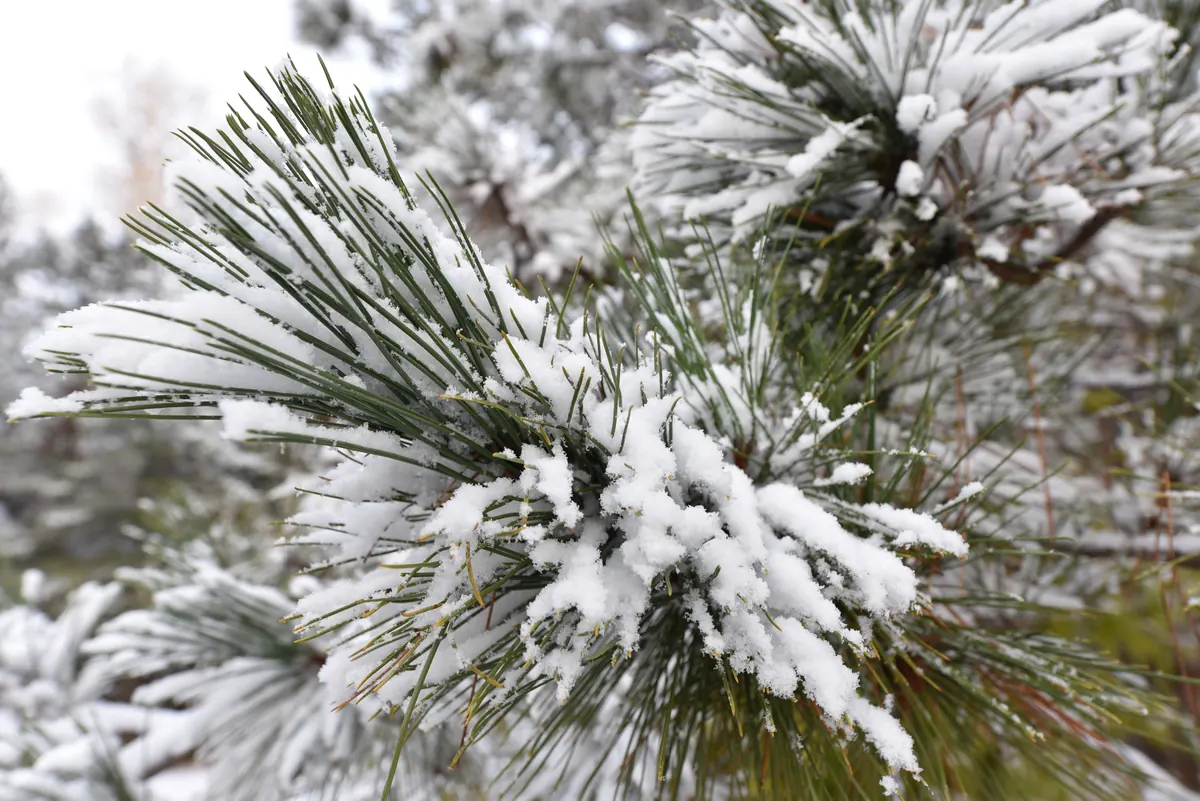
Leafless hardwoods leave the conifers on display. The DNR guide Forest Trees of Wisconsin: How to Know Them lists ten native conifers; tamarack drops all its needles in fall, and the other nine stay green all winter, so this is the month to learn them.
-
Three pines: count the needles
Year-round · White pine nearly statewide; red and jack pine mainly in the north and the Central Sands
Pull one bundle of needles and count. White pine is the only native pine with five, soft, blue-green and 3 to 5 inches long; the DNR calls it the largest and longest-lived tree of the region. Red (Norway) pine has two long needles, 4 to 6 inches, that break cleanly when bent double, and bark in reddish plates. Jack pine needles come in pairs too, but they are only about an inch long, twisted and sharp, and its curved cones may hang unopened for years until a fire’s heat releases the seed. It grows on sandy ground in the northern half and follows the Wisconsin River down to Iowa and Grant counties.
-
Balsam fir or white spruce?
Year-round · Northern forests, swamps and bog edges
Roll a needle between finger and thumb: a spruce needle is four-sided and rolls, a fir needle is flat and will not. Balsam fir needles are soft and blunt, with two silvery stripes underneath, and the smooth gray bark is dotted with blisters of resin. The cones point straight up from the top branches and shed their scales on the branch, leaving bare spikes. White spruce needles are stiff and sharp, crowded on the upper side of the twig, and smell faintly unpleasant when crushed. Black spruce, the bog tree, is smaller, with half-inch needles and little cones that can stay on for years.
-
Hemlock and the two cedars
Year-round · Hemlock in the northeast quarter and on cool north slopes; white cedar in wet ground; red cedar on dry southern ridges
Hemlock also has flat needles, short (under three-quarters of an inch), with two pale lines below and cones under an inch. Its native range is the northeastern quarter of the state, plus outlying stands on north-facing slopes in Columbia, Sauk and Vernon counties. Northern white cedar has flat sprays of tiny overlapping scales that smell sweet when crushed, and the DNR counts it among the deer’s preferred winter browse. Eastern red cedar, really a juniper, carries dark blue berry-like cones that birds eat in winter and grows on limestone ridges in the southwest and in abandoned fields.
The DNR names both balsam fir and white spruce as important Christmas trees, so a tree from a northern lot is likely one of the two. Before it goes to the curb, press a sprig and a cone scale into your journal beside the seeds, pods and cones.
How do Wisconsin animals survive the winter?
Every species has its own method. The DNR’s Wisconsin Natural Resources magazine collected some of the best in a winter feature, “Masters of Mother Nature.”
-
Frogs frozen in the leaves
From the first hard freezes until the spring thaw · Leaf litter on the forest floor
Wood frogs and spring peepers simply settle into the leaves and freeze. As they cool, their bodies load up with a sugary natural antifreeze; then breathing stops, the heart stops and brain activity ceases. In spring they thaw and head for the nearest pond. Any leaf pile in a damp woodland may hold one, and turtles do something similar under pond ice, slowing their metabolism by as much as 99 percent.
-
Ruffed grouse under the snow
Whenever about a foot of soft snow lies on the ground · Aspen and birch woods, mostly in the north and center
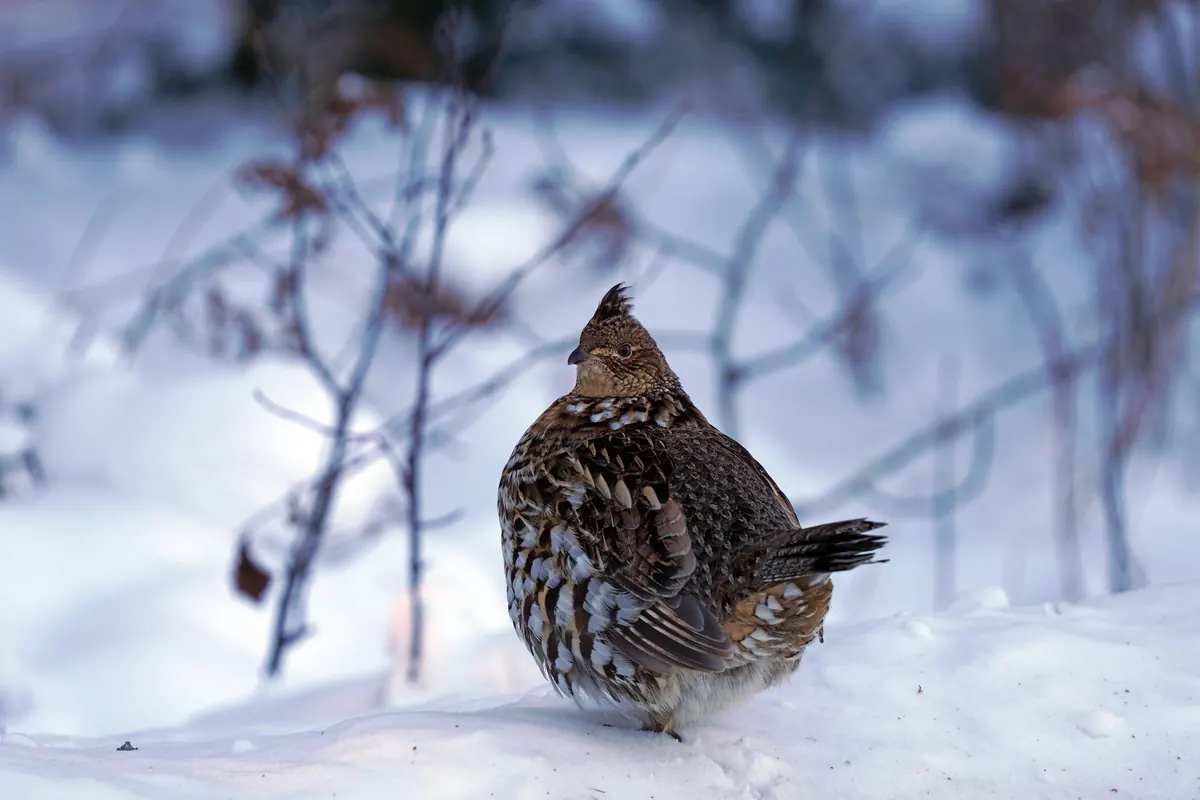
A grouse can fill its crop with aspen, birch, cherry or apple buds in roughly half an hour, enough to last a day or more. On bitter nights with deep, powdery snow it dives headfirst into a drift and works its way under, and its body heat soon warms the chamber several degrees above the outside air. Look for wing marks ending at a hole, or a scooped pit with droppings where a bird burst out.
-
Shrews that shrink, a squirrel that sleeps
All winter · Lawns, woods and grassy field edges
Shrews burn food so fast that some eat two to three times their weight each day, hunting all winter in runways beneath the snow; researchers in Germany found that common shrews even shrink for the cold months, with the brain and other organs losing up to 30 percent of their size and regrowing in spring. The thirteen-lined ground squirrel is a true hibernator: about six months underground, its heart slowed from 300 beats a minute to 10.
-
A larva inside a goldenrod ball
All winter · Old fields and roadsides with dead goldenrod stems
The round swellings on dry goldenrod stems are galls, each built around one goldenrod gall fly larva. In the cold it converts stored glycogen to glycerol and sorbitol, which keep ice from forming in its cells. Check the stems in spring for the adult fly’s exit hole.
A grouse roost hole, a gall a woodpecker has opened, or a squirrel’s dig in the snow all belong on the Field Journal’s reading-the-signs page.
What tracks can you find in Wisconsin snow in December?
Go out early after a light overnight snow with no wind, and every print you find will be fresh. The longtime Door County naturalist Roy Lukes offered rules of thumb that work anywhere in the state; a ruler or a glove laid beside each print makes the photos useful later.
-
Hares, rabbits and squirrels
Any snowy morning · Snowshoe hares mostly in the northern half; cottontails in the south; squirrels everywhere
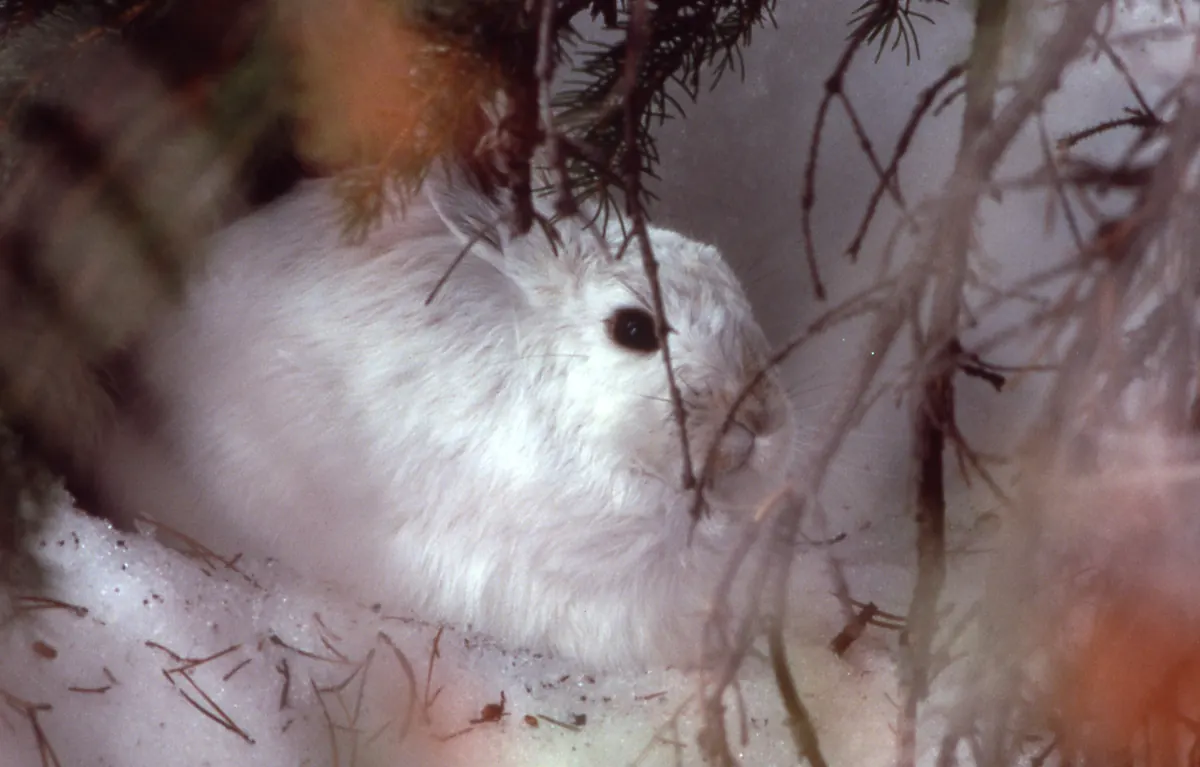
When these animals bound, the large hind feet swing past the front feet and land ahead of them, so the two big prints point the direction of travel. The snowshoe hare’s hind feet carry dense, stiff hair that lets it run on top of soft snow, and by December its coat is white. Cottontails leave smaller prints around brushy yards and field edges in the southern counties. A grouse print shows the comb-like fringes that grow on its toes each winter, which Lukes said roughly double the foot’s surface.
-
Foxes, coyotes and wolves
Fresh snow, especially along woods roads and frozen shorelines · Foxes and coyotes statewide; wolves in the northern and central forests
A fox or coyote at a walk places its feet nearly in one straight line, a tidy row of prints. Size separates the larger canids: Lukes put a coyote’s front print at about two and a half inches and a wolf’s at about four and a quarter or more. The DNR’s estimate for the winter of 2024–25 was 1,226 wolves in about 336 packs, with packs averaging around four animals in winter and territories averaging about 60 square miles. Wolves are federally protected; enjoy the tracks and leave the animals alone.
-
The DNR’s snow-tracking survey
Through the snow season, one to three days after a fresh snowfall · Survey blocks of about 200 square miles across the wolf range
Volunteers have helped DNR biologists track wolves and other carnivores since 1995. Because of a staff shortage, the department says it will not train new volunteer trackers for 2026–27; it suggests partner groups such as the Timber Wolf Information Network for classes.
Draw the clearest set you find on the tracks-to-know page, with the date, the snow depth and which way the animal was heading.
When do Wisconsin lakes freeze over?
Small, shallow ponds freeze first, often in November up north; big, deep lakes give up their heat slowly, and wind can shatter new ice more than once. Madison has the longest record: Lakes Mendota and Monona have had their freeze dates written down since the 1850s, and the Wisconsin State Climatology Office keeps the lists. Across the whole record Mendota has averaged 102 days of ice a winter and Monona 103; the five-winter running averages now stand at 73 and 77.
Lately Monona usually closes first, often in December, and Mendota often waits for January. False starts are common: Mendota froze on December 15, 2018, then opened again on the 21st, and Monona closed and reopened twice in December 2024 before ice finally stayed on January 5. The El Niño winter of 2023–24 stands out in the table below: neither lake closed until January 15, both were open by February 28, and Monona’s 44 days of ice set the record for its shortest season.
| Winter | Lake Monona froze | Lake Mendota froze | Monona days of ice | Mendota days of ice |
|---|---|---|---|---|
| 2025–26 | Dec 12 | Jan 1 | 89 | 71 |
| 2024–25 | Jan 5 | Jan 7 | 79 | 69 |
| 2023–24 | Jan 15 | Jan 15 | 44 | 44 |
| 2022–23 | Dec 19 | Dec 25 | 91 | 98 |
| 2021–22 | Jan 3 | Jan 7 | 82 | 85 |
| 2020–21 | Dec 29 | Jan 3 | 83 | 76 |
| 2019–20 | Jan 12 | Jan 12 | 82 | 70 |
| 2018–19 | Jan 10 | Jan 10 | 97 | 86 |
| 2017–18 | Dec 26 | Dec 27 | 93 | 94 |
| 2016–17 | Dec 16 | Jan 1 | 81 | 65 |
Choose one pond you pass often and log three dates: first skim of ice, frozen shore to shore, and ice-out. Matching first and last freeze dates for weather stations near you are on our Wisconsin frost dates page.
How much snow does Wisconsin get in December, and what could El Niño change?
Climatologists start winter on December 1, since on average the three coldest months are December, January and February, and the solstice on the 21st is the astronomers’ marker. NOAA’s 1991–2020 normals give most of Wisconsin 10 to 15 inches of snow in an average December, with at least an inch on the ground for 11 to 18 days in the south and 20 to 29 in the north. The snowbelt south of Lake Superior is the exception: arctic air crossing the unfrozen lake gathers moisture and unloads it on the hills of Iron and Ashland counties, so Hurley averages 34.7 inches in December and Mellen 22.1.
The Pacific is the wild card. On September 10, federal forecasters said the odds topped 90 percent that El Niño would reach very strong levels this winter; the official December-to-February maps appear October 15 on the CPC seasonal outlook page. In Wisconsin the record points toward mild, but not reliably snowless. The State Climatology Office notes that during the El Niño winter of 2023–24 parts of the north ended 20 to 60 inches below normal snowfall, and that the driest winter on record, 1986–87, was also an El Niño year. NWS Green Bay says El Niño winters in northeast Wisconsin tend to run warmer than normal, yet in the strong event of 2015–16 the city had no measurable snow cover until December 29, the second-latest on record, when 13.2 inches fell overnight. Expect a mild December, and keep the shovel handy.
| Station | Snowfall | Days with 1 in. on the ground | Average high | Average low |
|---|---|---|---|---|
| Hurley (Iron County snowbelt) | 34.7 in | 28.6 | 26 °F | 11 °F |
| Minocqua (Northwoods) | 19.7 in | 27.4 | 25 °F | 9 °F |
| Rhinelander (Northwoods) | 14.8 in | 25.4 | 26 °F | 9 °F |
| Superior (Lake Superior shore) | 12.3 in | 20.2 | 27 °F | 13 °F |
| Eau Claire (Chippewa Valley) | 11.0 in | 20.6 | 29 °F | 13 °F |
| Sturgeon Bay (Door County) | 13.7 in | 16.0 | 31 °F | 19 °F |
| Green Bay | 13.1 in | 16.7 | 31 °F | 18 °F |
| La Crosse (Mississippi valley) | 10.9 in | 17.7 | 33 °F | 18 °F |
| Madison | 12.0 in | 16.0 | 32 °F | 18 °F |
| Milwaukee (Lake Michigan shore) | 10.4 in | 11.1 | 36 °F | 23 °F |
A clear road can turn white within a few miles in the snowbelt, so look at weather now before driving north, and learn the lake-effect clouds with our cloud guide.
When is the earliest sunset in Wisconsin?
Not on the solstice. Every city in the table has its earliest sunset between December 9 and 11: 4:12 p.m. in Green Bay, 4:14 in Rhinelander, 4:17 in Wausau and Milwaukee, 4:20 in Superior, 4:23 in Madison, 4:25 in Eau Claire and 4:27 in La Crosse, all Central Standard Time. Where a town sits within the time zone matters as much as how far north it is, so eastern Green Bay loses the sun a quarter hour before La Crosse. From mid-month the evenings slowly brighten, but mornings keep darkening into early January, so total daylight still reaches its low on December 21.
From December 1 to the solstice, Superior goes from 8 h 49 m of daylight to 8 h 33 m, and Madison and Milwaukee from 9 h 15 m to 9 h 00 m. By December 31 each has gained back only three or four minutes.
| City | Dec 1 | Dec 21 | Dec 31 | Earliest sunset |
|---|---|---|---|---|
| Superior | 8 h 49 m | 8 h 33 m | 8 h 37 m | 4:20 p.m., Dec 11 |
| Rhinelander | 8 h 57 m | 8 h 41 m | 8 h 45 m | 4:14 p.m., Dec 10 |
| Eau Claire | 9 h 03 m | 8 h 47 m | 8 h 51 m | 4:25 p.m., Dec 10 |
| Wausau | 9 h 03 m | 8 h 46 m | 8 h 50 m | 4:17 p.m., Dec 10 |
| Green Bay | 9 h 05 m | 8 h 49 m | 8 h 53 m | 4:12 p.m., Dec 9 |
| La Crosse | 9 h 10 m | 8 h 54 m | 8 h 58 m | 4:27 p.m., Dec 9 |
| Madison | 9 h 15 m | 9 h 00 m | 9 h 03 m | 4:23 p.m., Dec 9 |
| Milwaukee | 9 h 15 m | 9 h 00 m | 9 h 04 m | 4:17 p.m., Dec 9 |
Look up your own street’s sunrise, sunset and twilight on any date in the Field almanac.
What can you see in the Wisconsin night sky in December?
Times below are Central Standard Time. With sunset near 4:20, December nights are long enough to stargaze before dinner.
-
The Geminid meteor shower
Night of Sunday, December 13, into Monday, December 14 · Anywhere dark; the radiant in Gemini rises in the east and climbs all evening
No shower this year is stronger. Forecasters at the International Meteor Organization expect about 150 an hour under an ideal sky, far more than anyone sees from town, though a few dozen an hour is realistic in the countryside. A slim crescent moon goes down by mid-evening, so most of the night is moonless. Meteors begin after dusk, and the richest hours are around 2 a.m., when Gemini is highest. Dress for ice fishing and let your eyes adjust for 20 minutes.
-
The Cold Moon and the solstice
Solstice at 2:50 p.m. Monday, December 21; full moon at 7:28 p.m. Wednesday, December 23 · Moonrise in the northeast near sunset
The sun reaches its farthest point south on Monday afternoon, and that day is the shortest of the year. Two evenings later comes the year’s nearest full moon: it is full only about seven hours before perigee, its closest approach to Earth, so it looks a little larger and brighter than usual. Christmas Eve’s moon still looks round.
-
Planets at dawn and dusk
All month · Venus, Jupiter and Mars in the morning; Saturn in the southwest after dark
Venus is the dazzling morning star in the southeast before sunrise, still climbing toward its greatest western elongation on January 3, 2027; a thin crescent moon joins it and the star Spica at dawn on the 4th and 5th. Jupiter and fainter, reddish Mars are up before dawn too, and by late December Jupiter is rising in mid-evening. Saturn is the only bright evening planet, a steady pale-gold point in the southwest that sets a little earlier each week.
| Phase | Date | Time |
|---|---|---|
| Last quarter | Tuesday, Dec 1 | 12:08 a.m. |
| New moon | Tuesday, Dec 8 | 6:52 p.m. |
| First quarter | Wednesday, Dec 16 | 11:42 p.m. |
| Full moon, the Cold Moon | Wednesday, Dec 23 | 7:28 p.m. (also near full on Christmas Eve) |
| Last quarter | Wednesday, Dec 30 | 12:59 p.m. |
For upcoming phases, see our moon phase calendar.
What can Wisconsin families do outdoors in December?
- Thursday, December 3, and Saturday, December 5: wreaths by the fire. The Kettle Moraine Southern Unit teaches wreath making with natural greens at the DJ Mackie picnic area near Dousman (1 p.m. Thursday; 10 a.m. or noon Saturday). Each session takes 10 people at $20; book through forest headquarters, 262-594-6200.
- Thursday, December 10, and Saturday, December 12: wreaths in the Northern Unit. OutWiGo! sessions at the Zillmer Trail shelter near Campbellsport run noon to 2 and 4 to 6 on Thursday and 1 to 3 on Saturday, $10 each; all ages, with an adult for anyone 17 or younger. Register at 262-626-2116; a park vehicle pass is required.
- Saturday, December 12: Havenwoods bird walk, Milwaukee. The state forest’s second-Saturday walk starts at 8:30 a.m., under a mile on level ground, with binoculars to borrow.
- Monday, December 21: solstice night hike. The Friends of the Kettle Moraine meet at the Mauthe Lake Recreation Area, 6:30 to 8 p.m., to trade longest-night traditions by the fire, then walk the dark woods to see what is awake. Best for children over 6; a state park sticker is needed.
- Saturday, December 26: Havenwoods again. Help clear invasive plants at Stewardship Saturday, 9 to 11 a.m., then watch the nature center’s turtles and snakes eat lunch at 1:30.
- New Year’s Day, January 1, 2027: walk in the year. America’s State Parks runs First Day Hikes across the country. The Kettle Moraine Northern Unit leads a 2-mile loop on the Tamarack Trail around Mauthe Lake from the shelter at 10 a.m., with a fire, hot drinks and s’mores afterward; leashed dogs are welcome and the first 27 hikers get a giveaway. Only severe cold or unsafe trails would call it off.
- Citizen science. Keep up Project FeederWatch counts and enter eagle and owl sightings in eBird.
See what came before in November in Wisconsin, or find another state on our nature pages.
Safety notes for December in Wisconsin
- Deer seasons and blaze orange. Gun hunting for deer goes on through much of December: muzzleloader season to December 9, a statewide antlerless-only hunt December 10–13, and an antlerless-only holiday hunt in selected farmland units December 24 through January 1. Archery and crossbow seasons last until January 3, or January 31 in metro subunits and some farmland counties. Under DNR rules, while any firearm deer season is open, hunters must wear blaze orange or blaze pink on at least 50 percent of their clothing above the waist, and on at least 50 percent of any hat. Elk season ends December 13, while pheasant, fall turkey and Zone A grouse run to January 3, and some duck and goose zones stay open into mid-December or January. On public land, a bright orange hat and jacket for you and an orange vest for your dog are wise all month.
- New ice. According to the DNR, no ice is ever 100 percent safe, its strength cannot be judged by thickness or appearance alone, and the department does not monitor local conditions. Avoid inlets, outlets and narrows where current eats at the ice; trust clear ice over snowy or bubbly ice; never go out alone or after dark; and carry ice claws, a rope, a life jacket and a phone in a waterproof case. If you break through, turn toward the way you came, kick yourself up onto the surface, and roll away from the hole before standing.
- Cold and short days. Sunset comes near 4:20, so set out on winter hikes soon after lunch, wear layers that stay warm when damp, and pack a headlamp. Subzero mornings become possible in the north this month.
- Snowbelt driving. Carry a blanket, shovel, sand and scraper, and check the forecast before any trip north.
Sources
- Wisconsin DNR: Visit Bald Eagle Watching Days in Sauk Prairie (January 2026)
- Ferry Bluff Eagle Council: roost count summary
- Ferry Bluff Eagle Council: Bald Eagle Watching Days
- Wisconsin DNR: Ferry Bluff State Natural Area
- USFWS: Upper Mississippi River National Wildlife and Fish Refuge, wildlife watching
- Audubon: join the Christmas Bird Count
- Wisconsin Society for Ornithology: join a Christmas count
- Southern Wisconsin Bird Alliance: Christmas Bird Count
- Schlitz Audubon Nature Center: Owls in winter
- Schlitz Audubon Nature Center: Knowing your neighborhood great horned owl
- Wisconsin DNR: Forest Trees of Wisconsin, How to Know Them (PUB-FR-053)
- UW–Madison Extension: Spruce and fir trees 101
- UW–Madison Extension Forestry: tree identification
- Wisconsin Natural Resources magazine: Masters of Mother Nature (Winter 2019)
- Door County Pulse: Animal tracks, by Roy Lukes
- Wisconsin DNR: Wolves in Wisconsin
- Wisconsin DNR: Wolf ecology and track training courses
- Wisconsin State Climatology Office: ice history of Lake Mendota
- Wisconsin State Climatology Office: ice history of Lake Monona
- NOAA NCEI: 1991–2020 monthly normals, Milwaukee, Madison, Green Bay, La Crosse, Eau Claire
- NOAA NCEI: 1991–2020 monthly normals, Hurley, Superior, Minocqua, Rhinelander, Sturgeon Bay, Mellen
- NOAA Climate Prediction Center: ENSO diagnostic discussion, September 10, 2026
- NOAA Climate Prediction Center: seasonal outlooks
- Wisconsin State Climatology Office: El Niño and Wisconsin
- National Weather Service Green Bay: A delayed winter at Green Bay (2015–16)
- U.S. Naval Observatory: moon phases
- U.S. Naval Observatory: Earth’s seasons, 2026
- U.S. Naval Observatory: sunrise and sunset, Madison, December 9, 2026
- International Meteor Organization: 2026 meteor shower calendar (archived)
- EarthSky: What is a supermoon?
- BBC Sky at Night: supermoons of 2026
- EarthSky: Venus at greatest elongation before sunrise
- Wisconsin DNR: season dates and application deadlines
- Wisconsin DNR: deer hunting (season dates and blaze orange rule)
- Wisconsin DNR: elk hunting
- Wisconsin DNR: ice safety
- Wisconsin DNR event: Wreath Making, Kettle Moraine Southern Unit
- Wisconsin DNR event: OutWiGo! Winter Wreath Making, December 10, noon
- Wisconsin DNR event: OutWiGo! Winter Wreath Making, December 10, 4 p.m.
- Wisconsin DNR event: OutWiGo! Winter Wreath Making, December 12
- Wisconsin DNR event: Second Saturday Bird Walks, Havenwoods State Forest
- Wisconsin DNR event: Winter Solstice Night Hike, Mauthe Lake
- Wisconsin DNR event: Stewardship Saturday, Havenwoods State Forest
- Wisconsin DNR event: Animal Feeding, Havenwoods State Forest
- Wisconsin DNR event: First Day Hike, Kettle Moraine Northern Unit
- America’s State Parks: First Day Hikes
- Cornell Lab of Ornithology: Project FeederWatch
- Photos via Wikimedia Commons; licenses and photographers are credited under each picture
