What to look for in nature in Wisconsin this February
February ends meteorological winter in Wisconsin, and you can see the season starting to fray. The snow can still be deep, and big storms still come, yet NOAA’s normal daily high at Madison rises from 27 °F on the first of the month to 36 °F on the last, and every city in our daylight table gains more than an hour of light. The eagles that spent January fishing below the dams are now carrying sticks, and the first pairs lay eggs. Out on Lake Winnebago, spearers cut holes in the ice for a fish that can outlive them. Horned larks come back to the bare roadsides, skunk cabbage warms its way through frozen marsh mud, and in a mild year the first maple taps go in. Here is where and when to look.
Other months in Wisconsin: October, November, December, January.
Start here
- Sturgeon season opens Saturday, February 13. The Winnebago System spearing season opens at 7 a.m. on February 13, 2027, and runs until February 28 unless a harvest cap closes it first. Spearing stops at 1 p.m. each day, and every fish must be registered by 2 p.m., so late morning is when the catch starts arriving.
- Count birds February 12 to 15. The four-day Great Backyard Bird Count, in its 30th year, is set for February 12 to 15, 2027. Even a quarter hour at the kitchen window counts; look carefully for redpolls and pine siskins, which forecasters expect in the western Great Lakes this winter.
- Jupiter rises at sunset on February 10. On Wednesday, February 10, Jupiter reaches opposition, rising in the east just as the sun sets and shining until dawn. Nothing in the evening sky but the moon is brighter. Nine days later Mars reaches its own opposition nearby in Leo.
Keep a record: if you can see an eagle nest from a road or trail, start a nest observed page and visit weekly to note when one adult begins sitting low. Add your first horned lark and your Great Backyard Bird Count list to birds I have seen, put the first skunk cabbage hood or the first sap bucket on reading the signs, and track the evenings on the dusk and dawn watch page by writing down the sunset every Sunday. On a clear night near February 20, note where Jupiter, Mars and the moon sit on a daily field log.
Regions used below: Northwoods and the Lake Superior shore; Northwest and the St. Croix; Central Sands and the Wisconsin River; Fox Valley, Green Bay and Door County; Southeast and the Lake Michigan shore; South Central and the Driftless Area.
When do bald eagles start nesting in Wisconsin?
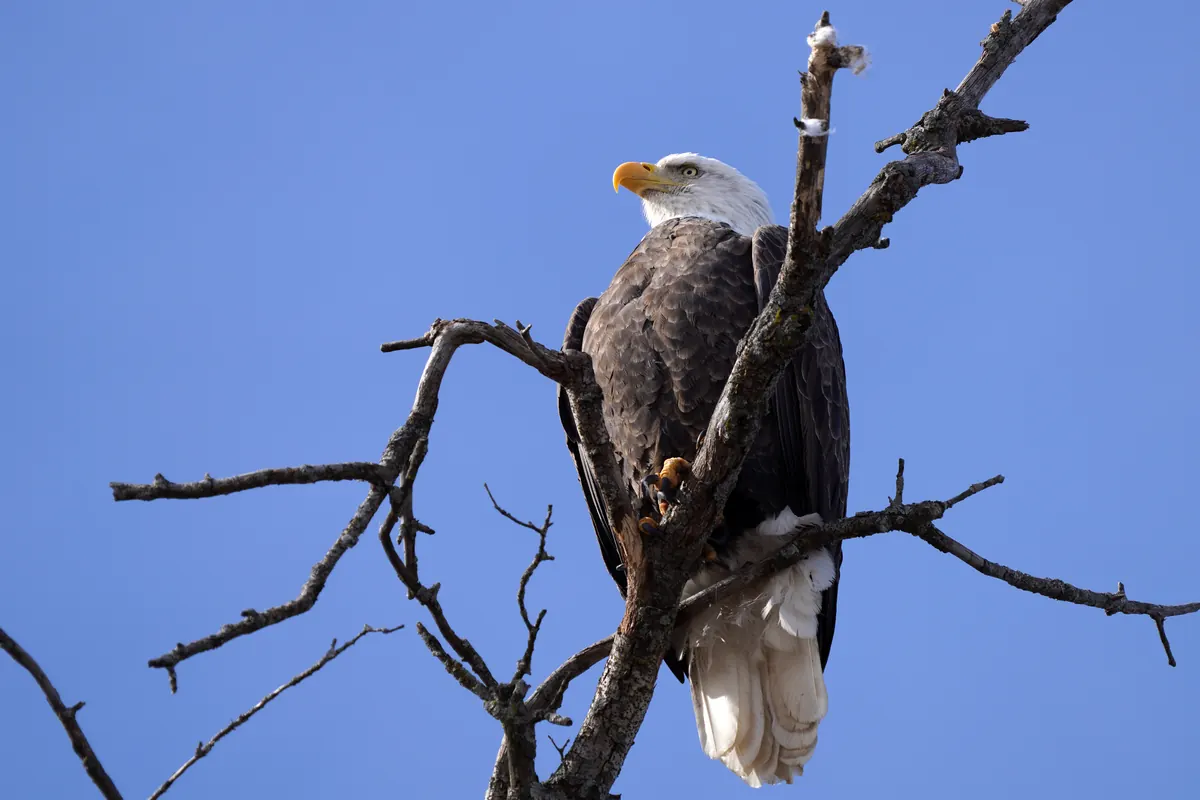
The eagles you watched in January are not just waiting out the cold. Pairs mate for life and return to the same territory, and by February many of them are hauling sticks to their old nests, some of which have been used and added to for years. A fact sheet the Ferry Bluff Eagle Council compiled from National Eagle Center and Wisconsin DNR sources says Wisconsin eagles lay their eggs anywhere from early February to early April. So this is the month when the first birds start to disappear from the open-water gatherings and settle down on eggs, while others, especially younger birds that will not breed yet, keep fishing below the dams.
-
Eggs in the snow
Early February to early April; earliest in the south · Large trees near rivers and lakes statewide, often the tallest pine or cottonwood in sight
Most Wisconsin pairs lay two eggs, and 10 to 15 percent lay three, according to the same fact sheet. Incubation lasts about 35 days, and both parents take turns, so a February clutch may sit through several snowstorms before it hatches in March. The young need another eight to twelve weeks before they fly. If you know a nest, the sign that eggs have arrived is simple: an adult lying flat and low in the cup, with only the white head showing over the rim, hour after hour.
-
Bald Eagle Appreciation Days, Prairie du Chien
Held each February; the 2027 dates are not yet posted · Hoffman Hall and spotting-scope stations along the Mississippi in Prairie du Chien
The Prairie du Chien Area Chamber of Commerce runs this free weekend every February, with live eagle and raptor programs, birding experts, exhibits, children’s activities and scopes set up for outdoor viewing. In 2025 it ran on Friday and Saturday, February 21 and 22, with evening talks at local hotels and the main Saturday program from 9 a.m. to 3 p.m. Check the chamber’s events calendar or call 1-800-732-1673 for the 2027 weekend.
-
Watching without disturbing
All month · Mississippi River overlooks, the La Crosse Eagle Watch wayside, the lower Wisconsin River
A nesting pair is far touchier than a crowd feeding below a dam. Watch from a distance with binoculars or a scope, and move away at once if a sitting bird stands or calls. Federal law protects the nest, the eggs and even a dropped feather.
The comeback is worth remembering as you watch. The DNR counted 108 occupied nests in the 1970s and 1,684 in its 2019 aerial survey.
When does sturgeon spearing season open on Lake Winnebago in 2027?
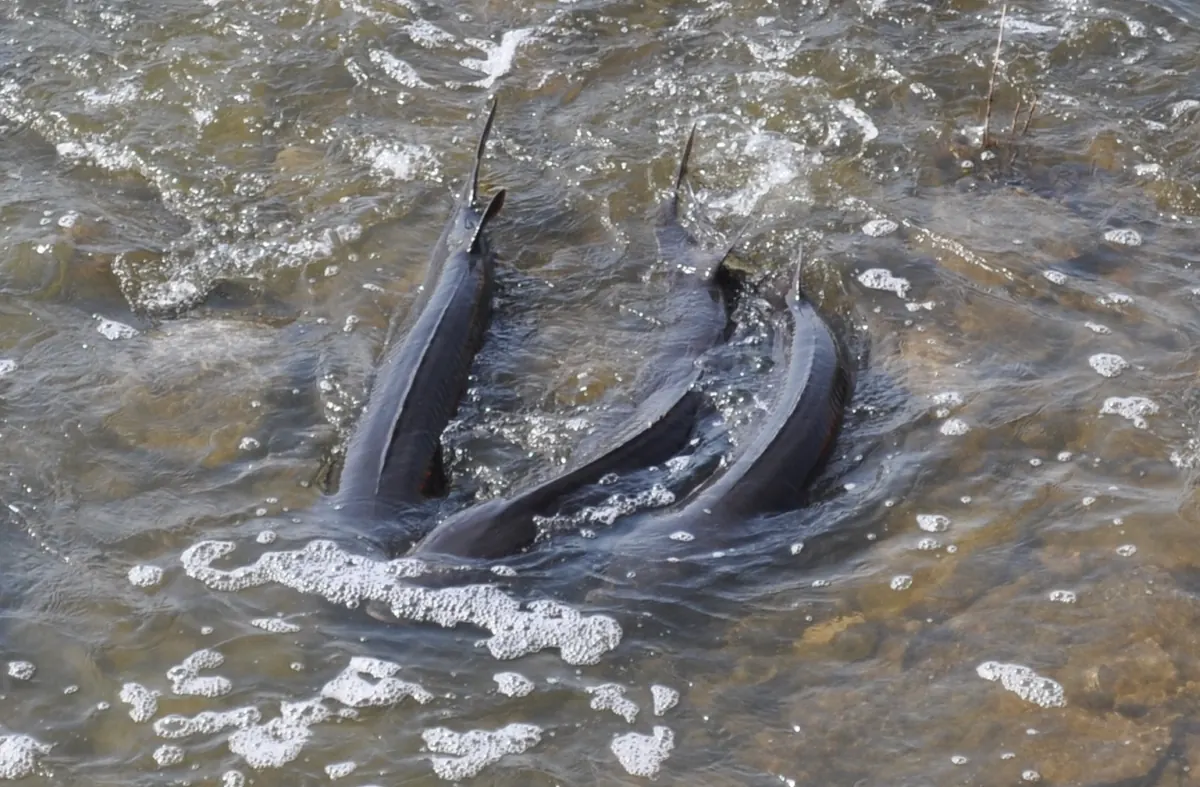
Lake Winnebago and its Upriver Lakes hold what Wisconsin Public Radio, citing the DNR, calls the largest self-sustaining lake sturgeon population in the world, and every February the state lets people spear a limited number of them through the ice. The season opens on the second Saturday of February and lasts at most 16 days, according to the DNR’s fishing regulations.
-
The 2027 season
Opens 7 a.m. Saturday, February 13; scheduled to close February 28 · Lake Winnebago and the Upriver Lakes, near Oshkosh, Fond du Lac and Neenah
Spearing is allowed from 7 a.m. to 1 p.m. each day the fishery is open, and each fish must be taken to a DNR registration station by 2 p.m. that day, where its length and weight are recorded. Anyone may buy a Lake Winnebago license, though only one per person and only before the October 31 deadline. The Upriver Lakes are limited to 500 license holders drawn from applicants, because success there is far higher: 62 percent of licensed spearers, the DNR says, against 9 percent on Winnebago.
-
Why seasons often end early
Any day after opening · The DNR posts a daily harvest update during the season
The DNR sets separate harvest caps for juvenile females, adult females and males, and closes a fishery once spearers come close to any one of them. In 2026 the Lake Winnebago cap for adult females was 659 fish; the lake closed on its tenth day, at 1 p.m. on Monday, February 23, because that cap was nearly reached, Wisconsin Public Radio reported. Water clarity matters a great deal, since spearers can only strike at what they can see through the hole.
-
A fish older than the spearer
Year-round residents; spawning comes in spring · Deep water of Lake Winnebago in winter
Lake sturgeon can live more than 100 years and possibly 150, a retired DNR fisheries leader told Wisconsin Public Radio. The heaviest fish registered in the modern spear fishery, taken from Lake Winnebago in 2010, weighed 212.2 pounds and was 84.2 inches long. A 2018 female that was even longer, 84.5 inches, was estimated by the DNR’s sturgeon biologist to be 80 to 120 years old. Harvest was closed entirely from 1915 to 1932 after the population crashed, and decades of careful limits have brought it back.
Bigger fish swim here than spearers ever see: the DNR caught, measured and released a 240-pound, 87.6-inch sturgeon in the Wolf River near Shawano in 2012.
What are the first signs of spring in Wisconsin in February?
Spring arrives in Wisconsin in pieces, and February holds the first few of them. None of them wait for the snow to melt completely; they need only a few bare fields, a soft marsh edge or a run of days above freezing.
-
Horned larks on bare fields
By mid-February, earlier in mild years · Plowed fields, manure-spread fields and gravel road edges in farm country, especially around Horicon Marsh and in the south
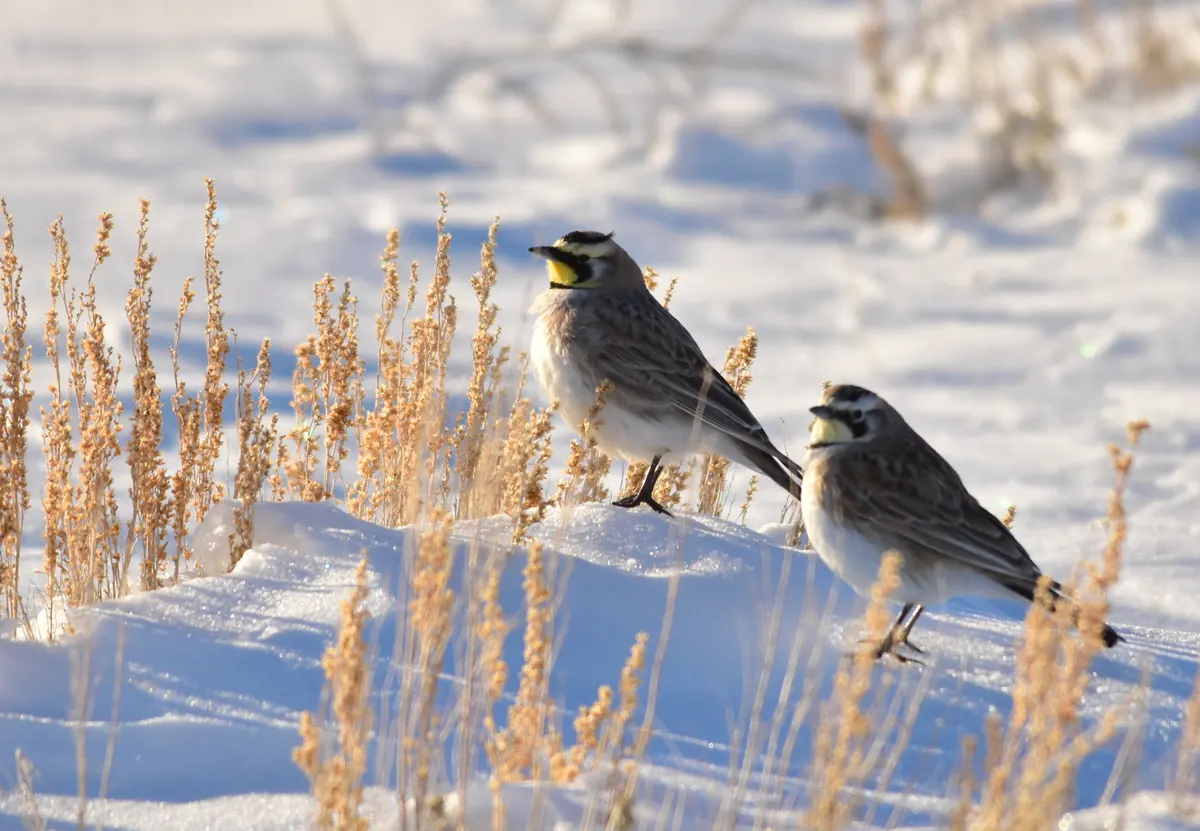
The DNR’s Horicon Marsh wildlife guide calls the horned lark Wisconsin’s first spring migrant, and says that by the middle of February the numbers on roadsides and fields around the marsh rise noticeably. They are small, sandy-brown birds that walk rather than hop, with a black mask, a yellow throat and two tiny feather tufts on the head. A flock flushed from a road shoulder flashes black tails as it goes.
-
Geese, blackbirds and cranes
Late February into March, depending on snowmelt · Marshes and open fields statewide; cranes first in the south
The same Horicon guide says red-winged blackbirds, grackles and returning Canada geese usually show up by late February or early March, with the timing set by how fast the snow goes. Sandhill cranes come back from wintering grounds in the Southeast by March, the DNR says, so in a mild year keep an ear out for their rolling, bugling calls over southern marshes in the last days of February.
-
Skunk cabbage in the swamp
Sometimes as early as late February; most often in March · Swampy forest floors, boggy woods and wet pond edges, such as the wetlands at Schlitz Audubon in Milwaukee
One of Wisconsin’s very first wildflowers is not much to look at: a mottled, purple-brown hood poking up through the last of the snow. My Wisconsin Woods, run by the Aldo Leopold Foundation and the DNR, notes it can appear as early as late February. The plant burns starch stored in its roots to make its own heat, enough to melt a ring of snow around it, and the Schlitz Audubon Nature Center in Milwaukee puts the temperature inside the hood around 55 °F. The same process gives off the foul smell that draws early insects; the big leaves follow later in spring.
Write the date of each first sighting on your reading the signs page. Over the years they add up to your own spring calendar.
Which winter finches could visit Wisconsin feeders this February?
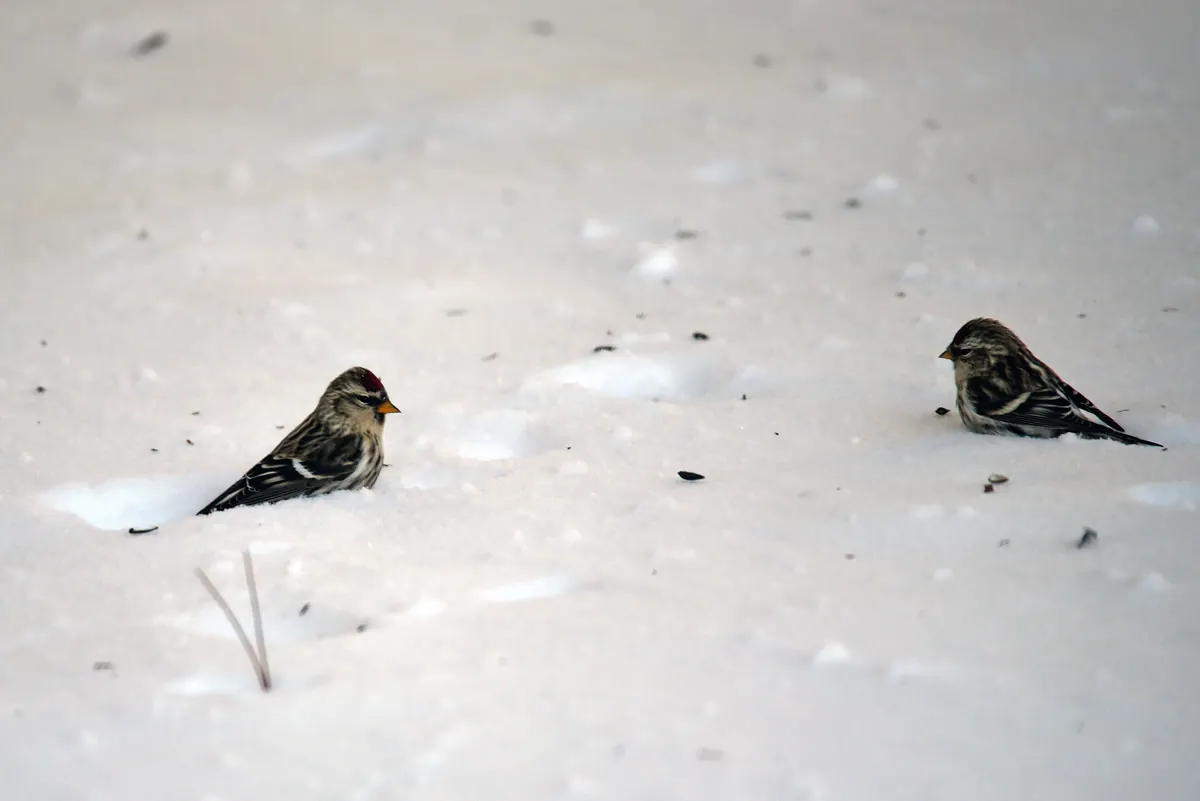
Some winters bring flocks of northern finches south to Wisconsin and some bring almost none, depending on how well the cone and seed crops did across Canada. The Finch Research Network’s forecast for 2026–27, published in late September 2026, describes poor seed crops through much of the central boreal forest, which tends to push birds toward the Great Lakes, but good crops of white pine and white cedar in the East, which may keep many in the woods rather than at feeders.
-
Redpolls and pine siskins
Any time; flocks often build at feeders in late winter · Feeders with nyjer or sunflower chips, birch and alder thickets, mostly in the north
The forecast expects a small to modest redpoll irruption in the western Great Lakes, while admitting the species is hard to predict. Redpolls are tiny, streaky finches with a red cap and a black chin, and they arrive in chattering flocks that empty a feeder fast. Pine siskins, brown and streaky with a yellow wing stripe, were already moving in large numbers past Hawk Ridge at Duluth in September, the forecast notes.
-
Evening grosbeaks and purple finches
Through the winter · Sunflower feeders in the Northwoods; purple finches statewide
Small to medium flocks of evening grosbeaks are expected around the Great Lakes, continuing a pattern of the last several winters. These are big, noisy yellow, black and white finches with pale, heavy bills. Purple finches, raspberry-washed rather than red like a house finch, should also come into the Great Lakes region to feed on the good crops there.
-
Crossbills in the pines
Through the winter, wherever cones are heavy · White pine and spruce stands in the north
Red crossbills had been passing Hawk Ridge and Whitefish Point in above-normal numbers since August, and white-winged crossbills, the forecast says, should roam the region in loose, scattered groups. Listen for their sharp flight calls and look for chunks of cone falling from the treetops; the crossed tips of the bill pry seeds from closed cones.
Whatever comes to your feeder, report it. The Great Backyard Bird Count on February 12 to 15 and Project FeederWatch, which runs into April, both rely on counts from ordinary backyards.
When does maple sap start running in Wisconsin?
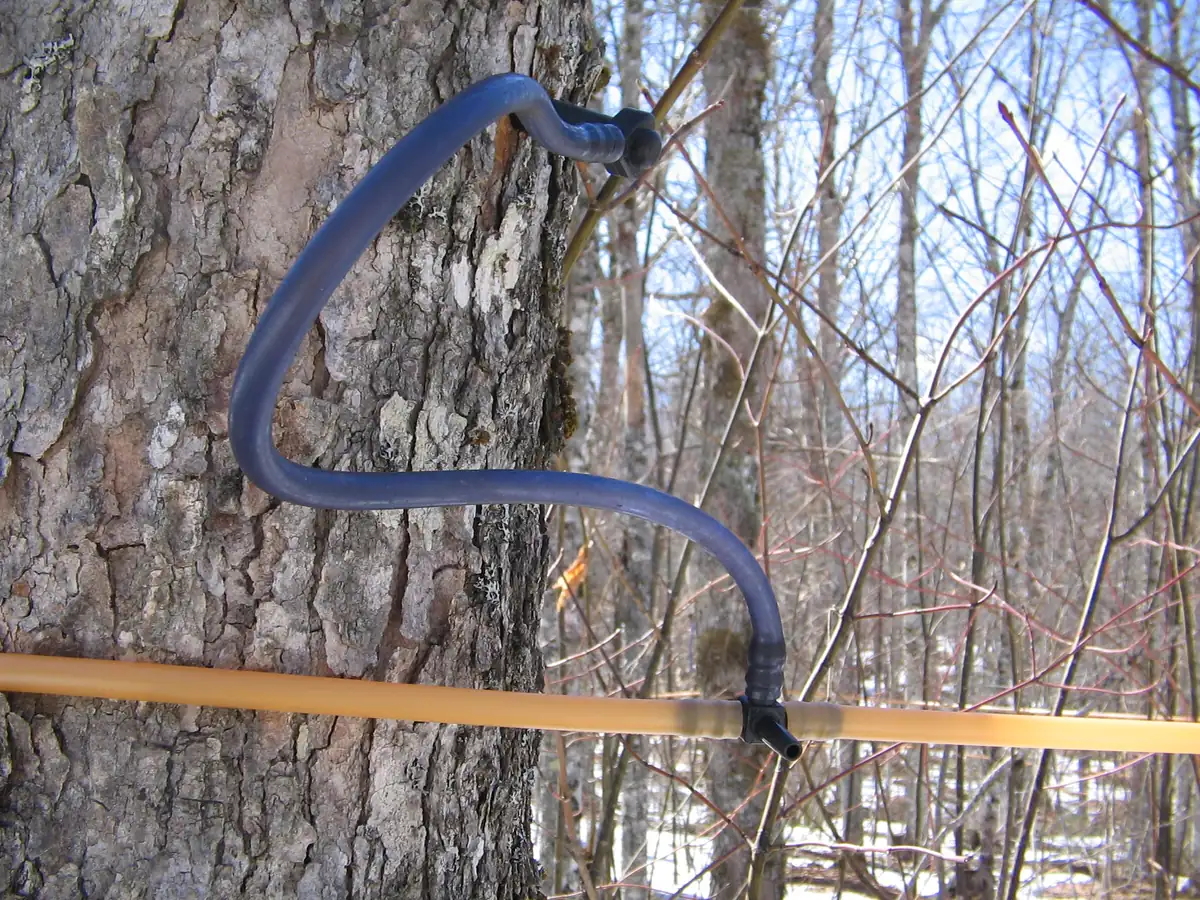
Wisconsin is one of the country’s leading syrup states, and a UW–Madison Extension educator told Wisconsin Public Radio that it also has more untapped maples than any other state. Sap runs when the weather swings: the Wisconsin State Climatology Office describes ideal days as sunny and at least 40 °F, with nights around 25 °F, a cycle that builds pressure inside the tree and pushes sap out through a tap hole.
-
February tapping, or March?
Historically mid-March into April; in mild winters, from late January or February · Sugar bushes statewide, earliest in the south
The climatology office describes the usual sugaring season as running from late March into early April, before maple flower buds open, and warns that a warming climate is shifting the best freeze-thaw days earlier. Producers have already seen it: in the El Niño winter of 2023–24, after a warm January with little snow, the season came earlier than usual, WPR reported. With another strong El Niño expected this winter, watch for the first long run of thawing afternoons, especially in southern Wisconsin.
-
Which trees, and how much
Any time the sap runs · Sugar maple woods; red, silver and boxelder maples in wetter ground
Sugar maple has the sweetest sap, but red maple, silver maple and boxelder can all be tapped, an Extension educator told WPR, as long as the trunk is at least 10 inches across at chest height. The educator's rule of thumb is about 40 gallons of sap for a single gallon of syrup, and the climatology office says a single tap hole yields about 10 gallons in a season, which boils down to about a quart.
The climatology office and the National Weather Service publish an experimental sap-flow forecast map for Wisconsin each season.
Which Wisconsin mammals are courting in February, and do groundhogs really wake up?
Under the snow and in the woods, late winter is mating season for several mammals that will give birth in spring. Others are still fast asleep, whatever the calendar says.
-
Gray foxes
Mating from mid-February to late March · Bluffs, hills, woodlands and field edges, often with brushy cover
The red fox began its season in January; the gray fox follows. The DNR says gray foxes breed from mid-February through late March and give birth to three or four kits between April and mid-May. They are excellent climbers with retractable, cat-like claws, and a den can be in a hollow tree as much as 30 feet up, as well as in a brush pile, a hollow log or under a rock ledge.
-
Woodchucks, still underground
Hibernating into late March · Burrows along field edges, fencerows and road banks statewide
The Urban Ecology Center in Milwaukee says Wisconsin woodchucks hibernate from October to late March and come out in April, their body temperature having dropped to about 40 °F with breathing and heartbeat slowed to a crawl. Males wake first and go looking for females, which emerge a week or two later and mate soon after. So a woodchuck that pops up on February 2 in Wisconsin has almost certainly been woken by people.
-
Jimmy the Groundhog in Sun Prairie
Groundhog Day, Tuesday, February 2 · Cannery Square, downtown Sun Prairie
Sun Prairie calls itself the Groundhog Capital of the World, a title its chamber of commerce claimed in 1949. A line of groundhogs all named Jimmy has given the town’s prediction since 1965, and the city holds the ceremony on February 2 each year. Winter’s true astronomical middle arrives on February 3 or 4, so Jimmy is a little early.
After a fresh snow, watch for a pair of fox trails running side by side along a woods edge, and sketch them on the tracks to know page.
How does Wisconsin measure how hard winter is on deer?
For white-tailed deer in the north, February and March are often the hardest weeks: body fat is running low and deep snow makes every step expensive. The DNR tracks this with its winter severity index. Each day from December 1 through April 30 scores one point if the temperature falls to 0 °F or below, one point if 18 inches or more of snow lie on the ground, and two points if both happen. A season total under 50 counts as mild, 50 to 80 moderate, 80 to 100 severe, and above 100 very severe. The DNR sets those bands from how past totals have lined up with winter deaths, fawn numbers and the following year’s buck harvest, and it posts maps of the running scores during the winter.
Deer cope by moving less and bunching up in stands of cedar, spruce and fir, which the DNR’s magazine calls deer yards; the evergreen canopy breaks the wind and holds back some of the snow. If packed trails lead into a cedar swamp, go around: a deer chased this late in winter burns energy it cannot easily replace.
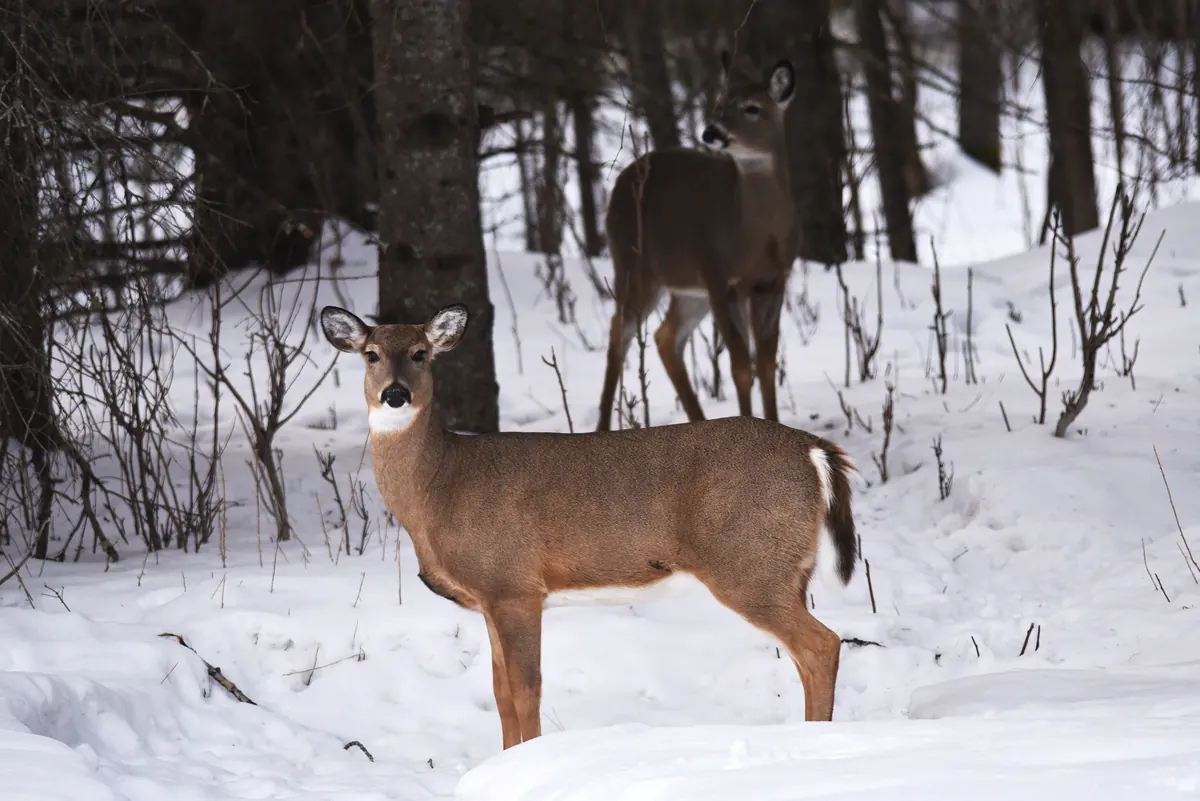
A mild El Niño winter would usually mean low scores, but the index is a running total, and a snowy March can still add many points.
How cold and snowy is February in Wisconsin, and what might El Niño do?
February is still firmly winter in Wisconsin, even if its snow totals are usually a little lower than January’s: NOAA’s 1991–2020 daily normals put Madison’s normal high at 27 °F on February 1 and 36 °F on February 28, and Eau Claire’s at 24 °F and 34 °F. The snowbelt of Iron County still averages more than two feet of snow in the month, and a northern station such as Minocqua averages a dozen nights at or below zero.
| Station | Snowfall | Average high | Average low | Days staying at or below 32 °F | Nights at or below 0 °F |
|---|---|---|---|---|---|
| Hurley (Iron County snowbelt) | 26.2 in | 25 °F | 4 °F | 21.0 | 11.3 |
| Minocqua (Northwoods) | 16.5 in | 25 °F | 3 °F | 20.0 | 12.6 |
| Rhinelander (Northwoods) | 12.3 in | 26 °F | 2 °F | 19.2 | 10.5 |
| Superior (Lake Superior shore) | 12.4 in | 27 °F | 9 °F | 19.7 | 8.1 |
| Eau Claire (Chippewa Valley) | 11.2 in | 28 °F | 9 °F | 17.6 | 7.8 |
| Sturgeon Bay (Door County) | 12.9 in | 28 °F | 12 °F | 17.6 | 5.3 |
| Green Bay | 12.0 in | 29 °F | 13 °F | 17.1 | 5.6 |
| La Crosse (Mississippi valley) | 9.7 in | 33 °F | 14 °F | 14.6 | 5.5 |
| Madison | 12.8 in | 31 °F | 15 °F | 14.6 | 4.5 |
| Milwaukee (Lake Michigan shore) | 11.8 in | 34 °F | 20 °F | 13.1 | 1.7 |
The tropical Pacific is building toward a very strong El Niño: NOAA’s forecasters, in a September 10, 2026 discussion, rated the chance of such an event this winter at better than 90 percent. The Wisconsin State Climatology Office explains that El Niño tends to lift the polar jet stream north and bottle up the coldest air in Canada, while its link to precipitation is weak; warmth may just turn snow to rain or sleet. Its history of El Niño Februaries shows the spread. February 1998 brought spells near 50 °F in the north and near 60 °F in the south. February 2024 produced the first February tornadoes known in the state and a 77 °F reading at Kenosha, an all-time high for the month. Yet February 2016, in another very strong event, dropped two major snowstorms on central Wisconsin, including the largest February storm on record at Wausau, and the office cautions that a bigger El Niño does not reliably mean bigger effects. NOAA refreshes its three-month outlook every month; find the latest maps at the Climate Prediction Center. Today’s conditions are on our weather page, our cloud guide can help you recognize the gray altostratus deck that often thickens ahead of a February snow, and gardeners counting down to planting can look up last-freeze dates on the Wisconsin frost chart.
How much daylight does Wisconsin gain in February?
By February the returning light is hard to miss. Each Wisconsin city in the table picks up more than an hour of daylight during the month: 73 minutes in Madison and Milwaukee, and 84 minutes in Superior, where the average works out to about three minutes a day. The farther north you live, the faster your days are now growing, the reverse of how they shrank so quickly there in the fall.
| City | Feb 1 | Feb 28 | Gained | Per day |
|---|---|---|---|---|
| Superior | 9 h 39 m | 11 h 03 m | 84 min | 3.1 min |
| Rhinelander | 9 h 45 m | 11 h 05 m | 80 min | 3.0 min |
| Eau Claire | 9 h 49 m | 11 h 06 m | 77 min | 2.9 min |
| Wausau | 9 h 48 m | 11 h 06 m | 78 min | 2.9 min |
| Green Bay | 9 h 50 m | 11 h 07 m | 77 min | 2.9 min |
| La Crosse | 9 h 54 m | 11 h 08 m | 74 min | 2.7 min |
| Madison | 9 h 57 m | 11 h 10 m | 73 min | 2.7 min |
| Milwaukee | 9 h 57 m | 11 h 10 m | 73 min | 2.7 min |
For sunrise and sunset in Ashland, Platteville or any other town, open the Field almanac.
What can you see in the Wisconsin night sky in February 2027?
Times below are Central Standard Time. Two bright planets steal the show in February 2027: Jupiter and Mars each reach opposition, nine days apart, in the constellation Leo, and Mercury has a short evening appearance early in the month.
-
Mercury after sunset
Late January to about February 10; farthest from the sun around February 2 and 3 · Very low in the west-southwest, half an hour or so after sunset
Pick a spot with an open western view, such as the shore of a frozen lake, and scan just above the horizon in the fading glow for a lone, unblinking dot. The evening of Sunday the 7th adds a hairline crescent, barely a day old, just beside Mercury; binoculars help you find both.
-
Jupiter at opposition
Wednesday, February 10 (6:21 p.m.) · Low in the east at dusk, due south near midnight
Opposition means the sun, Earth and Jupiter line up with us in the middle. Jupiter climbs out of the eastern horizon while the sun sinks in the west, stays up until dawn and is at its nearest for 2027, roughly 405 million miles off. Rest binoculars on a fence rail, and as many as four pinpoint moons may show in a row on either side of the planet, rearranged every night.
-
Mars at opposition
Friday, February 19; nearest to Earth on the 20th · In the east after dark, near Jupiter and Regulus
Mars lines up opposite the sun on Friday morning, then makes its nearest pass a day later, at about 63 million miles, which is far by Mars standards: expect a bright, rusty light, not a blazing one. Its ruddy color beside creamy Jupiter and the white star Regulus makes a fine trio.
-
The Snow Moon and a barely-there eclipse
Full at 5:23 p.m. Saturday, February 20; eclipse over at 7:13 p.m. · Rising in the east-northeast near sunset
The moon brushes Earth’s pale outer shadow that evening, a penumbral eclipse. The darkest moment, 5:13 p.m., comes a little before the moon clears the horizon in Wisconsin, so what remains is a faint smudge of gray on one side, if anything; few people will see a difference. Almanacs disagree on whether to call this full moon a supermoon. On Friday night the nearly round moon slips just past Jupiter, and on the 20th the moon, Jupiter, Mars and Regulus all sit close together.
-
Venus, Saturn and auroras
All month · Venus low in the southeast before dawn; Saturn in the west at dusk
Venus blazes before sunrise all month. Saturn, low in the west at dusk, is fading into twilight. Solar activity has eased from its 2024 peak, yet strong storms can still paint the northern sky over Wisconsin; check NOAA’s aurora forecast on dark, clear nights near the February 6 new moon.
| Phase | Date | Time |
|---|---|---|
| New moon | Saturday, Feb 6 | 9:56 a.m. |
| First quarter | Sunday, Feb 14 | 1:58 a.m. |
| Full moon, the Snow Moon | Saturday, Feb 20 | 5:23 p.m. |
| Last quarter | Saturday, Feb 27 | 11:16 p.m. |
That February 6 new moon also makes an annular solar eclipse, yet it is a Southern Hemisphere show, and no part of the United States sees even a partial eclipse. To plan your own dark-sky nights, see our moon calendar.
What can Wisconsin families do outdoors in February?
- Tuesday, February 2: Groundhog Day in Sun Prairie. The city holds its ceremony every February 2 at Cannery Square downtown; check the City of Sun Prairie’s Groundhog Day page for the 2027 schedule.
- Saturday, February 6: Candlelight Ski and Hike at Blue Mound State Park, 5:30 to 8:30 p.m., with a one-mile candlelit ski loop, a separate one-mile trail for walkers, snowshoers and leashed dogs, a bonfire with marshmallows and hot drinks in a heated shelter. A park sticker is the only cost, and the event depends on the weather; call 608-437-5711.
- Great Backyard Bird Count weekend, from Friday the 12th. Spend 15 minutes or more watching birds on one day or all four, then enter what you saw through eBird or the Merlin app.
- From Saturday, February 13: sturgeon season. Read the DNR’s daily updates together and look up how old the biggest fish might be.
- A February weekend: Bald Eagle Appreciation Days in Prairie du Chien, with live raptors and kids’ activities, all free. Confirm the 2027 dates with the Prairie du Chien Area Chamber of Commerce.
- Citizen science. FeederWatch tallies go on until April. Add eagles, horned larks and first red-winged blackbirds to eBird so researchers can track how early spring migrants arrive.
Missed the eagle festivals? They are covered on our January page for Wisconsin. Every state and month is listed on the nature index, and young birders can log counts and sketches in our Naturalist’s Field Journal.
Safety notes for February in Wisconsin
- Hunting and trapping seasons. According to the DNR’s 2026–27 season dates, gray and fox squirrel and cottontail rabbit seasons run to February 28, crow season to March 24, red and gray fox and raccoon hunting and trapping to February 15, and coyote trapping to the same date, while coyote hunting stays open all year. No deer seasons are open in February.
- Blaze orange. The DNR requires blaze orange or fluorescent pink only while a gun deer season is running in that area, which means it does not apply this month. On public land, though, small-game hunters are still out, and anyone skiing or hiking there is wise to wear something bright. Keep dogs leashed where trapping is likely.
- Late-season ice. The DNR says there is no such thing as completely safe ice, and that clear ice is stronger than ice with snow on it or bubbles in it. Stay away from inlets, outlets and narrows, bring a companion, and take along ice claws, a throw line, a life vest and a phone you have bagged against water. As the sun strengthens, ice weakens first near shore, over springs and where currents run. Under DNR rules, permanent ice shanties come off the Wisconsin–Iowa boundary waters by February 20 and off inland lakes south of Highway 64 by the first Sunday after March 1, which falls on March 7 in 2027. Stay off shelf ice on Lake Superior and Lake Michigan.
- Late-winter storms and cold. Heavy snow is still possible, as central Wisconsin learned in February 2016, and northern stations still average around ten or more subzero nights. Before a drive up north, look at the forecast and stow a shovel, blankets and snacks in the trunk.
- Icy trails. Thaws and refreezes glaze trails and boardwalks; slip-on traction cleats help.
Sources
- Wisconsin DNR: Eagles in Wisconsin (viewing, events, nest surveys)
- Ferry Bluff Eagle Council: Bald Eagle Facts and Figures (National Eagle Center and WI DNR)
- Prairie du Chien Area Chamber of Commerce: Bald Eagle Appreciation Days (2025 listing)
- Wisconsin DNR: Winnebago System sturgeon spearing
- Wisconsin DNR: Lake sturgeon seasons
- Wisconsin DNR: Daily sturgeon season update, February 20, 2026
- Wisconsin Public Radio: Sturgeon spearing season ending early on Lake Winnebago (2026)
- Wisconsin Public Radio: Sturgeon spearing season nears as Wisconsin’s ancient fish continue comeback
- Wisconsin Public Radio: Sturgeon speared on Lake Winnebago is record-setting (kind of)
- Wisconsin DNR: Wildlife of Horicon Marsh Wildlife Area
- Wisconsin DNR: Sandhill crane
- My Wisconsin Woods (Aldo Leopold Foundation and Wisconsin DNR): Skunk cabbage, a sign of spring
- Schlitz Audubon Nature Center: Wisconsin’s first spring flowers, skunk cabbage
- Finch Research Network: Winter Finch Forecast 2026–2027
- Wisconsin State Climatology Office: The sweet side of Wisconsin forests, maple sap tapping
- Wisconsin Public Radio: With maple syrup season coming early, Wisconsin specialist wants to tap into state’s full potential
- UW–Madison Extension Maple Program
- Wisconsin DNR: Gray fox
- Urban Ecology Center: Native animal of Wisconsin, the woodchuck
- City of Sun Prairie: Groundhog Day and history
- Wisconsin DNR: Winter Severity Index, deer statistics
- Wisconsin DNR: Deer management
- Wisconsin Natural Resources magazine: Masters of Mother Nature (deer yards)
- NOAA NCEI: 1991–2020 monthly normals, Milwaukee, Madison, Green Bay, La Crosse, Eau Claire
- NOAA NCEI: 1991–2020 monthly normals, Hurley, Superior, Minocqua, Rhinelander, Sturgeon Bay
- NOAA NCEI: 1991–2020 daily normals, Madison, Milwaukee, Eau Claire, Green Bay
- NOAA Climate Prediction Center: ENSO diagnostic discussion, September 10, 2026
- NOAA Climate Prediction Center: 90-day outlooks
- Wisconsin State Climatology Office: ENSO and Wisconsin
- Wisconsin State Climatology Office: Recent history of El Niño in Wisconsin
- National Weather Service Milwaukee/Sullivan: El Niño and southern Wisconsin
- U.S. Naval Observatory: Moon phases from December 30, 2026
- U.S. Naval Observatory: Earth’s seasons, 2027
- Fred Espenak: Sky Event Almanac 2027
- NASA: Lunar eclipses, 2021–2030
- NASA: Solar eclipses, 2021–2030
- EarthSky: Jupiter at opposition
- SEDS: Mars opposition 2027
- NOAA Space Weather Prediction Center: Aurora dashboard
- Wisconsin DNR: Hunting season dates, 2026–27
- Wisconsin DNR: Highly visible clothing (blaze orange) rule
- Wisconsin DNR: Ice safety
- Wisconsin DNR news release: 2026 ice shanty removal deadlines
- Wisconsin DNR event: Candlelight Ski and Hike, Blue Mound State Park, February 6, 2027
- Wisconsin DNR: Candlelight events calendar
- National Audubon Society: Great Backyard Bird Count (February 12–15, 2027)
- Project FeederWatch
- eBird
- Photos via Wikimedia Commons; licenses and photographers are credited under each picture
