What to look for in nature in Texas this May
By May, Texas has mostly stopped waiting for spring and started raising its young. Scissor-tailed flycatchers sit on fence posts beside their nests, painted buntings sing from brushy edges, and alligators guard mounds of rotting plants. The last warblers and flycatchers are passing through, bats are about to give birth under an Austin bridge, and the Chisos Mountains of Big Bend stay well cooler than the desert floor. The bluebonnets give way to firewheels, and the first week of the month has the year’s best spring meteor shower. Read on for the month from the High Plains to the border.
Other months in Texas: October, November, December, January, February, March, April.
Start here
- Find a nest by watching the adults. Pick a fence line or a brushy edge, sit still for ten minutes in the early morning, and follow a flycatcher or a bunting carrying food. Note where it goes, then leave the nest alone.
- Watch the bats at dusk. A warm evening at the Congress Avenue Bridge in Austin is a good May outing, and the free lawn on the south bank suits families. Arrive early, and go by the refuge’s posted start time.
- Look east before dawn from May 5 to 7. The Eta Aquariids come in moonless skies this year. Lie back in the last hours of darkness, face east and count for a quarter hour.
In the Naturalist’s Field Journal, a nest you watch from a distance belongs on “nest observed,” with the date of each change. A May dawn count can go on the “daily field log” or “birds I have seen,” and a dusk bat flight fits “dusk and dawn watch.” Indian blanket makes a fine entry for “colours of the day,” and a bluebonnet seed pod belongs with “seeds pods and cones.” A meteor count before sunrise belongs on “reading the signs,” and a spot you sketched in April deserves “the same place twice.”
Regions used below: Panhandle and North Texas; Central Texas and the Hill Country; East Texas and the Piney Woods; Gulf Coast; South Texas and the Rio Grande Valley; Trans-Pecos and Big Bend.
Which Texas birds are nesting in May?
By May the roadside wires, brush lines and creek bottoms of Texas are busy with families. Spring migration is winding down in the east, and across the rest of the state the birds that stay for summer are building nests, sitting on eggs and feeding young. Here are three that are easy to find without a long walk.
-
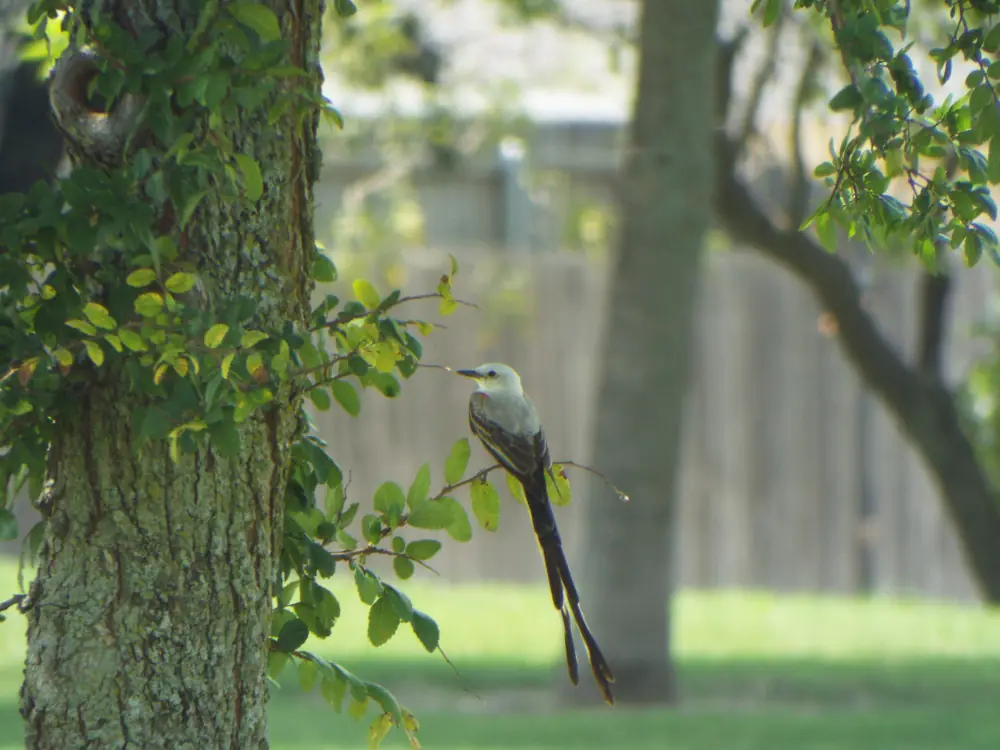
Scissor-tailed flycatchers on the wires
Nesting from late March to late August, with young leaving the nest about two weeks after hatching · Open country, ranchland, pastures and suburban edges
The Texas Breeding Bird Atlas says these flycatchers raise their families in semi-open country with scattered trees, from near sea level to about 4,000 feet. The female may finish a nest in as little as two to four days, and she often builds on a horizontal limb or on a utility pole or bridge girder. She usually lays four or five eggs, incubates them for 13 to 16 days, and the young leave the nest 14 to 17 days after hatching. Watch a fence post at dawn for the long forked tail and for the flycatcher sallying out to catch a grasshopper.
-
Painted buntings in brushy edges
Breeding from late March to late August; egg dates in the atlas run from April 27 to August 19 · Roadsides, stream edges and thickets with scattered trees
Painted buntings favor open ground with scattered shrubs and trees, and they nest low, on average about three feet off the ground. The atlas treats the western population, which includes Texas birds, as distinct from the one on the southeastern Atlantic coast. The male looks painted, with blue, green and red, while the female is plain green.
-
Mississippi kites over the northern plains
Breeding season runs April to August; one brood a year · North-central Texas and the Panhandle, including towns such as Lubbock
The atlas calls the Mississippi kite fairly common in the north-central part of the state and records regular breeding in the Panhandle. It tolerates cities, and Lubbock is one of the places it names. Egg-laying to fledging takes close to three months, so a nest started in late spring is still occupied in July. Give any nest tree plenty of room.
Log your dates in a notebook, even a rough one. Next year’s page of first songs, first nests and first fledglings is the best reference you will have for your own yard. The Naturalist’s Field Journal has pages for nests and first sightings that suit this month.
Is spring migration over in Texas by May?
Not quite. The big waves of warblers have passed on the coast, but May holds the tail of the season, and some of the most prized birds are the latest. Texas Parks and Wildlife’s migration timing list gives arrival and departure windows, and several species in it run into the second half of the month.
-
The latest flycatchers
Olive-sided and Traill’s flycatchers are listed from early to late May · Edges of woods and open perches almost anywhere in the state
The department’s list puts the olive-sided flycatcher and the Alder and Willow flycatchers, grouped as “Traill’s,” in a window from early May to late May, the latest end dates on the page. Eastern wood-pewees and yellow-billed cuckoos have windows running to mid-May. A late May bird in a Texas oak could well be on its way to a nesting spot in Canada. Silent “empid” flycatchers are notoriously hard to name, so a song is what settles it.
-
Warblers that finish by mid-May
Magnolia, Blackburnian and bay-breasted warblers are listed from late April to mid-May · Wooded sanctuaries on the upper coast and well-treed parks inland
These three warblers all end their Texas windows by mid-May on the department’s list. Birds Houston, whose sanctuaries host many of these migrants, says fallouts can happen at any time from early March to mid-May, usually after a strong, fast front crosses the coast around midday. If such a front arrives in the first half of May, the last good fallout of the year may follow. Visitors are asked to stay back from tired birds so they can feed and rest.
-
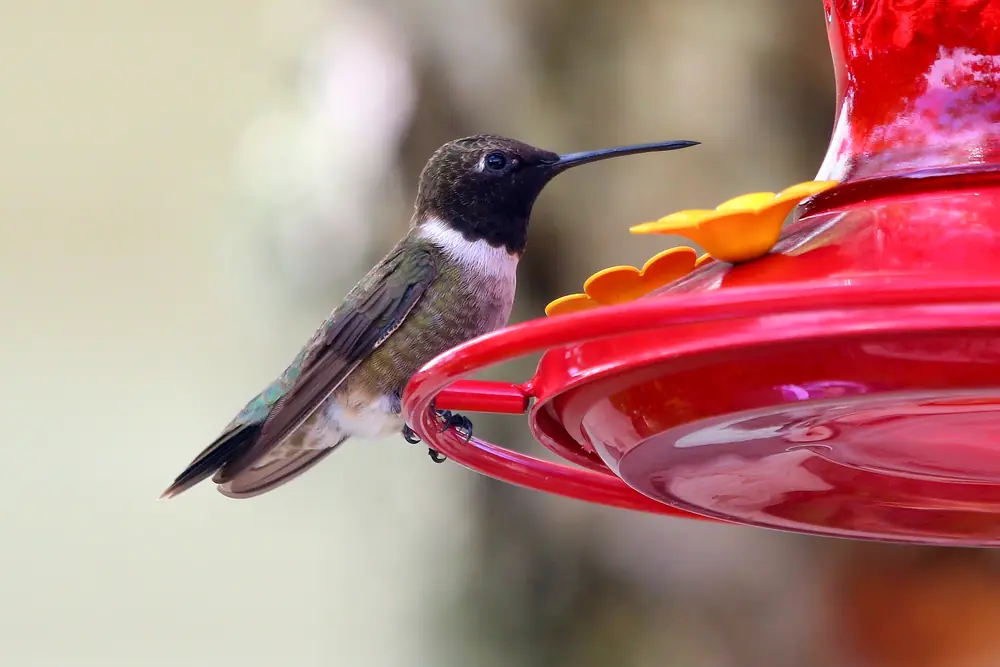
Ruby-throated hummingbirds heading north
Listed from late March to mid-May · Gardens and woodland edges in the east, and the coast
Birds Houston describes the ruby-throated hummingbird as common in spring migration (March to May) and again in fall, with a few staying to nest. Only the adult male has the crimson throat, and the female builds the nest and raises the young alone. Keep a feeder clean, since sugar water spoils quickly in humid heat.
A bird app can help: eBird’s hotspot pages show what other people saw in the last week, and the clouds page explains the frontal signs that can set off a fallout. Whatever you find, write down the date and the weather.
Are Texas bats in their nursery season in May?
May is the quiet before the pups. The Mexican free-tailed bats that winter in Mexico and Central and South America have mostly returned by now, and the females are heavily pregnant. The nightly flights are already worth the trip, and the colonies keep growing through the summer.
-
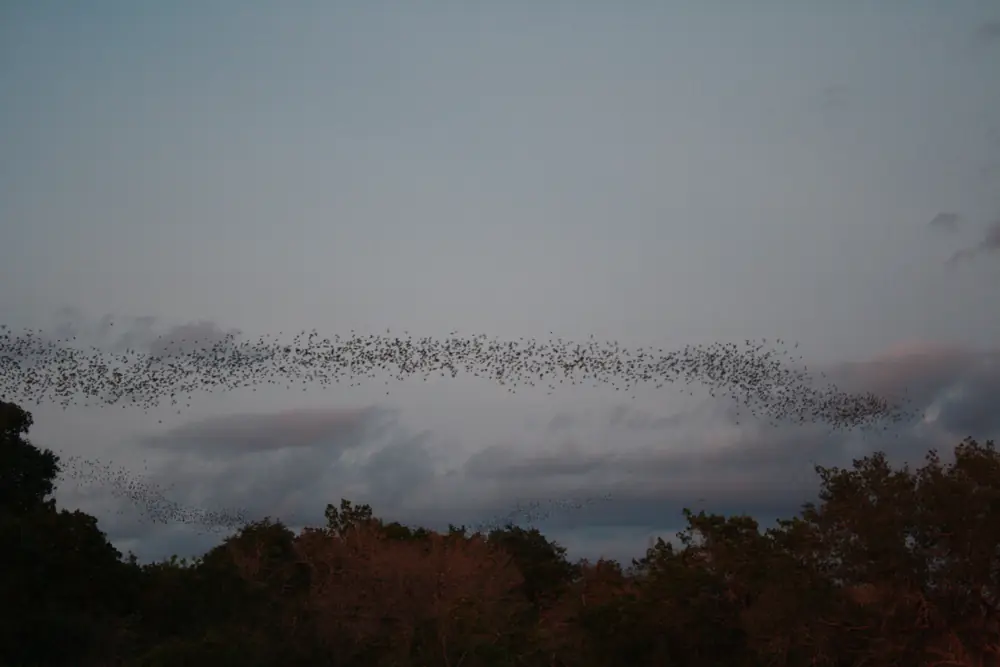
Congress Avenue Bridge in Austin
Bats are at the bridge from March through October; the refuge calls any visit from May to September excellent · Under the bridge in downtown Austin, with a free lawn on the south bank
The Austin Bat Refuge says the colony reaches “up to 1.5 million” bats. Females give birth in June, the pups are flying by July, and July and August hold the biggest numbers. In May the colony is still growing, so the flight is smaller than in midsummer. The refuge posts a daily start-time prediction, and it suggests arriving 30 to 45 minutes early on a weekend. Bats usually stay in on cold or rainy nights, and a bat found on the ground should never be touched.
-
Bracken Cave near San Antonio
Bat Conservation International lists flights from May through September; best in July and August · The cave, by reservation only
Bat Conservation International says expectant females return in March and April and each bears a single pup in late June. Reservations are required for every visitor, including children. The organization posts its season schedule each March, and its members’ registration opens on April 1, 2027, so no 2027 flight dates were available when we read the page. Check with the organization before planning, and expect popular dates to sell out.
-
Bat etiquette
Any evening flight · Anywhere bats leave a roost
Use your phone’s night mode rather than a flash, which does not help from a distance and disturbs both the animals and the crowd. Stay behind rails and signs, bring a light jacket for the cool air after sunset, and arrive before the predicted time.
Add a bat count to your dusk notes: the minute of the first flyer, the compass direction of the stream and how long the flight lasted. Dusk flights make a good entry for a “dusk and dawn watch” page.
What is Big Bend like in May?
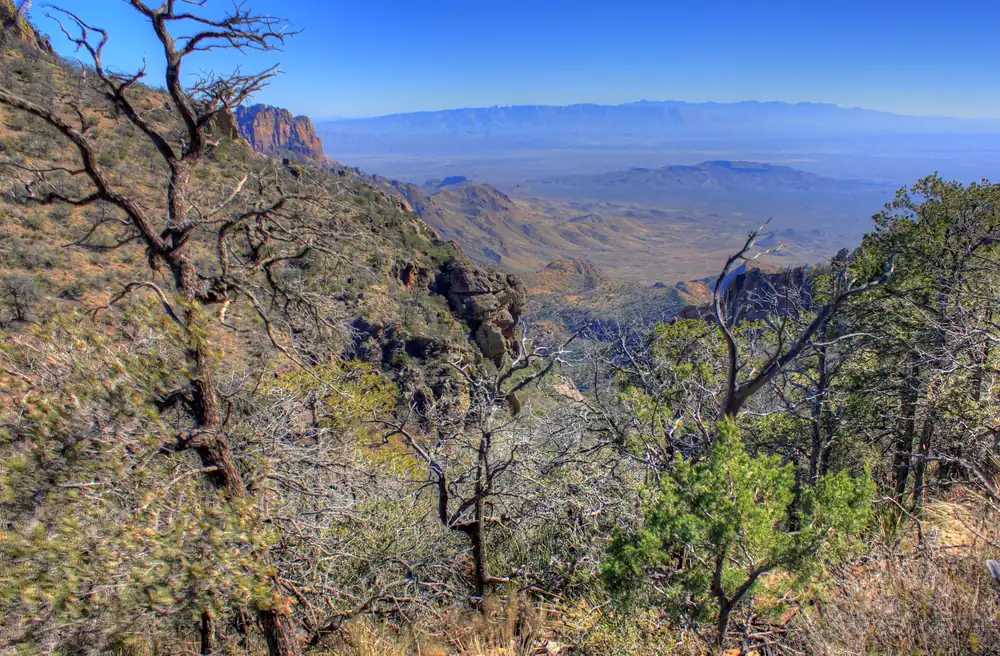
May is when Big Bend turns from comfortable to hot. The National Park Service calls May the start of summer heat and describes it as “extremely hot.” Birds still arrive, desert plants still flower, and the high country is the best place to be.
-
How hot, and where
Five-year averages for May, per the park · Chisos Basin, Panther Junction and Rio Grande Village
The park lists average May highs of 84 °F in the Chisos Basin at 5,401 feet, 90 °F at Panther Junction at 3,750 feet, and 102 °F at Rio Grande Village at 1,850 feet. Lows run from 62 °F in the Basin to 67 °F at the other two. The park says desert temperatures are usually well above 100 °F by late morning, and the Chisos run about 10 to 15 degrees cooler. Plan your hikes for sunrise, rest in the middle of the day, and bring at least one gallon of water for each person, every day.
-
A warbler that nests on the ground
Usually arrives in late April and is gone by August · Boot Canyon and the Laguna Meadows trail in the Chisos Mountains
The park’s bird page describes the Colima warbler’s nest as a cup of rootlets and fine grass placed on the ground under a rock, an arch of grasses or dry leaves. The best chance of seeing one is the steep 4.5 miles up to Boot Canyon or along Laguna Meadows. You may also find one on the Lost Mine Trail or near the Basin campground. Listen first, because the song often comes before the bird, and do not play recordings in its territory; the park warns that doing so can drive birds off their nests.
-
Desert flowers
Ocotillo flowers in mid-spring, and yuccas bloom in late spring in wetter years · Along park roads and trails at lower elevations
The park says ocotillo shows fiery red-orange tubular flowers at the stem tips in mid-spring, and that yuccas bloom in late spring only when there has been enough rain. Agaves flower just once in a lifetime, and the century plant takes decades. Do not count on a bloom date, and do not break stems or pick flowers.
If you cannot make it to West Texas, the same lesson holds anywhere in the state: check the forecast for the hour you will be out, not the day.
What is hatching along Texas rivers, bayous and beaches in May?
Along the coast and the water, May is a month of nests, and three different animals are doing it in three different ways: with a pile of rotting plants, with a hole dug in sand, and with a scrape on a gravel bar.
-
Alligators
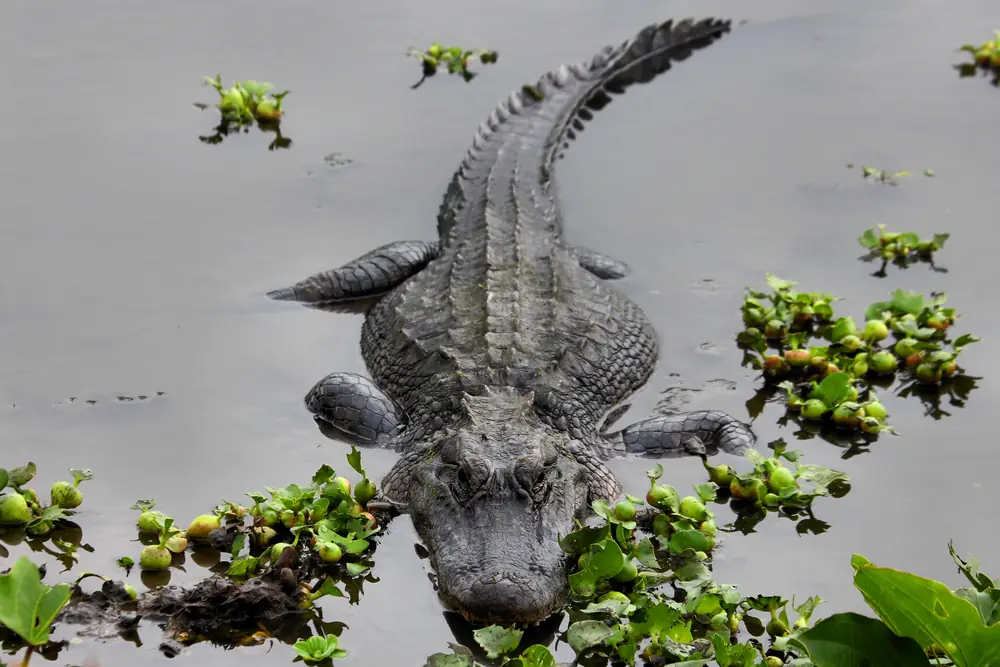
Peak breeding and nesting runs from March 1 through May 30 · Bayous, swamps and refuges in the east and along the coast
Texas Parks and Wildlife says the female builds a mound of vegetation up to six feet across and lays more than 35 eggs. The eggs incubate for about two months while she guards the nest. Hatchlings are about nine inches long and stay close to her for up to two years. Alligators four to five feet long often wander during breeding season looking for territory, so a small alligator on a trail is not necessarily lost. Keep pets away from the water’s edge and give a nesting mound a very wide berth.
-
Sea turtles on Padre Island
Nesting season is mid-March through August · Padre Island National Seashore
The National Park Service says a Kemp’s ridley may lay one to four clutches in a season, with about 100 eggs in a clutch and six to eight weeks until hatching. Turtles nest in the spring and summer, and park staff move nests to protected areas. Hatchling releases are open to the public when possible, but the park gives no fixed start date, so call the Malaquite Visitor Center at (361) 949-8068 or check its alerts before driving out.
-
Least terns on sandbars
Terns arrive between early April and early June; egg-laying starts in late May · Sandbars, gravel bars and similar open ground inland
The state’s species page for the interior least tern says the birds stay three to five months, that incubation takes about 20 to 22 days, and that breeding is usually done by late August. A lost nest can be replaced until late July. Fishing, camping and off-road vehicles near sandbars are threats, and human presence has been linked to lower success. If you see signs or fencing near a bar, keep outside it.
A clutch of eggs or a hatchling is a poor subject for a close-up. Use a long lens, stay well back and let the parent do the work.
Which wildflowers bloom in Texas in May?
The bluebonnets are over for most of the state, but the roadsides are not bare. May shifts the color from blue to red, orange and yellow.
-
Indian blanket
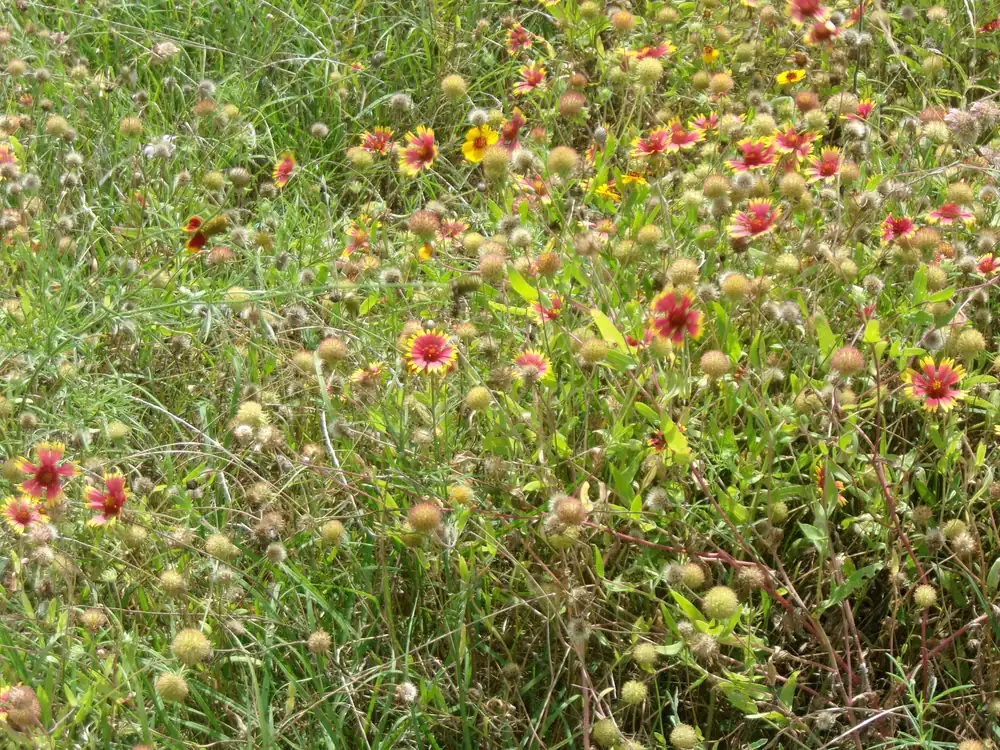
Blooms May through August, the Wildflower Center says, and longer with plentiful rain · Prairies and sandy or calcareous soils across the western two-thirds of Texas
The Lady Bird Johnson Wildflower Center describes Indian blanket as an annual up to about two feet tall with hairy branched stems. The flower heads are one to two inches across, red at the center and yellow at the edges, with three-toothed rays. It is also called firewheel. It spreads thickly after rain, and the same patches you photographed in blue in April may turn red and gold.
-
What is left of the bluebonnets
Most bloom is finished by May, with a few late flowers · Central and East Texas fields, plus higher or cooler spots
The Wildflower Center notes that bluebonnets are annuals that germinate in fall and spend winter as rosettes, bloom mainly from late March to mid- or late April in the Central and East Texas belt, and are only occasionally found blooming in May. The seed pods that follow dry and open to scatter the seeds for next year. Leaving them standing, and not mowing them early, helps next year’s flowers.
-
Prickly pear and cactus wrens
Cactus wrens nest in prickly pear at Santa Ana · South Texas brush country and the Rio Grande Valley
Santa Ana National Wildlife Refuge says cactus wrens nest in the prickly pear and chachalacas are noisy at dawn. It warns that heat exhaustion can come on quickly, and the refuge says animals are busiest from first light until ten and again in the last hours before sunset.
Photograph from the shoulder, not the pavement, and look at the grass before kneeling in it: ticks and snakes like it as much as the flowers do.
How hot and wet is May in Texas, and is tornado season over?
Summer heat arrives almost everywhere in Texas in May. The table shows normal afternoon highs from 80.9 °F in Amarillo to 90.3 °F in Brownsville, with nights from 52.6 °F to 73.7 °F. The wide gap in rainfall is the story: El Paso averages 0.43 inch in the month, while Austin, Houston and Dallas–Fort Worth all average between 4.78 and 5.04 inches.
Severe weather has not ended. For the Fort Worth weather office’s area, covering North and Central Texas, the National Weather Service counts 525 tornadoes in May from 1950 through 2025, second only to April’s 555, or about seven a year in each month. Storms in this season often bring hail and sudden flooding as well as wind.
| Station | Average high | Average low | Snowfall | Precipitation |
|---|---|---|---|---|
| Amarillo | 80.9 °F | 52.6 °F | 0.2 in | 2.27 in |
| Lubbock | 84.2 °F | 56.7 °F | 0.0 in | 2.69 in |
| El Paso | 88.7 °F | 62.1 °F | 0.0 in | 0.43 in |
| Midland | 88.5 °F | 62.2 °F | 0.0 in | 1.57 in |
| Dallas–Fort Worth | 83.6 °F | 64.5 °F | 0.0 in | 4.78 in |
| Austin (Camp Mabry) | 86.9 °F | 66.8 °F | 0.0 in | 5.04 in |
| San Antonio | 86.6 °F | 66.4 °F | 0.0 in | 4.40 in |
| Houston (IAH) | 86.9 °F | 67.8 °F | 0.0 in | 5.01 in |
| Corpus Christi | 87.3 °F | 70.7 °F | 0.0 in | 3.38 in |
| Brownsville | 90.3 °F | 73.7 °F | 0.0 in | 2.22 in |
Flash flooding is the top weather-related cause of death in Texas, according to the state transportation department, and just six inches of moving water can make a vehicle lose its grip. Driving around a barrier at a flooded crossing can bring a fine. Lightning is another May hazard: the National Weather Service reports about 20 deaths a year nationwide, and most strikes come in summer. Every month NOAA issues a new seasonal outlook, posted at the Climate Prediction Center (look for the three-month page). For a forecast covering the coming days, open the weather tool.
Can Texas still get a freeze in May?
Only in the far north, and only rarely. The table gives, for each city, an early date, the median and a late date for the last 32 °F night of spring. The late dates, which nine springs in ten have passed, are April 29 in Amarillo, April 22 in Lubbock and April 8 in Midland. A freeze later than those dates turns up in roughly one Panhandle spring out of ten. Everywhere south of Dallas–Fort Worth the late dates ended in March or earlier.
| Station | One year in ten | Median | Nine years in ten |
|---|---|---|---|
| Amarillo | Mar 29 | Apr 13 | Apr 29 |
| Lubbock | Mar 17 | Apr 4 | Apr 22 |
| El Paso | Feb 12 | Mar 2 | Mar 19 |
| Midland | Feb 28 | Mar 18 | Apr 8 |
| Dallas–Fort Worth | Feb 17 | Mar 8 | Mar 26 |
| Austin (Camp Mabry) | Jan 23 | Feb 20 | Mar 14 |
| San Antonio | Jan 29 | Feb 26 | Mar 17 |
| Houston (IAH) | Jan 12 | Feb 13 | Mar 12 |
| Brownsville | Dec 11 | Jan 6 | Feb 1 |
These are odds, not forecasts. Our Texas frost dates page lists the numbers for your own town, and your town may differ from the big-city stations above.
How much daylight do Texas cities gain in May?
Daylight is still growing in May, though at a gentler pace than in March. In the table, Amarillo adds 45 minutes between May 1 and May 31, while Brownsville adds only 30. Each day adds a little less than the one before, until the longest day arrives on June 21. The length of a day is unaffected by the clock change of March 14, and every clock time in the state is now daylight time.
| City | May 1 | May 31 | Gained | Per day |
|---|---|---|---|---|
| Amarillo | 13 h 37 m | 14 h 22 m | 45 min | 1.5 min |
| Lubbock | 13 h 31 m | 14 h 13 m | 42 min | 1.4 min |
| Dallas | 13 h 29 m | 14 h 10 m | 41 min | 1.4 min |
| El Paso | 13 h 26 m | 14 h 04 m | 38 min | 1.3 min |
| Austin | 13 h 21 m | 13 h 58 m | 37 min | 1.2 min |
| Houston | 13 h 19 m | 13 h 55 m | 36 min | 1.2 min |
| Corpus Christi | 13 h 14 m | 13 h 47 m | 33 min | 1.1 min |
| Brownsville | 13 h 08 m | 13 h 38 m | 30 min | 1.0 min |
Day length keeps growing until the June solstice, which falls on June 21, 2027. Sunrise and sunset for your hometown are a click away in the daylight tool.
What is in the Texas night sky in May 2027?
May brings a meteor shower at a nearly new Moon, and a full Moon with two names. For times in your own town, open the moon phases tool.
-
The Eta Aquariid meteors, at a new moon
Active from about April 19 to May 28; peak night May 5 to 6, with the best mornings May 5, 6 and 7 · Look east, in the hours before dawn
The American Meteor Society lists May 5 to 6 as the peak night and calls the Moon, a 2 percent waning crescent, very favorable. The meteors appear to stream from the constellation Aquarius, which is a pre-dawn arrival, so the hour or two before first light matters most. The Society puts the rate at about 10 to 30 meteors per hour near daybreak; the peak itself falls in the daytime on May 6, so the nights either side are close to equal. Texas, in the southern part of the country, sees more of them than the northern states do. The meteors are debris from Halley’s comet.
-
The Flower Moon, and a seasonal Blue Moon
Full at 5:59 a.m. CDT on Thursday, May 20 (4:59 a.m. MDT in El Paso) · Rising in the east on the evening of May 19
The full Moon of May is traditionally called the Flower Moon, and sky calendars also tag it a seasonal Blue Moon this year: counted from equinox to solstice, it is the third full Moon in a set of four. Counting by calendar months, 2027 has no Blue Moon at all. The Moon is full just before sunrise, so Wednesday evening, May 19, is the one to pick, with moonrise at about 7:50 p.m. in Houston by our calculations. It also looks full on the evening after.
-
Mercury in the evening
Greatest eastern elongation on May 28; the evenings of May 27 and 28 are the best · Low in the west-northwest, after sunset
Mercury’s widest evening separation from the Sun, about 23 degrees, comes on Friday, May 28, so the final days of the month favor a look at the planet. Look low in the west-northwest from roughly 45 to 90 minutes after sunset. It fades quickly in June. A flat western horizon and binoculars help.
-
Venus, Saturn and the Moon with Jupiter
Venus and Saturn are about a degree apart on the mornings of May 6 and 8; the Moon is beside Jupiter on the evening of May 12 · Low in the east before sunrise; high in the south after dark
Venus and Saturn stand very close together, about 0.6 degrees at the closest on May 7, but the pair is very low, because Venus clears the horizon barely an hour ahead of sunrise, so find a flat eastern horizon and take binoculars. After dark on May 12, a half-lit Moon sits beside Jupiter, a pairing that is simple to spot. By our calculations Jupiter sets around seven hours after sunset on May 1.
-
The Milky Way
The first two weeks of May and the last week · Dark skies in the Hill Country and West Texas, in the hours before dawn
Seen from Texas, the galaxy’s brightest region hangs low over the southern horizon, and showing it takes a dark site with no moonlight. For the central part of the country, we calculate good pre-dawn nights from May 1 through 14 and again from May 25 through 31. Texas lies farther south, so its windows should be at least that long. Try the Hill Country, the Davis Mountains or Big Bend, and look up the Moon first.
| Phase | Date | Time |
|---|---|---|
| New moon | Thursday, May 6 | 5:58 a.m. CDT (4:58 a.m. MDT) |
| First quarter | Wednesday, May 12 | 11:44 p.m. CDT (10:44 p.m. MDT) |
| Full moon, the Flower Moon | Thursday, May 20 | 5:59 a.m. CDT (4:59 a.m. MDT) |
| Last quarter | Friday, May 28 | 8:58 a.m. CDT (7:58 a.m. MDT) |
Use the table to plan around moonlight. The Moon is waning crescent for the Eta Aquariids and full around the Flower Moon, which makes the first week of May the darkest of the month.
What can Texas families do outdoors in May 2027?
- Mark World Migratory Bird Day. The organizers held the 2026 spring event on May 9, and no 2027 date was listed on their site when we read it. Ask the organizers for the 2027 date. A walk in a local park counts.
- Start a bird list. The eBird and Merlin apps let you save a checklist from a porch or a trail. Nesting birds are easy to find in May.
- Watch the bats. The Congress Avenue Bridge has a free lawn on the south bank, and the Austin Bat Refuge sets up an education table on weekend evenings, though its pages differ on the exact days, so check before you go.
- Join Texas Nature Trackers. Texas Parks and Wildlife runs a volunteer program to track wild plants and animals. Look at its projects page to see which surveys are open.
- Report a monarch. Journey North collects reports of monarch eggs, larvae and adults, and in spring it especially wants each volunteer’s first sighting of each stage.
- Walk a refuge in the cool of the morning. Santa Ana National Wildlife Refuge in the Rio Grande Valley is free on the first Sunday of the month (May 2, 2027), and its trails stay open every day between sunrise and sunset. Attwater Prairie Chicken National Wildlife Refuge, on the coastal prairie west of Houston, usually runs reserved van tours on the first Saturday, so confirm the date with the refuge. The refuges ask visitors to come early, before the heat.
- Plan for Memorial Day. Memorial Day is Monday, May 31, 2027. Book campsites and park day passes early, and expect heat.
- Look up on a clear dawn. The Eta Aquariids, May 5 to 7, need only a blanket and a thermos.
Dates change, so confirm any event before you go. For a nest log and a list of first sightings, see the Naturalist’s Field Journal. Last month is covered on the Texas April page, and the nature guides index leads to all other states and months.
Safety notes for May in Texas
- Turkey seasons, from the state wildlife agency. In the South Zone the hunting ends May 2, after a youth-only weekend on May 8 and 9. The North Zone runs through May 16 and has a youth-only weekend on May 22 and 23. The East Zone season ends May 14, and the one-turkey counties closed on April 30. Check the department’s page for counties and bag limits.
- Other May seasons. The department lists a squirrel season in East Texas for all of May, and an alligator season in its “all other counties” category that runs April 1 to June 30.
- Hunter orange. People hunting turkey, migratory birds, alligators or desert bighorn sheep are listed as exempt from the department’s blaze-orange requirement. A walker on public hunting land may still want something bright, since turkey hunters wear camouflage.
- Heat. Big Bend desert floors are well above 100 °F by late morning in May. Bring a full gallon of water per hiker for each day, wear a wide-brimmed hat and avoid hard hiking around midday.
- Flash floods and lightning. Never drive through a flooded crossing. Go indoors when thunder is heard and keep alerts on.
- Ticks. Texas A&M AgriLife says ticks are active all year and that early summer starts their busiest season. Wear light clothing, tuck pants into socks, check yourself and pets, and remove a tick by grasping it close to the head and pulling straight out.
- Snakes. AgriLife says Texas has about 75 snake species and about a dozen are venomous. Leave any snake alone, wear closed shoes and carry a flashlight after dark.
- Beaches. The National Weather Service says rip currents are a hazard on bright, calm days too, so pick a beach with a lifeguard on duty.
- Alligators and nests. Keep pets and children back from bayous in nesting season, and do not approach a mound or a hatchling.
Sources (43)
- NOAA NCEI 1991–2020 monthly normals, May, ten Texas stations
- Texas Parks and Wildlife: 2026–2027 hunting season dates
- Texas Parks and Wildlife: blaze orange laws
- Bat Conservation International: visit Bracken Cave
- National Park Service: Big Bend weather
- National Park Service: Big Bend bird stories (Colima warbler)
- National Park Service: Big Bend birds
- National Park Service: Big Bend desert succulents
- U.S. Fish and Wildlife Service: Aransas National Wildlife Refuge birding
- National Park Service: Kemp’s ridley at Padre Island National Seashore
- National Park Service: sea turtles at Padre Island National Seashore
- Audubon Texas
- World Migratory Bird Day
- Lady Bird Johnson Wildflower Center: bluebonnet FAQ
- Lady Bird Johnson Wildflower Center: Gaillardia pulchella (Indian blanket)
- Texas Parks and Wildlife: American alligator
- National Weather Service Fort Worth: tornado statistics
- Texas Parks and Wildlife: migration times
- Birds Houston: spring coastal migration
- Birds Houston: hummingbirds
- Texas Breeding Bird Atlas: scissor-tailed flycatcher
- Texas Breeding Bird Atlas: Mississippi kite
- Texas Breeding Bird Atlas: painted bunting
- Austin Bat Refuge: Congress Avenue Bridge
- Texas A&M AgriLife Today: keep your family safe from ticks
- Texas A&M AgriLife Today: preventing negative encounters with snakes
- U.S. Fish and Wildlife Service: Attwater Prairie Chicken National Wildlife Refuge
- U.S. Fish and Wildlife Service: Santa Ana National Wildlife Refuge
- Texas Parks and Wildlife: interior least tern
- Texas Parks and Wildlife: Texas Nature Trackers
- Journey North: monarch butterflies
- National Weather Service: rip current safety
- National Weather Service: lightning safety
- Texas Department of Transportation: flash floods
- Office of the Texas State Climatologist
- American Meteor Society: meteor shower calendar
- NOAA Climate Prediction Center: three-month outlook
- Amphibian Publishing: Texas frost dates
- NOAA Global Monitoring Laboratory: solar calculator
- U.S. Naval Observatory: 2027 moon phases
- Sea and Sky: 2027 astronomy calendar
- Wikimedia Commons
- Photos via Wikimedia Commons; licenses and photographers are credited under each picture
