What to look for in nature in Kentucky this January
Midwinter in Kentucky means January, the coldest and usually the snowiest of meteorological winter’s three months. It is also when the state’s wintering birds reach their peak. Sandhill crane roosts on Barren River Lake have swelled past 20,000 birds in a cold January, the aerial waterfowl survey finds tens of thousands of ducks and snow geese in the Purchase, and bald eagles hunt every patch of open water while resident pairs settle onto eggs. Great horned owls are already incubating. Below: where to look, what to look for, and when.
Other months in Kentucky: October, November, December, February.
Start here
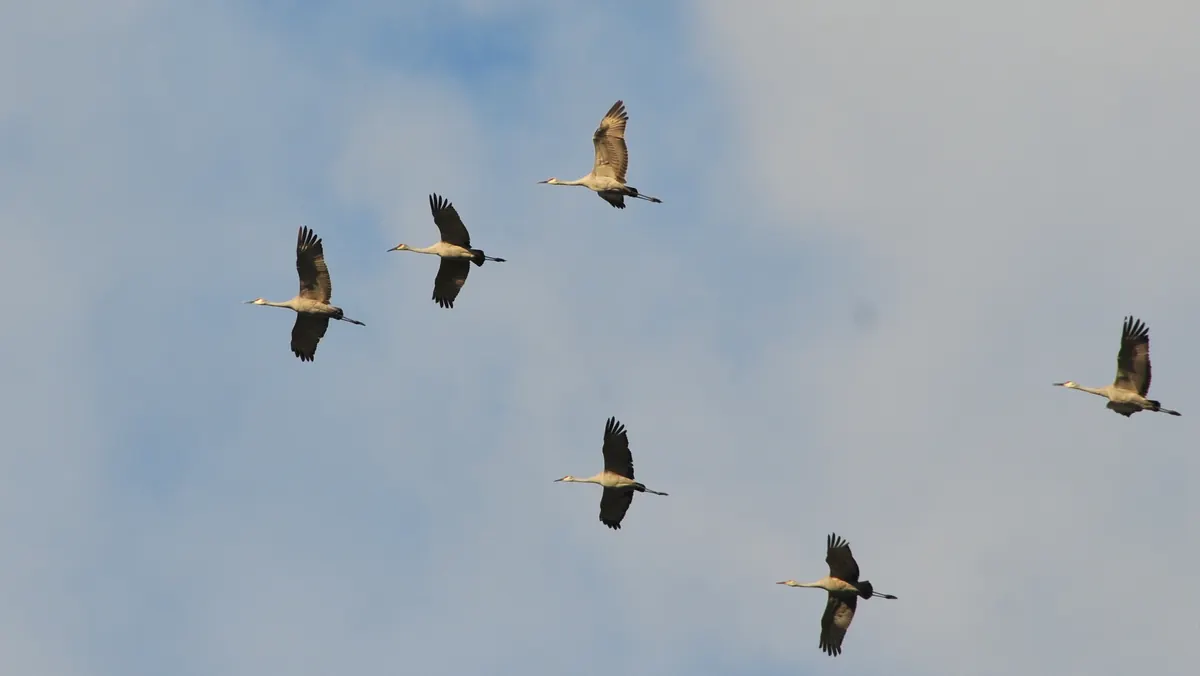
- Cranes flying in to roost at Barren River Lake. January is the crane month in south central Kentucky. Recent state counts at the lake have climbed from a few hundred birds at New Year to several thousand by the last week, and to 22,225 on January 21, 2025. Be there for the last hour of daylight (Central time) and listen for the rolling calls before you see the flocks.
- The Quadrantids before dawn on January 4. This is a good year for January’s strong, short meteor shower: the peak comes overnight from Sunday, January 3, into Monday, under a slim crescent Moon. Give it an hour before first light on Monday, January 4, facing northeast, where the radiant climbs highest.
- An eagle on open water. When ponds and coves freeze, eagles gather wherever water stays open: the tailwaters below Kentucky and Barkley dams, the Ohio River and the lake shores of Land Between the Lakes. Scan the tops of dead trees and the edges of duck rafts on a cold, clear morning.
For the Naturalist’s Field Journal: log the crane flight and the evening it peaked on birds I have seen, and press a sycamore or tuliptree twig onto seeds, pods and cones next to a sketch of its bud. After a snowfall, the rabbit, fox and deer trails in your yard go on tracks to know; the Quadrantid morning belongs on the dusk and dawn watch.
Regions used below: Western Kentucky and the Purchase; South Central and Cave Country; Louisville and the Ohio River; The Bluegrass and Northern Kentucky; Eastern Kentucky and the Appalachian coalfields.
When do sandhill cranes peak at Barren River Lake?
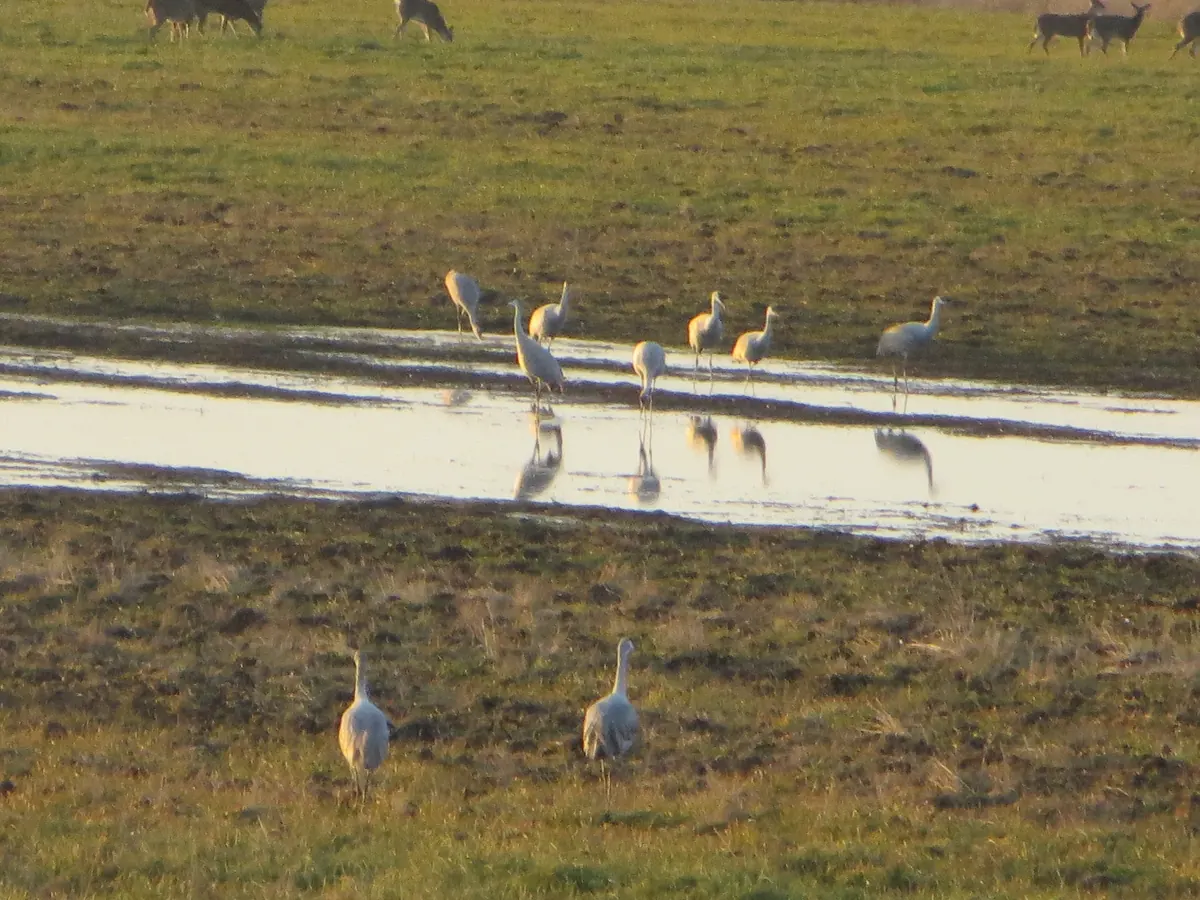
Usually in January, though the date moves with the weather. The eastern population of sandhill cranes, birds that nest around the Great Lakes, uses Barren River Lake, south of Glasgow, as a winter stopover and roost, and the flocks that start building in December keep growing through the new year.
State wildlife biologists count the roost most weeks and post each report. Its January numbers from four recent winters, in the table below, show how much the peak varies. The cold January of 2025 produced the biggest count we found in the department’s reports: 22,225 cranes on January 21, with the lake almost frozen over. A week later most were gone, and surveyors noted flocks heading north.
-
Watching the evening flight
The last hour of daylight, all month; the morning lift-off is the alternative · Barren River Lake WMA and Barren River Lake State Resort Park, Barren and Allen counties (Central time)
The cranes spend the day in harvested corn and bean fields around the lake and return to the shallow creek arms to sleep, standing in water where predators can’t reach them quietly. The state counts most of them in the Skaggs and Beaver Creek arm and in Peters Creek. Stay on public roads and pull fully off the pavement, and keep a polite distance; flushing a roost costs the birds energy they need on a cold night.
-
Nature Watch Weekend: crane tours
Friday, January 29, to Sunday, January 31, 2027 · Barren River Lake State Resort Park, near Lucas
The park lists its 2027 crane weekend on the state parks calendar: guided van tours at sunset and sunrise on Saturday and at sunrise on Sunday, with free presentations each evening. A van seat must be reserved by phone at 270-646-2151 (press 1). Late January has often been near the peak.
-
A word on sick birds
Any time in winter · Roosts and fields statewide
In early February 2025 the department’s crane report described about 20 dead cranes found on the Barren River Lake WMA mudflats and shoreline, with two sent for testing, after Tennessee and Indiana had confirmed highly pathogenic avian influenza (H5N1) in dead cranes; that week only three cranes were counted at the roost. Leave any dead or sick crane, goose or eagle alone, keep dogs away from it, and let the wildlife department know where it is.
| Count date | Cranes | Notes from the report |
|---|---|---|
| Jan 18, 2022 | 2,757 | Lake 15.7 feet above winter pool after a wet spell |
| Jan 26, 2022 | 4,640 | Numbers rising, with more reported nearby |
| Jan 2, 2024 | 205 | Cranes heard in Peters Creek that morning but missing at dusk |
| Jan 17, 2024 | 1,940 | The coldest week of that winter |
| Jan 29, 2024 | 6,942 | Locals reported thousands flying north |
| Jan 8, 2025 | 9,929 | Cranes feeding in fields never used before |
| Jan 14, 2025 | 12,067 | Flock flushed from the roost at 3:46 p.m. |
| Jan 21, 2025 | 22,225 | Lake almost frozen; new roost spots on the lake |
| Jan 29, 2025 | 1,903 | Flocks flying north since the previous week |
| Jan 12, 2026 | 2,926 | Several eagles at the lake |
| Jan 20, 2026 | 3,972 | A few white pelicans as well |
| Jan 28, 2026 | 3,771 | Icy roads, count incomplete; 80 percent of the lower lake iced over |
Sandhill crane hunting season runs to January 31, so expect hunters in some fields; the department asks them to be certain of their target because the occasional whooping crane travels with the sandhills. Last month’s first big flocks are on Kentucky in December.
Where are the most ducks and geese in Kentucky in January?
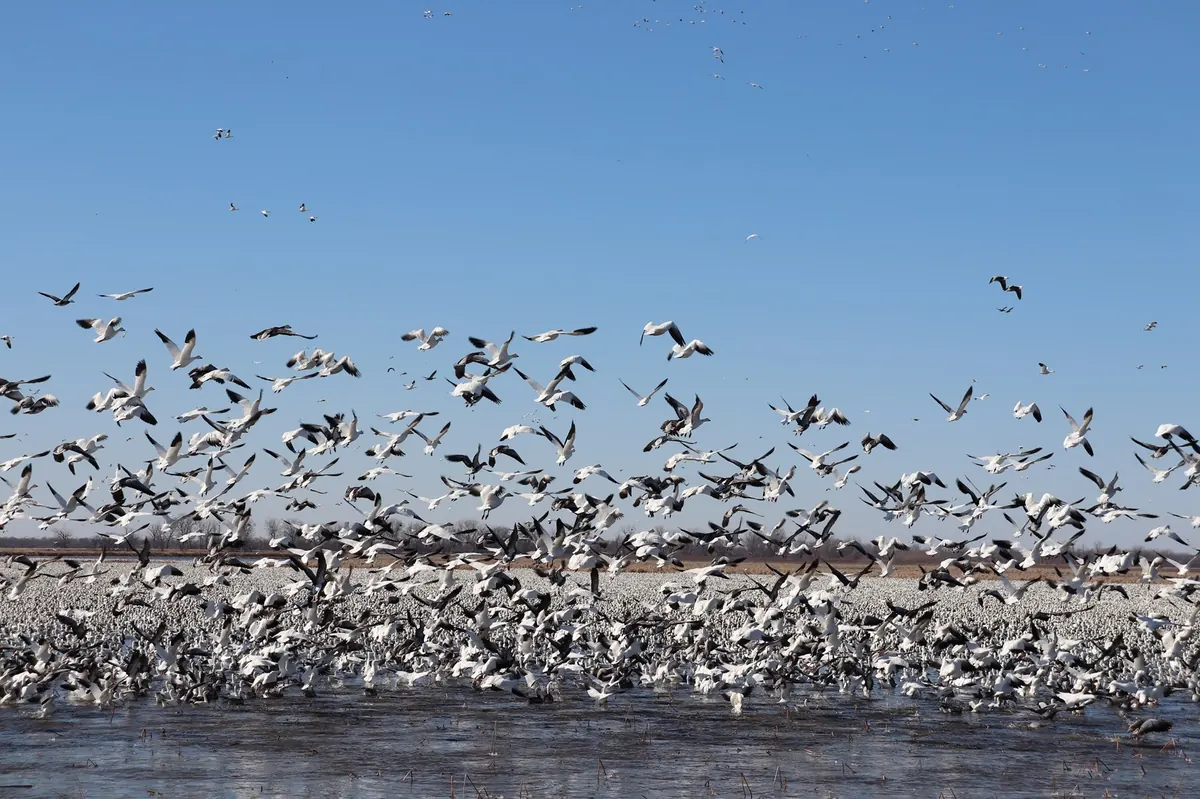
In the Purchase, the floodplain corner of Kentucky between the Ohio, Mississippi and Tennessee rivers. Every January state biologists fly the Mid-Winter Waterfowl Survey, a census flown across the Mississippi Flyway, and in each of the last three surveys the Purchase route held most of Kentucky’s ducks. How many depends on cold and water. During the polar vortex of January 2025, when shallow water froze statewide, ducks packed into the few open holes and the Purchase route counted more than 100,000. A year later, in a mild and very dry January, they were spread thinly over pumped wetlands and the count was about a third of that.
-
Ballard and Boatwright WMAs
All month; birds shift daily with ice and hunting pressure · Ballard County, along the Ohio and Mississippi (Central time)
Ballard WMA is the heart of it. The 2026 survey counted 17,982 ducks and 45,000 snow geese there on January 5, and the pilot noted that big snow goose numbers have been arriving earlier than they used to. In January 2025 Ballard held 44,680 ducks and neighboring Boatwright WMA 37,200. Both are managed for waterfowl hunting, with seasonal closures, so check the department’s public lands listing before you go and watch from the open roads and viewing spots.
-
Canvasbacks, goldeneyes and diving ducks
Coldest spells · The Ohio River around Birdsville Island, Kentucky Lake and Lake Barkley
The big lakes and rivers hold the diving ducks. In 2025 the survey pilot called the canvasback numbers near Birdsville Island, on the Ohio upstream of Paducah, about as high as he had ever seen there, and in 2024 he remarked on strong numbers of goldeneyes on the lakes.
-
Sloughs WMA and the lower Ohio
All month · Henderson and Union counties, west of Henderson (Central time)
The Western Coalfield route centers on Sloughs WMA, where the moist-soil units were at or above full pool in each of the last two surveys. The 2026 survey found 5,102 ducks and 7,100 snow geese there, along with five bald eagles, and thousands more snow geese on the Ohio nearby.
| Survey | Conditions the report described | Ducks | Snow and blue geese | White-fronted geese | Ducks at Ballard alone |
|---|---|---|---|---|---|
| January 2, 2024 | Dry; first cold weather of a mild winter | 46,392 | 5,400 | 6,500 | 25,060 |
| January 15, 2025 | Polar vortex; shallow water iced over | 104,290 | 56,500 | 14,700 | 44,680 |
| January 5, 2026 | Very dry and 15 to 20 degrees above normal | 33,240 | 45,000 | 390 | 17,982 |
Duck, coot and merganser season ends January 31 and goose season February 15; on hunting days, weekdays and afternoons are quieter for watching.
Where are the best places to see bald eagles in Kentucky in January?
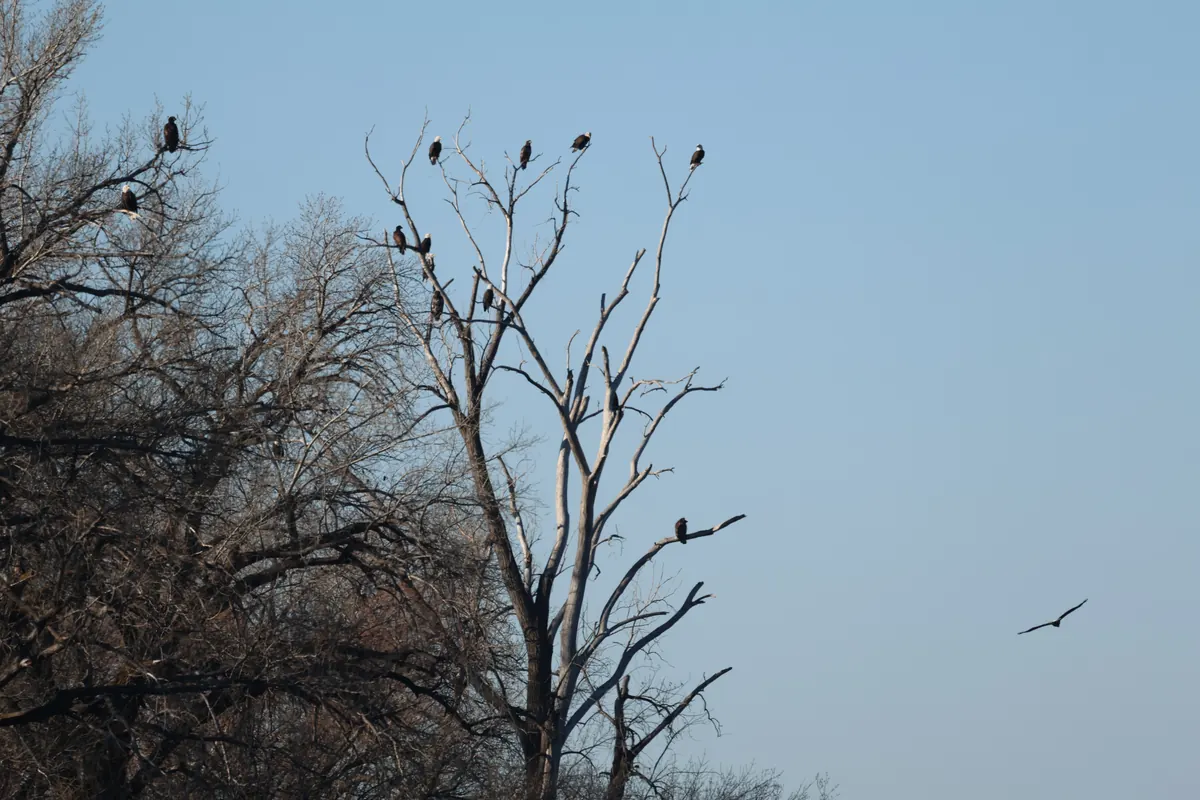
Anywhere big water stays open, and above all in the lake country of western Kentucky. Northern eagles that drift south as their lakes freeze join Kentucky’s resident pairs from December to March, and the department calls the Land Between the Lakes area a winter hot spot. January is also when the residents start a new family: Kentucky’s eagles usually lay eggs from January through March, in nests they began repairing as early as October.
-
Kentucky Lake, Lake Barkley and the tailwaters
All month; early morning, and the colder the better · Land Between the Lakes, Kentucky Dam and Barkley Dam, and the shorelines between them (Central time)
Below the dams, water released through the turbines stays open and can leave fish stunned near the surface, and eagles, gulls and herons gather to pick them off. Along the lakes, scan tall dead trees on points and islands. Adults are easy at a distance thanks to the white head and tail; the mottled brown youngsters need four or five years to grow them.
-
Eagle Watch tours at the western state parks
Usually from late January into February; 2027 dates not yet posted · State resort parks on Kentucky Lake and Lake Barkley
For decades the state parks, the wildlife department and the Army Corps of Engineers have teamed up on winter eagle tours at several western parks each January and February, usually with lodging packages and evening talks. The 2027 dates were not on the parks calendar when we wrote this; check parks.ky.gov. Land Between the Lakes has offered eagle programs in past winters, but its Woodlands Nature Station is closed December through February, so confirm before you plan around one.
-
The Midwinter Eagle Survey
Early January · Four survey routes, rotating by region
Since 1979 volunteers and biologists have counted eagles along standard routes each January as part of a national survey, which the Army Corps of Engineers and USGS keep going today. The 2026 survey window ran from January 7 to 21; the department keeps four routes going. The January waterfowl flights count eagles as well, 33 across two routes in 2024.
-
Nests and eggs
Eggs from January to March; young leave the nest from April to July · Big trees near lakes and rivers statewide
Kentucky had a single known eagle nesting territory in 1986 and 187 by 2019. Watch from at least 330 feet away, the distance the department recommends on foot, and leave quickly if an adult calls or flies off the nest.
When do great horned owls nest in Kentucky?
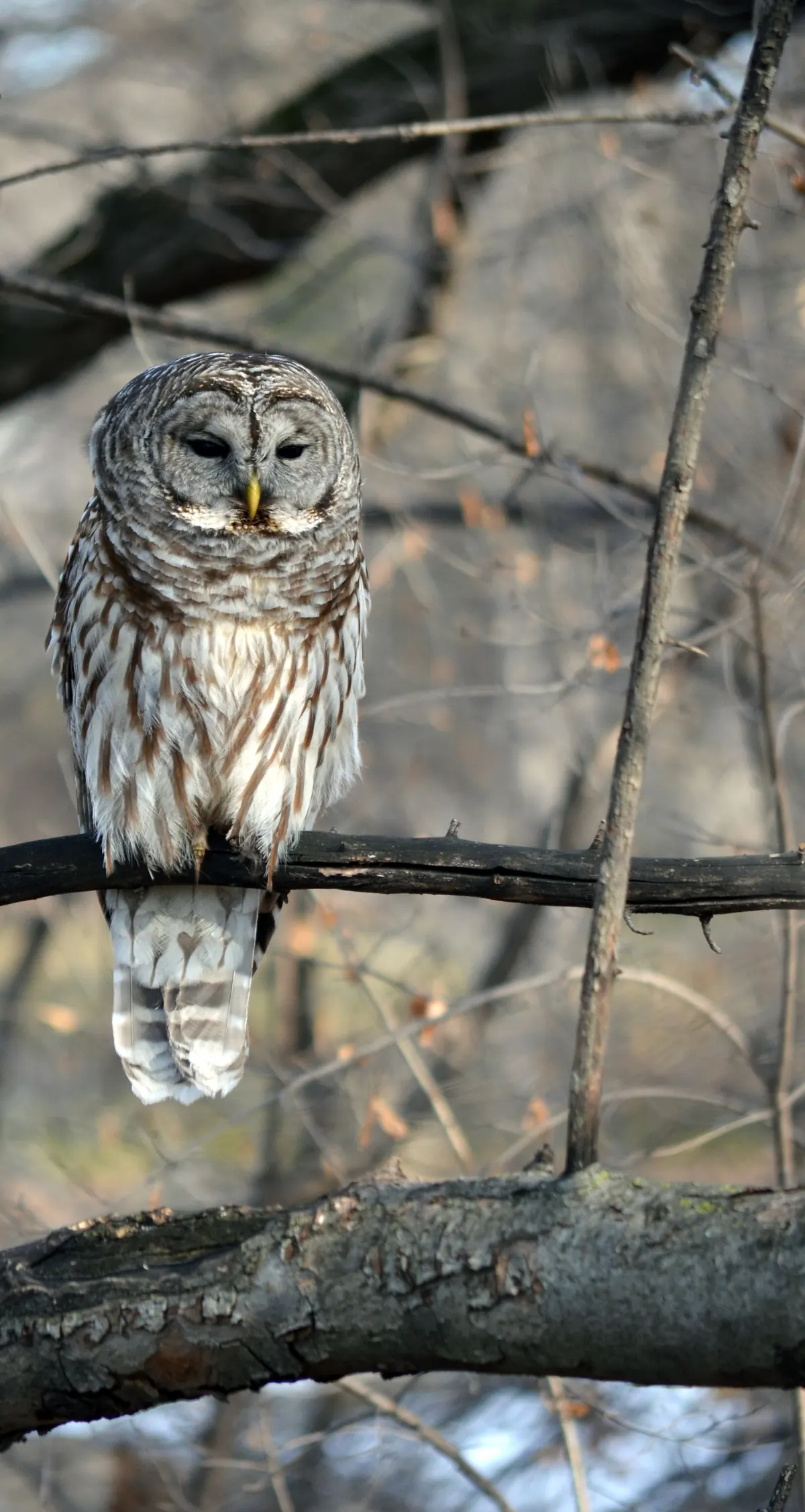
Earlier than any other Kentucky bird. Raptor Rehabilitation of Kentucky says great horned owls here breed in December and have eggs in the nest by January, so a January owl walk is a chance to find a bird already sitting on eggs through snow and freezing rain.
-
Great horned owls on the nest
Incubation through January and February · Old red-tailed hawk nests (sometimes even an eagle’s), hollow trunks and the crooks of big limbs
These owls are poor builders. They often take over a red-tail’s platform, driving off the hawks, and have been known to evict bald eagles. The female lays usually two or three eggs and does most of the incubating, which takes about four to five weeks, so owlets can hatch by February. A pair of ear tufts and two yellow eyes over a nest rim in a leafless tree is the thing to look for; the male often roosts within sight. Keep well back and don’t linger.
-
Duets at dusk
The first hour after sunset and before dawn, on calm nights · Farm woodlots, cemeteries, city parks and suburbs
Even with eggs to tend, the pair keeps calling to each other, the female’s voice higher than the male’s. In winter the deep, soft hoots carry a long way across frozen fields.
-
Barred and screech owls
All month · Creek bottoms and river woods (barred); yards with big old trees (screech)
The barred owl’s rhythmic hooting and the screech-owl’s soft, trembling whinny round out a Kentucky winter night.
Night walks in the cold are short, so dress like you are going to stand still, not hike.
How do you identify Kentucky trees in winter?
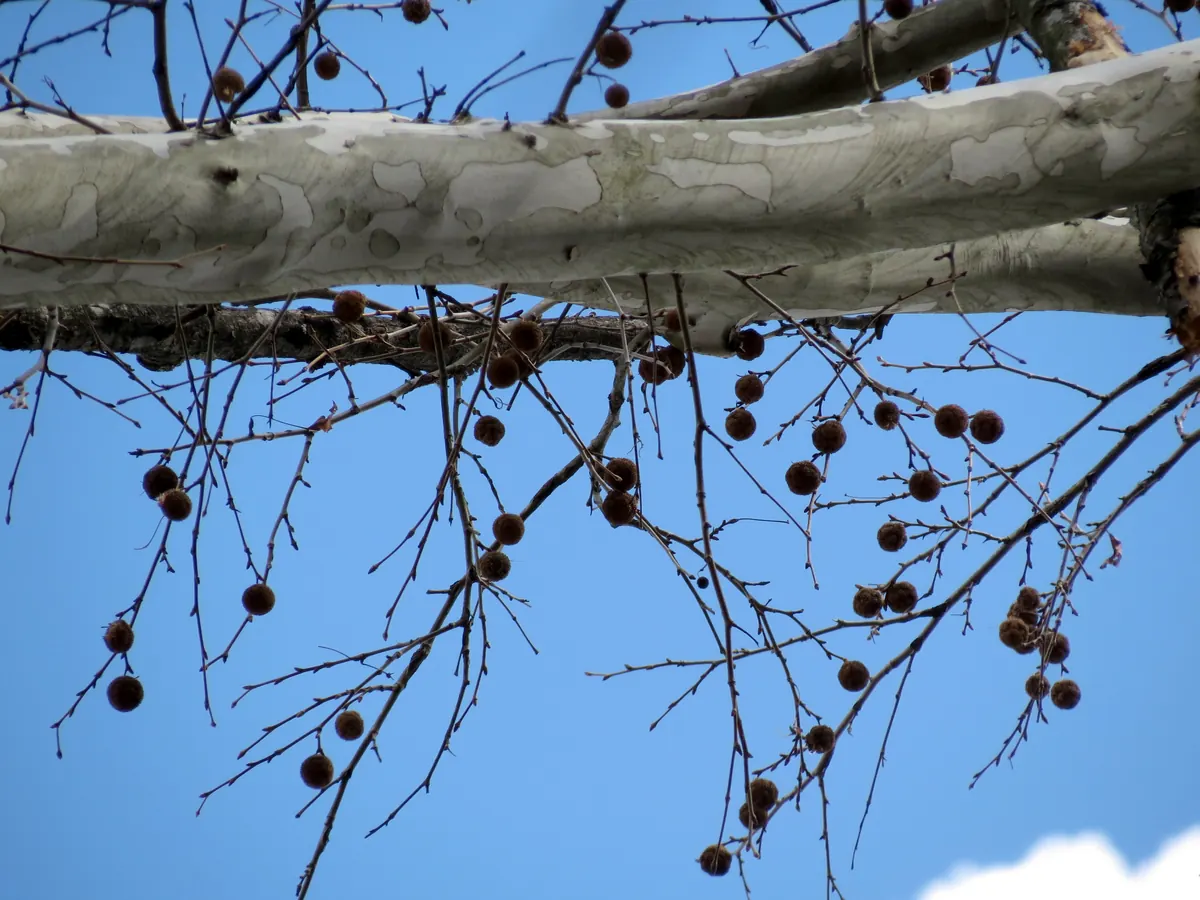
By bark, buds and the fruit some trees hold all winter. With the leaves down, January is the clearest month to learn the shape of a tree and the details of its twigs. These five are common in Kentucky and easy to tell apart; all the descriptions follow the North Carolina State Extension plant database.
-
Sycamore
All winter · Stream banks and river bottoms statewide
The easiest tree in a winter landscape: the upper trunk and limbs peel to a white or cream inner bark that glows along creeks, while the lower trunk stays scaly and brown. The twigs zigzag, the buds hide under a single cap-like scale, and a few round, fuzzy seed balls often still hang on long stalks.
-
Tuliptree (yellow-poplar)
All winter · Coves, slopes and old fields, especially in the east
Look for a tall, straight trunk with bark of flat-topped ridges and pale furrows in a diamond pattern. The terminal buds are flattened and shaped like a duck’s bill, the twigs smell sweet and spicy when broken, and the cone-like clusters of winged seeds on the branch tips come apart a few at a time all winter.
-
American beech
All winter · Moist, rich woods and ravines
Thin, smooth, gray bark and long, slender, sharply pointed buds about an inch long make beech one of the surest winter IDs. Prickly husks often stay on the tree after the nuts have fallen.
-
Pawpaw
All winter · Shady creek bottoms, often in patches
Pawpaw buds have no scales at all; they are covered in rusty, cinnamon-brown hairs, and the young twigs are the same warm brown. The bark is smooth and brown, spotted with warty lenticels.
-
Sweetgum
All winter · Bottomlands, yards and old fields
Spiky “gumballs” hang on the branches and litter the ground under the tree from December through April. Some twigs carry corky wings, and the bark of older trees is deeply furrowed.
Pick one of these near your home, photograph its bud and bark now, and go back to the same twig in April to see what came out of it.
How do Kentucky’s birds and mammals get through the coldest weeks?
By eating more, staying together and saving heat. January’s long nights and occasional deep cold are the hardest stretch of the year for small animals, and a few minutes at a feeder or along a snowy trail shows the strategies at work.
-
Chickadee flocks
All month, busiest in the first hour after sunrise · Yards, parks and woodland edges statewide
Kentucky’s chickadee is the Carolina chickadee. In winter it moves in small flocks with titmice, nuthatches and downy woodpeckers, and Audubon’s guide notes that pairs, which may mate for life, travel together inside the flock until it breaks up in late winter and they claim nesting territories. Winter food is about half insects and spiders and half seeds and berries, which is why a suet feeder is so popular after an ice storm.
-
Tracks in snow
The morning after a snowfall · Field edges, creek banks and your own yard
January is the best tracking month in Kentucky because, by the federal normals, it brings more snow than any other month at every station in our table except Paducah, where February edges ahead. A cottontail leaves two long hind prints placed ahead of two small front ones; a red or gray fox walks a neat, nearly straight line; a deer’s split hoof prints sink deep and drag between steps in deeper snow; a squirrel’s bounding tracks start and stop at tree trunks.
-
Finches from the north
Through winter, if at all · Feeders with sunflower and nyjer seed; sweetgum and sycamore seed heads
The Finch Research Network’s 2026–27 winter forecast, released on September 25, 2026, expects good seed crops to hold most northern finches far north this winter, so redpolls, crossbills and evening grosbeaks are unlikely here. Pine siskins are the exception to watch: the forecast leaves room for a small to moderate flight into the southeastern states, and sweetgum seeds are a siskin favorite.
How much daylight does Kentucky gain in January?
Every town in the table ends January with 40 to 43 more minutes of daylight than it had on New Year’s Day. The northern towns, which had the shortest days at the solstice, pick up the most: Covington, on the Ohio across from Cincinnati, goes from 9 hours 29 minutes on January 1 to 10 hours 12 minutes on the 31st, a gain of 43 minutes, while Paducah, Bowling Green and Corbin gain 40.
Almost all of that gain arrives in the evening. Sunrise in Kentucky keeps creeping later until early January and then barely moves for weeks, while sunset slides steadily later all month. The pace quickens as well: the days lengthen slowly at New Year and faster by the end of January, on the way to the quickest gains of the year around the March equinox.
| City | Jan 1 | Jan 31 | Gained | Per day |
|---|---|---|---|---|
| Paducah | 9 h 40 m | 10 h 20 m | 40 min | 1.3 min |
| Owensboro | 9 h 36 m | 10 h 18 m | 42 min | 1.4 min |
| Bowling Green | 9 h 41 m | 10 h 21 m | 40 min | 1.3 min |
| Louisville | 9 h 34 m | 10 h 15 m | 41 min | 1.4 min |
| Lexington | 9 h 35 m | 10 h 17 m | 42 min | 1.4 min |
| Covington | 9 h 29 m | 10 h 12 m | 43 min | 1.4 min |
| Ashland | 9 h 32 m | 10 h 14 m | 42 min | 1.4 min |
| Corbin | 9 h 40 m | 10 h 20 m | 40 min | 1.3 min |
Our daylight calculator works out sunrise, sunset and day length for any Kentucky town.
How cold and snowy is January in Kentucky, and what could El Niño do this winter?
January is the coldest month on average across the state. NOAA’s 1991–2020 normals, below, put average January lows in the 20s everywhere and average highs in the low to mid 40s, a little colder in Northern Kentucky. Normal snowfall ranges from under 3 inches at Paducah to more than 7 inches at Jackson, in the eastern mountains, and at the Northern Kentucky airport, and January’s normal snowfall is the highest of the year everywhere in the table except Paducah.
Two of Kentucky’s official weather records belong to January. The state’s official record low is 37 below zero, set at Shelbyville on January 19, 1994, and its greatest snow depth, 31 inches, was measured at La Grange on January 20, 1978, in the winter of the great blizzard. The weather service office in Louisville lists the city’s largest January snowfall as 15.5 inches on January 17, 1994; Lexington’s is 13.4 inches on January 26, 1943, and Bowling Green’s 12.2 inches on January 22, 2016.
A very strong El Niño is the backdrop: federal forecasters’ discussion of September 10, 2026 rated one by winter more than 90 percent likely. The Louisville weather office, looking at nine of the strongest El Niño events since 1950, points to one risk in particular: an increased chance of extremely dry weather in Kentucky and Indiana, especially from January through March. It also notes that El Niño’s effects in the Ohio and Tennessee valleys tend to be weak, with the meaningful ones most often from midwinter into spring, and that its composites are not a forecast. Dry winters matter to wildlife here: the state’s January 2026 waterfowl report described bottomland wetlands left dry and ducks confined to pumped water.
NOAA’s winter outlook comes out in mid-October with monthly revisions after that; you can follow them through the 90-day outlook maps. Our weather page covers the coming week, and our Kentucky frost dates tell you when spring’s last freeze usually comes.
| Station | Average high | Average low | Precipitation | Snowfall |
|---|---|---|---|---|
| Paducah | 44.7 °F | 27.3 °F | 3.85 in | 2.7 in |
| Bowling Green | 46.2 °F | 28.3 °F | 3.64 in | 3.2 in |
| Louisville airport | 43.6 °F | 27.8 °F | 3.39 in | 4.5 in |
| Lexington airport | 42.3 °F | 25.4 °F | 3.42 in | 4.7 in |
| Northern Kentucky airport | 39.6 °F | 23.1 °F | 3.30 in | 7.7 in |
| London-Corbin airport | 45.2 °F | 26.7 °F | 3.89 in | n/a |
| Jackson | 44.2 °F | 27.4 °F | 3.96 in | 7.4 in |
What can you see in Kentucky’s night sky in January?
A strong meteor shower with little moonlight, the closest full moon of 2027 and the brightest planet at its best in the morning. Times below are Eastern Standard Time for most of the state; western Kentucky, including Paducah, Owensboro and Bowling Green, is on Central time, one hour earlier.
-
The Quadrantids
Active December 28 to January 12; best before dawn on Monday, January 4 · Northeastern sky, climbing higher toward morning
Forecasts for the short peak range from about 10:30 p.m. EST (9:30 p.m. CST) Sunday, January 3, from the American Meteor Society, to roughly two hours later. Because the radiant, low in the north between Boötes and Draco in the evening, gains height until daybreak, Kentucky’s best window is the predawn of the 4th. The crescent Moon stays out of the way until shortly before dawn. A dark rural site may show dozens per hour; town lights cut that sharply.
-
Perihelion
Saturday, January 2, at 9:33 p.m. EST (8:33 p.m. CST) · Everywhere
Earth swings closest to the Sun, roughly 91.4 million miles out, in the same weeks Kentucky shivers through its coldest month: winter is about the low angle of sunlight, not distance.
-
The Wolf Moon, closest of the year
Full Friday, January 22, at 7:17 a.m. EST (6:17 a.m. CST) · Rising in the east-northeast at dusk on the 21st
With perigee falling late the previous afternoon, this is 2027’s closest full moon, roughly 222,229 miles from Earth, and every list of supermoons includes it. Watch Thursday night, January 21, from moonrise at dusk until it sets around dawn; on Friday evening it still looks round. Jupiter is close by on Saturday evening, the 23rd. Cumberland Falls moonbows need clear skies near full moon, and the park posts each year’s dates, so check its 2027 schedule before driving down.
-
Venus, Jupiter and Saturn
All month · Venus in the southeast before dawn; Jupiter up most of the night; Saturn in the southwest after dark
Venus, at greatest elongation on January 3 (as far from the Sun as it appears this cycle), blazes in the southeast before sunrise. Jupiter, heading for opposition in February, rises during the evening, and Saturn sinks into the southwest. In January’s final week, Mercury edges into view low in the west-southwest after dusk.
| Phase | Date | Time |
|---|---|---|
| New moon | Thursday, Jan 7 | 3:24 p.m. EST; 2:24 p.m. CST |
| First quarter | Friday, Jan 15 | 3:34 p.m. EST; 2:34 p.m. CST |
| Full moon, the Wolf Moon | Friday, Jan 22 | 7:17 a.m. EST; 6:17 a.m. CST |
| Last quarter | Friday, Jan 29 | 5:55 a.m. EST; 4:55 a.m. CST |
The dark, moonless evenings around the January 7 new moon are best for faint stars and the winter Milky Way. Our moon phase calendar gives moonrise times for your town, and our cloud-cover forecast shows which night will be clear.
What are good winter outings for Kentucky families in January?
- Friday, January 1: start the year on a trail. Carter Caves State Resort Park’s free New Year’s hike, led by a park naturalist, meets at 1 p.m. Eastern in the Cascade Cave parking lot for the 0.8-mile Box Canyon Trail, with stairs, rocks and a few climbs. If the trail is snowy or icy, everyone needs spikes or other traction devices. Other parks across the country list First Day Hikes through America’s State Parks.
- Through Tuesday, January 5: a Christmas Bird Count. Audubon’s count window closes on the 5th. Last winter ten Kentucky circles held their count on one of the first four days of January, from Bernheim Forest and Somerset on New Year’s Day to Hopkinsville and Sorgho on the 4th. The Kentucky Ornithological Society lists each circle and its compiler; email ahead to ask if children can tag along or tally a feeder.
- Second-Saturday hike at Barren River Lake. The resort park’s naturalist leads a free walk from the lodge at 10 a.m. Central on the second Saturday of most months, no reservation needed. Only the 2026 dates were on its calendar when we checked, so ask the park whether the January 2027 walk is on, and stay for the crane flight at dusk.
- Thursday, January 28, to Sunday, January 31: Winter Adventure Weekend. Carter Caves’ long-running festival has more than 200 guided trips, workshops and talks, from beginner hikes to wild caving, a 5K and yoga in a cave; registration is $25, and trip prices vary. Details are at winteradventureweekend.com.
- Friday, January 29, to Sunday, January 31: crane weekend at Barren River Lake. Nightly presentations are free; van tours need a reservation.
- Eagle Watch weekends. Usually late January into February at the western lake parks; watch the state parks calendar for 2027 dates.
- All winter: Project FeederWatch. Cornell Lab of Ornithology’s count of feeder birds starts on November 1 and runs into April; U.S. participants pay $18 a year, and children can keep the tally.
Cold, early dusk and icy trails change plans; call ahead, and dress children in layers that stay warm when damp. The rest of the year, state by state, is on our nature pages, and a field journal is a good place for a child to keep a winter bird list.
Safety notes for January in Kentucky
- Hunting seasons and hunter orange. Archery and crossbow deer seasons run through January 18. The second week of the cow elk firearm season, in eastern Kentucky’s elk country, is January 2 to 6, and Kentucky’s hunter orange rule covers firearm elk seasons: hunters and anyone with them must wear solid hunter orange outer clothing, seen from every side, over head, chest and back in daylight hours; waterfowl and dove hunters are exempt. Duck, coot, merganser, snipe and sandhill crane seasons close January 31, and goose seasons February 15. Crow season opens January 4. Squirrel, grouse and furbearer hunting and trapping last through February 28, rabbit hunting through January 31 in the eastern zone and February 10 in the western zone, and coyote is open year-round. Orange for you and your dog is still sensible on public land.
- Ice. Kentucky ponds and lakes do freeze in a hard cold spell, as the crane surveyors saw in January 2026 with most of the lower Barren River Lake iced over, but the ice is rarely thick or even enough to trust, and springs and inlets keep thin spots open. Admire it from shore and keep dogs leashed near frozen water.
- Wind chill. On a windy January day the air feels far colder on exposed skin than the thermometer suggests; the weather service’s wind chill chart shows how quickly frostbite can set in.
- Snow and ice on the roads. Freezing rain, sleet and refrozen slush are common in a Kentucky January and make back roads and park drives treacherous; in January 2026 the state’s crane counters had to start one survey late and leave another incomplete because of icy roads. Check road conditions before you set out for a dusk crane or eagle trip and carry a blanket in the car.
- Short days and icy ledges. Finish hikes in daylight, carry a headlamp, and expect shaded ledges in places like Red River Gorge to stay icy all day.
- Dead or sick birds. Don’t handle dead waterfowl, cranes or eagles, keep pets away, and call the state wildlife agency.
Sources
- KDFWR: Waterfowl and sandhill crane reports and surveys
- KDFWR: Weekly sandhill crane ground count reports, 2025–26
- KDFWR: Sandhill crane ground counts, 2024–25
- KDFWR: Sandhill crane ground counts, 2023–24
- KDFWR: Sandhill crane ground counts, 2021–22
- Kentucky State Parks: Nature Watch Weekend, sandhill crane tours (January 29–31, 2027)
- KDFWR: 2026 Mid-Winter Waterfowl Aerial Survey Report, January 5–12, 2026
- KDFWR: 2025 Mid-Winter Waterfowl Aerial Survey Report, January 13–15, 2025
- KDFWR: 2024 Mid-Winter Waterfowl Aerial Survey Report, January 2–4, 2024
- KDFWR: Public lands search (wildlife management areas)
- KDFWR: Bald eagles in Kentucky
- Midwinter Bald Eagle Survey database (through 2021)
- Kentucky State Parks: Eagle Watch Weekends announcement (2020)
- Land Between the Lakes: Woodlands Nature Station
- Raptor Rehabilitation of Kentucky: Great horned owls
- National Audubon Society guide: Great horned owl
- KDFWR: Identifying Kentucky’s owls
- National Audubon Society guide: Carolina chickadee
- Finch Research Network: Winter finch forecast 2026–2027
- NC State Extension plant toolbox: Platanus occidentalis (sycamore)
- NC State Extension plant toolbox: Liriodendron tulipifera (tuliptree)
- NC State Extension plant toolbox: Fagus grandifolia (American beech)
- NC State Extension plant toolbox: Asimina triloba (pawpaw)
- NC State Extension plant toolbox: Liquidambar styraciflua (sweetgum)
- NOAA NCEI: 1991–2020 monthly normals for seven Kentucky stations
- NOAA NCEI: U.S. Climate Normals
- NOAA NCEI State Climate Extremes Committee: state records
- NWS Louisville: Snow climatology for Louisville, Lexington and Bowling Green
- NWS Louisville: El Niño and La Niña impacts on Kentucky and southern Indiana
- NOAA Climate Prediction Center: ENSO diagnostic discussion, September 10, 2026
- NOAA Climate Prediction Center: 90-day outlooks
- National Weather Service: Wind chill chart
- U.S. Naval Observatory: Moon phases, December 2026 to March 2027
- U.S. Naval Observatory: Earth’s seasons and apsides, 2027
- American Meteor Society: Meteor shower calendar
- Fred Espenak: Sky Event Almanac 2027
- EarthSky: What is a supermoon?
- Kentucky State Parks: New Year’s Hike 2027, Carter Caves
- Kentucky State Parks: Winter Adventure Weekend, January 28–31, 2027
- Winter Adventure Weekend
- Kentucky State Parks: 2nd Saturday Hike, Barren River Lake
- Kentucky State Parks: Events calendar
- America’s State Parks: First Day Hikes
- National Audubon Society: Christmas Bird Count
- Kentucky Ornithological Society: Christmas Bird Count schedule
- Project FeederWatch: Project overview
- KDFWR: Kentucky hunting and fishing seasons planner
- KDFWR: Hunting regulations (hunter orange)
- KDFWR: Rabbit hunting seasons
- KDFWR: Deer hunting
- U.S. Army Corps of Engineers: National Midwinter Bald Eagle Survey (2026 dates, Corps and USGS coordination)
- Photos via Wikimedia Commons; licenses and photographers are credited under each picture
