What to look for in nature in Tennessee this January
January is the deep middle of Tennessee’s winter, and it is also when a surprising amount of wildlife is busiest. The crane flock on the Hiwassee reaches its largest size of the year, eagles from the north crowd the big western lakes, the great horned owls have begun incubating, and on the first mild evening a woodcock may spiral up over a wet pasture. Days are lengthening again, mostly at the supper-table end. Clock times below are marked Central or Eastern, since the time-zone line splits the state.
Other months in Tennessee: October, November, December, February.
Start here
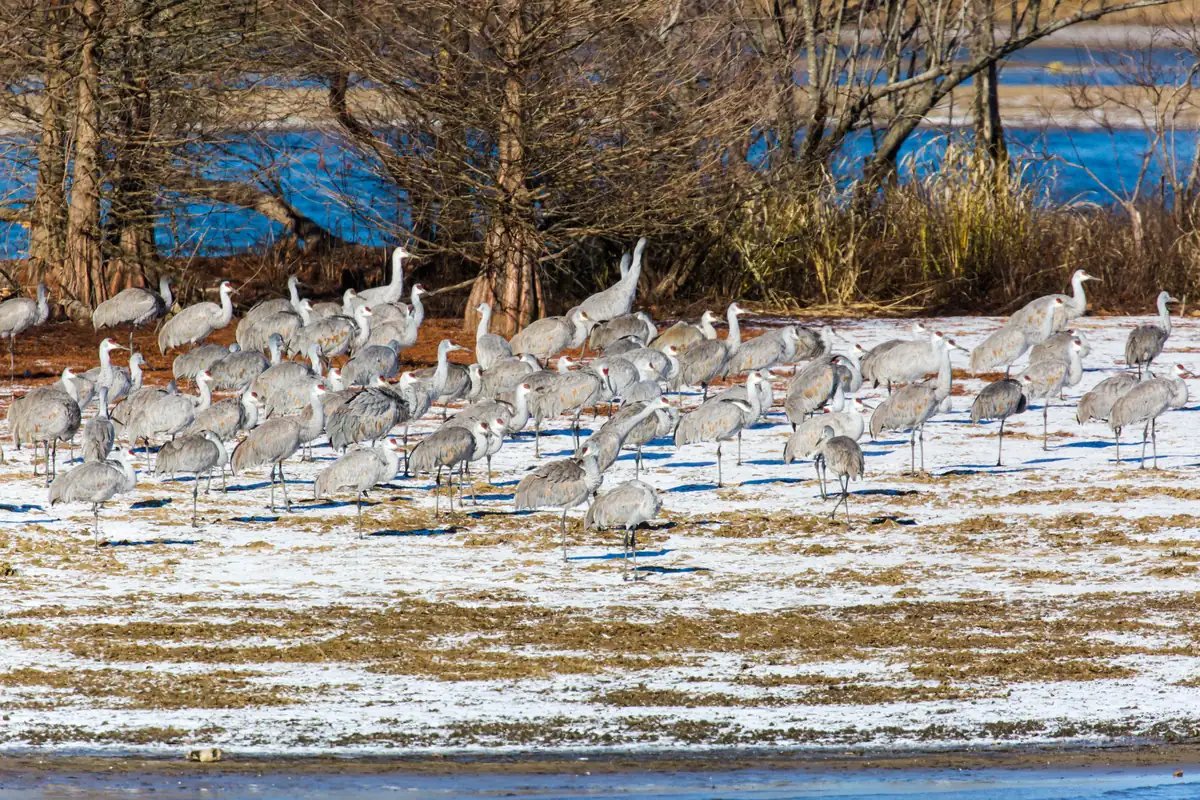
- The crane peak and the festival. TWRA expects the most sandhill cranes of the winter at the Hiwassee Refuge in January, and Birchwood hosts the Sandhill Crane Festival on the weekend of January 16 and 17, 2027. The viewing platform north of Birchwood stays open even while the refuge itself is closed.
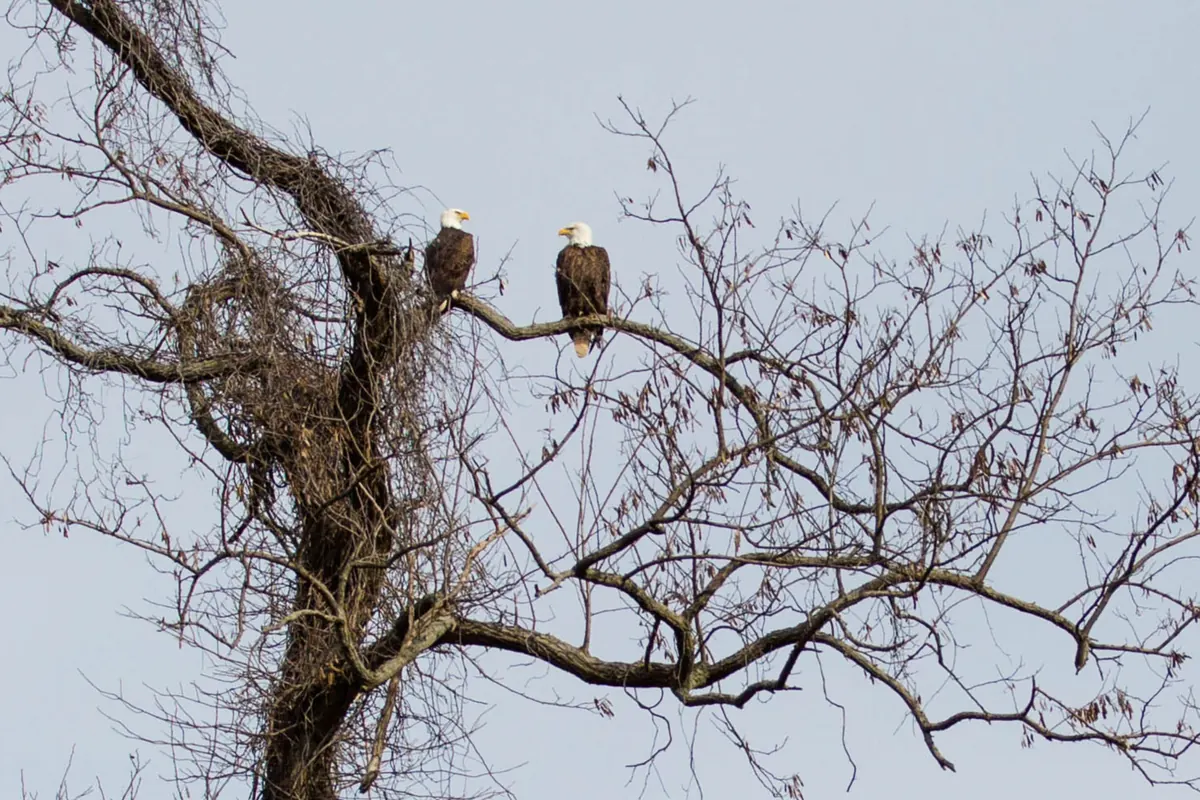
- Eagles on the western lakes. Wintering bald eagles keep building toward a peak that TWRA places between late January and mid-February. Reelfoot Lake State Park runs eagle tours through the winter by reservation; book ahead, then drive the national wildlife refuge’s auto tour.
- A supermoon and a fine meteor night. Sunday night, January 3, brings the Quadrantid peak with hardly any moonlight in the way, and the Wolf Moon of the 22nd comes closer to us than any other full moon this year. The evening before the meteors, Earth swings through the closest point of its orbit.
In the Naturalist’s Field Journal, the birds-I-have-seen page suits a crane and eagle tally, the dusk-and-dawn watch is made for a woodcock evening, the tracks-to-know plate waits for the first skim of snow, and a tree-through-the-seasons page can start now with one tulip poplar’s chalky bark.
Regions used below: West Tennessee; Middle Tennessee; The Cumberland Plateau; East Tennessee and the Valley; The Smokies and Blue Ridge.
When is the best time to see sandhill cranes at the Hiwassee Refuge?
Right now. TWRA’s page for the Hiwassee Refuge names January as the month with the highest crane numbers, after a fall flight that runs from late October to late December. The agency puts the eastern population that passes through and winters in Tennessee at a minimum of 89,000 birds and says up to 20,000 return to the Hiwassee area each year. The flock stays into February; TWRA gives mid-February to late March as the window for the spring departure north.
-
The Hiwassee viewing platform
Open all year; the rest of the refuge is closed from November 15, 2026, through the end of February 2027 · Near the mouth of the Hiwassee River on Chickamauga Lake, north of Birchwood, Meigs County (Eastern time)
The refuge totals about 6,000 acres, 2,500 of land and 3,500 of water, and it is off limits to every use during the winter closure, but the platform overlooking it never closes. Mornings can be rewarding when the birds lift off to feed; late afternoon brings them back to the river in noisy strings. On a cold day the wind off the lake is sharp, so bring a hat, gloves and a thermos, and use a scope rather than walking closer.
-
Tennessee Sandhill Crane Festival
Saturday and Sunday, January 16 and 17, 2027 · Birchwood, Meigs and Hamilton counties (Eastern time)
TWRA lists this as the festival’s 36th year. During the weekend, spotting scopes are set up both at the refuge platform and at the Cherokee Removal Memorial overlook, so families without optics can still see the birds well. Check TWRA’s festival page in January for the schedule of programs and parking.
-
Look for a white crane among the gray
Any day of the winter, rarely · Fields and sandbars used by the sandhill flock
Whooping cranes are rare in Tennessee, but TWRA notes that one sometimes feeds in the same fields as the sandhills. An adult whooper is pure white with black wingtips; an adult sandhill is gray with a red crown. If you see one, report it rather than approaching: it is an endangered species.
The Southeast Crane Zone hunt closes for three days around the festival, January 15 to 17, and the season ends statewide on January 31; there is no hunting on the refuge during its winter closure.
Where can you see bald eagles in Tennessee in January?
Anywhere there is open water and fish, but best on the big reservoirs and at Reelfoot. Eagles from farther north begin coming in at the end of October, and TWRA says their numbers top out between late January and mid-February. The agency’s list of lakes worth a winter visit is six reservoirs and natural lakes spread from the Mississippi bluffs to the Valley: Reelfoot, Kentucky and Pickwick in the west, Dale Hollow on the Kentucky line, and Watts Bar and Chickamauga in the east. Tennessee went more than two decades without a successful eagle nest, from 1961 until a pair near Dover raised young in 1983; now TWRA says nesting pairs live all over the state.
-
Reelfoot Lake: van tours and the Eagle Festival
Tours through the winter by reservation; festival usually on a weekend around the turn of January into February · Reelfoot Lake State Park and Reelfoot National Wildlife Refuge, Lake and Obion counties (Central time)
The state park runs guided eagle tours in winter, and reservations are recommended (731-253-9652); ask the park for this winter’s days and departure times. The Reelfoot Lake Eagle Festival, with tours, live birds of prey, photo contests and children’s activities, has in recent years been held over the weekend where January turns into February (January 30 to February 1 in 2026); the tourism council had not posted 2027 dates by early October, so ask the council or the park before planning a trip. On your own, the refuge’s 3.5-mile auto tour and its viewing towers look over the cypress-lined upper lake, and the Fish and Wildlife Service offers a free self-guided eagle tour packet.
-
Dale Hollow Lake Eagle Watch
Usually Saturdays in January, occasionally one in February; 2027 dates not yet posted · Dale Hollow Lake on the Kentucky line, from Lillydale Campground, Clay County (Central time)
The U.S. Army Corps of Engineers, with the Friends of Dale Hollow Lake, runs barge tours each winter, free apart from a small reservation fee, on a lake the Corps describes as home to the second largest population of wintering bald eagles in Tennessee and Kentucky. Recent tours left Lillydale Campground at 9:30 a.m. and 12:30 p.m. Central, carried up to 50 people, lasted up to three hours, and filled through advance reservations on Recreation.gov. Watch the Corps’ Nashville District news page in November and December for the 2027 dates.
-
Golden eagles, the rarer cousin
Mid-November to early March · Any region, most regularly Reelfoot Lake and Tennessee National Wildlife Refuge
TWRA calls the golden eagle a rare but regular winter visitor. Do not mistake it for a young bald eagle: young balds have bare lower legs, most show scattered white feathers on body and wings after their first year, and they flap more often than goldens do.
Resident pairs are already adding sticks to their nests, and egg-laying peaks in late February; if you find a nest, watch from far enough away that the birds keep doing what they were doing.
When do great horned owls lay eggs in Tennessee?
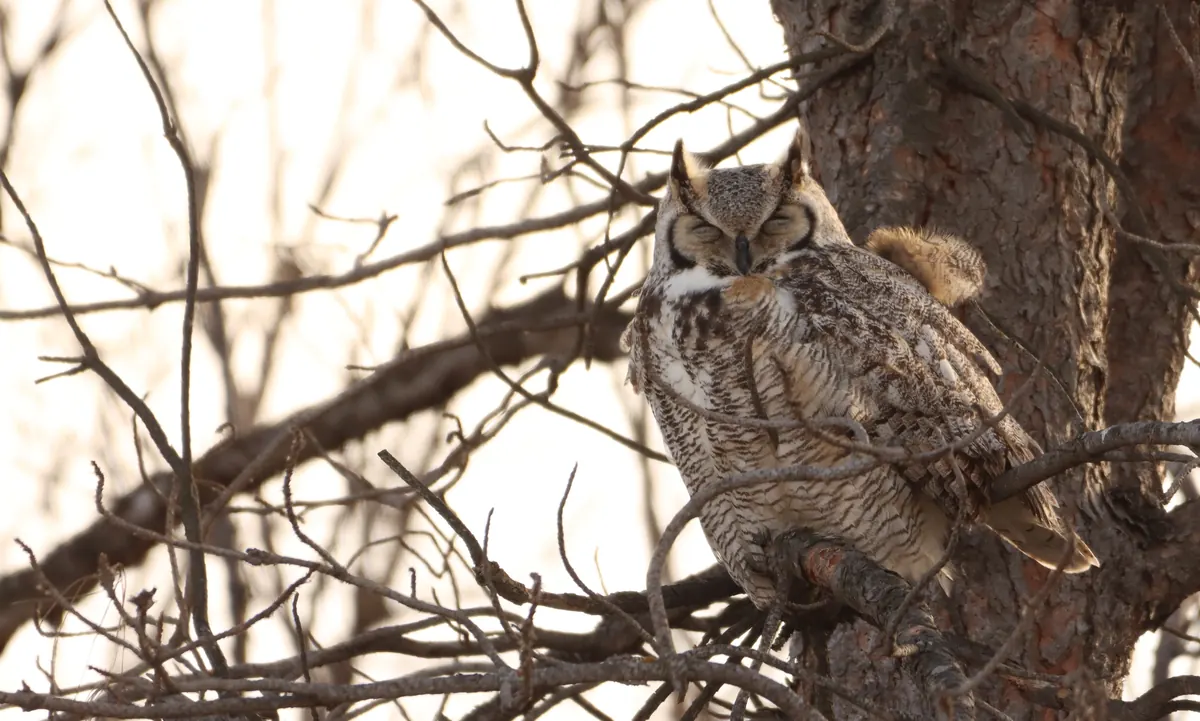
In January. No other Tennessee bird starts a family so early in the year. TWRA says the eggs usually go down this month, two in a typical clutch and rarely as many as five. The female does most of the sitting, for 26 to 35 days, so many Tennessee owlets hatch in February while frost is still on the ground. The young leave the nest at about five weeks but cannot fly well until they are about nine weeks old, and they stay with their parents for roughly three months after that.
-
Finding a sitting owl
Daylight, through January and February · Old hawk and crow nests, broken snags and tree hollows, often 30 to 50 feet up
Great horned owls rarely build a nest of their own. Check big stick nests in leafless trees for two feathered horns showing above the edge, or for a big gray-brown shape pressed into a cavity. The mate often roosts in a nearby evergreen, and a crowd of scolding crows is a good clue to where one is sitting.
-
What they eat in winter
Mostly at night · Fields, woodland edges, marshes
TWRA lists rabbits, geese, herons, amphibians and smaller birds among their prey, mostly mammals, and calls the great horned owl the only bird known to readily kill and eat skunks. An owl can weigh just over three pounds with a wingspan near 44 inches, and the female is the larger of the pair.
Pairs keep hooting through the nesting season, so evening listening is still worthwhile. Keep your distance from a nest with a sitting bird, and leave the recordings at home.
When do woodcock start their sky dance in Tennessee?
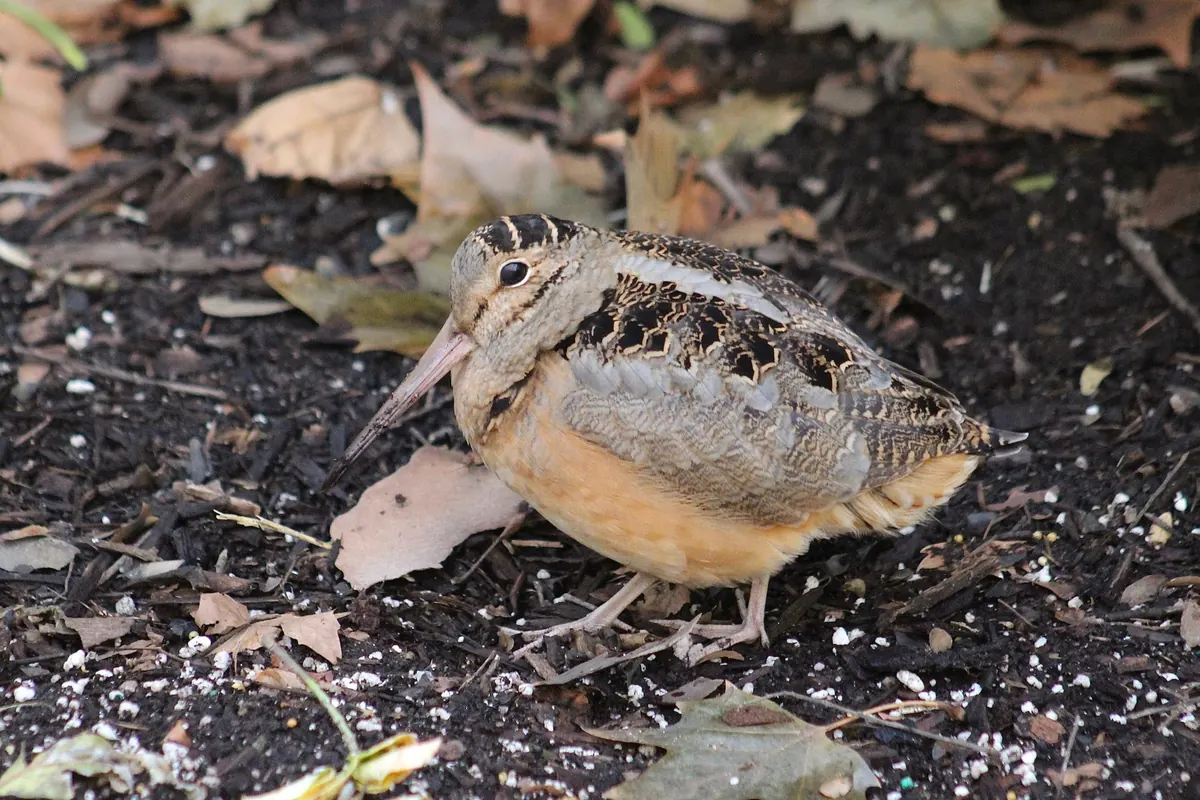
Often this month. TWRA describes the male American woodcock displaying now and then on warm evenings from mid-October into December, then regularly from January into March, before tapering off through May. Peak nesting in Tennessee comes in the first half of March, so the January performances are courtship in earnest. The agency calls the woodcock an uncommon resident statewide, rare in winter and a more common breeder in the eastern two-thirds of the state, so finding one takes a little luck and a calm, mild evening.
-
The display
Dusk, and on moonlit nights, when it is above freezing · Open fields and clearings next to moist, shrubby young woods and old farmland
Stand at the edge of a field as the light fades and listen for a short, buzzy, nasal peent from the ground. After several calls the male rises 50 to 100 yards into the sky, his wings twittering as he climbs, then tumbles back down with a run of liquid chirps and lands near where he started, ready to begin again.
-
Where to try
Late January into March · Wet pastures, powerline cuts and regrowing clearcuts statewide
Any brushy, damp field with young trees nearby is worth a try. Arrive twenty minutes after sunset, stay quiet, and bring a light for the walk out. Note the date, the temperature and how many birds you hear.
Tennessee’s second woodcock hunting segment runs January 10 to 31, so wear bright colors if your field is on public hunting land.
Do salamanders and frogs breed in Tennessee in January?
Some do, on the right night. The Tennessee Aquarium notes that salamander breeding migrations can come anywhere from October to as late as January and February, depending on the species, and that the cue is a sudden warm-up together with heavy rain. A January thaw with a soaking rain after dark is the night to watch.

-
Spotted salamanders on the move
Warm, rainy nights from midwinter into early spring · Woods around fishless ponds and seasonal pools, statewide
TWRA calls the spotted salamander common and widespread across Tennessee and says warm rains set off mass migrations to the breeding ponds. The animals are black with two rows of round yellow spots and grow up to about 7.75 inches long. Each female lays roughly 100 to 300 eggs a year in several firm, jelly-coated masses attached to sticks underwater. A naturalist with the Tennessee River Gorge Trust, near Chattanooga, wrote in 2025 that the timing depends entirely on rain and temperature, with the trigger being rainy nights once the soil a foot down has warmed past 40 °F.
-
Wood frogs, the first to call
The first mild spell after hard cold · Moist woods in the eastern half of the state
TWRA counts the wood frog as the first Tennessee frog to begin calling, sometimes before the ice has fully left its pond. The chorus sounds like a raft of distant ducks. Females leave big round clusters of up to 3,000 eggs fixed to underwater plants, and because many pairs breed at once, the masses appear in a pool all together.
-
Chorus frogs in flooded fields
Rainy nights above freezing · Roadside ditches, wet pastures and temporary pools
Upland chorus frogs join in with their rising, comb-like trill as soon as winter rains fill the shallow pools. On a drive home after a warm rain, crack the window near a flooded field.
If salamanders are crossing a road, slow down, and if you stop to help, move them in the direction they were heading with wet hands. Never handle them with sunscreen or lotion on your skin.
How can you identify Tennessee trees in winter?
Start with bark and shape. UT Extension’s pocket guide to common Tennessee trees says that once the leaves are gone and the buds are out of reach, bark and the tree’s overall form are the most readily available and reliable clues, and that a tree’s site narrows the choices, since trees stay put. The guide also suggests checking the ground for old leaves and seeds, while warning that they may have blown in from a neighbor.
-
Tulip poplar (yellow-poplar)
All winter · Coves, slopes and old fields statewide
Tennessee’s state tree grows tall and straight with a clean trunk. Its giveaway, in UT’s words, is what looks like white to silver-white chalk dust in the channels of the bark, from the base to the top. Look up, too: last year’s seed heads stand on the branch tips like small peeled bananas.
-
Sycamore and shagbark hickory
All winter · Sycamores along creeks and rivers; shagbark on drier slopes
Sycamore bark peels away in thin tan flakes to show big smooth patches of pale blue-green and silver-gray, so a creek lined with them glows white on a gray day. Shagbark hickory sheds long, hard strips that curl away from the trunk at both ends.
-
Sweetgum, red maple and white oak
All winter · Yards, bottomlands, ridges
Corky ridges on the small branches point to sweetgum (or winged elm), and spiny gumballs under the tree settle it. Red maple bark is variable but has small pimples on its smooth parts. White oak bark is light gray, soft and easy to break, and may peel from the side in long ridges.
-
Baldcypress and its knees
All winter · Reelfoot Lake, the Hatchie and other West Tennessee swamps and sloughs
Baldcypress drops its needles in fall, and UT notes that in winter a young one can look like a dead cedar. Look instead for the flared, fluted base and the knobby knees rising out of the water or ground around it. On an eagle trip to Reelfoot, the knees are everywhere along the shore.
Pick one tree near home and give it a page in the Naturalist’s Field Journal: sketch its bark now, then come back to the same tree in April.
How much snow falls in the Smokies in January?
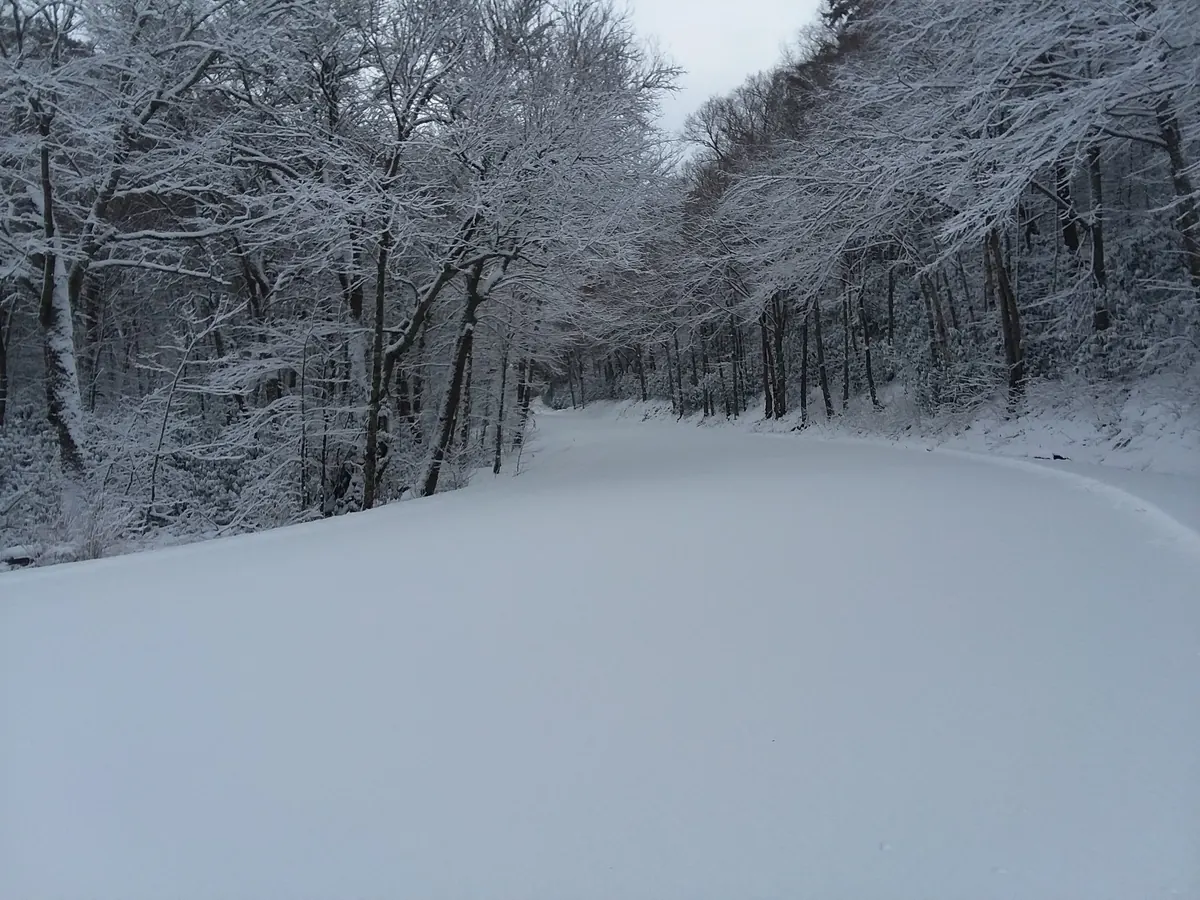
A lot more on the summits than in the towns. The park’s own averages for January give Kuwohi, the highest point at 6,643 feet, a high of 35 °F, a low of 19 °F, 7.0 inches of precipitation and 18 inches of snow; Gatlinburg, in the valley, averages 51 °F and 28 °F and gets 4.8 inches of rain and melted snow, of which 2.3 inches fall as snow. The park says snow is most likely in the mountains in January and February, that a single mountain storm can bring up to two feet, and that lows of -20 °F are possible in the high country.
-
Snow on the crest
After each cold front · Newfound Gap, Mount Le Conte and the main crest of the range
Snow showers on the back side of a storm often whiten the high ridges while Gatlinburg and Townsend only get cold rain. Fresh snow is the best time of year to read tracks: follow a set along a trail edge and see where the animal stopped, turned or dug.
-
Which roads are open
All month · Park roads in Tennessee and North Carolina
The park’s 2026 seasonal schedule has the road to Kuwohi closed from November 30 until April 1, with Roaring Fork Motor Nature Trail, Rich Mountain, Parson Branch and Little Greenbrier roads also shut for the winter. Cades Cove Loop Road stays open, weather permitting, and Newfound Gap Road can close for snow or ice at short notice. Look at the park’s conditions page before you leave home.
Snow on the mountain roads is a reason to plan, not to stay home: low-elevation trails along the Little River and in Cades Cove make fine January walks when the high country is closed.
Is January the coldest month in Tennessee, and how might El Niño change it?
On average, yes. The Nashville weather office lists January as the city’s coldest month, with a normal mean temperature of 39.6 °F, Knoxville’s coldest reading since records began in 1871 came on January 21, 1985, at -24 °F, and Nashville’s all-time low, -17 °F, was set in January 1985 as well. In the 1991–2020 normals, January lows sit near or below freezing at every station in the table, and Crossville and Bristol each log over 20 freezing nights in a typical January.
-
Snow, ice and the cold plateau
Any week of the month · Statewide; most often on the Cumberland Plateau and in the northeast
January snowfall normals are modest in the cities, from under an inch at Memphis to 3 or 3.5 inches at Bristol and Crossville, but one winter can differ wildly from another: Nashville’s record for a single January day is 8.5 inches, set in 1905. Freezing rain and sleet can be more disruptive than snow, glazing trees and bridges on the plateau while the valleys stay just above freezing.
-
What a very strong El Niño might mean
January through March · Statewide
In its September 10, 2026, update, the Climate Prediction Center gave better than 90 percent odds that this winter’s El Niño peaks in the very strong range. The clearest Tennessee example of what such an event can do is 1982–83, which the Nashville weather office wrote up as an unusually mild winter: every month ran warmer than normal, the season averaged 3.6 °F above normal, January and February were both drier than normal, and the whole winter brought only 1.5 inches of snow against a 9.2-inch average at the time. One winter is not a forecast, and the office’s own example is a single season, so treat it as a sign of what is possible rather than a promise. NOAA’s seasonal outlooks, updated every month, can be found through the CPC seasonal outlook maps.
| Station | Average high | Average low | Nights at 32 °F or colder | Precipitation | Snowfall |
|---|---|---|---|---|---|
| Memphis | 50.9 °F | 33.3 °F | 14.9 | 4.14 in | 0.9 in |
| Jackson | 48.7 °F | 29.3 °F | 19.4 | 4.07 in | – |
| Nashville | 49.1 °F | 30.1 °F | 18.8 | 4.02 in | 2.0 in |
| Crossville | 41.6 °F | 25.1 °F | 22.5 | 5.49 in | 3.5 in |
| Chattanooga | 51.0 °F | 32.4 °F | 17.0 | 5.02 in | 1.0 in |
| Knoxville | 48.2 °F | 30.0 °F | 18.5 | 4.76 in | 1.7 in |
| Bristol | 46.5 °F | 26.3 °F | 21.8 | 3.65 in | 3.0 in |
| Gatlinburg (park) | 51 °F | 28 °F | – | 4.8 in | 2.3 in |
| Kuwohi (park) | 35 °F | 19 °F | – | 7.0 in | 18 in |
Check our local forecast page before a winter outing; our Tennessee freeze page lists when the final spring frost tends to arrive, handy when the seed catalogs come.
How much daylight does Tennessee gain in January?
Between 37 and 39 minutes in every city in the table, and nearly all of it added after supper rather than before breakfast. In Nashville, sunrise only moves from 6:58 to 6:49 a.m. Central over the month, while sunset slides from 4:43 to 5:13 p.m. Knoxville’s sunset moves from 5:32 to 6:02 p.m. Eastern, and Memphis, at the far western end of the Central zone, goes from 4:59 to 5:28 p.m. Sunrise is at its latest of the year around the first week of January, which is why the mornings feel so stubborn.
| City | Jan 1 | Jan 31 | Gained | Per day |
|---|---|---|---|---|
| Memphis | 9 h 50 m | 10 h 28 m | 38 min | 1.3 min |
| Jackson | 9 h 48 m | 10 h 26 m | 38 min | 1.3 min |
| Nashville | 9 h 45 m | 10 h 24 m | 39 min | 1.3 min |
| Clarksville | 9 h 44 m | 10 h 22 m | 38 min | 1.3 min |
| Crossville | 9 h 46 m | 10 h 24 m | 38 min | 1.3 min |
| Chattanooga | 9 h 51 m | 10 h 28 m | 37 min | 1.2 min |
| Knoxville | 9 h 46 m | 10 h 25 m | 39 min | 1.3 min |
| Bristol | 9 h 43 m | 10 h 22 m | 39 min | 1.3 min |
Each day adds a bit more than the one before: under a minute at the start of January, closer to two minutes by the 31st. Look up your own street’s sunrise and sunset with our daylight calculator.
What can you see in Tennessee’s night sky in January 2027?
Look for Quadrantid meteors in the first week, dazzling Venus before sunrise, and a supermoon in the third week. Readers west of the time-zone line (Memphis, Nashville, Crossville) should use the Central times; Chattanooga, Knoxville and the Tri-Cities use Eastern. Daylight saving time does not begin until March.
-
The Quadrantid meteor shower
Night of Sunday, January 3, into the dawn of Monday, January 4 · Anywhere dark; the radiant sits low in the evening and climbs toward morning
The Quadrantids, a short, sharp shower, are best around 9:30 p.m. Central by the American Meteor Society’s reckoning (10:30 p.m. Eastern) on the 3rd; EarthSky’s estimate is a couple of hours later. Peak rates last roughly six hours. This year the moon is a thin sliver that does not clear the horizon until late in the night, which leaves the evening dark. Away from town lights, a patient watcher can count several dozen per hour during the last dark hours of Monday morning, once the radiant has climbed high.
-
Perihelion and Venus at its farthest
Saturday, January 2, and Sunday, January 3 · Venus in the southeast before sunrise
Earth makes its closest pass of the sun at 8:33 p.m. Central (9:33 p.m. Eastern) on January 2, about 91.4 million miles away, which shows that the planet’s tilt, not its distance, sets the seasons. On the 3rd, Venus stands 47 degrees from the sun, as far west of it as it gets this time around, so it comes up hours ahead of the sun and blazes in the southeast until the sky brightens.
-
The Wolf Moon, the closest full moon of 2027
Night of Thursday, January 21, into Friday, January 22 · Rising in the east-northeast around sunset on the 21st
Full moon arrives at 6:17 a.m. Central (7:17 a.m. Eastern) on Friday the 22nd, less than a day after the moon’s closest approach to Earth, which makes it a supermoon and the nearest full moon of the year. Both the Thursday and Friday evenings show a round moon; on snow, it lights a field well enough to see tracks.
-
Moon, Jupiter and Regulus; Mercury and Saturn at dusk
Evening of Saturday, January 23; late January · East after dark; low in the west-southwest after sunset
The night after the full moon, the moon rises close to bright Jupiter, with the star Regulus nearby, according to Fred Espenak’s almanac. Jupiter is heading for opposition in February and is up most of the night. At dusk, Saturn, low in the southwest, loses altitude week by week, and by the final days of January Mercury starts to appear in the twilight glow toward the west-southwest, best half an hour or so after sundown.
| Phase | Date | Time |
|---|---|---|
| New moon | Thursday, Jan 7 | 2:24 p.m. CST (3:24 p.m. EST) |
| First quarter | Friday, Jan 15 | 2:34 p.m. CST (3:34 p.m. EST) |
| Full moon, the Wolf Moon | Friday, Jan 22 | 6:17 a.m. CST (7:17 a.m. EST) |
| Last quarter | Friday, Jan 29 | 4:55 a.m. CST (5:55 a.m. EST) |
Check the cloud outlook before you set an alarm for meteors, and use our moon phase calendar to time moonrise for the Wolf Moon.
What can Tennessee families do outdoors in January 2027?
- Start the year on a trail. Ranger-led First Day Hikes on January 1 are a Tennessee State Parks tradition; check the state parks website in December for the 2027 list and choose one close to home.
- Finish the Christmas Bird Count. Audubon’s count season runs through January 5, so a few circles hold their count after New Year’s Day. Ask the nearest Tennessee Ornithological Society chapter whether a team still needs help.
- Go to the crane festival. The Sandhill Crane Festival in Birchwood is January 16 and 17, 2027, with scopes set up at the refuge platform and the Cherokee Removal Memorial overlook.
- Ride with the eagles. Book a Reelfoot Lake State Park van tour, or watch for the Corps of Engineers’ free Dale Hollow Lake Eagle Watch barge tours, usually held on winter Saturdays; reservations go fast for both.
- Count meteors before school. Early on Monday, January 4, step outside before dawn for ten minutes and count Quadrantids together.
- Listen for a woodcock. On the first mild evening of the month, stand quietly at the edge of a damp field after sunset and listen for the peent.
- Make a bark rubbing. Hold paper against a tulip poplar, a sycamore and an oak and rub with the side of a crayon, then compare the patterns at home.
- Join a project. Project FeederWatch runs all winter, eBird and iNaturalist welcome crane, eagle and owl sightings, and a CoCoRaHS gauge turns every snowfall into data.
For last month’s highlights, read Tennessee in December, and browse our other state guides for the rest of the country.
Safety notes for January in Tennessee
- Hunting seasons this month. TWRA’s 2026–27 dates have deer gun, muzzleloader and archery seasons ending January 3, and a young sportsman deer weekend follows on January 9 and 10. Some bear zones have a late season from December 31 through January 3. Ducks and coots are open to January 31, geese to February 14, sandhill cranes to January 31 (with the festival-weekend pause in the Southeast Crane Zone), doves to January 15, and woodcock January 10 to 31. Quail, grouse, rabbit and snipe stay open through February 28, crow season reopens January 1, and furbearer seasons, including bobcat, run through February 28.
- Orange or pink. TWRA requires big-game hunters to cover head and upper body with no less than 500 square inches of blaze orange or blaze pink so it can be seen coming and going; the rule is waived for turkey hunting and archery-only hunts. The rule applies to hunters only, yet a vivid cap and vest cost little and make sense for anyone walking public hunting ground until the young sportsman hunt ends.
- Cold and wind. January nights fall below freezing across much of the state, and Kuwohi averages 19 °F. Dress in layers, keep hands and feet dry, and remember that wind on a crane platform or an eagle barge makes it feel far colder than the thermometer says.
- Ice, on roads and underfoot. Freezing rain and black ice are common on the plateau and in the mountains. Carry traction devices for shaded trails, and keep children and dogs off any frozen pond or lake, whatever the ice looks like.
- Short days. Even with the evenings growing, Nashville’s sun sets before 5 p.m. Central until about January 19. Start hikes early and carry a light.
- Winter storms and floods. Heavy January rains can flood creeks quickly; never drive or walk through moving water. Keep a way to receive weather warnings at night.
- Refuge closures. The Hiwassee Refuge is closed through February except for the viewing platform, and waterfowl sanctuaries at Tennessee and Cross Creeks refuges stay closed until March 15.
Sources
- TWRA: Sandhill Crane Festival, January 16–17, 2027 (crane numbers, migration timing, whooping cranes)
- TWRA: Hiwassee Refuge (January peak, winter closure, viewing platform, eagles)
- TWRA: sandhill crane hunting, 2026–27 season
- TWRA: bald eagle (winter peak, nesting, recovery, best lakes)
- TWRA: golden eagle
- Tennessee State Parks: Reelfoot Lake State Park (eagle tours)
- Reelfoot Lake Tourism Council: Reelfoot Lake Eagle Festival
- U.S. Fish and Wildlife Service: Reelfoot National Wildlife Refuge
- U.S. Fish and Wildlife Service: Reelfoot NWR self-guided eagle tour packet
- U.S. Army Corps of Engineers (via DVIDS): reservations open for Dale Hollow Lake Eagle Watch tours
- U.S. Army Corps of Engineers, Nashville District: eagle watchers flock to Dale Hollow Lake
- TWRA: great horned owl
- TWRA: American woodcock
- Tennessee Aquarium: salamanders and temporary wetlands
- TWRA: spotted salamander
- Tennessee River Gorge Trust: spotted migrants of the forest floor (2025)
- TWRA: wood frog
- TWRA: upland chorus frog
- UT Extension PB1756: The All Season Pocket Guide to Identifying Common Tennessee Trees (PDF)
- National Park Service: weather in Great Smoky Mountains National Park (January averages)
- National Park Service: seasonal road schedule, Great Smoky Mountains
- National Park Service: current conditions, Great Smoky Mountains
- NOAA NCEI: 1991–2020 monthly normals for Tennessee stations (data API)
- NWS Nashville: Nashville climate (coldest month, record low, January snow records)
- NWS Morristown: Knoxville climate (record low, January 21, 1985)
- NWS Nashville: the El Niño winter of 1982–83 in Nashville
- Climate Prediction Center: ENSO diagnostic discussion, September 10, 2026
- Climate Prediction Center: 90-day outlooks
- U.S. Naval Observatory: moon phases, 2027 (data API)
- U.S. Naval Observatory: earth’s seasons and apsides, 2027
- Fred Espenak: Sky Event Almanac 2027 (GMT)
- American Meteor Society: meteor shower calendar
- EarthSky: what is a supermoon
- EarthSky: Venus before sunrise, greatest elongation
- National Audubon Society: Christmas Bird Count (December 14 to January 5)
- Tennessee Ornithological Society: chapters
- Tennessee State Parks: First Day Hikes
- Project FeederWatch
- CoCoRaHS: community rain, hail and snow network
- TWRA: 2026–27 hunting and trapping season dates
- TWRA: migratory bird seasons, 2026–27 (woodcock, snipe, waterfowl, crow)
- TWRA: big game hunting, fluorescent orange or pink requirement
- U.S. Fish and Wildlife Service: Tennessee National Wildlife Refuge, visit us (seasonal closures)
- U.S. Fish and Wildlife Service: Cross Creeks National Wildlife Refuge, visit us
- Photos via Wikimedia Commons; licenses and photographers are credited under each picture
