What to look for in nature in Tennessee this November
November is when Tennessee fills up with winter visitors. Cranes stack up on the sandbars below Blythe Ferry, rafts of mallards settle on Reelfoot and the Tennessee River bottoms, juncos and sapsuckers move into the yards, and the hardwoods drop their leaves from the bottom of the state upward. Each clock time below names its zone, Central or Eastern.
Other months in Tennessee: October, December.
Start here
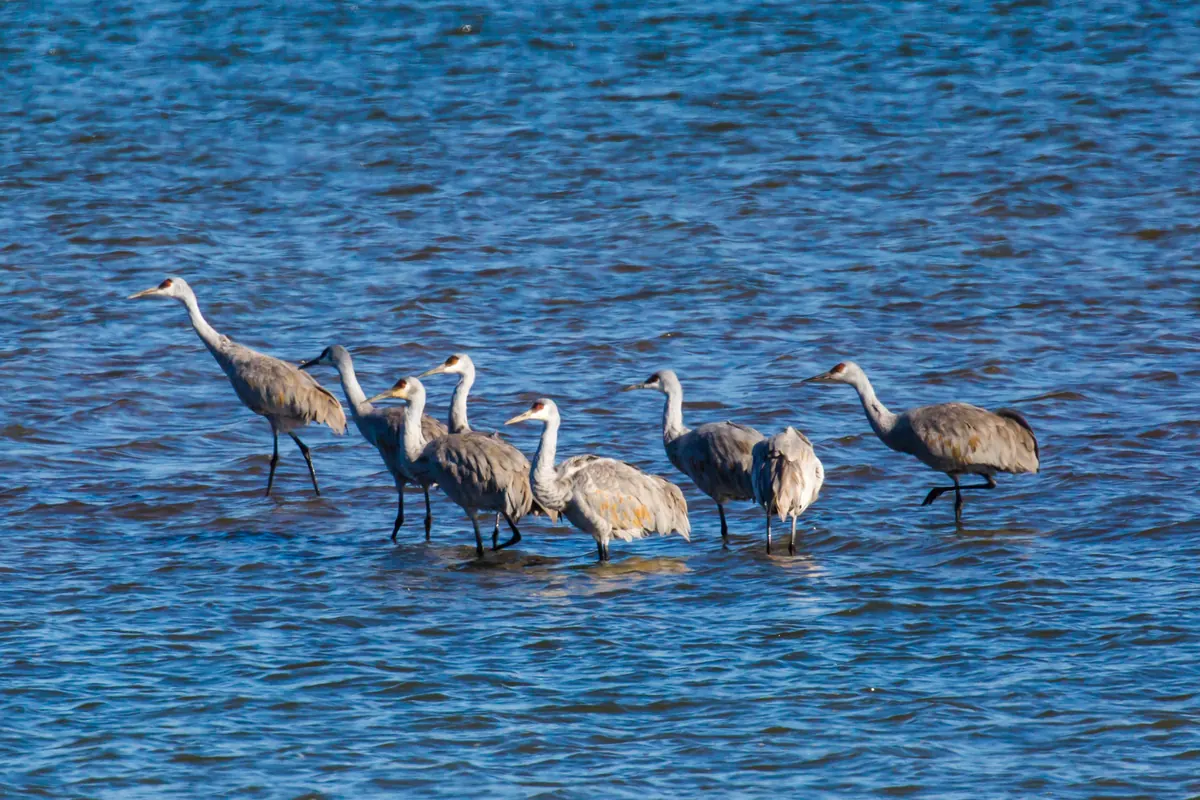
- Cranes on the Hiwassee. Through November the sandhill flock at Hiwassee Wildlife Refuge grows from hundreds toward thousands, and the year-round viewing platform off Priddy Lane near Birchwood is the place to stand. The refuge itself closes to entry on November 15, but the platform does not. Go in the first or last hour of light, when the birds fly between the fields and the river.
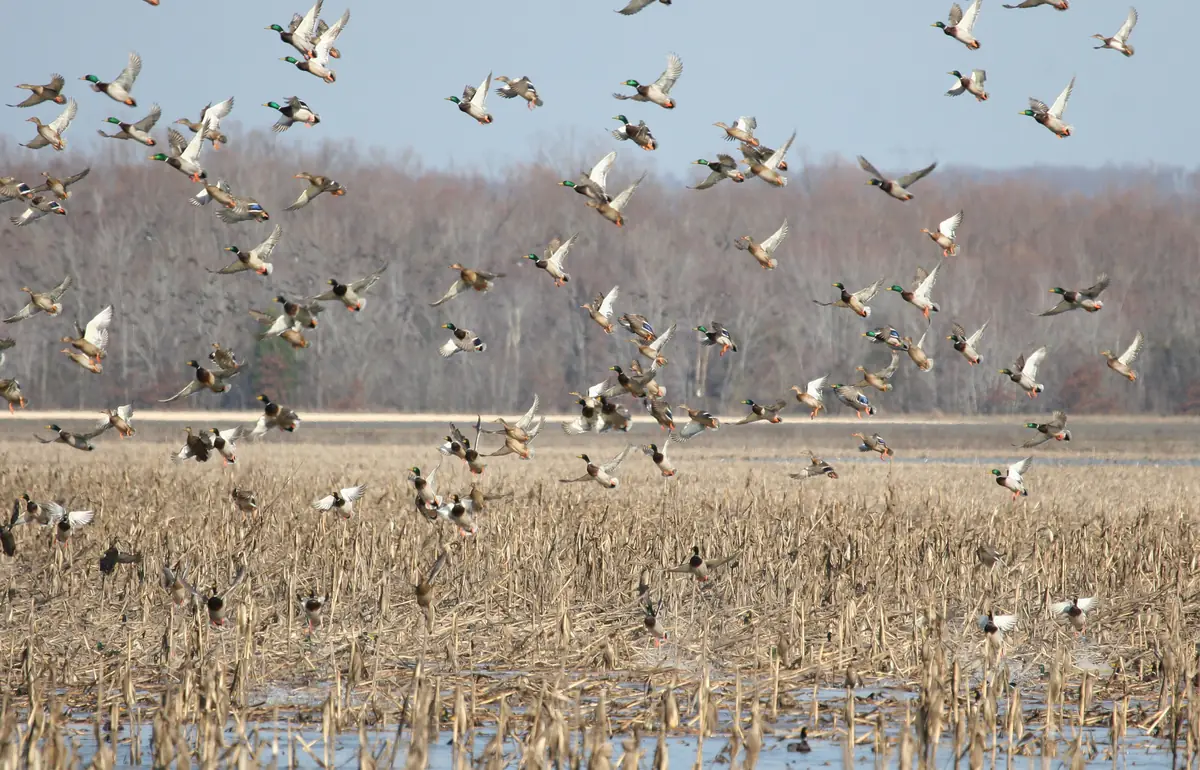
- Ducks and eagles in the west. Reelfoot Lake and the Tennessee National Wildlife Refuge take in the first big waves of mallards, gadwall and wigeon this month, and the bald eagles follow the ducks. Sanctuary areas close on November 15, so drive the Grassy Island Auto Tour at Reelfoot or use the decks and towers that stay open all winter.
- Two planets and a shower before dawn. Mars and Jupiter stand barely a degree apart in the predawn sky on two mornings, November 15 and 16, while dazzling Venus shines below them. Two mornings later, on the 18th, the Leonids are at their best once the half-lit moon has set, around midnight in Nashville and a little before 1 a.m. in Knoxville.
In the Naturalist’s Field Journal, save room for the first sandhill crane flock on the birds-I-have-seen page, a beech or white oak twig still clinging to its brown leaves on a-tree-through-the-seasons, a buck’s rub on a cedar sapling for reading the signs, and a dusk-and-dawn watch from the Hiwassee platform as the cranes come in to roost.
Regions used below: West Tennessee; Middle Tennessee; The Cumberland Plateau; East Tennessee and the Valley; The Smokies and Blue Ridge.
When do the sandhill cranes pile into the Hiwassee Refuge?
November is the build-up month. TWRA’s birding trail says the first cranes reach the Hiwassee in very late October; through November new flocks drop in behind every cold front, and TWRA says the largest concentrations come in January. The agency calls the Hiwassee flock the biggest winter gathering of sandhill cranes anywhere in the Southeast outside Florida, and the state as a whole has averaged more than 29,000 wintering cranes. A second, smaller flock of several thousand uses the Hop-In Refuge and the surrounding farmland near Reelfoot Lake in the northwest corner.
-
The Hiwassee viewing platform
All month; best in the first and last hour of daylight · Off Priddy Lane, north of Birchwood, Meigs County (Eastern time)
From I-75 exit 25 at Cleveland, take Highway 60 north through Birchwood, then follow the signs by way of Shadden Road and Blythe Ferry Road. TWRA shuts the refuge itself on November 15 and keeps it closed through February so the birds can rest, but the observation platform stays open every day of the year. A spotting scope helps a great deal, since the birds feed on the far side of the fields and roost on the river’s sandbars.
-
Look for a white one
November through February · Among the sandhill flocks
TWRA notes that an occasional endangered whooping crane turns up with the sandhills from November on. It is the only white bird in the flock with black wingtips and a red crown, and it stands a head taller. If you see one, keep your distance and report it; there are only a few in the eastern population.
-
Hop-In Refuge near Reelfoot
From late in the month · Obion County, northwest Tennessee (Central time)
TWRA calls this the largest wintering crane flock in West Tennessee. The refuge is closed to all entry from November 1 through February, and the birds scatter across harvested fields, so listen first: the rolling, wooden rattle of a crane carries for a mile or more. Watch from public roads and do not walk into the fields.
The crane hunting season opens on December 3 this year, and the Sandhill Crane Festival returns to Birchwood in January. For now, November is the quiet month to watch the flock grow; note the date and size of the first big group you see, and you will have something to compare against next fall.
Where do ducks and eagles gather in Tennessee in November?
The river bottoms and the big reservoirs. The Fish and Wildlife Service says Reelfoot and Lake Isom refuges start receiving mallards, gadwall, American wigeon and ring-necked ducks in October, with the mallard count capable of reaching about 150,000 by midwinter, and that 100 to 200 bald eagles normally spend the winter around Reelfoot Lake. Farther east, along 65 miles of the Tennessee River, the Tennessee National Wildlife Refuge supports well over 200,000 ducks and geese in most winters; refuge staff fly a survey of the whole refuge about every two weeks from November through March.
-
Reelfoot and Lake Isom refuges
All month; units close to entry November 15 · Near Samburg and Tiptonville, Lake and Obion counties
The refuge’s own calendar marks November as the month when the Grassy Island Auto Tour, the hiking trails and the viewing towers are all open, and the management units close to public entry on the 15th. The two observation towers, one on the auto tour and one at the Long Point entrance, are open all year, as is the tower at Lake Isom. Ask at the visitor center for the self-guided eagle tour packet; the refuge brochure lists guided eagle tours from December on.
-
Tennessee National Wildlife Refuge
Building through the month · Big Sandy, Duck River and Busseltown units, between Paris and Perryville
More than 51,000 acres of flooded corn, moist-soil wetlands and river backwater make this the state’s most important duck refuge. Some areas close as sanctuary from November 15 to March 15, but most refuge roads and trails, and the observation decks and blinds, stay open. The visitor center near Paris keeps weekday and Saturday hours.
-
Cross Creeks and the Cumberland
Sanctuary closure begins November 15 · Stewart County, east of Dover
Cross Creeks National Wildlife Refuge, on the Cumberland River’s Lake Barkley, is the counterpart for ducks and geese on that river. Its sanctuary areas also close mid-month; the roads along the edges are where to watch from afterward.
Waterfowl move with the weather, so the best day is often the first clear morning after a strong cold front. A spotting scope turns a gray smudge into wigeon, gadwall and pintail, and the birds-I-have-seen page has room for every species you can name.
When is the deer rut in Tennessee?
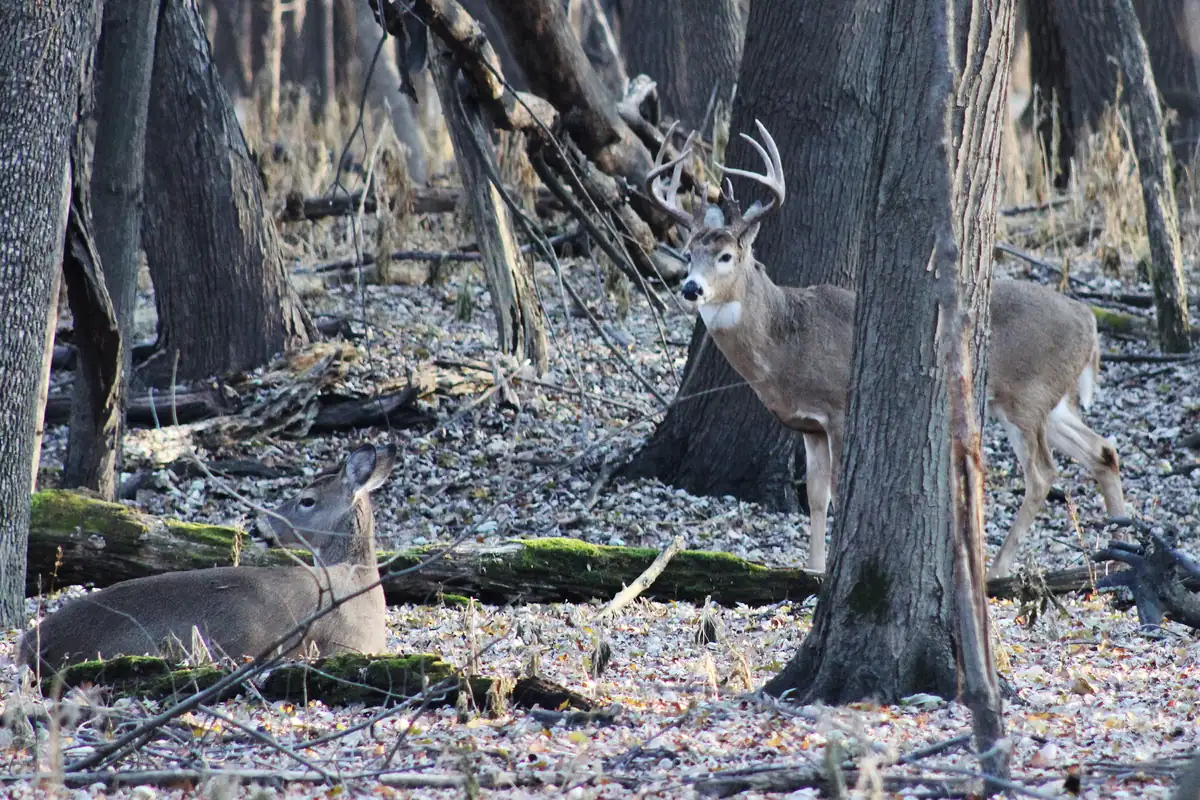
Most of it falls in November. Shortening days set off the breeding season, and through the month bucks shed their caution: they chase does across fields in daylight, tear the bark off saplings and paw scrapes under overhanging branches. TWRA puts the state herd at about 900,000 deer and the gestation period at about 199 days, which is why does bred in mid-November drop their fawns around the start of June.
-
Rubs and scrapes
All month · Field edges, fencerows, creek bottoms
A rub is a sapling, often a cedar or a young pine, stripped raw between the knees and the waist of a person; a scrape is a bare patch of pawed ground, usually under a low limb the buck has chewed and marked. Find a line of rubs and you have found a travel route. Photograph one and sketch it on the reading-the-signs plate.
-
Deer on the road
Dawn and dusk, all month · Rural roads statewide; worst in Montgomery County
The state Department of Safety says November has historically been the worst month for deer-related crashes in Tennessee. In 2024 the state counted 8,036 of them, including 465 with injuries and five fatal crashes. Montgomery County, around Clarksville, led the state; Shelby, Madison and Henderson led West Tennessee, Sumner and Robertson followed in Middle Tennessee, and Hamilton, Sullivan and Washington led the east. The Highway Patrol’s rule: if you see one deer, expect another behind it.
The rut lines up with the busiest part of the hunting calendar; the muzzleloader season opens November 7 and the gun season November 21. See the safety notes before walking on any public hunting land this month.
Which Tennessee trees hold their leaves longest?
The color moves downhill and westward into November. Below 4,000 feet in the Smokies, the park expects the best show between mid-October and early November, and in Middle and West Tennessee the peak usually comes around Halloween with color lingering into the first week of the month. After that, the oaks and beeches are what is left.
-
Beeches and oaks that keep their leaves
November into spring · Young beeches in coves and ravines; white oaks and other oaks on the ridges
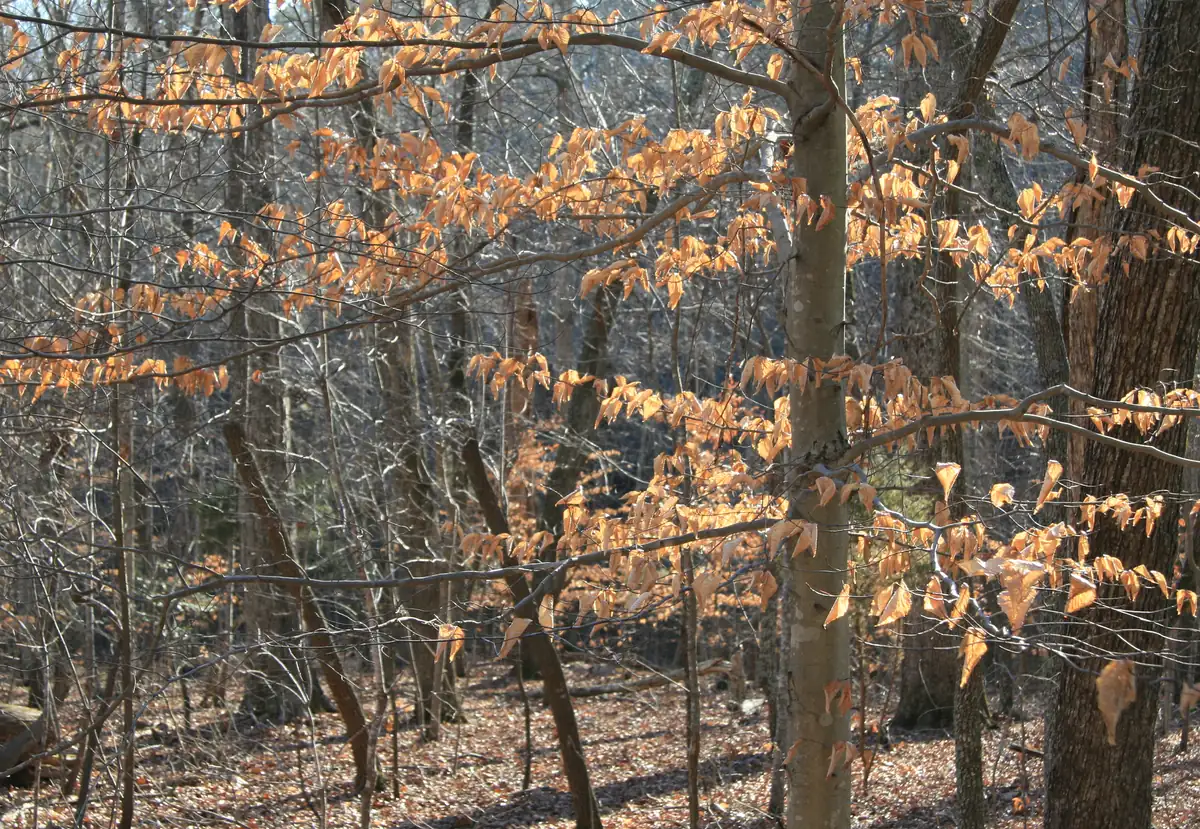
Most broadleaf trees grow a separation layer at the base of each leaf stalk and drop their leaves cleanly. Many young American beeches and some oaks never finish that layer, so the dead leaves hang on, pale tan on the beech and russet on the oaks, until wind or new buds push them off in spring. Botanists call it marcescence. In a bare November woods, the papery beech saplings glow in low light and are easy to spot from a distance.
-
Witch hazel in bloom
Through November · Moist slopes and stream banks
The thread-like yellow flowers open on bare or nearly bare twigs this month. Smell them on a mild afternoon, and look for the woody seed capsules from last year on the same branch; when they dry, they can shoot their seeds several feet.
-
Persimmons after the leaves fall
Fruit hangs into winter · Old fields, fencerows
Once the leaves are down, a fruiting persimmon stands out across a pasture, its branches studded with orange. The soft ones are ripe; check the ground beneath for opossum, raccoon and fox tracks.
Pick one tree near home and record it every week this month on the tree-through-the-seasons page: the date it is half bare, the date it is fully bare, and which leaves hang on.
Which winter birds come to Tennessee feeders in November?
By November the winter crowd is mostly in place. TWRA’s species accounts list golden-crowned kinglets (arriving from early October to mid-April), hermit thrushes (early October to late April, the only brown thrush to expect in winter), fox sparrows (by mid-October, mostly in Middle and West Tennessee), and yellow-bellied sapsuckers, which arrive for the winter and drill neat rows of small holes in yard trees. Dark-eyed juncos, white-throated sparrows and yellow-rumped warblers are already here.
-
Winter finches: a quiet year likely
Any time from November · Feeders with sunflower and nyjer; conifers
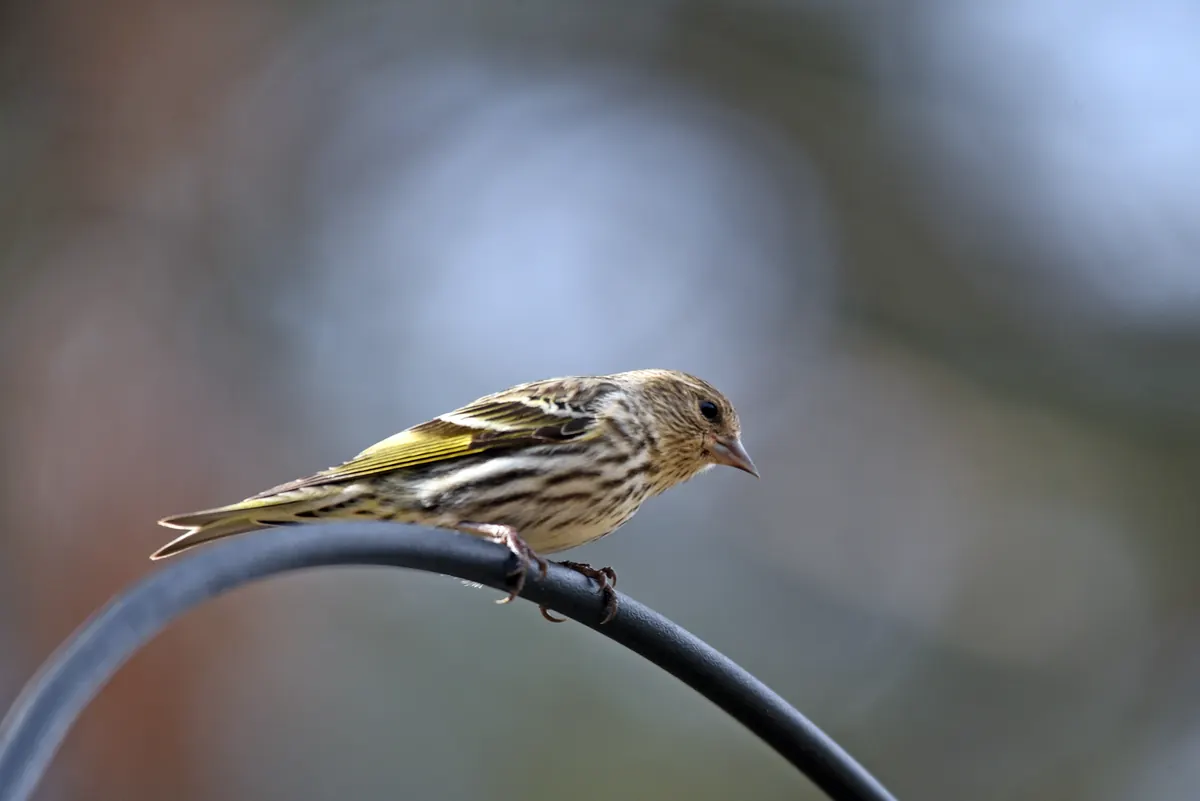
Purple finches and pine siskins are the irruptive northern finches that reach Tennessee, in numbers that swing with the northern cone crop. The Finch Research Network’s 2026–27 forecast, issued in late September, found cones abundant in the Northeast, so it sees no reason for a large flight into the Southeast; it allows a small to moderate siskin flight and at most a late, small purple finch flight. The red-breasted nuthatch nests on the high Smoky Mountain peaks but is expected to stay mostly in the north this winter as well.
-
Project FeederWatch begins
November 1 to April 30 · Your yard or window
Cornell Lab and Birds Canada’s winter count opens on November 1. Families choose a two-day count window each week, note the highest number of each kind seen together at any moment, and report those numbers; a feeder count of three chickadees and a cardinal is just as useful as a rare bird. There is a participation fee.
-
Sapsucker wells
All winter · Maples, hickories, pecans and fruit trees
Look for neat horizontal rows of small square holes in the bark of a yard tree. The sapsucker returns to the same tree to drink the sap and catch insects stuck in it; ruby-crowned kinglets and even wintering warblers visit the wells too.
If you plan to join a Christmas Bird Count this year (December 14 to January 5), November is the time to contact a local compiler through the Tennessee Ornithological Society chapters or Audubon.
How do Tennessee’s bears, bats and trout get ready for winter?
-
Black bears go up a tree to den
Late October to mid-December · The Smokies, Cherokee National Forest, northern Cumberland Plateau
The park says Smokies bears settle into dens from late October to mid-December, and many choose hollow standing trees high above the ground rather than a hole in the earth. It is torpor rather than deep hibernation: a denned bear does not eat or drink for months but can wake and move if disturbed. Pregnant females drag in bedding they chew into small pieces, and the cubs arrive in the den in late winter, around the turn from January to February, at just 8 to 12 ounces. Until they den, bears are still feeding hard on acorns, so keep trash and bird feeders secured in bear country.
-
Bats move into the caves
From October; hibernation runs through the winter · Caves across the Highland Rim, Cumberland Plateau and the Valley
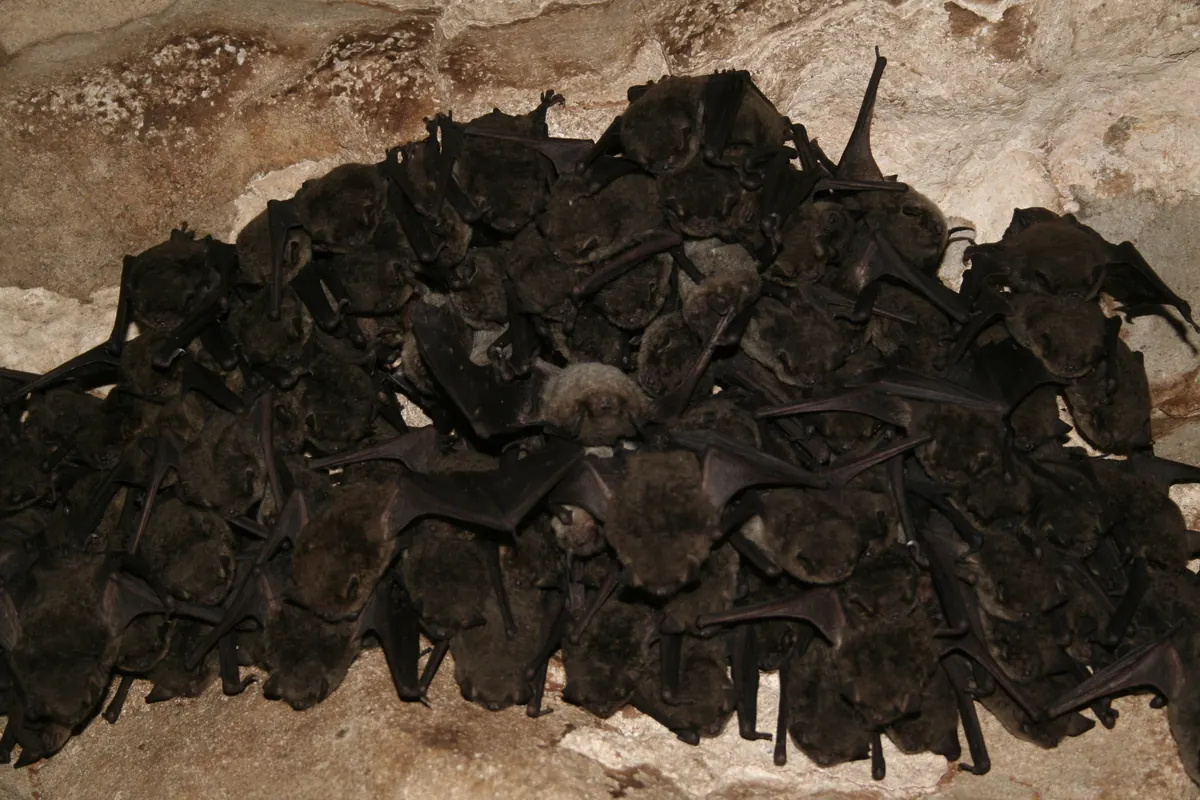
Tennessee has more than 10,000 caves, yet TWRA says most of the state’s endangered gray bats hibernate in only eight of them. Gray bat females mate in fall and enter hibernation soon afterward. TWRA has now confirmed white-nose syndrome, the fungus that rouses hibernating bats and drains their winter fat, in 52 of the state’s 78 cave counties, and the agency keeps its own caves closed to the public. Leave hibernating bats alone, and if you visit any cave, follow the decontamination rules for boots and gear.
-
Brook trout spawning in the mountains
Fall; roughly October to mid-November · High, cold streams in the Smokies
The Southern Appalachian brook trout, the only trout native to the Smokies, spawns in the fall as the days shorten and the water cools. Females sweep out a nest in the gravel, a redd, which shows as a clean, pale patch on the stream bed; how fast the eggs hatch depends on water temperature. The park does not give exact weeks, so use the Shenandoah park’s early October to mid-November as a rough guide, and keep your boots out of gravelly riffles.
The mammal-watch page is for tracks along a muddy creek bank this month; raccoons, opossums and deer are all moving more as they feed for winter.
Has Tennessee had its first freeze by November?
Most of the state usually has. In NOAA’s 1991–2020 normals, the typical first night at or below 32 °F comes before November begins at Crossville (October 20), Bristol (October 24), Knoxville (October 28), and Jackson and Clarksville (October 30). Nashville (November 3), Memphis (November 5) and Chattanooga (November 9) are usually still waiting when the month starts, and in one fall out of ten Memphis goes until November 22 and Chattanooga until November 26 before the first freeze. November’s normal lows range from 34.2 °F at Bristol to 42.9 °F at Memphis.
| Station | One year in ten | Median | Nine years in ten |
|---|---|---|---|
| Memphis | Oct 25 | Nov 5 | Nov 22 |
| Jackson | Oct 18 | Oct 30 | Nov 13 |
| Nashville | Oct 22 | Nov 3 | Nov 18 |
| Clarksville | Oct 17 | Oct 30 | Nov 11 |
| Chattanooga | Oct 27 | Nov 9 | Nov 26 |
| Knoxville | Oct 13 | Oct 28 | Nov 9 |
| Crossville | Oct 8 | Oct 20 | Nov 1 |
| Bristol | Oct 11 | Oct 24 | Nov 4 |
The frost calculator for Tennessee towns gives the freeze odds where you live. Gardeners in Memphis and Chattanooga can usually keep kale, collards and lettuce going under a row cover well into the month; up on the Cumberland Plateau and around Bristol, the season has ended.
How much daylight does Tennessee lose in November?
About three-quarters of an hour, roughly a minute and a half a day, and the clock change on the first morning makes it feel like far more. The switch to standard time happens overnight going into November 1, and by suppertime that day the light is already fading. From November 1 to 30, Chattanooga loses 45 minutes of daylight, Memphis and Crossville 46, Jackson, Nashville and Knoxville 47, and Clarksville and Bristol, the northernmost cities on the list, 48. Remember that the state runs on two clocks: Central from Memphis to Crossville, Eastern from Chattanooga and Knoxville to the Virginia line.
| City | Nov 1 | Nov 30 | Lost | Per day |
|---|---|---|---|---|
| Memphis | 10 h 45 m | 9 h 59 m | 46 min | 1.6 min |
| Jackson | 10 h 43 m | 9 h 56 m | 47 min | 1.6 min |
| Nashville | 10 h 41 m | 9 h 54 m | 47 min | 1.6 min |
| Clarksville | 10 h 40 m | 9 h 52 m | 48 min | 1.7 min |
| Crossville | 10 h 41 m | 9 h 55 m | 46 min | 1.6 min |
| Chattanooga | 10 h 45 m | 10 h 00 m | 45 min | 1.6 min |
| Knoxville | 10 h 42 m | 9 h 55 m | 47 min | 1.6 min |
| Bristol | 10 h 40 m | 9 h 52 m | 48 min | 1.7 min |
The year’s earliest Tennessee sunsets come about two weeks ahead of the solstice, in early December. Our daylight and twilight calculator gives the times for your own street; start afternoon walks early enough to finish while it is still light.
Does Tennessee get tornadoes or snow in November, and what might El Niño do this winter?
November is a transition month with a split personality. NOAA’s 1991–2020 normals put Nashville’s average high at 61.4 °F and low at 39.2 °F, with Bristol cooler (58.7 and 34.2) and Memphis milder (62.6 and 42.9). It is wetter than October across the state: Chattanooga averages 4.80 inches, Memphis 4.69, Nashville 3.86 and Bristol 3.14.
It is also Tennessee’s second severe-weather season. In the Nashville weather office’s long climatology of Middle Tennessee tornadoes, November stands out as a secondary peak with thirty tornadoes, 6 percent of all those recorded, including the outbreak of November 10, 2002, which produced 12 in the region, and an F4 that killed 27 people in Maury County on November 20, 1900. Most Middle Tennessee tornadoes touch down in the late afternoon and evening. On days with a strong cold front, check the local forecast page and keep a way to receive warnings after dark.
Snow is the exception in the cities. The normal November snowfall at Nashville is 0.1 inch; the Nashville weather office puts the average date of the first measurable snow at December 23, although flakes have fallen as early as October 31, 1993. The mountains are another matter. The park lists November normals at Kuwohi of 42 °F for the high, 28 °F for the low and 5 inches of snow, against 61 and 33 at Gatlinburg with under an inch. LeConte Lodge ends its 2026 season on November 24, and the park’s Kuwohi Road and Roaring Fork loop close on November 29.
The winter ahead has an unusual backdrop. Federal forecasters wrote on September 10 that El Niño is strengthening and put the odds above 90 percent that it will be a very strong one by the cold season of 2026–27. NOAA’s climate.gov notes that the typical El Niño signal in the Tennessee Valley is a drier-than-average winter, and NWS Huntsville’s study of south-central Tennessee found moderate events running about three inches drier than neutral winters. Strong events are less predictable: the Nashville office’s review of the very strong 1982–83 episode found that winter 3.6 °F warmer than normal, with only 1.5 inches of snow and a Christmas high of 72 °F. One past winter is not a forecast. For a Tennessee-specific answer, wait for mid-October: on the 15th the government’s forecasters publish their December-to-February temperature and rain maps on this CPC page.
What can you see in Tennessee’s night sky in November?
With the clocks back on standard time, darkness falls early enough for children to stargaze before bedtime. Times below are Central for Memphis, Jackson, Nashville, Clarksville and Crossville, and Eastern for Chattanooga, Knoxville and the Tri-Cities.
-
The Leonid meteor shower
Pre-dawn mornings of November 17 to 19; best on the 18th · Overhead; the radiant in Leo rises late in the evening
No outburst is predicted this year; the International Meteor Organization’s figure is roughly 15 an hour for an observer under ideal dark skies. The first-quarter moon goes down at roughly midnight Central time (closer to 1 a.m. Eastern in Knoxville), and Leo climbs higher until dawn, so set the alarm for the small hours of the 18th rather than staying up in the evening. These meteors are swift, and the brightest leave a short-lived glowing streak.
-
Taurid fireballs around the new moon
Southern branch near November 5; northern branch near November 12 · High in the south and east from mid-evening
The two Taurid streams are dust from Comet Encke. Expect just a few per hour; the reward is their slow pace and the occasional dazzling fireball. Both peaks fall near the November 9 new moon, so moonlight is no problem; for the southern branch, watch before the thin crescent comes up in the early morning hours.
-
Mars and Jupiter side by side
Before dawn on November 15 and 16 · South to southeast, among the stars of Leo
Only 1.2 degrees will separate them, so one binocular view holds both: bright, cream-colored Jupiter and fainter, orange Mars. Venus blazes lower in the east-southeast and grows brighter all month, peaking in brilliance somewhere between November 24 and 27. Mercury can be picked out very low in the east-southeast in morning twilight from roughly the 18th through the 25th. Early on November 2 the moon also sits close to Mars, with Jupiter nearby.
-
The Beaver Moon
Evenings of Monday, November 23 and Tuesday, November 24 · Rising in the east-northeast near sunset
Full moon comes on Tuesday morning, the 24th, which makes the moon look complete on Monday evening and Tuesday evening alike, with Tuesday the nearer of the two. It counts as a modest supermoon, with the moon’s nearest approach about 30 hours after full. Overnight on Monday it drifts past the Pleiades, but its glare washes out the cluster.
-
Saturn alone in the evening
All month after dusk · South to southwest
Saturn holds the evening sky to itself; find it low in the south after dusk, a steady, pale-yellow light in the dim region of Pisces. A small telescope shows the rings. On November 25 Uranus comes to opposition in Taurus, a few degrees from the Pleiades; it is just visible in binoculars from a dark site, but the full moon makes that week a poor time to look.
| Phase | Date | Time |
|---|---|---|
| Last quarter | Sunday, Nov 1 | 2:28 p.m. CST (3:28 p.m. EST) |
| New moon | Monday, Nov 9 | 1:02 a.m. CST (2:02 a.m. EST) |
| First quarter | Tuesday, Nov 17 | 5:48 a.m. CST (6:48 a.m. EST) |
| Full moon, the Beaver Moon | Tuesday, Nov 24 | 8:53 a.m. CST (9:53 a.m. EST) |
| Last quarter | Tuesday, Dec 1 | 12:08 a.m. CST (1:08 a.m. EST) |
Before you go out, check the cloud forecast on our sky and cloud page, and the moon phase calendar tells you when the moon clears the ridges near you.
What can Tennessee families do outdoors in November?
- Count the yard birds from November 1. Sign up for Project FeederWatch, put a feeder where the children can see it from the kitchen, and keep a running list on the birds-I-have-seen plate.
- Band birds and look for owls in Nashville. Warner Park Nature Center lists Fall Migration Bird Banding on Wednesday, November 4 (noon to 4 p.m.) and Tuesday, November 10 (8 a.m. to noon), Searching for Owls of Warner Parks on Friday, November 6 (4:45 to 7 p.m.), Helping Wildlife Through Winter on Saturday, November 7, and Early Winter Birds of Edwin Warner Park on Saturday, November 14. Times are Central; many programs require registration.
- Walk the last color in the state parks. The state parks’ fall calendar has listed a guided afternoon hike on the Island Loop at Pickwick Landing on November 7 and a foliage hike to Three Forks Lake at Savage Gulf on November 8; confirm details and registration with each park before you go.
- Watch the cranes come in. Drive to the Hiwassee platform for the last hour before sunset on a clear afternoon after the 15th, when the refuge is closed and the birds are settled.
- Take an eagle drive at Reelfoot. Pick up the self-guided eagle tour packet at the Reelfoot National Wildlife Refuge visitor center and drive the Grassy Island Auto Tour, stopping at the tower.
- Hike off the turkey on November 27. Tennessee State Parks holds free ranger-led Day After Thanksgiving Hikes on Black Friday, November 27. As of early October the parks had not yet posted the list of locations, so check the state parks’ hikes page later in the month and register.
- Go out for the Leonids. Set an alarm for the early hours of November 18, take blankets to a dark field and count what you see in fifteen minutes.
- Join a community science project. Put a CoCoRaHS rain gauge in the yard (it also measures snow), add your crane, eagle and sapsucker sightings to eBird or iNaturalist, and keep a page in the field journal for the first frost you see on the car windshield.
Once November is done, the rest of the year is waiting on our month-by-month nature guides, and last month’s page is at October in Tennessee.
Safety notes for November in Tennessee
- Hunting seasons and orange. TWRA’s 2026–27 calendar has the young sportsman deer weekend on October 31 and November 1, archery-only deer November 2 to 6, muzzleloader and archery November 7 to 20, then gun hunting from November 21 to January 3. Several bear hunt zones also have seasons open during November; TWRA’s summary lists the zone-by-zone dates. Rabbit and quail open November 7, woodcock runs November 14 to December 6, and the first duck and goose segment is November 28 and 29. TWRA’s rule for big-game hunters is 500 square inches or more of blaze orange or fluorescent pink worn on the head and upper body and showing from both front and back; archery-only and turkey hunts are exempt. Nothing in the rule covers hikers, yet in a wildlife management area or the Cherokee National Forest during November, a blaze-orange hat and vest are simple insurance, and so is an orange collar for the dog.
- Refuge closures. Hiwassee Refuge, the Reelfoot units and the sanctuary areas of the Tennessee and Cross Creeks refuges close on November 15. Stay on the open roads, platforms and towers.
- Burn permits and wildfire. From October 15 to May 15 the Division of Forestry requires a free permit for debris burning, issued only on days when it is safe to burn. Tennessee averages about 1,000 wildfires a year, more than 90 percent of them started by people, and dry leaves under a November wind can carry fire quickly.
- Early dark and cold mountains. By November 30 the sun sets at about 4:33 p.m. in Nashville and 4:48 in Memphis (Central), and about 5:22 in Knoxville and 5:30 in Chattanooga (Eastern). Pack a headlamp. In the Smokies, temperatures at the high elevations can be 10 to 20 degrees colder than in the valley, and snow and ice are possible on high trails; carry layers and traction devices.
- Storms. November cold fronts can carry tornadoes, often after dark. Know where you would shelter at a campsite or cabin.
- Bears and deer. Bears are feeding hard until they den, so keep food and trash locked away. Drivers should ease off in the half-light of morning and evening, switch to high beams on empty roads, and brake for a deer instead of swerving.
Sources
- TWRA: Hiwassee Refuge (crane concentrations, November 15 closure, platform open year-round, whooping cranes, directions)
- TWRA: sandhill crane hunting in Tennessee (2026–27 season, wintering average, Hop-In Refuge)
- TWRA: Tennessee Sandhill Crane Festival
- TWRA Tennessee Birding Trail: Hiwassee Refuge (crane arrival in very late October)
- TWRA: Hop-In Refuge, Obion County (wintering cranes, November 1 closure)
- U.S. Fish and Wildlife Service: Reelfoot and Lake Isom National Wildlife Refuges general brochure, January 2014 (waterfowl, eagles, calendar, closures, towers) (PDF)
- U.S. Fish and Wildlife Service: Reelfoot National Wildlife Refuge (auto tour, towers, self-guided eagle tour packet)
- U.S. Fish and Wildlife Service: Tennessee National Wildlife Refuge
- U.S. Fish and Wildlife Service: Tennessee National Wildlife Refuge, visit us (November 15 – March 15 closures, decks and blinds)
- U.S. Fish and Wildlife Service, Southeast Inventory and Monitoring Branch update, April 2016 (Tennessee NWR waterfowl surveys) (PDF)
- U.S. Fish and Wildlife Service: Cross Creeks National Wildlife Refuge
- TWRA: white-tailed deer in Tennessee (herd size, gestation)
- Tennessee Department of Safety and Homeland Security: It’s “Deer Season” on Tennessee roads, too (November 13, 2025)
- National Park Service: fall colors in Great Smoky Mountains National Park
- Tennessee State Parks: where and when to view fall colors
- International Oak Society, reprinted from The Morton Arboretum: When oak leaves fail to fall (marcescence)
- UT Gardens: versatile witchhazels feature fall and winter blooms
- USDA NRCS plant guide: common persimmon (PDF)
- TWRA: golden-crowned kinglet
- TWRA: hermit thrush
- TWRA: fox sparrow
- TWRA: yellow-bellied sapsucker
- TWRA: pine siskin
- TWRA: purple finch
- TWRA: red-breasted nuthatch
- Finch Research Network: Winter Finch Forecast 2026–2027
- Project FeederWatch: how to participate (season November 1 – April 30)
- National Audubon Society: Christmas Bird Count
- Tennessee Ornithological Society
- National Park Service: black bears in the Smokies (denning, torpor, cubs)
- TWRA: gray bat
- TWRA: white-nose syndrome monitoring in bats
- National Park Service: Southern Appalachian brook trout eggs (Great Smoky Mountains)
- National Park Service: brook trout (Shenandoah National Park; spawning early October to mid-November)
- NOAA NCEI: U.S. climate normals 1991–2020 (first-freeze probabilities, as used on the site’s Tennessee frost pages)
- NOAA NCEI: 1991–2020 monthly normals for Memphis, Nashville, Chattanooga and Bristol (data API)
- NWS Nashville: Nashville climate records (first measurable snow, normal snowfall)
- NWS Nashville: tornado climatology of Middle Tennessee
- NWS Nashville: El Niño and Nashville’s winter of 1982–83
- NWS Huntsville: El Niño winter precipitation impacts, Tennessee climate division 3
- NOAA climate.gov ENSO blog: United States El Niño impacts
- Climate Prediction Center: ENSO diagnostic discussion, September 10, 2026
- Climate Prediction Center: 90-day outlooks
- National Park Service: weather in Great Smoky Mountains National Park (monthly normals for Gatlinburg and Kuwohi)
- National Park Service: seasonal road closures, Great Smoky Mountains (2026 dates)
- LeConte Lodge: trail and weather information (2026 season March 23 – November 24)
- U.S. Naval Observatory: moon phases (data API)
- U.S. Naval Observatory: moonrise and moonset, Nashville (November 17) and Knoxville (November 18), 2026
- International Meteor Organization: 2026 meteor shower calendar (PDF, archived copy)
- EarthSky: what is a supermoon (2026 full supermoons)
- EarthSky: best stargazing of 2026 (Mars and Jupiter, November 16)
- EarthSky: Uranus at opposition
- Metro Nashville Parks: Warner Park Nature Center (November 2026 programs)
- Tennessee State Parks: fall happenings
- Tennessee State Parks: After-Thanksgiving Hikes
- Tennessee State Parks: event registration
- CoCoRaHS: community rain, hail and snow network
- TWRA: 2026–27 hunting and trapping season dates
- TWRA: deer hunting, 2026–27 season dates
- TWRA: big game hunting, fluorescent orange or pink requirement
- Tennessee Department of Agriculture: fire prevention efforts critical in Tennessee’s coming wildfire season (October 9, 2025)
- Photos via Wikimedia Commons; licenses and photographers are credited under each picture
