What to look for in nature in Tennessee this October
For most of Tennessee, October is the driest month of the year. The color works its way down the mountains week by week, bull elk bugle across the Cumberland coalfields, and by Halloween the first sandhill cranes are circling over the Hiwassee. This guide goes region by region and gives every time in both of the state’s clocks.
Start here
- Elk bugling. Tennessee’s own herd rounds up its harems on the North Cumberland Wildlife Management Area, and the Hatfield Knob viewing tower in Campbell County is built for watching it. TWRA puts peak bugling in late September and early October with a second peak in mid-October, loudest from 7 to 9 in the morning and 6 to 8 in the evening. In the Smokies, the Cataloochee rut runs into late October.
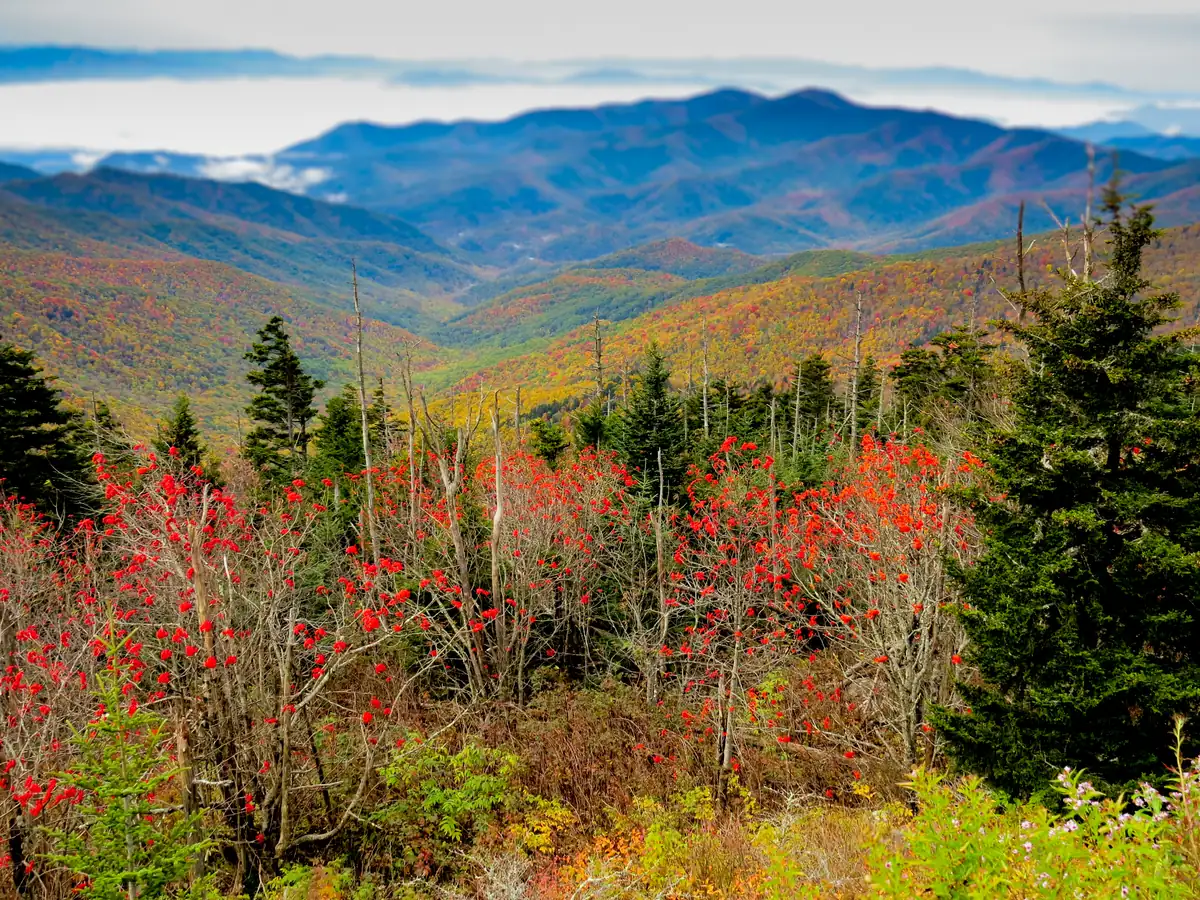
- Color coming down the mountain. Above 4,000 feet the Smokies color early to mid-October; below that, mid-October into early November. East Tennessee peaks around the third week, the plateau in late October, and Middle and West Tennessee by Halloween. The exact week is never certain, so treat these as windows.
- The Moon hides Jupiter, then the Hunter’s Moon. Before dawn on Tuesday, October 6, the waning crescent covers Jupiter and uncovers it an hour later, low in the east, and Tennessee sees both ends of it. The Orionids are best in the dark hours after moonset on the 21st and 22nd, and the full Hunter’s Moon rises around sunset on Sunday, October 25.
For the notebook: the Naturalist’s Field Journal includes a map-of-sounds plate for a dawn of bugling elk or a sky full of crane calls, a tree-through-the-seasons page for the maple you pass every day, and a seeds, pods and cones plate for the acorn and hickory count under one tree. One observation at a time.
Regions used below: West Tennessee; Middle Tennessee; The Cumberland Plateau; East Tennessee and the Valley; The Smokies and Blue Ridge.
When do the leaves change in Tennessee?
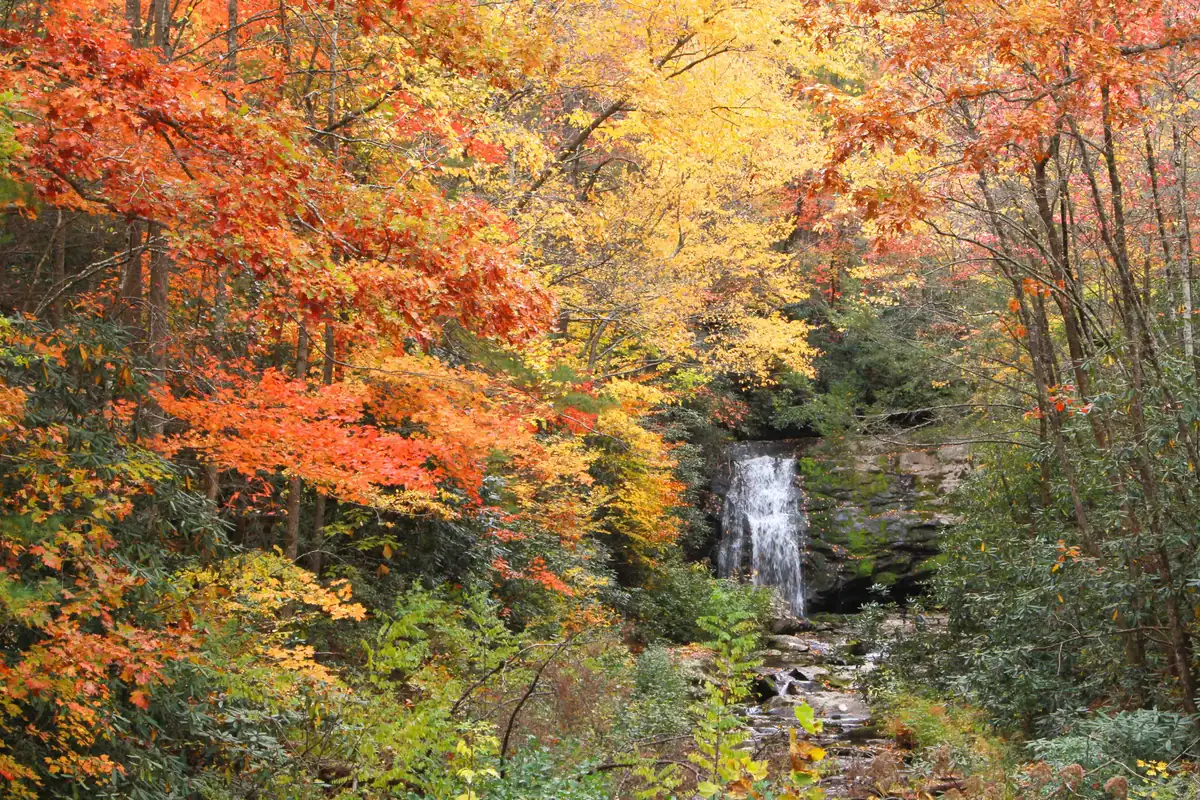
Tennessee’s color season is long because the state climbs more than 6,000 feet from the Mississippi bottoms to Kuwohi. Great Smoky Mountains National Park says that above 4,000 feet “color changes can begin as early as mid-September” in the yellow birch, American beech, mountain maple, hobblebush and pin cherry, and that the high country typically develops through early and mid-October; below 4,000 feet the big show of sugar maple, scarlet oak, sweetgum, red maple, yellow poplar and hickories comes “between mid-October and early November.” Tennessee State Parks gives the rule for the rest of the state: leaves in East Tennessee “begin to change color in early October and peak around the third week of the month,” while in Middle and West Tennessee “color change begins in mid-October and peaks by Halloween,” and most trees are bare by Thanksgiving.
| Where | Typical window | What is turning |
|---|---|---|
| Smokies high country above 4,000 ft: Kuwohi, Newfound Gap, the Roan Highlands | Starts mid-Sept; early to mid-Oct | Yellow birch, beech, mountain maple, hobblebush, pin cherry |
| Smokies mid and low slopes: Cades Cove, Little River Road, Cataloochee | Mid-Oct to early Nov | Sugar maple, scarlet oak, sweetgum, red maple, yellow poplar, hickories |
| East Tennessee and the Valley: Rocky Fork, Roan Mountain, Norris Dam, Seven Islands | Starts early Oct; peak about the third week | Maples, oaks and hickories on the ridges; the parks suggest mid-October for Roan and Rocky Fork |
| Cumberland Plateau: Fall Creek Falls, Savage Gulf, Cumberland Mountain, Big South Fork | Late Oct | Oaks and hickories on the tableland, maples in the gorges |
| Middle Tennessee: Radnor Lake, Montgomery Bell, the Harpeth, Bledsoe Creek | Starts mid-Oct; peak by Halloween, into early Nov | Maples, hickories and oaks; sweetgum along the rivers |
| West Tennessee: Reelfoot Lake, Meeman-Shelby Forest, Chickasaw, the Hatchie bottoms | Starts mid-Oct; peak by Halloween, into early Nov | Bald cypress turning rust at Reelfoot; sweetgum, oaks and hickories in the bottoms |
October is “the busiest month of the year in the Smokies,” the park warns; go midweek, or start at dawn. Heintooga Ridge Road closes for the season on October 31, Rich Mountain and Parson Branch roads on November 9, and Kuwohi Road (the former Clingmans Dome Road) and the Roaring Fork Motor Nature Trail stay open through November 29. For leaf-out and leaf-drop timing measured by satellite at your own address, open the Field almanac.
Where can you hear elk bugle in Tennessee?
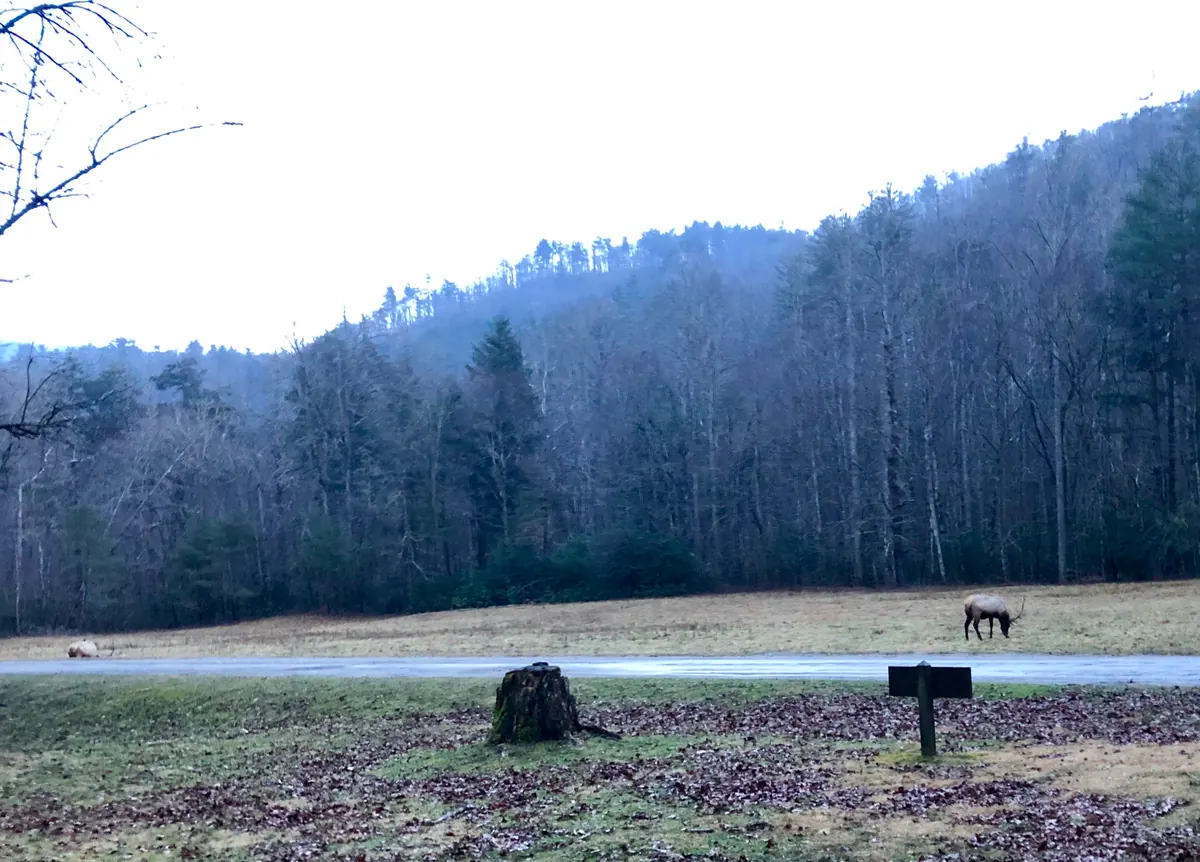
Tennessee has had elk again since December 2000, when the first of 201 animals, released over eight years, arrived in the northern Cumberlands. The herd’s front porch is the Hatfield Knob viewing tower on the Sundquist Unit of the North Cumberland Wildlife Management Area, rebuilt in 2022 so that it is accessible, with a live elk camera for everyone else. TWRA finds that “overall peak bugling occurs from late September to early October, with an additional peak in the middle of October,” loudest “7:00–9:00 a.m. and 6:00–8:00 p.m.”
-
Hatfield Knob, North Cumberland WMA
Dawn and dusk; peaks late Sept – early Oct and again mid-Oct · Sundquist Unit, Campbell County (Central time)
Sit on the tower at first light and let the sound find you before the animals do; a bugle starts low, climbs to a whistle and ends in grunts. The state’s elk hunts run in the area from September 26 to October 16 (nineteen permits in all), so wear bright orange on the walk in and keep to the tower and the road.
-
Cataloochee and Oconaluftee
Rut into late October; early morning and late evening · North Carolina side of the Smokies (Eastern time)
The park says “from early September to late-October, elk gather in mixed herds for their mating season,” and dominant bulls hold harems of up to 20 cows. The fields at Cataloochee and Oconaluftee are closed to all visitors during the rut, and approaching within 50 yards (150 feet) is illegal. Rangers suggest early morning or late evening, and ask you to stay beside your vehicle when elk are near the road. About 270 elk live in western North Carolina, descended from 52 animals released in 2001 and 2002.
If an elk walks toward you, the park’s advice is to “slowly back away.” Bring binoculars.
When do sandhill cranes arrive at the Hiwassee Refuge?
Late in the month, if the north wind cooperates. TWRA’s birding-trail account says the cranes “begin arriving in very late October and are present into winter and depart usually by early to mid-March,” and its festival page puts the viewing season “from mid-October through February (sometimes into March).” Read those together as first birds from mid-to-late October, most in November, and a December-to-January peak. TWRA says up to 20,000 sandhills return to the area each year, and Tennessee as a whole “has wintered an average of over 29,000 cranes.” A few thousand more winter at the Hop-in Refuge near Reelfoot Lake. Whooping cranes turn up with them, mostly from mid-November to February.
The refuge itself closes from November 15 to the last day of February, but the observation platform is open all year; it is off Highway 60 north of Birchwood, by way of Shadden Road, Blythe Ferry Road and Priddy Lane. The Sandhill Crane Festival is held in Birchwood each January (January 17–18 in 2026; the 2027 dates were not posted when this page was written), and the state’s crane hunting season runs December 3 to January 31, with the Southeast Crane Zone closed January 15–17.
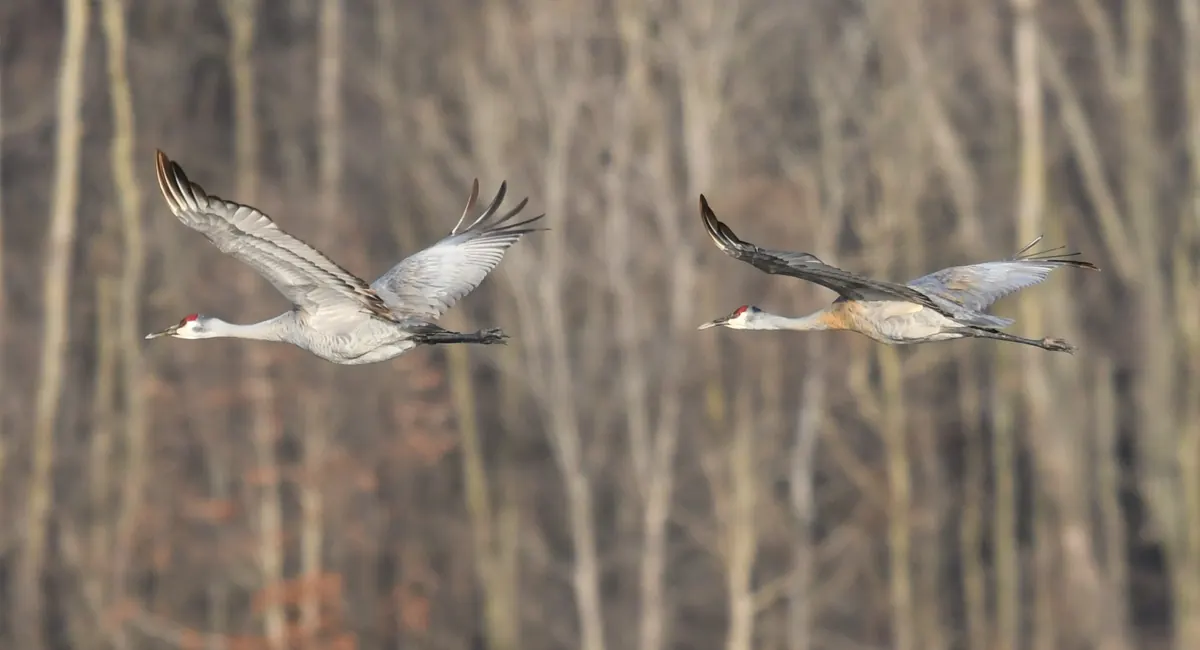
The call gives them away before the shape does: a rolling, rattling bugle from birds far overhead. From the third week on, look up on any clear afternoon after a cold front.
What other birds arrive, leave or pass through in October?
October is the changeover month: the summer birds that eat flying insects leave, the winter sparrows and warblers arrive, and the two groups overlap early in the month.
-
Hawks over Walden’s Ridge
September and early October best; more mid-Oct and into Nov · Soddy Mountain hawk watch, Highway 111 above Soddy-Daisy
The only Tennessee lookout ever counted through full spring and fall seasons sits on a 75-foot bluff on the eastern face of Walden’s Ridge above Highway 111, reached by driving about 20 miles up Highway 27 from Chattanooga. Its five commonest fall birds are broad-winged hawk, turkey vulture, red-tailed hawk, sharp-shinned hawk and black vulture, and the counters say “Fall (Sept and early Oct) is best.” Later in the month, expect fewer broad-wings and more sharp-shins, red-tails and vultures, best on a northwest wind behind a front.
-
Monarchs
Peak passage about Sept 20 – Oct 6; stragglers to mid-October · Statewide; goldenrod fields, ridgelines, roost trees at dusk
Monarch Watch’s latitude windows put the peak from September 24 to October 6 along 35° N, the line through Memphis and Chattanooga, and from September 19 to October 1 at 37° N, just over the Kentucky border; Nashville and Knoxville sit in between. After the first week of October the main flight is south of the state, though single butterflies drift through on warm afternoons. Report roosts and sightings to Journey North, or tag a few with a Monarch Watch kit.
-
Hummingbirds and the feeder
Most gone by early October · Yards and gardens
TWRA calls the ruby-throat a summer inhabitant “from mid-April to early October,” after which it flies nonstop across the Gulf, nearly 500 miles in 18 to 20 hours. Keep the feeder clean and up for a few weeks after your last bird; a western stray may find it. Write down the date of your last ruby-throat; it is a small piece of real data.
-
Ducks and eagles on the big waters
Eagles from late October; ducks building through November · Reelfoot Lake, Tennessee NWR, Cross Creeks NWR, the Hatchie
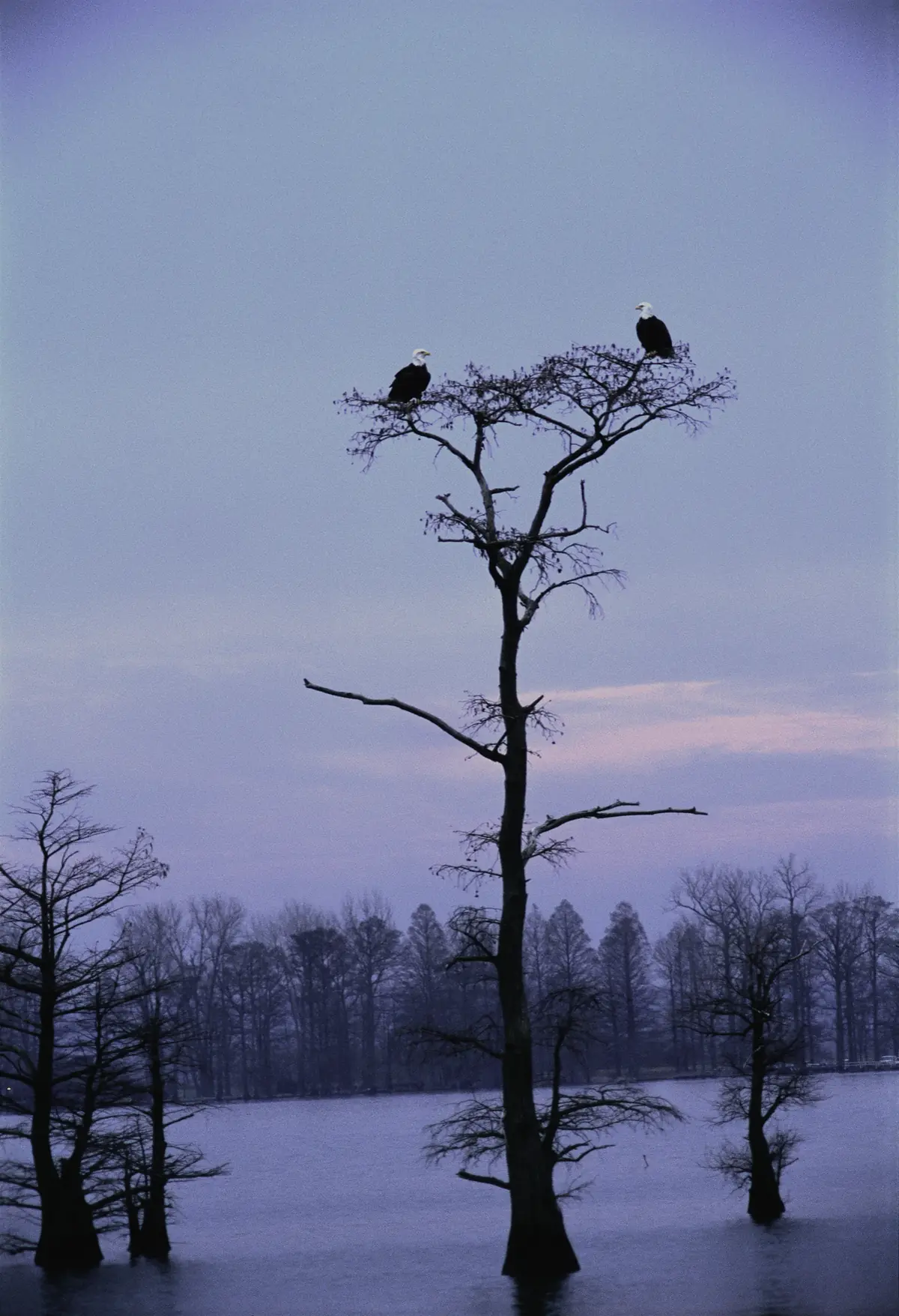
Northern bald eagles “migrate to Tennessee for the winter, arriving in late October,” with peak numbers from late January to mid-February at Reelfoot, Dale Hollow, Kentucky, Chickamauga, Watts Bar and Pickwick lakes; Reelfoot Lake State Park counts more than 200 wintering there. The ducks trickle in behind them, building through November toward a midwinter peak. Cross Creeks and parts of Tennessee National Wildlife Refuge close as waterfowl sanctuary from November 15 to March 15, so October is the month to walk them; Hatchie NWR, bottomland hardwood along 23 miles of the Hatchie River in Haywood County, is the quiet alternative.
| Bird | In October | Tennessee dates |
|---|---|---|
| Ruby-throated hummingbird | Leaving | Summer resident from mid-April to early October |
| Chimney swift | Leaving | Late March to mid-October; dusk roost flocks on the way out |
| Yellow-rumped warbler | Arriving | Late September to mid-May |
| Ruby-crowned kinglet | Arriving | Late September to early May |
| White-throated sparrow | Arriving | Early October to mid-May; the most abundant wintering sparrow |
| Dark-eyed junco | Arriving | Early October to mid-April; year-round above 4,000 ft in the east |
| Bald eagle (northern migrants) | Arriving | Late October; peak numbers late January to mid-February |
| Sandhill crane | Arriving | Mid-to-late October; most in November; gone by mid-March |
Inland, migration is a steady turnover, and the morning after a cold front is the morning to go out. The journal’s birds-I-have-seen plate is for the first junco.
When is the first freeze in Tennessee?
This month on the plateau and in the northeast; usually not until November in Memphis and Chattanooga. The median first 32 °F night is October 20 at Crossville, October 24 at Bristol, October 28 at Knoxville, October 30 at Jackson and Clarksville, November 3 at Nashville, November 5 at Memphis and November 9 at Chattanooga, and in one year in ten Crossville has already frozen by October 8. October’s normal highs are still in the low to mid 70s in the cities (66 at Crossville), with normal lows near 50 and in the mid 40s at Bristol and on the plateau, so one clear, calm night behind a front can do it.
| Station | One year in ten | Median | Nine years in ten |
|---|---|---|---|
| Memphis | Oct 25 | Nov 5 | Nov 22 |
| Jackson | Oct 18 | Oct 30 | Nov 13 |
| Nashville | Oct 22 | Nov 3 | Nov 18 |
| Clarksville | Oct 17 | Oct 30 | Nov 11 |
| Chattanooga | Oct 27 | Nov 9 | Nov 26 |
| Knoxville | Oct 13 | Oct 28 | Nov 9 |
| Crossville | Oct 8 | Oct 20 | Nov 1 |
| Bristol | Oct 11 | Oct 24 | Nov 4 |
Look up your own town’s odds on the first and last frost dates for Tennessee. Up on the plateau and in the northeast corner, this is when the potted plants come inside and the first frosty morning goes in the journal; around Memphis, Nashville and Chattanooga, it is still time to sow lettuce, kale and other cool-season crops.
How fast are Tennessee’s days getting shorter?
A little more than an hour, about two minutes a day, and nearly the same everywhere because the state is so close to a single line of latitude. Sunrise in Nashville slips from about 6:42 to 7:09 a.m. and sunset from 6:31 to 5:52 p.m. across the month; Knoxville, on Eastern time, goes from about 7:31 to 7:57 a.m. and 7:19 to 6:41 p.m.; Memphis from 6:55 to 7:21 a.m. and 6:44 to 6:07 p.m. The state has two clocks: Central time in Memphis, Jackson, Nashville, Clarksville and Crossville, Eastern time from the edge of the plateau east through Chattanooga, Knoxville and Bristol. Daylight saving time ends at 2:00 a.m. on Sunday, November 1, and the evenings get an hour darker overnight.
| City | Oct 1 | Oct 31 | Lost | Per day |
|---|---|---|---|---|
| Memphis | 11 h 49 m | 10 h 46 m | 63 min | 2.1 min |
| Jackson | 11 h 49 m | 10 h 45 m | 64 min | 2.1 min |
| Nashville | 11 h 49 m | 10 h 43 m | 66 min | 2.2 min |
| Clarksville | 11 h 48 m | 10 h 42 m | 66 min | 2.2 min |
| Chattanooga | 11 h 49 m | 10 h 47 m | 62 min | 2.1 min |
| Knoxville | 11 h 48 m | 10 h 44 m | 64 min | 2.1 min |
| Crossville | 11 h 49 m | 10 h 43 m | 66 min | 2.2 min |
| Bristol | 11 h 48 m | 10 h 42 m | 66 min | 2.2 min |
For your own sunrise, sunset and twilight, and how many minutes you are losing this week, enter your location in the Field almanac.
Is October dry in Tennessee, and what will El Niño bring?
It is the driest month of the year for most of the state. In the 1991–2020 normals, October ranks last at Nashville (3.36 in), Chattanooga (3.59), Crossville (3.68), Knoxville (2.81) and Bristol (2.52), and the Morristown weather office says the same for its whole area: “March is the wettest month of the year across the HSA while October is the driest month.” West Tennessee is the exception; Memphis (3.98) and Jackson (3.63) have their driest weeks in August and September, and October rain picks back up a little. Flash flooding peaks in July, but a stalled front or the remains of a Gulf storm can still put a creek over a road in October.
Tennessee has a second severe-weather season, and it is coming. NWS Nashville’s climatology of Middle Tennessee tornadoes from 1830 to 2003 finds two-thirds of them in March, April and May, September the quietest month with only four, and “a secondary peak in activity is centered around November, during which thirty tornadoes (6% of all events) have struck, including a significant outbreak in 2002.” October sits between the two; check the Weather now page when a strong front is coming, and have a way to get warnings at night.
The bigger question is the winter. The Climate Prediction Center’s September 10 discussion says El Niño is strengthening, with better than 90 percent odds that it becomes a very strong event through fall and winter 2026–27. Tennessee sits on the northern edge of El Niño’s signature; the wet, stormy subtropical jet runs along the Gulf Coast. NWS Huntsville’s studies of south-central Tennessee found moderate El Niño winters a little more than 3 inches drier and more than 2 °F cooler than neutral ones, and WSMV in Nashville says El Niño winters “tend to favor cooler and drier conditions” in Middle Tennessee. The very strong events are less tidy: 1982–83 and 1997–98 were quiet, but 2015–16 brought a December tornado outbreak and eight inches of snow at the Nashville airport in January. October itself is only weakly affected. NOAA publishes its official winter outlook on October 15, and we will explain what it means for Tennessee once it is out.
What can you see in Tennessee’s night sky in October?
Every time below carries its zone. The same full moon falls on Sunday night in Nashville and just after midnight on Monday in Knoxville.
-
The Moon hides Jupiter
Before dawn, Tuesday, October 6 · Low in the east; you need a flat horizon
The thin waning crescent rises with Jupiter beside it and then covers it. Jupiter disappears behind the bright edge at about 3:16 a.m. CDT in Memphis, Jackson and Nashville (4:16 a.m. EDT in Chattanooga, 4:17 in Knoxville) with the moon only 5 to 10 degrees up, and reappears from the dark edge at about 4:15 a.m. CDT in Memphis and Jackson and 4:17 in Nashville (5:17 a.m. EDT in Chattanooga, 5:18 in Knoxville), by then 17 to 23 degrees high. Both the disappearance and the reappearance happen in a dark sky across the state. Binoculars show it well.
-
Saturn all night
At opposition Oct 4; near the Moon Oct 23–24 · Rising in the east at sunset
On October 4 Saturn reaches opposition, its nearest and brightest of 2026. It comes up in the east around sunset, stays up until dawn, and outshines every star in its faint corner of sky near the Pisces–Cetus border.
-
Draconid meteors
Evening of Thursday, October 8 · Look north after dark
Expect only five to ten slow meteors an hour at best. Unlike most showers it is an early-evening event, and the new moon two days later means a dark sky, so children can watch before bedtime.
-
Orionid meteors
Pre-dawn, October 21 and 22 · Anywhere dark; face southeast
The shower runs October 2 through November 7 and peaks broadly on the 21st and 22nd, usually at 10 to 20 meteors an hour under dark skies. In Nashville the waxing gibbous moon sets at about 2:08 a.m. CDT on the 21st and 3:10 a.m. on the 22nd, leaving a dark window until twilight at about 6:35 a.m.; in Knoxville it sets at 2:56 and 3:58 a.m. EDT with twilight about 7:22 a.m. By the 23rd the moon is up past 4 a.m. and the window shrinks.
-
The Hunter’s Moon
Sunday, October 25, rising about half an hour before sunset · Everywhere; find a low eastern horizon
The full moon after the Harvest Moon. It rises at about 5:27 p.m. CDT in Nashville, half an hour before sunset, and at 6:15 p.m. EDT in Knoxville, and comes up again a little later on the 26th. It is not a supermoon by the strict perigee definition.
-
Venus drops out; Jupiter and Mars rule the dawn
Venus only in the first days; Jupiter and Mars before dawn all month · West at dusk; east at dawn
Catch Venus in the first few evenings of the month, very low in the west after sunset; it sinks into the glare and crosses between the sun and Earth on October 23. The morning sky belongs to Jupiter, high in the east before sunrise, with Mars above it; on the morning of the 11th Mars passes the Beehive cluster, a pretty sight in binoculars.
-
Star programs in the state parks
October 10 and 16 · Harrison Bay and Montgomery Bell
Both fall in dark-moon windows: Harrison Bay State Park near Chattanooga leads a “Signs in the Stars” night hike on Saturday, October 10, 10 to 11 p.m. EDT, the night of the new moon, and Montgomery Bell State Park west of Nashville holds a star viewing on Friday, October 16, 7 to 10 p.m. CDT. Check the park calendar for registration.
| Phase | Central (Nashville, Memphis) | Eastern (Knoxville, Chattanooga) |
|---|---|---|
| Last quarter | Saturday, Oct 3, 8:25 a.m. CDT | Saturday, Oct 3, 9:25 a.m. EDT |
| New moon | Saturday, Oct 10, 10:50 a.m. CDT | Saturday, Oct 10, 11:50 a.m. EDT |
| First quarter | Sunday, Oct 18, 11:12 a.m. CDT | Sunday, Oct 18, 12:12 p.m. EDT |
| Full moon, the Hunter’s Moon | Sunday, Oct 25, 11:12 p.m. CDT | Monday, Oct 26, 12:12 a.m. EDT (looks full the evenings of Oct 25 and 26) |
| Last quarter | Sunday, Nov 1, 2:28 p.m. CST | Sunday, Nov 1, 3:28 p.m. EST |
Before you set an alarm, see whether clouds will get in the way on Today’s sky, and look up local moonrise and moonset on the moon phases page.
What is blooming, ripening and dropping?
-
Goldenrod and the asters
Through October; asters to the first hard frost · Roadsides, old fields, cedar glades, creek banks
UT Gardens puts it simply: goldenrod “blooms between late summer and fall providing a much-needed source of late season nectar,” and it does not cause hay fever; its pollen “is too heavy to be carried in the wind,” and the culprit is ragweed, blooming at the same time. Its fall companions are the field list too: aromatic aster, New England aster, ironweed, Joe-Pye weed and beautyberry. The pollinator-watch plate is for a goldenrod head on a warm afternoon; count what lands in ten minutes.
-
Witch hazel
October to December · Moist woods and streambanks; UT Gardens at Knoxville, Crossville and Jackson
The last native shrub to flower. American witch hazel opens its ragged yellow, fragrant blooms “October to December,” often on the same branch as its golden fall leaves.
-
Persimmons and pawpaws
Persimmons ripen September to November; pawpaws mostly done by mid-October · Field edges, fencerows, old homesites; pawpaws in rich bottomland shade
The USDA plant guide says the common persimmon “fruits in September–November,” with “highly astringent pulp before ripening, turning yellowish-orange to reddish-orange and sweet in the fall.” A ripe one is soft, frost or no frost, and the fruit can hang on the bare tree “unaffected by freezing temperatures.” Look for deer, fox and raccoon tracks beneath a loaded tree. Pawpaws ripen “in late summer to early fall” and drop when soft; check under them early in the month, before the raccoons do.
-
Acorns and hickory nuts
White oak acorns September to November; shagbark hickory in October · Every oak-hickory ridge in the state
This is the crop the whole forest waits for. White oak acorns “appear from September–November” and feed woodpeckers, blue jays, turkeys, deer, squirrels and bears; shagbark hickory nuts split their husks and drop in October for squirrels, chipmunks and bears. A heavy year keeps the bears on the ridges and the deer in the woods; a poor one sends both into yards and onto roads. Count the acorns in one square yard under one tree, write it in the seeds-pods-and-cones plate, and do it again next year.
What are the salamanders, bears, deer and snakes doing?
-
Marbled salamanders nesting in dry pond beds
October into November; eggs hatch when winter rains flood the nest · Dried beds of woodland pools, statewide except the far northeast
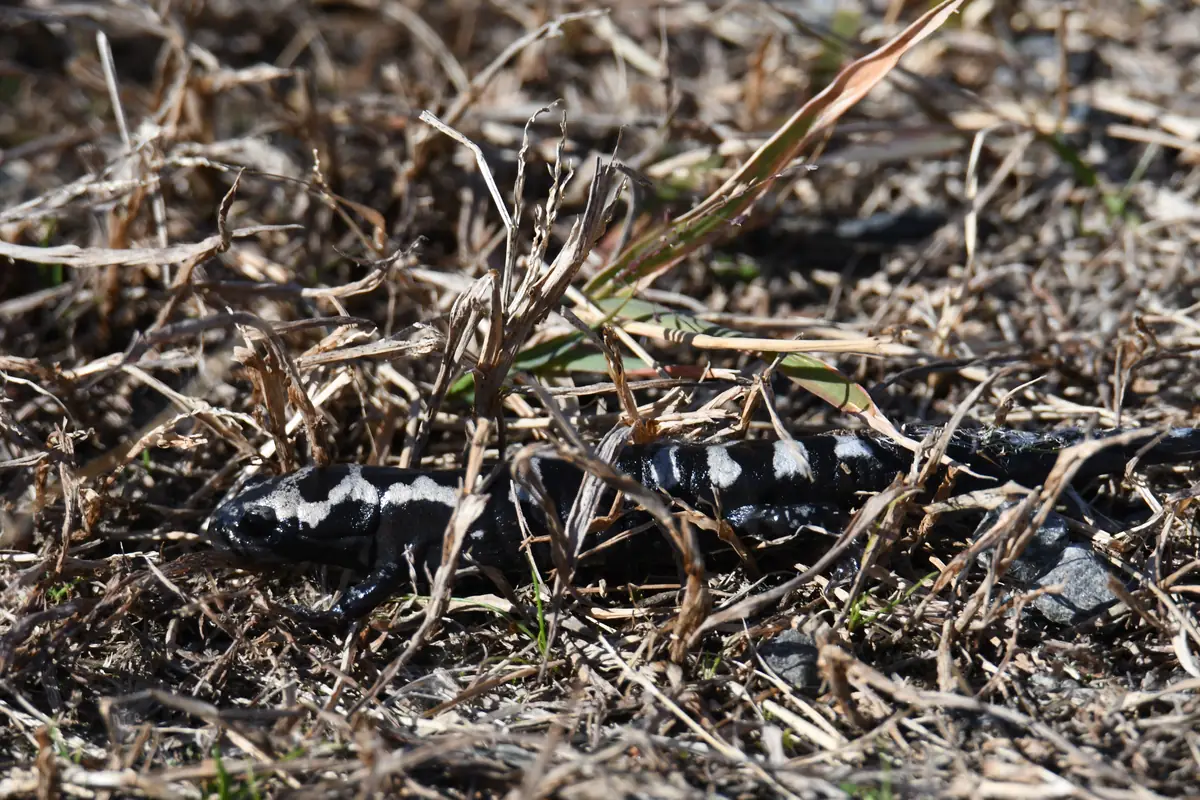
Tennessee’s strangest October event happens under leaves in a pond that is not there. The marbled salamander “is the only member of its family in Tennessee to mate and lay eggs upon land”: in fall, TWRA explains, “females construct nests just below the leaf litter of dried beds of temporary or drying ponds,” then “will often stay to protect the eggs from small predators and fungus,” and the eggs “hatch when the nest is flooded during winter or early spring rains.” It is a stout, four-inch animal, black with white bands in males and gray in females, “found everywhere in the state except the northeastern corner.” If you look, lift one leaf at a time at the edge of a dry basin and put everything back.
-
Bears eating for winter
All month; denning begins late October · The Smokies, the Cherokee National Forest, the northern Cumberlands
The park says “nuts and acorns are especially important during the fall,” that bears “can nearly double their weight” for winter, and that “between late October and mid-December, black bears begin settling into their winter den sites.” BearWise notes bears may forage up to 20 hours a day now, and that October “is one of the top months for vehicle collisions with animals, including bears.” Roughly 1,900 bears live in the Smokies, about two per square mile.
-
Deer: rubs and scrapes
October; the breeding peak comes later in the fall · Statewide; field edges and creek bottoms
Bucks are rubbing the bark off saplings and pawing scrapes under low branches this month; dawn and dusk on a field edge will show you why. The dusk-and-dawn watch plate is for this, and so is slowing down on rural roads after sunset.
-
Copperheads and timber rattlesnakes, still out
Warm afternoons all month · Rocky, wooded hillsides; bluffs and ledges; leaf litter
Both occur “across the entire state,” and both court and mate in fall, so October is not the month to stop watching your feet. The copperhead “prefers forested habitat” and rocky hillsides with logs and leaf litter, but also suburbs and stream edges. The timber rattlesnake, “the largest and most dangerous of the 4 venomous snakes in Tennessee,” likes “rocky, south-facing hillsides; often associated with bluffs or ledges,” which are exactly the overlooks people hike to for the color. TWRA’s rule: “Always check before putting your hands in cracks and crevices.”
What are good October outings for Tennessee families?
- Hear the elk. Go to the Hatfield Knob tower at dawn or dusk in the first half of the month, or drive to Cataloochee, with the map-of-sounds plate.
- Ride the color. Warriors’ Path State Park at Kingsport runs a Fall Foliage Float on Saturday, October 10, 10 a.m. EDT; Pickwick Landing has an autumn pontoon cruise on Friday, October 9, at 3 p.m. CDT; Norris Dam runs a Fall Color Cruise on Sunday, October 18, at 2 p.m. EDT; Burgess Falls serves sunrise coffee at the cascades at 7 a.m. CDT on October 11 and 31.
- Meet the raptors. Chickasaw State Park near Henderson lists Birds of Prey programs on the mornings of October 17 and 18 and Meet a Barred Owl at 4 p.m. CDT on the 17th; confirm times with the park. Bledsoe Creek’s Field Trip Friday on October 9 at 11 a.m. is “Spooky Species,” and Fall Creek Falls lists its Spooktacular for Saturday, October 17; check the parks for full schedules.
- Look up. Join the Harrison Bay or Montgomery Bell star programs (see the sky section), or watch the Draconids from the backyard on October 8.
- Bird with the clubs. The Memphis chapter of the Tennessee Ornithological Society leads field trips to Ensley Bottoms on October 3, Eagle Lake Refuge on October 17, Nonconnah Creek on October 18 and the Wolf River WMA on October 31, most at 7 a.m. CDT; the Nashville chapter meets the third Thursday at Radnor Lake. Seven Islands State Birding Park near Knoxville has a volunteer workday on Saturday, October 3, 9 a.m. to noon.
- Put the observations to work. Report a monarch roost or your last hummingbird to Journey North, tag monarchs with a Monarch Watch kit, add the salamander, the persimmon and the first junco to iNaturalist, and join Project FeederWatch before its season opens on November 1. Set out a CoCoRaHS rain gauge too; in the driest month of the year, a reading of zero is data.
Read the safety notes before any trip to a wildlife management area; this is the busiest month of the hunting calendar.
Safety notes for October in Tennessee
- Bears. In the Smokies it is illegal to approach within 50 yards of a bear or an elk. Lock up food and trash, and if a bear follows you, change direction and never run.
- Ticks. They are not done: the CDC says adult blacklegged ticks “are most active” in early spring and fall. Treat boots and pants with 0.5 percent permethrin, use an EPA-registered repellent, do a full-body check when you get home, shower within two hours and tumble clothes on high heat for ten minutes. Light-colored clothing makes ticks easier to spot.
- Snakes and water. Watch hands and feet on rocky overlooks (see the snake notes above), and never drive through water over a road.
- Hunting seasons and orange. Archery deer runs September 26 to October 30 and November 2 to 6, the young sportsman weekend is October 31 to November 1, muzzleloader November 7 to 20, and the gun season November 21 to January 3. Bear archery runs September 26 to October 23 with hound hunts from October 3 in some zones; fall turkey with shotgun is October 17 to 30, dove reopens October 10 to November 1, squirrel is open, and the North Cumberland elk hunts run September 26 to October 16. TWRA requires big-game hunters to wear at least 500 square inches of daylight fluorescent orange or pink on the head and upper body, visible front and back, except on archery-only and turkey hunts; archers must wear it too where their season overlaps a big-game gun hunt, such as the bear hound seasons. TWRA asks everyone else to “wear bright colors, especially orange and yellow (avoid white),” to “be mindful of areas that allow hunting, especially on opening weekends,” and warns that “some WMAs are closed to all uses except hunting during scheduled hunts.” National and state parks, state natural areas and city parks are where hunting is generally not allowed.
- Traffic. Expect long weekend delays in the Smokies, especially on Newfound Gap Road and the Cades Cove loop.
Sources
- National Park Service: fall colors in Great Smoky Mountains National Park
- National Park Service: seasonal road closures, Great Smoky Mountains (Kuwohi Road, Heintooga Ridge Road)
- Tennessee State Parks: where and when to view fall colors
- Tennessee Wildlife Resources Agency: elk in Tennessee (rut, bugling peaks, Hatfield Knob tower)
- National Park Service: elk in the Smokies
- National Park Service: elk rutting season underway (September 2025 release; field closures, 50-yard rule)
- National Park Service: how to safely view elk (rut September 1 – October 31)
- TWRA Tennessee Birding Trail: Hiwassee Refuge (crane arrival, closure dates, directions)
- TWRA: Sandhill Crane Festival and Hiwassee Refuge viewing season
- TWRA: sandhill crane hunting in Tennessee, 2026–27 season and wintering numbers
- TWRA: ruby-throated hummingbird
- TWRA: chimney swift
- TWRA: yellow-rumped warbler
- TWRA: ruby-crowned kinglet
- TWRA: white-throated sparrow
- TWRA: dark-eyed junco
- TWRA: bald eagle (winter arrivals and viewing lakes)
- Tennessee Watchable Wildlife: Soddy Mountain hawk watch
- Monarch Watch: peak migration dates by latitude
- Monarch Watch: tagging program
- Journey North: monarch sightings and roost reports
- Reelfoot Lake State Park: eagles and Eagle Fest
- U.S. Fish and Wildlife Service: Reelfoot and Lake Isom refuges general brochure (PDF)
- U.S. Fish and Wildlife Service: Cross Creeks National Wildlife Refuge (sanctuary closure Nov 15 – Mar 15)
- U.S. Fish and Wildlife Service: Tennessee National Wildlife Refuge, visit us (seasonal closures)
- U.S. Fish and Wildlife Service: Hatchie National Wildlife Refuge
- NOAA NCEI: U.S. climate normals 1991–2020 (first-freeze probabilities, as used on the site’s Tennessee frost pages)
- NOAA NCEI: 1991–2020 monthly precipitation and temperature normals for Tennessee stations (data API)
- NWS Morristown: precipitation and flash flood climatology (October the driest month)
- NWS Nashville: tornado climatology of Middle Tennessee, 1830–2003
- Climate Prediction Center: ENSO diagnostic discussion, September 10, 2026
- NWS Huntsville: El Niño winter precipitation impacts, Tennessee climate division 3
- NWS Huntsville: El Niño winter temperature impacts, Tennessee climate division 2
- WSMV Nashville: El Niño has officially arrived, what it means for Tennessee (June 12, 2026)
- Nashville Severe Weather: super El Niño, what it means for Middle Tennessee (September 20, 2026)
- U.S. Naval Observatory: moon phases 2026 and sunrise, sunset, moonrise and moonset (data API)
- International Occultation Timing Association: lunar occultation of Jupiter, October 6, 2026 (city timings)
- EarthSky: meteor shower guide; Saturn at opposition; visible planets
- Tennessee State Parks: fall happenings (October 2026 event listings)
- Tennessee Ornithological Society: events (Memphis chapter field trips, October 2026)
- Nashville Chapter, Tennessee Ornithological Society
- Project FeederWatch: how to participate
- CoCoRaHS: community rain, hail and snow network
- UT Gardens: grow on the wild side with goldenrod
- UT Gardens: versatile witchhazels feature fall and winter blooms
- USDA NRCS plant guide: common persimmon (PDF)
- NC State Extension plant toolbox: Diospyros virginiana
- NC State Extension plant toolbox: Asimina triloba (pawpaw)
- NC State Extension plant toolbox: Quercus alba (white oak acorns)
- NC State Extension plant toolbox: Carya ovata (shagbark hickory)
- TWRA: marbled salamander
- National Park Service: black bears in the Smokies
- BearWise: what bears do in October
- TWRA: copperhead
- TWRA: timber rattlesnake
- CDC: Lyme disease, causes and transmission (adult blacklegged ticks most active in fall)
- CDC: preventing tick bites
- TWRA: 2026–27 hunting and trapping season dates
- TWRA: big game hunting, hunter orange requirement
- TWRA: safety tips and a code of ethics for wildlife watching
- Photos via Wikimedia Commons; licenses and photographers are credited under each picture
