What to look for in nature in Louisiana this January
January is Louisiana’s coldest month and, for wildlife, one of its busiest. Eaglets hatch in nests high over the coastal lakes, ducks reach their midwinter numbers on the marshes and rice country, great horned owls hoot through the long nights, and somewhere along the coast the first purple martin of the year drops in to check last summer’s gourd. Most days are mild, a few are bitter, and once in a generation the whole south of the state turns white. Below: the sights of the month, the places to find them, and the source for every date.
Other months in Louisiana: October, November, December, February.
Start here

- Watch an eagle nest feeding. From a road or levee well away from the tree, spend half an hour with binoculars on a known eagle nest near Lake Verret, Lake Palourde or another big coastal lake. An adult arriving with a fish and tearing it into small bites means chicks have hatched.
- Put up the martin gourds. Clean out last year’s purple martin housing now. Scouts, the older birds coming back to sites they used before, can turn up along the Gulf Coast in early January; in 2023 the Purple Martin Conservation Association reported the nation’s first one from New Orleans on January 7.
- Count ducks from a refuge levee. January usually brings the midwinter crowd of ducks to the coast. Visit Cameron Prairie or Lacassine refuge, pick one pond, and count every bird on it.
Record the month in the Naturalist’s Field Journal. An eagle nest you return to through the month belongs on the nest observed page, and a refuge morning of ducks and geese goes on birds I have seen. Owl duets at night make a fine map of sounds; the Quadrantid morning and the Wolf Moon go on the dusk-and-dawn watch; and the same marsh or bayou bank, visited now and again in April, makes a strong pair of pages for the same place twice.
Regions used below: North Louisiana (Shreveport, Monroe and the northern hills); Central Louisiana and the Kisatchie country; Southwest Louisiana and the Chenier Plain; Acadiana and the sugarcane parishes; Baton Rouge and the Florida Parishes; New Orleans and the southeast marshes.
When do bald eagle chicks hatch in Louisiana?
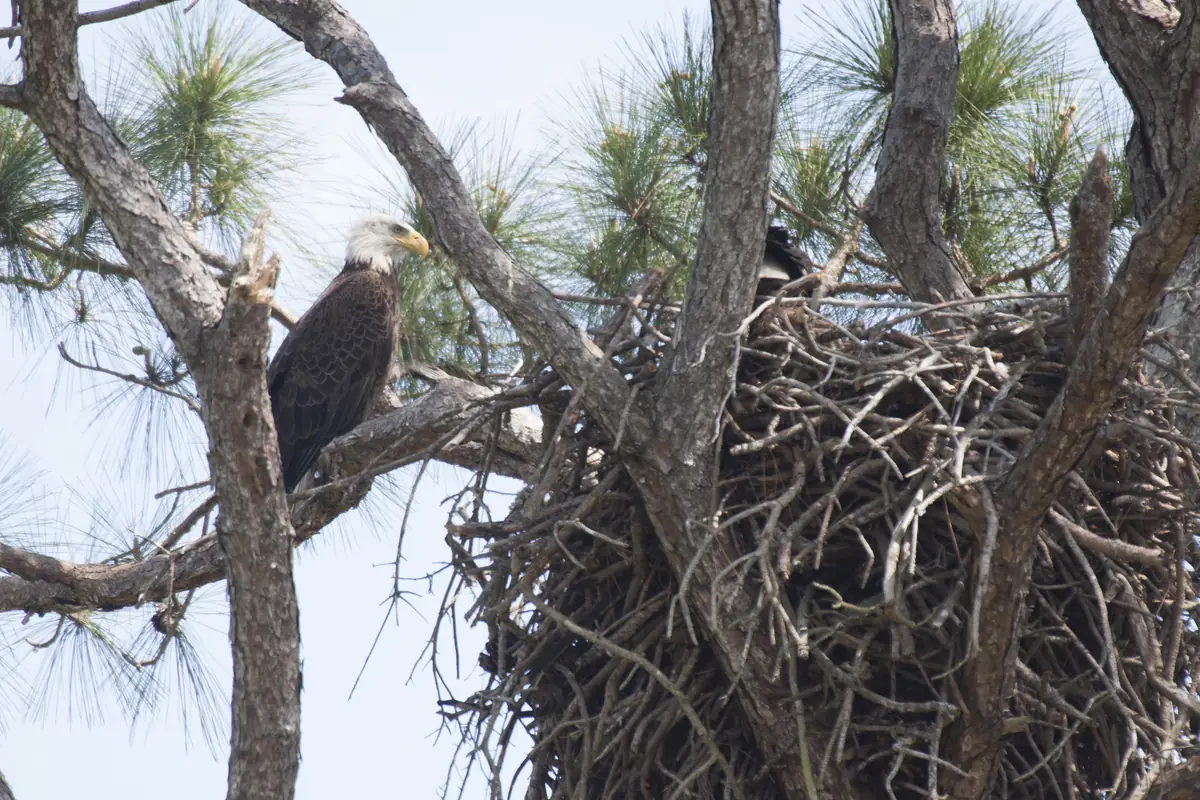
Mostly now. LDWF’s fact sheet says Louisiana’s bald eagles nest in winter and early spring and gives an incubation period of about 35 days, so a clutch laid in December hatches in January. A pair usually has up to three eggs. The adults take turns at the nest, and from hatching on the rhythm changes: instead of a white head sitting low and motionless, you see an adult standing on the rim, bending down to tear fish or coot into slivers for the downy young.
The same fact sheet notes that the young leave the nest 72 to 78 days after hatching, which puts first flights from January nests in late March and April. Most of the state’s nests are in the southeastern coastal parishes, typically in the crowns of cypress trees beside open lakes, where the birds hunt fish and also take ducks, coots and nutria. Nests in the north and center of the state are fewer and, the department says, less successful.
To watch without disturbing them, stay far back (a car or a distant levee makes a good blind) and leave if an adult starts calling or flies off. LDWF also lists midwinter surveys of eagles that are not nesting, and the fact sheet notes that a young eagle needs four to five years to grow its white head and tail. Until then it is dark brown, often blotched with white, so not every big dark bird on a cypress snag is a vulture. The Kisatchie National Forest’s eagle cameras, described in our November guide, let you follow a nest from home.
How many ducks winter in Louisiana, and where are they in January?
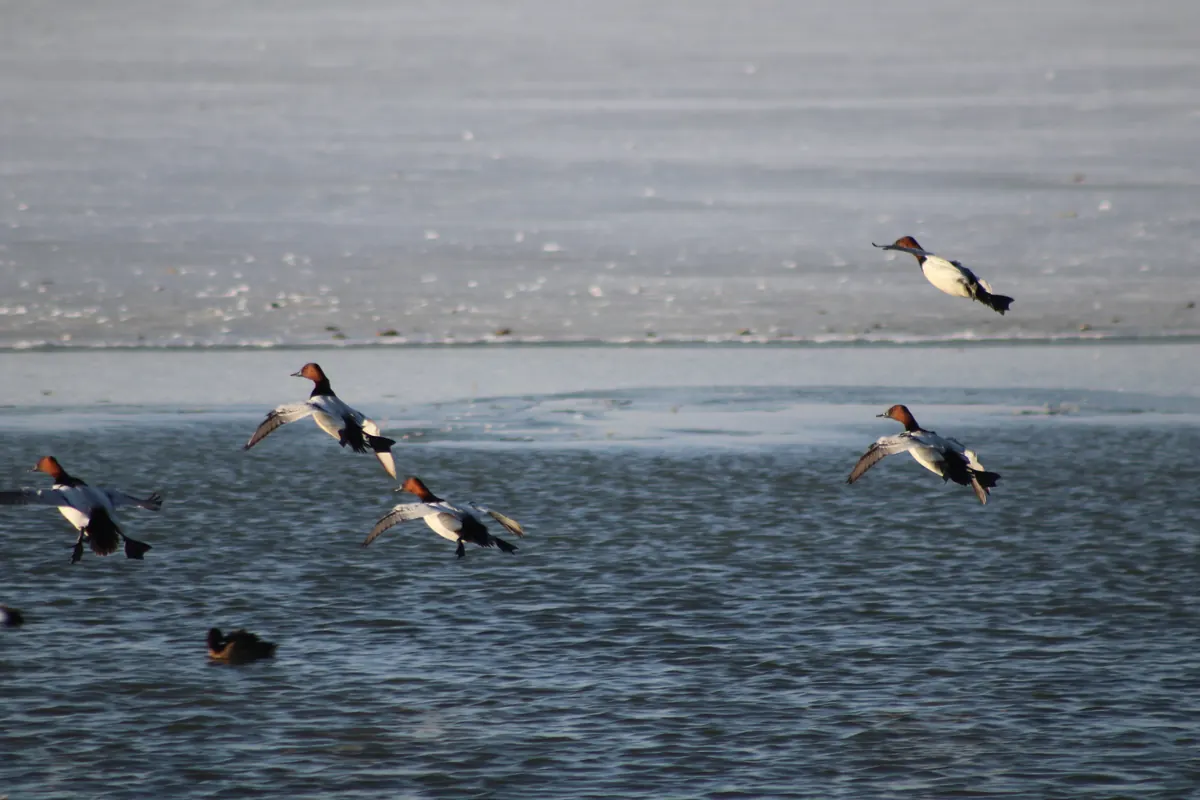
January is the month of the midwinter count. LDWF flies its coastal aerial survey from September through January along 27 north–south lines from the Gulf to U.S. Highway 90, at 125 feet and about 100 miles an hour, and in early January it also joins the U.S. Fish and Wildlife Service’s mid-winter waterfowl inventory, a coordinated count across the flyway. The January 2023 survey estimated close to 2 million ducks on the coast and Little River Basin, the old Catahoula Lake survey area, plus another 193,000 in the northeast Delta parishes. Numbers swing hard from year to year: the January 2024 report, the newest January report we could retrieve from LDWF’s site, put the same area at 1.47 million, the lowest January estimate on record and about half the long-term January average of 2.96 million, after a summer of poor marsh plant growth and low water had cut how many birds the southwest marshes could feed.
A few patterns from the January 2023 report, the more typical year, are worth knowing before you go out. About six in ten of the coastal ducks were in the southwest, where green-winged teal and gadwall were the commonest, and the biologists noted that big flocks of ducks and geese sat on harvested rice fields left undisturbed. Southeast Louisiana had more canvasbacks than any other duck, and more than half its total was at the mouth of the Mississippi. On Catahoula, in central Louisiana, rafts of canvasbacks totaling 85,000 were almost the only ducks on the lake. A separate count found scaup rafting on Lake Borgne and Lake Pontchartrain, where the department surveys them each December and January because the lakes are a continentally important wintering site.
| Species or group | January 2023 estimate |
|---|---|
| Green-winged teal | 427,000 |
| Gadwall | 359,000 |
| Ring-necked duck | 330,000 |
| Canvasback | 233,000 |
| Northern pintail | 203,000 |
| Northern shoveler | 190,000 |
| Blue-winged teal | 145,000 |
| Mallard | 37,000 |
| Scaup | 36,000 |
| All ducks | 1,988,000 |
| American coot | 689,000 |
Good places to look without a boat include Cameron Prairie and Lacassine national wildlife refuges in the southwest, both managed for wintering ducks and geese, and Catahoula National Wildlife Refuge in central Louisiana. Check each refuge’s visitor page for which roads, levees and trails are open in hunting season, which closes earlier in the west than the east this year (see the safety notes). LDWF posts each month’s survey report on its aerial waterfowl survey page.
When do purple martins come back to Louisiana?
Earlier than almost anywhere else. Purple martins spend the winter in South America, and the first ones back in the United States usually land along the Gulf Coast. The Purple Martin Conservation Association calls these first arrivals scouts, and its timing guide explains that they tend to be adult birds returning to the same colony sites they used the year before. Last year’s young follow later, from 4 to 12 weeks after the first adults.
In 2023 the association announced the country’s first sighting of the year from New Orleans on January 7, reported by a martin landlord. First dates shift from year to year and from town to town, and the association’s live map is the best guide to when they reach your parish. Because the scouts are adults, the males among them are already glossy blue-black all over, easy to tell from the duller females that follow.
If you host martins, clean and ready the housing before the scouts arrive, and report your first bird to the association’s Scout-Arrival Study, a community science map that shows the spring wave moving north through the season. If you don’t, look for the white gourd racks that stand beside ponds and in yards across the south of the state, and watch them on a sunny afternoon.
Why are owls hooting so much in Louisiana in January?
Because it is courtship and nesting season for the two big owls of Louisiana’s woods and swamps. Long, still winter nights carry their voices a surprising distance, and the leafless canopy makes them easier to spot at dusk.
-
Great horned owl
Hooting peaks in midwinter; eggs early in the year · Woodlots, farm edges, pine woods and city parks statewide
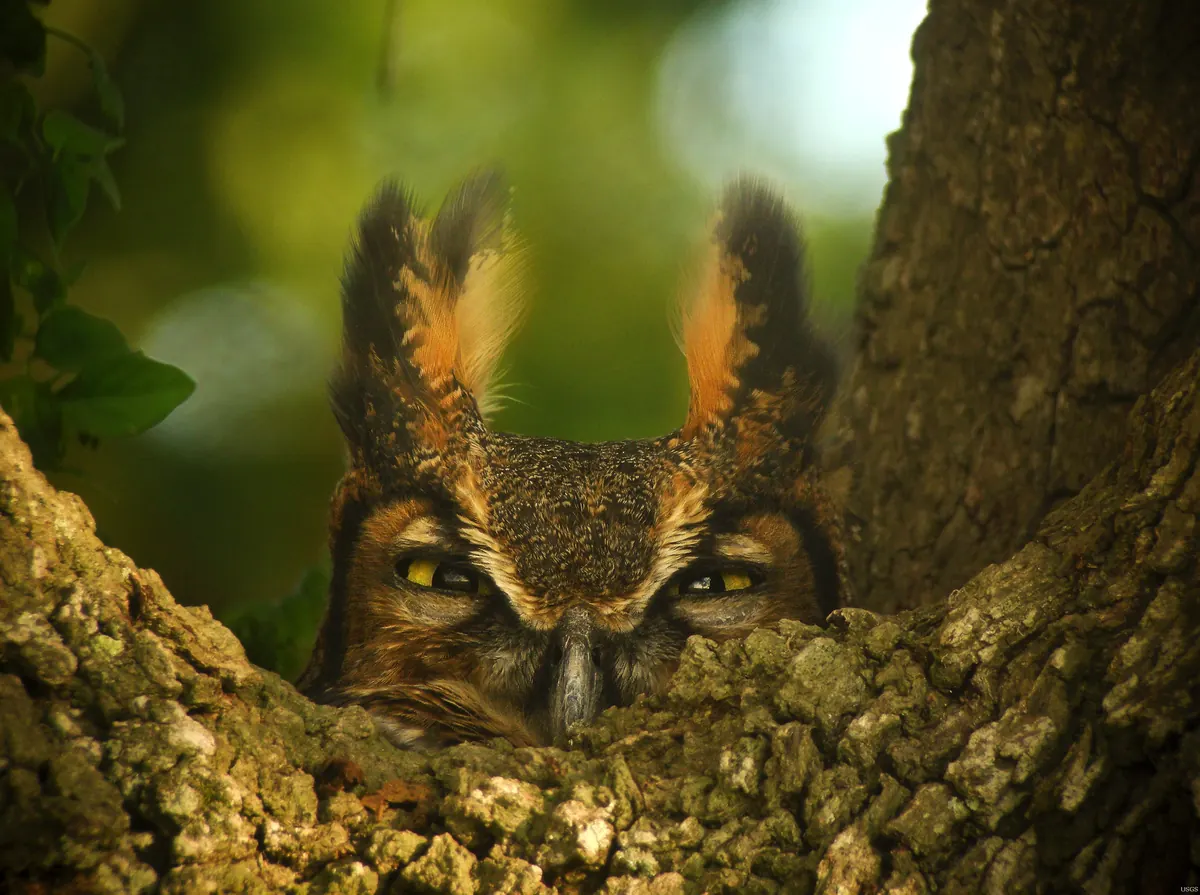
Audubon’s guide notes that this owl begins nesting very early and that on winter nights its low hooting carries far through bare woods. It does not build a nest of its own: a pair usually takes over an old stick nest of a hawk, crow, heron or even an eagle, 20 to 60 feet up, and lays two or three eggs, which the female does most of the sitting on, for 28 to 35 days. Listen at dusk for a low, soft hoo-h’HOO-hoo-hoo, and for a pair answering each other, the female’s voice a little higher.
-
Barred owl
All year; pairs call in duet during courtship · Cypress swamps, bottomland hardwoods and wooded bayous
The familiar “who cooks for you” call is, in Audubon’s words, a characteristic sound of southern swamps, and pairs often trade calls back and forth, breaking into wild cackling duets. Barred owls nest in large tree hollows or broken snags, or in an old red-shouldered hawk nest, and both birds bob, bow and call during courtship. They hunt by day as well as night, so a walk on the Barataria Preserve boardwalk or along a bottomland trail on a gray afternoon can turn one up perched low over the water, watching for crawfish and frogs.
Keep owl watching respectful. Don’t play recordings near a nest, and keep flashlight beams off the birds; a quiet wait at the edge of the woods at sunset is usually enough.
What blooms first in Louisiana as winter turns?
January is the deep middle of winter here, but it is never fully dormant. Watch for these first flowers and swelling buds, especially in the south of the state and after a run of mild days.
-
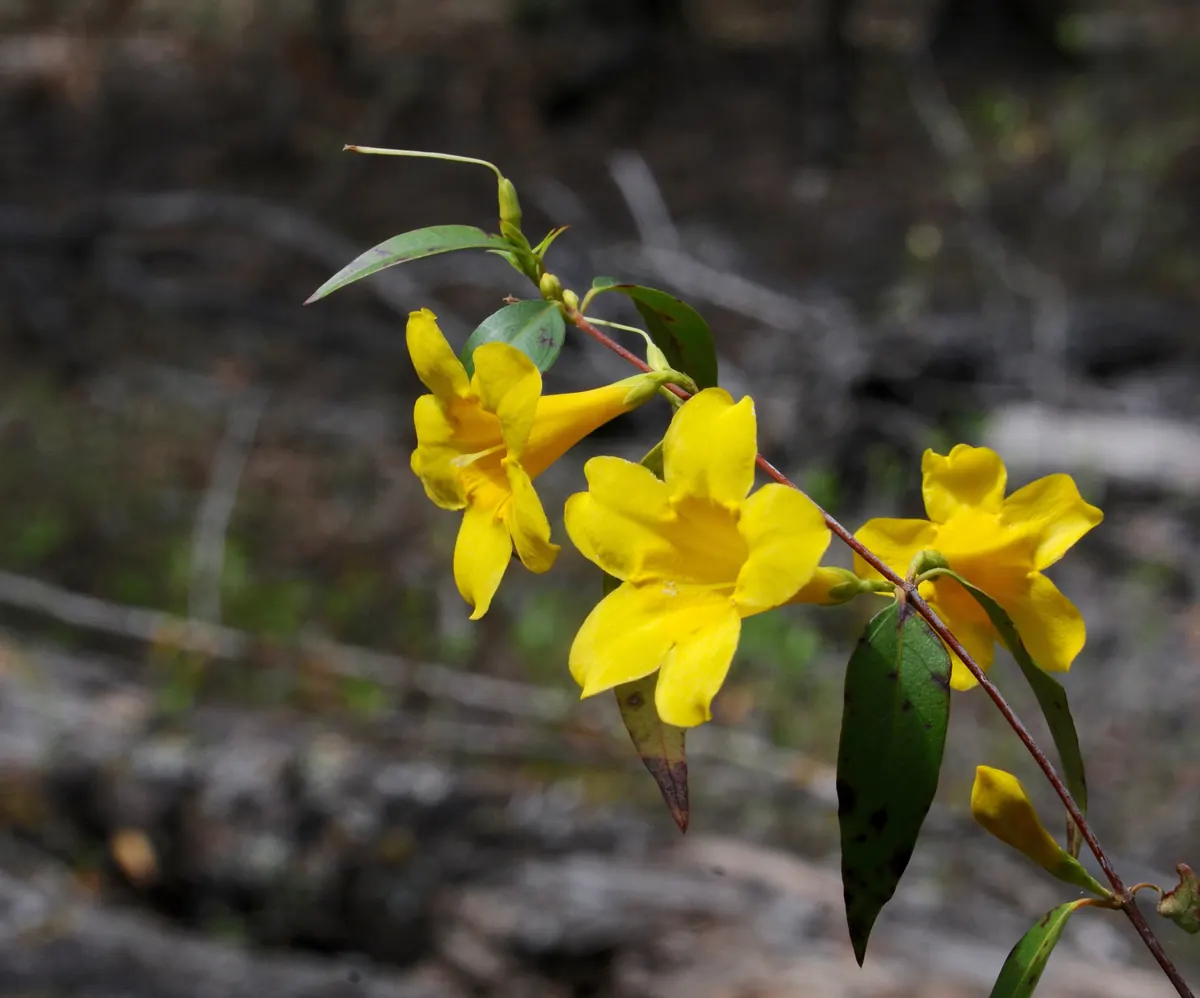
Carolina jessamine
Occasional flowers from December; main bloom in early spring · Woods edges, fences and pine flatwoods
This native evergreen vine climbs fences and trees and carries bright yellow trumpets an inch or more long. Its main show is a short burst in early spring, but the Wildflower Center records flowers as early as December, so a warm spell in January often brings out a few early flowers along sunny edges.
-
Swamp red maple
Red buds swell now; flowers usually from February · Swamps, bottomlands and wet woods, especially in the south
Louisiana’s swamp variety of red maple (Drummond’s red maple) is native from southeast Texas east to Florida and north to southern Illinois, in moist woods and swamps. The Wildflower Center lists its bloom as February through April, but the fat red buds on bare twigs give the crowns a faint rosy tinge before then. Its red, winged fruits follow the flowers and color the swamps again in spring.
-
American elm
Flowers from February, before the leaves · Bottomland forests, stream banks and older towns
Elm flowers are small, reddish-green and hang in drooping clusters of three or four, appearing before any leaf. Look up at a bare elm in late January and you may see the twigs thickening with buds. They are easy to miss, and that is the fun of it: a winter tree ID page that you check again in March.
Which other birds are easy to see in Louisiana in January?
-
Robin flocks
All winter, wandering with the berry supply · Lawns, parks, woods with holly, hackberry and yaupon
Audubon notes that robins in fall and winter may gather by the hundreds in roaming flocks, moving to wherever berries are thickest. A January robin in Louisiana is a winter visitor or a wanderer, not a sign of spring. Count a flock in your neighborhood and see how long it stays.
-
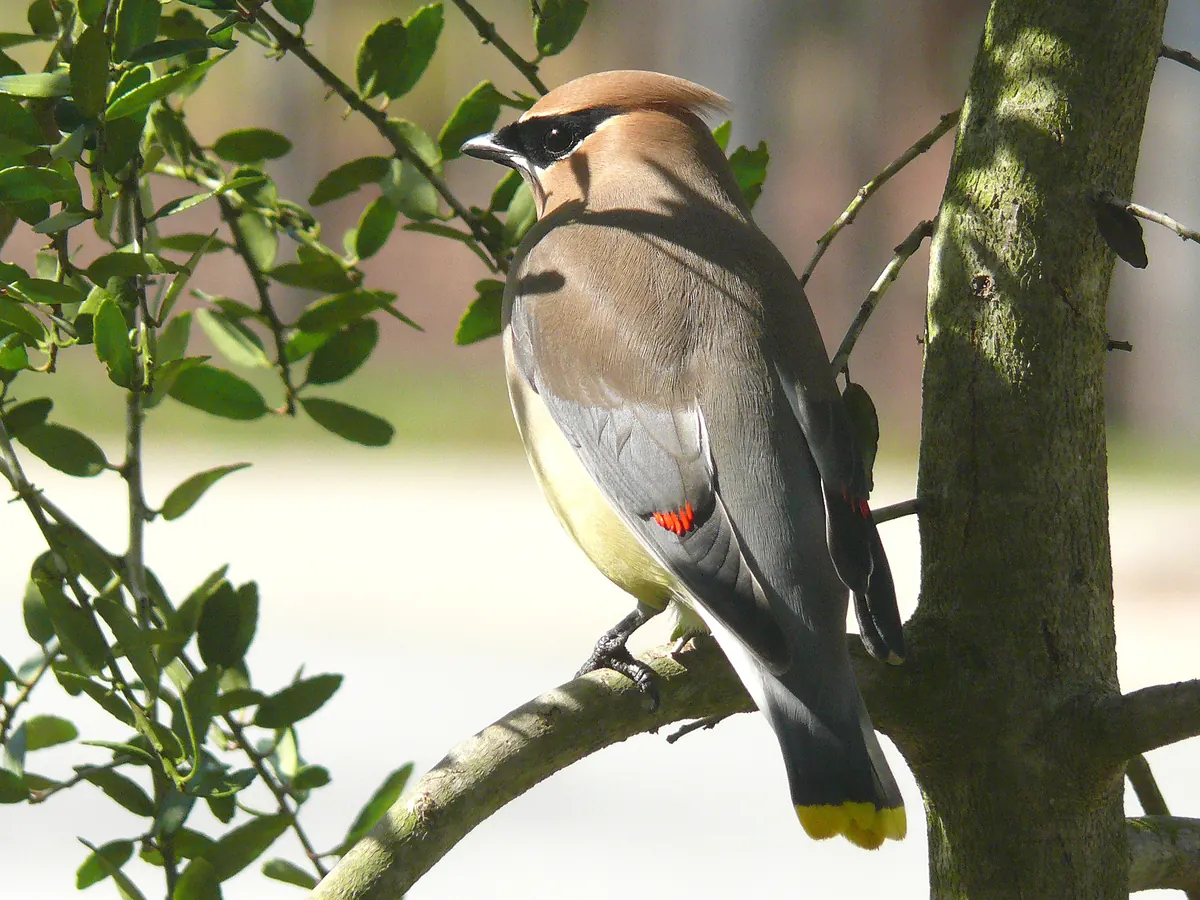
Cedar waxwings
Irregular; plentiful some winters, scarce in others · Berry-laden trees in towns and woods
Waxwings travel in tight flocks and give thin, lisping calls as they descend on a tree, strip its fruit and move on. Their wintering areas change from year to year with the berry crop, so some Januarys bring them in numbers and others hardly at all. The sleek, crested bird with a black mask and yellow-tipped tail is unmistakable.
-
Whooping cranes in rice country
All year in southwest Louisiana · Rice fields, crawfish ponds and marsh edges of southwest Louisiana
LDWF’s non-migratory flock, started with a release at White Lake in 2011, spends the winter in the same flat farm country as the ducks and geese. As of 2025 there were more than 800 whooping cranes in three wild populations nationwide. The birds are still endangered and LDWF counts poaching among their threats. If you see one, stay in your car at a distance and report the sighting, or any harassment you witness, through the department’s whooping crane page.
-
The last Christmas Bird Counts
Through Tuesday, January 5 · Count circles statewide
Audubon’s count window this winter runs to January 5, and some Louisiana compilers schedule their circle after New Year’s Day. Check Audubon’s map for a circle that still needs help.
Has it ever snowed a lot in Louisiana in January?
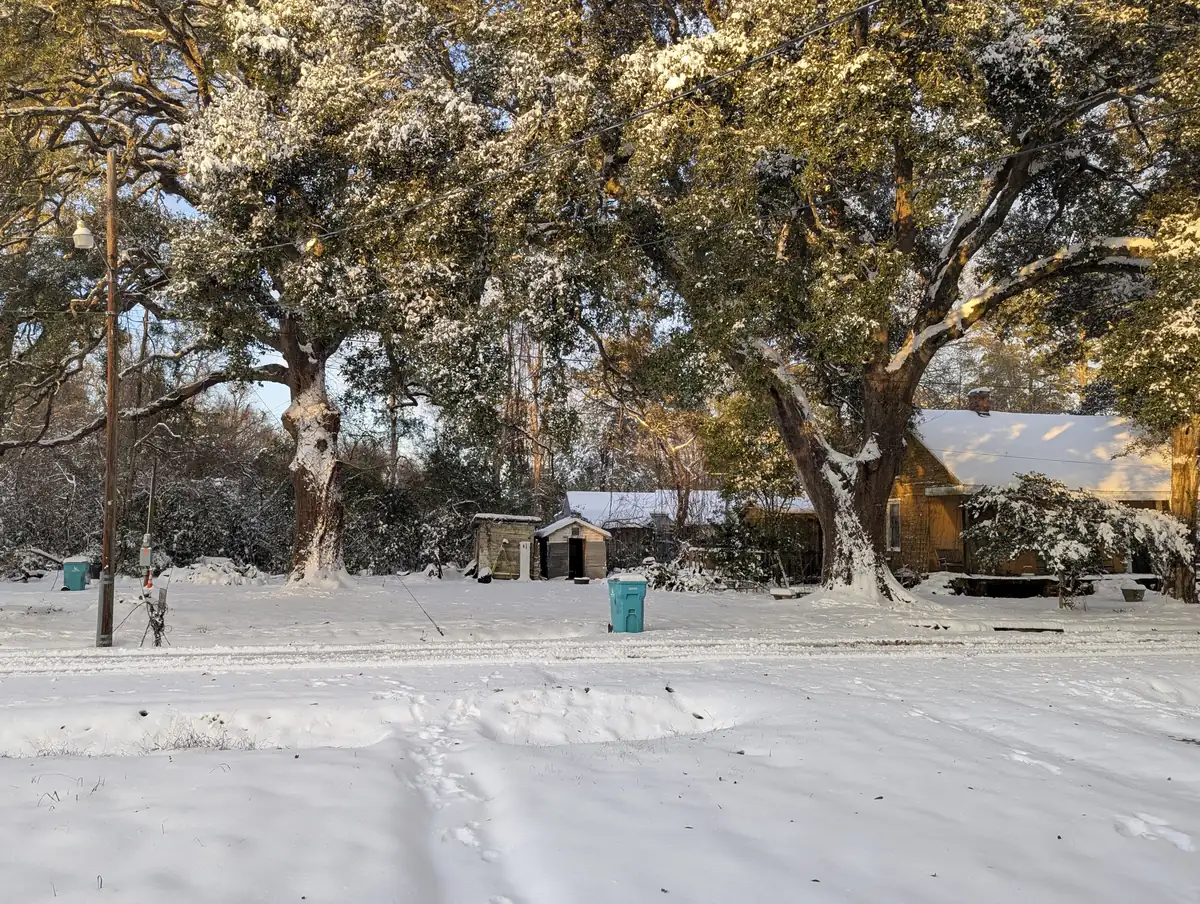
Most dramatically, and most recently, in 2025, in a storm that rewrote the record books. On January 20 and 21, 2025, a low pressure system crossing the Gulf ran into an Arctic air mass. Snow began on the Monday evening and turned heavy by Tuesday morning, with winds of 20 to 25 miles an hour gusting to 30 or 40 and visibility down to a quarter mile or less. The National Weather Service in Lake Charles issued the first blizzard warning in that office’s history. Totals ranged from an inch or two in central Louisiana to more than a foot in spots across Acadiana.
NOAA’s account of the storm records that New Orleans had its snowiest day since its records began in 1948, Baton Rouge its snowiest since 1892, and Thibodaux its snowiest since 1893. Then the skies cleared over the fresh snow and the temperature plunged. On the morning of January 22, New Iberia fell to 2 °F and Lafayette to 4 °F, both all-time record lows, and Baton Rouge reached 7 °F, its coldest since records there began in 1930. Temperatures stayed below freezing for 36 to 40 hours across much of the Lake Charles forecast area.
| Location | Snowfall | Reported by |
|---|---|---|
| Carencro (northeast of Lafayette) | 13.6 in | NWS Lake Charles |
| Rayne | 11.4 in | NWS Lake Charles |
| Lafayette Regional Airport | 9.0 in | NWS Lake Charles |
| Jennings | 9.0 in | NWS Lake Charles |
| Thibodaux | 8.5 in | NOAA Climate.gov |
| New Iberia (Acadiana Regional Airport) | 8.0 in | NWS Lake Charles |
| New Orleans | 8.0 in | NOAA Climate.gov |
| Baton Rouge | 7.6 in | NOAA Climate.gov |
| Lake Charles Regional Airport | 5.5 in | NWS Lake Charles |
| Alexandria International Airport | 2.7 in | NWS Lake Charles |
A storm like that is not something to plan around, and most Januarys bring none at all to the south of the state. It is a reminder, though, to take every hard freeze warning seriously. If the forecast ever turns white again, keep a notebook handy: the tracks of raccoons, rabbits and wading birds pressed into Louisiana snow are a rare thing to record.
How cold does January get in Louisiana, and what might El Niño bring?
In NOAA’s 1991–2020 normals, all seven of the state’s main airport stations run a little colder in January than in December or February. Average highs run from 57 °F at Monroe and 58 °F at Shreveport to about 62 or 63 °F from Lafayette and Baton Rouge to Lake Charles and New Orleans. Average lows tell the bigger story: about 37 °F in Monroe and Shreveport, 39 °F in Alexandria, 42 °F in Baton Rouge and 46 °F at New Orleans International Airport. Monroe and Shreveport average 10 to 11 nights at freezing or below in January, Alexandria about 10, Baton Rouge 7, Lafayette 5, Lake Charles between 4 and 5, and New Orleans International Airport about 3. It is a wet month too, with normal rain from about 4.4 inches at Shreveport to 6.4 inches at Baton Rouge.
This winter has an unusual push behind it. Odds that the warm Pacific event will crest at the very strong level by midwinter topped nine in ten in the federal ENSO outlook issued September 10. NOAA’s Climate.gov summary of a century of El Niño winters calls a wetter-than-average October-to-March along the Gulf Coast the most reliable U.S. signal of all, seen in more than 80 percent of events, and says that in strong events the Gulf Coast and Southeast have been consistently wet. The National Weather Service in Jackson, which covers northeast Louisiana, sums up the pattern for the Deep South as wetter and cooler in winter and spring.
NOAA’s official outlook for the season is due October 15 and is refreshed every month after that; you can see the newest version on the federal 90-day outlook maps.
For the chance of frost on any given night in your town, the Louisiana freeze dates page gives typical freeze dates for stations around the state, and the local forecast page shows what is coming this week.
How much daylight does Louisiana gain in January?
The days are lengthening again, slowly at first and then faster. Evenings started stretching back in early December, while sunrises keep getting later until roughly January 4 to 6 in Louisiana, so early in the month the extra light arrives only in the evening. By the end of the month mornings are brightening too, and each day adds noticeably more light than at the start. The table shows how much light each city adds over the month.
| City | Jan 1 | Jan 31 | Gained | Per day |
|---|---|---|---|---|
| Shreveport | 10 h 03 m | 10 h 37 m | 34 min | 1.1 min |
| Monroe | 10 h 04 m | 10 h 37 m | 33 min | 1.1 min |
| Alexandria | 10 h 09 m | 10 h 41 m | 32 min | 1.1 min |
| Lake Charles | 10 h 15 m | 10 h 45 m | 30 min | 1.0 min |
| Lafayette | 10 h 15 m | 10 h 45 m | 30 min | 1.0 min |
| Baton Rouge | 10 h 13 m | 10 h 44 m | 31 min | 1.0 min |
| New Orleans | 10 h 16 m | 10 h 46 m | 30 min | 1.0 min |
| Houma | 10 h 17 m | 10 h 47 m | 30 min | 1.0 min |
Saturday evening, January 2, brings perihelion, Earth’s yearly closest pass by the sun, proof enough that Louisiana’s winter comes from Earth’s tilt rather than distance. For sunrise, sunset and twilight times in your own parish, try the daylight calculator.
What is in the Louisiana night sky in January?
-
The Quadrantid meteors
Peak the night of Sunday, January 3, into Monday, January 4 · Look northeast after midnight; the radiant climbs toward dawn
This short, sharp shower is often missed because of winter clouds and moonlight, but 2027 looks promising, because the waning crescent is thin and rises late. The American Meteor Society times the maximum at about 9:30 p.m. Central time on January 3, and EarthSky’s forecast is a little later, near midnight. Meteors fan out from a point between Boötes and Draco that hugs the northern horizon at nightfall and rises steadily until morning. For Louisiana watchers, the hours before first light on Monday, January 4, should be the most productive. Count on dozens per hour at the very most, and only well away from town lights.
-
Venus, the morning star
All month; greatest elongation January 3 · Southeast before sunrise
On January 3 Venus swings out to its widest separation from the sun, 47 degrees, and rules the predawn southeast at magnitude about −4.3, far brighter than any star. Steady it in binoculars or a backyard telescope and you will see it half lit, like a miniature first-quarter moon.
-
The Wolf Moon, the closest full moon of 2027
Full Friday, January 22, at 6:17 a.m. CST · Rising in the east-northeast at dusk on the 21st
Perigee, the moon’s nearest approach, comes a little over half a day ahead of the full phase, making this the nearest full moon of the year, about 222,000 miles away, and every list counts it as a supermoon. The best night is Thursday, January 21: it rises around sunset and sets near sunrise on the 22nd at its fullest. Two nights later, on Saturday the 23rd, look for Jupiter sitting just beside the rising moon.
-
Jupiter, Saturn and Mercury in the evening
All month · East after dusk (Jupiter); southwest (Saturn); low west-southwest late in the month (Mercury)
Jupiter clears the eastern horizon during the evening, earlier each week, and heads for opposition on February 10, so it grows brighter and climbs higher through the month. Saturn hangs in the southwest after dark, dropping toward the twilight week by week. Mercury joins them at the very end of the month; search close to the horizon a bit south of west in the half hour or so after the sun goes down. Its finest evening appearance of this winter comes around February 3.
| Phase | Date | Time |
|---|---|---|
| New moon | Thursday, Jan 7 | 2:24 p.m. |
| First quarter | Friday, Jan 15 | 2:34 p.m. |
| Full moon, the Wolf Moon | Friday, Jan 22 | 6:17 a.m. |
| Last quarter | Friday, Jan 29 | 4:55 a.m. |
Moonless evenings, best for the Milky Way and faint stars, run from about the 3rd through the 12th. Before a night out, check the cloud forecast, and the moon phase calendar for the hour the moon clears your treeline.
What can families do outside in Louisiana in January 2027?
- First Day Hikes, Friday, January 1, 2027. Louisiana State Parks joins the national New Year’s Day hiking tradition; for 2026 it listed 35 state parks and historic sites, from Lake Bistineau to Grand Isle, hosting hikes on January 1 and 2. No 2027 lineup was online in early October; watch lastateparks.com as the holidays approach.
- A Christmas Bird Count before January 5. If a circle near you still has its count ahead, the compiler will usually welcome a beginner or a feeder watcher.
- Bird walk in Baton Rouge, early January. Baton Rouge Audubon Society guides a monthly walk at BREC’s Bluebonnet Swamp, normally held on a month’s opening Saturday from 7 a.m. in the parking lot, with a $3 park admission fee and no registration. The January 2027 walk was not yet listed when we checked, so confirm the date with the society, especially with New Year’s weekend in play.
- Programs at Big Branch Marsh. The refuge headquarters in Lacombe runs Nature Explorers, a free program of play and learning for kids aged 6 and under, on the first and third Fridays of the month, and Homeschool Fridays for kindergarten through eighth grade on the fourth Friday. The refuge had not posted January 2027 dates when we checked, and the holiday may shift the first session, so check its events page before going.
- Barataria Preserve. The national park unit south of New Orleans lists its ranger-led walks and talks on the park calendar, and January’s were not yet posted when we checked; the boardwalk trails are a good place to listen for barred owls and see wintering ducks and wading birds on a mild afternoon.
- Community science at home. Keep Project FeederWatch counts going through the winter, add your sightings to eBird, and if you host purple martins, report your first scout to the Scout-Arrival Study. Looking ahead, the Great Backyard Bird Count normally falls in the middle of February, and its 2027 dates will appear at birdcount.org.
We checked these against each organizer’s page on October 2, 2026; programs change, and many cancel in freezing rain, so call or check online first. You can browse other states and months through our nature calendar, and a bayou walk or refuge morning slips neatly onto one sheet in the Naturalist’s Field Journal.
Safety notes for January in Louisiana
- Deer seasons in January. LDWF’s 2026–27 schedule changes week to week this month. Hunting with or without dogs ends January 3 in Areas 1, 3, 4, 7 and 8, and January 17 in Area 2, and still-hunting in Area 10 also ends January 3; Areas 1 and 4 then reopen to still-hunting January 4–24. Area 6 stays open to either sex through January 24, as do Areas 5 and 9 for bucks only. Primitive firearms seasons follow: January 4–10 in Areas 3, 7, 8 and 10, January 18–24 in Area 2, and January 25–31 in the remaining five areas (1, 4 and 6, plus 5 and 9 for bucks only). Archery runs to January 15 in Areas 3, 7, 8 and 10, to January 31 in Areas 1, 2 and 4, and to February 15 in Areas 5, 6 and 9. State WMAs and the Kisatchie National Forest keep separate calendars, so read those before a walk on public land.
- Birds and small game. Duck season ends January 24 in the West Zone, with a youth and veterans day on January 30, and January 31 in the East Zone. Goose seasons run to February 7, woodcock to January 31, and doves to January 10 in the South Zone and January 17 in the North Zone. Snipe close January 10 and reopen January 25. Quail, rabbit and squirrel seasons continue to February 28, and the furbearer trapping season runs from November 20 to March 31.
- Hunter Orange or Blaze Pink. Through every open gun season for deer, LDWF requires anyone carrying buckshot, slugs, a centerfire rifle or pistol, or a muzzleloader-type primitive gun, whatever the quarry, to wear a combined 400 square inches of the two approved colors on head, chest or back. Hunters on privately owned property may substitute a hat in either color, and a deer hunter on private land may go without once up in a raised stand. WMA rules go further: during open firearms deer seasons, every hunter and trapper there, waterfowl and dove hunters excepted, wears both the full 400 square inches and a hat in one of the two colors. Hikers and birders aren’t required to wear it, but on public land this month a bright hat is sensible.
- Hard freezes. January is the month for them. When the forecast drops into the 20s, let faucets drip, move pets and potted plants indoors, and expect bridges and overpasses to ice before other roads. The 2025 storm showed how fast roads can close.
- Cold water. Lakes and bayous are at their coldest. A capsized canoe in January water can bring on cold shock and then hypothermia within minutes; wear a life jacket and paddle with a partner.
- Fog and short days. Dense fog is common on calm winter mornings near the Atchafalaya, the coast and the big lakes. Sunset still comes early, so carry a light on afternoon walks.
Sources
- LDWF: Rare Animals of Louisiana, bald eagle fact sheet (PDF)
- LDWF: Louisiana bald eagle population shows growth according to latest nest survey
- USDA Forest Service: Kisatchie National Forest
- LDWF: aerial waterfowl surveys (methods, scaup survey and mid-winter goose count)
- LDWF: Louisiana aerial waterfowl survey, January 2023 (PDF)
- USFWS: mid-winter waterfowl inventory
- USFWS: Cameron Prairie National Wildlife Refuge
- USFWS: Lacassine National Wildlife Refuge
- USFWS: Catahoula National Wildlife Refuge
- Purple Martin Conservation Association: timing (scouts and subadult arrival)
- Purple Martin Conservation Association: Scout-Arrival Study
- L’Observateur: Purple Martin Conservation Association release on the first 2023 sighting, New Orleans, January 7 (January 15, 2023)
- National Audubon Society guide to North American birds: great horned owl
- National Audubon Society guide to North American birds: barred owl
- Lady Bird Johnson Wildflower Center: Carolina jessamine (Gelsemium sempervirens)
- Lady Bird Johnson Wildflower Center: Drummond’s red maple (Acer rubrum var. drummondii)
- Lady Bird Johnson Wildflower Center: American elm (Ulmus americana)
- National Audubon Society guide to North American birds: American robin
- National Audubon Society guide to North American birds: cedar waxwing
- LDWF: whooping crane reintroduction in Louisiana
- National Audubon Society: Christmas Bird Count
- National Weather Service Lake Charles: January 20–24, 2025, record snowfall and record cold
- NOAA Climate.gov: historic January 2025 snowstorm in the southern U.S.
- NOAA NCEI: monthly climate normals 1991–2020 for seven Louisiana airports (data API)
- NOAA NCEI: U.S. Climate Normals 1991–2020
- Climate Prediction Center: ENSO diagnostic discussion, September 10, 2026
- Climate Prediction Center: seasonal outlooks (winter outlook issued October 15, 2026, updated monthly)
- NOAA Climate.gov: United States El Niño impacts
- NWS Jackson, Mississippi: El Niño and La Niña in the Deep South
- NOAA Global Monitoring Laboratory: solar calculator (sunrise, sunset and day length)
- U.S. Naval Observatory: moon phases, December 2026 to 2027 (data API)
- U.S. Naval Observatory: Earth’s seasons and perihelion, 2027 (data API)
- Fred Espenak: Sky Event Almanac 2027
- Fred Espenak: full moons at perigee, 2001–2100
- American Meteor Society: meteor shower calendar
- EarthSky: meteor shower guide
- EarthSky: what is a supermoon?
- EarthSky: Venus at greatest elongation before sunrise
- Sea and Sky: astronomy calendar of celestial events, 2027
- Louisiana State Parks: First Day Hikes
- Baton Rouge Audubon Society: events and calendar (first Saturday bird walks)
- BREC: Bluebonnet Swamp Nature Center
- USFWS: Big Branch Marsh National Wildlife Refuge events (Nature Explorers, Homeschool Fridays)
- National Park Service: Jean Lafitte National Historical Park and Preserve calendar
- Project FeederWatch: how to participate
- eBird: submit sightings
- Great Backyard Bird Count
- LDWF: 2026–2027 Louisiana hunting and WMA regulations (PDF; deer areas, migratory bird and small game seasons, hunter orange and blaze pink)
- LDWF: hunting seasons and regulations
- LDWF: furbearers (trapping season November 20 to March 31)
- LDWF: 2026–2027 WMA trapping regulations (PDF)
- LDWF: Louisiana aerial waterfowl survey, January 2024 (coastal and Little River Basin, PDF)
- Photos via Wikimedia Commons; licenses and photographers are credited under each picture