What to look for in nature in New Jersey this February
February is the hinge of the New Jersey winter. At most of the state’s long-running weather stations it averages more snow than any other month, yet the season is already turning underneath it. The earliest bayshore eagle nests begin to hatch. Off the Cape May jetties, long-tailed ducks court with yodeling calls, and in wet woods from Bergen County to Salem County, skunk cabbage heats its own blooms and opens bare patches in the snow. On the first rainy night that stays in the mid-40s, spotted salamanders and wood frogs may start walking to their pools. In the sky, Leo hosts back-to-back oppositions of Jupiter (the 10th) and Mars (the 19th), and the February 20 Snow Moon clears the Jersey horizon with Earth’s faint outer shadow already brushing it.
Other months in New Jersey: October, November, December, January.
Start here
- Keep the eagle cam open for a hatch. Bald eagle eggs take about five weeks to hatch, so pairs that laid in mid-January are due in the second half of February. The Duke Farms camera on the Raritan in Hillsborough lets you watch for the first cracked shell from your kitchen table.
- Make a rain plan for the amphibians. If a mild winter brings a rainy February evening in the mid-40s, the first salamanders and wood frogs can cross the roads to their breeding pools. Drive slowly near wet woods on those nights, and ask the Conserve Wildlife Foundation about helping at a crossing.
- See Jupiter at its biggest. On Wednesday, February 10, Jupiter sits opposite the Sun, coming up at dusk and lasting until dawn. Hold binoculars steady against something solid and Jupiter’s biggest moons appear as specks lined up on either side.
For the Naturalist’s Field Journal in February: date the first skunk cabbage hood on “reading the signs,” keep counting the days on a bald eagle “nest observed” page until the first chick appears, list the first spring migrants on “birds I have seen,” and if you go out on a warm rainy night, start a page of “the same place twice” at the pool where you found them.
Regions used below: Skylands and the Kittatinny Ridge; Gateway and the Watchungs; Central Jersey and the Delaware Valley; Pine Barrens; Jersey Shore; Cape May and the Delaware Bayshore.
When do bald eagle eggs hatch in New Jersey?
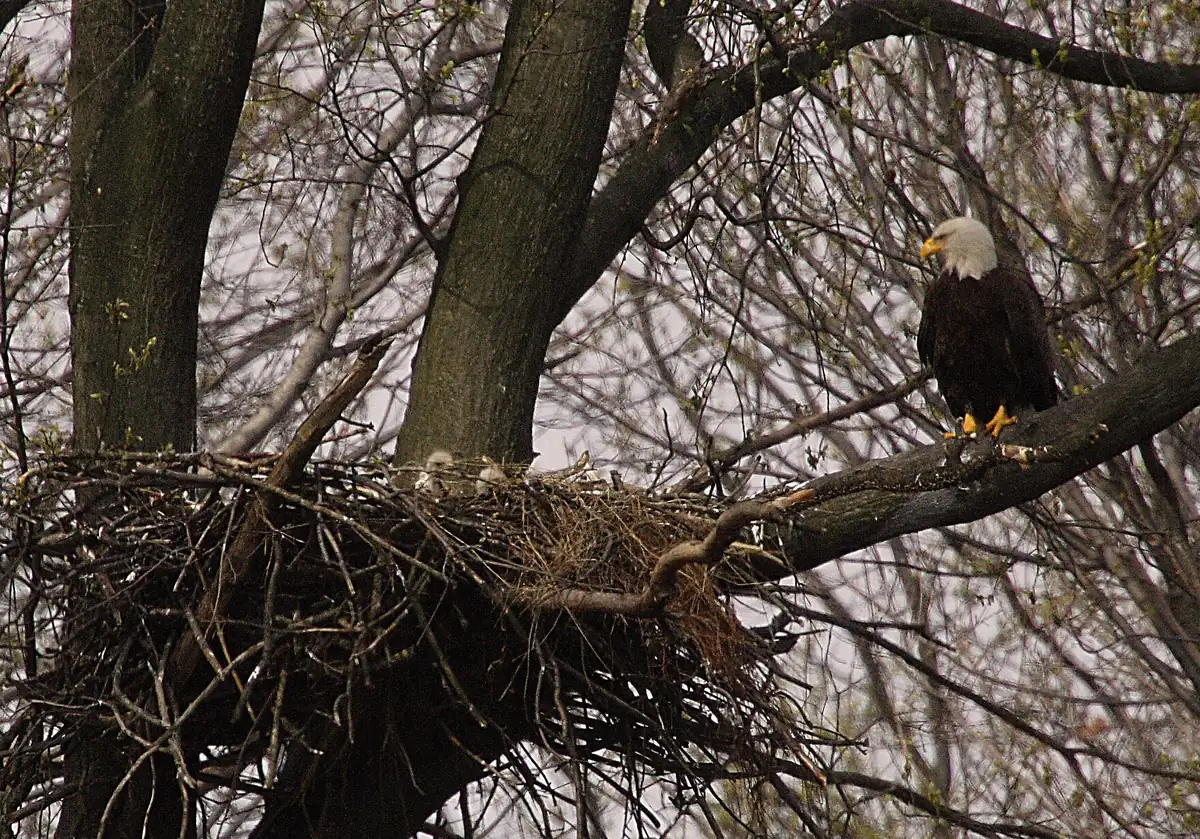
January was the month for laying; February is the month of patient sitting, and for the earliest pairs, of hatching. The table of nests in the state’s 2025 eagle report shows how spread out the season is. At Alloways Creek in Salem County, one pair was incubating by January 24 and had a chick on February 23, while other pairs only began sitting in February: Alloways Creek E on February 7, Avis Mill on February 11, Atlantic City on February 21 and Audubon, in Camden County, on February 24. So in February some nests hold eggs, a few hold chicks, and some pairs are still building.
-
The first chicks
From about the third week of February at the earliest nests; most hatch in March · Nests across the state, especially within a dozen miles or so of the Delaware River and Bay
Incubation lasts about 35 days, the New Jersey Conservation Foundation notes, and both parents share it. A newly hatched eaglet is a wobbly ball of gray down, and an adult keeps it covered most of the time in cold weather. From a distance the change shows in posture: a parent that used to lie flat in the bowl now stands at the rim and bends down to feed small bits of fish. In 2025, the three Duke Farms eaglets hatched on February 25, 27 and 28.
-
A record count, then a setback
Nesting season, January through July · Statewide; most nests on private land
New Jersey had just 11 active eagle nests in 1995. By 2024, state biologists and Conserve Wildlife Foundation volunteers had 264 nests with eggs. In 2025 the number dipped to 251, the first decline since the project began, and the share of nests that failed rose to 29 percent, well above the ten-year average of 20. The report links the drop to bird flu in the winter of 2024–25; half the eagles examined after death in 2025 carried it.
| Year | Active nests | Young fledged |
|---|---|---|
| 1995 | 11 | 19 |
| 2000 | 23 | 30 |
| 2005 | 48 | 64 |
| 2010 | 82 | 69 |
| 2015 | 150 | 199 |
| 2020 | 220 | 307 |
| 2023 | 255 | 309 |
| 2024 | 264 | 288 |
| 2025 | 251 | 271 |
Newly hatched chicks chill within minutes if an adult is flushed off the nest, so the 1,000-foot buffer that state nest monitors keep matters even more in February than in January. Watch from a car or a road shoulder with a scope, and if a bird stands up and stares at you, back away.
Where can you watch long-tailed ducks courting in New Jersey?
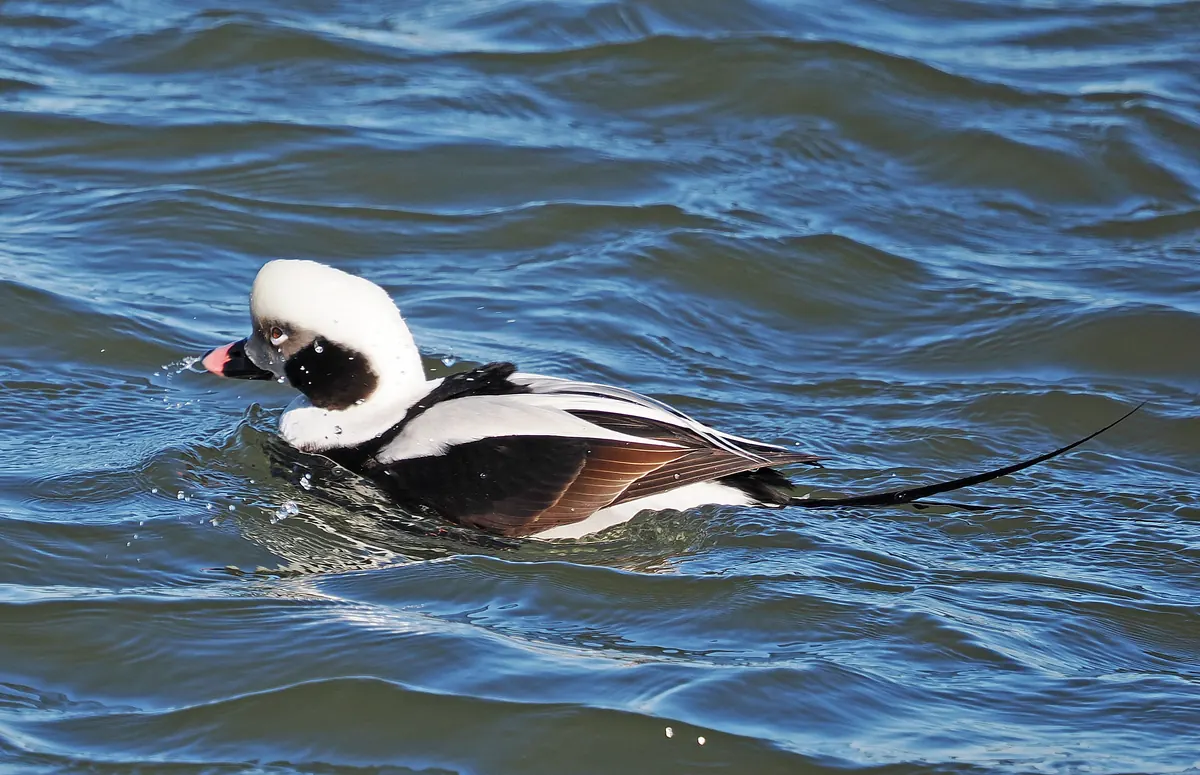
Out on the ocean, February is a noisy month. Long-tailed ducks winter along the whole Jersey coast, and as the days lengthen, the males begin to show off to the females in earnest. NJ Audubon’s Cape May Bird Observatory times a field trip each year to the peak of their courtship, which it places around Valentine’s Day.
-
Long-tailed ducks
All winter; courtship builds through February; flocks head north in March · Off the beaches and inlets from Sandy Hook to Cape May; Avalon, Stone Harbor and Cape May Point are reliable
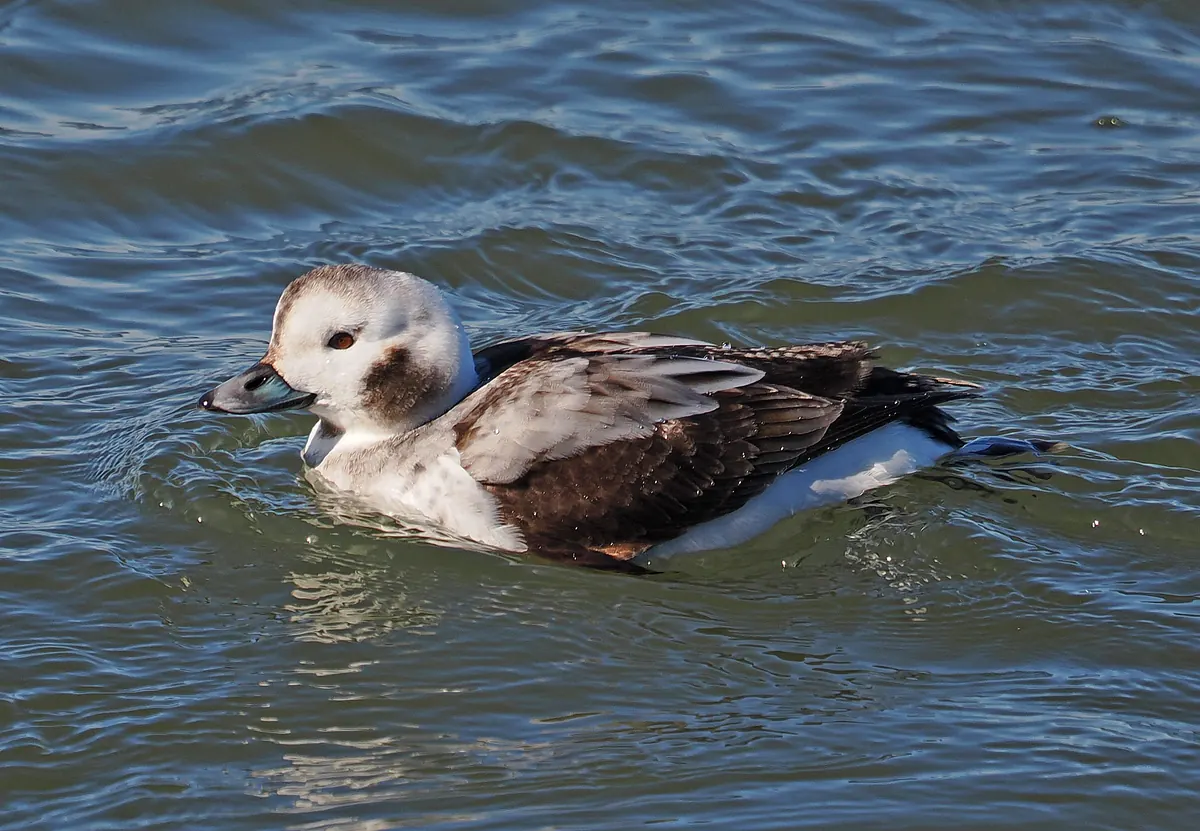
A winter male is mostly white with a dark chest, a pink band on the bill and two long, thin central tail feathers that he cocks upward when he displays. Audubon’s field guide describes the display as head-shaking, tail-raising and tossing the head straight back with the bill pointed at the sky, and the call as a musical, yodeling “ow-owdle-ow” repeated over and over, which carries surprisingly far over calm water. These are deep divers, reportedly able to go down more than 200 feet, deeper than any other duck. On March 4, 2023, the observatory’s spring migration count at Cape May Point tallied 455 of them moving past in a single day.
Bring a spotting scope, since most rafts sit beyond the breakers, and pick a calm morning when the calls carry. Scoters, red-breasted mergansers and horned grebes often share the same water.
What are the first signs of spring in New Jersey in February?
Spring in New Jersey starts low to the ground and in the wet places. Before any tree leafs out, a swamp plant flowers in the snow, and the first flocks of returning birds begin to sing from the cattails.
-
Skunk cabbage
Flowers from February, often with snow still on the ground · Swamps, spring-fed seeps, stream edges and wet wooded slopes statewide
NJ Fish & Wildlife counts skunk cabbage among the state’s earliest spring plants, blooming in February. The part you notice is a spotted, purplish hood poking out of the mud, curled around a rounded spike of tiny blossoms. It makes its own heat, and the state’s naturalist sheet puts the flowers at 27 to 63 °F above the air temperature, so snow often melts back around each hood. The smell, like spoiled meat, draws in early flies and bees as pollinators. Contractile roots pull the stem deeper into the mud each year, and the big cabbage-like leaves that come later, up to about 22 inches long, are one of the first foods a black bear eats after leaving the den. Flat Rock Brook in Englewood has a patch.
-
Robins and red-winged blackbirds
Building through late February · Marshes, wet fields and lawns; Cape May and the bayshore first
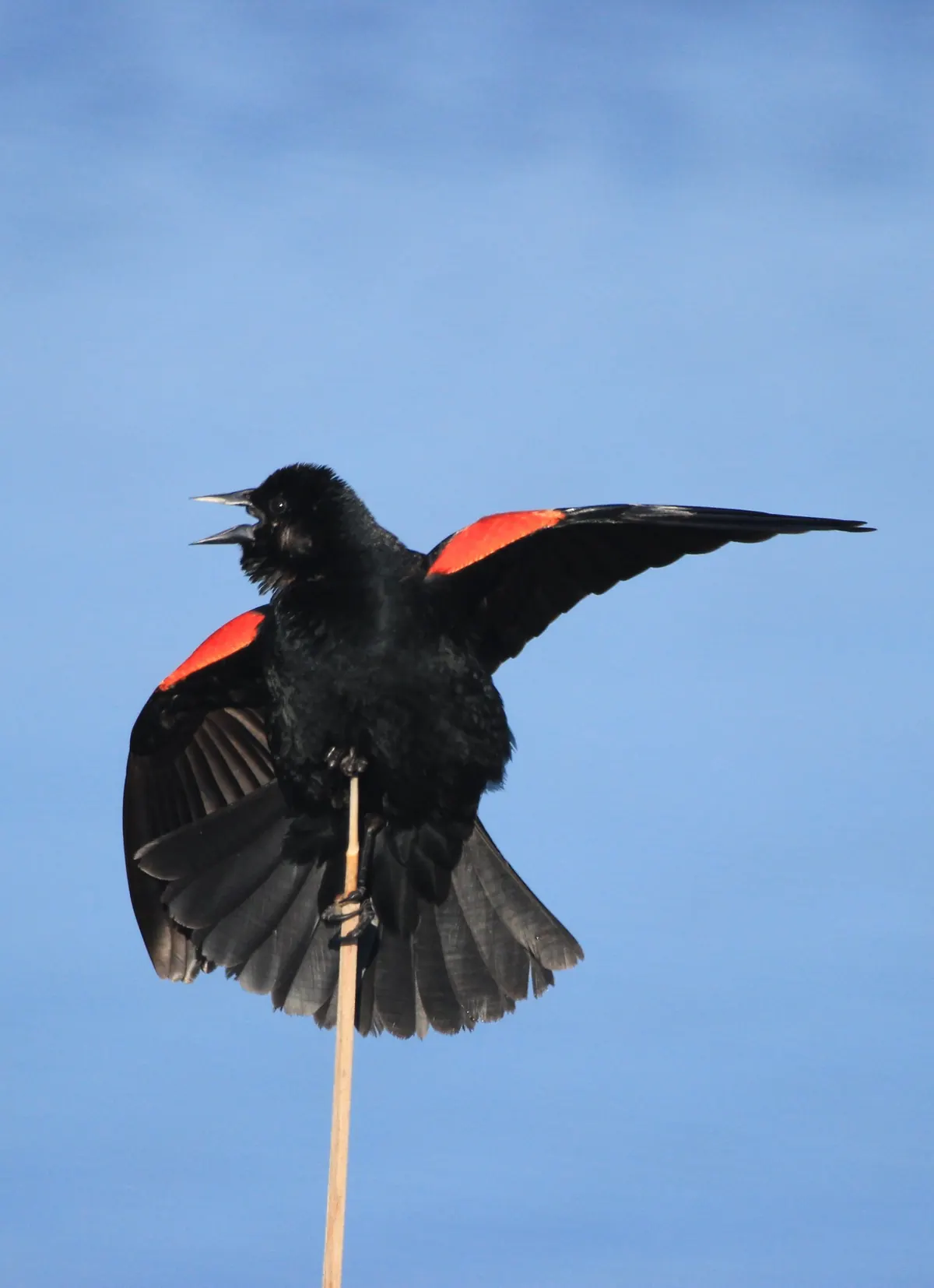
Robins and red-winged blackbirds grow more numerous and start to sing as February goes on. On a February 14, 2026, walk at Cape May Point, Cape May Bird Observatory naturalists tallied 165 red-winged blackbirds and 135 American robins, along with eight tundra swans and 20 yellow-rumped warblers. A male red-wing flaring his red shoulders on a cattail and calling “conk-la-ree” is as reliable a sign of the season’s turn as anything on the calendar.
Keep these firsts with their dates; after a few years, your “reading the signs” page shows whether spring is coming earlier where you live.
When do salamanders and frogs start migrating in New Jersey?
All winter, spotted salamanders, Jefferson salamanders and wood frogs wait underground or under leaf litter in the woods, some of them frozen solid. When the ground thaws and a warm rain falls after dark, they move all at once toward the vernal pools where they breed. The New Jersey Conservation Foundation says that can happen as early as February in a mild winter or as late as April, and that most of the movement is packed into three to six nights.
-
The big night
The first rainy or misty evenings in the mid-40s °F or warmer; February in a mild year, more often March · Roads that run between upland woods and seasonal pools, especially in Sussex and Warren Counties and elsewhere in the north
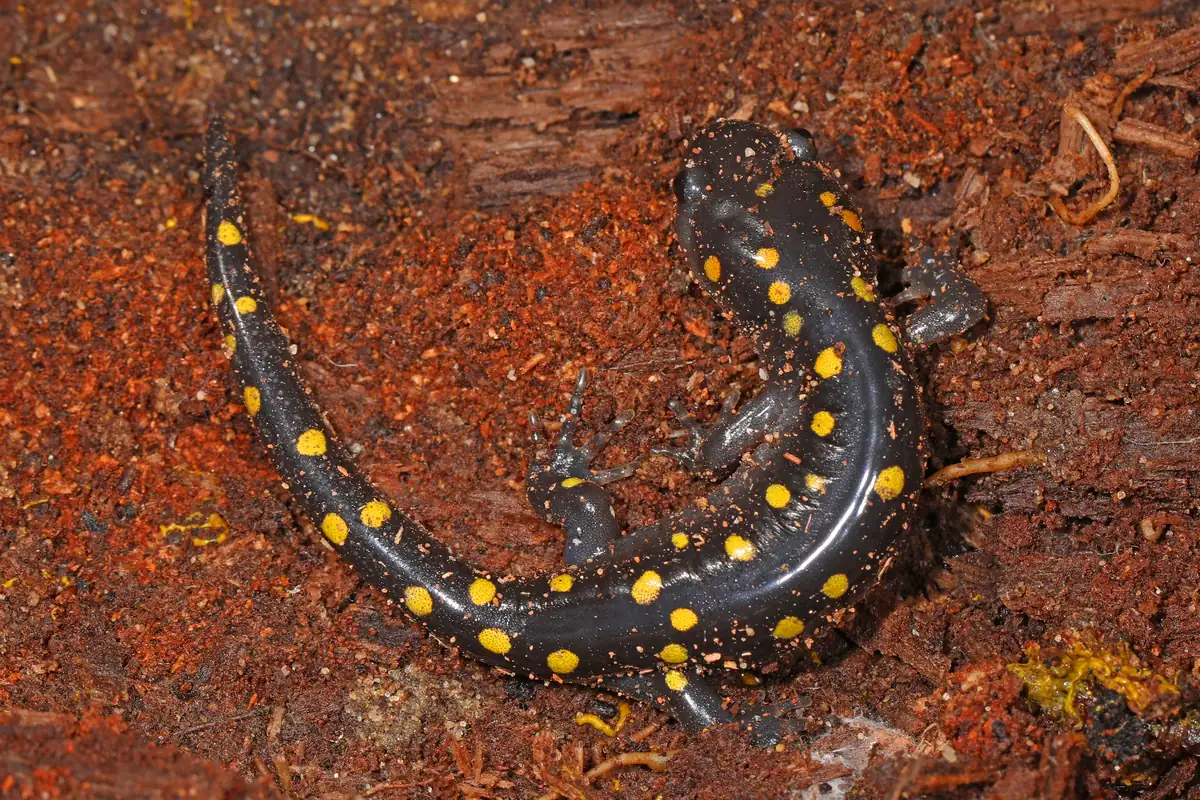
Often the first to move are spotted salamanders, dark bodies marked with paired yellow dots. Wood frogs follow, and their chorus sounds less like a frog than a flock of quacking ducks; males call by day and night. Spring peepers join them with a fast, high whistle. A single wood frog lays a mass of 1,000 to 3,000 eggs, and a peeper 750 to 1,200, so one good night at a pool sets up the whole year. Wood frogs and both of these mole salamanders depend on vernal pools, which are fishless because they go dry by summer.
-
Helping at a road crossing
Peak nights, called on short notice · Crossing sites organized by the Conserve Wildlife Foundation of New Jersey
Since 2002 the foundation and the state’s Endangered and Nongame Species Program have run volunteer crews that carry amphibians across busy roads, count them by species and record how many are killed by traffic. Its three main monitoring sites are at Waterloo, Swartswood and Hope, with more than ten other roads watched across the north. On one 2024 night at Swartswood State Park, volunteers moved 284 wood frogs, 15 spring peepers, three Jefferson salamanders, a spotted salamander and eight red-spotted newts.
If you can’t join a crew, you can still help: on a warm wet night, drive slowly on wooded back roads, watch for small shapes in the headlights, and move an animal across only if it is safe to stop, carrying it in the direction it was heading, with clean, wet hands.
When does the woodcock sky dance start in New Jersey?
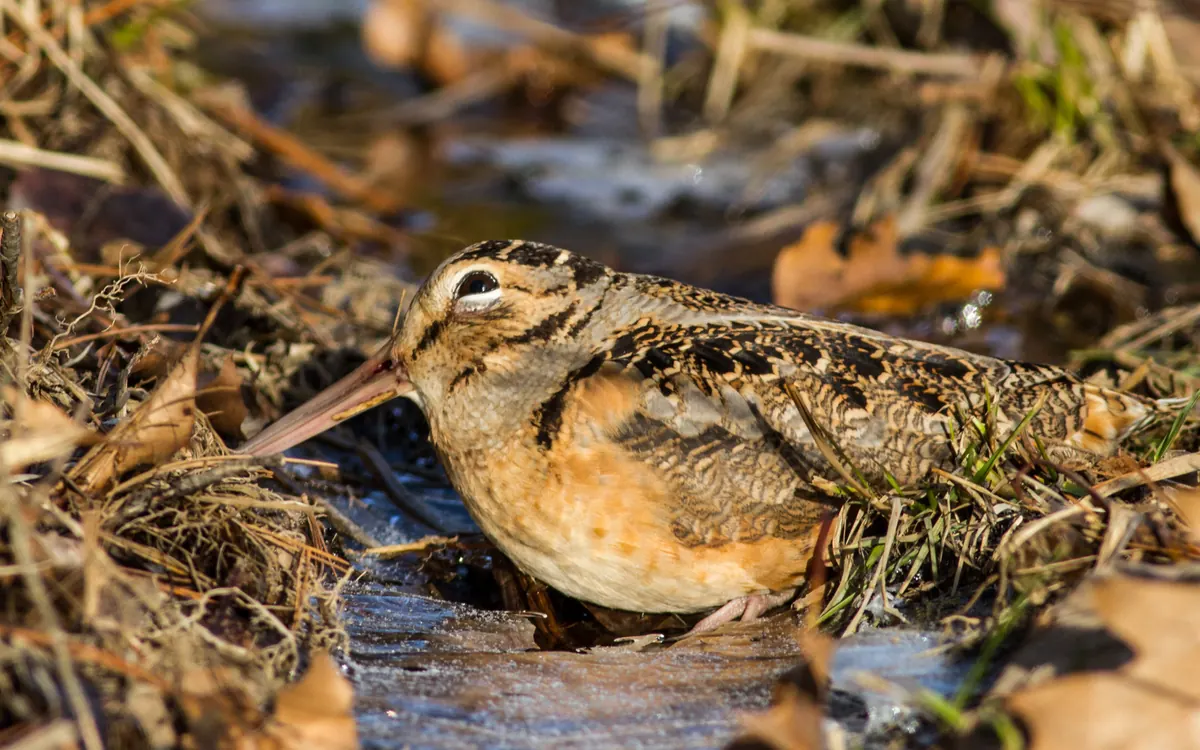
Picture a sandpiper that has given up beaches for brushy, damp woods: the American woodcock is round, short-legged and big-eyed, and it hunts earthworms by pushing its long bill into soft soil. In southern New Jersey it is a common migrant and a common winter visitor. Late winter mixes birds that wintered here with others already moving north from farther south.
-
Peenting at dusk
Late February into April, at dusk and again before dawn on calm days · Overgrown fields next to young woods; Negri-Nepote Native Grassland Preserve in Franklin Township, Somerset County; Cape May and the bayshore
NJ Audubon describes migrating woodcock stopping in New Jersey on their way north, where males put on an elaborate song and dance for the females. The show begins on bare ground, where the male gives a flat, insect-like “peent” at intervals of a few seconds. Then the bird bursts upward on twittering wings, spirals high over the field until it is a speck, and tumbles back down in a zigzag with liquid chirping notes, landing close to where it started. NJ Audubon has led evening woodcock walks at Negri-Nepote in late February and early March, and in 2026 the walks fell on February 27 and March 5; check with NJ Audubon for 2027 dates.
-
A hard winter for a worm eater
After snow and long freezes · Cape May peninsula especially
A woodcock that can’t push its bill into the ground can’t eat. After a storm on January 25, 2000, covered Cape May County in 6 to 15 inches of snow, ice and sleet, more than 400 dead or weakened woodcock were found around Cape May and West Cape May. Academy of Natural Sciences researchers estimated the birds had gone ten days or more without food, and they weighed about half the normal winter weight. The same thing happened in 2026: after a snowstorm on January 25 and a long hard freeze, more than 170 dead woodcock were collected around Cape May and given to a museum for study, the Cape May County Herald reported, and on the Cape May Bird Observatory’s February 14 walk, no one saw a single woodcock.
In a deep freeze, woodcock come out to feed on any bare, soft ground, including road shoulders and lawns. Drive slowly and leave them be; every flush costs a starving bird energy.
Can you make maple syrup in New Jersey, and when does the sap run?
Sap rises in maples during the short stretch between winter and spring, when a hard overnight frost gives way to a thawing afternoon, day after day. In New Jersey that usually begins in February, and the run stops when the buds swell and the sap turns bitter.
-
Red maple syrup in South Jersey
From February for a few weeks, depending on the weather · Stockton University in Galloway and partner hubs across South Jersey
The trees that dominate southern New Jersey are red maples, not sugar maples, and their sap holds about half as much sugar. Stockton University has been testing whether a syrup business can still work here, backed by federal grants. Its estimates vary: the state Department of Agriculture quoted 44 gallons of sap per gallon of syrup in 2022, while the New Jersey Conservation Foundation reported 50 to 60 gallons for red maples. The campus sugarbush taps about 400 red maples and made about 25 gallons of syrup in 2022.
-
Watching the sap run yourself
February weekends in past years; check with the organizer for 2027 · Somerset County Park Commission’s Environmental Education Center, Lord Stirling Road, Basking Ridge
The Park Commission’s maple program walks families half a mile from the center to a sugar shack in Lord Stirling Park, where staff show how to tap a tree, collect sap and boil it down. The outdoor program lasts about an hour, and tickets are sold on the day at the center. It has run on February weekends in past years; check with the commission for its 2027 dates before you go.
Red maples are easy to find in February even without leaves: look for red twigs, clusters of round red buds and smooth gray bark on young trees. Sketch one for “a tree through the seasons,” then visit again in March to catch its small red flowers, which open well before the leaves.
How much daylight does New Jersey gain in February?
The days lengthen faster in February than at any earlier point this winter. Newton, in Sussex County, has 10 hours 6 minutes of sun on February 1; by the 28th that is up to 11 hours 14 minutes, a gain of 68 minutes, and even Cape May, which started the winter with the most light, adds 62. Come February 28, Newton through Cape May all sit less than an hour short of 12-hour days. Groundhog Day lands on Tuesday, February 2, a little ahead of schedule: the real halfway mark between solstice and equinox falls on February 3 to 4. The rate is still rising: next door in New York City, the daily gain grows from about 2.2 minutes on February 1 to 2.7 minutes on the 28th.
| City | Feb 1 | Feb 28 | Gained | Per day |
|---|---|---|---|---|
| Newton | 10 h 06 m | 11 h 14 m | 68 min | 2.5 min |
| Newark | 10 h 07 m | 11 h 15 m | 68 min | 2.5 min |
| Trenton | 10 h 10 m | 11 h 15 m | 65 min | 2.4 min |
| Toms River | 10 h 11 m | 11 h 15 m | 64 min | 2.4 min |
| Camden | 10 h 11 m | 11 h 16 m | 65 min | 2.4 min |
| Atlantic City | 10 h 13 m | 11 h 17 m | 64 min | 2.4 min |
| Cape May | 10 h 15 m | 11 h 17 m | 62 min | 2.3 min |
The northern towns keep catching up with the southern ones all month. Plug your own town into the daylight tool to see its sunrise, sunset and dusk on any February day.
Is February New Jersey’s snowiest month, and what could El Niño bring?
By NOAA’s 1991–2020 normals, February averages more snow than January at Newark (10.1 inches against 9.1), New Brunswick, Trenton, the Pine Barrens station at Indian Mills, Atlantic City and Cape May, which makes it the snowiest month of the year at most of the state’s main stations. The exception is the cold northwest: the Sussex station averages 9.9 inches in February but 11.6 in January. The medians, the amount half of all Februaries fall short of, sit well below the averages, because a few big storms carry much of the long-term total.
| Station | High | Low | Nights ≤ 32 °F | Nights ≤ 10 °F | Precipitation | Snowfall, average | Snowfall, median |
|---|---|---|---|---|---|---|---|
| Sussex 3 WNW (Skylands) | 38.0 | 17.9 | 26.0 | 6.4 | 2.72 | 9.9 | 4.5 |
| Newark International Airport | 43.0 | 27.2 | 20.0 | 1.0 | 2.98 | 10.1 | 5.4 |
| New Brunswick 3 SE (Central Jersey) | 42.8 | 24.0 | 23.6 | 2.3 | 2.97 | 9.3 | 5.8 |
| Trenton Mercer County Airport | 42.8 | 25.9 | 22.1 | 1.1 | 2.65 | 8.7 | 4.5 |
| Indian Mills 2 W (Pine Barrens) | 45.0 | 24.4 | 22.2 | 2.4 | 3.01 | 8.9 | 5.5 |
| Atlantic City International Airport | 45.8 | 26.2 | 21.5 | 1.5 | 3.23 | 5.9 | 3.4 |
| Cape May 2 NW | 45.2 | 29.4 | 17.9 | 0.4 | 2.97 | 5.7 | 3.4 |
Warm water spreading across the equatorial Pacific points to a big El Niño: on September 10, NOAA’s Climate Prediction Center judged a very strong peak this winter more than 90 percent likely. Mid-October brings NOAA’s first official winter outlook, with fresh maps every month after; check the three-month outlook maps.
In NOAA and the Northeast Regional Climate Center’s summary of El Niño winters, storms riding the southern jet stream often track northeast along the coast, which tends to leave the East Coast with more rain and snow than usual; in the record-strength event of 2015–16, the Mid-Atlantic had above-normal snowfall while New England had less. What that means for one February varies a lot. February 2016, at the height of that El Niño, ran 1.8 °F above the normal of the time and was snow-poor at 5.1 inches statewide, the state climatologist’s office found, yet it held a brutal morning: on February 14 the air fell to −14 °F at the High Point Monument, where the wind chill reached −46, before Woodbine reached 68 °F on the 21st and Cherry Hill did the same on the 24th. February 2024, during the strong El Niño that followed, was the 14th mildest and 12th driest since 1895, though two quick storms on the 13th and the 16th to 17th left 13 inches or more in Sussex and Hunterdon Counties while the south got little. And in the El Niño winter of 2009–10, February buried the state: West Milford measured 62.6 inches and Vineland 59.4, both above the old state monthly record of 50.1 inches from 1880, which was under review at the time. None of these is a forecast for 2027.
For the next few days, use our local forecast page; for clear spells on planet nights, check the cloud cover forecast; and for the usual last spring freeze where you garden, see our New Jersey frost dates.
What can you see in the New Jersey night sky in February 2027?
Times are Eastern Standard Time; daylight saving time doesn’t start until March 14. This is a planet month, with two oppositions in Leo eight days apart. Moonless evenings, roughly the 2nd through the 11th, favor dim stars and star clusters.
-
Mercury at dusk
Late January to about February 10; greatest elongation 1 a.m. Wednesday, February 3 · Very low in the west-southwest, 30 to 45 minutes after sunset
This is Mercury’s best evening showing of the winter, at 18 degrees from the Sun. A flat western horizon, like the beach at Cape May Point, helps. One more pairing comes on Sunday, February 7, when a slim crescent barely a day old hangs just beside the planet, low in the afterglow. Wait until the Sun is fully down before using binoculars.
-
Jupiter at opposition
7:21 p.m. Wednesday, February 10 · Up in the east at dusk, high in the south by midnight
With our planet passing between it and the Sun, Jupiter stays in view all night and peaks in brightness for the year, about magnitude −2.5, some 405 million miles away. Binoculars pick out the four big moons, rearranged each evening; a small telescope shows the two darker belts of cloud. The almost-full Moon sweeps very close to Jupiter overnight from the 19th into the 20th.
-
Mars at opposition
Friday, February 19; closest to Earth February 20 · Rising in the east around sunset, in Leo near the star Regulus
Mars reaches opposition about 10 a.m. on the 19th, and on the 20th it is at its nearest, roughly 63 million miles from us. Mars is nearly at aphelion (the outermost bend of its orbit), which makes this a modest opposition: the planet looks orange and bright, around magnitude −1.2, but tiny in a telescope. Compare its steady, ruddy light with white Regulus nearby, and with Jupiter, which outshines both.
-
The Snow Moon and a faint eclipse
Full at 6:23 p.m. Saturday, February 20; eclipse greatest at 6:13 p.m. · Rising in the east-northeast around 5:30 p.m.
The full moon of February 20 slips through the pale outer fringe of Earth’s shadow, the penumbra, and misses the dark umbra completely, so this eclipse is subtle at best. It has already begun when the Moon clears the horizon (5:32 p.m. in New York City, a few minutes either way across New Jersey). The deepest moment is 6:13 p.m. and it is all over by 8:13 p.m. Eastern states get the country’s best look, but the Moon will hang low in a bright dusk sky, and the most a sharp-eyed watcher can hope for is a smudge of gray along one edge of the Moon, and many will notice nothing. Later that evening the Moon, Jupiter, Regulus and Mars crowd into the same patch of sky. (February 6 also brings an annular solar eclipse, but its path lies over the Southern Hemisphere and Africa, far out of New Jersey’s view.)
| Phase | Date | Time |
|---|---|---|
| Last quarter | Friday, Jan 29 | 5:55 a.m. |
| New moon | Saturday, Feb 6 | 10:56 a.m. |
| First quarter | Sunday, Feb 14 | 2:58 a.m. |
| Full moon, the Snow Moon | Saturday, Feb 20 | 6:23 p.m. (penumbral eclipse at moonrise) |
| Last quarter | Sunday, Feb 28 | 12:16 a.m. |
| New moon | Monday, Mar 8 | 4:29 a.m. |
Early risers still get brilliant Venus low in the southeast; Saturn, meanwhile, sinks a bit lower into the southwestern dusk week by week. For moonrise and moonset on every night, open our moon phase calendar.
What are good February nature outings for New Jersey families?
- February 12–15: the Great Backyard Bird Count. Birds Canada, a partner in the count, gives the 2027 dates as Friday through Presidents’ Day Monday. Watch for 15 minutes or more at a feeder, park or beach, then enter what you saw in eBird or the Merlin app; one session is enough to take part.
- Saturdays, February 6, 13, 20 and 27: Birding Cape May Point. NJ Audubon’s two-hour morning walks start at 8 a.m. ($8 members, $12 others; register ahead).
- February 13: Longtails in Love. A noon to 4 p.m. trip from Avalon to Cape May to see long-tailed ducks courting, plus scoters, eiders and grebes ($20 members, $25 others; scopes recommended).
- Sundays, February 21 and 28: Nightfall at Jake’s Landing. A 4:30 p.m. walk to dusk where woods meet salt marsh near Woodbine, looking for northern harriers, short-eared owls and great horned owls ($8 members, $12 others).
- February 27: Birding on the Barrier Islands. An afternoon on Seven Mile Island, 1 to 4 p.m., with up to two miles of walking on sand and boardwalk ($20 members, $25 others).
- Early February: Cumberland County Winter Eagle Festival. In past years the county has held it on a Saturday at the start of the month (February 1 in 2025), based at the Mauricetown firehall, with live raptors, staffed scope sites along the bayshore and owl watches; ask the county before planning a trip around it, since no 2027 date has been announced.
- February weekends: maple sugaring in Basking Ridge. The Somerset County Park Commission’s sugar shack program has run on February weekends in past years; check with the organizer for 2027 dates.
- From home: hatch watch. Follow the Duke Farms eagle camera and write down the date and time the first chick appears.
Project FeederWatch keeps running through April. To compare months, open January in New Jersey or the full set of state guides in our nature collection; the pages named throughout come from the Naturalist’s Field Journal.
Safety notes for February in New Jersey
- Deer. In the 2026–27 Hunting and Trapping Digest, the winter bow season stays open through February 20 under all three regulation sets, and permit shotgun and muzzleloader deer hunting also continue to February 20 in the High set (permit shotgun in the Low set too). Check the digest’s zone map for the land you plan to walk.
- Small game and birds. Rabbit, hare and gray squirrel seasons run to February 20, pheasant and chukar to February 15, and raccoon (at night) to March 1. Coyote and fox can be hunted by day and at night through March 15. Light geese stay open to March 8, a special winter Canada goose season runs February 1–15 in mapped areas only, crow hunting continues on Mondays, Thursdays, Fridays and Saturdays to March 20, and Saturday, February 6, is a joint waterfowl day for youth, veterans and active military.
- Hunter orange. With a gun, a deer, small game or upland bird hunter needs either a cap that is entirely fluorescent orange or an outer layer carrying 200 square inches or more of that color, showing from every side. Waterfowl, crow and turkey hunters, night coyote and fox hunters and, outside the six-day firearm season, bowhunters are exempt. Walkers on wildlife management areas should put on bright orange too, and a vest on the dog.
- Sundays. Hunting with a gun is generally banned on Sundays (raccoon and opossum hunters may stay out from 12:01 a.m. until an hour before Sunday sunrise, and shooting preserves have their own rules), and no hunting of any kind takes place in state parks and forests that day. Bowhunting for deer is legal on Sundays on private land and wildlife management areas.
- Traps. Trapping for beaver, coyote, foxes, mink, muskrat and raccoon runs to March 15; otter closes February 9. Keep dogs on a leash along marsh edges, creeks and wildlife management areas.
- Late-winter ice. A thaw and a refreeze leave ice gray, layered and weak even where it looks thick. NJ Fish & Wildlife’s guide calls 2 inches or less unsafe and asks for at least 4 for ice fishing; stay off ice near inlets, springs and stream mouths, and off any lake after a few days above freezing.
- Storms and cold. February nor’easters can bring heavy, wet snow inland and flooding at high tide on the barrier islands and the bayshore. Check tide times before a coastal walk.
- Amphibian nights. Leave road rescues to organized crews at their marked sites, and never stop in traffic or on a blind curve for a salamander.
- Sick or dead birds. Bird flu has killed eagles and waterbirds here; report sick or dead birds to NJ Fish & Wildlife rather than touching them.
Sources
- NJ Fish & Wildlife and Conserve Wildlife Foundation: New Jersey Bald Eagle Project Report, 2025 (PDF)
- Duke Farms: Eagle Cam (2025 hatch dates, 2026 clutch)
- New Jersey Conservation Foundation: The domestic duties of New Jersey’s winter raptors (incubation)
- Conserve Wildlife Foundation of NJ: Bald Eagle Project
- NJ Audubon: Longtails in Love (February 13, 2027)
- Audubon Guide to North American Birds: long-tailed duck
- NJ Audubon: Cape May Springwatch, early-March update (March 17, 2023)
- NJ Fish & Wildlife: Ask a Naturalist, skunk cabbage (PDF)
- Flat Rock Brook Nature Association: Spring never smelled so... gross? (skunk cabbage)
- NJ Audubon: Birding Cape May Point, February 14, 2026 (trip report)
- New Jersey Conservation Foundation: Amphibians on the move! (March 18, 2021)
- Conserve Wildlife Foundation of NJ: Amphibian Crossing Project
- Conserve Wildlife Foundation of NJ: Exploring New Jersey’s amphibian migrations (March 27, 2024)
- NJ Audubon: Timberdoodles, the American woodcock (program and 2026 woodcock walks)
- Rice, Sharp and Lehman: American Woodcock Winter Mortality in Southern New Jersey, Cassinia 69 (Delaware Valley Ornithological Club) (PDF)
- Cape May County Herald: Over 170 American woodcock killed by week-long freeze (2026)
- New Jersey Conservation Foundation: Sweet! South Jersey taps its maple syrup potential (February 2, 2023)
- New Jersey Department of Agriculture: maple sugaring and the Stockton University red maple project (March 18, 2022)
- Stockton University: Tapping into South Jersey maple trees (2020)
- Somerset County Park Commission: Environmental Education Center, maple sugaring
- NOAA NCEI: monthly climate normals 1991–2020, February values for New Jersey stations
- NOAA NCEI: monthly snowfall normals 1991–2020, January to December, for the seven New Jersey stations
- Office of the New Jersey State Climatologist: February 2016 summary
- Office of the New Jersey State Climatologist: February 2024 summary
- Office of the New Jersey State Climatologist: February 2010 summary
- NOAA and Northeast Regional Climate Center: El Niño impacts and outlook, Northeast region (PDF)
- Climate Prediction Center: Oceanic Niño Index, historical El Niño and La Niña episodes
- Climate Prediction Center: ENSO diagnostic discussion, September 10, 2026
- Climate Prediction Center: seasonal (90-day) outlooks
- U.S. Naval Observatory: moon phases API (December 2026 to March 2027)
- U.S. Naval Observatory: Earth’s seasons, 2027 (solstice and equinox times)
- Fred Espenak, Sky Event Almanac 2027 (Mercury, Jupiter and Mars oppositions, Moon pairings)
- Sea and Sky: astronomy calendar of celestial events, 2027
- NASA Goddard: lunar eclipses 2021–2030 (penumbral eclipse of February 20, 2027)
- NASA Goddard: solar eclipses 2021–2030 (annular eclipse of February 6, 2027)
- Old Farmer’s Almanac: eclipses (February 20, 2027, visibility)
- Birds Canada: Great Backyard Bird Count (February 12–15, 2027)
- NJ Audubon: events calendar, February 2027
- NJ Audubon: Birding Cape May Point (Saturday walks, February 2027)
- NJ Audubon: Nightfall at Jake’s Landing (February 21 and 28, 2027)
- NJ Audubon: Birding on the Barrier Islands (February 27, 2027)
- Cumberland County: Winter Eagle Festival (2025 listing; 2027 date not yet posted)
- Project FeederWatch: how to participate
- New Jersey Hunting & Trapping Digest 2026–27: deer hunting seasons
- New Jersey Hunting & Trapping Digest 2026–27: small game hunting
- New Jersey Hunting & Trapping Digest 2026–27: upland game birds
- New Jersey Hunting & Trapping Digest 2026–27: migratory bird seasons
- New Jersey Hunting & Trapping Digest 2026–27: trapping regulations
- New Jersey Hunting & Trapping Digest 2026–27: general regulations (hunter orange, Sunday hunting)
- NJ Fish & Wildlife: ice fishing safety tips (PDF)
- National Weather Service, Mount Holly (Philadelphia) forecast office
- National Weather Service, New York (Upton) forecast office
- Photos via Wikimedia Commons; licenses and photographers are credited under each picture
