What to look for in nature in New Jersey this January
January is the coldest month in New Jersey, from the Sussex County valleys to Cape May, and also the month when the year’s first families begin. Bald eagles settle onto their eggs, often by the middle of the month, great horned owls take over old hawk nests, and in dens in the northern hills, mother bears give birth to cubs that each weigh about eight ounces. On the coast, tens of thousands of brant graze the back bays, tundra swans float on the flooded bogs at Whitesbog, and young gray and harp seals from the north haul out on the beaches. After dark, the Quadrantids streak across a moonless sky late on January 3, and on the 22nd the Wolf Moon becomes the nearest full moon of the year. The guide below runs region by region.
Other months in New Jersey: October, November, December, February.
Start here
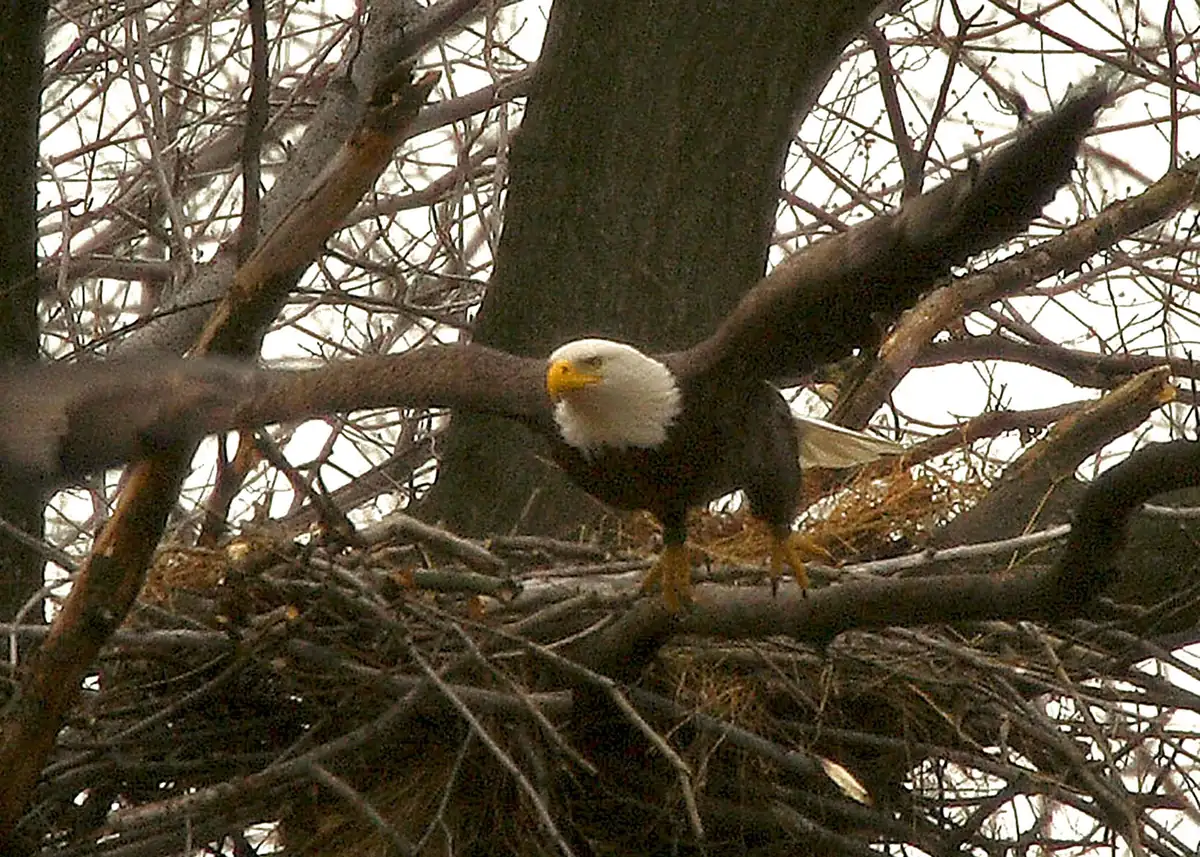
- Check the Duke Farms eagle nest. The live camera on the Raritan River in Hillsborough looks into a nest about 80 feet up a sycamore. In January 2026 the female laid three eggs between the 13th and the 18th, so the first eggs of 2027 could come in the same week. You can watch from home, any hour.
- Find the swans at Whitesbog. The old cranberry bogs in Brendan T. Byrne State Forest hold wintering tundra swans whenever some water stays open. Bring binoculars and scan the far edges of the flooded bogs.
- Go out for the Quadrantids. This shower is short and sharp, and in 2027 it falls on a moonless evening and a nearly moonless night: late Sunday, January 3, into dawn on Monday, January 4. Pick the darkest field you can reach and give it at least an hour.
For the Naturalist’s Field Journal in January: start a “nest observed” page the day a local eagle pair begins sitting tight, add a pair of great horned owls duetting at dusk to “a map of sounds,” draw the camouflage bark of a sycamore on “a tree through the seasons,” and log brant, swans and the first birds of the new year on “birds I have seen.”
Regions used below: Skylands and the Kittatinny Ridge; Gateway and the Watchungs; Central Jersey and the Delaware Valley; Pine Barrens; Jersey Shore; Cape May and the Delaware Bayshore.
When do bald eagles lay eggs in New Jersey, and where do they gather in winter?
After a month of stick-carrying, January is when New Jersey’s eagle pairs commit. The state’s 2025 eagle nesting report, compiled by state biologists and Conserve Wildlife Foundation volunteers, estimates that incubation began at the earliest nests as early as January 7, with many more starting in the first three weeks of February. Visiting eagles from the frozen north swell the numbers at the same time.
-
Eggs in the nest
The earliest clutches in early to mid-January; most pairs by late February · Nests statewide, thickest along the Delaware River and Bay; the Duke Farms nest on the Raritan in Hillsborough
Once eggs are laid, one adult lies low in the bowl with only its white head above the rim, and the pair trade places through the day. The New Jersey Conservation Foundation notes that both parents incubate, for about 35 days, and that a clutch is one to three eggs. At Duke Farms, the female on the camera has now laid three eggs three years in a row; in 2026 they appeared on January 13, 15 and 18. In 2025 all three hatched between February 25 and 28.
-
Wintering eagles at open water
Arriving in December; concentrations peak in January and February, thinning by mid-March · The Delaware River from the Water Gap upstream; reservoirs and tidal rivers wherever ice leaves open water
Eagles from Canada and New England that cannot fish through ice drift south to rivers that keep flowing. The National Park Service says the Upper Delaware, the stretch of river above New Jersey along the New York and Pennsylvania border, draws about 150 to 200 wintering eagles each year, which are most active at first light and again toward dusk. Downstream, the Delaware Water Gap National Recreation Area describes the river valley as important winter habitat for a large population of bald eagles, so the New Jersey river accesses in Sussex and Warren Counties are worth a slow, cold morning drive. In the south, the tidal Maurice River and the Cumberland County marshes hold both nesting pairs and visitors.
Watch from at least 1,000 feet, which is the distance state volunteers keep from nests, and stay in your car near a roost or feeding spot: the Park Service points out that eagles tolerate vehicles far better than people on foot. A pair flushed off eggs in freezing weather can lose the clutch in minutes.
When do great horned owls nest in New Jersey?
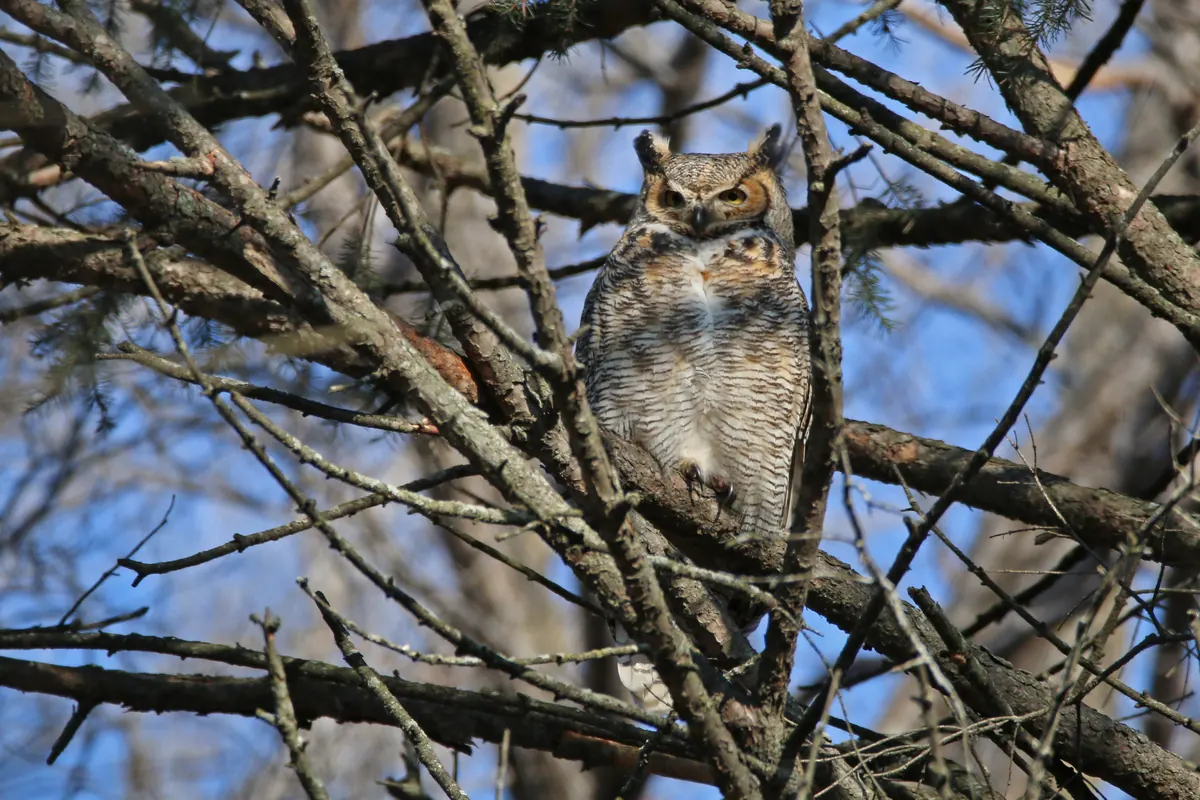
The deep hooting that started in December becomes a sign of a settled pair by January. Few New Jersey birds lay eggs as early as great horned owls do, and by the end of the month many females are already sitting on eggs while snow still lies in the woods.
-
Great horned owls on eggs
Mating through January into early February; eggs from late January; hatching in March · Woodlots, river corridors, parks and quiet suburbs statewide
This owl builds nothing. It moves into a ready-made platform, most often an old red-tailed hawk nest, or uses a broken-topped tree, a cavity or a ledge. According to the New Jersey Conservation Foundation, the female lays one to four eggs and incubates them alone for about five weeks, while the male hunts for both of them. The young depend on their parents well into the fall. If you know a hawk nest from last summer, look at it again in late January: two ear tufts poking above the rim are the giveaway.
-
How to hear them
The half hour after sunset, on calm, dry evenings · Any wood edge with big trees
Stand still and listen for a soft, stuttering series of five or so low hoots. When both birds are calling, the male’s voice is noticeably deeper than the female’s, even though she is the larger bird. Screech owls whinny and trill from yards, and barred owls in wet woods call their rhythmic “who cooks for you.”
Keep a good distance from a nesting owl and leave recordings at home; playing owl calls can draw a male away from the nest and stress the pair. Mark the spot where you hear a duet on your “map of sounds.”
Where do brant and tundra swans spend the winter in New Jersey?
The Midwinter Waterfowl Survey has tallied wintering ducks, geese and swans across the Atlantic Flyway states since 1955, usually starting in the first week of January. In the U.S. Fish and Wildlife Service’s database, New Jersey’s counts are flagged as comparable from year to year for two birds in particular, Atlantic brant and tundra swans, and both are easy to find this month.
-
Atlantic brant
All winter; feeding on lawns and fields more as the winter goes on · Barnegat Bay, Great Bay and the Forsythe impoundments; back bays south to Cape May; waterfront parks and golf courses
The Atlantic Flyway’s brant management plan put the core of the species’ winter range between Cape May and northwestern Long Island, with roughly 85 percent of the population in that short stretch of coast. The midwinter count is the only measure of how many brant there are, so the January flights over New Jersey’s bays matter far beyond the state. Brant once lived mainly on eelgrass, but a disease devastated Atlantic eelgrass in the 1930s, and they now depend chiefly on sea lettuce and, more and more, on the grass of lawns and playing fields. That reliance has a cost: in the winter of 1977–78, a failed sea lettuce crop and severe cold together starved about two-thirds of the brant wintering on the coast. In a hard January, look for flocks grazing ballfields close to the bay.
-
Tundra swans
Usually from December into March, as long as some water stays open · Whitesbog, in Brendan T. Byrne State Forest near Browns Mills; also coastal impoundments
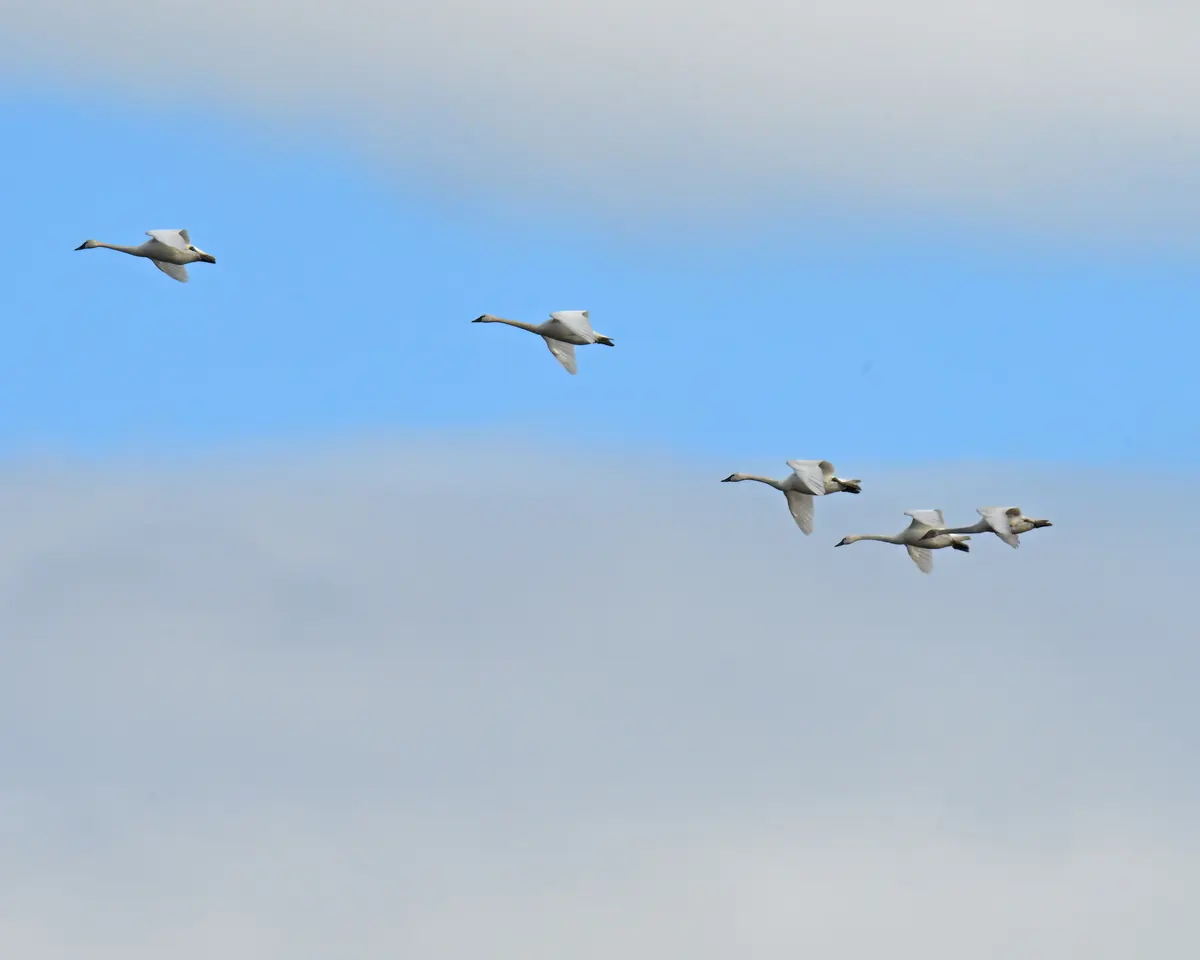
NJ Audubon’s Pine Barrens guide calls tundra swans reliable winter visitors at Whitesbog, the historic cranberry and blueberry village whose old bogs are now part of the state forest. These are Arctic nesters, pure white with black bills (many show a yellow fleck near the eye), and they give a soft, high whooping that carries across the bogs. They usually rest far out, so a scope helps. A five-mile driving tour with numbered posts winds through the bogs, and the area is open from dawn to dusk.
When ice seals the freshwater pools, ducks crowd into the last open water and the tidal creeks, which can make a cold snap the best birding of the winter. Note the date and count of your largest flock on a “birds I have seen” page.
When are seals easiest to see in New Jersey, and what if you find one on the beach?
Harbor seals have been back since November, but January is when the season fills out. Gateway National Recreation Area’s seal guide for Sandy Hook puts the main season in the winter months, and newcomers from farther north join the residents.

-
Harbor seals at Sandy Hook
Peak from December through March; best at low tide · Skeleton Hill Island in Sandy Hook Bay; the rocks off Officers’ Row at Fort Hancock
At low tide the seals pull out onto sand and rock to rest, digest and warm up, lying in curved, banana-shaped poses with head and tail raised. The New Jersey Conservation Foundation recommends visiting at low tide and using binoculars or a long lens, never walking closer. Federal rules under the Marine Mammal Protection Act call for staying at least 150 feet away, and farther if a seal lifts its head to watch you.
-
Gray seals and Arctic visitors
Gray seals mostly in January and February; harp, hooded and ringed seals now and then · Beaches and jetties along the whole coast
Gray seals give birth from mid-December to early February, NOAA Fisheries says, on islands off Maine and Massachusetts. A pup is fed for only a couple of weeks, and then it is on its own, so the young gray seals that turn up on New Jersey beaches in January and February are often first-winter animals finding their way. Some young seals travel hundreds of miles to get here, and rarer harp, hooded and ringed seals from the Arctic sometimes appear as well. A gray seal has a long, horse-like face; a harbor seal’s is short, like a puppy’s.
-
A seal on the sand
Any day of the winter · Ocean and bay beaches
A seal lying on the beach is usually resting, not stranded. Keep people and dogs well back, don’t pour water on it or try to push it to the sea, and call the Marine Mammal Stranding Center in Brigantine on its 24-hour hotline, 609-266-0538, if the animal looks hurt, thin or tangled, or if people are crowding it.
The American Littoral Society, based at Fort Hancock, usually leads a few guided seal and waterfowl walks on Sandy Hook between January and March, by advance registration; check its calendar for the 2027 dates. Back home, sketch the seals’ postures on a “mammal watch” page.
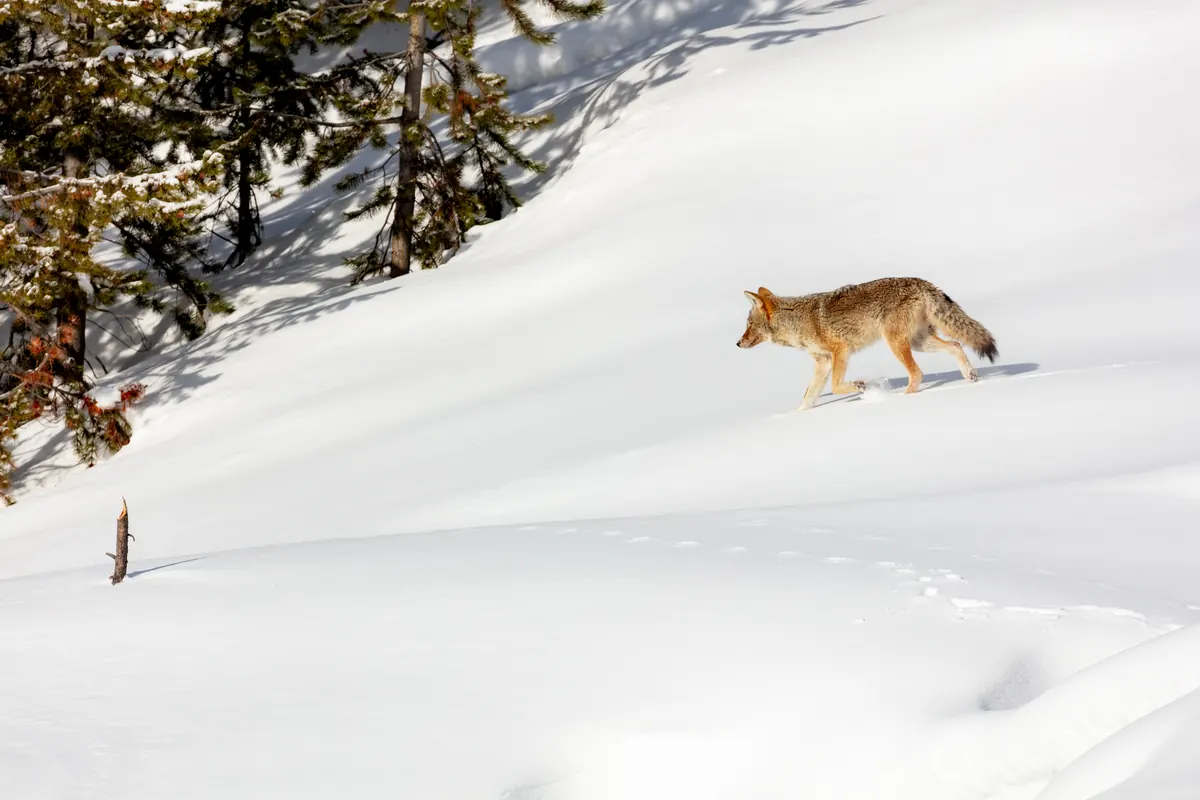
What are bears and coyotes doing in New Jersey in January?
Two of the state’s largest mammals do their most important business in January, one hidden underground and one loudly in the open.
-
Bear cubs born in the den
January · Dens in rock crevices, hollow trees, brush piles and ground nests, mostly in the northwestern counties
According to NJ Fish & Wildlife, the state’s black bear cubs arrive in January, blind and thinly furred and about eight ounces each, and nurse on their mother’s milk while she stays in the den. A sow can have one to six cubs, but three is the state’s average. Bears are not true hibernators and can stir on mild days. The family usually stays put until April. Give any den you come across a wide berth, and keep dogs leashed in bear country.
-
Coyotes courting
Breeding mostly in January and February; pups born in April or early May · Statewide, from the Pine Barrens and farm country to suburban edges
NJ Fish & Wildlife’s fact sheet on the eastern coyote explains that the family groups of summer and fall break up by early winter and the adults pair off to breed once a year, in January and February. During this midwinter season coyotes are seen and especially heard more than at almost any other time. New Jersey males usually weigh 35 to 40 pounds, more than western coyotes, and their coats run from gray-tan to nearly black, but the bushy tail, black-tipped and with a dark spot about a third of the way down, is a reliable mark. Gestation is about nine weeks, and litters average about six pups.
If fresh snow falls, follow a line of coyote or fox prints across a field and draw the trail on your “tracks to know” page, using a glove to show the size of one print.
How can you tell New Jersey trees apart in winter?
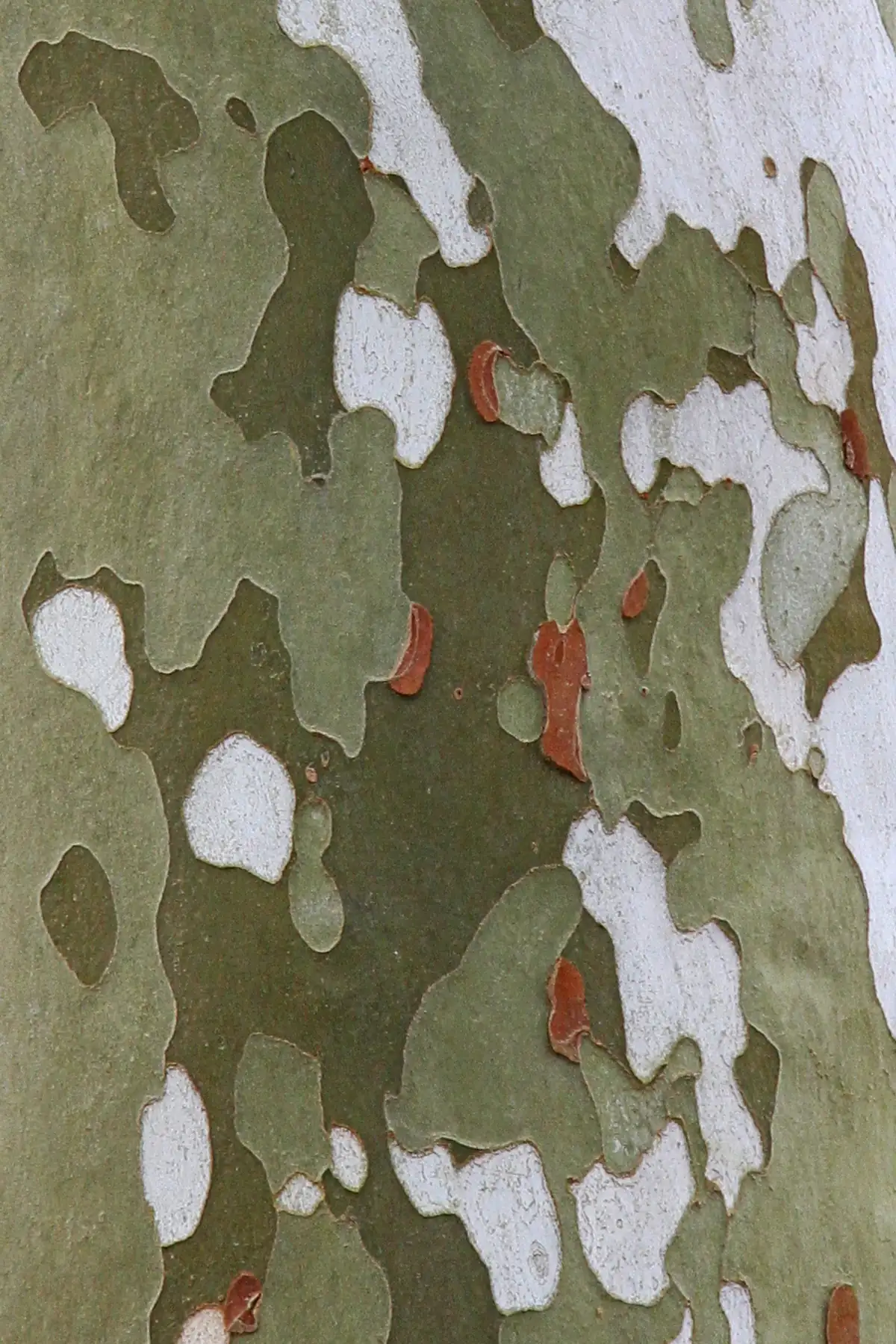
Bark, buds and leftover fruit name these three common trees in January; details follow Virginia Tech’s dendrology fact sheets.
-
American sycamore
All winter; seed balls break apart in late winter · Stream banks and river floodplains statewide, including the Raritan at Duke Farms
The upper trunk and limbs peel in patches of white, green, tan and brown, the so-called camouflage bark that stands out across a river valley on a gray day. Round seed balls dangle on long stalks all winter, like ornaments, and break apart in late winter to release tiny winged seeds. The twigs zigzag, and each bud sits under a single cap-like scale.
-
Tuliptree
All winter · Rich woods across the north and center of the state
Often the tallest, straightest trunk in the forest. Look for the twig’s flattened end bud, shaped like a duck’s bill, and for the bases of last year’s seed clusters still standing upright on the branch tips, like small wooden flowers. A broken twig smells sweet and spicy.
-
Sweetgum
Seed balls on the tree and the ground all winter · Southern and central New Jersey; widely planted on streets
The spiny brown gumballs underfoot give it away. Young branches often carry corky wings or ridges, and the large end bud is shiny and sticky.
Sketch one twig from a tree you pass every day and return to it when the buds break in spring; the “tree through the seasons” page has room for both drawings.
How much daylight does New Jersey gain in January?
The solstice is behind us, and January is when the extra light becomes noticeable. Over the month, Newton in Sussex County goes from 9 hours 17 minutes of daylight to 10 hours 4 minutes, a gain of 47 minutes, while Cape May gains 43 minutes, from 9 hours 30 minutes to 10 hours 13 minutes. The northern towns start with less light and gain it back faster, which is why the gap between Newton and Cape May narrows through the winter. The gains speed up week by week. Just across the Hudson in New York City, each day adds under a minute at New Year’s but over two minutes by February 1, and the first 5 p.m. sunset of the year arrives on January 21. Most of the gain comes in the evening; the mornings brighten more slowly.
| City | Jan 1 | Jan 31 | Gained | Per day |
|---|---|---|---|---|
| Newton | 9 h 17 m | 10 h 04 m | 47 min | 1.6 min |
| Newark | 9 h 19 m | 10 h 05 m | 46 min | 1.5 min |
| Trenton | 9 h 23 m | 10 h 07 m | 44 min | 1.5 min |
| Toms River | 9 h 23 m | 10 h 09 m | 46 min | 1.5 min |
| Camden | 9 h 24 m | 10 h 08 m | 44 min | 1.5 min |
| Atlantic City | 9 h 27 m | 10 h 11 m | 44 min | 1.5 min |
| Cape May | 9 h 30 m | 10 h 13 m | 43 min | 1.4 min |
Every town in the table passes ten hours of daylight before January ends, Cape May first and Newton and Newark last. Type any New Jersey town into our daylight calculator for its own sunrise, sunset and twilight times.
How cold and snowy is a New Jersey January, and what might El Niño bring?
NOAA’s 1991–2020 normals make January the coldest month at Newark, in the Sussex County highlands and at Cape May alike. The Sussex 3 WNW station averages a high just under 35 °F and a low of 16.7 °F, with nearly ten nights at or below 10 °F, while Cape May’s average low stays at 28.5 °F and averages fewer than one night that cold per January. Average snowfall falls from 11.6 inches in the northwest to 4.5 at Cape May. Averages flatter the snow, though: half of all Januaries at Newark bring 4.4 inches or less, a long way below its 9.1-inch mean, because a single big storm can supply a whole season’s worth.
| Station | High | Low | Nights ≤ 32 °F | Nights ≤ 10 °F | Precipitation | Snowfall, average | Snowfall, median |
|---|---|---|---|---|---|---|---|
| Sussex 3 WNW (Skylands) | 34.9 | 16.7 | 28.8 | 9.8 | 3.50 | 11.6 | 9.4 |
| Newark International Airport | 40.0 | 25.5 | 22.6 | 2.2 | 3.42 | 9.1 | 4.4 |
| New Brunswick 3 SE (Central Jersey) | 40.3 | 22.9 | 25.8 | 3.8 | 3.74 | 8.3 | 5.1 |
| Trenton Mercer County Airport | 39.7 | 24.3 | 24.6 | 3.0 | 3.29 | 8.2 | 5.6 |
| Indian Mills 2 W (Pine Barrens) | 42.0 | 23.5 | 24.6 | 3.6 | 3.68 | 6.0 | 3.5 |
| Atlantic City International Airport | 43.2 | 25.1 | 23.6 | 3.1 | 3.38 | 5.7 | 3.7 |
| Cape May 2 NW | 43.3 | 28.5 | 20.7 | 0.7 | 3.22 | 4.5 | 2.9 |
The equatorial Pacific is warming toward a major El Niño: in their September 10 update, federal forecasters gave a very strong event this winter better than nine chances in ten. The official NOAA winter outlook appears October 15 with monthly revisions, and the current maps are posted at the Climate Prediction Center.
What a strong El Niño does to a New Jersey January is not fixed, but the two most recent examples both turned on storms. NOAA and the Northeast Regional Climate Center point to research finding roughly two additional classic nor’easters, the kind that form off the Carolinas and run up the coast, in El Niño winters, especially strong ones. January 2016 showed how that can go. The state climatologist’s office at Rutgers found the month close to normal in temperature, yet the blizzard of January 22 to 24 dropped 28.1 inches at Newark Airport, a new record for the station, and up to 30 inches in Morris and Somerset Counties, while tidal flooding in Cape May County topped the levels reached in Sandy. January 2024, during the next strong El Niño, ran 3 °F above normal and was the sixth wettest on record: on January 9 and 10, heavy rain on melting snow sent the Passaic at Little Falls and the Raritan at Bound Brook to two of their highest crests in a century and pushed the Delaware at Burlington to a record level. Neither is a forecast for 2027.
Our weather page has the near-term picture, the cloud forecast tells you whether a meteor night is worth the cold, and the New Jersey frost page maps the usual date of the final spring freeze, station by station.
What can you see in the New Jersey night sky in January 2027?
Times below are Eastern Standard Time. Long, clear, cold nights make January a fine stargazing month, and the first two weeks are nearly moon-free in the evening.
-
The Quadrantids
Sunday night, January 3, into the dawn of Monday, January 4 · All over the sky; the radiant sits low in the northeast in the evening and climbs after midnight
At their best the Quadrantids rival any shower of the year, though the burst is brief. The forecast from the American Meteor Society has it near 10:30 p.m. on Sunday, January 3; one other forecast says about 12:47 a.m. Both fall in New Jersey’s dark hours. The Moon is a thin waning crescent that rises only a few hours before sunrise, so the sky stays dark. Because the radiant climbs higher as the night goes on, the predawn hours of Monday may be best. Under dark skies at Wharton State Forest or High Point, dozens an hour are possible near the peak; in town, far fewer.
-
Perihelion and Venus at its widest
Perihelion 9:33 p.m. Saturday, January 2; Venus greatest elongation Sunday, January 3 · Venus in the southeast before sunrise
Earth reaches perihelion, its nearest point to the Sun for 2027, at 9:33 that Saturday evening, roughly 91.4 million miles out; New Jersey’s cold comes from the tilt that keeps the winter Sun low, not from distance. Next morning Venus reaches greatest western elongation, a full 47 degrees clear of the Sun, and it dominates the predawn southeast; through a backyard telescope it shows a half disk.
-
The Wolf Moon, a supermoon
Full at 7:17 a.m. Friday, January 22; best on the evening of Thursday, January 21 · Rising in the east-northeast around sunset
Perigee comes roughly fourteen and a half hours before full, so this is 2027’s nearest full moon, about 222,000 miles off. Because the moment of full falls just after sunrise on the 22nd, the night of the 21st is the one to watch: it rises at dusk and sets around dawn. A winter full moon also rides high, and over snow it lights the woods well enough to see tracks. On the evening of Saturday, January 23, one almanac places the Moon about one and a half degrees from Jupiter.
-
Saturn, Mercury and dark evenings
Saturn all month; Mercury in the last days of January; moonless evenings about January 3 to 12 · Saturn in the southwest after dark; Mercury very low in the west-southwest after sunset
Saturn, in the southwest after dusk, sets a little earlier every night. In the final days of January, Mercury starts its finest evening showing of the season, very low in twilight half an hour or so after sunset; a beach facing the bay or an open field helps. Evenings free of moonlight last from roughly January 3 to 12.
| Phase | Date | Time |
|---|---|---|
| Last quarter | Wednesday, Dec 30, 2026 | 1:59 p.m. |
| New moon | Thursday, Jan 7 | 3:24 p.m. |
| First quarter | Friday, Jan 15 | 3:34 p.m. |
| Full moon, the Wolf Moon | Friday, Jan 22 | 7:17 a.m. (a supermoon, the closest full moon of 2027) |
| Last quarter | Friday, Jan 29 | 5:55 a.m. |
| New moon | Saturday, Feb 6 | 10:56 a.m. |
Moonrise and moonset for every night of the year are on our Moon calendar.
What are good January nature outings for New Jersey families?
- January 1: First Day Hikes. Free guided New Year’s Day walks have been offered at many state parks in past years, part of a national program; the 2027 lineup is usually posted by New Jersey State Parks in December.
- January 1: Kick Off Your Year List. NJ Audubon’s Cape May Bird Observatory spends New Year’s Day, 9 a.m. to 5 p.m., touring Cape May County hotspots such as Cape May Point State Park and the South Cape May Meadows ($30 members, $35 others; register ahead).
- Until January 5: Christmas Bird Counts. The 127th count runs through January 5, and some New Jersey circles hold their count after New Year’s.
- Saturdays, January 2, 9, 16, 23 and 30: Birding Cape May Point. Two-hour walks starting at 8 a.m. ($8 members, $12 others; registration required).
- January 9: Coastal Birding at Stone Harbor Point. A 1 to 4 p.m. walk on Seven Mile Island with stops at the Avalon jetty for purple sandpipers and great cormorants ($20 members, $25 others).
- January 24: Brigantine and Mott’s Creek. A 1:30 to 5:30 p.m. trip through the Forsythe refuge for ducks, brant, raptors and, with luck, short-eared owls at dusk ($20 members, $25 others, plus the refuge’s $4 vehicle pass).
- Any low tide: seals at Sandy Hook. Bring binoculars to Fort Hancock and scan Skeleton Hill Island. The American Littoral Society’s guided seal walks are usually announced for midwinter.
- Early February: Cumberland County Winter Eagle Festival. Usually held on a Saturday at the start of February in Mauricetown, with staffed raptor-viewing sites, owl walks and live birds of prey in past years; the county posts each year’s date.
- From home: the Duke Farms Eagle Cam. Watch for the first egg in the middle of the month and count the days to hatching.
Keep feeding the birds and counting them with Project FeederWatch, which runs into April, and record every outing on eBird. Guides for other states and months are gathered in our nature hub, the field pages mentioned here belong to the Naturalist’s Field Journal, and the December guide for New Jersey covers the start of the winter.
Safety notes for January in New Jersey
- Deer seasons continue. In the 2026–27 Hunting and Trapping Digest, winter bow season runs January 1 to February 20 in all three regulation sets. Permit muzzleloader runs January 1–9 (Medium and Low) or to February 20 (High), and permit shotgun January 1–16 (Medium) or to February 20 (High and Low). Check the digest’s zone map to see which set covers the land you walk.
- Small game, birds and predators. Rabbit and squirrel seasons run to February 20 and pheasant to February 15. Duck seasons close January 14 in the North Zone, January 21 in the South Zone and January 29 in the Coastal Zone; Canada goose hunting continues to January 30 (North and South) or January 29 (Coastal), and brant to January 7 (North and South) or January 23 (Coastal). Coyote and fox may be hunted by day through March 15, and from January 1 also at night with shotguns.
- Hunter orange. Anyone hunting deer, small game or upland birds with a firearm must show fluorescent orange: a cap of solid orange, or an outer layer with no less than 200 square inches of orange that shows from every direction. Waterfowl hunters are exempt, and in January bowhunters are too. Hikers sharing state forests and wildlife management areas on hunting days should wear orange themselves and put a vest on the dog.
- Sundays. Firearms may not be used for hunting on Sundays, and state parks and forests are closed to every kind of hunting then, so Sunday makes a calm day for a forest walk. Archers may still hunt deer on Sundays on wildlife management areas and private land.
- Traps. Trapping seasons for muskrat, mink, raccoon, foxes and coyotes run to March 15, beaver from mid-December, and otter to February 9. Keep dogs leashed on wildlife management areas and near marsh edges and stream banks.
- Ice. By NJ Fish & Wildlife’s ice chart, 2 inches or less is unsafe, a lone walker needs at least 3 inches, and ice fishing needs 4; no one should drive onto ice anywhere in the state. Clear black ice is stronger than white or gray ice, and springs, inflows and rain all weaken it. Carry ice picks and go with a partner.
- Cold and storms. Northwestern nights can fall to single digits. Wear layers, cover hands and ears, and start back early. Nor’easters can flood island and bayshore roads at high tide; check tides before a coastal trip and keep off icy or wave-washed jetties.
- Wildlife you should not touch. Leave resting seals for the stranding center to judge, and don’t pick up a dead or sick eagle or waterbird: avian influenza has killed eagles here, so phone NJ Fish & Wildlife instead.
Sources
- NJ Fish & Wildlife and Conserve Wildlife Foundation: New Jersey Bald Eagle Project Report, 2025 (PDF)
- Duke Farms: Eagle Cam (nest history, 2025 and 2026 clutches)
- New Jersey Conservation Foundation: The domestic duties of New Jersey’s winter raptors (January 9, 2025)
- National Park Service, Upper Delaware Scenic and Recreational River: eagle watching
- National Park Service, Delaware Water Gap National Recreation Area: birds
- Conserve Wildlife Foundation of NJ: Bald Eagle Project
- NJ Audubon: Brigantine and Mott’s Creek (January 24, 2027)
- NJ Audubon: The Best of Winter Birding, Eagles, Owls, Ducks and More (January 9–10, 2027)
- NJ Audubon: Coastal Birding at Stone Harbor Point (January 9, 2027)
- NJ Audubon: Kick Off Your Year List 2027 (January 1, 2027)
- NJ Audubon: Birding Cape May Point (Saturday walks, January 2027)
- NJ Audubon: events calendar, January 2027
- U.S. Fish and Wildlife Service Migratory Bird Data Center: about the Mid-Winter Waterfowl Survey
- Atlantic Flyway Council: Atlantic Brant Management Plan (2002, revised 2011) (PDF)
- NJ Audubon Pine Barrens Birding Trail: Brendan T. Byrne State Forest, Whitesbog
- Whitesbog Preservation Trust
- National Park Service, Gateway National Recreation Area: Seals in Sandy Hook Waters (PDF)
- New Jersey Conservation Foundation: Enjoy winter’s seals from a distance (December 7, 2023)
- NOAA Fisheries: gray seal
- Marine Mammal Stranding Center, Brigantine (24-hour hotline)
- American Littoral Society: winter waterfowl and seal walks at Sandy Hook
- NJ Fish & Wildlife: Bear Facts for Kids (cubs born in January, litter size) (PDF)
- NJ Fish & Wildlife: black bear biology and behavior
- NJ Fish & Wildlife: Eastern Coyote in New Jersey, natural history fact sheet (PDF)
- Virginia Tech Dendrology: American sycamore
- Virginia Tech Dendrology: yellow-poplar (tuliptree)
- Virginia Tech Dendrology: sweetgum
- Virginia Tech Dendrology: sassafras
- NOAA NCEI: monthly climate normals 1991–2020, data access service (January values for New Jersey stations)
- NOAA NCEI: monthly mean temperature normals 1991–2020, Newark, Sussex and Cape May (January the coldest month)
- Office of the New Jersey State Climatologist: January 2016 summary (the January 22–24 blizzard)
- Office of the New Jersey State Climatologist: January 2024 summary (January 9–10 flooding)
- NOAA and Northeast Regional Climate Center: El Niño impacts and outlook, Northeast region (PDF)
- Climate Prediction Center: ENSO diagnostic discussion, September 10, 2026
- Climate Prediction Center: seasonal (90-day) outlooks
- U.S. Naval Observatory: moon phases API (December 2026 to March 2027)
- U.S. Naval Observatory: Earth’s seasons and apsides, 2027 (perihelion January 3, 02:33 UT)
- Fred Espenak, Sky Event Almanac 2027 (Venus elongation, Moon and Jupiter, Mercury)
- American Meteor Society: meteor shower calendar (Quadrantids 2027)
- EarthSky: Quadrantid meteor shower
- EarthSky: what is a supermoon? (January 22, 2027, the closest full moon of the year)
- New Jersey Hunting & Trapping Digest 2026–27: deer hunting seasons
- New Jersey Hunting & Trapping Digest 2026–27: small game hunting
- New Jersey Hunting & Trapping Digest 2026–27: upland game birds
- New Jersey Hunting & Trapping Digest 2026–27: migratory bird seasons by zone
- New Jersey Hunting & Trapping Digest 2026–27: trapping regulations
- New Jersey Hunting & Trapping Digest 2026–27: general regulations (hunter orange, Sunday hunting)
- NJ Fish & Wildlife: ice fishing safety tips (PDF)
- New Jersey State Parks: First Day Hikes
- America’s State Parks: First Day Hikes
- Audubon: Christmas Bird Count (December 14 to January 5)
- Cumberland County: Winter Eagle Festival (2025 listing)
- Project FeederWatch: how to participate
- eBird
- National Weather Service, Mount Holly (Philadelphia) forecast office
- National Weather Service, New York (Upton) forecast office
- Photos via Wikimedia Commons; licenses and photographers are credited under each picture
