What to look for in nature in South Carolina this November
November is when South Carolina’s winter residents check in. The first right whales of the season swim south past the Grand Strand toward their calving waters, tundra swans and thousands of ducks settle onto the refuge marshes of Lake Marion, and bald eagle pairs tidy their stick nests for eggs that usually come in December. A rufous hummingbird from the Pacific Northwest may claim a forgotten feeder. In the swamps the bald cypress turns the color of rust, the deer rut winds down, and once the clocks fall back on the first, the sun sets before the school bus comes home. The guide below goes week by week, with sources.
Other months in South Carolina: October, December.
Start here
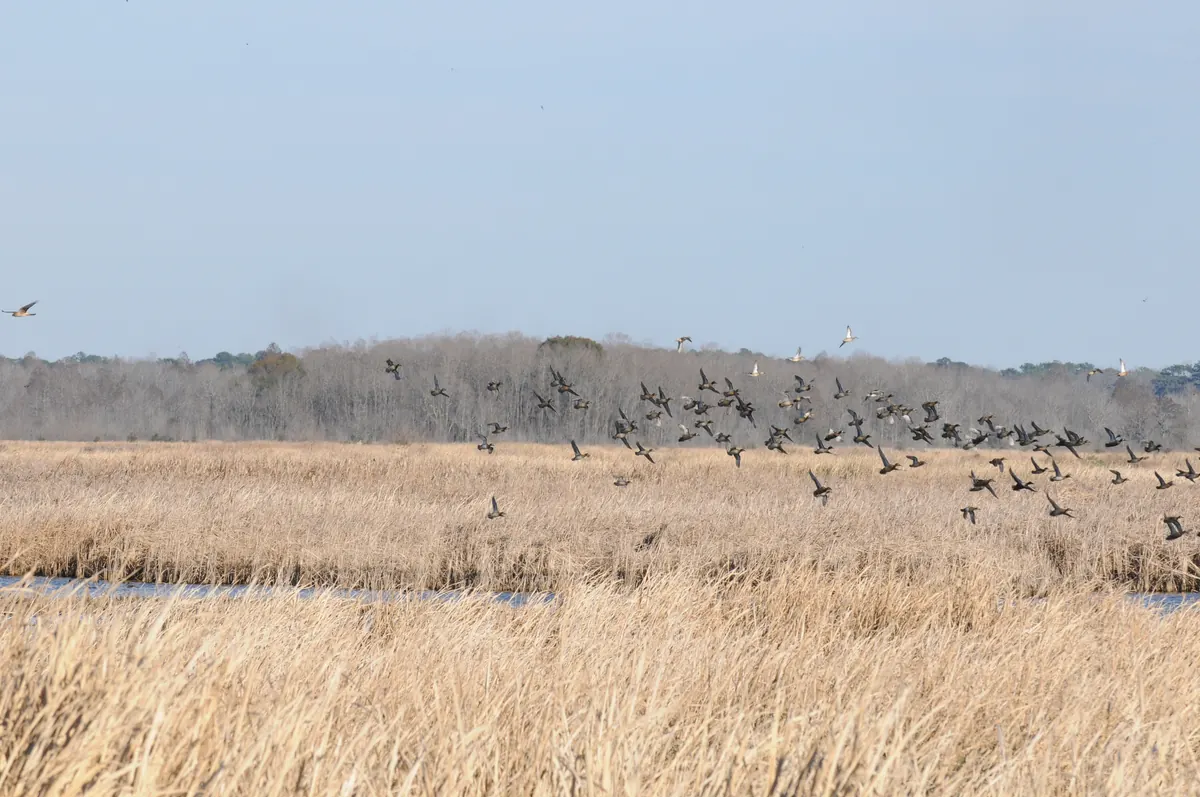
- Ducks and swans on Lake Marion. Santee National Wildlife Refuge closes Cantey Bay and other waters to all visitors from November 1 to March 1 so wintering waterfowl can rest. The birds are the reason: watch from the Bluff Unit’s observation tower, where five kinds of geese have been seen in a winter, and tundra swans on the open water.
- Leave one hummingbird feeder up. Rufous and other western hummingbirds turn up at South Carolina feeders between November and mid-March. Keep a clean feeder filled with four parts water to one part sugar, and tell the Carolina Bird Club’s winter hummingbird project about any visitor.
- Leonids before dawn, Wednesday, November 18. The Leonid shower peaks on the evening of November 17 in Eastern time, but the radiant in Leo only climbs after about midnight. Watch from moonset until first light on the 18th for perhaps a dozen swift meteors an hour from a dark site.
Keep a record: write the season’s first tundra swan, bufflehead or gannet on the Naturalist’s Field Journal page titled “birds I have seen,” give a local eagle nest its own “nest observed” page, one bald cypress makes a good “tree through the seasons” as it rusts and drops its needles, and the Leonid morning belongs in the dusk and dawn watch. Note the date, the hour and the weather beside each.
Regions used below: Upstate and the Blue Ridge Escarpment; Midlands and Congaree; Pee Dee and the Sandhills; Grand Strand; Lowcountry and the Sea Islands.
When do right whales come back to the South Carolina coast?
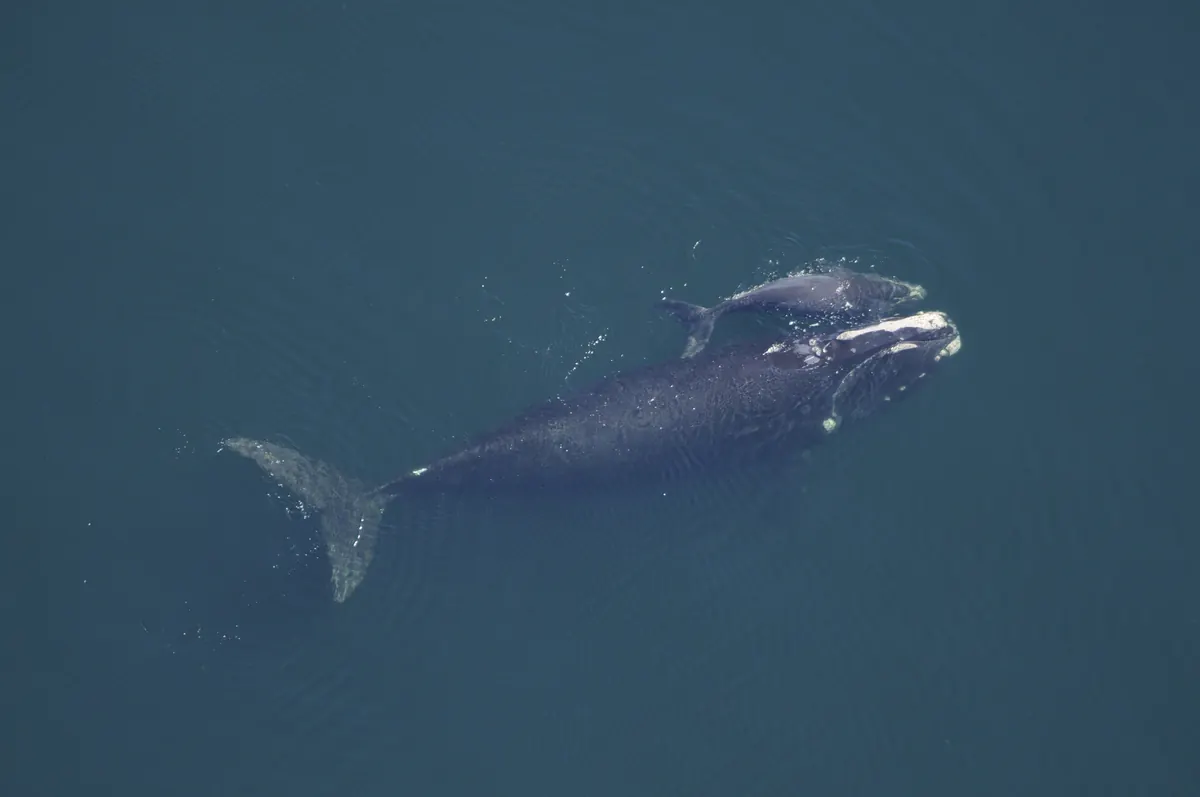
Starting in November. North Atlantic right whales spend the summer feeding off New England and Canada, and pregnant females swim south each fall to give birth in the shallow, warm water off the Southeast. NOAA Fisheries puts the calving season from mid-November to mid-April, and the South Carolina coast is part of the travel lane between the feeding grounds and the main nursery off Georgia and northeast Florida. Few great whales are rarer; NOAA’s latest estimate is about 380 animals, with roughly 70 females of breeding age.
-
Slow zones switch on November 1
November 1, 2026 to April 30, 2027 · Within about 20 nautical miles of shore from Wilmington, N.C., to Brunswick, Ga., including the Charleston approaches
Beginning November 1, ships and boats 65 feet or longer are limited to 10 knots inside NOAA’s Seasonal Management Area along the Carolinas and Georgia, which runs through April 30. Smaller boats are not covered, but NOAA asks them to slow down too, since a whale resting at the surface is hard to see and a collision with any boat can kill. A separate calving-ground zone farther south, off Georgia and Florida, opens on November 15.
-
Mothers and calves
Most sightings December through March · Usually within 20 miles of the beach, from the Grand Strand to Hilton Head
Last winter was a hopeful one. NOAA counted 23 calves in the 2025–26 season, the most in 17 years, and mother-and-calf pairs were documented offshore from Kiawah Island, Charleston and Hilton Head. Right whales have no dorsal fin, a broad, dark back and rough white patches on the head, and their blow is V-shaped when seen from in front or behind. From shore you are most likely to catch one from a high vantage point on a calm, clear day.
-
If you see one
Any time through April · From shore, boat, kayak or plane
Under federal law nobody may come within 500 yards of a right whale, and that includes drones, kayaks and paddleboards. If you are closer, move away slowly. Report a sighting from North Carolina to Florida to NOAA’s hotline at 877-942-5343 (877-WHALE-HELP), with the time, place and a photo if you can take one safely; researchers identify individuals from the callosity pattern on the head.
Where can you see ducks, geese and tundra swans in South Carolina?
The wintering flocks build through November. Bird Watcher’s Digest describes migratory waterfowl arriving “in some abundance” in winter, with the ACE Basin, Savannah National Wildlife Refuge and Santee National Wildlife Refuge among the best places to see them. The Carolina Bird Club’s site guides list tundra swans at Santee in winter and sea ducks off the Grand Strand jetties, so the state offers both inland marsh and open-ocean birding in the same month.
-
Santee National Wildlife Refuge
Sanctuary closures November 1 to March 1; birds build through the winter · The north shore of Lake Marion near Summerton, Clarendon County
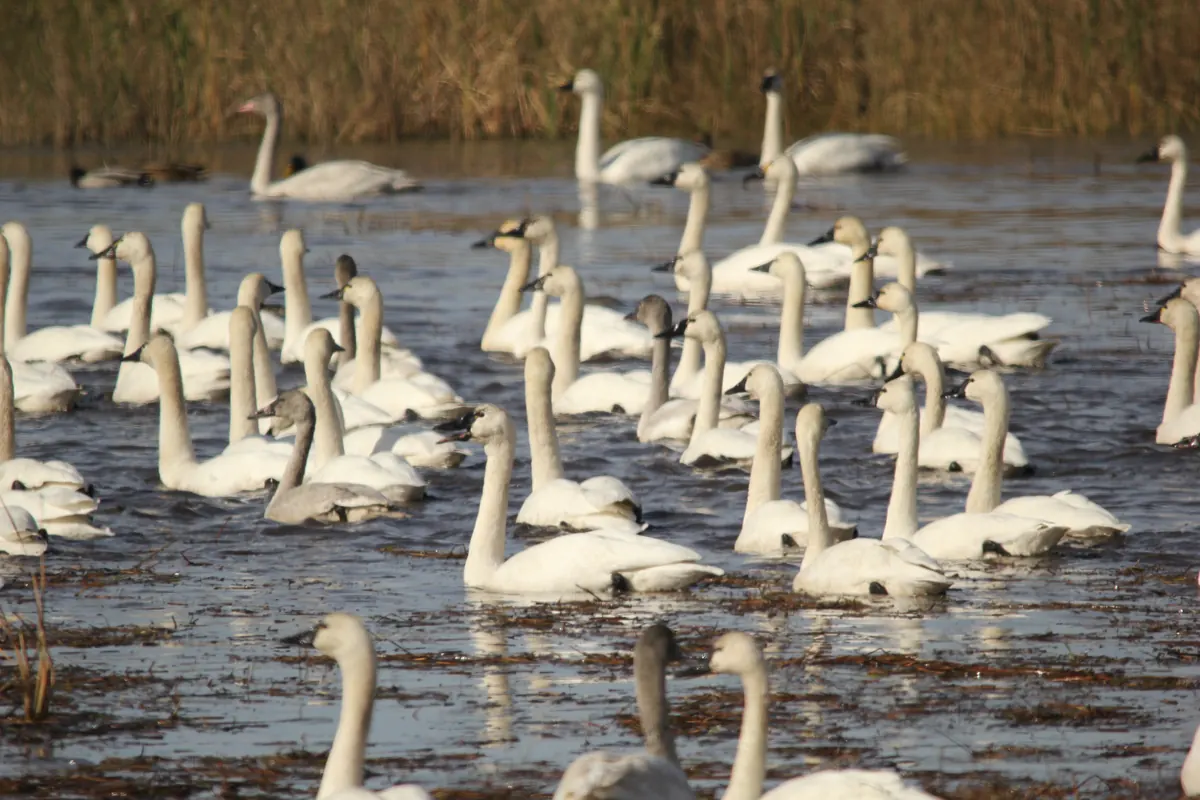
The refuge shuts the waters of Cantey Bay, Savannah Branch and Black Bottom, along with farm fields and parts of the Cuddo and Pine Island units, from November 1 to March 1, giving the birds undisturbed water. Visitors still have plenty: the Bluff Unit’s observation tower looks out over goose fields and Cantey Bay, Dingle Pond is good for ducks, rails and woodcock in winter, and the Wrights Bluff Nature Trail stays open year-round. Look for ring-necked ducks, pintails, teal and wood ducks among Canada geese, and for the white necks of tundra swans out on the bay. The visitor center is open Tuesday through Friday, 8 a.m. to 4 p.m.
-
Sea ducks and gannets at the Huntington Beach jetty
Winter visitors; go within two or three hours of high tide · Huntington Beach State Park, Murrells Inlet; the jetty is a 1.3-mile beach walk north of the main lot
The Carolina Bird Club’s site guide gives the jetty a long winter list, which includes black and surf scoters, common loons and red-throated loons, northern gannets diving offshore, purple sandpipers on the rocks and, in some years, common eider or harlequin duck. Allow three or four hours for the round trip, and bird the causeway between Mullet Pond and the salt marsh on the way in.
-
Duck season opens November 21
First segment November 21–28; second December 12 to January 31 · Statewide, including many impoundments open to hunting
SCDNR’s 2026–27 dates put the first duck and goose weekend on Saturday, November 21, with a youth day a week earlier, on November 14. Tundra swans have no open season in South Carolina. If you bird managed impoundments, check whether they are hunted that day and go after the shooting stops at midday where rules allow it.
Waterfowl numbers on eBird climb all month, so a weekly check of the same pond makes a satisfying comparison. A small spotting scope helps at the Santee tower and the jetty.
When do bald eagles nest in South Carolina?
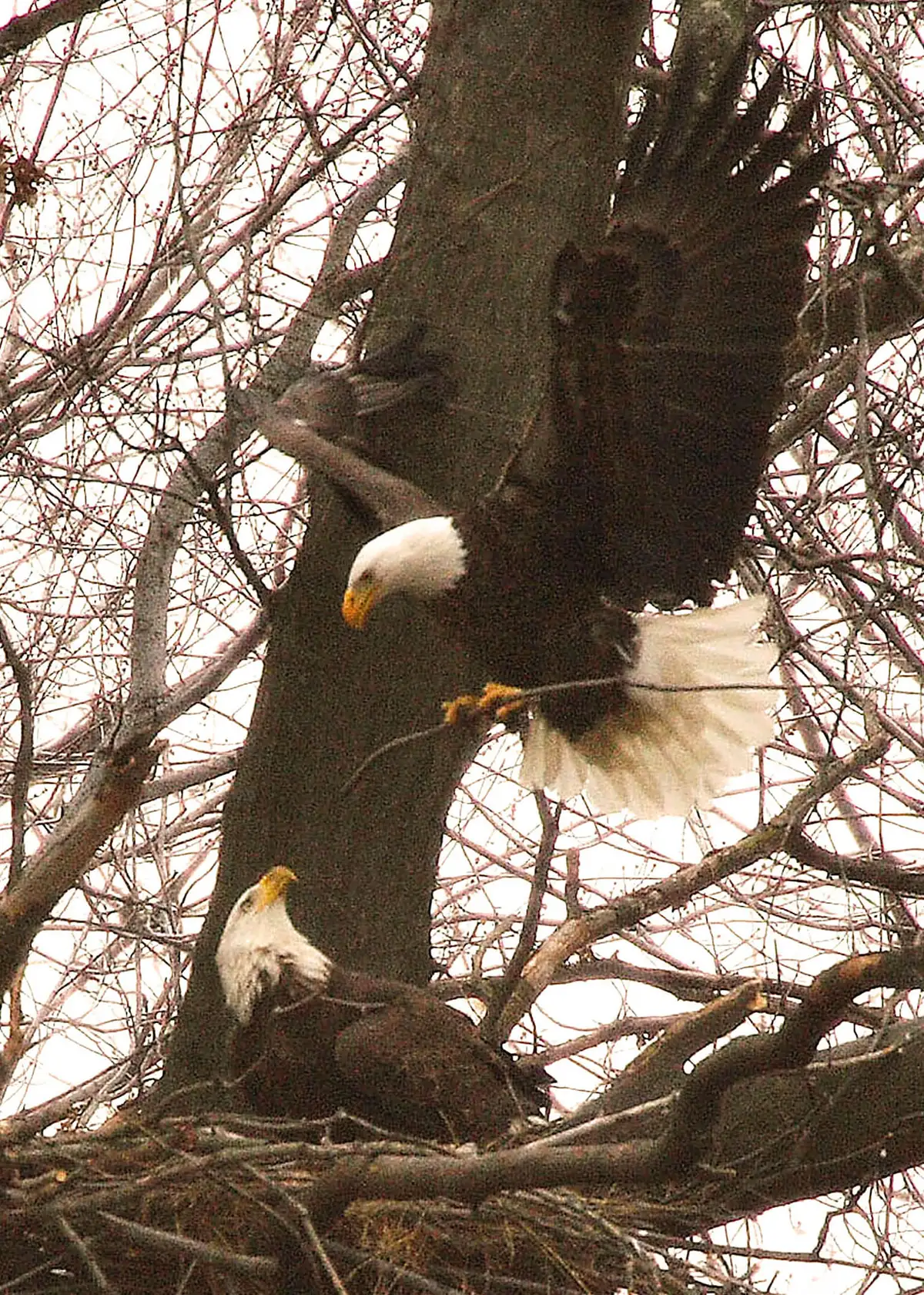
In winter, earlier than most people expect. SCDNR says egg laying generally happens in December, although it can fall anywhere from November to March, so November is when pairs are back on territory and adding fresh sticks to nests that can reach four to six feet across. Incubation takes about five weeks, and the whole cycle from nest repair to independent young lasts around seven months. The comeback has been remarkable: the state had 13 occupied territories in 1977 and about 208 pairs by 2005, and SCDNR now describes the population as thriving.
-
Where to look
Pairs on territory in November; eggs mostly in December · Coastal impoundments, the ACE Basin, Lake Marion and Lake Moultrie, and the big Piedmont reservoirs
SCDNR’s biology notes say most nests sit within about six-tenths of a mile of open water, often on the line where forest meets marsh, and that 79 percent are built in live pines, with others in cypress and dead trees. Impounded marsh managed for ducks is a favorite, which is why an eagle often turns up over a refuge pool full of coots. Watch from a distance; SCDNR keeps nest locations confidential under state law, and you can send general questions or a new nest report to its bald eagle program.
-
The last hawks over Caesars Head
The official count ends December 1 · Caesars Head State Park overlook, Greenville County
The hawk watch on the escarpment keeps counting through November. Red-tailed hawks are among the latest migrants, and HawkCount’s records for the site show red-tail days in early November and a season average of about 15 bald eagles, with a golden eagle in a good year. Bring a warm layer; the cliff faces south but the wind does not.
An occupied nest is worth a page of its own in a field journal. Visit at the same time each week and note which bird is sitting, who brings sticks and when the first one stays put; that is often the sign that an egg has been laid.
Should you leave your hummingbird feeder up in South Carolina?
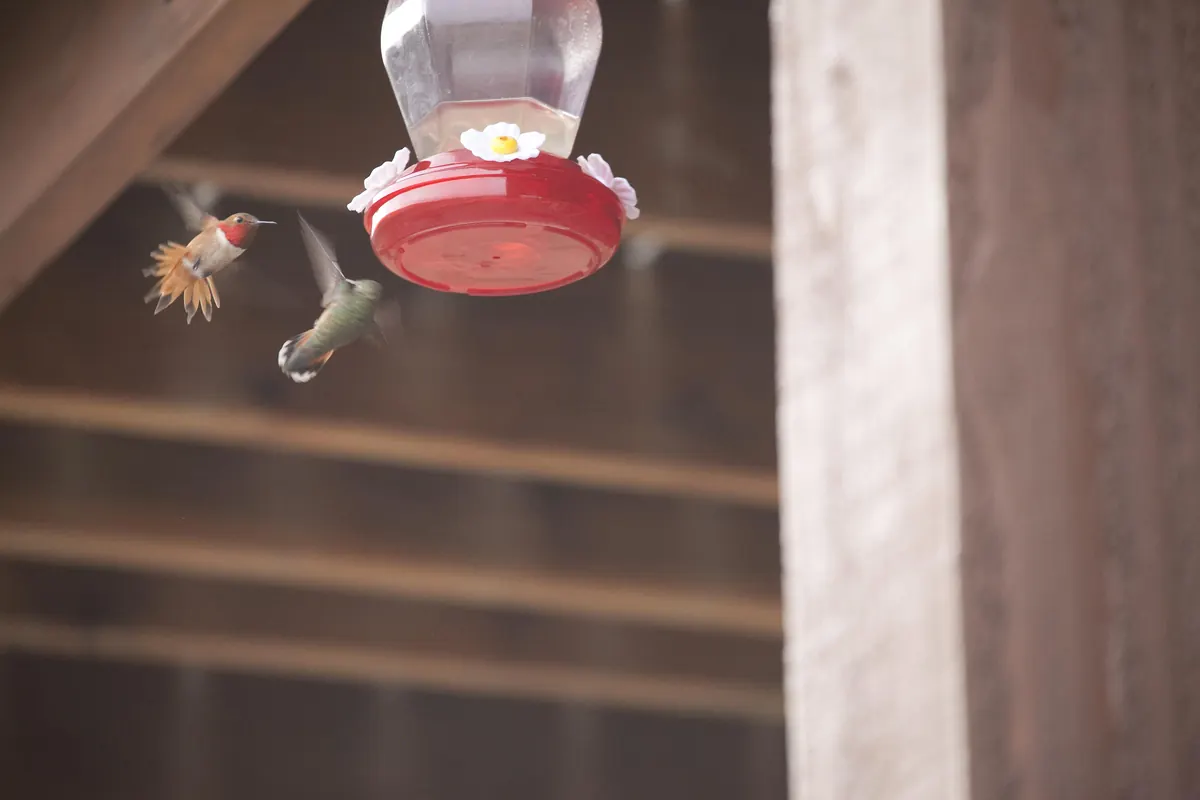
Yes, at least one. The Carolina Bird Club’s winter hummingbird page says South Carolina has recorded six species of hummingbirds besides the ruby-throated, and most of the winter birds investigated have been rufous hummingbirds, which nest as far north as Alaska. Winter visitors are expected between November 1 and March 15, and the club asks you to report one during that window so a bander can try to identify and band it.
-
Keeping a winter feeder
November through mid-March · Backyards statewide
The same simple recipe works: four parts water to one part white sugar, no dye. In cool weather the solution keeps longer, and the club says a cleaning and refill about every two weeks is usually enough. A hummingbird after Halloween is worth a photo of the tail and back, since a young rufous and a late ruby-throated can look alike at a glance.
-
The winter finch outlook
Through the winter · Feeders and pine woods
Writing for the Finch Research Network on September 25, forecaster Tyler Hoar did not expect a big finch irruption in the southeastern states. Cone crops on white pine, cedar and red spruce are generous in the Northeast, which should hold most finches there. A small to moderate southward push of pine siskins remains possible, but a red-breasted nuthatch invasion like last winter’s is not expected, and purple finches will likely be scarce.
-
Project FeederWatch starts November 1
November 1, 2026 to April 30, 2027 · Any yard, balcony or schoolyard with a feeder
Cornell Lab’s winter survey asks you to pick a pair of back-to-back days to watch, up to once weekly, and note, species by species, the biggest group present at a single moment, so no bird gets counted twice. It costs a small fee, and the counts show how chickadees, titmice and juncos shift from one winter to the next.
Where are the leaves still turning in South Carolina in November?
In the lowlands. In the mountains the color is usually past its best by the first week of November, and Congaree National Park says its fall color peaks between the end of October and early November. The latest color of all belongs to the swamps, where the bald cypress turns long after the oaks on the hills are bare. Clemson’s Home & Garden Information Center describes the needles fading through tan and orange-red into reddish-brown before they fall; it is one of only a handful of conifers that sheds every fall.
-
Bald cypress in the swamps
Through November · Congaree National Park, Francis Beidler Forest near Harleyville, the Cuddo Unit at Santee NWR
Clemson notes a champion bald cypress in Congaree 113 feet tall and the towering stands at Beidler Forest. Walk the boardwalk on a still morning and the knees, which act as snorkels for the roots, stand out against the dark water. Congaree charges no entrance fee.
-
Sasanqua camellias
In bloom now, into early winter · Yards, churchyards and campuses statewide
The sasanquas are the fall camellias; Clemson’s camellia fact sheet pictures fall bloomers such as ‘Shishi-Gashira’ and ‘Yuletide’ in flower in November, ahead of the larger Camellia japonica. The single pink and white flowers drop petal by petal, and on a warm afternoon bees work them hard.
-
Berries for the waxwings
November · Dogwoods, hollies and red cedars
Bird Watcher’s Digest says cedar waxwings commonly show up in November to feed on dogwood and other berries. Flocks travel together, strip a tree in an afternoon and move on, so listen for their thin, high whistles.
When is the deer rut in South Carolina, and what are the bears doing?
-
The tail end of the rut
Generally the first two weeks of November · Statewide, worst along rural roads at dusk and dawn
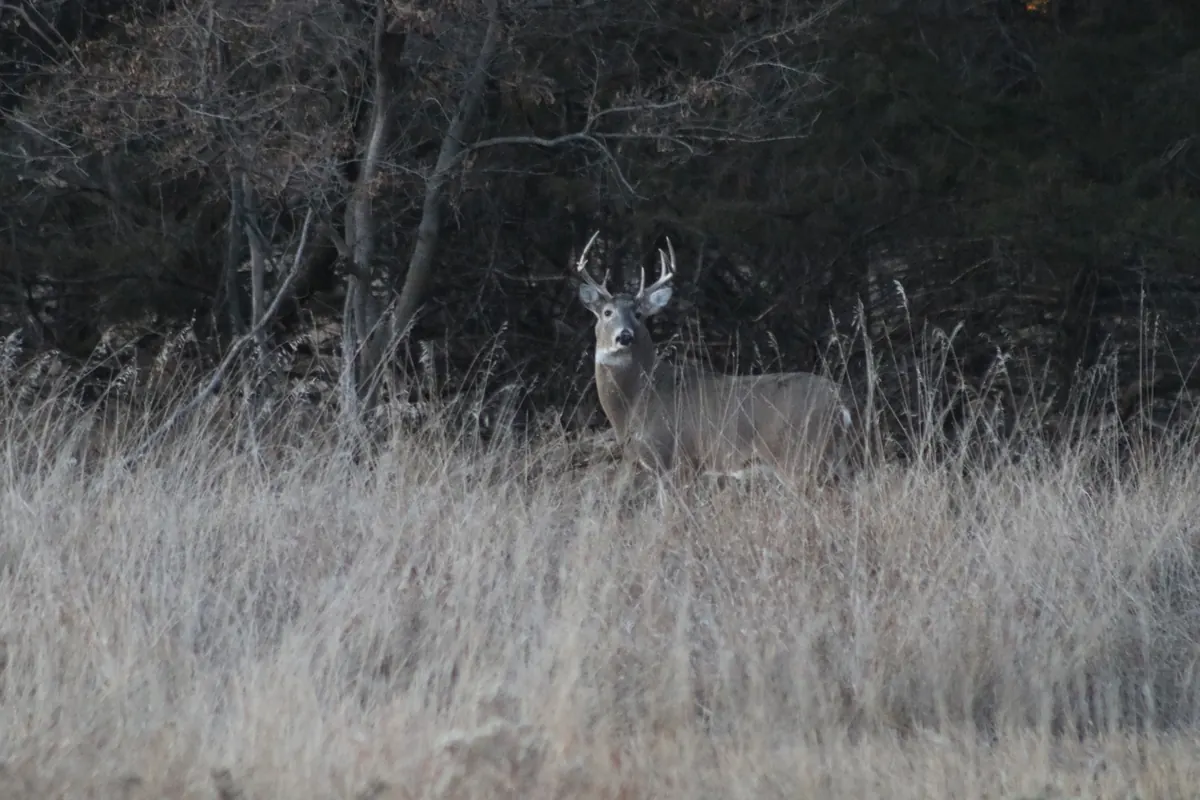
SCDNR places most breeding between mid-October and mid-November, with some breeding almost any time in fall and winter. For drivers the timing is awkward: the rut overlaps the clock change, so evening rush hour suddenly happens in the dark, right when bucks are crossing roads in pursuit of does. Slow down near field edges and creek crossings, and if one deer crosses, expect another.
-
Bears heading for dens
Fall feeding now; dens in winter · The mountains and upper Piedmont, and the coastal plain population
Bears in South Carolina eat mostly plants, berries and nuts, more than 80 percent of the diet by SCDNR’s account, and in November they are still putting on fat. Cubs are born in January or February while the mother is in her den, so pregnant females tend to den first. Keep garbage, pet food and bird seed out of reach in bear country.
-
Tracks in the mud
After the rain · Creek banks, sandy roads, trail edges
Soft mud after a November rain records raccoon hands, opossum stars, deer hearts and the neat line of a gray fox. Photograph a track beside a coin or a pen for scale and you will know it again.
Has South Carolina had its first freeze yet?
Upstate, very likely; on the coast, probably not. By NOAA’s normals, Jocassee 8 WNW in the Oconee County mountains usually sees 32 °F by October 17, and Caesars Head’s comes on November 2. The Upstate cities and the Midlands follow in the first full week: a median of November 4 at Rock Hill and November 7 at both Greer and Columbia. The Pee Dee and the Grand Strand usually wait until the middle of the month, with Florence and Myrtle Beach both at November 13. Charleston International Airport’s median is November 27, Thanksgiving weekend, and Beaufort’s is December 3, so Beaufort gets through November without a freeze more often than not.
| Station | One year in ten | Median | Nine years in ten |
|---|---|---|---|
| Jocassee 8 WNW (Oconee County mountains) | Oct 5 | Oct 17 | Nov 1 |
| Caesars Head (Blue Ridge Escarpment) | Oct 22 | Nov 2 | Nov 16 |
| Greer (Greenville–Spartanburg) | Oct 26 | Nov 7 | Nov 24 |
| Rock Hill York County Airport | Oct 23 | Nov 4 | Nov 19 |
| Columbia (Midlands) | Oct 26 | Nov 7 | Nov 24 |
| Florence Regional Airport (Pee Dee) | Nov 1 | Nov 13 | Dec 2 |
| Myrtle Beach (Grand Strand) | Oct 31 | Nov 13 | Dec 3 |
| Charleston International Airport | Nov 8 | Nov 27 | Dec 21 |
| Beaufort Mcas (Lowcountry) | Nov 14 | Dec 3 | Jan 1 |
Low spots freeze first. Sandhills valleys and river bottoms can frost over while a nearby hilltop stays above 32, so a thermometer at your own garden beats any airport. Find the closest station on the South Carolina frost dates page, bring in the potted citrus when lows near freezing are forecast, and write the first frosty windshield in the daily field log.
How early does it get dark in South Carolina in November?
Very early, once the clocks change. In Columbia the sun sets at about 5:31 p.m. on November 1 and about 5:15 p.m. on November 30, and Charleston’s sunsets run a couple of minutes earlier than that. Mornings move the other way: Columbia’s sunrise slips from about 6:44 to 7:11. Across the month the Upstate gives up the most light, 45 minutes at Greenville and Rock Hill, which finish November with an even ten hours of daylight, while Charleston and Beaufort lose 41. The rate slows as the solstice nears; by late November each day is only about a minute shorter than the one before.
| City | Nov 1 | Nov 30 | Lost | Per day |
|---|---|---|---|---|
| Greenville | 10 h 45 m | 10 h 00 m | 45 min | 1.6 min |
| Rock Hill | 10 h 45 m | 10 h 00 m | 45 min | 1.6 min |
| Columbia | 10 h 47 m | 10 h 04 m | 43 min | 1.5 min |
| Aiken | 10 h 49 m | 10 h 07 m | 42 min | 1.4 min |
| Florence | 10 h 47 m | 10 h 03 m | 44 min | 1.5 min |
| Myrtle Beach | 10 h 48 m | 10 h 06 m | 42 min | 1.4 min |
| Charleston | 10 h 51 m | 10 h 10 m | 41 min | 1.4 min |
| Beaufort | 10 h 52 m | 10 h 11 m | 41 min | 1.4 min |
Whether you live in Walhalla or Bluffton, the Field almanac lists your own town’s sun times and twilight.
What is November weather like in South Carolina, and what will El Niño do this winter?
November is cool, mostly dry and often bright. NOAA’s 1991–2020 normals give average highs of 63 °F at Greer, about 66 to 67 °F across the Midlands, the Pee Dee and the Grand Strand, and 69 °F at Charleston, with average lows from 40 °F upstate to 47 °F at Charleston. Monthly rain runs from about 2.6 inches at Florence and Charleston to 3.84 at Greer, the wettest of the five, which also averages a token tenth of an inch of snow. NWS Wilmington’s fall outlook expected the long dry spell across the eastern Carolinas to improve or possibly end this fall. The hurricane season officially closes on November 30.
Higher water on the coast is the month’s other event. NWS Wilmington flagged November 24–26 for possible minor coastal flooding from astronomical tides around the full moon. NOAA’s predictions for Charleston Harbor peak at 6.70 feet above mean lower low water at 6:59 a.m. on the 24th, 6.78 feet at 7:52 a.m. on the 25th and 6.73 feet at 8:48 a.m. on the 26th, just short of the 7.0-foot level where minor flooding starts. A northeast wind or a downpour at high tide could close low streets downtown.
Then there is the winter ahead. Pacific waters are running hot. In mid-September NOAA’s ENSO forecasters judged it more than 90 percent likely that this El Niño will be very strong by the cold months. The South Carolina State Climatology Office’s summary of the research says the strongest El Niño signal in the Southeast falls along the coast in December, January and February, and that an El Niño usually brings colder winters with more rain, because the storm track settles across the southern states. Its own charts of South Carolina winters back to 1895 show El Niño winters cooler and wetter than La Niña ones. The office adds a caution: how cold a winter turns also depends heavily on the Arctic Oscillation, whose negative phase lets Arctic air spill farther south. NOAA posts its winter temperature and precipitation maps on October 15 among the Climate Prediction Center’s 90-day outlooks; for this week’s weather in your own county, try the site’s Weather now page.
What is in South Carolina’s night sky this November?
-
Clocks fall back
2 a.m. Sunday, November 1 · Statewide
Daylight saving time ends early on the 1st. The sun rises an hour sooner by the clock that morning and sets around 5:30 p.m., so stargazing starts before supper for the rest of the year.
-
Taurid fireballs around the new moon
Southern Taurids peak about November 5; Northern Taurids about November 12; new moon November 9 · High in the east and south after dark
Only a handful of Taurids fall each hour, ten or fewer even at a peak, yet this shower is famous for slow, bright fireballs. The International Meteor Organization notes that the new moon falls between the two peaks, leaving dark skies for most of the second week. The grit comes from Comet Encke.
-
The Leonids
Pre-dawn hours of Wednesday, November 18 (also the 17th and 19th) · Face east to south after the radiant in Leo rises around midnight
The International Meteor Organization’s predicted maximum is November 17 at 6:45 p.m. EST, before Leo has risen here, so the mornings either side are what count. Expect about 15 an hour under ideal skies and fewer from town; no outburst is predicted this year. The first quarter moon sets around midnight, leaving the hours before dawn dark. Leonids are among the fastest meteors, and some leave a glowing trail for a second or two.
-
The Beaver Moon
Full at 9:53 a.m. EST, Tuesday, November 24; look on the evenings of the 23rd and 24th · Rising in the east-northeast near sunset
This full moon comes a day before perigee, so it counts as a modest supermoon, a little bigger and brighter than average; December’s will be closer still. Overnight from Monday into Tuesday morning the moon drifts in front of the Pleiades; moonlight washes the little star cluster out, but binoculars may pick a few stars from the glare. The same close moon drives the high tides on the coast that week.
-
Planets in the morning, Saturn at night
All month · Saturn high in the south after dusk; the rest low in the east before sunrise
Ringed Saturn rules the early evening by itself, with no rival planet anywhere after dusk. Before dawn the show is crowded: Venus climbs quickly out of the twilight as a brilliant morning star and reaches peak brilliance during Thanksgiving week; red Mars creeps toward Jupiter among the stars of Leo, and before sunrise on November 15 and 16 the two are about 1.2 degrees apart, close enough to share a binocular view; and Mercury peeks above the east-southeast horizon in morning twilight for roughly a week from November 18. Watch for Venus beside Spica, the bright star of Virgo, on the morning of November 9. Uranus is at opposition on the 25th, a faint green-gray dot for binoculars near the Pleiades.
| Phase | Date | Time |
|---|---|---|
| Last quarter | Sunday, Nov 1 | 3:28 p.m. |
| New moon | Monday, Nov 9 | 2:02 a.m. |
| First quarter | Tuesday, Nov 17 | 6:48 a.m. |
| Full moon, the Beaver Moon | Tuesday, Nov 24 | 9:53 a.m. (looks full the evenings of Nov 23 and 24) |
| Last quarter | Tuesday, Dec 1 | 1:08 a.m. |
Before an early alarm, look at the Today’s sky cloud page, and plan the dark nights ahead with the moon phase calendar.
What can South Carolina families do outside in November?
- Sunday, November 1: the first evening of early dark. Walk outside at 5:30 p.m. and note how the light looks; the same moment was still daylight the night before.
- Thursday, November 5: Waccamaw Audubon Society meeting at Myrtle Beach State Park, 6:30 to 8 p.m., a friendly way to meet local birders before winter trips.
- Saturday, November 7: Nocturnal Family Foray at Audubon’s Beidler Forest near Harleyville, 5:30 to 7 p.m., a naturalist-led night walk on the swamp boardwalk.
- Saturday, November 14: guided boardwalk tour at Beidler Forest, 10 a.m. to noon, among the turning cypress; that afternoon Table Rock State Park hosts Music on the Mountain, 2 to 6 p.m. Huntington Beach State Park’s Atalaya sleepover runs the night of November 14–15.
- Friday, November 20: sunset lighthouse climb at Hunting Island State Park, 4:45 to 5:45 p.m., then Park After Dark from 7:30 to 9 p.m.
- Saturday, November 21: a full day at Myrtle Beach State Park: a bird walk from 8 to 10 a.m., Live Birds of Prey in Flight from 1 to 2 p.m., and the Oh Silent Night hike from 5:30 to 6:45 p.m. The same evening Beidler Forest offers a Night Exploration on the Boardwalk, 5:15 to 7:45 p.m.
- Tuesday through Thursday, November 24–26: king-tide mornings on the coast. Photograph the water against a fixed landmark each day, from somewhere dry.
- Friday, November 27: Black Friday at a state park. South Carolina State Parks lists free admission at all parks on Black Friday on its seasonal events page; check the page or call your park the week before to confirm.
- Citizen science. Sign the feeder up for FeederWatch, which begins November 1, report winter hummingbirds to the Carolina Bird Club, enter waterfowl and eagle sightings in eBird, report right whales to NOAA, and log rain for CoCoRaHS. The Christmas Bird Count season opens in mid-December, and many South Carolina circles welcome beginners.
Schedules shift with weather and staffing, so call ahead. A pocket Naturalist’s Field Journal holds a season of these outings, the October page for South Carolina covers the month just past, and the nature hub has November in the other states.
Safety notes for November in South Carolina
- Deer season everywhere. On private land, gun season for deer is open in all four Game Zones through January 1: in Zones 1 and 2, the mountains and Piedmont, since October 11; in Zone 3 since mid-August; and in Zone 4 since September 1. Expect hunters in the woods on any day of the week.
- Other November openers. SCDNR’s 2026–27 dates include the second dove segment, November 13–28; snipe from November 14; the state youth waterfowl day on November 14; ducks, coots, Canada and snow geese November 21–28; quail with guns from November 23; and rabbits with guns, plus ruffed grouse in Game Zone 1, from Thursday, November 26, Thanksgiving Day. Bear seasons closed in October.
- Hunter orange. On Wildlife Management Area lands, SCDNR requires every hunter, small-game hunters included, to wear a solid international orange hat, coat or vest whenever a firearm or muzzleloader season is open there for deer, bears or feral hogs. The exemptions cover bowhunters in archery-only deer seasons and anyone hunting doves, turkeys, waterfowl or other migratory birds. State law extends the orange rule to all nonexempt persons on WMA land during deer season. SCDNR lists no orange requirement on private land. Hikers, birders and dog walkers near hunted land should wear orange anyway.
- Early dark. After November 1 the sun is down by about 5:30 p.m., and by month’s end a quarter past five. Carry a headlamp on any afternoon hike, tell someone your route, and remember that deer are most active on the roads in the hour after sunset.
- Water. Winter is Congaree’s most flood-prone season, and the park warns that the floodplain can rise with little warning; check trail conditions before you go. On king-tide mornings avoid driving through standing salt water, which damages cars and hides curbs. Cold surf and cold lakes cause hypothermia fast; wear a life jacket on the water.
- Burning. Dry leaves and a breezy afternoon make a debris fire easy to lose. Outside city limits, state law requires you to notify the South Carolina Forestry Commission before burning yard debris; it takes notifications online or by phone. Clear a firebreak and stay with the fire until it is out.
- Ticks. Ticks keep biting on warm November days. Check people and dogs after a walk.
Sources
- NOAA Fisheries: reducing vessel strikes to North Atlantic right whales (Seasonal Management Areas)
- NOAA Fisheries: North Atlantic right whale calving season 2026
- NOAA Fisheries: how you can help North Atlantic right whales (500-yard rule, sighting hotline)
- U.S. Fish and Wildlife Service: Santee National Wildlife Refuge (seasonal closures, visitor center hours)
- Carolina Bird Club: Santee National Wildlife Refuge site guide
- Carolina Bird Club: Huntington Beach State Park site guide
- Bird Watcher’s Digest: South Carolina birding by season, winter
- Bird Watcher’s Digest: South Carolina birding by season, fall
- SCDNR (eRegulations): migratory bird seasons, shooting hours and bag limits, 2026–27
- SCDNR: South Carolina’s bald eagles, biology
- SCDNR: South Carolina’s bald eagles, nesting (territory counts)
- SCDNR: South Carolina’s bald eagles, nest locations and reporting
- South Carolina Public Radio: SCDNR to conduct bald eagle nest surveys (February 2, 2026)
- HawkCount (HMANA): Caesars Head Hawk Watch site profile and averages
- Carolina Bird Club: winter hummingbirds, leave your feeder up
- Finch Research Network: Winter Finch Forecast 2026–2027
- Project FeederWatch: how to participate
- National Park Service: Congaree National Park weather and seasons
- Clemson Home & Garden Information Center: bald-cypress
- Clemson Home & Garden Information Center: camellia
- South Carolina State Parks: fall foliage reports
- SCDNR: white-tailed deer FAQs (breeding season)
- SCDNR: black bear
- Site data: NOAA 1991–2020 first-freeze normals for South Carolina stations
- NOAA NCEI: 1991–2020 monthly normals for Greer, Columbia, Charleston, Florence and North Myrtle Beach (data API)
- NWS Wilmington: fall 2026 climate outlook (drought, El Niño, coastal flooding dates)
- NOAA Tides and Currents: Charleston Harbor tide predictions, November 2026 (station 8665530)
- NWS Charleston: coastal flood thresholds, Charleston Harbor
- Climate Prediction Center: ENSO diagnostic discussion, September 10, 2026
- Climate Prediction Center: 90-day (seasonal) outlooks
- SC State Climatology Office: the impacts of ENSO and the Arctic Oscillation on South Carolina climate variability (PDF)
- U.S. Naval Observatory: moon phases (data API)
- International Meteor Organization: 2026 meteor shower calendar (PDF, archived copy)
- EarthSky: what is a supermoon? (2026 full supermoons)
- EarthSky: Mercury before sunrise, greatest western elongation
- EarthSky: Uranus at opposition
- Star Walk: planetary conjunctions 2026 (Mars and Jupiter)
- In-The-Sky.org: Venus at greatest brightness, November 2026
- Audubon: events at the Audubon Center at Beidler Forest
- South Carolina State Parks: holiday and seasonal events (Black Friday free admission)
- South Carolina State Parks: Myrtle Beach programs and events
- South Carolina State Parks: Hunting Island programs and events
- South Carolina State Parks: Table Rock programs and events
- South Carolina State Parks: Huntington Beach programs and events
- CoCoRaHS: South Carolina
- SCDNR (eRegulations): deer seasons on private lands, 2026–27
- SCDNR (eRegulations): alligator and bear regulations, 2026
- SCDNR (eRegulations): small game seasons, 2026–27
- SCDNR (eRegulations): WMA regulations, hunter orange
- South Carolina Code of Laws, Title 50, Chapter 11 (Section 50-11-365, international orange on WMA lands)
- South Carolina Forestry Commission: fire and burning (debris burn notification)
- CDC: preventing tick bites
- Photos via Wikimedia Commons; licenses and photographers are credited under each picture
