What to look for in nature in Utah this January
January is the middle of meteorological winter, the December-to-February stretch that averages coldest, and in Utah it is the month the cold settles in and stays. Valleys fill with still, frigid air between storms, the reservoirs lock up, and the wildlife that winters here narrows down to the places that still offer food: a hole in the ice for an eagle, a south-facing slope of sagebrush for a deer, a haypile under the rocks for a pika. It is also a month of beginnings. Great horned owls are already on eggs, the first desert bighorn lambs appear on Zion’s slickrock, and the afternoons stretch a little longer every week. Region by region, this is the Utah January.
Other months in Utah: October, November, December, February.
Start here

- Scan the cottonwoods for eagles. Bald eagles keep arriving all month and gather wherever water stays open. Try the trees near Willard Bay, the Compton’s Knoll overlook at Salt Creek, the roost north of Cedar City on State Route 130, or Ouray National Wildlife Refuge near Randlett, and go early, before the birds leave their night perches.
- Listen for owls after dark. On a calm evening, step outside and listen for deep hooting in a broken rhythm, and for a reply in a slightly higher pitch. That is a great horned owl pair keeping in touch. Write down the date of the first duet you hear.
- Meteors on the 3rd, a big moon on the 22nd. Quadrantid meteors are at their best from Sunday night, January 3, until dawn on Monday, and moonlight will hardly interfere. On Friday, January 22, at 5:17 a.m. Mountain time, the Wolf Moon turns full, the closest full moon of 2027; watch it the night before.
In the Naturalist’s Field Journal, add each eagle and owl to birds I have seen, and use nest observed if you find an owl incubating in a hawk’s old stick nest. Copy deer, elk or rabbit prints from fresh snow onto tracks to know, and keep mammal watch for bighorn on Zion’s east side. On an inversion day, fill colours of the day with the gray of the valley and the blue above it, and note the date of your first hooting owl on a map of sounds.
Regions used below: Cache Valley and the north; Wasatch Front and the Great Salt Lake; Wasatch Back and the Uintas; Uinta Basin; Central Utah and the high plateaus; Canyon Country and Moab; Color Country and St. George.
Where are Utah’s bald eagles in January, and what is the midwinter eagle count?
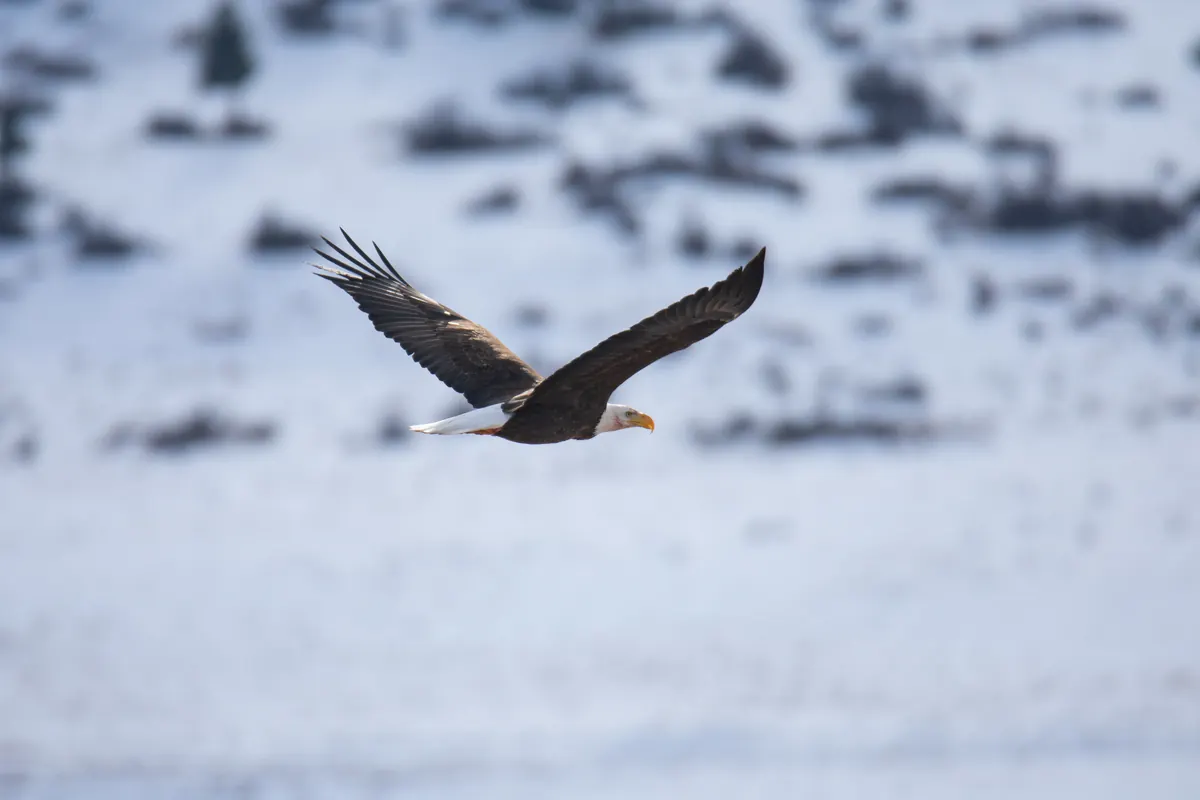
By January the wintering eagles are past the arrival stage and into the business of staying alive. As marshes and reservoirs freeze, the birds bunch up wherever there is still open water and stranded or weakened prey, and their numbers keep building. The Division of Wildlife Resources says hundreds have reached Utah by the time February comes, which makes January the build-up to the best viewing of the year.
-
Eagles at the edge of the ice
All month, early morning best · Willard Bay, Farmington Bay, Salt Creek, the Bear River marshes, Utah Lake
At Bear River Migratory Bird Refuge, winter is the lean season: the refuge says December, January and February hold its smallest waterbird numbers, often fewer than 20,000, as its wetlands freeze and thaw again and again. The ducks that stay, mostly mallards, buffleheads and common goldeneyes, crowd into the last open patches, and the eagles follow them. Watch for an eagle hunched on the ice beside a hole, or a row of dark shapes along a dike. Away from the lake, the DWR’s guide also sends viewers to Ouray National Wildlife Refuge near Randlett and to the Cedar City and Sanpete Valley roosts, where birds fly out at sunrise and return before dark.
-
The Midwinter Bald Eagle Survey
Standard routes counted during the first two weeks of January · Survey routes statewide
Each January, biologists and volunteers across the lower 48 count eagles along fixed routes, usually on one of two target days early in the month; the U.S. Army Corps of Engineers has most recently coordinated the effort. A 2015 analysis in the Journal of Raptor Research listed 19 Utah routes and 302 surveys between 1986 and 2010, with a slight downward trend for Utah that was not statistically significant. Agency crews run the routes; your own eagle counts belong on eBird.
Only adults wear the white head and tail, which the DWR says they reach at four to five years old; the brown, blotchy birds are younger. If you spot one from the car, find a safe pullout first; a stopped car in a lane is a hazard on icy roads.
Why are great horned owls hooting in Utah in January?
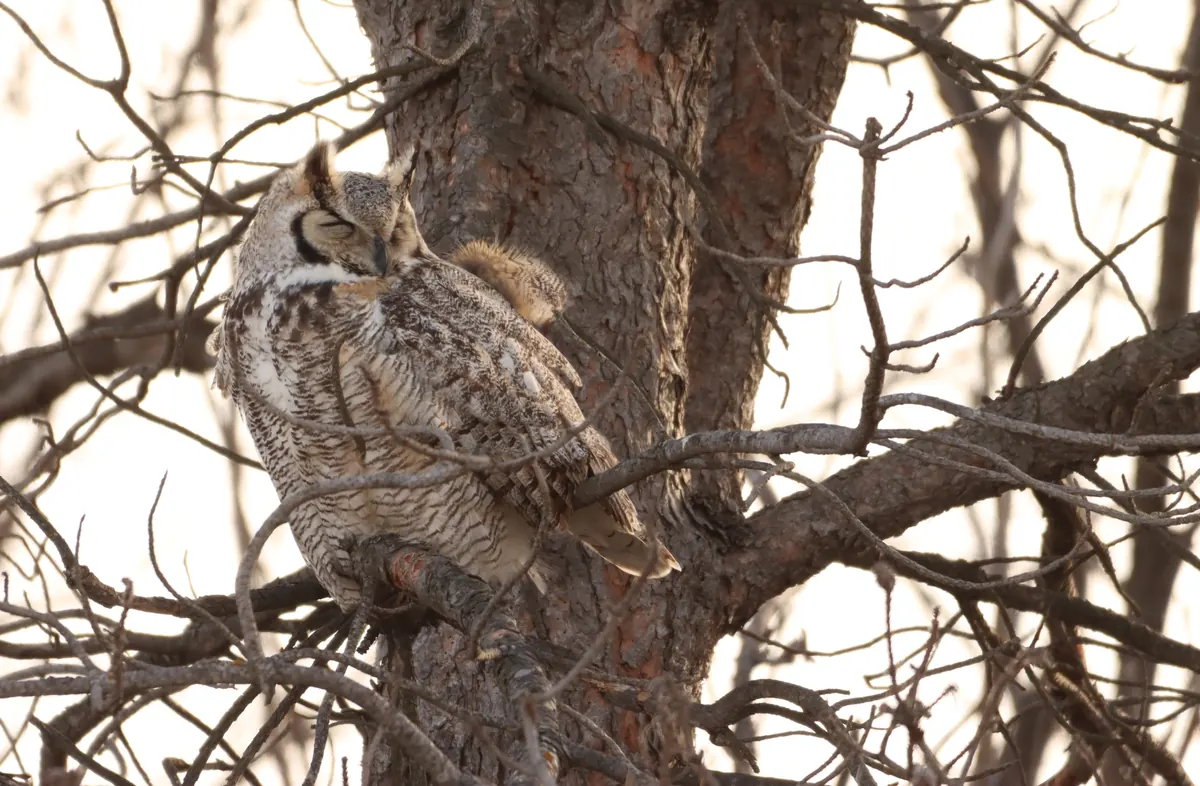
Most birds will not nest for months, but Utah’s great horned owls are already at it. Writing for Utah Public Radio’s Wild About Utah, Jack Greene describes these owls as early breeders whose hooting peaks between December and March. Pairs that have shared a territory all year now call to each other at dusk, and many females settle onto eggs while snow still covers the ground.
-
Duets at dusk
From sunset into the evening, and again before dawn · Cottonwood bottoms, foothill canyons, parks, cemeteries and older neighborhoods with big trees
Calm, cold evenings carry the deep hoots a long way. Note the date, time and direction of every call; a few weeks of notes will show roughly where the pair is nesting.
-
Borrowed nests
Eggs in many nests by late January and February · Old hawk nests in cottonwoods; cliff ledges, rock outcrops and caves in canyon country
Instead of building, a great horned owl moves into a nest some other bird made, very often a red-tailed hawk’s, and in Utah’s canyons they also nest on cliff ledges, rocky outcrops and in caves. Greene recalls a pair that nested near the Logan Tabernacle for many years. Look up into bare cottonwoods for a stick nest with two ear tufts showing over the rim, and once you find one, watch from well away; an owl flushed off eggs in January leaves them to chill.
The Ogden Nature Center also counts western screech-owls and barn owls among Utah’s native owls. Skip playback of recorded calls, which stresses nesting birds; just listen, and log what you hear on eBird.
When are the first desert bighorn lambs born in Zion, and what is the southern desert doing?
While the north is buried in snow, southwestern Utah runs on a different calendar. Zion’s canyon floor has afternoons in the 50s, and its cliffs are home to one of Utah’s most watched wildlife herds.
-
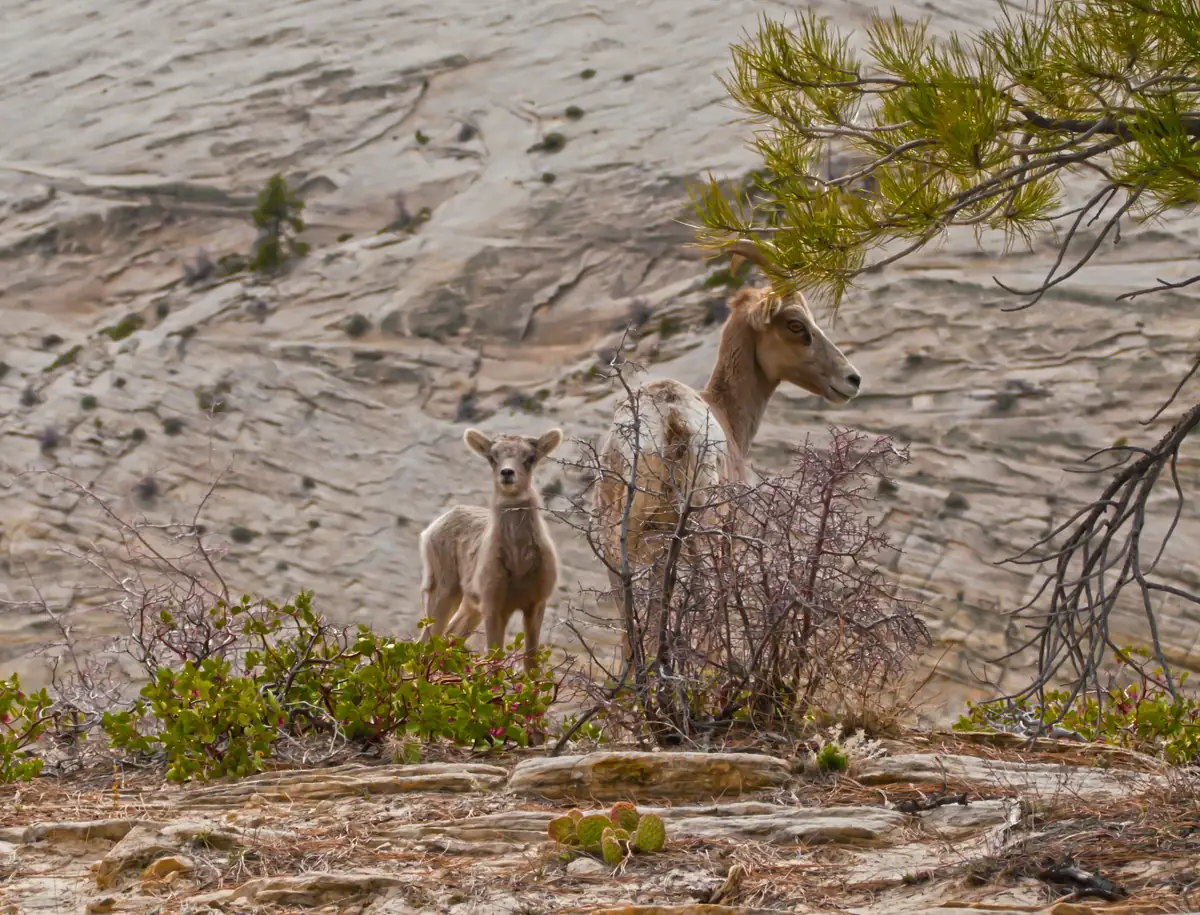
Desert bighorn lambs
Newborn lambs can be seen from mid-January through the end of April · Zion National Park, between the Zion-Mount Carmel Tunnel and the East Entrance
Zion’s bighorn rut from July through October, and lambs arrive about six months later. Look for a small, pale lamb pressed against a ewe on the slickrock. The herd, rebuilt from 14 sheep returned to the park by 1978, passed 500 animals in 2018. Use the roadside pullouts, never stop in the road, and stay well back.
-
The east side under snow
After winter storms · Zion-Mount Carmel Highway, Checkerboard Mesa, Canyon Overlook
The east side of Zion sits higher than Zion Canyon, so it holds snow after storms that only wet the canyon floor. The park describes winter days of 50 to 60 °F with nights well below freezing, and says nearly half of Zion Canyon’s yearly precipitation falls from December through March. Shaded trails ice up, and some trails close when ice falls from the cliffs, so carry traction devices for your boots.
-
Desert tortoises out of sight
All winter · Red Cliffs National Conservation Area and the Red Cliffs Desert Reserve around St. George
Utah’s Mojave desert tortoises are underground now. The U.S. Fish and Wildlife Service says they can spend up to nine months a year in burrows and are most active from March to June and in September and October. The species has been listed as threatened since 1990; leave any burrow you find alone.
Mild January days suit desert walking, but save the tortoise search for spring.
How do deer and elk get through a Utah January, and why are some areas closed?
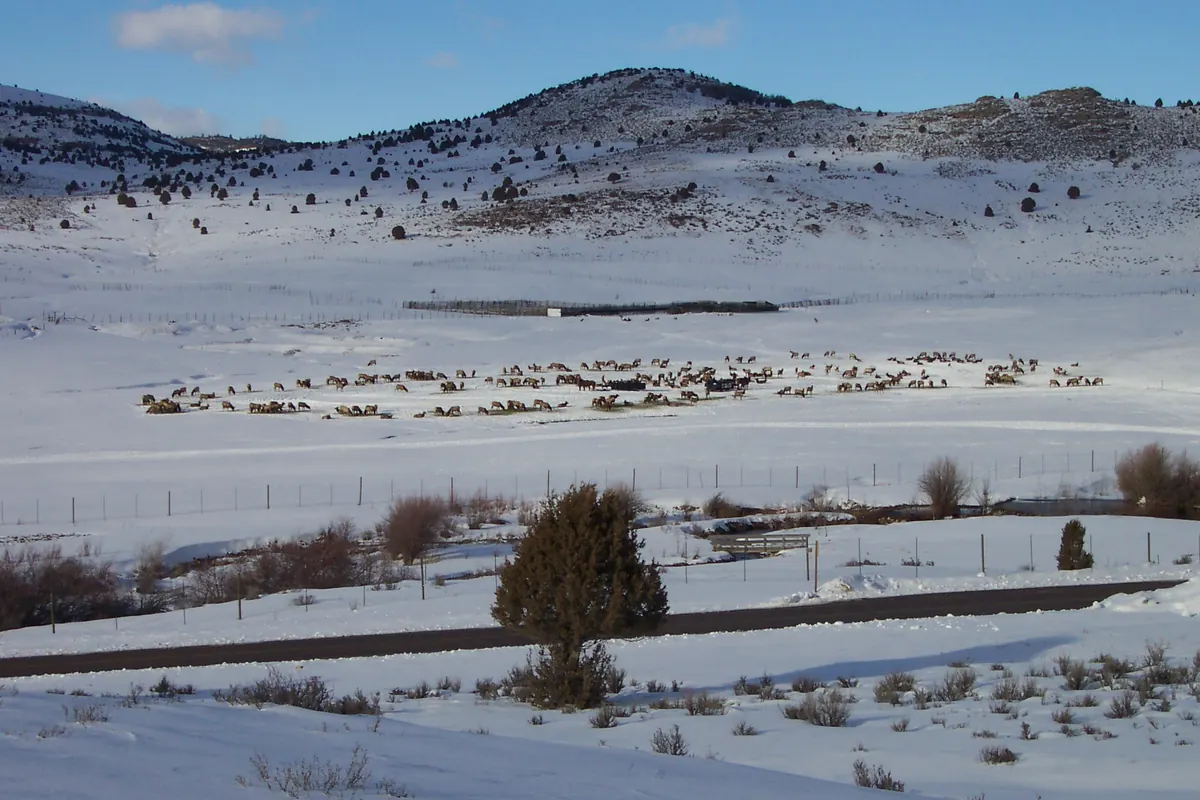
For Utah’s big game, January opens the hardest stretch of the year. Deep snow buries forage and cold drains the fat reserves animals built up in the fall, and every forced run through the snow spends energy that has to last until green-up. The DWR says most of its wildlife management areas exist for exactly this season: their main purpose is to give deer, elk and other animals a winter range with food and shelter.
-
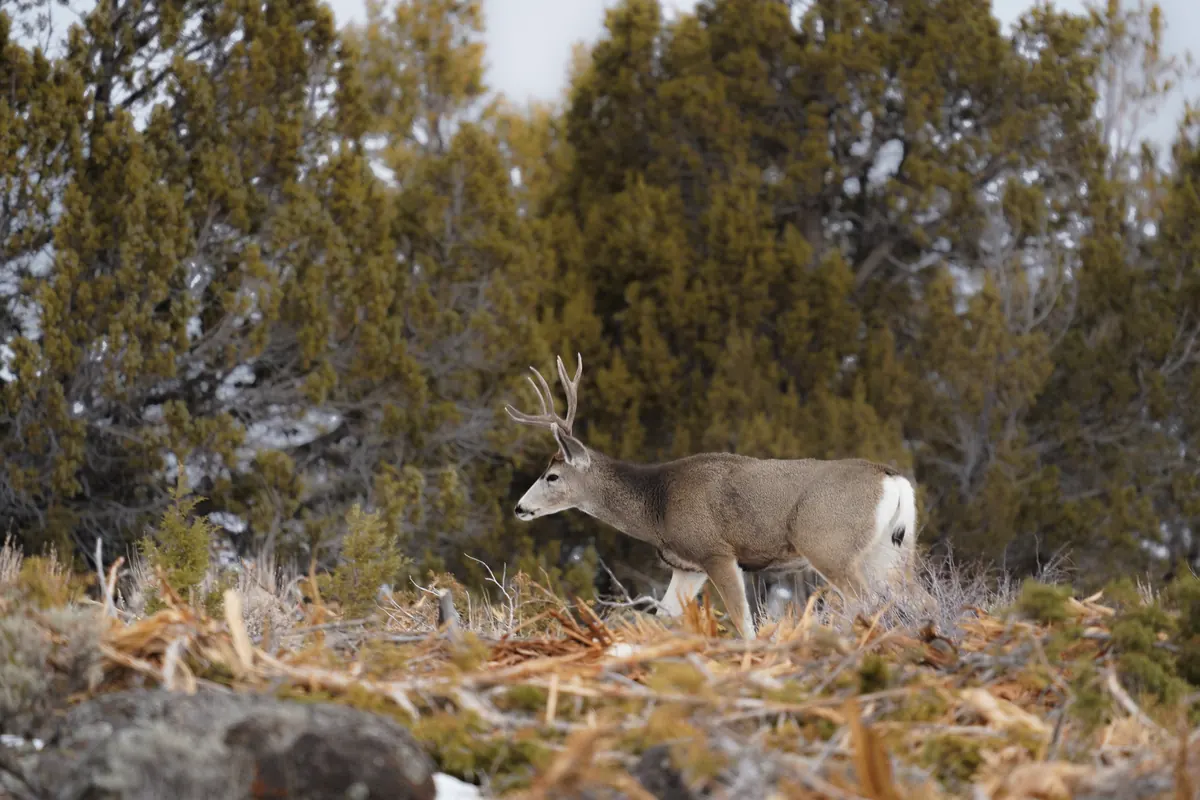
Mule deer on the benches
All month, most active at dawn and dusk · Sagebrush foothills along the Wasatch Front, Cache Valley, central Utah and the Uinta Basin
Deer gather on the lowest slopes with thin snow and browse sagebrush and bitterbrush. Watch from a distance; a deer that bolts through deep snow pays for it later. Some WMAs close to visitors through the most critical months, and the DWR asks visitors to check each area’s posted rules before going in.
-
Shed antlers and a new rule on January 1
Ethics course required from January 1 to May 31 · Statewide
Bucks and bulls drop their antlers through late winter, and collecting them is popular. Utah’s 2026 field regulations require anyone gathering shed antlers or horns between January 1 and May 31 to complete a free online antler-gathering ethics course and carry proof in the field. If a harsh winter forces emergency feeding of big game, the DWR director will close shed gathering statewide. Drones may not be used to look for any protected wildlife through January 31.
-
Elk at Hardware Ranch
Sleigh or wagon rides Fridays to Sundays through February 15 · Blacksmith Fork Canyon, east of Hyrum
By January the elk on the Hardware Ranch meadows have settled into a routine of hay and rest, and the bulls still carry their antlers. Rides into the herd take about 45 minutes; buy tickets on the day at the education center.
Driving the canyons at dusk in January means sharing the road with deer and elk that have come low. Slow down where the snow is deep on both sides.
What lives under the snow in Utah’s mountains in January?
Above about 8,000 feet, a deep snowpack is not only an obstacle; for many small animals it is a blanket. Down at ground level, under a few feet of snow, is a layer biologists call the subnivean zone, much milder and calmer than the open air above.
-
Pikas and their haypiles
All winter · Talus slopes in the Bear River Range, the Uintas, the high plateaus of the Dixie National Forest and the La Sal Mountains
Pikas, small round-eared relatives of rabbits, stay awake all winter. They spent the summer clipping grasses and wildflowers into haypiles tucked among the rocks, and now they feed from those stores beneath the snow, relying on a deep snowpack to insulate them from the cold, as a National Park Service brief explains. A project funded through Utah’s Watershed Restoration Initiative found pikas in every Utah mountain range where they had been recorded, from Bear Lake and the Uintas south to the Dixie National Forest and the La Sals. In January you will not see them, but you are standing over them on any snowy talus field.
-
Voles, mice and shrews in the tunnels
All winter · Meadows, sagebrush flats and forest openings under snow
Park Service teaching materials describe mice, voles and shrews tunneling under the snow, eating seeds and bark, and poking small vent holes to the surface. Look for those holes, and for weasel or fox tracks hunting along the tunnels.
-
Snowshoe hares and grouse
All winter · Spruce-fir and aspen forests of the Wasatch, the Uintas and the high plateaus
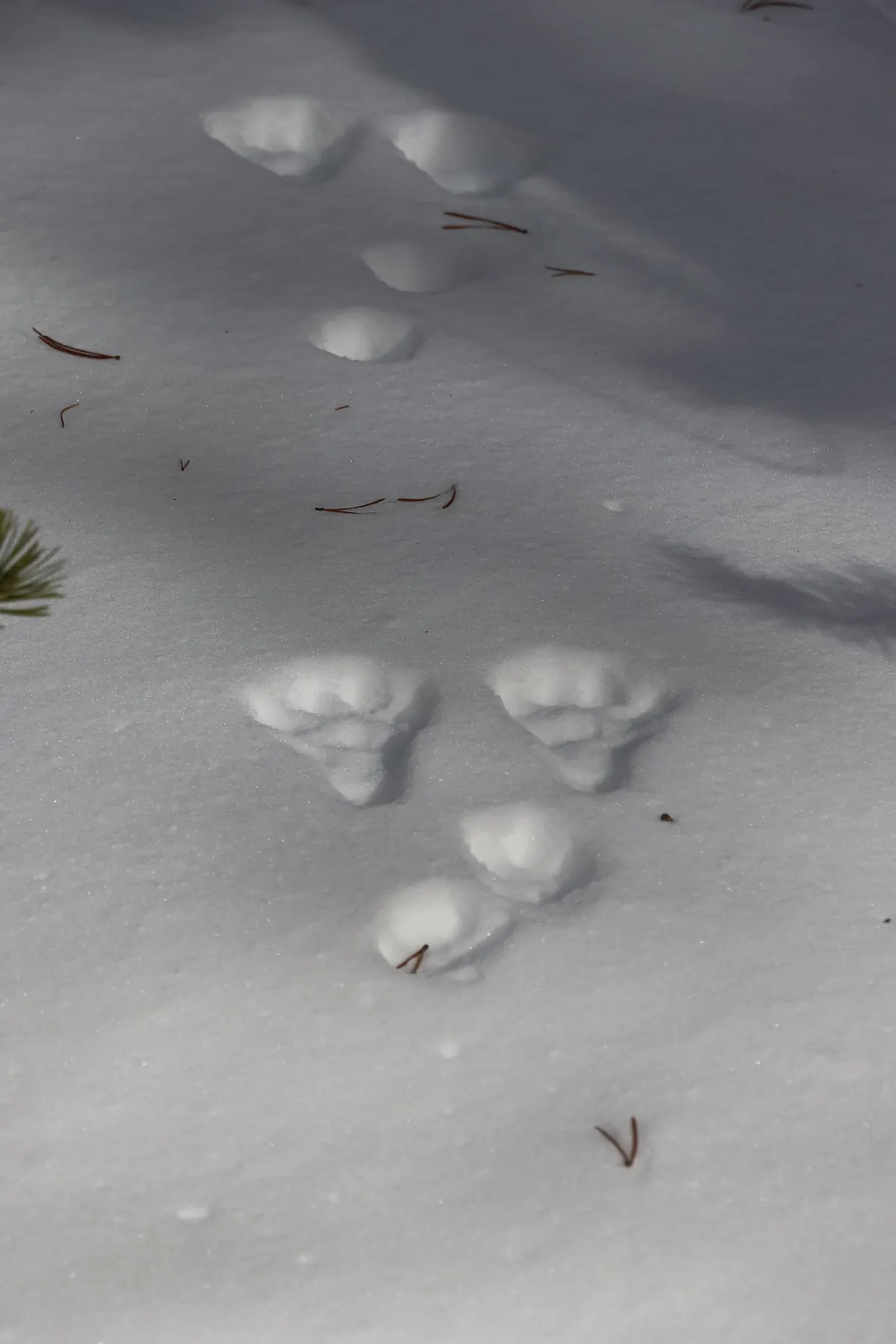
The same lesson adds snowshoe hares and grouse to the list of animals that use the snow to survive. A hare’s big hind feet print ahead of its front feet, and a grouse that burrowed in for the night leaves a hole and wing marks where it burst out.
The best time to read the snow is the morning after a light snowfall on an older, firm base. Sketch what you find, and lay a glove or a pen beside each print in your photos so you can judge its size later.
Why does the Great Salt Lake make less lake-effect snow in January?
When cold air from the northwest crosses the Great Salt Lake, the warmer water can feed bands of heavy snow that dump on the Salt Lake Valley and the Wasatch while a few miles away the sky is clear. University of Utah researchers who examined 13 cool seasons of radar data found an average of 13 lake-effect events a season, ranging from 3 to 20.
-
A midwinter lull
Fewest events in January · Downwind of the lake: the Salt Lake Valley, Tooele Valley and the Wasatch
That study, published in Weather and Forecasting in 2012, found that events are most frequent from mid-October to mid-December and again in early April, with a minimum in January, when the lake’s surface is at its coldest. Lake effect needs a big temperature gap between the water and the air about 10,000 feet up, which a chilled lake makes harder. The authors also found winter events can form with a smaller difference than in fall or spring, so a January band is less likely, not impossible.
-
How to spot one
Behind a cold front, often overnight or in the morning · Radar, and the sky to the northwest
On radar, look for a narrow ribbon of snow that starts over the lake and trails southeast, while the sky elsewhere is clearing.
| Station | Snowfall | Average high | Average low | Nights below 0 °F |
|---|---|---|---|---|
| Logan (Utah State University) | 12.9 | 32.2 | 17.6 | 2.2 |
| Randolph | 12.7 | 27.7 | 4.1 | 14.2 |
| Salt Lake City airport | 12.7 | 38.6 | 24.2 | 0.4 |
| Tooele | 14.0 | 38.7 | 20.6 | 0.4 |
| Alta | 74.7 | 30.7 | 15.0 | 2.0 |
| Heber | 21.5 | 36.5 | 12.5 | 4.5 |
| Echo Dam | 17.3 | 35.1 | 12.2 | 6.3 |
| Provo (BYU) | 12.5 | 41.2 | 23.8 | 0.4 |
| Vernal | 5.8 | 29.2 | 10.0 | 5.8 |
| Manti | 10.3 | 37.9 | 18.5 | 2.1 |
| Richfield | 4.3 | 41.0 | 17.0 | 2.8 |
| Bryce Canyon headquarters | 19.8 | 36.9 | 17.0 | 2.3 |
| Moab | 1.7 | 43.5 | 21.4 | 0.3 |
| Kanab | 5.4 | 49.4 | 24.9 | 0.1 |
| Zion National Park | 0.7 | 53.8 | 30.4 | 0.0 |
| St. George | 0.5 | 54.0 | 28.4 | 0.0 |
Alta averages nearly 75 inches of snow in January, while St. George averages half an inch. When your own valley starts warming toward spring, the Utah frost dates page gives the usual last freeze for stations near you.
Why are inversions worst in January, and where is the coldest place in Utah?
Look again at the table: Vernal, at about 5,300 feet in the Uinta Basin, averages a January high of 29.2 °F, colder by day than Alta, more than 3,000 feet higher in the Wasatch. That upside-down result is the signature of January in Utah’s basins, where cold air pools on the valley floor and the mountains around it stay milder.
-
The valley lid
Between storms, often for days at a time · Wasatch Front, Cache Valley, Uinta Basin and other enclosed valleys
The Utah Department of Environmental Quality explains that in winter, snow on the ground reflects sunlight, nights are long and the low sun adds little warmth, so the air near the ground can end up colder than the air above it. With light winds, that warmer layer acts as a lid on pollution, often in the days after a snowstorm. January has the ingredients at their strongest: the longest run of snow cover and short days. It takes the wind of the next storm to stir the valley clean.
-
Peter Sinks, Utah’s cold pool in miniature
Coldest on calm, clear nights after an arctic front · A limestone sinkhole in the Bear River Range, northeast of Logan
On February 1, 1985, a reading of −69.3 °F was recorded at Peter Sinks, which the Utah Climate Center lists as the second-coldest temperature ever measured in the lower 48. On calm nights the chilled air drains into the bowl like water into a basin and sits there. Utah State University researchers working with the Utah Climate Center are still placing temperature sensors at different heights in sinkholes like this one, partly because they behave like small-scale versions of the inversions over the Salt Lake and Cache valleys and could help improve inversion forecasts.
-
Winter ozone in the Uinta Basin
Some winters, during multi-day inversions with snow on the ground · Uinta Basin, especially lower elevations
Ozone is usually a summer problem, but researchers at Utah State University’s Bingham Research Center in Vernal have shown that the Uinta Basin can build high ozone in winter. It takes snow cover, which reflects sunlight back up and strengthens the inversion while giving the chemistry more light, plus a strong high-pressure system that keeps the lid in place, with emissions from oil and gas fields supplying the ingredients. Their 2015 study found that inversions start earlier and last longer at lower elevations, and that elevation and nearness to wells explained most of the differences in ozone from place to place.
Check air.utah.gov or the UtahAir app before strenuous exercise on an inversion day. For a look at whether a front is coming to clear the air, see the cloud cover map.
Does a very strong El Niño change Utah’s January and late-winter snow?
Forecasters are unusually sure about this one. In NOAA’s September 10 ENSO discussion, the chance that this event peaks in the very strong range topped 90 percent. What it means for Utah is less clear, because the state sits between the wetter southern pattern that strong El Niños tend to bring and the drier pattern farther north.
NOAA’s own look at past events, on Climate.gov, finds the wet signal over the Southwest weaker than along the Gulf Coast and dependent on the strength of the El Niño, with strong events the more reliable, while the Pacific Northwest and northern Rockies show a less dependable dry signal. Utah straddles that line. A U.S. Geological Survey climate science summary adds that northern and western Utah can have wet, dry or normal winters during El Niño, and warns that rain falling on a deep snowpack late in the season can raise the risk of avalanches, flooding and erosion.
In practice, southern Utah, from St. George to the high plateaus, has the better case for a wet winter; northern Utah should expect anything.
NOAA updates its three-month outlooks every month after the first winter maps on October 15, so check the latest Climate Prediction Center seasonal outlooks as January nears. For the next storm, our weather page has the local forecast.
How much daylight does Utah gain in January?
January brings the light back, but lopsidedly. Mornings lag: in Salt Lake City the sun comes up at 7:52 a.m. every day from New Year’s Day through January 8 and is still rising at 7:39 on the 31st. Evenings move much faster, with sunset sliding from 5:11 p.m. on January 1 to 5:30 on the 20th and 5:44 by month’s end. Across the table, the month adds between 40 and 48 minutes of daylight, and the daily gain is still speeding up as February begins.
| City | Jan 1 | Jan 31 | Gained | Per day |
|---|---|---|---|---|
| Logan | 9 h 12 m | 10 h 00 m | 48 min | 1.6 min |
| Ogden | 9 h 16 m | 10 h 03 m | 47 min | 1.6 min |
| Salt Lake City | 9 h 19 m | 10 h 05 m | 46 min | 1.5 min |
| Provo | 9 h 22 m | 10 h 07 m | 45 min | 1.5 min |
| Vernal | 9 h 21 m | 10 h 06 m | 45 min | 1.5 min |
| Moab | 9 h 32 m | 10 h 14 m | 42 min | 1.4 min |
| Cedar City | 9 h 37 m | 10 h 18 m | 41 min | 1.4 min |
| St. George | 9 h 40 m | 10 h 20 m | 40 min | 1.3 min |
For sunrise and sunset at a particular trailhead, use the daylight and twilight calculator.
What can you see in Utah’s night sky in January 2027?
Utah’s dry winter air and long nights make for sharp stars, as long as you dress for single digits in the high country. The darkest evenings come in the days around the new moon of January 7, roughly from the 3rd to the 12th. Times here are Mountain Standard Time.
-
The Quadrantid meteors
Night of Sunday, January 3, into Monday, January 4 · Anywhere dark; meteors can appear in any part of the sky
This shower has a short, sharp peak of about six hours, and 2027 is a good year for it. The American Meteor Society puts the peak at about 8:30 p.m. on Sunday, Utah time; another forecast puts it a little after 10:45 p.m. Because the shower’s radiant sits low after dusk and rises overnight, expect Utah’s best counts in Monday’s small hours. The Moon will be a sliver that clears the horizon only near daybreak. Under dark skies, dozens of meteors an hour is a reasonable hope.
-
Perihelion and Venus
Saturday, January 2, 7:33 p.m.; Venus best before dawn all month · Venus low in the southeast before sunrise
Perihelion, the nearest point of Earth’s orbit, comes on Saturday evening, January 2, at a distance of roughly 91.4 million miles. So Utah’s coldest weeks arrive with the Sun at its closest, because winter is set by the slant of sunlight, not by distance. The next day Venus stands 47 degrees west of the Sun, as far as it gets on this swing, and blazes in the southeast before sunrise.
-
The Wolf Moon
Full at 5:17 a.m. on Friday, January 22 · Rising in the east-northeast at dusk on the 21st
Perigee, the Moon’s nearest approach on this orbit, falls on the afternoon of the 21st, about 14 hours ahead of the full phase. That makes the Wolf Moon the closest full moon of 2027, about 222,200 miles out. Watch it rise over the Wasatch or the Book Cliffs on Thursday night, the 21st, or on Friday evening, when it still looks round. A day later, on the evening of the 23rd, bright Jupiter shines just beside it.
-
Planets and aurora
All month · Saturn low in the southwest after dark; Jupiter in the east; Mercury low in the west-southwest late in the month
Saturn is low in the southwest early in the evening and sinks a little earlier each week. Jupiter rises in the evening and grows brighter as it heads toward opposition on February 10. In the final week of the month, Mercury begins its best evening appearance of the winter; try a clear western horizon about half an hour after sunset. The solar cycle peaked in 2024, yet a strong storm on the Sun could still bring a faint red aurora to Utah’s northern sky; NOAA’s Space Weather Prediction Center issues the alerts.
| Phase | Date | Time |
|---|---|---|
| New moon | Thursday, Jan 7 | 1:24 p.m. |
| First quarter | Friday, Jan 15 | 1:34 p.m. |
| Full moon, the Wolf Moon | Friday, Jan 22 | 5:17 a.m. |
| Last quarter | Friday, Jan 29 | 3:55 a.m. |
To plan a night out, check moonrise and moonset times for your town, and look at the current cloud cover before you leave; inversions can leave the valleys foggy when the mountains are clear.
What can families do outdoors in Utah in January 2027?
- Friday, January 1: First Day Hikes. Each New Year’s Day, state parks nationwide put on guided hikes. Utah’s 2027 hikes were not yet listed in early October; the Utah State Parks events calendar will carry them.
- Up to January 5: final Christmas Bird Counts. This season’s window closes on Tuesday the 5th. Audubon’s circle map lists each Utah count and its compiler if a late count is still looking for help.
- Sunday night, January 3: Quadrantid meteors. Bundle up for half an hour after dark; children can catch a few before bed, and early risers can try again before dawn Monday.
- Fridays to Sundays all month: sleigh rides at Hardware Ranch. Rides into the elk herd run 10 a.m. to 4:30 p.m. through February 15, with tickets sold at the education center on the day.
- Ranger-led snowshoe walks at Cedar Breaks. Last winter the monument’s ranger tours began the first weekend of January and ran on Fridays and Saturdays, with snowshoes provided. Watch the Cedar Breaks news page for the 2027 schedule and registration.
- Eagles from a warm room. The DWR’s Eccles Wildlife Education Center in Farmington, free and open Tuesday through Saturday, 11 a.m. to 4 p.m., in the division’s latest listing, looks out over Farmington Bay. The DWR has held organized eagle-viewing events in February in some years; watch its news page for dates.
- Thursday night, January 21: a Wolf Moon walk on a snowy trail, bright enough to leave the headlamp off.
- Citizen science. Count birds at a feeder for Project FeederWatch, report eagles and owls to eBird, and post tracks, lichens and winter twigs on iNaturalist. Next up is the Great Backyard Bird Count, normally held over a mid-February weekend; birdcount.org announces each year’s dates.
Give each outing a dated page in the Naturalist’s Field Journal. Missed the start of eagle season? Utah’s December page covers it, and the nature index has every state.
Safety notes for January in Utah
- Hunting seasons still open in January. From the DWR’s 2026 to 2027 guidebooks: the northern duck zone (ducks, mergansers, coots and snipe) closes January 16 and the southern zone January 23; dark goose seasons end January 16 in the eastern Box Elder area, January 23 in the southern area, January 31 in the northern goose area and February 15 in the Wasatch Front goose area; light geese reopen January 15 in the southern goose area. Chukar and Hungarian partridge stay open into mid-February and cottontail season to the end of that month. For big game, the West Cache extended archery elk hunt runs to January 31, and statewide sportsman buck deer and bull elk permits to January 15. Bobcat trapping runs to March 1, and cougars may be hunted and trapped year-round on most units.
- Hunter orange. Under Utah Code 23A-11-205, big game hunters must wear visible hunter orange, but archery, muzzleloader and HAMSS hunters are exempt outside areas where a general-season any-legal-weapon deer or elk hunt is under way, as are statewide permit holders, so few January hunters will be in orange. The DWR strongly encourages it for upland hunters. Hikers near hunting areas should wear something bright.
- Ice. Stay off any ice thinner than 4 inches of clear, hard ice on foot, Utah State Parks advises, or 6 inches for a snowmobile or ATV. If you break through, think 1-10-1: about a minute of gasping cold shock, roughly ten minutes of useful muscle control, and about an hour before hypothermia brings unconsciousness.
- Avalanches. January snowpacks in the Wasatch, the Uintas and the La Sals can hide weak layers. Read the Utah Avalanche Center forecast before any trip onto or beneath steep slopes. Beacon, shovel, probe and a trained companion are the minimum kit.
- Bad air. During long inversions, check air.utah.gov before running or hard exercise outdoors, especially for children, older adults and anyone with asthma.
- Cold and driving. Randolph averages 14 nights below zero in January, and high basins can be colder. Watch for violent shivering, slurred speech or numb, waxy skin; budget twice your usual time on snowy trails; and keep chains, a blanket and food in the car for canyon roads, where deer and elk feed at dusk.
Sources
- Utah DWR: bald eagle viewing in Utah (flyer, January 2026)
- USFWS: monthly bird happenings, Bear River Migratory Bird Refuge
- Eakle et al. (2015): wintering bald eagle count trends, 1986 to 2010, Journal of Raptor Research
- eBird
- Wild About Utah (Utah Public Radio): great horned owl
- Ogden Nature Center: a guide to native Utah owls
- NPS, Zion National Park: bighorn sheep
- NPS, Zion National Park: seasons and weather
- USFWS: desert tortoise species profile
- Utah DWR: wildlife and waterfowl management areas
- Utah DWR: 2026 big game field regulations guidebook
- Utah DWR: shed antler gathering
- Utah DWR: Hardware Ranch sleigh rides
- NPS: pikas resource brief
- Utah Watershed Restoration Initiative: American pika persistence in the face of climate change
- NPS: Snug in the Snow (subnivean zone lesson)
- Alcott, Steenburgh and Laird (2012): Great Salt Lake-effect precipitation, Weather and Forecasting
- NOAA NCEI: 1991 to 2020 monthly climate normals for Utah stations
- Utah DEQ: frequently asked questions about Utah’s inversion season
- Utah Climate Center (Utah State University): Peter Sinks temperature monitoring (−69.3 °F on February 1, 1985)
- KSUT: studying the coldest place in Utah could help combat inversions (September 28, 2026)
- Lyman and Tran (2015): inversion structure and winter ozone distribution in the Uintah Basin, Atmospheric Environment
- Utah Division of Air Quality: current conditions
- NOAA Climate Prediction Center: ENSO diagnostic discussion, September 10, 2026
- NOAA Climate Prediction Center: 90-day outlooks
- NOAA Climate.gov ENSO blog: United States El Niño impacts (Southwest wet signal depends on El Niño strength; dry signal in the northern Rockies)
- USGS Climate Adaptation Science Centers: regional super El Niño impacts, Southwest U.S.
- U.S. Naval Observatory: Moon phases
- U.S. Naval Observatory: Earth’s seasons and apsides, 2027
- American Meteor Society: meteor shower calendar
- EarthSky: Quadrantid meteor shower
- Fred Espenak: Sky Event Almanac 2027
- EarthSky: what is a supermoon
- NOAA Space Weather Prediction Center: aurora forecast
- America’s State Parks: First Day Hikes
- Utah State Parks: events
- National Audubon Society: join the Christmas Bird Count
- NPS, Cedar Breaks National Monument: winter conditions and snowshoe tour registration (December 2025)
- NPS, Cedar Breaks National Monument: current conditions
- Project FeederWatch: how to participate
- iNaturalist
- Great Backyard Bird Count
- Utah DWR: 2026 to 2027 waterfowl, upland game and turkey guidebook
- Utah DWR: 2026 black bear, cougar and furbearer guidebook
- Utah Code 23A-11-205: hunter orange
- Utah State Parks: cold weather safety
- Utah Avalanche Center
- Photos via Wikimedia Commons; licenses and photographers are credited under each picture
