What to look for in nature in Utah this October
In Utah, October happens at every elevation at once. Aspens go gold on the plateaus while St. George still has afternoons near 80 degrees; the Great Salt Lake fills with grebes, cranes gather along the Green River, riders push the Antelope Island bison herd into the corrals, and the first hard freeze walks down from the high valleys toward the Wasatch Front. What follows is a month of it, place by place, with dates you can plan around.
Start here

- Grebes and swans on the lake. Up to five million eared grebes, by the Division of Wildlife Resources’ count at its highest, crowd the Great Salt Lake in fall to eat brine shrimp before a nonstop flight south. At Bear River Migratory Bird Refuge the duck count climbs toward 200,000 through October, and the first tundra swans arrive from Alaska in the last week or so.
- Bison roundup on Antelope Island. On Saturday, October 24, horseback riders move the island’s bison herd north to the corrals; watchers need no registration and gather at the White Rock Bay viewing area. Free tours run October 27–29 while the animals are sorted and checked.
- Aspen gold and a dark-sky Orionid morning. Aspens on the Wasatch Back are forecast to peak in early to mid-October, and the high plateaus are likely close behind. Later, on October 21 and 22, the moon sets before 4 a.m. along the Wasatch Front, leaving more than three dark hours for Orionid meteors before dawn.
For the Naturalist’s Field Journal this month: the birds-I-have-seen list for the first swan and the crane flocks, a tree through the seasons for one aspen or maple you can visit weekly, seeds, pods and cones for a pinyon cone and a maple key, tracks to know for bison and deer prints in lakeshore mud, and the dusk and dawn watch for cranes flying to roost. Write the place and the elevation beside each date; in Utah, the elevation explains half of what you saw.
Regions used below: Cache Valley and the north; Wasatch Front and the Great Salt Lake; Wasatch Back and the Uintas; Uinta Basin; Central Utah and the high plateaus; Canyon Country and Moab; Color Country and St. George.
When do the leaves change in Utah, and where is the color in October?
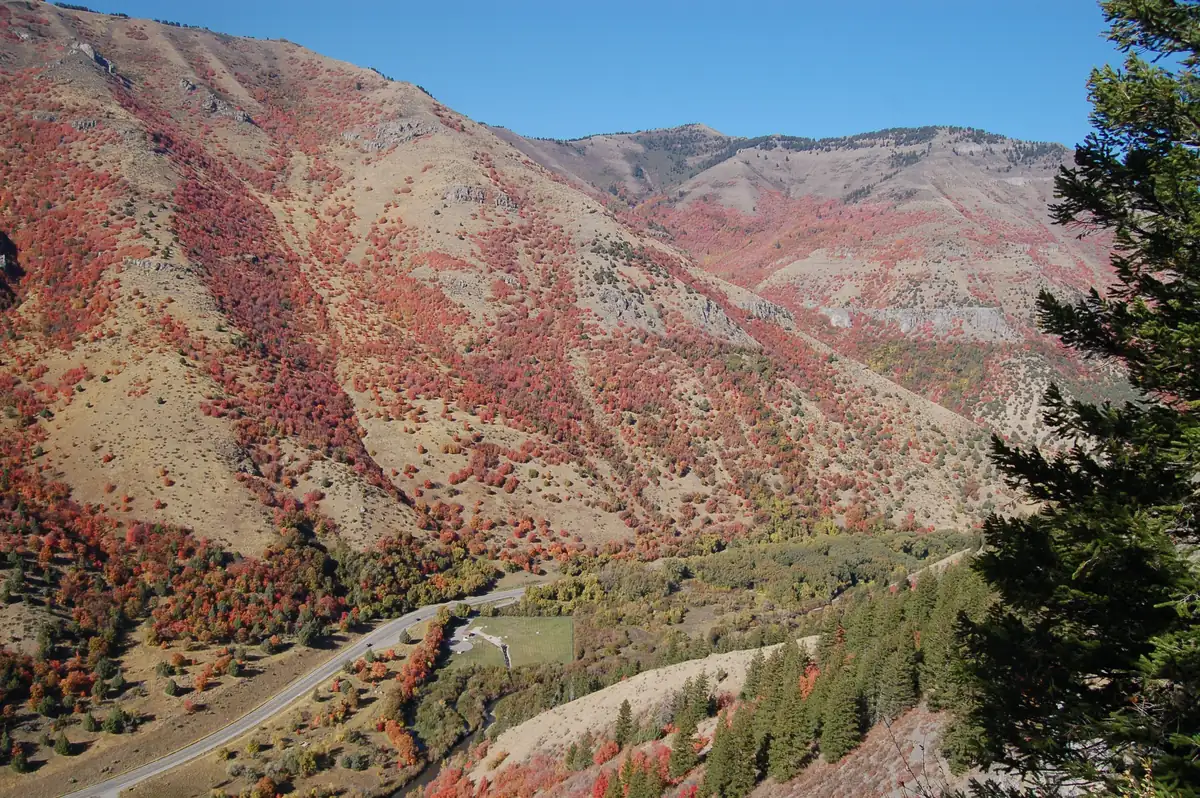
Utah’s color runs downhill. The bigtooth maples of the Wasatch canyons usually light up first, the aspens take over higher up, Gambel oak turns rust on the foothills, and the cottonwoods along desert rivers are last, into November. This year the Wasatch Back had a wet August, and forecasters quoted by the Park Record expected maples and aspens there to peak in early to mid-October; a local guide added that late-summer rain tends to bring color a little later and brighter. A cold snap or a windstorm can end a canyon’s show in a day, so go early in the month for the high country.
-
Bigtooth maple in the Wasatch canyons
Late September into early October; lower canyons last · Logan Canyon, the Alpine Loop, Mount Nebo Loop, Big and Little Cottonwood, Millcreek
The Forest Service describes bigtooth maple as growing between about 4,200 and 9,200 feet in Utah, most thickly on moist, north-facing slopes; that is why one side of a canyon can be scarlet while the facing side stays olive. By October the winged seeds have mostly dropped, between mid-August and early October. The Uinta-Wasatch-Cache National Forest points drivers to the Logan Canyon Scenic Byway, the Mirror Lake Highway and the Mount Nebo Loop. Go on a weekday morning; the canyon roads fill by noon on weekends.
-
Aspens, and Pando
Early to mid-October on the high plateaus · Guardsman Pass, Bonanza Flat, the Mirror Lake Highway, Fishlake and Dixie national forests
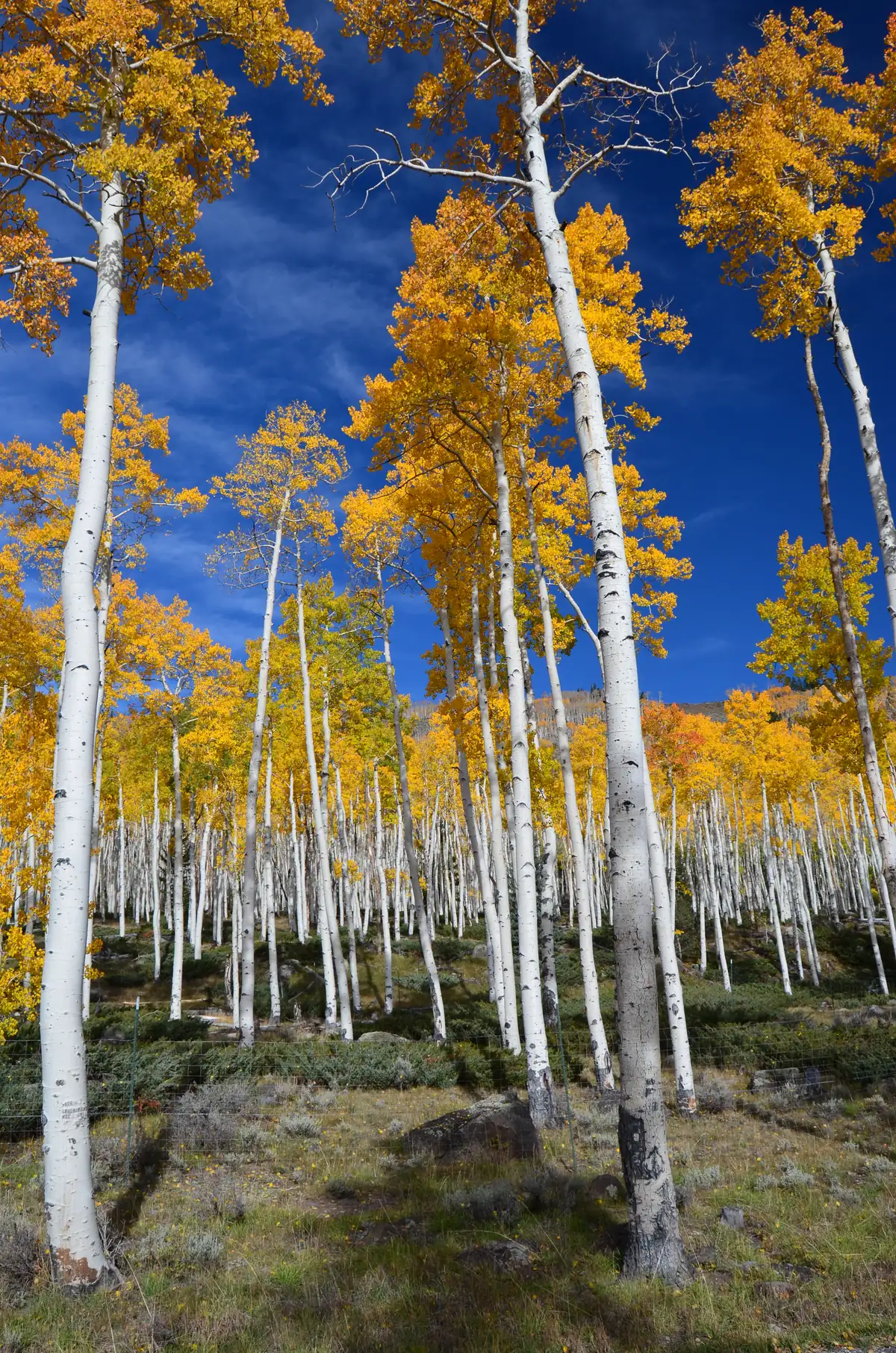
Aspen stands turn as a single color because each is usually one clone, grown from one root system. The most famous is Pando, about a mile southwest of Fish Lake on State Route 25: the Fishlake National Forest describes it as a single aspen spreading over 106 acres, with more than 40,000 stems and a weight of nearly 13 million pounds. Trails start near Doctor Creek Campground. On the Dixie National Forest, near Bryce Canyon and Cedar Breaks, aspens mix with maples and oakbrush.
-
Cottonwoods in the red-rock canyons
End of October into early November · Zion Canyon, the Virgin River, the Colorado and Green river corridors
The National Park Service says Zion’s color starts at the highest elevations and works down to Zion Canyon at the end of October and in early November. The Fremont cottonwoods along the Virgin River are the last big yellow of the year in Utah,. Moab’s river bottoms follow a similar schedule.
Choose a single tree near home and take its picture weekly from one fixed spot; by Halloween you will have your own record of how the season arrived.
What is happening on the Great Salt Lake in October?
For migrating waterbirds the lake is a refueling stop of continental importance. By the Division of Wildlife Resources’ estimate, some 10 million birds, from over 250 species, use the lake in a year, many of them fueled by brine shrimp and brine flies. October belongs to the grebes, the ducks and, at the end, the swans.
-
Eared grebes by the million
Fall staging through October; departure in November or December · Open water across the lake; rafts can often be seen from Antelope Island
The DWR’s Great Salt Lake Ecosystem Program counts as many as 5 million eared grebes in fall, at times half to 90 percent of the North American population. They eat almost nothing but brine shrimp while they are here. As they fatten, their flight muscles shrink and their digestive organs grow until the birds cannot fly; then, beginning in November or December, they rebuild their muscles and leave in huge flocks over three to four weeks for a nonstop flight to the Gulf of California.
-
Ducks, geese and the first swans at Bear River
Ducks building all month; tundra swans from late October · Bear River Migratory Bird Refuge auto tour route, west of Brigham City
The refuge’s month-by-month guide says most shorebirds have gone by October, leaving avocets, marbled godwits, greater yellowlegs and long-billed dowitchers, while the duck count nears 200,000. Canvasbacks, goldeneyes and lesser scaup arrive late in the month, and cinnamon teal leave. The DWR’s swan survey history says most tundra swans reach Utah around the first of November, and peak fall numbers of 40,000 to 60,000 are regular, mostly on the refuge and nearby marshes; the refuge puts the swan peak in the week before Thanksgiving. The DWR says statewide duck numbers often peak in mid-September, while the refuge’s own count tops out in early November; either way the auto tour route, open daily in daylight, will be busy.
-
The Antelope Island bison roundup
Roundup Saturday, October 24; working days October 27–29 · Antelope Island State Park; public viewing at White Rock Bay
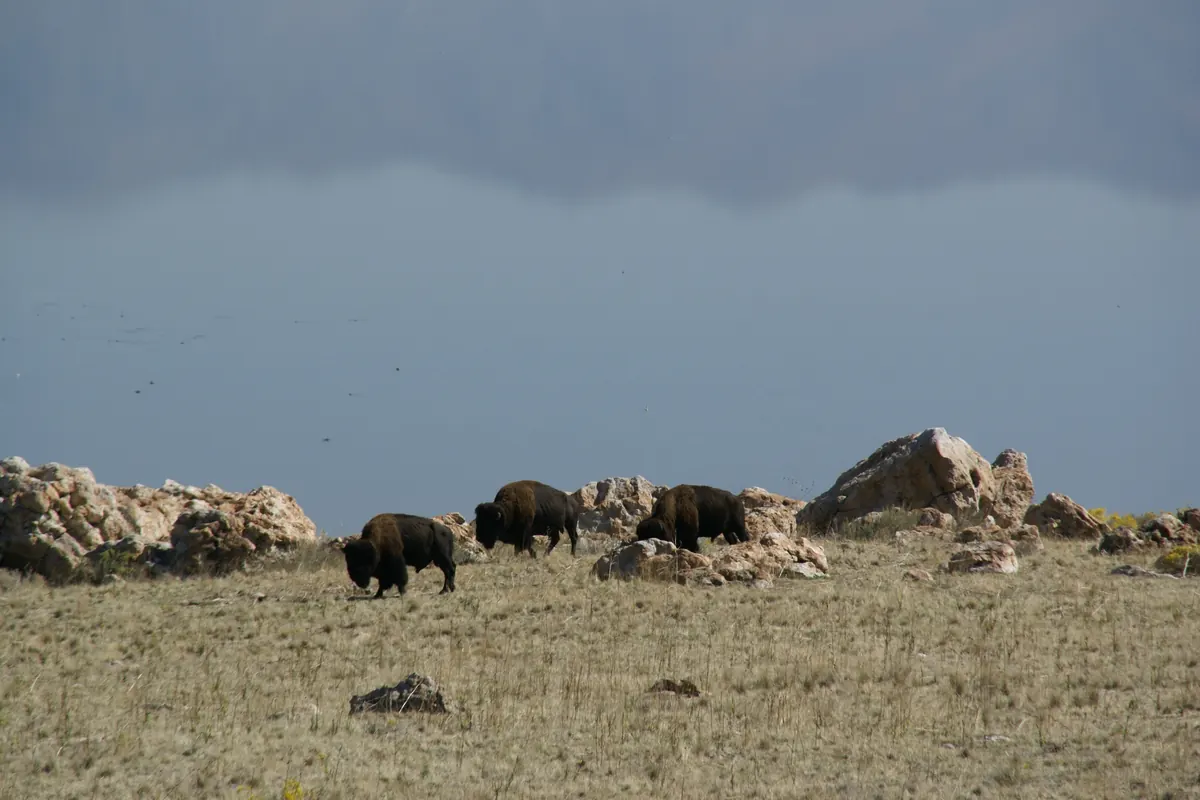
Utah State Parks keeps the island’s herd at about 500 to 550 animals. With 100 to 200 calves a year and no predator able to take an adult, the herd must be thinned. On October 24 riders assemble at 9 a.m. and push the bison toward the corrals, usually finishing between noon and 3 p.m.; spectators do not register and gather at the White Rock Bay viewing area. From October 27 to 29 the animals get health checks and are sorted, with free public tours; surplus animals go to an online auction in early November (the park page lists both November 3 and 4). Bring binoculars and stay well back from any bison, penned or not.
Which birds are migrating through Utah in October?
Beyond the lake, October brings cranes to the Uinta Basin, hawks to the ridgelines, and sparrows and juncos to every brushy canyon mouth. Songbird migration is winding down, and the birds that winter here are settling in.
-
Sandhill cranes in the Uinta Basin
Arriving now; guided viewing Saturday, October 10 · Fields near the Green River at Jensen; Pelican Lake and Ouray National Wildlife Refuge
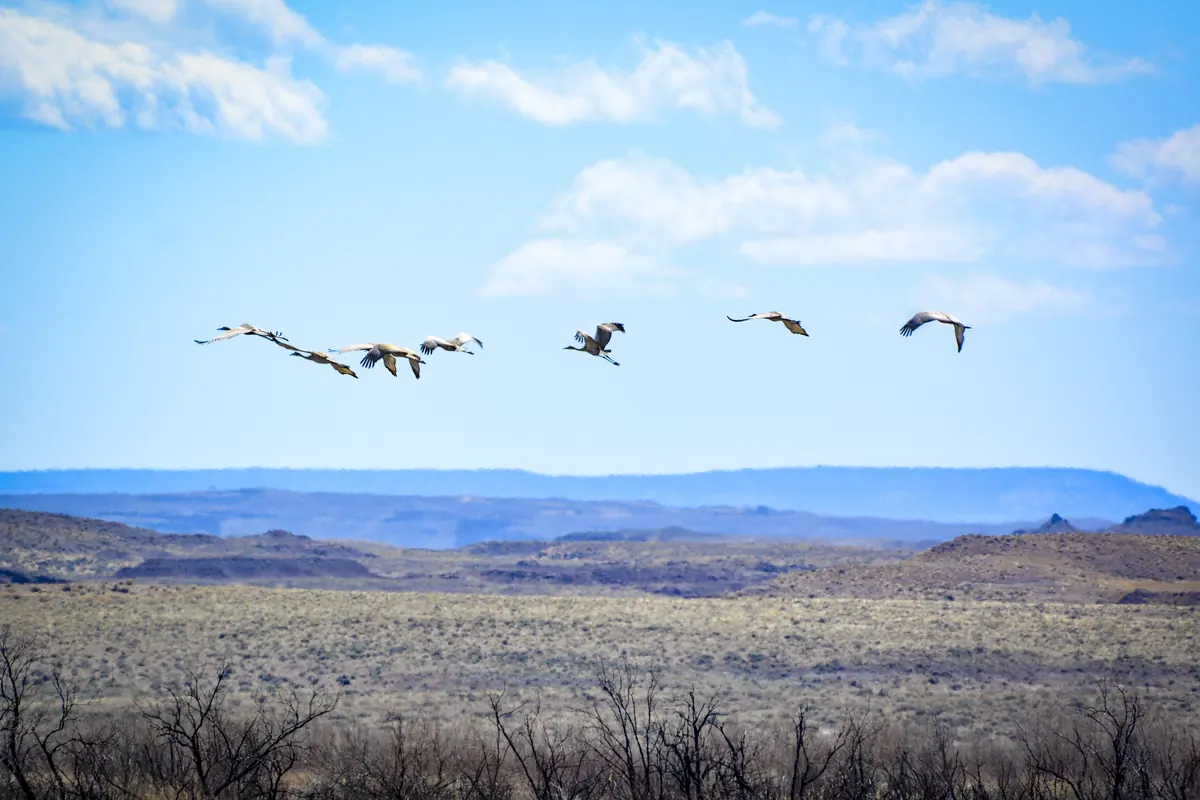
DWR’s Northeastern Region says the cranes are easy to find in the basin’s fields during migration and have already begun to arrive. They stand about 4 feet tall, wear a crimson crown on a gray body, and call loudly enough to be heard up to 2.5 miles away. The division runs two free auto tours on October 10: 7 to 9 a.m. from Jensen Nature Park, 8775 E. 6000 South, and 5 to 7 p.m. from the commuter lot at Highway 40 and State Route 88, where the evening group watches cranes come in to roost near Pelican Lake and the Ouray refuge. Register in advance on Eventbrite; scopes are provided, but bring binoculars if you have them.
-
Hawks along the Wasatch
Late September through October · Ridgelines above the Wasatch Front; Goshute Mountains just over the Nevada line
HawkWatch International, based in Salt Lake City, opened an exploratory count site in the Wasatch Mountains this fall when wildfires shut two of its regular sites, and its crew tallied more than 600 migrating raptors in the first three days. The group has not published public-visit details for the new site. Its long-running Goshute Mountains station in Nevada, south of West Wendover, can be reached by visitors willing to hike about 2.5 miles with 1,800 feet of climbing.
-
Juncos, sparrows and the winter crowd
All month, building by Halloween · Canyon mouths, riparian thickets, backyard feeders
Dark-eyed juncos come down from the mountains and in from the north, white-crowned sparrows fill the brushy edges, and northern harriers return in numbers to the marshes. Tally them on October 10, the worldwide October Big Day, or on any walk; a list from your own block counts as much as one from a famous refuge.
Where can you still see red kokanee salmon in Utah in October?
Kokanee are landlocked sockeye salmon, silver most of the year, that turn bright red in September and early October and run up streams to spawn and die. The DWR says the best viewing is usually mid-September to mid-October, depending on the water. Several of the most popular spots peak in September, so in October go high and go early in the month.
-
Electric Lake
First half of October · Wasatch Plateau, Emery County
The DWR lists the first half of October as the viewing window at Electric Lake, one of the later runs in the state.
-
Smith and Morehouse Reservoir
Late September to mid-October · Weber River drainage, east of Oakley
Up the Weber River road from Oakley at the edge of the western Uintas, with red fish in the inlet stream into the middle of the month.
-
Fish Lake, self-guided
Through October · Twin Creeks boardwalk, Fish Lake
This year’s Fish Lake viewing event was canceled because too few fish came in to spawn, but the DWR says the Twin Creeks boardwalk is still open for looking on your own. Combine it with a walk in Pando down the road.
From September 10 to November 30, any kokanee caught anywhere in Utah must be released. Watch from the bank or a bridge, and keep kids and dogs out of the gravel beds where the eggs are.
When is the first frost and freeze in Utah?
Across Utah the first freeze depends far more on elevation and cold-air drainage than on latitude. Park City, at about 6,900 feet, reaches its median first freeze on September 25; Bryce Canyon headquarters on September 27. Down in the valleys the median first freeze arrives October 6 at Vernal, October 13 at Cedar City, October 16 at Logan, October 21 at Provo and October 23 at Moab. The Salt Lake City airport, on the valley floor, waits until October 31, and St. George, down at about 2,900 feet, until November 10. Clear, calm nights after a storm are when a frost settles into the low spots, so a garden in a hollow freezes days before the one on the bench.
| Station | One year in ten | Median | Nine years in ten |
|---|---|---|---|
| Logan Utah St Univ (Cache Valley) | Oct 1 | Oct 16 | Oct 29 |
| Ogden Hinkley Airport (Ogden) | Oct 7 | Oct 22 | Nov 6 |
| Salt Lake City International Airport (Salt Lake City) | Oct 17 | Oct 31 | Nov 13 |
| Provo Byu (Provo) | Oct 7 | Oct 21 | Nov 4 |
| Park City (Wasatch Back) | Sep 12 | Sep 25 | Oct 9 |
| Vernal (Uinta Basin) | Sep 23 | Oct 6 | Oct 20 |
| Moab (Canyon Country) | Oct 8 | Oct 23 | Nov 4 |
| Cedar City (Color Country) | Sep 30 | Oct 13 | Oct 28 |
| St George (St. George) | Oct 27 | Nov 10 | Nov 22 |
Ogden’s airport station freezes, on median, on October 22. For the station nearest you, including dozens of mountain and desert sites, use the Utah first and last frost table. Pick the tomatoes and squash on the evening a clear, still night is forecast, and note the date of the first frosted car roof.
How much daylight does Utah lose in October?
A little over an hour, and more in the north: Logan gives up 81 minutes over the month, Salt Lake City 77 and St. George 67. In Salt Lake City, sunrise moves from 7:24 to 7:57 a.m. and sunset from 7:09 to 6:25 p.m. Because all of Utah keeps Mountain time while sitting in the western part of the zone, October mornings stay dark late, especially in the southwest corner. Once Mountain Standard Time resumes (Sunday, November 1, 2 a.m.), Salt Lake City’s sunrise jumps back to about 7 a.m. and sunset to about 5:25 p.m.
| City | Oct 1 | Oct 31 | Lost | Per day |
|---|---|---|---|---|
| Logan | 11 h 45 m | 10 h 24 m | 81 min | 2.7 min |
| Ogden | 11 h 44 m | 10 h 26 m | 78 min | 2.6 min |
| Salt Lake City | 11 h 45 m | 10 h 28 m | 77 min | 2.6 min |
| Provo | 11 h 46 m | 10 h 30 m | 76 min | 2.5 min |
| Vernal | 11 h 45 m | 10 h 29 m | 76 min | 2.5 min |
| Moab | 11 h 47 m | 10 h 35 m | 72 min | 2.4 min |
| Cedar City | 11 h 47 m | 10 h 38 m | 69 min | 2.3 min |
| St. George | 11 h 47 m | 10 h 40 m | 67 min | 2.2 min |
Type your own town into the daylight and twilight calculator to see its sunrise, sunset and the minutes you lose each week.
What is October weather like in Utah, and will El Niño bring a snowy winter?
October is one of Utah’s kindest months, dry and clear more often than not, with a wide daily swing. Thirty-year NOAA averages (1991–2020) put a typical October afternoon near 66 °F at the Salt Lake City airport, 79 °F at St. George and 74 °F at Moab, but only 61 °F at Logan and 58 °F at Bryce Canyon, where the average low sits right at freezing (32 °F). Precipitation is light: 1.26 inches at Salt Lake City, 1.83 at Logan, 0.77 at St. George. Snow usually starts in earnest in November; Salt Lake City’s normal snowfall is half an inch in October and 7 inches in November. Bryce Canyon averages 3 inches in October, and the park notes that October snowstorms “are not unusual” there. Once the first cold air pours over a lake that is still warm, lake-effect bands off the Great Salt Lake can bring a surprise burst of snow to parts of the valley.
The larger question is winter. Federal forecasters now treat a very strong El Niño as close to a sure thing: better than nine chances in ten, in the Climate Prediction Center’s mid-September reading, issued on the 10th. Utah sits across the dividing line of El Niño’s usual pattern. CPC meteorologist Scott Handel told Utah Public Radio that the southern Intermountain West, including parts of Utah, generally favors above-normal precipitation in El Niño winters and the northern Rockies below-normal. State climatologist Jon Meyer of the Utah Climate Center told Fox 13 that southern Utah does tend to have wetter winters under strong El Niños, while the outcome farther north is harder to call and varies from event to event; he also warned that a warm storm track can deliver rain instead of snow. So the best bet is a wetter winter in Color Country and Canyon Country and a coin toss along the Wasatch, while El Niño will barely touch this October. NOAA’s three-month winter maps land in mid-October; for the coming days, our forecast page has it.
What can you see in Utah’s night sky in October?
Thin, dry air over a dark desert gives Utah some of its finest stargazing of the year in October. All times below are Mountain Daylight Time for Salt Lake City unless noted; St. George runs roughly 5 to 15 minutes later.
-
Jupiter and the crescent moon rise together
Tuesday, October 6, from about 3 a.m. · Low in the east-northeast
States farther east watch the moon cover Jupiter on this date. In Utah the moon is still below the horizon when Jupiter slips behind it, and the International Occultation Timing Association (IOTA) lists the planet coming back out from the moon’s dark edge at about 3:09 a.m. in Salt Lake City and Ogden, when the moon is only 1 degree up, a few minutes after moonrise at 3:02. With the Wasatch to the east, almost nobody will see that moment. What everyone can see is the thin crescent and bright Jupiter climbing the eastern sky side by side until dawn; in southern Utah, where the moon rises later, Jupiter is already clear of the moon when the pair comes up.
-
The Hunter’s Moon
Sunday, October 25 and Monday, October 26 · East at dusk
Full moon falls at 10:12 p.m. Mountain time on the 25th, and to the eye it is just as full on the 26th. Salt Lake City sees it come up at 6:01 p.m. on the 25th, 32 minutes ahead of sunset (6:33), and at 6:34 p.m. on the 26th, three minutes after the sun goes down; St. George’s moonrise on the 25th is 6:15 p.m. Ignore any supermoon billing; the moon is nowhere near close enough this time.
-
Orionid meteors
Before dawn, October 21 and 22 · Anywhere dark; look up and east of south
The Orionids, bits of Halley’s Comet, run from early October into November with a broad peak on October 21–22. The gibbous moon sets at 2:46 a.m. on the 21st and 3:51 a.m. on the 22nd in Salt Lake City (2:58 and 4:01 in St. George), and dawn twilight does not begin until about 7:20, which leaves between roughly three and a half and four and a half hours of darkness. A lawn chair at any state park away from the valley glow is enough.
-
Draconid meteors
Evening of Thursday, October 8 · Look north after dark
A slow, unpredictable shower best in the early evening, which makes it good for children. With moonrise not until 5:24 a.m., the whole evening is moonless.
-
Saturn all night, Jupiter and Mars before dawn
Saturn at opposition October 4; moon near Saturn October 23–24; Mars at the Beehive October 11 · Saturn in the east at dusk; Jupiter and Mars in the east before sunrise
Saturn’s opposition date is October 4; it rises at dusk, sets at dawn and shines pale gold without twinkling, with the moon alongside on the 23rd and 24th. Venus is a brief, low glint in the west during October’s opening days and reaches inferior conjunction on the 23rd. Before sunrise the eastern sky belongs to Jupiter, and on the 11th red Mars sits inside the loose Beehive star swarm, a pairing worth pulling out binoculars for.
| Phase | Date | Time |
|---|---|---|
| Last quarter | Saturday, Oct 3 | 7:25 a.m. MDT |
| New moon | Saturday, Oct 10 | 9:50 a.m. MDT |
| First quarter | Sunday, Oct 18 | 10:12 a.m. MDT |
| Full moon, the Hunter’s Moon | Sunday, Oct 25 | 10:12 p.m. MDT (looks full the evenings of Oct 25 and 26) |
| Last quarter | Sunday, Nov 1 | 1:28 p.m. MST |
The Salt Lake Astronomical Society holds free public star parties on clear Saturday nights at sites along the Wasatch Front. For tonight’s clouds, see the sky conditions page, and for local moonrise and moonset, the moon calendar.
What is blooming and fruiting in Utah in October?
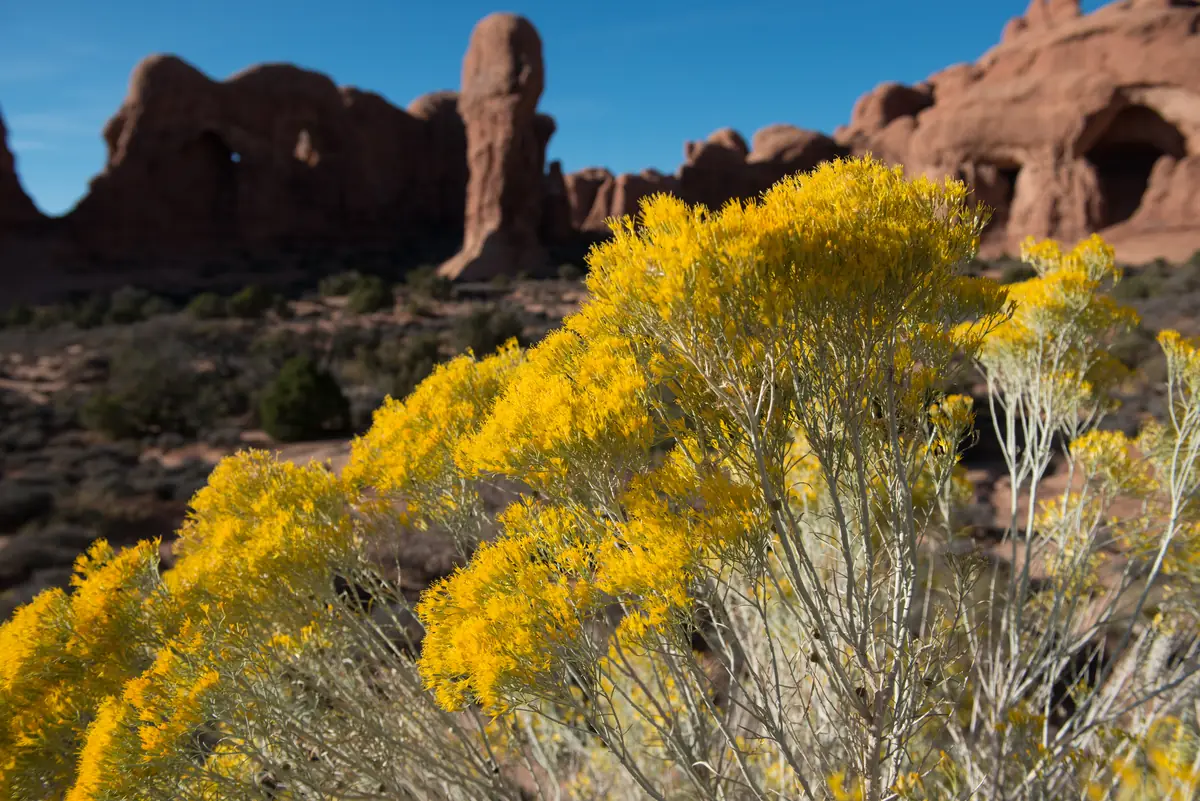
By October most wildflowers have finished, and the desert shrubs take over: yellow rabbitbrush, flowering sagebrush, ripe pinyon cones. The smell of a Utah October is sagebrush after rain.
-
Rubber rabbitbrush
September into October in the valleys and deserts · Roadsides, foothills, disturbed ground statewide
According to Forest Service research summaries, mountain populations bloom in July while low-desert plants flower much later, which is why the valleys go mustard yellow just as the mountains go gold. On warm afternoons it draws late bees and butterflies, and pronghorn eat both the flower heads and the new leaves in fall.
-
Big sagebrush in flower
Late summer into fall; seeds shed through winter · Valleys, benches and the West Desert
Sagebrush flowers are tiny and easy to miss, but for many people the pollen is a fall allergy trigger. The Forest Service calls Wyoming big sagebrush perhaps the single most important plant to sage-grouse, and its evergreen leaves feed mule deer and pronghorn through the winter.
-
Pinyon cones open
Late September and October · Pinyon-juniper woodland from Moab to Cedar City and the central valleys
Pinyon cones need two years to ripen, then spread their scales from late September through October. Heavy crops come only every three to seven years and are cut by drought, so after this year’s heat and drought the harvest may be thin in many places. Pinyon jays, scrub jays, Steller’s jays and Clark’s nutcrackers cache the seeds and forget some, which is how new pinyons get planted. If you want to gather nuts for your own use, check with the local Forest Service or BLM office first.
-
Maple keys and Gambel oak acorns
Maple seeds down by early October; acorns through the fall · Foothills and canyon mouths along the Wasatch
Birds and small mammals eat bigtooth maple seeds, and elk and mule deer browse the twigs. The DWR says this spring’s early warmth, hard freezes and summer drought damaged the berries and acorns that bears depend on, so expect a poor acorn year on many slopes and hungry animals looking elsewhere.
What are Utah’s bears, elk and deer doing in October?
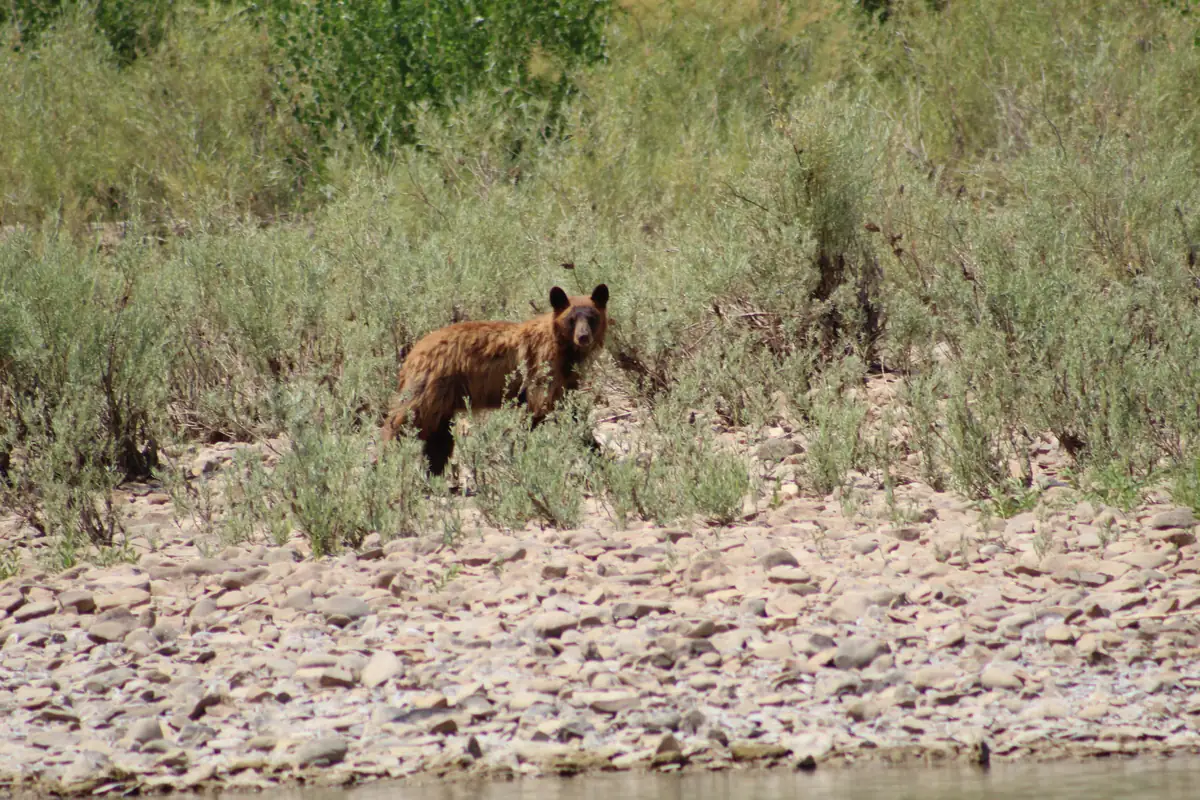
October is the season when big animals move. Bears eat as much as they can before hibernation, elk finish the rut, and mule deer drift toward their winter ranges as snow builds up high.
-
Hungry black bears
All month, until denning · Canyons, campgrounds and foothill neighborhoods
As of August 25 the DWR had responded to 168 bear incidents this year, twice the 83 of 2025. The division blames a failed natural food crop: a warm spring, hard freezes and then heat and drought damaged the berries, acorns and roots that make up about 90 percent of a black bear’s diet, pushing bears downhill into town. Fall is when bears feed hardest, so bring in bird feeders and pet food, keep trash in the garage until pickup morning, and lock food in your vehicle at camp.
-
Elk bugling fades
Early October · Aspen parks and meadows in the Wasatch, Uintas and high plateaus
The rut usually peaks in late September, and bulls still bugle at dusk and dawn in the first days of October. The general-season any-bull rifle hunts open October 3, so listen from roads and trailheads rather than wandering into the timber.
-
Mule deer on the move, and a disease check
Through October and November · Foothills, benches and highways between summer and winter range
Storms in the high country push mule deer down toward the sagebrush, and deer cross roads more often at dawn and dusk. Chronic wasting disease is present across Utah, mostly in the northeast and southeast; the DWR runs check stations October 17–26 during the rifle hunt and says 78 percent of hunters have never had a deer tested.
In the journal’s dusk and dawn watch, log the time of the first owl call, the direction deer cross your road and the evening you last see a bat.
What can families do outdoors in Utah in October?
- October 2–4, 9–11 and 16–18: “Wild Night Life” at Hardware. A free nocturnal-wildlife exhibit with crafts and hourly story times, 10 a.m. to 3 p.m., at the Hardware Wildlife Education Center in Blacksmith Fork Canyon, about 15 miles from Hyrum on State Route 101.
- Thursday, October 8: Draconid meteors in the early evening, with no moon to wash them out.
- Saturday, October 10: crane tours and a big birding day. The DWR’s free sandhill crane auto tours leave Jensen Nature Park at 7 a.m. and the Highway 40 and State Route 88 lot at 5 p.m. (register on Eventbrite). October 10 is also the global October Big Day on eBird, so send in a checklist from wherever you are.
- Saturday, October 17: Creatures of the Night at the Ogden Nature Center. A “non-spooky” Halloween walk, 4 to 8:30 p.m.; $10 for ages 13 and up, $8 for children, free under 4.
- Wednesday, October 21: The Shoshone Plant Experience at Tracy Aviary in Liberty Park, 10 to 11 a.m., on the plant knowledge of the Northwestern Band of the Shoshone Nation. Check the aviary for tickets.
- Saturday, October 24: the Antelope Island bison roundup. Watch from White Rock Bay; no registration needed. Free tours of the sorting and health checks follow October 27–29.
- Clear Saturday nights: public star parties with the Salt Lake Astronomical Society. Ask for Saturn, which is at its best this month.
- Citizen science. Log birds on eBird, photograph plants and insects for iNaturalist, and report a bear that gets into trash to the DWR so its biologists can track the problem. Project FeederWatch starts November 1, a good reason to put up a feeder at the end of the month once bears are denning.
Every outing on this list deserves a dated line in the Naturalist’s Field Journal; pages for other states sit on the nature index.
Safety notes for October in Utah
- Hunting seasons. Utah’s biggest hunts fall in October. The general-season any-legal-weapon buck deer hunt runs October 17–25. Any-bull elk rifle hunts run October 3–9 and October 10–16, spike-bull elk October 3–15, and the muzzleloader elk hunt October 28–November 5; general archery deer and elk have been open since August 15. Duck season opens October 3 in the northern zone and October 10 in the southern zone, and the permit-only tundra swan hunt runs October 3–December 13. Youth pheasant opens October 31.
- Hunter orange. Under Utah Code 23A-11-205, anyone hunting big game must wear at least one visible hunter-orange hat, shirt, jacket, coat, vest or sweater. Exceptions include once-in-a-lifetime and statewide conservation or sportsman permits, cooperative wildlife management units, and archery, muzzleloader and HAMSS hunters outside areas where a general any-legal-weapon deer or bull elk hunt is under way. Inside those areas, archers and muzzleloader hunters need orange as well. The DWR also urges rabbit hunters to wear it, and hikers, mountain bikers and dog walkers on public land should wear it anyway during the rifle weeks, with a bright vest or collar for the dog.
- Bears. With incident calls doubled this year, never leave food, coolers or trash out at camp; if you meet a bear, stand your ground, do not run or climb a tree, and fight back if it attacks.
- Toxic algae. The Utah Division of Water Quality still had 27 lakes and reservoirs under watch or warning advisories in mid-September, including Andy Adams Reservoir, and regular monitoring stops October 31. Keep dogs out of green, scummy or discolored water, and see a vet right away if one is exposed.
- Cold nights, short days and slot canyons. Desert afternoons in the 70s drop into the 30s after dark, and Bryce Canyon’s average October low is right at freezing. Carry a headlamp, since sunset comes before 6:45 p.m. by late month, and a warm layer. In slot canyons, check the National Weather Service flash-flood outlook before you go; a storm miles away can fill a canyon.
Sources
- Utah State Parks: 2026 Antelope Island bison roundup (dates, viewing, herd size)
- U.S. Fish and Wildlife Service: monthly bird happenings, Bear River Migratory Bird Refuge (PDF)
- Utah DWR Great Salt Lake Ecosystem Program: birds (eared grebes, phalaropes, tundra swans)
- Utah DWR Great Salt Lake Ecosystem Program: brine shrimp
- Utah DWR Great Salt Lake Ecosystem Program: aerial tundra swan survey
- Utah DWR: sandhill crane viewing events in the Uintah Basin, October 10, 2026
- Utah DWR: Wild Night Life exhibit at Hardware Wildlife Education Center, October 2026
- Utah DWR: where to see red kokanee salmon this fall (2026)
- Utah DWR: bear incidents doubled from last year (August 27, 2026)
- Utah DWR: CWD check stations for deer, October 17–26, 2026
- Utah DWR: what hunters should know for the 2026 deer and elk hunts
- Utah DWR: what hunters should know about the 2026 waterfowl season
- Utah DWR: what hunters should know about the 2026 upland game hunts
- Utah DWR: 2026 Utah Big Game Field Regulations guidebook (PDF; hunter orange rule)
- Utah Code 23A-11-205: requirement to wear hunter orange
- Utah DWR: 27 waterbodies under harmful algae advisories (September 17, 2026)
- Utah Division of Water Quality: recreational water quality and harmful algal bloom advisories
- HawkWatch International: update on the 2026 migration network (September 24, 2026)
- HawkWatch International: migration network sites and visiting
- Park Record: when and where to see fall leaves in the Wasatch Back (September 15, 2026)
- USDA Forest Service: fall colors by national forest (Uinta-Wasatch-Cache, Dixie, Fishlake)
- Fishlake National Forest: Pando aspen clone
- Friends of Pando
- National Park Service: Zion seasons and fall color timing
- National Park Service: Bryce Canyon weather (October normals and snow)
- USDA Forest Service Fire Effects Information System: bigtooth maple
- USDA Forest Service Fire Effects Information System: twoneedle pinyon
- USDA Forest Service Fire Effects Information System: rubber rabbitbrush
- USDA Forest Service Fire Effects Information System: Wyoming big sagebrush
- NOAA NCEI: 1991–2020 monthly normals, Utah stations (data API)
- Climate Prediction Center: ENSO diagnostic discussion, September 10, 2026
- Utah Public Radio: strong El Niño could bring Utah a wetter winter (CPC’s Scott Handel, September 4, 2026)
- Fox 13: could a super El Niño bring Utah a big snow year? (state climatologist Jon Meyer)
- Wikipedia: lake-effect snow (Great Salt Lake effect)
- U.S. Naval Observatory: moon phases 2026 (data API)
- U.S. Naval Observatory: sun and moon rise, set and twilight for one day (data API)
- International Occultation Timing Association: lunar occultation of Jupiter, October 6, 2026
- EarthSky: visible planets and night sky guide (Saturn opposition, Venus, Mars and the Beehive)
- EarthSky: meteor shower guide (Draconids, Orionids)
- Salt Lake Astronomical Society: public star parties
- Ogden Nature Center: events (Creatures of the Night, October 17, 2026)
- Tracy Aviary: Liberty Park special events, October 2026
- BirdsCaribbean: October Big Day 2026 (Saturday, October 10)
- Project FeederWatch: how to participate (season begins November 1)
- iNaturalist
- Photos via Wikimedia Commons; licenses and photographers are credited under each picture
