What to look for in nature in Utah this November
November is the month Utah trades one set of visitors for another. Tens of thousands of tundra swans drop into the marshes north of the Great Salt Lake, the eared grebes that fattened on brine shrimp all fall slip away south in the dark, and the first wintering bald eagles from the north settle into the cottonwoods. Mule deer bucks chase does across the foothills while the bears go to ground, and in Zion the cottonwoods along the Virgin River hold the state’s last gold. In the valleys, the first snow and the first winter haze arrive within a few weeks of each other. Here is where and when to look; the other months and states are gathered on our nature calendar.
Other months in Utah: October, December.
Start here
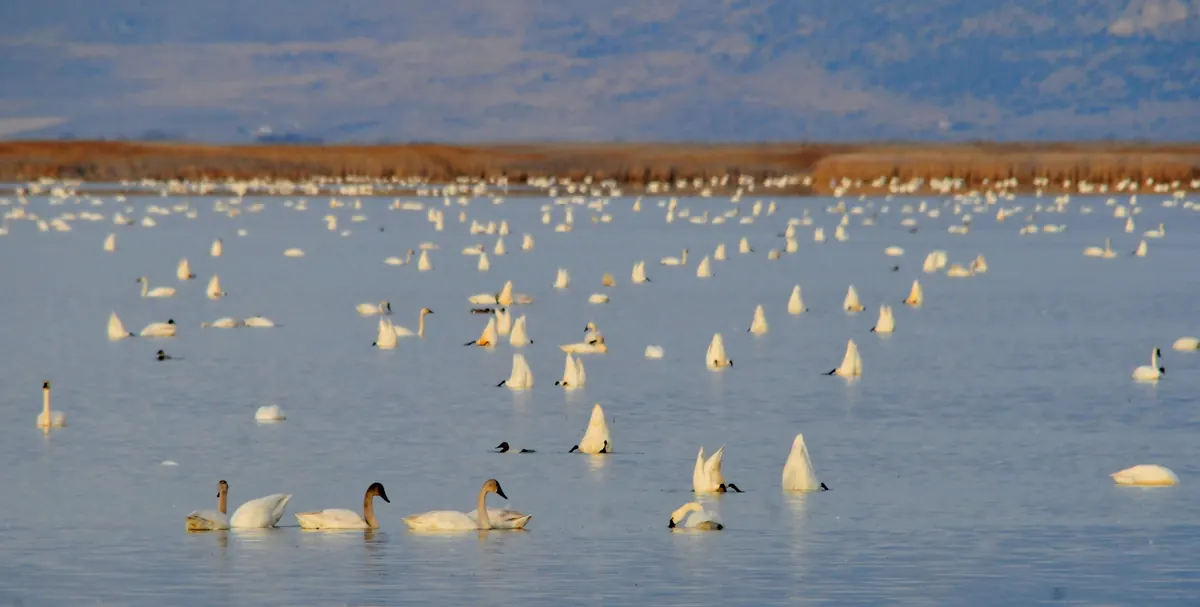
- Swans at Bear River. Tundra swans from Alaska begin arriving around November 1 and, by the refuge’s own reckoning, reach their peak in the week before Thanksgiving. Drive the auto tour route west of Brigham City on a calm morning and listen for their high, whooping calls before you see them.
- Eagles in, grebes out. Wintering bald eagles start turning up along the marsh edges and big rivers as the shallow water freezes, while the eared grebes on the Great Salt Lake leave in nightly waves starting in November or December. Scan bare cottonwoods by day; at dusk, think of the flocks lifting off the lake.
- Leonids and the Beaver Moon. Set an alarm for the predawn hours of Wednesday the 18th; after the half-lit Moon sets, Leonids streak out of the east until dawn. Six days later the Beaver Moon turns full at 7:53 a.m. MST, a slightly oversized supermoon that looks round on Monday evening and Tuesday evening alike.
In the Naturalist’s Field Journal, give the birds-I-have-seen list your first swan flock, your first wintering eagle and a rough-legged hawk hovering over a marsh; give the mammal watch a rutting buck and the does he follows; and use dusk and dawn watch to time how early the light fails. A daily field log kept from November 1 to 30 will show the first frosty windshield, the first snow on the valley floor and the first gray inversion morning, each with its date.
Regions used below: Cache Valley and the north; Wasatch Front and the Great Salt Lake; Wasatch Back and the Uintas; Uinta Basin; Central Utah and the high plateaus; Canyon Country and Moab; Color Country and St. George.
When do tundra swans come to Utah, and where can I see them?
The marshes where the Bear River meets the Great Salt Lake are one of the great swan stopovers of the West. The Division of Wildlife Resources (DWR) says about three quarters of the western population of tundra swans travels an interior route from Alaska that passes through the lake, and that fall peaks of 40,000 to 60,000 swans have been routine. November is their month, and it is also the month the duck flocks crest and then thin out as the water starts to freeze.
-
Tundra swans
Arriving around November 1; peak the week before Thanksgiving; most leave after the first hard freeze · Bear River Migratory Bird Refuge auto tour route, west of Brigham City; neighboring marshes of Box Elder County
The DWR flew weekly swan counts from 1962 until 2018, and in those years the birds usually showed up around the start of November and crested in the middle of the month, tens of thousands strong. The refuge’s own bird guide places the peak in the week before Thanksgiving, which this year means roughly November 16 to 25. Most stay into early December and leave once a hard freeze seals the shallows. Swans feed by tipping head-down for roots and tubers, so look for white rumps poking out of the water. The auto tour route is open daily in daylight, weather and road permitting.
-
Ducks at their peak, then the exodus
Peak in the first week of November · Bear River refuge; Farmington Bay, Ogden Bay and other waterfowl management areas along the lake
The refuge’s guide says its fall waterfowl count crests at about 220,000 birds during the opening week of November, and that the season’s first freeze then sends most of them south in a rush. Go early in the month for the biggest rafts of ducks; the state’s waterfowl management areas will be busy with hunters on the same mornings.
-
Rough-legged hawks
Arriving through November and staying the winter · Over open marsh, fields and sagebrush flats in northern Utah
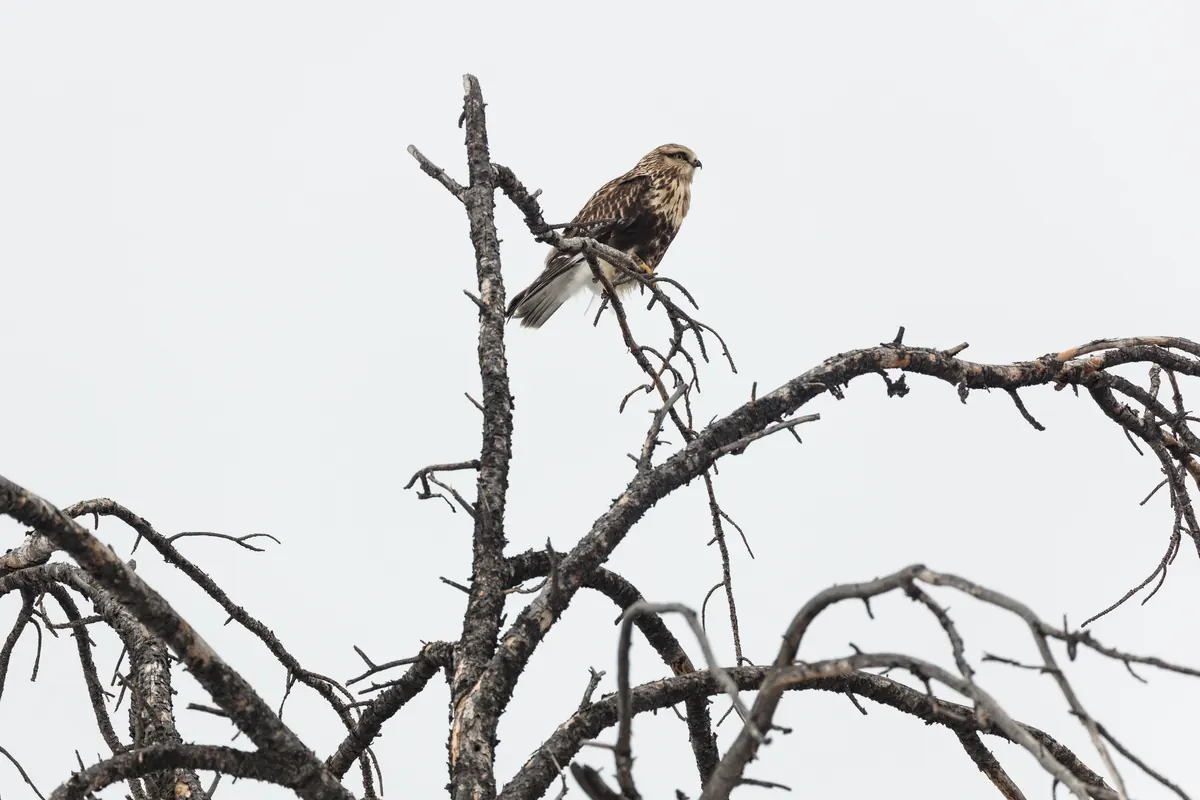
The refuge notes that rough-legged hawks, pushed south from their Arctic breeding grounds, begin patrolling the marsh edges this month. They are buteos about the size of a red-tailed hawk, with feathered legs, a dark band across the belly and black wrist marks under each wing, and they often hang in the wind on beating wings over one spot while they hunt for voles.
Bridgerland Audubon’s November field trip, on Saturday, November 14, visits Wellsville Reservoir in southern Cache Valley; details are in the families list below.
When do eared grebes leave the Great Salt Lake?
All fall, the open water of the Great Salt Lake carries one of the strangest bird gatherings on the continent: eared grebes in the millions, which by the DWR’s estimate can make up anywhere from half to more than 90 percent of every eared grebe in North America. They come for the brine shrimp, and November is when they start to leave.
-
The grebes’ night departures
Beginning in November or December and lasting three to four weeks · Over the whole lake; you will not see them go, but you may see the rafts shrink
Once the exodus begins, the DWR’s Great Salt Lake Ecosystem Program says, flocks lift off nearly every evening around sunset for three to four weeks, bound without a stop for Mexico’s Gulf of California. You will not see them go, but from the Antelope Island causeway you can watch the dark specks that dotted the water in October thin out week by week. In winter dress a grebe is a small gray-and-white diver with a thin bill and red eyes.
-
When grebes fall out of the sky
Stormy nights during the migration · Anywhere along their route, including towns in southern Utah
Grebes need open water for a running takeoff, so a bird that lands on pavement is stranded. In December 2011 thousands came down in Cedar City, many in a Walmart parking lot, after storm clouds over the city lights made the snowy ground look like water, a DWR biologist told KSL. Volunteers boxed more than 3,000 and released them in Washington County ponds; at least 1,500 died. If you find a grounded grebe after a storm, call the nearest DWR office.
-
Brine shrimp harvest, and a low lake
Harvest season opened October 1, 2026 · Boats on the south and north arms of the lake
Licensed companies skim the shrimp’s dormant eggs, called cysts, off the lake and sell them as feed for fish and shrimp farms; the DWR values the harvest at $10 million to $60 million a year. The lake itself is low: KSL reported 4,190.40 feet in mid-August, not far above the record of 4,188.5 feet set in November 2022, though state officials did not expect a new record this year. Fall is when the lake usually bottoms out, so the exposed shoreline is at its widest.
-
Antelope Island after the roundup
Online auction of surplus bison on Tuesday, November 3 · Antelope Island State Park
After the roundup the herd, held at about 500 to 550 animals, is back on the range and the surplus goes to an online auction. The island also has mule deer, bighorn sheep and pronghorn. The park is open 6 a.m. to 10 p.m. but closes on Thanksgiving Day (November 26).
When do bald eagles come to Utah for the winter?
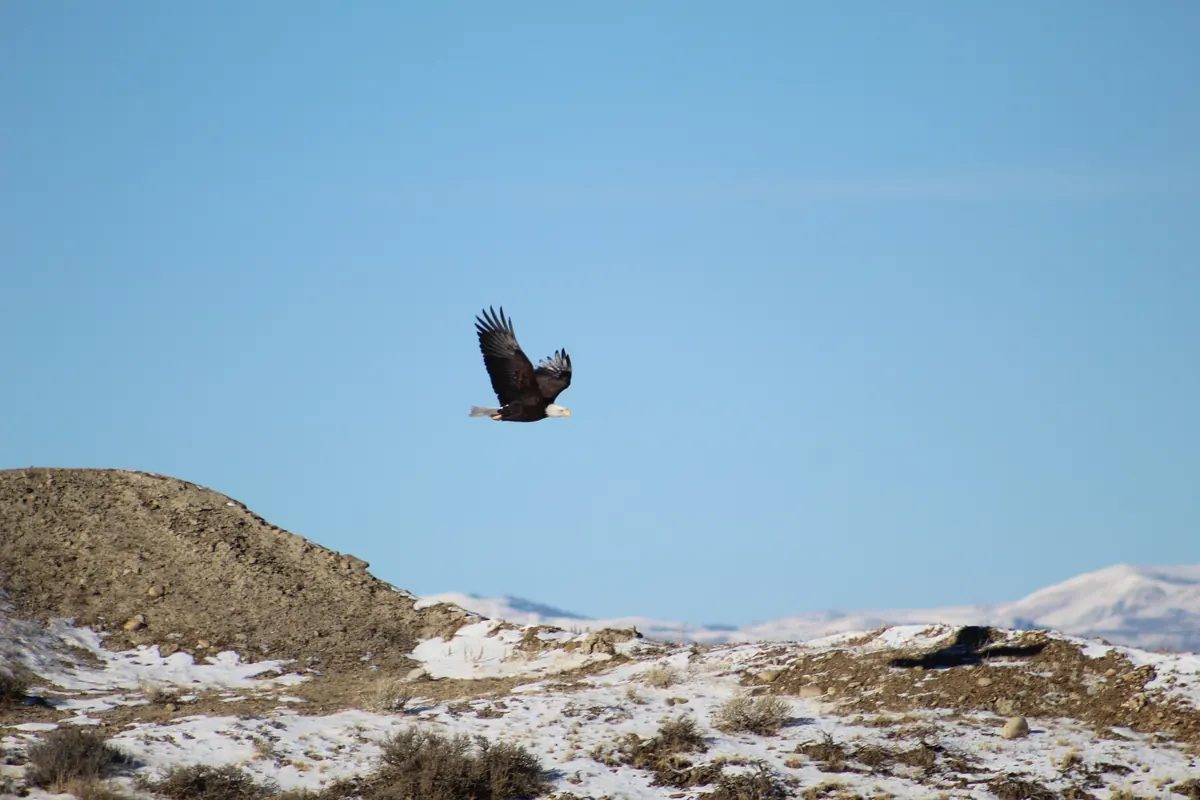
Bald eagles from farther north spend the winter in Utah, and November is when the first of them appear. The DWR’s viewing flyer says that by February hundreds have arrived, which is why the state celebrates them that month. The early birds follow food: once the marshes freeze, Bear River refuge notes, eagles line the edges of the open water where ducks crowd together.
-
Farmington Bay and the Great Salt Lake marshes
First arrivals in November; numbers building toward February · Farmington Bay Waterfowl Management Area and the Eccles Wildlife Education Center, Farmington
The George S. and Dolores Doré Eccles Wildlife Education Center looks out over the Farmington Bay management area, one of the state’s best-known eagle spots. The DWR lists the center as free; check its hours before you go, since they change with the season. Expect a handful of eagles in November rather than the crowds of February.
-
Cottonwood roosts in the south and center
From late fall through winter · Rush Lake Ranch and west Cedar City; the Fountain Green hatchery area in Sanpete County
The DWR names two roosts near Cedar City: Rush Lake Ranch at 9600 N. Minersville Highway (State Route 130), about 12 miles north of town, and a stand of cottonwoods west of 3900 W. and 2700 N. In Sanpete County, eagles often gather in a large cottonwood about 3.7 miles south of the Fountain Green State Fish Hatchery, and they turn up on poles and fence posts across the valley. The division also lists Willard Bay and Ouray National Wildlife Refuge.
Pull fully off the pavement before stopping to look, as the DWR asks. Adults are easy to name across a marsh; immature birds stay blotchy brown for several years and are often taken for golden eagles.
When is the mule deer rut in Utah, and where do bears and elk go in November?
For Utah’s big mammals, November is the turning point between fall and winter. Mule deer breed and move downhill, elk follow the snow line, and black bears disappear into dens until spring.
-
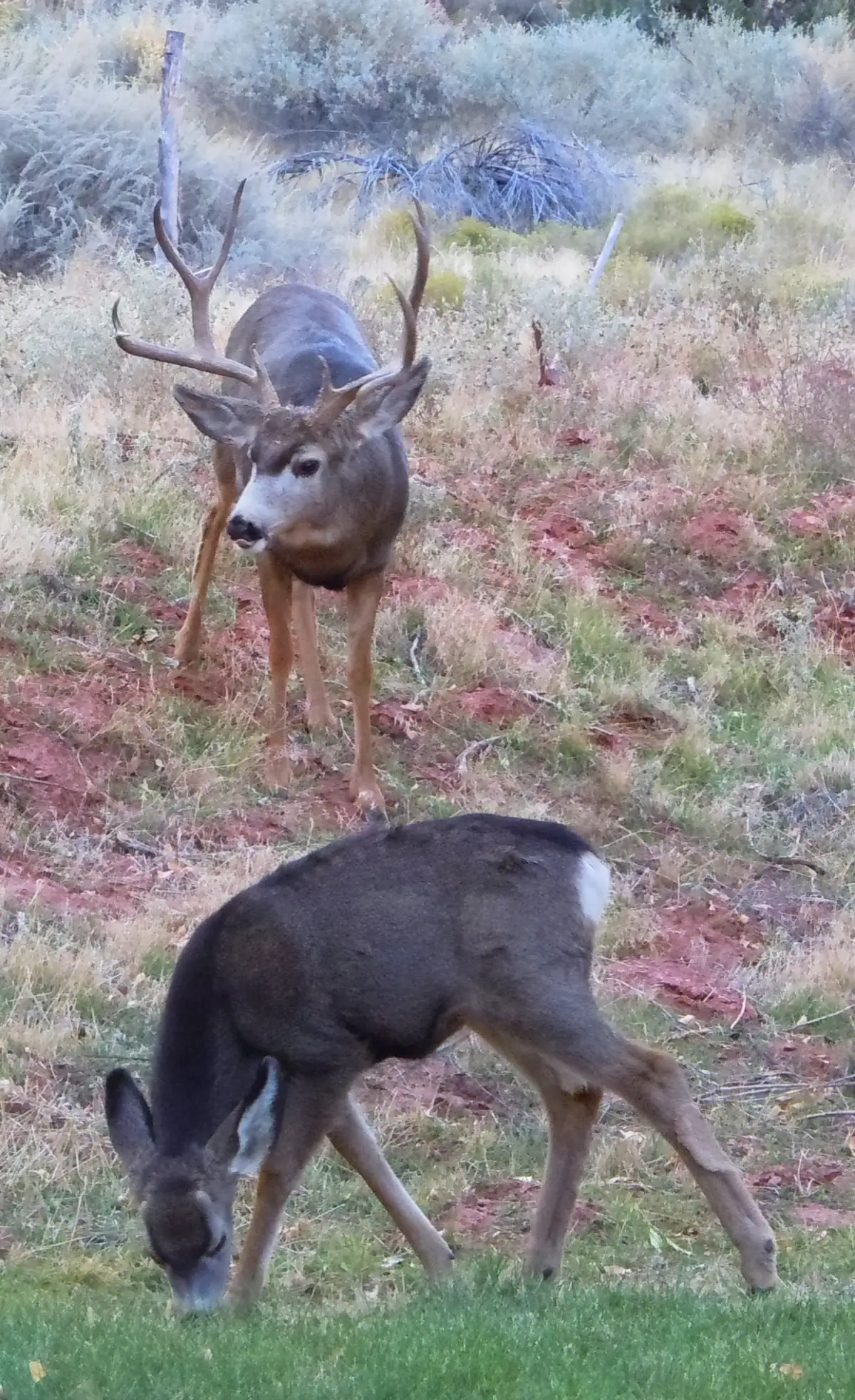
The mule deer rut
Through November; many observers put the peak near mid-month or Thanksgiving · Foothills and benches along the Wasatch Front, Antelope Island, the Book Cliffs, the Henry Mountains and southern Utah’s plateaus
Wild Aware Utah, a partnership that includes the DWR, describes the late fall breeding season as the time when bucks become combative with each other and can be aggressive toward people and pets. A KSL field guide says the rut usually peaks in November and notes that day length, more than weather, sets the timing. Watch for a swollen-necked buck, nose low, dogging a doe, or two bucks shoving antler to antler; Antelope Island’s big bucks can be watched from the road. Keep well back and leash dogs.
-
Deer on the highways
Dawn and dusk all month, worst in the first weeks after the time change · Highways that cross migration routes between summer and winter range
A DWR migration coordinator told the Park Record that November is Utah’s peak month for hitting deer: bucks roam after does and herds drift to winter range just as the evening drive turns dark. A 2012 DWR study found roughly 10,000 deer-vehicle collisions a year, likely fewer now that more fences and wildlife bridges are in place.
-
Bears go to ground
Most enter dens in November · North- and east-facing slopes in oak brush and conifers
The DWR’s black bear notebook says Utah bears typically den in November, once most of their food is gone, and stay in a deep sleep for about six months, with body temperature dropping only 8 to 10 degrees. A pregnant female’s embryo does not begin to grow until late November or early December, timed to her entry into the den; the cubs are born there in January or February. After a year in which DWR bear calls doubled because wild food failed, bears may stay active a little later near towns, so lock up garbage and take feeders in until snow stays on the ground.
-
Elk coming down to Hardware Ranch
As persistent cold and snow arrive; sleigh rides from December 5 · Hardware Wildlife Management Area, Blacksmith Fork Canyon east of Hyrum
The DWR says elk move down to the Hardware meadows once cold and snow settle in, on no fixed date. Sleigh or wagon rides through the herd begin Saturday, December 5, and run Fridays through Sundays to February 15.
Is there any fall color left in Utah in November?
By November the mountain aspens and maples are bare, but the deep canyons of southern Utah are just finishing. The Fremont cottonwoods along desert rivers are the last trees in the state to turn.
-
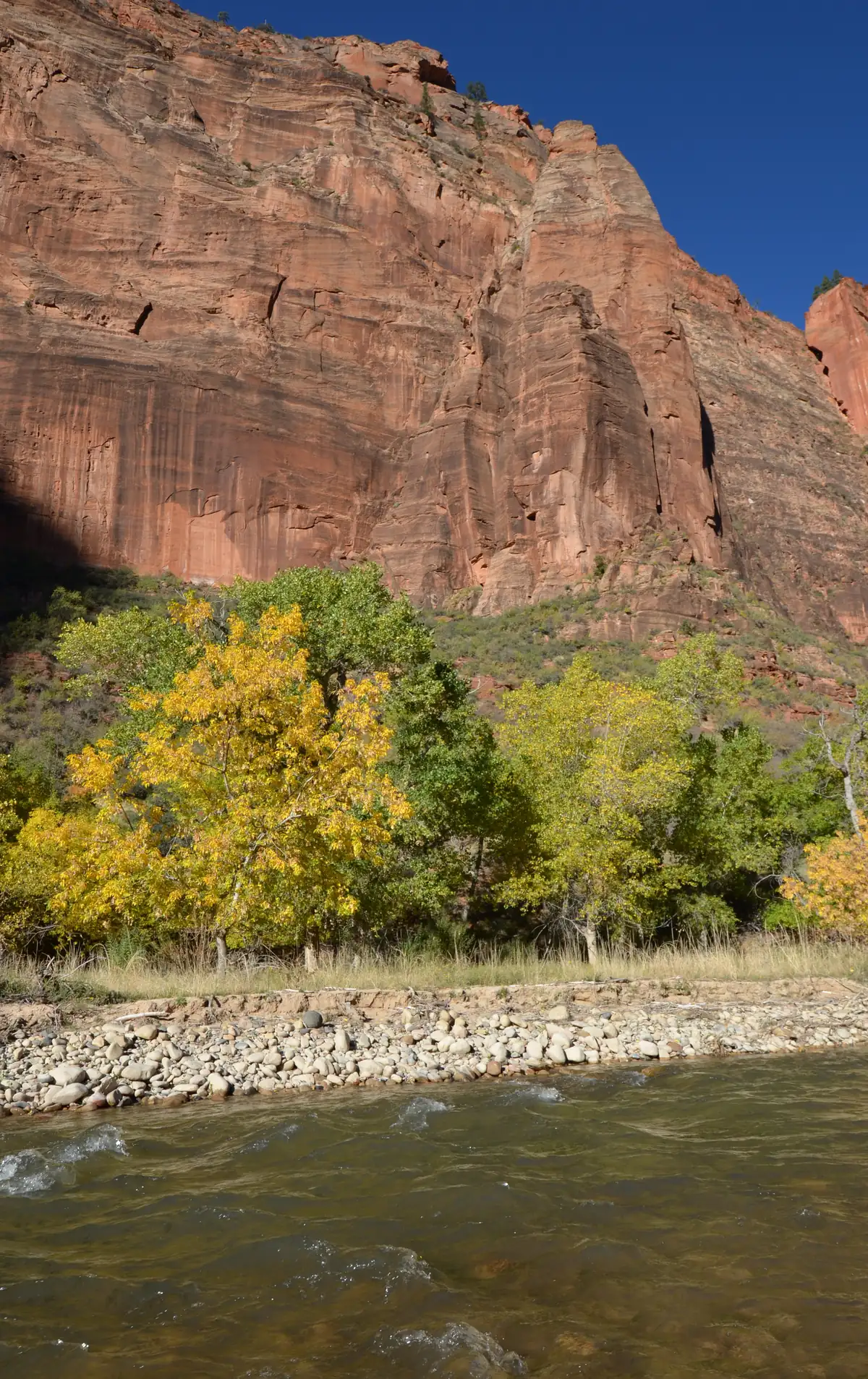
Cottonwoods in Zion Canyon
Late October into the first week or two of November · The Virgin River from Springdale to the Temple of Sinawava; the Pa’rus Trail and Riverside Walk
According to the park, color begins up on the plateaus and creeps downhill, getting to the canyon floor late in October and lingering into the first days of November. On a calm morning the canyon floor is a ribbon of yellow under red cliffs. November days in the park can reach 50 to 60 °F, but nights drop well below freezing, so a warm layer belongs in the pack even on a sunny walk. Snow that falls in the canyon usually melts within hours, the park notes, while it builds up on the plateaus above.
On a tree through the seasons page, sketch one bare cottonwood now to compare in April.
Has all of Utah had its first freeze by November?
Nearly all of it. Of the nine stations in the table, eight have a median first freeze in September or October: Park City’s comes on September 25, Vernal’s on October 6, Cedar City’s on October 13, Logan’s on October 16, Provo’s on October 21, Ogden’s on October 22, Moab’s on October 23 and the Salt Lake City airport’s on October 31. Even so, in about one fall out of ten, Ogden, Provo and Moab are still frost-free on November 1, and at the Salt Lake City airport the first days of November are close to a coin toss, though nine years in ten have frozen by November 13. The one place still waiting in a typical year is St. George, with a median first freeze of November 10; in one year in ten it holds off until November 22.
| Station | One year in ten | Median | Nine years in ten |
|---|---|---|---|
| Logan Utah St Univ (Cache Valley) | Oct 1 | Oct 16 | Oct 29 |
| Ogden Hinkley Airport (Ogden) | Oct 7 | Oct 22 | Nov 6 |
| Salt Lake City International Airport (Salt Lake City) | Oct 17 | Oct 31 | Nov 13 |
| Provo Byu (Provo) | Oct 7 | Oct 21 | Nov 4 |
| Park City (Wasatch Back) | Sep 12 | Sep 25 | Oct 9 |
| Vernal (Uinta Basin) | Sep 23 | Oct 6 | Oct 20 |
| Moab (Canyon Country) | Oct 8 | Oct 23 | Nov 4 |
| Cedar City (Color Country) | Sep 30 | Oct 13 | Oct 28 |
| St George (St. George) | Oct 27 | Nov 10 | Nov 22 |
For a station closer to home, including many in the mountains and the West Desert, open the Utah frost dates. Gardeners in Washington County should keep a sheet handy for the first clear, still night of the month; everywhere else, November’s question is snow.
When does it start snowing in Utah’s valleys, and when does inversion season begin?
In northern Utah, November brings both the first real valley snow and the start of the winter haze season, and both come down to cold air pooling in the basins.
-
First valley snow
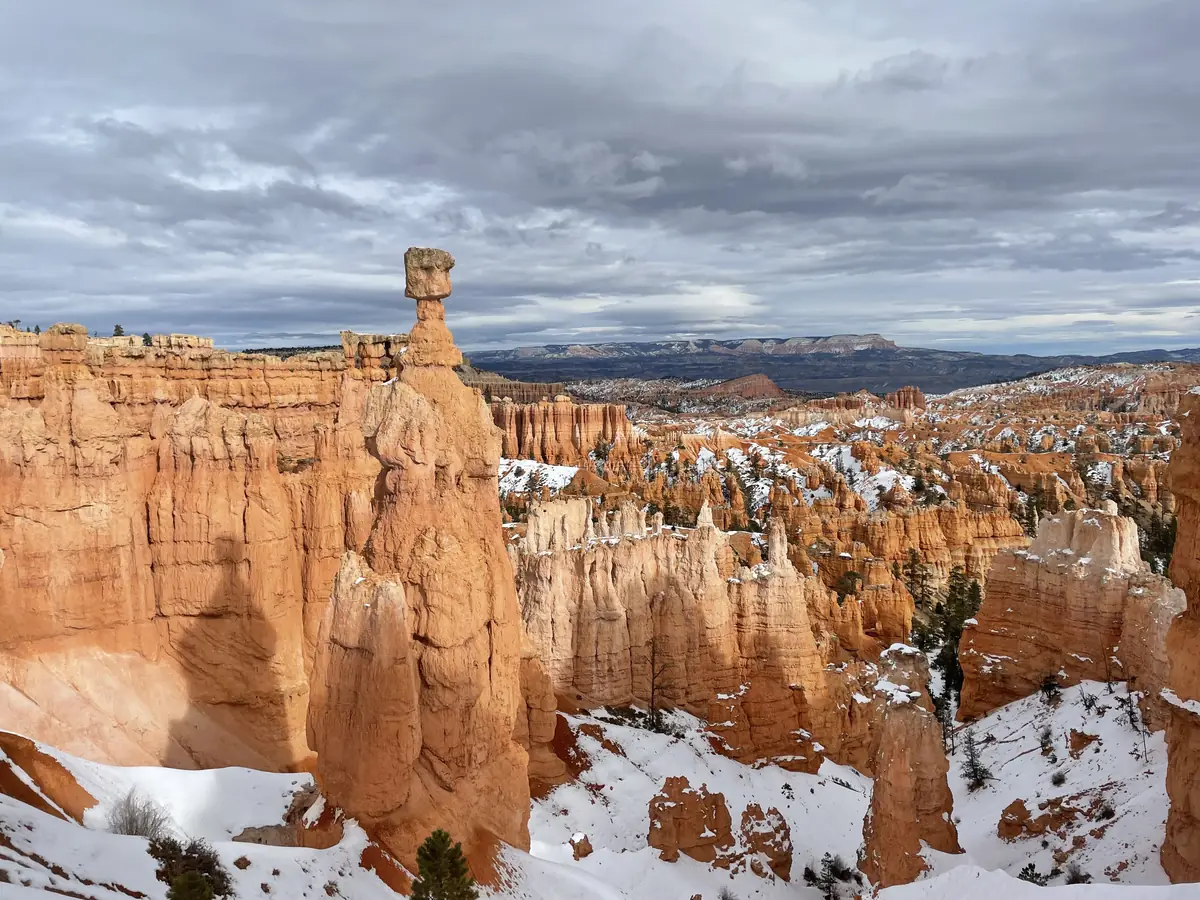
Any time in November, more often later in the month · Salt Lake and Cache valleys first; southern deserts rarely
By NOAA’s 1991 to 2020 normals, the Salt Lake City airport gets 7.0 inches of snow in an average November and 12.1 in December. Logan averages 6.3 inches in November and Bryce Canyon 9.7, while Moab sees about an inch and St. George none. Typical November afternoons reach about 51 °F at the Salt Lake City airport, 45 °F at Logan and 64 °F at St. George, with nights near 33, 29 and 35 °F.
-
Inversion season
Wood-burning restrictions in force from November 1 to March 1 · Northern Utah valleys, above all the Wasatch Front
When high pressure settles in after a storm, cold air sits in the valleys under a lid of warmer air and the haze thickens day by day. The Utah Department of Environmental Quality, whose wood-burning rules take effect November 1, calls no-burn days when fine particles threaten unhealthy levels; check air.utah.gov or the UtahAir app before lighting a fire. On those gray days a short drive up a canyon often breaks into sunshine, and the top of the murk shows as a flat brown line across the mountains, worth a note under colours of the day.
For the clouds and the clearing behind a storm, the sky conditions page shows what is coming in over the next few hours.
How much daylight does Utah lose in November?
The biggest jump comes on the first day. Salt Lake City’s Halloween sunset, at 6:25 p.m. MDT, becomes a 5:24 p.m. sunset one day later once standard time returns, and sunrise moves from 7:57 to 6:58 a.m. After that the sun simply sets a little earlier each evening, reaching 5:01 p.m. on November 30, with sunrise at 7:31 a.m. Over the month the eight cities in the table lose between 48 and 58 minutes of daylight, about 1.7 to 2 minutes a day. Logan, the farthest north, loses the most and ends the month with 9 hours 24 minutes of daylight; St. George loses the least and still has 9 hours 50 minutes, with a November 30 sunset at 5:18 p.m. to Logan’s 4:58.
| City | Nov 1 | Nov 30 | Lost | Per day |
|---|---|---|---|---|
| Logan | 10 h 22 m | 9 h 24 m | 58 min | 2.0 min |
| Ogden | 10 h 24 m | 9 h 27 m | 57 min | 2.0 min |
| Salt Lake City | 10 h 26 m | 9 h 30 m | 56 min | 1.9 min |
| Provo | 10 h 28 m | 9 h 32 m | 56 min | 1.9 min |
| Vernal | 10 h 27 m | 9 h 31 m | 56 min | 1.9 min |
| Moab | 10 h 33 m | 9 h 42 m | 51 min | 1.8 min |
| Cedar City | 10 h 35 m | 9 h 46 m | 49 min | 1.7 min |
| St. George | 10 h 38 m | 9 h 50 m | 48 min | 1.7 min |
To find the minutes of sun at your own trailhead, and when civil twilight ends, enter the town in our sunrise and sunset calculator.
What will a very strong El Niño mean for Utah this winter?
Ask the Climate Prediction Center and the El Niño question is nearly settled: its September 10 discussion gave odds above nine in ten that this event reaches very strong status by midwinter. What it means for Utah depends on where you live, because the state straddles the line between the wetter south that strong El Niños tend to favor and the drier north.
Speaking to Fox 13, Utah’s state climatologist, Jon Meyer, said the far south is the one part of Utah where the signal hangs together, with wetter winters under strong events; farther north the record is mixed. Fox 13’s own look back at past strong events found that 1982 to 1983 brought huge snow and historic spring floods, 1997 to 1998 reached about 132 percent of average snowpack by April 1, and 2015 to 2016 ended near average. He also warned that warm storms can bring rain instead of snow, leaving reservoirs short next summer. Ski Utah forecaster Evan Thayer told KSL in August that strong events have tended to give northern Utah average to below-average snowpack, especially early, with a slow November and December.
For November itself, then, a slow start in the Wasatch would not be a surprise, and Color Country is the region with the better odds of a wet winter. NOAA’s official December-to-February maps arrive on October 15, two weeks after we wrote this, alongside the other 90-day outlooks. The next few days are on our forecast page.
What is in Utah’s night sky in November 2026?
Utah leaves daylight time behind at 2 a.m. on November 1, when the clock reads 1 a.m. again, and by mid-month dusk has faded before 6 p.m. in every Utah town. Times here are Mountain Standard Time.
-
The Leonid meteors
Before dawn on Wednesday, November 18, with the mornings of the 17th and 19th as backups · Face east or overhead after the Moon sets, somewhere away from valley lights
The International Meteor Organization expects a normal Leonid year: around 15 in an hour for a patient watcher in the desert, and no storm. The radiant in the constellation Leo climbs out of the east around midnight and is highest just before dawn, and the first-quarter Moon is down by about then, so the best window runs from moonset to the start of twilight. Leonids are among the fastest meteors, and bright ones may leave a glowing streak that hangs briefly after the meteor is gone. Utah’s state parks with dark skies, from Antelope Island to Goblin Valley, are ideal if you can stay warm.
-
Taurid fireballs
Southern branch peaks about November 5, northern about November 12 · All night; the radiant is near the Pleiades
Expect only a handful of Taurids an hour, slow movers that now and then flare into a fireball; the grit comes from Comet Encke. With the new Moon arriving just after midnight on Monday, November 9, the evenings between the two peaks are free of moonlight.
-
Four planets before sunrise, one after sunset
Mars and Jupiter closest on the mornings of November 15 and 16; Mercury best about November 18 to 25 · East and south before dawn; Saturn in the south after dark
Venus has moved into the morning sky and climbs higher each week, blazing low in the east-southeast before sunrise and reaching its greatest brilliancy late in the month. Above it, in Leo, are Jupiter and the much fainter, orange Mars, which pass about 1.2 degrees apart before sunup on both November 15 and 16, close enough to share a binocular view. Mercury joins them low in the dawn glow, best roughly from the 18th to the 25th. In the evening only Saturn shows, a steady yellowish point due south once twilight fades. Uranus, at its yearly best on the 25th, sits in Taurus, where binoculars and a star chart will find it.
-
The Beaver Moon
Full at 7:53 a.m. on Tuesday, November 24 · Rising in the east-northeast near sunset on the 23rd and 24th
With the instant of fullness falling in the morning, the Moon will look round on both Monday and Tuesday evenings, and Tuesday’s moonrise is a bit closer to full. Perigee follows roughly a day and a quarter later, enough to call this a modest supermoon. Late on the 23rd the bright Moon sits beside the Seven Sisters and washes them out. December’s Cold Moon, full on the evening of December 23, comes even closer: no full moon this year looks bigger.
| Phase | Date | Time |
|---|---|---|
| Last quarter | Sunday, Nov 1 | 1:28 p.m. |
| New moon | Monday, Nov 9 | 12:02 a.m. |
| First quarter | Tuesday, Nov 17 | 4:48 a.m. |
| Full moon, the Beaver Moon | Tuesday, Nov 24 | 7:53 a.m. (looks full the evenings of Nov 23 and 24) |
| Last quarter | Monday, Nov 30 | 11:08 p.m. |
In Mountain time this month has two last-quarter Moons, on the 1st and the 30th. The Salt Lake Astronomical Society’s public schedule for 2026 ended in October, so in November you are on your own; for moonrise and moonset at home, open the moon calendar.
What can families do outdoors in Utah in November 2026?
- Sunday, November 1: FeederWatch opens. The Cornell Lab’s winter feeder survey runs to April 30; you choose two back-to-back count days and record the largest group of each species seen together.
- Saturday, November 14: Wellsville Reservoir with Bridgerland Audubon. A two-hour birding trip, 8 to 10 a.m.; the group carpools from the southwest corner of the Smith’s Marketplace parking lot at 750 N. Main Street in Logan.
- Saturday, November 14: clean up for the Jordan River. The Jordan River Commission’s #LoveYourWatershed cleanup meets at Winchester Park in Murray from 10 a.m. to noon to clear curbs and gutters before trash washes into the river. Tools and snacks are provided; registration is required.
- Tuesday, November 17: storytime in a garden. Salt Lake County Library’s monthly songs-and-stories program for young children at Conservation Garden Park in West Jordan, free, in the 9 to 11 a.m. window.
- Wednesday, November 18: meteors before school, and Shoshone plant stories. The Leonids are at their best before dawn, and at 10 a.m. Tracy Aviary in Liberty Park hosts the Shoshone Plant Experience, about how the Northwestern Band of the Shoshone Nation has used Utah’s plants (check the aviary’s event page for admission).
- The week before Thanksgiving: swan week on the Bear River refuge auto tour route; give a child the tally sheet.
- Saturday, November 28: Birding 101 at the Ogden Nature Center. A free beginners’ class and guided walk led by Wasatch Audubon, 9 to 11 a.m.; register in advance and bring binoculars if you have them, since only a few loaners may be available.
- Citizen science. Log swans and eagles on eBird, post tracks and late insects to iNaturalist, and report road-killed deer with the Utah Roadkill Reporter app.
Utah State Parks had not announced any free entry for the day after Thanksgiving when this page was written; check stateparks.utah.gov before you go. Whatever you do, give each outing a line, with the date and the place, in the Naturalist’s Field Journal, and look back at what you found in Utah in October.
Safety notes for November in Utah
- Hunting seasons still open. The general-season muzzleloader elk hunt and the limited-entry late muzzleloader deer hunts run October 28 to November 5. Limited-entry HAMSS (handgun, archery, muzzleloader, shotgun and straight-walled rifle) hunts for buck deer, and for bull elk on four units, run November 7 to 30. Extended archery continues for deer through November 30 in seven extended areas and for elk through December 15 (January 31 in West Cache), and the limited-entry late archery elk hunts run November 28 to December 13. The general pheasant season is November 7 to December 6 and quail runs November 7 to December 31, after youth hunts from October 31. Duck season is open statewide, dark-goose hunting on the Wasatch Front reopens November 10, and the permit-only tundra swan hunt continues to December 13. On November 14 parts of several wildlife management areas, including Annabella, Pahvant, Pine Canyon and part of Ogden Bay, close to the public for youth and beginner pheasant hunts.
- Hunter orange. Utah Code 23A-11-205 requires anyone hunting big game to keep at least one item of hunter orange showing on the outside, whether a hat, a vest or another outer layer. Archery, muzzleloader and HAMSS hunters are exempt only outside units where a general rifle hunt for bucks or bulls is going on, and hunts on cooperative wildlife management units and once-in-a-lifetime permits have their own exceptions. For upland birds the DWR strongly encourages orange, while it advises turkey hunters not to wear it, since bright colors can be mistaken for a turkey’s head. If you hike or run a dog on public land this month, borrow the rule and put on something orange.
- Deer on the road. Drive slower around sunrise and sunset, flip to high beams on empty stretches, and brake rather than swerve if a deer steps out.
- Short days and cold nights. Sunset comes around 5 p.m. by midmonth and canyons lose the sun earlier. Carry a headlamp, a warm layer and water. Zion’s nights fall well below freezing even after a 60-degree afternoon.
- Early snow in the mountains. The Utah Avalanche Center’s regular forecasts usually begin in late November or December, but slides can run on the first thin snowpack before then; check utahavalanchecenter.org before heading into steep terrain.
- Thin ice and bad air. Ponds that skin over in November are not safe to walk on. On mandatory no-burn days, people with asthma or heart and lung conditions should limit hard outdoor exercise in the valleys.
Sources
- U.S. Fish and Wildlife Service: monthly bird happenings, Bear River Migratory Bird Refuge (PDF; November swan peak, waterfowl peak, eagles, rough-legged hawks)
- Utah DWR Great Salt Lake Ecosystem Program: tundra swan aerial survey history
- Utah DWR Great Salt Lake Ecosystem Program: birds of the lake (eared grebes, tundra swans)
- Utah DWR Great Salt Lake Ecosystem Program: brine shrimp
- Utah DWR Great Salt Lake Ecosystem Program: brine shrimp harvest season and reports
- KSL: thousands of grebes crash-land in Cedar City (December 2011)
- KSL: Great Salt Lake not expected to hit a new low in 2026 (August 12, 2026)
- Utah State Parks: Antelope Island bison roundup and auction, 2026
- Utah State Parks: Antelope Island State Park (wildlife, hours, holiday closures)
- Utah DWR: bald eagle viewing in Utah (2026 flyer, PDF)
- Wild Aware Utah: mule deer
- KSL: Utah field guide, the mule deer rut
- Park Record: November is the peak time for deer-vehicle collisions in Utah (DWR interview)
- Utah DWR Wildlife Notebook: American black bear (PDF, via Wild Aware Utah)
- Utah DWR: bear incidents doubled from last year (August 27, 2026)
- Utah DWR: visiting Hardware Wildlife Management Area (2026 to 2027 sleigh rides)
- National Park Service: Zion seasons, fall color and November weather
- NOAA NCEI: 1991 to 2020 monthly normals, Utah stations (data API)
- Utah Department of Environmental Quality: wood-burning restrictions begin November 1
- Utah Division of Air Quality: current conditions and three-day action forecast
- Climate Prediction Center: ENSO diagnostic discussion, September 10, 2026
- Climate Prediction Center: official 90-day outlooks (winter outlook issued October 15, 2026)
- Fox 13: could a super El Niño bring Utah a big snow year? (state climatologist Jon Meyer)
- KSL: what a super El Niño could mean for Utah ski resorts (Ski Utah forecaster Evan Thayer, August 4, 2026)
- Utah Public Radio: strong El Niño could bring Utah a wetter winter (September 4, 2026)
- U.S. Naval Observatory: phases of the Moon from November 2026 (data API)
- International Meteor Organization: 2026 meteor shower calendar (PDF, archived)
- EarthSky: what is a supermoon? (2026 full supermoons)
- EarthSky: Uranus at opposition
- EarthSky: Mercury’s greatest western elongation
- Star Walk: planetary conjunctions (Mars and Jupiter, November 2026)
- Sea and Sky: astronomy calendar 2026
- Salt Lake Astronomical Society: 2026 star party schedule (PDF)
- Bridgerland Audubon: Wellsville Reservoir field trip, November 14, 2026
- Utah Outdoor Recreation: #LoveYourWatershed cleanup, November 14, 2026
- Utah Outdoor Recreation: storytime at Conservation Garden Park, November 17, 2026
- Tracy Aviary: Liberty Park special events (Shoshone Plant Experience, November 18, 2026)
- Utah Outdoor Recreation: Birding 101 and community bird walk, Ogden Nature Center, November 28, 2026
- Project FeederWatch: how to participate (November 1 to April 30)
- eBird
- iNaturalist
- Utah DWR: 2026 Utah Big Game Field Regulations guidebook (PDF; November hunts and hunter orange)
- Utah DWR: what hunters should know for the 2026 deer and elk hunts
- Utah DWR: 2026 to 2027 Waterfowl, Upland Game and Turkey Guidebook (PDF; pheasant, quail and orange advice)
- Utah DWR: what hunters should know about the 2026 upland game hunts
- Utah DWR: what hunters should know about the 2026 waterfowl season
- Utah State Legislature: Utah Code 23A-11-205, hunter orange
- Utah Avalanche Center
- Photos via Wikimedia Commons; licenses and photographers are credited under each picture
.jpg)