What to look for in nature in Illinois this December
Meteorological winter opens on December 1. Climatologists bundle December, January and February together as the cold season, and Illinois generally lives up to the name within a week or two. The sandhill cranes that have been calling over Chicago since October peak at their Indiana stopover as the month opens, then vanish within a week. As backwaters ice over, bald eagles pack into the unfrozen tailwaters of the Mississippi and Illinois River dams, and snowy owls, in the winters they come south, rest on the beach and pier at Montrose. Bird clubs head out for their Christmas Bird Counts, Chicago's sun sets at its earliest of the year around December 8, and on December 23 a supermoon, 2026's closest full moon, comes up at dusk. What follows runs from Rockford to Cairo.
Other months in Illinois: October, November.
Start here
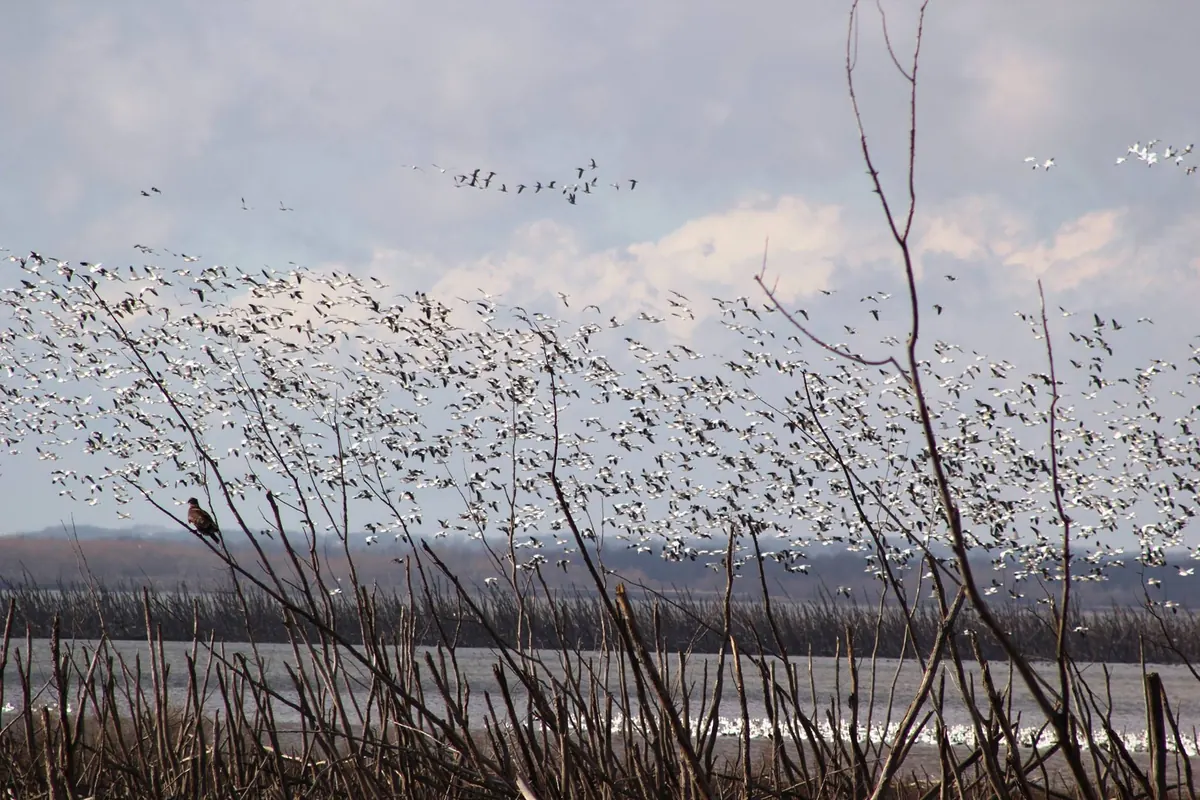
- Go to the river after the first hard freeze. Once the backwaters skin over, bald eagles gather where the water still churns below the locks and dams. After one cold snap, on December 28, 2022, Army Corps rangers counted 810 eagles at Lock and Dam 18 near Gladstone. Go at first light, stay in the car or at the overlooks, and bring binoculars.
- Sign up for a Christmas Bird Count. This season's counts fill the weeks between December 14 and January 5, one day per circle. Illinois ran 69 of them in the 2022–23 season, from the Wisconsin line to Crab Orchard. Find a circle on Audubon's map and write to the compiler in November or early December; birders of every level are welcome, and feeder watchers count too.
- Stay up for the Geminids on December 13. The year's strongest shower, the Geminids, peaks during the night that begins Sunday, December 13. The crescent moon sets in mid-evening, so the whole night is dark; the best rates come around 2 a.m., when the radiant in Gemini stands high in the south.
For the Naturalist's Field Journal: a snowy or short-eared owl deserves a line of its own among the birds I have seen, with your Christmas Bird Count tally underneath. Draw a white pine's five-needle bundle and a sprig of red cedar berries for seeds, pods and cones, sketch fox or rabbit prints from fresh snow on tracks to know, and log the clock time of sunset on December 8 and on December 31 on the dusk and dawn watch.
Regions used below: Chicago and the Lake Michigan shore; Northern Illinois and the Rock River; Central Illinois and the Illinois River valley; Western Illinois and the Mississippi; Southern Illinois and the Shawnee Hills.
When does winter start in Illinois, and how much snow falls in December?
Meteorologists don't wait for the solstice. Their winter begins December 1, since the trio of December, January and February averages coldest. By December even Cairo and the Midway station have usually logged a 32-degree night (station dates are on our Illinois frost page), and the normals show the rest. NOAA's 1991–2020 averages put December highs at about 34 °F in Rockford and 37 °F at O'Hare, climbing to 45 °F at Carbondale and 48 °F at Anna, with lows from about 20 °F in the northwest to near 30 °F in the far south. Rockford and Moline average about 9 inches of December snow and O'Hare nearly 8; Springfield gets about 4, and the far south between 2 and 3. Precipitation runs the other way, about 2 inches in the north and close to 4 in the south, where more of it falls as rain.
| Station | Average high | Average low | Precipitation | Snowfall |
|---|---|---|---|---|
| Rockford (Greater Rockford Airport) | 34.3 | 20.2 | 1.93 | 9.4 |
| Moline (Quad City Airport) | 37.0 | 20.8 | 2.04 | 8.8 |
| Chicago O'Hare | 36.6 | 24.4 | 2.11 | 7.6 |
| Peoria (Greater Peoria Airport) | 38.5 | 23.2 | 2.21 | 6.2 |
| Springfield (Capital Airport) | 40.7 | 25.2 | 2.15 | 4.3 |
| Carbondale (sewage plant station) | 45.4 | 27.2 | 3.72 | 2.7 |
| Anna | 48.0 | 29.7 | 4.10 | 2.6 |
This winter arrives with El Niño in charge. Nine-in-ten odds, or better: that is how federal forecasters scored a very strong El Niño hanging on through Illinois' winter, in the Climate Prediction Center discussion dated September 10. What that has meant for Illinois before is easiest to see in snow. In 1997, as another powerful El Niño built, the Midwestern Climate Center in Champaign set six strong El Niño winters (1957–58 to 1991–92) against every other winter since 1951. Midway averaged 25 inches in those six winters against 44 in the rest; Rockford 24 against 38; Champaign 13 against 27; and Springfield 14 against 25. Even the snowiest of the six stayed below normal at all four Illinois stations. The state climatologist's office adds a caution: El Niño winters in Illinois lean warm and dry with below-average snow, but no two events behave alike, and other influences on Illinois weather can outweigh it. NOAA posts its official December-to-February outlook on October 15; look for it among the CPC's three-month maps, and the forecast page here gives your own town's next seven days.
When do the sandhill cranes leave for the South?
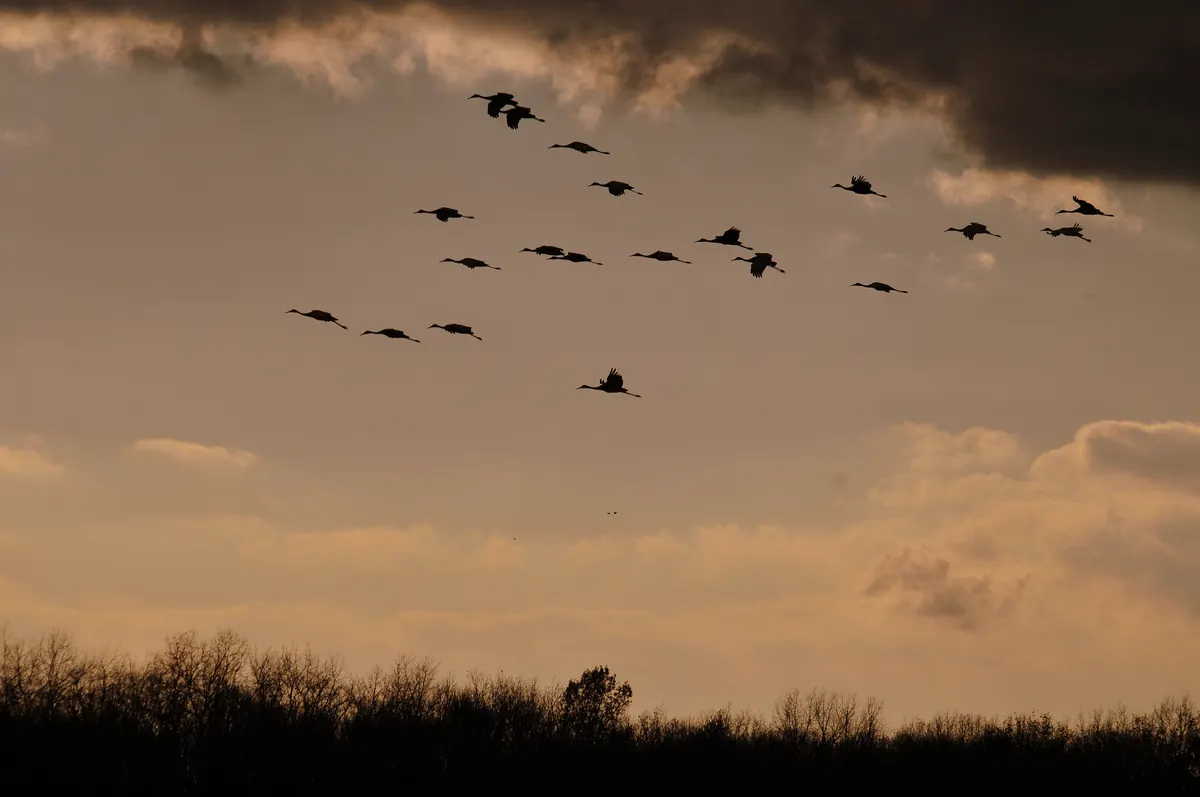
For a month the cranes have been gathering at Indiana's Jasper-Pulaski Fish and Wildlife Area, the staging marsh for the eastern population, and many of the flocks Chicagoans hear overhead are commuting there. Indiana DNR says numbers peak in late November or early December and the birds usually stay until about mid-December. When they go, they go fast.
-
The last big count
Late November to the first week of December · Jasper-Pulaski Fish and Wildlife Area, near Medaryville, Indiana, about two hours southeast of the Loop
Last season the weekly count jumped to 16,400 on December 2, its high for the fall. A week later, on December 9, the counters found 115; the cold had sent nearly every bird on toward Tennessee and Florida. The site's record, 32,938, came on November 28, 2023. If you have been meaning to see the spectacle, the first weekend of December is the safest bet, and a sudden hard freeze is the signal that the end is near.
-
Crane Saturdays end December 19
Saturdays, 4:30 to 6:30 p.m. Central, through December 19, 2026 · The observation tower at Jasper-Pulaski
International Crane Foundation staff are on the platform on the last three Saturdays of the season, December 5, 12 and 19, to explain what you are seeing. Indiana DNR advises arriving at least an hour before sunset, when flocks begin to glide in from the fields on every side to roost in the marsh, calling the whole way. Dress for standing still in the wind.
-
Southbound flocks over Illinois
Clear days after a cold front, mostly the first half of the month · Overhead in the Chicago suburbs and the Kankakee valley; a few flocks farther west
The departure flights pass high, often in long, wavering lines, and you will hear the rattling calls before you find the birds. Add each flock to eBird with a rough count; the reports show which way the birds went and when.
Write the date you last hear cranes on your map of sounds. Next spring, compare it with the date they come back.
Where are the bald eagles in Illinois in December?
The eagles that trickled in during November become a real gathering once the rivers start to freeze. Ice on the pools pushes the birds to the few places with open water and easy fish, which along the Mississippi and the Illinois means the tailwaters just below the locks and dams. A natural resource specialist with the Army Corps of Engineers put it simply: the colder the weather, the more of the river is frozen and the more tightly the eagles bunch up by the dams.
-
Lock and dam counts
Wednesday mornings, December through February · Locks and dams on the Mississippi and Illinois rivers, including Lock and Dam 18 near Gladstone, in Henderson County
Rock Island District park rangers count eagles at their locks and dams at 8:30 every Wednesday morning from December through February and post the totals on the district's eagle-watching page, so you can see where birds are concentrating before you drive. The best count of the 2022–23 season came at Lock and Dam 18 on December 28, 2022, right after a cold snap: 680 adults and 130 brown juveniles. A crowded tailwater is the easiest place to compare the white-headed adults with the mottled brown young birds.
-
The Illinois River and Pere Marquette
From late December; reservations open in mid-November · Pere Marquette State Park near Grafton; Chautauqua and the Illinois River refuges near Havana; Starved Rock
According to the Fish and Wildlife Service, the Illinois River valley draws plenty of eagles every winter. At Pere Marquette, where the Illinois meets the Mississippi, the park runs morning eagle programs with a talk at the visitor center at 8:30 a.m. followed by a drive to the roosts; the state's eagle calendar listed the first of last season's programs on December 26, with reservations opening November 15. Call the visitor center for this winter's dates. The bigger eagle festivals, in Alton, the Quad Cities, Quincy and at Starved Rock, fall in January and February.
Watch from your car or from marked overlooks, and keep well back from any perched eagle. A bird that flies off to avoid people spends energy it cannot easily spare in the cold.
Where can you see owls in Illinois this winter?
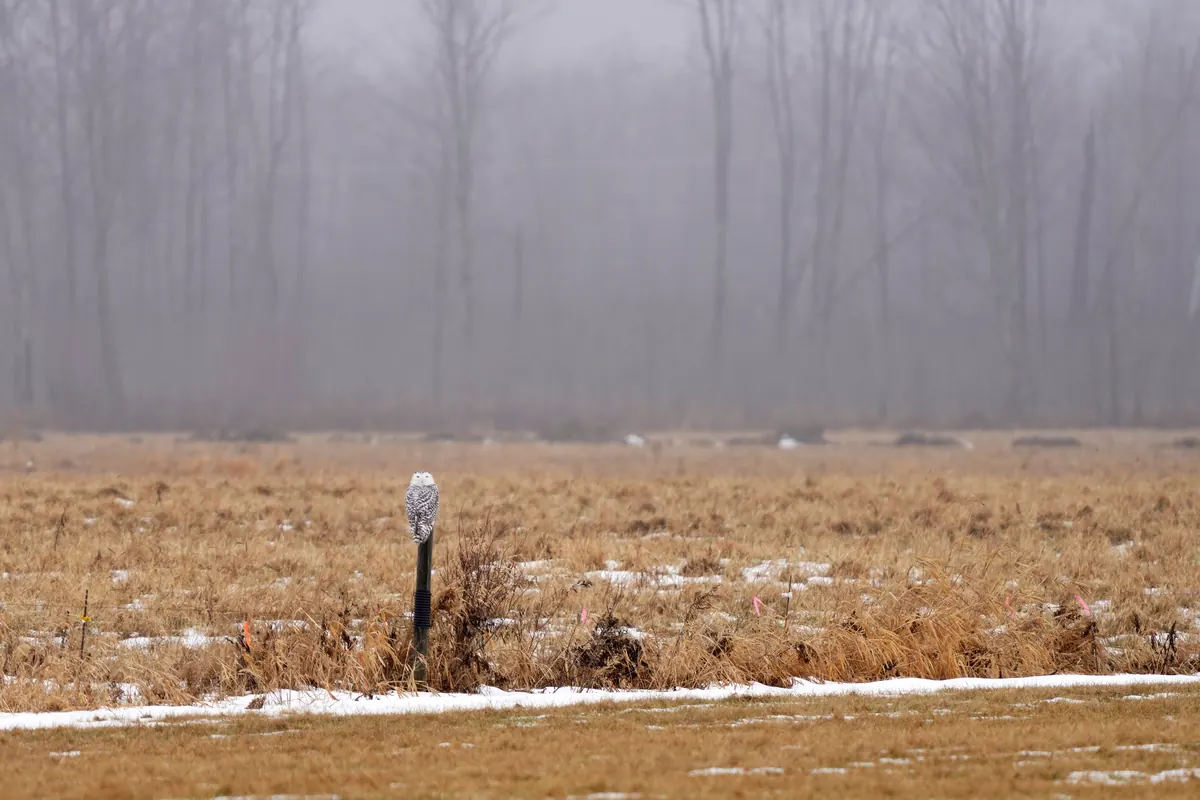
December is owl month. Great horned owls are already pairing up, short-eared owls have come down from the north onto the grasslands, and in some winters a snowy owl or two settles on the Chicago lakefront.
-
Snowy owls on the lakefront
Late November into winter, in irruption years · Montrose Point and Beach; the South Side lakefront
Snowy owls breed on the Arctic tundra and reach Illinois in good numbers only in irruption winters, so a sighting is never guaranteed. Last year two arrived at Montrose Beach in the second half of November, early for them, and drew birders from as far as Indiana and Arizona. They look for open, treeless ground that resembles home, which is why a wide, empty beach suits them. Chicago Bird Alliance asks watchers to stay at least 300 feet away, keep quiet, skip the flash, never bait an owl, and back off if the bird keeps watching you. Only adult males are close to pure white; most snowies are barred with brown.
-
Short-eared owls at dusk
Late afternoon to dark, all winter · Midewin National Tallgrass Prairie near Wilmington, especially the southeast bison pasture; large grasslands in southern Illinois
Short-eared owls and northern harriers, both listed as endangered in Illinois, hunt voles over the same winter grasslands, and at Midewin the Forest Service describes the two fighting in the air over a vole in the last light before sunset. A state recovery outline notes that both species are far more common here in migration and winter than in summer, sometimes in roosts of 20 or more, and that grasslands in southern Illinois and southwestern Indiana appear to be of continental importance for wintering short-eared owls. Look for a buoyant, moth-like flight low over the grass.
-
Great horned owls start nesting
Hooting now; eggs as early as January · Woodlots, river bottoms, parks and cemeteries statewide
IDNR calls the great horned owl common and native, and one of the earliest nesting birds in the state; it takes over an old hawk, crow or squirrel nest and can be sitting on two or three white eggs in January. Its deep, soft hooting carries far on still December evenings. Stand outside for ten minutes after dark and listen.
Keep owl roost locations to yourself and a few careful friends; crowds and flash photography can push a tired bird off its perch.
How do I join a Christmas Bird Count in Illinois?
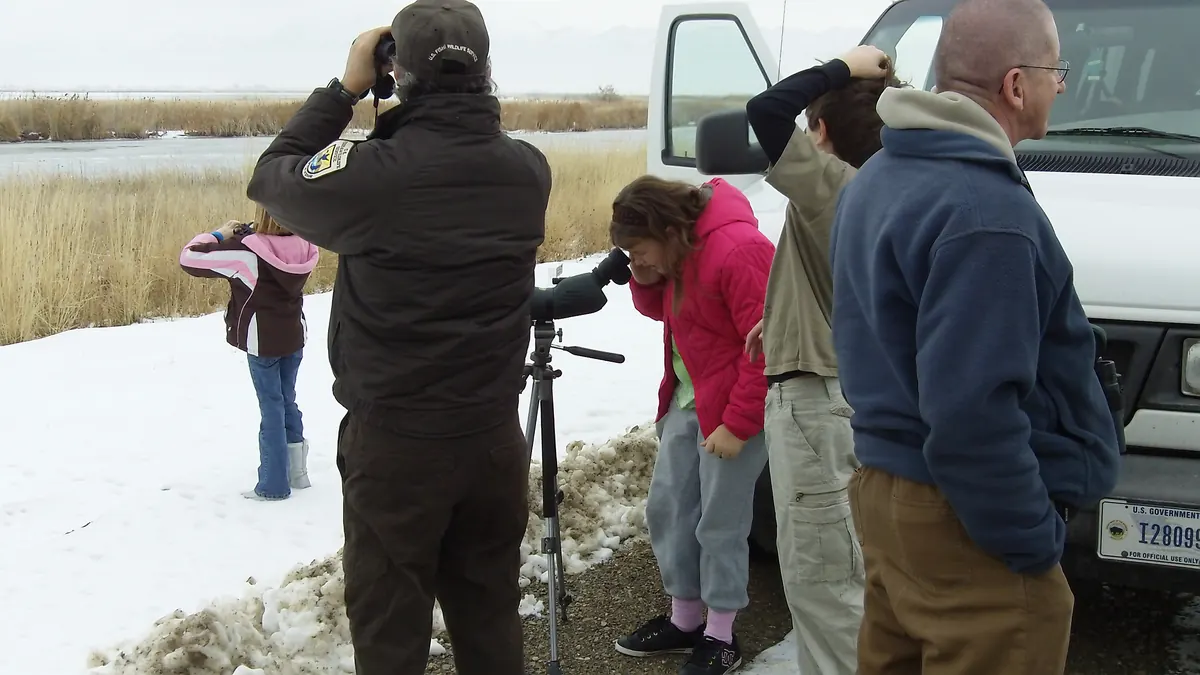
The Audubon Christmas Bird Count began in 1900 and is one of the oldest citizen science projects anywhere. Each count covers a fixed circle on a single day between December 14 and January 5; for the 127th count that window runs from Monday, December 14, 2026, to Tuesday, January 5, 2027. It is free, and Audubon's online circle map shows which counts are open to newcomers and how to reach each compiler.
-
What Illinois counts find
Statewide summary from the 2022–23 season · 69 count circles
Audubon's summary of the 123rd count in Illinois listed 1,208 field observers and 201 feeder watchers, who together found 168 species. The southern reservoirs topped the list: Rend Lake with 103 species, Crab Orchard National Wildlife Refuge with 99 and Carlyle Lake with 96. The long view is the real value. Pileated woodpeckers, found on 15 to 20 Illinois counts a year in the 1980s, now turn up on about 58, while house sparrows have fallen from roughly 200,000 counted in the 1970s to about 25,000.
-
Counts around Chicago
Dates are usually set by early November · Cook, Lake, DuPage, Will and Kane counties
The Chicago Ornithological Society posts a Chicagoland count guide each fall. Last season's listed eleven counts, among them Lisle–Arboretum, Barrington, Joliet, Chicago South, Chicago Urban, Evanston–North Shore and Calumet–Sand Ridge, plus a Chicago Lakeshore count on Christmas Day itself. Sign-up deadlines fell between December 1 and 8, so write early.
-
Downstate counts
Through the count period · Peoria, Chautauqua, Chillicothe, Champaign County, Clinton Lake, Middle Fork, Allerton and many more
Peoria Audubon runs three circles, one of them named for the Chautauqua refuge, and Champaign County Audubon's count, run since 1941, falls on the first Saturday of the count period. Local Audubon chapters and bird clubs announce dates in their newsletters; if none is near you, Audubon's feeder-count option lets you count from home inside a circle.
Bring a thermos and dress in layers. Copy your share of the count into the journal's bird list, noting the circle, the date and the weather.
When is the earliest sunset in Illinois?
Not on the shortest day. The solstice falls at 2:50 p.m. CST on Monday, December 21, yet Chicago's earliest sunset comes almost two weeks ahead of it and its latest sunrise nearly two weeks later, because the sun's noon position drifts later through December. In Chicago the sun goes down at 4:19 p.m. around December 8, and by New Year's Eve it sets at 4:29, ten minutes later, while mornings keep getting darker until the first days of January. Downstate the turn comes a day or two sooner: Carbondale and Cairo reach their earliest sunsets, 4:38 and 4:40 p.m., around December 6. The minimum is so shallow that sunset stays within a minute of its earliest time for days before and after. At the solstice Cairo gets 9 h 38 m of daylight, 33 minutes more than Rockford.
| City | Dec 1 | Dec 21 | Dec 31 | Earliest sunset |
|---|---|---|---|---|
| Rockford | 9 h 19 m | 9 h 05 m | 9 h 09 m | 4:24 p.m., Dec 8 |
| Chicago | 9 h 21 m | 9 h 08 m | 9 h 11 m | 4:19 p.m., Dec 8 |
| Moline | 9 h 24 m | 9 h 10 m | 9 h 14 m | 4:32 p.m., Dec 8 |
| Peoria | 9 h 29 m | 9 h 15 m | 9 h 19 m | 4:31 p.m., Dec 8 |
| Champaign | 9 h 32 m | 9 h 19 m | 9 h 22 m | 4:27 p.m., Dec 8 |
| Springfield | 9 h 33 m | 9 h 21 m | 9 h 24 m | 4:34 p.m., Dec 7 |
| Carbondale | 9 h 45 m | 9 h 34 m | 9 h 36 m | 4:38 p.m., Dec 6 |
| Cairo | 9 h 49 m | 9 h 38 m | 9 h 40 m | 4:40 p.m., Dec 6 |
Type any Illinois address into our sunrise and sunset tool to see the day it turns, including twilight.
What is in the Illinois night sky in December 2026?
Long nights and a cooperative moon favor stargazing in December. The two big events, the Geminids and the Cold Moon, come ten days apart.
-
The Geminids
Active December 4 to 20; best on the night of Sunday, December 13, into Monday, December 14 · Anywhere dark, looking up rather than at the horizon; the radiant in Gemini is highest around 2 a.m.
A peak near 150 an hour is the International Meteor Organization's figure for an ideal sky with the radiant overhead. It calls this year's maximum moon-free, since just a slender crescent shows after dusk and is down by about 9 p.m. Real counts will be lower, but it remains the year's strongest shower. Dress as if for ice fishing, lie back on a pad, and give your eyes twenty minutes.
-
The Cold Moon, the closest full moon of 2026
Full at 7:28 p.m. CST on Wednesday, December 23 · Rising in the northeast near sunset
Full moon and perigee are just seven hours apart this time, so the Cold Moon is 2026's closest and biggest-looking full moon, a true supermoon. December 23 is the night to look, with Christmas Eve almost as round. November's Beaver Moon was a supermoon too, but only just.
-
Planets
All month · Saturn in the south and southwest after dusk; Venus, Jupiter and Mars before dawn
Saturn is the lone evening planet, setting earlier each week. Venus is a dazzling morning star in the southeast, rising higher until early January; at dawn on the 4th a waning crescent passes Spica, and on the 5th it sits a little closer to Venus. In Leo, Jupiter is up by mid-evening at month's end and outshines everything but Venus; Mars, brightening steadily, is the reddish point not far away. Early on the evening of December 21, a gibbous moon slides up beside the Pleiades.
-
The Ursids and a look ahead to the Quadrantids
Ursids peak around December 22; Quadrantids peak on the night of January 3, 2027 · Ursids from near the Little Dipper; Quadrantids from the northeast after midnight
The Ursids manage about ten an hour, mostly lost this year to a nearly full moon. Save your energy for the Quadrantids, whose brief peak comes around 9:25 p.m. CST on January 3 with the moon nearly new.
| Phase | Date | Time |
|---|---|---|
| Last quarter | Tuesday, Dec 1 | 12:08 a.m. CST |
| New moon | Tuesday, Dec 8 | 6:52 p.m. CST |
| First quarter | Wednesday, Dec 16 | 11:42 p.m. CST |
| Full moon, the Cold Moon | Wednesday, Dec 23 | 7:28 p.m. CST (a supermoon; Christmas Eve looks nearly as full) |
| Last quarter | Wednesday, Dec 30 | 12:59 p.m. CST |
Check whether tonight will be clear on our cloud outlook, and the moon phase calendar lists moonrise wherever you are.
Which Illinois trees stay green in winter, and how do you name the bare ones?
Illinois has few native evergreens, which makes the ones it has easy to find against a gray December woods. And the bare trees around them are more identifiable than they look.
-
The white pines of the Rock River valley
All winter; cross-country ski trails open when there is snow · White Pines Forest State Park, west of Oregon near Mount Morris, in Ogle County
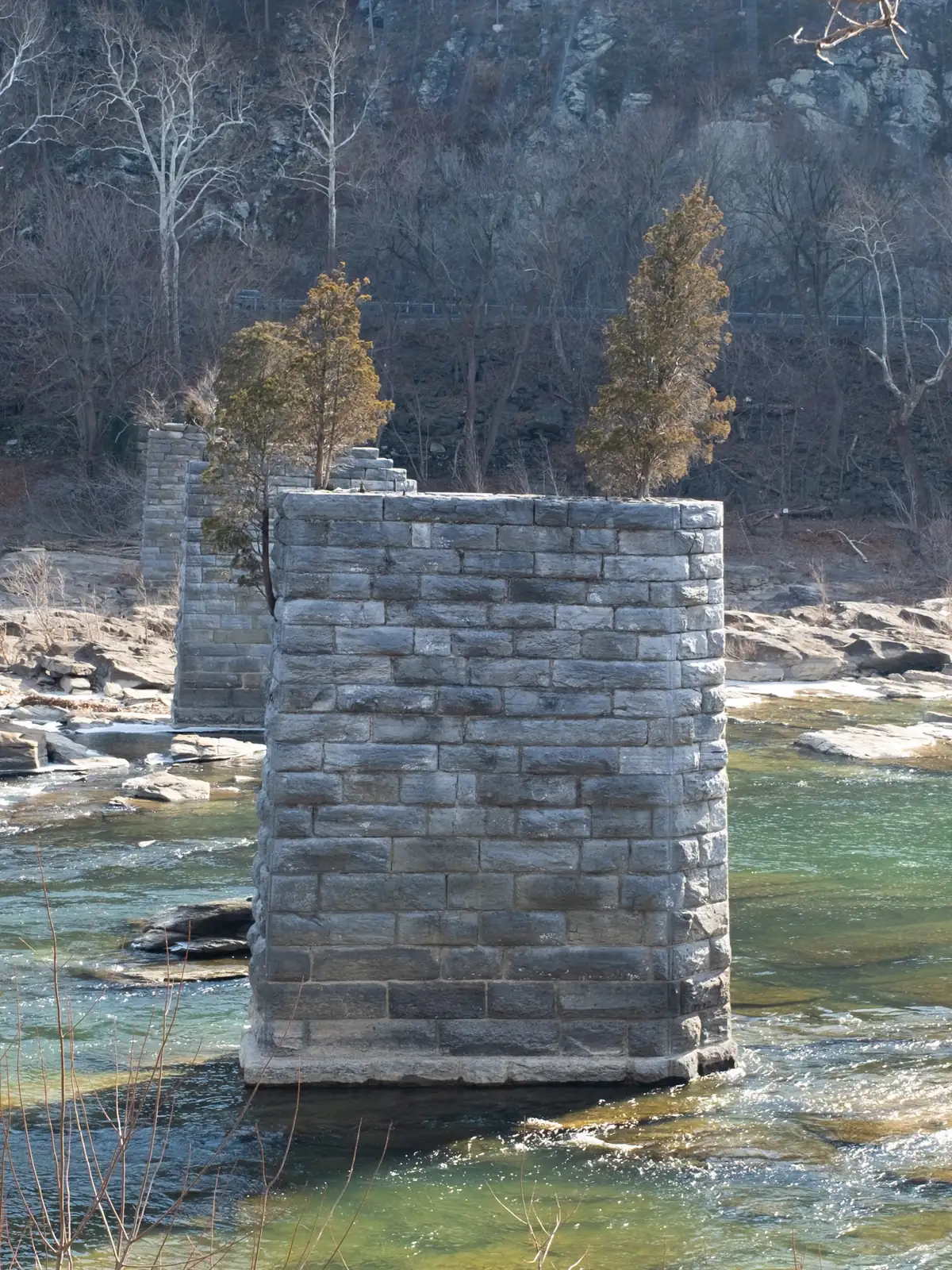
IDNR says this 385-acre park protects one of Illinois' last stands of native eastern white pine and one of the southernmost natural stands in the country. Settlers found the pines along Pine Creek, and the effort to save them led to the park in 1927. The Morton Arboretum's field marks: soft needles in bundles of five, crowded toward the branch tips, and slender cones up to 8 inches long tipped with white resin.
-
Eastern red cedar and its winter berries
Berries hang on through winter · Fencerows, old pastures, limestone bluffs and roadsides statewide
Red cedar is a juniper, not a true cedar. The Morton Arboretum notes that its prickly, blue-green foliage often turns bronze in winter, and that female trees carry berry-like cones that ripen a powdery blue-gray and often hang on all winter, a favorite of many birds. Check a fruiting cedar for the robins that flock to winter berries, and look at the reddish-brown bark peeling in strips low on the trunk.
-
Naming trees without leaves
All winter · Any park or woodlot; classes at the Morton Arboretum in Lisle on December 4 and 12
Start with how the twigs are arranged. Maples, ashes, dogwoods and buckeyes grow their buds in opposite pairs; almost everything else alternates. Then look at the buds, the leaf scars and the bark: the long, cigar-shaped buds of beech, the curling plates of shagbark hickory, the warty ridges of hackberry. The Arboretum's winter tree identification class teaches exactly these clues, with in-person field sessions from noon to 4 p.m. on Friday, December 4, and Saturday, December 12 (fee and registration).
Press one cone or berry sprig into the seeds, pods and cones page and add a bark rubbing beside it. A pine cone left out in the rain will close; bring it inside and watch it open again.
How do Illinois animals get through the winter?
Most Illinois mammals stay active all winter, but a few check out entirely. IDNR's teaching guide on mammals counts eleven Illinois species that truly hibernate: seven bats, the woodchuck, Franklin's and thirteen-lined ground squirrels, and the meadow jumping mouse. In true hibernation a body that normally runs near 95 °F can cool to about 36 °F, the heart slows from more than 100 beats a minute to four or five, and breathing drops to about once a minute. A hibernator can lose a third of its weight by spring.
-
Sleepers and dozers
December to February or March · Burrows, caves, old mines and tree cavities
Woodchucks dig a single-entrance winter burrow, often under tree roots in the woods, and Illinois Extension says one may stay below for as long as four months before coming up in February. Chipmunks and raccoons are not true hibernators: the Forest Preserve District of DuPage County notes they sink into torpor for days at a stretch, then wake to eat and relieve themselves. Skunks and raccoons den up through the coldest spells and live off their fat. Even true hibernators rouse now and then, more often as spring nears.
-
The ones you can see
All month, especially at dawn and dusk · Field edges, woodlots, suburban yards
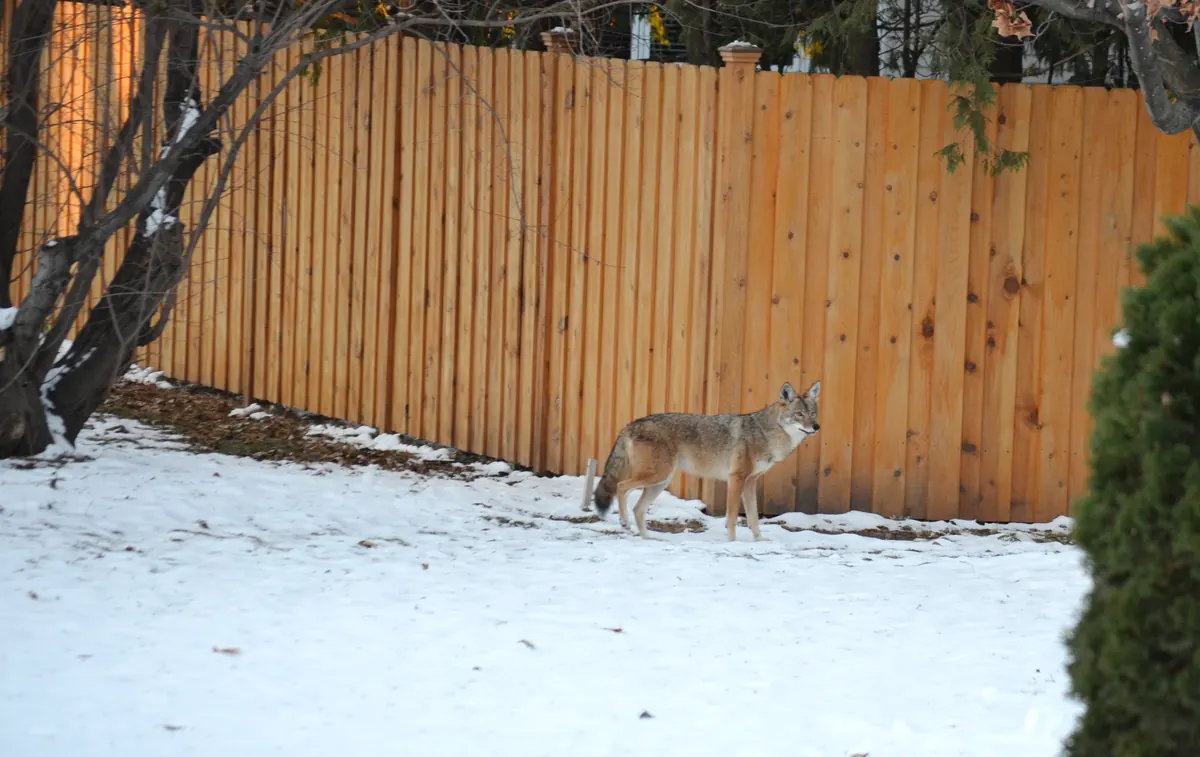
Wildlife Illinois says deer, turkeys and coyotes tend to group up in winter and grow bolder as food runs short, and that rabbits and voles turn to the bark of young trees and shrubs once other food is gone. Coyotes wear a thick winter coat that makes them look bigger than they are, and their barks and howls carry farthest on cold, still nights; breeding peaks in late February or early March. Robins that stay for the winter flock up and switch from worms to berries.
-
Reading tracks after a snow
The morning after a fresh, light snowfall · Fence lines, stream banks, the edge of any woods
An inch of new snow turns a field into a guest book. Foxes and coyotes leave a neat, nearly straight line of prints; a cottontail bounds, so its long back feet print in front of its little forefeet. Follow a trail backward rather than forward, so you never push the animal that made it.
Sketch the clearest print you find on tracks to know, with its length and the distance between steps, and note who you think made it.
What can Illinois families do outdoors in December?
- Saturdays, December 5, 12, 19 and 26: Wooded Island bird walks with Chicago Bird Alliance in Jackson Park, 8 to 10 a.m., free, about two miles; the group has walked here every Saturday, weather permitting, for more than 50 years.
- Wednesday, December 16: North Pond bird walk with the Chicago Ornithological Society in Lincoln Park, 7 to 9 a.m., meeting at the North Pond fishing pier off Cannon Drive.
- Saturday, December 5: holiday wreath workshop at Giant City State Park south of Carbondale, led by University of Illinois Extension, 10 to 11:30 a.m. or 1 to 2:30 p.m. The park's winter Gnome Roam starts December 1 and runs through February. Programs are free; most ask you to register with the visitor center.
- December 5, 12 and 19: the last Crane Saturdays at Jasper-Pulaski, in Indiana, with the International Crane Foundation on the tower from 4:30 to 6:30 p.m. Central.
- Through January 2: Illumination at the Morton Arboretum in Lisle, an evening walk among lit trees, this year with a 400-foot display inspired by the northern lights. Buy tickets ahead; December 2, 9 and 16 are dog nights.
- December 14 to January 5: Christmas Bird Counts. Join a field team or count from your feeder inside a circle; Audubon's map lists the compilers.
- Late December: eagle mornings at Pere Marquette State Park, by reservation only, starting at the visitor center at 8:30 a.m. Call 618-786-3323 for this season's dates.
- New Year's Day: First Day Hikes, January 1, 2027. Last January 1, 17 Illinois state parks, among them Starved Rock, Giant City, Pere Marquette and Illinois Beach, hosted self-guided hikes with trail maps and stickers at a check-in table. IDNR usually posts the new list in December.
- Keep counting all month. Project FeederWatch runs through April 30, and every walk can become an eBird checklist.
See how this month compares with the fall on our November guide for Illinois, or pick another state from the full list of nature guides. A blank page in the Naturalist's Field Journal is waiting for each of these outings.
Safety notes for December in Illinois
- Second firearm deer season, December 3–6, then muzzleloader, December 11–13. Wherever gun deer hunting is allowed, bowhunting for deer and turkey stops for December 3 to 6 and resumes December 7, running to January 17; squirrel, coyote, skunk and furbearer hunting also pause for those four days. The late-winter antlerless and special CWD deer seasons open December 31 and run to January 3 in the counties IDNR lists. Cook, DuPage, Lake and Kane east of Route 47 have no gun deer season.
- Waterfowl and small game. Duck season runs to December 27 in the North Zone. The Central Zone closes December 13 and reopens December 19 to January 3; the South Zone closes after December 6 and reopens December 19 to January 24. Canada and snow goose seasons continue into late January. Pheasant, quail and partridge run to January 8 in the north and January 15 in the south, rabbit to February 15, and snipe ends December 20.
- Blaze orange or pink. IDNR has deer hunters put on a solid-colored hat in blaze orange or blaze pink and, on the upper body, at least 400 square inches of the same color in every firearm deer season, including the muzzleloader, late-winter and CWD hunts. Upland and rabbit hunters must wear the same on IDNR sites and at least the cap on private land. If you hike on state fish and wildlife areas or in the Shawnee in December, wear something bright yourself and dress the dog in orange as well.
- Ice. University of Illinois Extension says it takes at least four inches of clear, newly formed ice to hold one person on foot, and thickness can change from a foot to an inch within ten feet on the same pond. River and backwater ice, weakened by current, is never trustworthy. Keep children and dogs off retention ponds, and carry ice picks and a rope if you go out to fish.
- Cold and early dark. With sunset before 5 p.m. everywhere this month, and as early as 4:19 in Chicago, aim to finish hikes by mid-afternoon, and pack a headlamp, a dry layer and a charged phone. Wind off Lake Michigan makes the lakefront far colder than the thermometer suggests; cover your ears and fingers, which frost-nip first.
- Deer on the roads. IDNR's crash data put October through December at the top of the year, and the evening commute now falls in full dark. Slow down where woods meet fields and brake rather than swerve.
Sources
- NOAA NCEI: U.S. Climate Normals 1991–2020, monthly temperature, precipitation and snowfall for Illinois stations (data API)
- Climate Prediction Center: ENSO diagnostic discussion, September 10, 2026
- Climate Prediction Center: 90-day seasonal outlooks (winter outlook issued October 15, 2026)
- Midwestern Climate Center (Illinois State Water Survey): El Niño may mean less snowfall in the Midwest this winter, September 29, 1997
- Illinois State Climatologist Office: El Niño and La Niña in Illinois
- Indiana DNR: sandhill cranes at Jasper-Pulaski Fish and Wildlife Area (2025 weekly counts and 2026 Crane Saturdays)
- eBird (Cornell Lab of Ornithology): submit checklists
- U.S. Army Corps of Engineers, Rock Island District (DVIDS): people flock to see eagles soar, March 2023
- U.S. Army Corps of Engineers, Rock Island District: eagle watching and weekly eagle counts, Mississippi River
- State of Illinois, Eagles in Illinois: eagle watching sites and events
- U.S. Fish and Wildlife Service: Chautauqua National Wildlife Refuge
- Chicago Bird Alliance: tips for responsibly observing visiting snowy owls, December 10, 2025
- WTTW: snowy owls delighting birders on Chicago's lakefront, November 21, 2025
- USDA Forest Service, Midewin National Tallgrass Prairie: animals
- Illinois Endangered Species Protection Board (IDNR): status review and recovery outline for grassland raptors, northern harrier and short-eared owl
- IDNR Wild About Illinois Birds: great horned owl
- National Audubon Society: join the Christmas Bird Count
- National Audubon Society: the 123rd Christmas Bird Count in Illinois
- Chicago Ornithological Society: 2025 Chicagoland Christmas Bird Count guide
- Peoria Audubon Society: bird counts
- Champaign County Audubon Society: bird counts and citizen science
- U.S. Naval Observatory: moon phases (data API)
- U.S. Naval Observatory: Earth's seasons, 2026 (data API)
- U.S. Naval Observatory: sunrise and sunset, Chicago, December 8, 2026 (data API)
- International Meteor Organization: 2026 meteor shower calendar
- EarthSky: what is a supermoon? (2026 full supermoons)
- BBC Sky at Night Magazine: supermoons in 2026
- IDNR: about White Pines Forest State Park
- IDNR: White Pines Forest State Park (visitor information)
- The Morton Arboretum: eastern white pine
- The Morton Arboretum: eastern red-cedar
- The Morton Arboretum: winter tree identification class, December 2026
- IDNR, Wild Mammals of Illinois teacher's guide: hibernation
- University of Illinois Extension: great groundhogs, Illinois' burrowing hibernator
- Forest Preserve District of DuPage County: how wildlife survive winter
- Wildlife Illinois (IDNR): seasonal behaviors
- Wildlife Illinois (IDNR): coyote
- Wildlife Illinois (IDNR): deer–vehicle accidents
- Chicago Bird Alliance: upcoming events, December 2026
- Chicago Ornithological Society: events, December 2026
- IDNR: Giant City State Park 2026 calendar of events
- The Morton Arboretum: Illumination returns November 14, 2026 (press release)
- IDNR calendar: First Day Hikes at Illinois state parks
- NPR Illinois: Illinois state parks hosting New Year's Day hikes, December 26, 2025
- Project FeederWatch: how to participate
- IDNR: 2026–27 Illinois Digest of Hunting and Trapping Regulations, season dates card
- Hunt Illinois (IDNR): deer seasons and blaze orange or pink requirements
- Hunt Illinois (IDNR): upland and small game, blaze orange or pink rules
- University of Illinois Extension: don't be fooled by thin ice
- National Weather Service: winter weather safety, cold
- Photos via Wikimedia Commons; licenses and photographers are credited under each picture