What to look for in nature in Illinois this January
Halfway through meteorological winter, January is normally the coldest stretch of the Illinois year. That cold is exactly what makes it the best eagle month of the year: as the big rivers freeze, the birds crowd into the few open stretches below the locks and dams, and towns along the Mississippi and the Illinois hold their eagle weekends. Diving ducks bob in the open water off Chicago, Canada geese settle into the old goose refuge at Horseshoe Lake near Cairo, and red foxes begin pairing up in the snow. Overhead, the Quadrantid meteors peak in the first week, and the year's closest full moon rises on January 21. This guide runs from the Wisconsin line to the Ohio River.
Other months in Illinois: October, November, December, February.
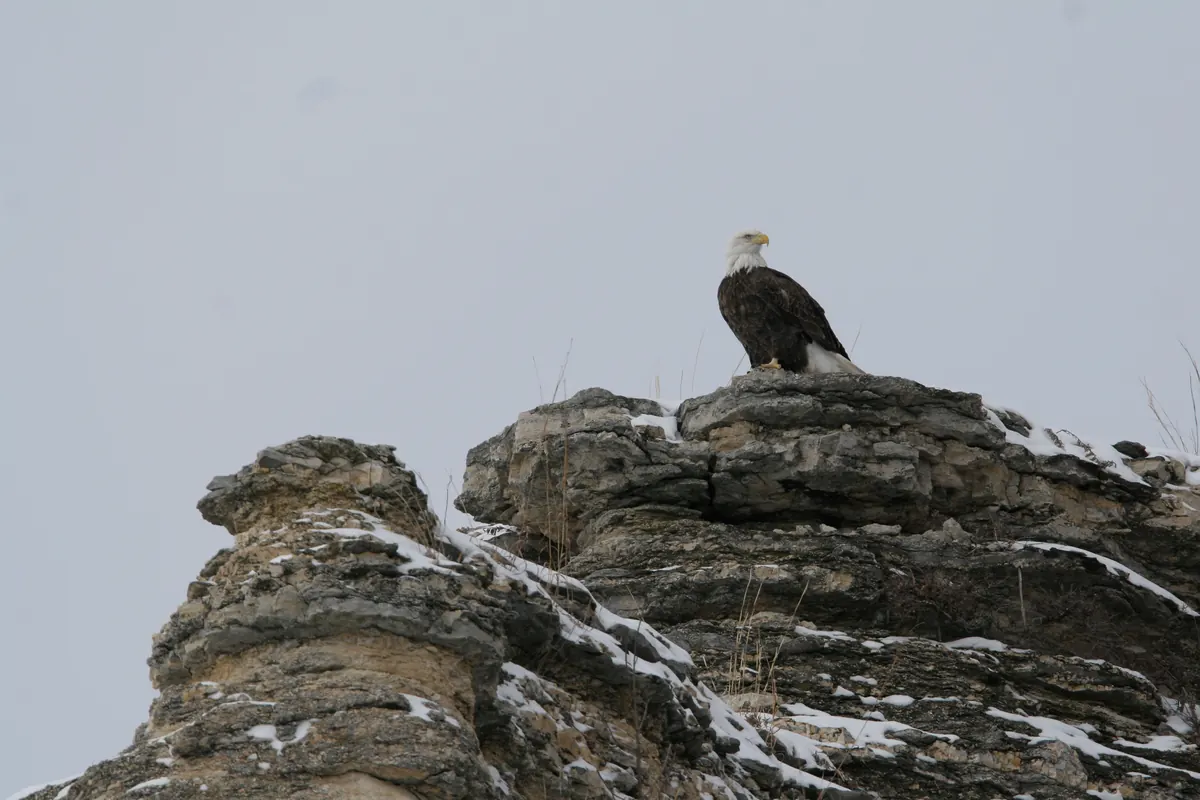
Start here
- Pick an eagle weekend. Three of the state's big eagle festivals already have 2027 dates: Quad City Bald Eagle Days in Rock Island (January 8 to 10), the Alton Eagle Ice Festival (January 9), and the Starved Rock Eagle Watch Weekend in Utica (January 30 and 31). Go early in the day, when the birds are fishing.
- Watch the Quadrantids before dawn on January 4. Its brief maximum comes after dark on Sunday, January 3, and the best watching runs until dawn on Monday. The moon is a slim crescent that comes up late, so a dark country sky might give you several dozen meteors per hour toward morning. Face northeast and give your eyes twenty minutes to adjust.
- Look up at the Wolf Moon. The full moon of January 22 is the closest of 2027, a supermoon. It is technically full at 6:17 a.m. CST that Friday, so catch it coming up big and orange in the east-northeast near sunset on Thursday, January 21.
For the Naturalist's Field Journal: give the eagles their own entry in birds I have seen, splitting your count into white-headed adults and brown immatures and noting the water temperature or ice. Sketch a fox's straight-line trail or an otter slide on tracks to know, log the clock time of sunset on January 1 and January 31 on the dusk and dawn watch, and return to one frozen pond or riverbank early and late in January for the same place twice.
Regions used below: Chicago and the Lake Michigan shore; Northern Illinois and the Rock River; Central Illinois and the Illinois River valley; Western Illinois and the Mississippi; Southern Illinois and the Shawnee Hills.
How cold and snowy is January in Illinois?
In NOAA's 1991–2020 normals, January runs a few degrees colder than December almost everywhere in the state, and across the north it brings more snow than December too. Rockford averages an afternoon high of 29 °F and a morning low near 14, with almost 11 inches of snow; O'Hare sees a little more snow, about 11.3 inches. Springfield's normal is closer to 7 inches, and at Anna, in the far south, January highs reach the mid-40s and snow averages under 3 inches. To see when your own town usually gets its last spring freeze, open the frost dates for Illinois.
-
The coldest reading ever taken in Illinois
January 31, 2019 · Mount Carroll, Carroll County, northwest Illinois
During the polar vortex outbreak at the end of January 2019, the cooperative weather observer at Mount Carroll read −38 °F. A national panel, the State Climate Extremes Committee, later accepted it as the new statewide record, beating the −36 °F set at Congerville on January 5, 1999. Its report noted a textbook setup for a deep freeze: clear skies, light winds and snow cover. Both records fell in January, which says something about the month.
-
Ice on Lake Michigan
Builds through January; usually near its seasonal peak in mid to late February · The Chicago shoreline, harbors and Illinois Beach State Park
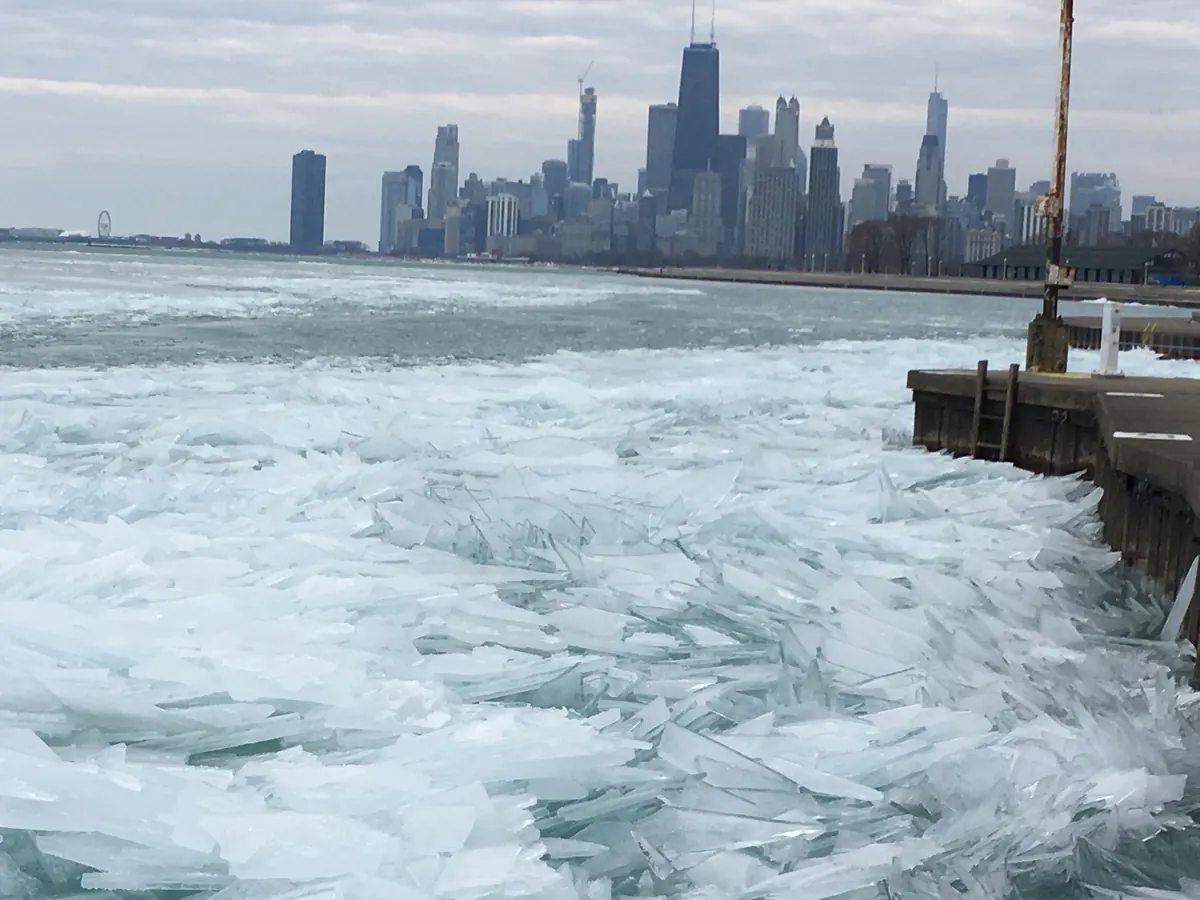
In a cold spell, slush and pancake ice gather along the Chicago lakefront, and wind can stack broken plates into ridges against the breakwalls. NOAA scientists note that the Great Lakes usually approach their seasonal ice maximum in mid to late February, so January is the building phase. Enjoy it from the shore and keep children off the piled ice; it can hide open water and break without warning.
| Station | Average high | Average low | Precipitation | Snowfall |
|---|---|---|---|---|
| Rockford (Greater Rockford Airport) | 29.1 | 14.5 | 1.60 | 10.9 |
| Moline (Quad City Airport) | 31.8 | 14.8 | 1.66 | 10.8 |
| Chicago O'Hare | 31.6 | 18.8 | 1.99 | 11.3 |
| Peoria (Greater Peoria Airport) | 33.6 | 17.6 | 2.06 | 7.7 |
| Springfield (Capital Airport) | 35.9 | 19.9 | 2.03 | 6.7 |
| Carbondale (sewage plant station) | 41.3 | 23.4 | 3.36 | 3.2 |
| Anna | 45.2 | 25.4 | 3.53 | 2.6 |
This winter, El Niño is the wild card. Illinois weather this season takes its cue from the tropical Pacific. On September 10 the Climate Prediction Center's ENSO team rated it above 90 percent likely that the present El Niño reaches very strong territory across December, January and February. The Illinois State Climatologist's office summarizes what El Niño has usually meant here: winters that run warmer and drier, with snowfall below average and smaller heating bills. There is a lakefront twist, too. NOAA researchers describe low-ice years on the Great Lakes as common in El Niño winters, and they add that years with little ice hold the greatest potential for big lake-effect snow events, because open water keeps feeding moisture to cold air passing over it. Even so, one sharp cold wave or a single big storm can still define a mild winter. NOAA's official outlook for the season is published on October 15 and refreshed every month; you will find the current maps on the Climate Prediction Center's 90-day outlook page, and a seven-day local forecast is on the weather page here.
Where can you see the most bald eagles in Illinois in January?
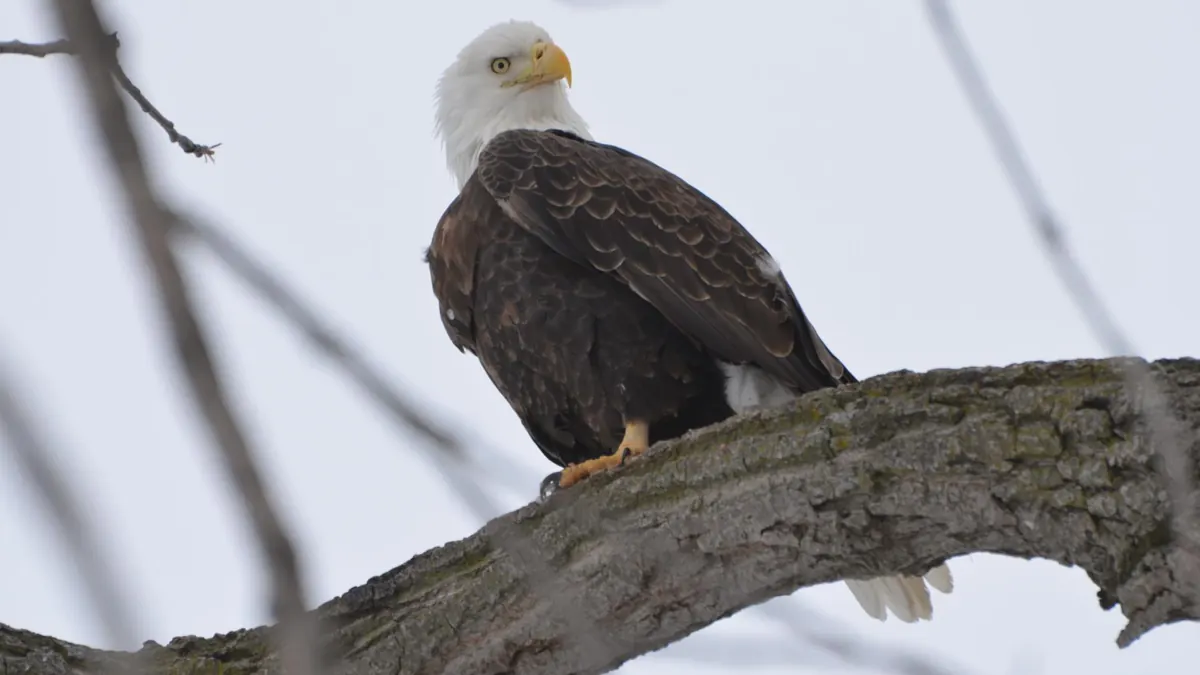
By the state's own count, Illinois hosts more than 3,100 wintering bald eagles, more than any other state outside Alaska, and its eagle site calls January and February the best months to see them. The reason is ice. Eagles here live mostly on fish, and when the pools behind the dams freeze, the open, churning water just below each lock and dam becomes the best place to find a meal. An Army Corps resource specialist put it plainly: the more of the river that freezes, the more the eagles have to bunch up near the locks.
-
Tailwaters of the Mississippi locks
All month, best in the morning; most crowded after a hard freeze · Mississippi River locks and dams from the Quad Cities to Alton, including Lock and Dam 18 near Gladstone and Lock and Dam 21 at Quincy
Rangers from the Rock Island District count the birds at their locks every Wednesday morning from December into February and post the tallies online, so you can check where numbers are building before you set out. Scan the big shoreline trees for perched birds, then wait: sooner or later one glides down to the boiling water below the gates, grabs a fish with its feet and flaps back to a branch to eat.
-
Starved Rock and Plum Island
January to early March · The Illinois Waterway Visitor Center across the river from Starved Rock State Park, near Ottawa and Utica
Below the Starved Rock Lock and Dam on the Illinois River, eagles fish the open water and roost on Plum Island, a 55-acre uninhabited island just downstream from Ottawa that you can see from the top of Starved Rock. The Corps' Illinois Waterway Visitor Center sits across the river from the park, and on the Eagle Watch Weekend, Starved Rock Audubon members set up spotting scopes there and talk about the island's history as an eagle sanctuary.
-
The confluence near Alton and Grafton
Late December to early March · The Great River Road between Alton and Grafton; Pere Marquette State Park
The regional tourism bureau ranks the meeting of the Mississippi, Illinois and Missouri rivers among the country's premier eagle wintering areas, and says a drive along the bluffs can turn up 25 to 150 eagles. Use the marked pull-offs only.
-
The midwinter count
The first two weeks of January · Fixed routes along rivers and reservoirs statewide
Volunteers have tallied wintering eagles nationwide since the National Wildlife Federation launched a coordinated count in 1979. Each counter repeats a fixed route in the first two weeks of January, and the survey is now run by the Army Corps. Local clubs run their own censuses as well. On January 9, 2026, Champaign County Audubon members counted 43 bald eagles between Havana and Beardstown on the Illinois River, 26 adults, 16 immatures and one unidentified, with several thousand greater white-fronted geese and a few dozen trumpeter swans thrown in.
Each time an eagle is spooked into flight, it spends energy that is hard to replace in deep cold. Stay in your car or at overlooks, keep your voice down, and never walk out toward a bird on the ice for a closer photograph.
When are the eagle festivals in Illinois in 2027?
River towns celebrate the eagles with indoor raptor shows, guided viewing and shuttle tours. The events below list 2027 dates on the organizers' own pages; the others run every year and usually fall in the same part of January, so check with the organizer before you drive.
-
Quad City Bald Eagle Days
Friday, January 8, 4 to 8 p.m.; Saturday, January 9, 10 a.m. to 6 p.m.; Sunday, January 10, 10 a.m. to 3 p.m. · QCCA Event Center, 2621 4th Avenue, Rock Island
Live eagle and raptor programs, conservation exhibits, nature vendors and intertribal dancing fill the hall. Quad City Audubon leads free 45-minute bus trips to see wild eagles on Saturday and Sunday. Admission is $7 for adults and $1 for ages 6 to 15; children 5 and under get in free.
-
Alton Eagle Ice Festival
Saturday, January 9, 2027, 10 a.m. to 4 p.m. · Flock Food Truck Park, 210 Ridge Street, Alton, with eagle activities around town
Now in its 18th year, this free festival mixes ice carving and food with live eagle meet-and-greets. In past winters the area has also offered free meet-and-greets with live eagles at the Alton and Grafton visitor centers and guided eagle shuttle tours along the river road; ask the bureau at 618-465-6676 for this season's dates.
-
Starved Rock Eagle Watch Weekend
Saturday and Sunday, January 30 and 31, 2027, 9 a.m. to 4 p.m. · Starved Rock Lodge, the state park visitor center, the Illinois Waterway Visitor Center and the Utica Village Hall
Admission is free. Raptor rehabilitation groups bring live birds of prey to four sites linked by a trolley loop, kids can dissect owl pellets, and Audubon volunteers staff scopes at the lock. The lodge offers a guided winter hike at 10 a.m. both days for a fee.
-
Pere Marquette Bald Eagle Festival and eagle mornings
Annual festival, usually a Sunday in late January; reserved eagle programs on many winter mornings · Pere Marquette State Park and lodge, Grafton
The lodge has held an indoor Bald Eagle Festival with live raptor shows in late January in past winters, but its 2027 date was not on the lodge's own events page in early October, so check with the lodge before you plan around it. Separately, the park runs reservation-only eagle mornings that start with an 8:30 a.m. talk at the visitor center and then head out to watch birds along the river; last winter's ran into early March. Call the park for this season's dates.
-
Great River Eagle Days in Quincy
Annual, usually a weekend in late January · Oakley-Lindsay Center, downtown Quincy, with viewing at Lock and Dam 21
The 2026 edition, the 13th, ran January 24 and 25, with live raptors, Native American dancing and a blessing of the eagle ceremony, while Corps rangers set up free scopes at Lock and Dam 21. The 2027 date had not been posted when this guide was written; check with See Quincy.
Dress for standing still. Wind off open river water bites harder than the thermometer suggests.
Where do ducks, geese and swans spend January in Illinois?
Waterfowl hold on in Illinois wherever water stays open: on Lake Michigan, below dams, and across the far south, where shallow lakes freeze only briefly. The Illinois Natural History Survey has flown weekly aerial counts of the Illinois and central Mississippi rivers since 1948, from September until early January, overlapping the federal midwinter waterfowl count, so the first week of the month is when the season's last survey flights go up.
-
Diving ducks off the Chicago lakefront
All winter, wherever the lake stays open · Northerly Island, Montrose Harbor, the Jackson Park harbors, Illinois Beach State Park
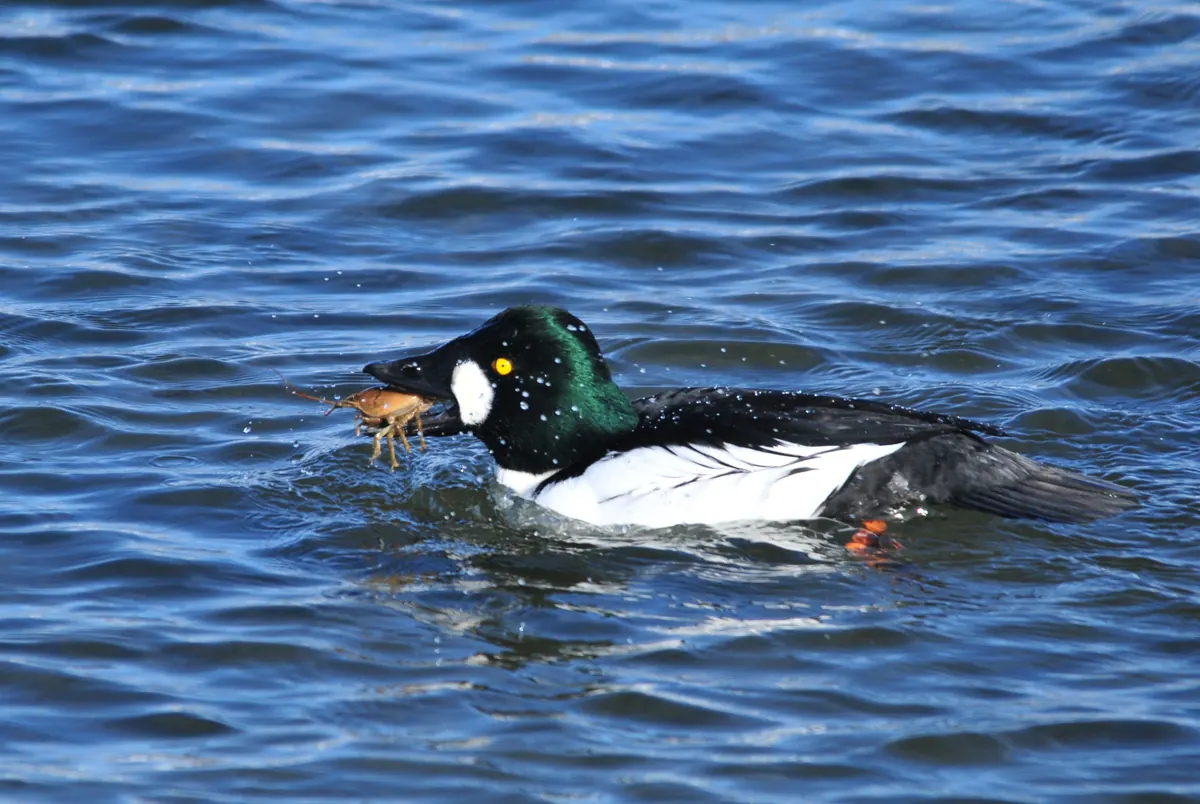
When the Chicago Ornithological Society held its first Winter Waterfowl Watch at Northerly Island on January 10, 2026, more than 200 people turned out, despite poor weather, to see common goldeneyes, red-breasted mergansers, greater and lesser scaup, redheads and canvasbacks. The club says it will now run the event every year; watch its calendar for the 2027 date. Male goldeneyes are easy to learn: a glossy dark head, a white cheek patch near the bill, a yellow eye, and a body that looks white at a distance.
-
White-fronted geese and trumpeter swans
Through January, moving with the ice · The Illinois River backwaters between Havana and Beardstown, including Anderson Lake and Sanganois
Champaign County Audubon's January census of this stretch found several thousand greater white-fronted geese and several dozen trumpeter swans in 2026. White-fronts have orange legs, a pink bill and a white band at its base; trumpeters are pure white with a long, straight black bill and are much bigger than any goose.
A spotting scope helps on the lake, where rafts of ducks often sit far offshore. Note the date the harbor ices over and the date it opens again.
What is winter like in the swamps and refuges of southern Illinois?
Below the Shawnee Hills, the land flattens into the old floodplains of the Ohio and Mississippi, with cypress swamps and shallow lakes more like the Deep South than the prairie. January here is wetter and milder, and it belongs to waterfowl and eagles.
-
Horseshoe Lake's goose refuge
Fall through winter · Horseshoe Lake State Fish and Wildlife Area, Alexander County, near Miller City
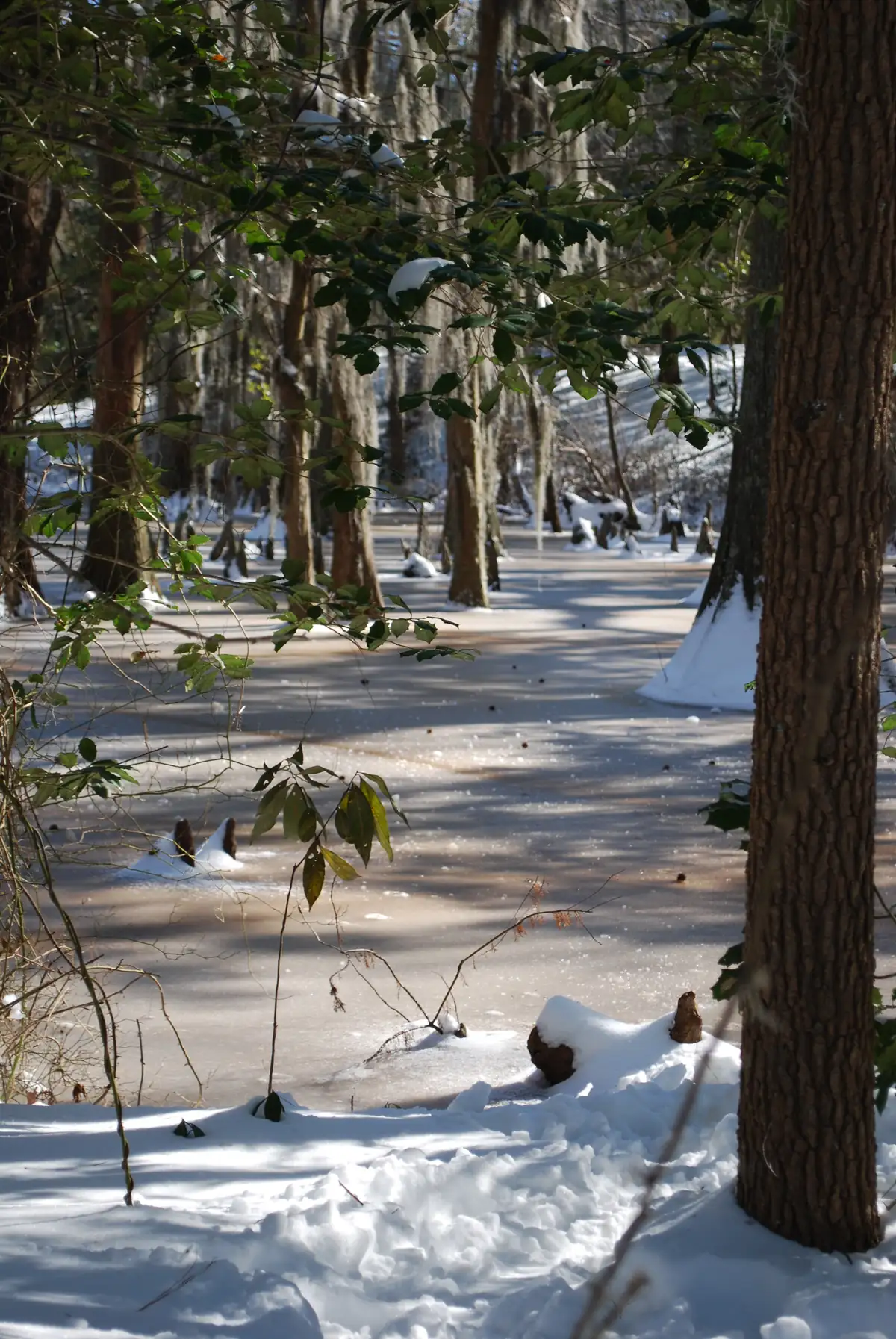
The state bought the first 49 acres here in 1927 to protect Canada geese, and the area is still managed as a winter refuge for them; over the decades biologists have trapped, banded and released more than 50,000 birds. IDNR says fall and winter visitors see large numbers of waterfowl and bald eagles, framed by bald cypress, tupelo gum and swamp cottonwood around the lake's oxbow.
-
Bare cypress in the Cache River swamps
All winter · Cache River State Natural Area, including Heron Pond and Little Black Slough; Cypress Creek National Wildlife Refuge
Unlike pines, bald cypress sheds its needles each fall, so in January the swamps look like a forest of gray masts standing in black water. IDNR says many of the Cache River trees are more than a thousand years old, with buttressed bases more than 40 feet around, and the wetlands are recognized under the Ramsar Convention as internationally important. Winter is a good time to look for the small, round cones, which the Morton Arboretum notes stay on the branches into the cold months. The neighboring Cypress Creek refuge serves as a winter feeding and resting area for waterfowl.
Low roads in the far south flood after winter rains; check conditions with the site first, and never drive through water over the road.
Which Illinois animals start courting in the middle of winter?
For several Illinois predators, the new breeding cycle opens in the deepest cold. Young born in early spring need a long head start, and their parents begin in the cold.
-
Great horned owls on eggs
Nesting can begin in January · Old hawk, crow or squirrel nests, tree cavities and even buildings, statewide
IDNR lists the great horned owl among the earliest nesting birds in the state; a pair may be sitting on two or three round white eggs before the month is out. Listen at dusk for the male's deep hooting and a female answering in a slightly higher voice. Should you spot a nest, keep well back, because an owl flushed off its eggs leaves them exposed to the cold.
-
Red foxes pairing up
Breeding from January into early February · Field edges, cemeteries, golf courses and quiet suburbs
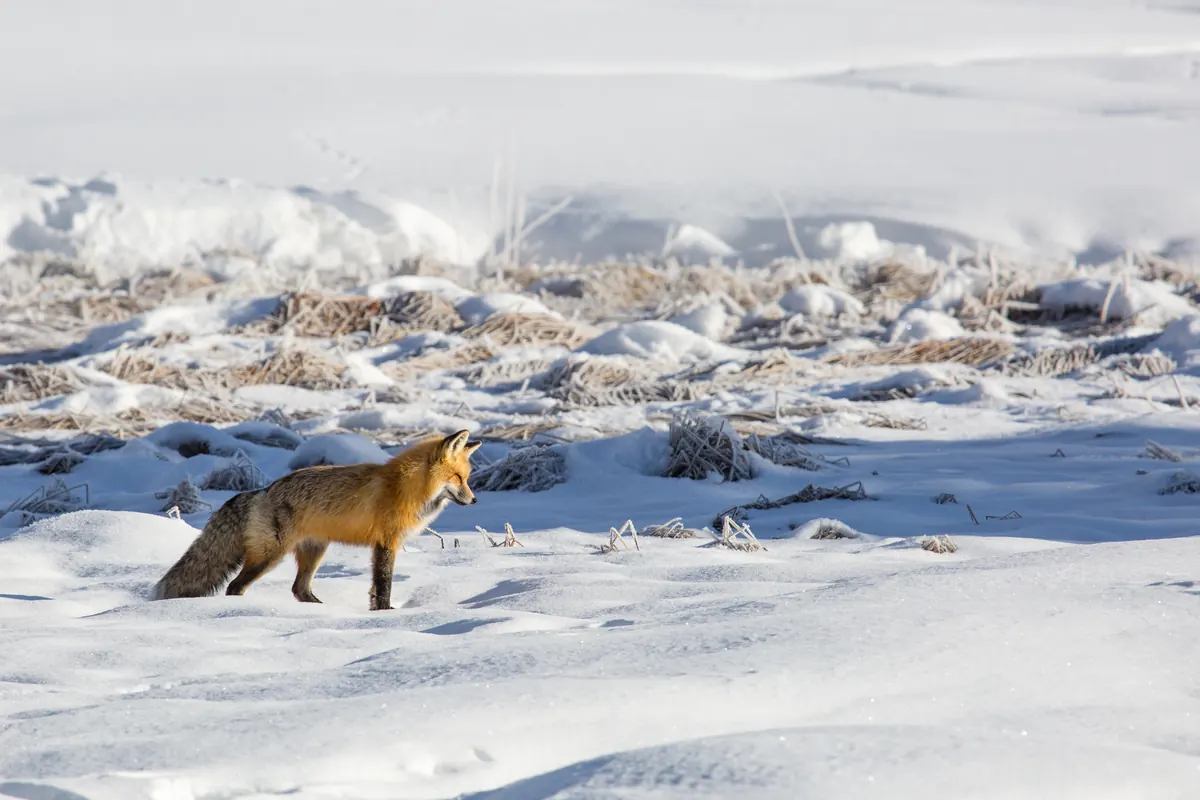
Wildlife Illinois says red foxes breed from January through early February; after a gestation of seven or eight weeks the kits are born from late March into April, often in an old woodchuck den. In fresh snow, fox prints run in a nearly straight line, much like a small coyote's. Watch open fields at dusk for a fox standing still, head cocked, then springing to pounce on a vole under the snow.
-
River otters sliding
All winter; kits are born from January to May · Streams, rivers and backwaters, now in every county
Fewer than 100 otters were left in Illinois in 1989; after reintroductions in the 1990s they came off the state's threatened list in 2004. On snow and ice they bound and slide, leaving belly troughs 10 to 20 feet long between sets of webbed prints 2½ to 3½ inches wide.
Draw any slide or trail you find with a coin beside it for scale, and record the date and the snow depth.
Will winter finches come to Illinois this year?
Every fall the Finch Research Network forecasts which northern seed-eaters will leave the boreal forest. Its 2026–27 forecast, issued September 25, calls the picture mixed: Ontario-to-Maritimes conifers and the British Columbia-to-Alaska forests bore well, while the central boreal largely failed, which points birds east toward the Great Lakes and New England more than south. On the southern edge of those movements, Illinois should expect some finches, not a flood.
-
Pine siskins and purple finches
Any time in winter, often in flocks · Feeders with nyjer or sunflower; conifer plantings, alders and birches
The forecast notes days with over a thousand siskins at Hawk Ridge, Minnesota, and a very good northern white cedar crop around the Great Lakes, which siskins love; it also expects many purple finches to move into the Great Lakes region, though good seed crops tend to keep birds farther north. Look for small, streaky siskins showing a yellow wing stripe when they fly; a male purple finch is washed all over in a soft rosy red, with less streaking below than a house finch.
-
Redpolls, grosbeaks and crossbills
Unpredictable; watch eBird alerts · Weedy fields, birches, conifer groves, feeders in the north
The forecast calls for a small to modest redpoll flight, mostly in the western Great Lakes, evening grosbeaks that a good mountain-ash crop may hold farther north, and crossbills that could wander the region in search of cones. Any of them would be a fine find in northern Illinois; check pine and spruce plantings in arboretums and cemeteries.
-
Count your feeder
Through April 30 · Your own yard or a nearby park
For Project FeederWatch, you watch on two consecutive days, no more than once a week, and send in the most individuals of each species seen at one time. Those numbers are how researchers learn whether a forecast came true.
If northern finches turn up, write the date of the first flock and the last on your bird list; irruption years are worth comparing.
When does the sun start setting later in Illinois?
The turnaround has already begun. Chicago's earliest sunsets came in early December, and through January the evenings stretch noticeably, even as sunrise holds near its latest for the first week or so. On New Year's Day the sun rises at 7:18 a.m. and sets at 4:30 p.m. in Chicago; by January 28 sunset reaches 5:00 p.m. for the first time since early November. Over the month Chicago's day grows from 9 hours 12 minutes to 10 hours even, and the daily gain speeds up, from under a minute a day at New Year's to more than two minutes a day as February begins. Downstate the days are longer but grow more slowly: Cairo goes from 9 hours 41 minutes to 10 hours 21 minutes, a gain of 40 minutes, while Rockford gains 48.
| City | Jan 1 | Jan 31 | Gained | Per day |
|---|---|---|---|---|
| Rockford | 9 h 10 m | 9 h 58 m | 48 min | 1.6 min |
| Chicago | 9 h 12 m | 10 h 00 m | 48 min | 1.6 min |
| Moline | 9 h 14 m | 10 h 02 m | 48 min | 1.6 min |
| Peoria | 9 h 20 m | 10 h 06 m | 46 min | 1.5 min |
| Champaign | 9 h 23 m | 10 h 08 m | 45 min | 1.5 min |
| Springfield | 9 h 25 m | 10 h 09 m | 44 min | 1.5 min |
| Carbondale | 9 h 37 m | 10 h 17 m | 40 min | 1.3 min |
| Cairo | 9 h 41 m | 10 h 21 m | 40 min | 1.3 min |
Northern towns start with the shortest days but gain fastest. For exact sunrise, sunset and twilight times at your address, use our daylight calculator.
What can you see in the Illinois night sky in January 2027?
Long, frosty nights favor sky watching, and January 2027 opens strong: a well-placed meteor shower, Venus at its widest, perihelion and a supermoon.
-
The Quadrantids
Active December 28 to January 12; peak the night of Sunday, January 3, into Monday, January 4 · A dark site away from town lights, facing northeast; best in the hours before dawn
Forecasters place the narrow peak somewhere between about 9:30 p.m. and midnight CST on January 3. The radiant, between the Big Dipper's handle and the old constellation of Boötes, sits low in the evening and climbs high by the small hours, so expect the most meteors in the predawn hours of Monday. A crescent moon, roughly one-sixth illuminated, stays below the horizon until late. Under a truly dark sky you might see dozens an hour; in town, far fewer.
-
Perihelion
Saturday, January 2, 8:33 p.m. CST · No special viewing; it is a fact to note
The planet passes nearest the sun for the year, roughly 91.4 million miles out, in the depths of northern winter; seasons come from Earth's tilt, not its distance.
-
Venus in the morning
All month; greatest western elongation Sunday, January 3 · Low in the southeast before sunrise
On Sunday, January 3, Venus pulls 47 degrees clear of the sun, its widest gap of this morning season, and blazes at about magnitude −4.3; after the moon, nothing in the night sky outshines it. Aim a small telescope at it and you will see a lit half, like a first-quarter moon in miniature.
-
The Wolf Moon, the closest full moon of 2027
Full at 6:17 a.m. CST on Friday, January 22 · Rising in the east-northeast at dusk on January 21
Perigee, the moon's nearest point, comes about 14½ hours ahead of full, so this is the year's nearest and biggest-looking full moon, about 222,229 miles away. Catch moonrise on Thursday evening, January 21; on Friday evening it still appears round. On Saturday, January 23, the moon, just past full, sits close to Jupiter in the evening sky, with the star Regulus nearby.
-
Evening planets
All month · Saturn in the southwest after dark; Jupiter in the east by mid-evening; Mercury low in the west-southwest at month's end
Saturn slips lower into the dusk each week. Jupiter, which reaches opposition in February, clears the eastern horizon a little sooner every night and by mid-evening is the brightest point in that part of the sky; reddish Mars, also building toward opposition, keeps it company in Leo. Toward month's end, Mercury may show itself as a small spark low toward the west-southwest in the deepening dusk. The darkest evenings for faint stars fall around the new moon of January 7.
| Phase | Date | Time |
|---|---|---|
| New moon | Thursday, Jan 7 | 2:24 p.m. CST |
| First quarter | Friday, Jan 15 | 2:34 p.m. CST |
| Full moon, the Wolf Moon | Friday, Jan 22 | 6:17 a.m. CST (a supermoon, the closest full moon of 2027) |
| Last quarter | Friday, Jan 29 | 4:55 a.m. CST |
Before you set an alarm for the meteors, see whether the night will be clear on our cloud forecast, and our moon calendar lists local moonrise and moonset for any Illinois town.
What can Illinois families do outside in January?
- Friday, January 1: First Day Hikes. For New Year's Day 2026, IDNR listed 17 state parks, including Starved Rock, Pere Marquette, Giant City and Illinois Beach, for self-guided hikes, with a check-in spot near each visitor center for a trail map and a sticker. IDNR had not yet named the 2027 parks this fall, so look for its list in December.
- Through Tuesday, January 5: final Christmas Bird Counts. The count period ends January 5, and a few circles still need help in the final days. Audubon's map lists the compilers.
- January 8 to 10: Quad City Bald Eagle Days in Rock Island, with free Audubon bus trips to see wild eagles on the weekend.
- Saturday, January 9: Alton Eagle Ice Festival, free, with live eagles and ice carving.
- January 30 and 31: Starved Rock Eagle Watch Weekend, free, with raptor shows, owl-pellet dissection for kids and scopes at the lock.
- Saturday mornings: Wooded Island bird walks in Chicago's Jackson Park. Chicago Bird Alliance has led them every Saturday, year round and weather permitting, for more than 50 years.
- A January lakefront duck watch. The Chicago Ornithological Society plans to repeat its Winter Waterfowl Watch at Northerly Island each year; check its events page for the date.
- All month: Project FeederWatch and eBird. Count your feeder birds two days at a time, or log a winter walk as a checklist.
December's highlights for the state are still on our December guide for Illinois, and you can browse every other state from our nature guides index. Pack the Naturalist's Field Journal for the eagle trip; a cold pencil works better than a frozen pen.
Safety notes for January in Illinois
- Deer hunting continues. Archery deer and archery fall turkey run through January 17. Late-winter antlerless and special CWD firearm seasons are open December 31 to January 3 and again January 15 to 17 in the counties IDNR lists. IDNR's rule for every firearm deer hunt, these two included, calls for a solid hat in blaze orange or pink, and on the torso an outer layer with 400 square inches or more of the same color.
- Waterfowl and small game. The Central Zone's duck season ends January 3, the South Zone's on January 24; Canada, light and white-fronted geese run to January 26 in the North and January 31 in the Central and South zones, and the South holds a youth waterfowl day on January 30. Pheasant, quail and Hungarian partridge end January 8 in the North Zone and January 15 in the South. Rabbit and squirrel stay open to February 15, crow to February 28, and the late dove season ends January 9. On IDNR sites, upland and rabbit hunters must wear the full orange or pink hat and vest; on private land, at least the hat.
- Furbearers. Raccoon, opossum, bobcat and red fox hunting and most trapping run to February 15, and beaver and otter trapping to March 31. Gray fox seasons are closed. Leash dogs near creeks, where traps are set.
- Ice. Illinois Extension advises at least 4 inches of clear, new ice for one person on foot, and warns that ice on the same pond can vary from a foot to an inch within a few paces. Clear ice is stronger than cloudy ice, and new ice stronger than old. Rivers, backwaters with current, spring-fed ponds and the Lake Michigan shelf ice are never safe. Anyone who does go out should wear a flotation vest beneath the coat, with ice picks around the neck and a rope within reach.
- Cold and wind chill. January's mornings average in the teens across northern Illinois and can fall far lower in an Arctic outbreak. The National Weather Service warns that in extreme cold, frostbite and hypothermia can set in within minutes, and that bare skin, hands and feet freeze first. Keep children's outings short on bitter days.
- Winter roads and short days. Across most of the state the sun is down before 5 p.m. until late in the month. Plan hikes to finish well before dark, carry a headlamp and a charged phone, and keep a blanket, water and a shovel in the car on trips to the river towns.
Sources
- NOAA NCEI: U.S. Climate Normals 1991–2020, monthly temperature, precipitation and snowfall for Illinois stations (data API)
- Illinois State Climatologist: Mt. Carroll reclaims record minimum temperature, March 2019
- Weather Underground Category 6: Illinois sets a new all-time record low of −38 °F on January 31, 2019
- Climate Prediction Center: ENSO diagnostic discussion, September 10, 2026
- Climate Prediction Center: 90-day seasonal outlooks
- Illinois State Climatologist Office: El Niño and La Niña in Illinois
- NOAA Climate.gov: how warm winters and low ice may impact the Great Lakes, March 18, 2024
- NOAA Great Lakes Environmental Research Laboratory: Great Lakes ice cover
- State of Illinois, Eagles in Illinois: wintering bald eagles and Plum Island
- State of Illinois, Eagles in Illinois: eagle watching sites and events
- U.S. Army Corps of Engineers, Rock Island District (DVIDS): people flock to see eagles soar, March 2023
- U.S. Army Corps of Engineers, Rock Island District: eagle watching and weekly eagle counts
- U.S. Geological Survey Data Series 753: golden eagle records from the Midwinter Bald Eagle Survey (survey history and methods)
- Champaign County Audubon Society: Bald Eagle Survey, January 2026
- Great River Road / Rivers & Routes Tourism Bureau: eagle watching in Alton and Grafton
- Great Rivers & Routes Tourism Bureau: Alton Eagle Ice Festival 2027
- QCCA Event Center: Quad City Bald Eagle Days, January 8–10, 2027
- Starved Rock Lodge: Eagle Watch Weekend 2027
- IDNR calendar: Eagle Watch Weekend at Starved Rock
- Muddy River News: 13th annual Great River Eagle Days in Quincy, January 24–25, 2026
- Illinois Natural History Survey, Forbes Biological Station: waterfowl aerial inventories
- Hunt Illinois (IDNR): waterfowl and aerial survey archive
- Chicago Ornithological Society: field trip recap, Winter Waterfowl Watch, January 2026
- Chicago Ornithological Society: events
- IDNR: about Horseshoe Lake State Fish and Wildlife Area, Alexander County
- IDNR: about Cache River State Natural Area
- U.S. Fish and Wildlife Service: Cypress Creek National Wildlife Refuge
- The Morton Arboretum: bald-cypress
- IDNR Wild About Illinois Birds: great horned owl
- Wildlife Illinois (IDNR): red fox
- Wildlife Illinois (IDNR): raccoon
- Wildlife Illinois (IDNR): river otter
- Finch Research Network: Winter Finch Forecast 2026–2027, September 25, 2026
- Project FeederWatch: how to participate
- eBird (Cornell Lab of Ornithology): submit checklists
- U.S. Naval Observatory: moon phases (data API)
- U.S. Naval Observatory: Earth's seasons and perihelion, 2027 (data API)
- U.S. Naval Observatory: sunrise and sunset, Chicago, January 28, 2027 (data API)
- Fred Espenak, Sky Event Almanac 2027 (GMT)
- American Meteor Society: meteor shower calendar
- EarthSky: what is a supermoon?
- Sea and Sky: astronomy calendar of celestial events, 2027
- IDNR calendar: First Day Hikes at Illinois state parks (January 1, 2026 listing; 2027 not yet posted)
- National Audubon Society: join the Christmas Bird Count
- Chicago Bird Alliance: upcoming events and Saturday walks
- IDNR: 2026–27 Illinois Digest of Hunting and Trapping Regulations, season dates card
- Hunt Illinois (IDNR): deer seasons and blaze orange or pink requirements
- Hunt Illinois (IDNR): upland and small game, blaze orange or pink rules
- University of Illinois Extension: don't be fooled by thin ice
- National Weather Service: winter weather safety, cold
- Photos via Wikimedia Commons; licenses and photographers are credited under each picture
- Pere Marquette Lodge: upcoming events (no 2027 eagle festival date posted as of October 2026)