What to look for in nature in Illinois this October
Illinois reaches from the Wisconsin line down to Cairo, where the Ohio meets the Mississippi, and October shows the whole length of it. Hawks stream down the Lake Michigan shore at Zion while snakes cross a gravel road below the limestone bluffs of the Shawnee. Ducks build on the Illinois River backwaters, chinook salmon nose into the Chicago harbors, and the Rockford maples peak about two weeks before the Shawnee oaks. The first freeze reaches the northwest hills around October 7 and holds off until Halloween at Midway. Here is what to look for, region by region, with dates.
Start here

- Walk the Snake Road before October 30. Forest Road 345 at LaRue-Pine Hills, in Union County, is closed to cars from September 1 through October 30 while snakes and amphibians cross from LaRue Swamp to their winter dens in the bluffs. You can still walk it. Stay on the gravel and touch nothing: collecting or handling the animals is against federal and state law.
- Stand under the lakefront flyway. Volunteers at the Illinois Beach State Park hawk watch, in Zion, count sharp-shinned hawks, red-tails and merlins through October, and visitors are welcome. On the Chicago lakefront, sparrows crowd Montrose Point, and late in the month the first sandhill cranes can go over the city, bugling, bound for Indiana.
- The moon hides Jupiter, then the Hunter’s Moon. Before dawn on Tuesday, October 6, Jupiter slips behind the crescent moon at about 3:22 a.m. in Chicago and comes back out at about 4:17, well before twilight. Three weeks on, the Hunter’s Moon turns full late on Sunday, October 25 (11:12 p.m. CDT) and looks round on the evenings of the 25th and 26th.
For the Naturalist’s Field Journal: log the first white-throated sparrow and the first crane flock on the “birds I have seen” list, a deer at the field edge on the dusk and dawn watch, a persimmon, hedge apple or cypress cone on the seeds, pods and cones plate, and the night the cranes pass over calling on a map of sounds. Date each entry.
Regions used below: Chicago and the Lake Michigan shore; Northern Illinois and the Rock River; Central Illinois and the Illinois River valley; Western Illinois and the Mississippi; Southern Illinois and the Shawnee Hills.
When do the leaves peak in Illinois, north to south?
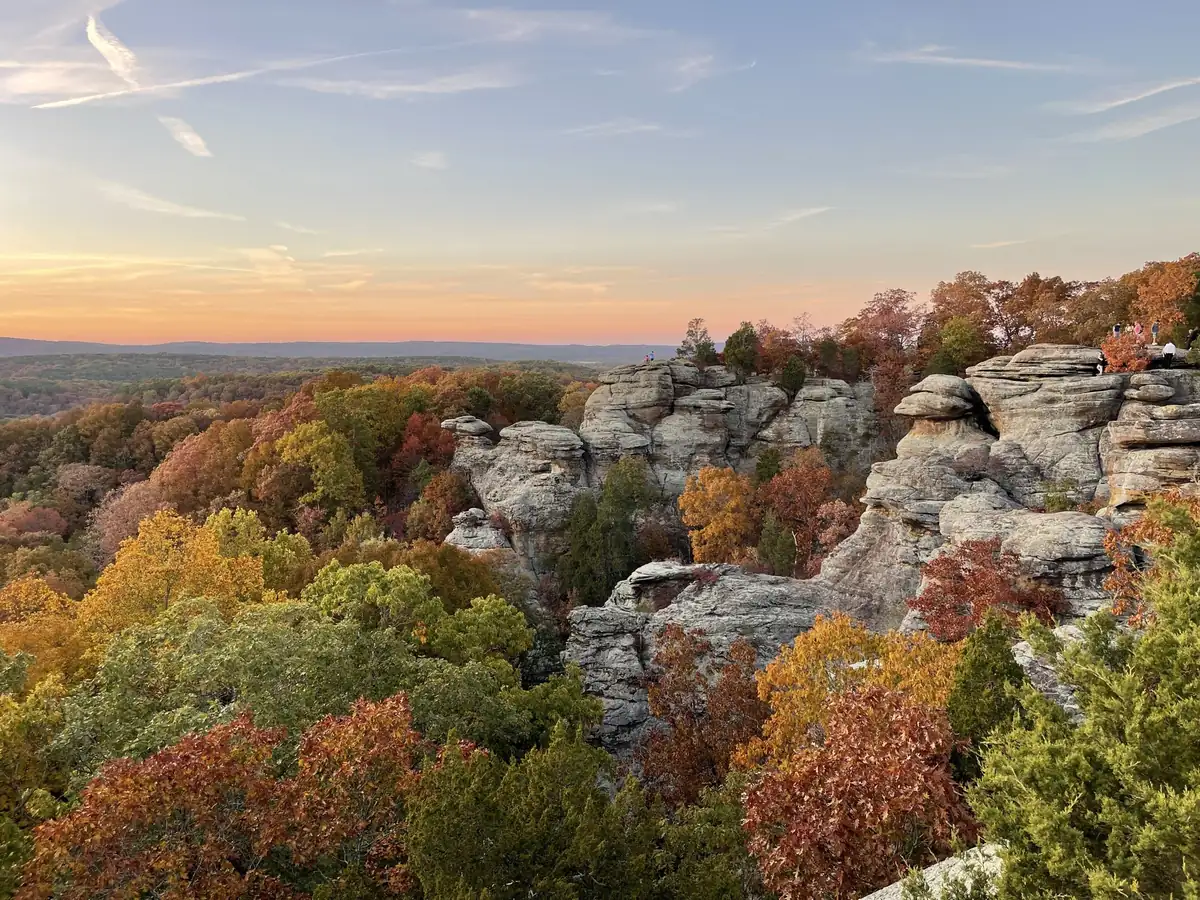
Later than usual, this year. The first Fall Color Report from Enjoy Illinois and the Illinois Department of Natural Resources, posted the week of September 21, found the state still “a vibrant summery green” because the heat had only just broken. Its estimates: northern Illinois, including the Galena area, in the second week of October; central Illinois in late October; the southwest and far south in the final week. The NWS office in Lincoln puts the usual central and southeastern peak between mid-October and early November, with the best color after “warm sunny days and cool, but not freezing, nights.” The wet summer should help: State Climatologist Trent Ford reports that summer 2026 was the eighth wettest on record statewide, and Danville had its wettest ever.
-
Where to go in the north and center
Second and third weeks of October in the north; late October in the center · Galena; Starved Rock and Matthiessen state parks; Allerton Park near Monticello; Lake Decatur
The report sends northern travelers to the Galena hills and to Starved Rock, where the canyons along the Illinois River hold maples and oaks. Starved Rock Lodge, inside the park, lists guided hikes at 10 a.m. and Matthiessen hikes at 9 a.m. on October 3 and 4, and fall color trolley tours with lunch on October 3 and 6; check its calendar for later dates. In the center, the picks are Allerton Park on the Sangamon and the woods around Lake Decatur. In farm country, drive the river bluffs, where the big trees are.
-
The Shawnee and the Cache River
Last week of October; bald cypress into late November · Garden of the Gods, Giant City State Park, Cache River State Natural Area
At Garden of the Gods, near Harrisburg, the quarter-mile Observation Trail winds among sandstone formations named Camel Rock and Devil’s Smokestack above oak and hickory hills. Farther south the Cache River swamps turn last: bald cypress, some over 1,000 years old with buttresses more than 40 feet around, go copper, and the Wildflower Center puts that terra-cotta color at its best “around Thanksgiving.”
Our Field almanac estimates when the leaves come off where you live. Pick one tree on your block and photograph it from the same spot each weekend until it is bare.
When is the Snake Road migration in the Shawnee National Forest?
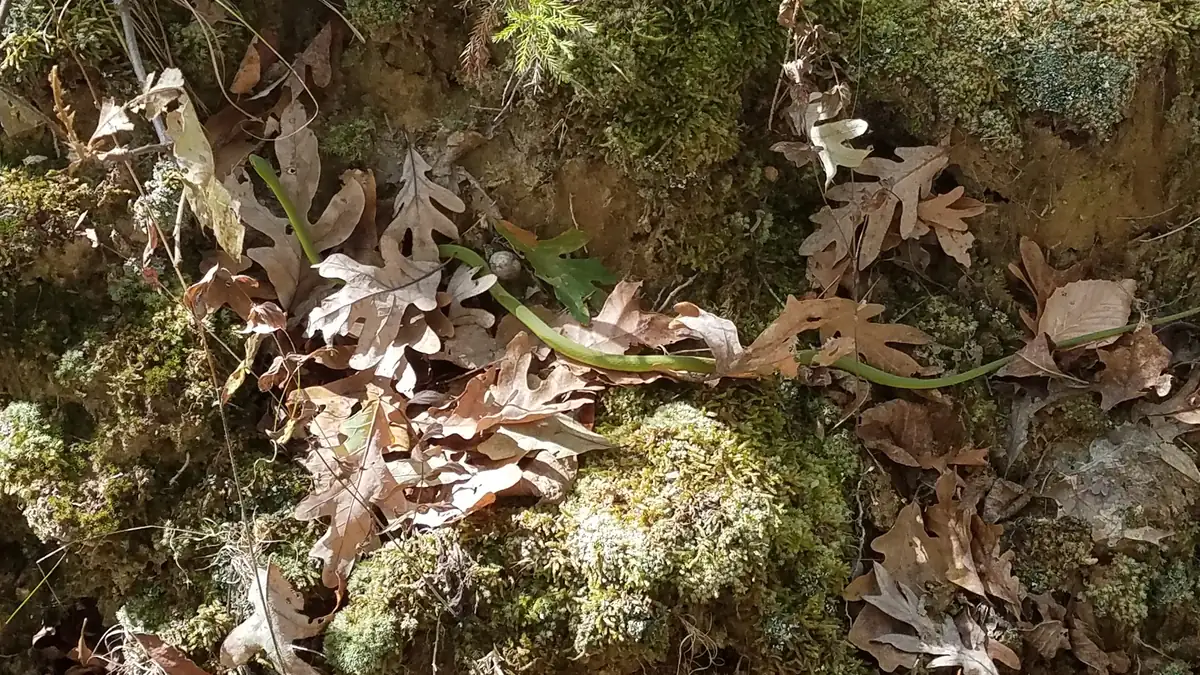
Twice a year, snakes and amphibians at LaRue-Pine Hills, in Union County near Wolf Lake, cross a gravel road at the foot of the Mississippi River bluffs: they feed in LaRue Swamp all summer and winter in cracks in the limestone above it. The road carried traffic year-round until 1972, and many animals died on it. Now the Forest Service closes a 2.5-mile stretch of Forest Road 345 to vehicles from March 15 to May 15 and from September 1 to October 30, and the 2026 fall closure began on schedule.
-
What you might see
Through October 30; warm afternoons are best · Forest Road 345, off Illinois Route 3 near Muddy Levee Road, about 14 miles south of Murphysboro
The Forest Service counts 35 snake species here, about 59 percent of the reptiles known from Illinois, and 23 amphibians, about two-thirds of the state’s. Its list runs from western cottonmouths and copperheads to rat snakes, kingsnakes, hognose snakes, rough green snakes, marbled salamanders and box turtles. Herpetologists say ground temperature sets the migration moving, so a sunny afternoon after a cool night is a good bet; in a cold snap you may see nothing.
-
How to visit
Daylight; allow two to four hours round trip · Small parking area for about 15 cars
The walk is flat, 1 to 2 hours each way. Stay on the gravel, give every snake room and never pick one up; copperheads and cottonmouths live here, and handling or collecting any animal is against federal and state law. LaRue-Pine Hills/Otter Pond became the nation’s 250th Research Natural Area in 1991, holds more than 1,350 species, and is one of only two places in Illinois where shortleaf pine grows wild. The nearest hospital is in Murphysboro.
-
Snake Sentinels
During the closures · Snake Road
The Forest Service trains volunteers, called Snake Sentinels, to count snakes, visitors and cars on the road. If you walk it often, ask the Shawnee’s Mississippi Bluffs Ranger District about the training; the counts help the Forest Service see how the closure is working.
When do the ducks build up on the Illinois River?
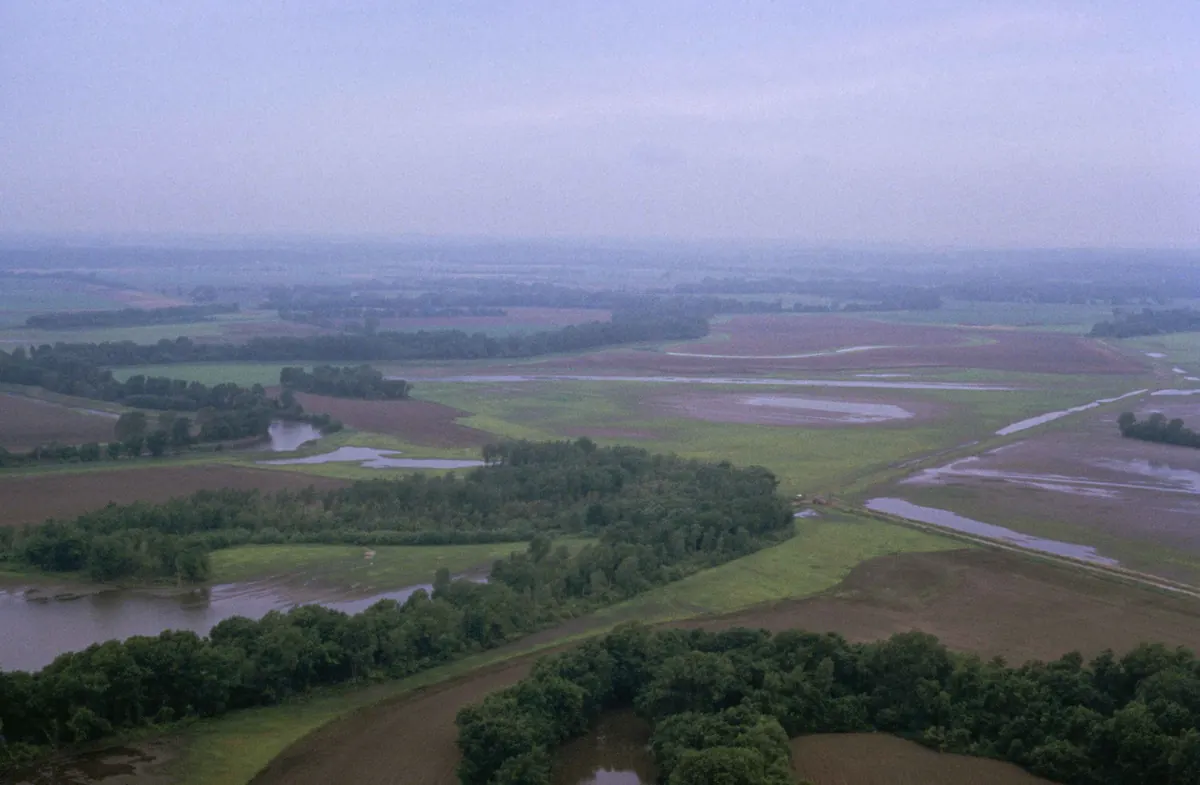
Since 1948 the Illinois Natural History Survey has counted ducks on the Illinois and Mississippi rivers from the air. Its biologists fly 23 sites on the Illinois, from Spring Valley to Grafton, and 18 on the Mississippi from Moline to Alton, about weekly from early September into January, and post the results on the Forbes Biological Station site, so you can see what is on the backwaters before you drive out.
-
The 2026 story so far: a flood, then a slow start
September surveys · Illinois and central Mississippi rivers
The first 2026 flight, on September 3, was “a Tale of Two Rivers”: the Illinois was still recovering from a mid-summer flood that drowned the moist-soil plants ducks eat, while the Mississippi looked better. By September 17 pintails, green-winged teal and shovelers were arriving, but blue-winged teal ran 9 percent below the 10-year average on the Illinois and 53 percent below on the Mississippi, and the mudflats left by falling water were sprouting late. “Time isn’t on our side,” the survey noted. A thin food crop can mean birds pass through rather than linger.
-
What late October usually looks like
Building through October; peak usually in November · Emiquon, Chautauqua, Rice Lake, Senachwine Lake
For comparison, the late-October flight in 2025 found 146,925 ducks in the Illinois River valley, 29 percent under the long-term average, most of them on freshly flooded moist-soil units. Green-winged teal were a little above average, almost half of that surplus on Chautauqua National Wildlife Refuge near Havana, while mallards were well under. The valley’s biggest numbers usually come later.
-
Emiquon and Chautauqua
Ducks from October to late November; refuge sanctuary closure from October 16 · Near Havana and Lewistown, about an hour southwest of Peoria
The Fish and Wildlife Service says its Emiquon refuge averages a one-day peak of about 71,450 ducks of 28 waterfowl species, usually in November. Parts of the refuge close as a waterfowl sanctuary from October 16 to January 31, but The Nature Conservancy’s Emiquon Preserve next door keeps its boardwalk and spotting scopes open sunrise to sunset. White pelicans, logged on the survey’s first flight, still use these lakes early in the fall. Chautauqua, a sanctuary since 1936, is a Ramsar Wetland of International Importance.
Bring a spotting scope if you have one, and note the water level and wind in the daily field log beside the birds.
What is moving along the Chicago lakefront in October?
Lake Michigan works like a wall for birds heading south. Songbirds caught over water at dawn turn back to shore, and hawks follow the coast rather than cross it, so the strip from Zion to the Indiana line gathers migrants. Chicago Bird Alliance says about 5 million birds of more than 250 species pass through the city. October is when sparrows, kinglets and hawks take over from September’s warblers.
-
The Illinois Beach hawk watch
August 25 to November 25; sharp-shins at mid-October, merlins later · Illinois Beach State Park, Zion, from the pavilion east of Sand Pond
Volunteers have counted raptors here since 2000, for at least four hours a day when weather allows, and visitors are welcome. Seasons average about 1,400 red-tailed hawks, 1,140 sharp-shinned hawks, 1,110 broad-wings (mostly in September) and some 400 merlins, plus ospreys, harriers, Cooper’s hawks, kestrels, peregrines and the odd golden eagle. Sharp-shins crest around mid-October and merlins late in the month.
-
Sparrows and kinglets
All month · Montrose Point Bird Sanctuary, Jackson Park’s Wooded Island, North Pond, Big Marsh
White-throated sparrows are the signature bird of a Chicago October, under every shrub in every park, with kinglets, hermit thrushes, juncos and the last warblers on the same edges. Montrose Point is the famous spot; Wooded Island in Jackson Park, North Pond in Lincoln Park and Big Marsh on the Southeast Side all hold migrants on a good morning.
-
Lights Out Chicago
August 15 to November 15 · Downtown and lakefront buildings; any home with lit windows
Night migrants steer by the stars and get trapped circling bright buildings until they hit glass or drop. Lights Out Chicago, running since 2000 and the first coordinated program of its kind, asks tall buildings to shut decorative lights after 11 p.m. and everyone to draw blinds or switch off lights overnight. Chicago Bird Collision Monitors, whose volunteers pick up stunned birds downtown at dawn, find white-throated sparrows more than any other species; in one October night in 2023, nearly 1,000 birds died against McCormick Place. Put a stunned bird in a closed paper bag or box and take it to a rehabilitator such as Willowbrook Wildlife Center.
-
Sandhill cranes over the city
First flocks in the second half of October; the big days come in November · Overhead across northeastern Illinois, headed southeast
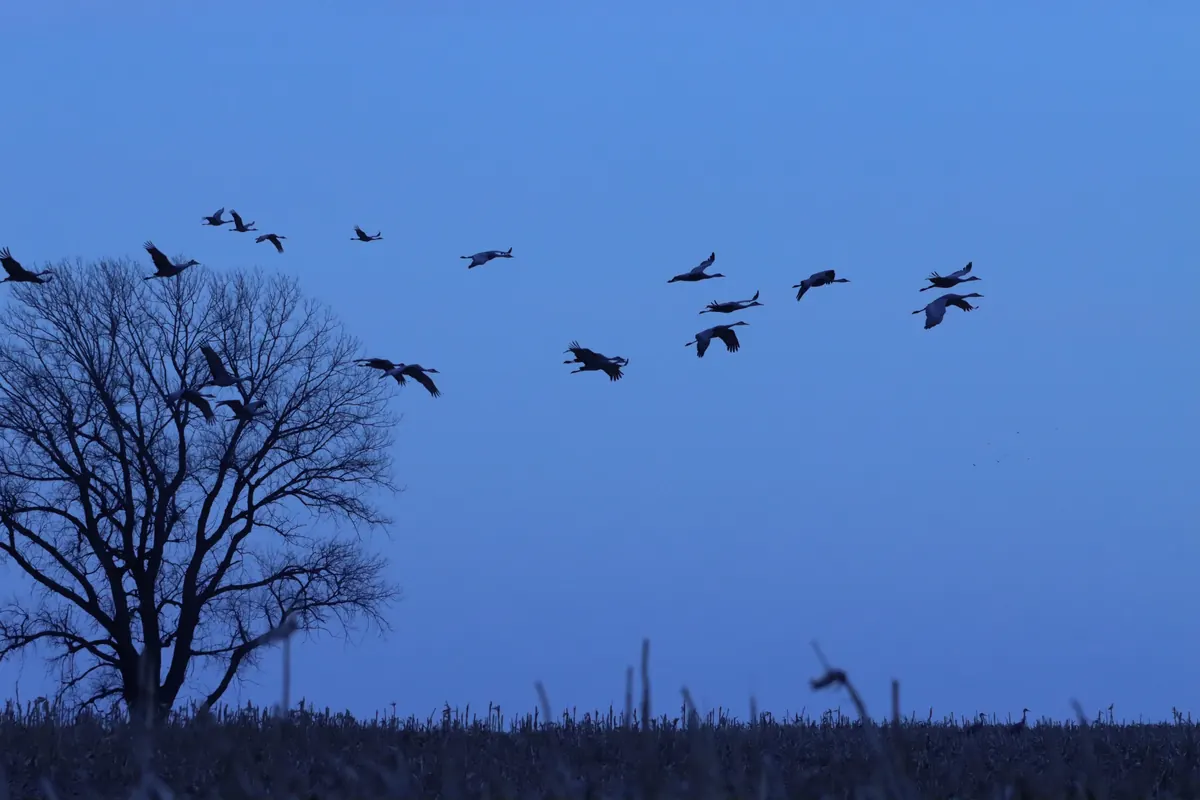
Thousands of eastern sandhill cranes stop at Jasper-Pulaski Fish and Wildlife Area in northwest Indiana from mid-October through mid-December, peaking in late November or early December; Indiana DNR counted 16,400 there on December 2 last year. Many cross the Chicago area on the way, in long wavering lines, with a rolling, trumpeting call you hear before you see them. October flocks are small, so write down the date of the first one.
-
Salmon in the harbors
In the harbors from mid-September; snagging season October 1 to December 31 · Jackson, Diversey and Waukegan harbors; Lincoln Park Lagoon; the Winnetka power plant discharge
Each May the Jake Wolf Memorial Fish Hatchery stocks chinook and coho salmon in Jackson, Diversey and Waukegan harbors. They return there as adults, and from mid-September the harbors fill with fish looking for a river that is not there. Snagging is legal from October 1 through December 31 at four named places, including Lincoln Park Lagoon south of Fullerton Avenue and Waukegan’s North Harbor basin, five fish a day. The lake is cooling fast: NOAA Great Lakes lab satellite averages for 1995–2025 put Lake Michigan near 62 °F on October 1 and 52 °F on Halloween.
When is the first frost and freeze in Illinois?
The first freeze moves from the northwest hills to the southern tip, and from the fields in to the lakefront. Mount Carroll and Polo, in the hills of the northwest, have a median first freeze of October 7. At Midway Airport, warmed by the city and a lake still in the 50s, the median is October 31, the same date as Cairo at the far southern tip. Latitude is not the whole story: the Carbondale airport station, more than 300 miles south of Rockford, has a median only five days later than Rockford’s. A white frost on lawns and car roofs, possible on a clear, calm night near 36 °F, tends to show up a week or two ahead of the first real freeze.
| Station | One year in ten | Median | Nine years in ten |
|---|---|---|---|
| Rockford Gtr Rockford Airport (Rockford) | Oct 2 | Oct 17 | Oct 30 |
| Moline Quad City International Airport (Quad Cities) | Oct 4 | Oct 18 | Oct 28 |
| Chicago Ohare International Airport (Chicago) | Oct 15 | Oct 28 | Nov 11 |
| Chicago Midway Airport (Chicago) | Oct 20 | Oct 31 | Nov 14 |
| Peoria Gtr Peoria Airport (Peoria) | Oct 9 | Oct 23 | Nov 3 |
| Champaign Willard Airport (Champaign-Urbana) | Oct 3 | Oct 17 | Oct 31 |
| Springfield Capital Airport (Springfield) | Oct 5 | Oct 20 | Nov 1 |
| Carbondale Southern Il Airport (Carbondale) | Oct 8 | Oct 22 | Nov 1 |
| Cairo 3 N (Cairo) | Oct 18 | Oct 31 | Nov 13 |
Every station in the state, including the farm towns between these cities, is on our Illinois first and last frost page. When a clear, still night is forecast, bring in the tender pots, pick the green tomatoes and cover the lettuce with a sheet; the morning after, note the date the birdbath first skins over.
How much daylight does Illinois lose in October?
Between 68 and 81 minutes, depending on how far north you live. Rockford loses 81 minutes over the month and Cairo 68. In Chicago the sun rises at 6:48 a.m. on October 1 and at 7:22 on October 31, and it sets at 6:32 p.m. and then 5:46 p.m., both on daylight time. Central standard time resumes in the early hours of Sunday, November 1 (2 a.m.), which pulls Chicago’s sunset back to about 4:45.
| City | Oct 1 | Oct 31 | Lost | Per day |
|---|---|---|---|---|
| Rockford | 11 h 44 m | 10 h 23 m | 81 min | 2.7 min |
| Chicago | 11 h 44 m | 10 h 24 m | 80 min | 2.7 min |
| Moline | 11 h 45 m | 10 h 25 m | 80 min | 2.7 min |
| Peoria | 11 h 45 m | 10 h 28 m | 77 min | 2.6 min |
| Champaign | 11 h 46 m | 10 h 30 m | 76 min | 2.5 min |
| Springfield | 11 h 46 m | 10 h 32 m | 74 min | 2.5 min |
| Carbondale | 11 h 47 m | 10 h 38 m | 69 min | 2.3 min |
| Cairo | 11 h 48 m | 10 h 40 m | 68 min | 2.3 min |
For your own street, including twilight times and this week’s loss, type your town into the Field almanac.
What is October weather like in Illinois, and what could El Niño mean for the winter?
October is when Illinois cools off in earnest. NOAA’s 1991–2020 normals give average highs of 62 °F at Rockford, 63 °F at O’Hare, 65 °F at Peoria, 67 °F at Springfield and 70 °F at Carbondale, and lows from about 42 °F at Rockford to 48 °F at Cairo. Rain runs from 2.63 inches at Rockford to 3.43 at O’Hare and 4.14 at Cairo, usually in a few soaking fronts with bright days between. October snow is a tenth or two of an inch in the normals; November averages 2.3 inches at Rockford, 1.8 at O’Hare and 1.2 at Springfield.
This year the bigger question is winter. The Climate Prediction Center’s September 10 update rated a very strong El Niño this winter as better than nine chances in ten. State Climatologist Trent Ford has checked the record: of the past fifteen moderate or strong El Niño winters, ten were warmer than normal in Illinois, nine were drier, and most brought less snow. In September he put this winter’s likely warming at 1 to 3 degrees for Illinois, which over a whole season paints “a pretty strong picture of a response for milder winters.” He adds that El Niño does not rule out snow or severe storms, and a few El Niño winters have brought Illinois well above its usual snowfall. October itself feels little of this; the pattern does most of its work from November to January. NOAA’s winter outlook comes out in mid-October, and our weather page carries the week ahead for any Illinois town.
What is in the Illinois night sky this October?
-
The moon covers Jupiter
Tuesday, October 6, about 3:20 to 4:20 a.m. CDT · Low in the east; the moon 7 to 20 degrees up
The waning crescent rises at about 2:18 a.m. in Chicago and 2:31 in Springfield with Jupiter about one moon-width off its bright edge. According to IOTA, the occultation timers’ association, the planet disappears at the moon’s sunlit edge at 3:22 a.m. in Chicago (3:21 at Kankakee, 3:18 at Belleville, near St. Louis) and returns from the dark edge at 4:17 in Chicago and 4:16 at Belleville, with the sun well down both times. The moon is only about 10 degrees up in Chicago at the start and lower downstate, so find an open eastern horizon: a lakefront beach, a hilltop, a harvested field.
-
The Hunter’s Moon
Evenings of Sunday, October 25 and Monday, October 26 · Rising in the east around sunset
The moon is exactly full at 11:12 p.m. CDT on the 25th. In Chicago it rises at 5:19 p.m. that evening, 35 minutes before the 5:54 sunset, and at 5:51 p.m. the next evening, about as the sun goes down; in Springfield the times are 5:32 and 6:05 p.m. It is not a supermoon this year.
-
Orionids
Active October 2 to November 7; best on the mornings of October 21 and 22 · Anywhere dark, facing south and east
Fast meteors from the dust of Halley’s Comet, often leaving trails. The peak is broad; the obstacle is a bright gibbous moon. It sets at 2:02 a.m. in Chicago on the morning of the 21st, and at 3:09 a.m. (3:19 in Springfield and Carbondale) on the 22nd. From then until dawn grays the sky, around 6, is the window; ten to twenty an hour from a dark site is a fair year.
-
Draconids
Evening of Thursday, October 8 · Look high in the north after dusk
An early-evening shower, so it suits a school night, and the moon stays out of the way until the small hours before dawn. Rates are usually low and hard to predict; give it half an hour and count anything you see as a bonus.
-
Planets: Saturn all night, Jupiter and Mars at dawn
Saturn at opposition Sunday, October 4; Mars at the Beehive October 11 · Saturn east at dusk; Jupiter and Mars east before sunrise
Opposition on the 4th puts Saturn up from dusk to dawn, a steady yellowish light in an empty stretch of sky; the moon pairs with it on October 23–24. Venus can be caught very low in the west after sunset only at the start of the month, before it drops into the glare and reaches inferior conjunction on October 23. At dawn Jupiter outshines everything in the east, and on October 11 Mars passes the Beehive cluster, a fine pairing in binoculars.
| Phase | Date | Time |
|---|---|---|
| Last quarter | Saturday, Oct 3 | 8:25 a.m. CDT |
| New moon | Saturday, Oct 10 | 10:50 a.m. CDT |
| First quarter | Sunday, Oct 18 | 11:12 a.m. CDT |
| Full moon, the Hunter’s Moon | Sunday, Oct 25 | 11:12 p.m. CDT (looks full the evenings of Oct 25 and 26) |
| Last quarter | Sunday, Nov 1 | 2:28 p.m. CST |
Before you set an alarm, look at tonight’s cloud forecast on Today’s sky. Your town’s moonrise and moonset times are on our moon phase calendar.
What is ripening on the prairies and in the southern woods?
-
Big bluestem and the bison prairies
Seed ripe in October and November · Nachusa Grasslands near Franklin Grove; Midewin National Tallgrass Prairie near Wilmington
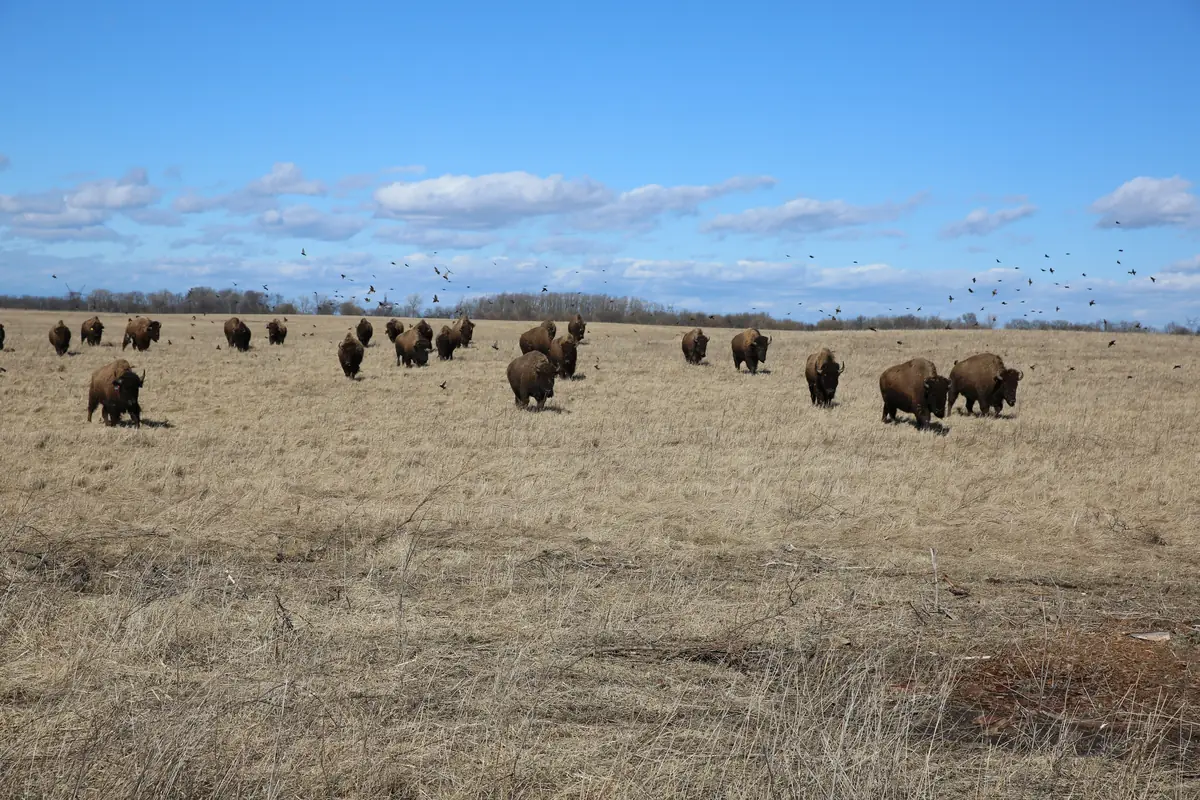
Big bluestem, four to eight feet tall, turns a maroon-tan in fall and ripens its three-pronged “turkey foot” seed heads in October and November, when restoration volunteers go out to strip seed by hand. Two Illinois prairies carry bison again. The Nature Conservancy brought 30 to Nachusa Grasslands in October 2014; the herd now numbers about 120–130 in summer on 1,500 acres. The Forest Service brought bison to Midewin, on the old Joliet arsenal, in 2015, and its Iron Bridge Trailhead information station, with loaner binoculars, is staffed weekends 10:30 a.m. to 4 p.m. through October. Neither place can promise a sighting.
-
Persimmons and pawpaws
Persimmons late September into November; pawpaws early fall · Woods edges and old fields, mostly central and southern Illinois; pawpaws in river bottoms
Wild persimmons turn orange from late September into November, but an unripe one is full of tannin and puckers the whole mouth; the Wildflower Center says they are not edible until they have had frost or steady cold, so wait until they are soft, wrinkled and on the ground. Pawpaws ripen in fall and often drop before they are fully ripe, finishing on the kitchen counter; they are ready when the skin browns. Eat only fruit you can identify.
-
Hedge apples
Dropping from late fall into winter · Old fence rows across the prairie counties
The green, brain-wrinkled balls, four to six inches across, come from Osage orange, a southern tree settlers planted as living fence before barbed wire; its thorny rows still mark old field lines across central Illinois. The Morton Arboretum notes the fruit drops from female trees in late fall and on through winter.
New England aster, which blooms into October, is the last big nectar plant for late monarchs and bumblebee queens. Monarch Watch puts the peak monarch flight at Chicago’s latitude in mid-September and at Cairo’s between September 19 and October 1, so southern Illinois still sees stragglers early in the month; report any to Journey North.
What are Illinois deer, bats and other animals doing in October?
-
Deer: the rut begins
From October; peak mid-November · Statewide, and on every rural road at dusk
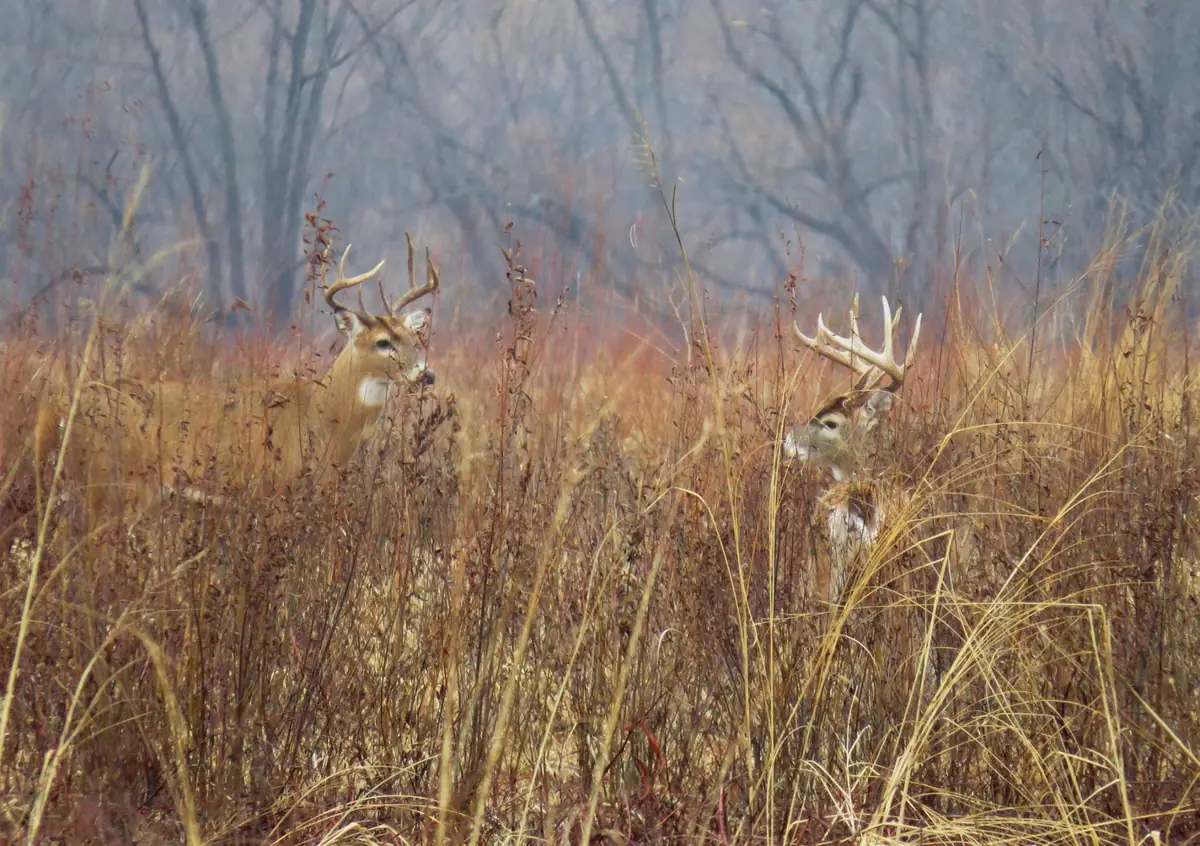
IDNR says white-tailed deer breed from October through January, peaking in mid-November. This month bucks rub saplings bare and paw out scrapes, patches of bare ground marked with urine, along woods edges. The dusk and dawn watch plate is made for a deer logged with the time and the light.
-
Bats looking for a winter home
Fall · Attics, garages and chimneys
IDNR’s Wildlife Illinois notes that in fall bats may move into houses and other buildings to hibernate. If one gets into the living space, close off the room, open a window and let it leave on its own; never handle a bat bare-handed, and call the local health department if anyone may have been bitten. Bat Week, October 24–31, is a good time to learn which Illinois bats hibernate in caves and which fly south.
-
The last crickets
Until the first hard freeze · Any warm evening outdoors
Snowy tree crickets slow as the evenings cool. The number of chirps in 14 seconds, plus 40, gives a fair guess at the temperature in °F; the cricket thermometer plate holds those counts, and the first silent night deserves a line too.
What can Illinois families do outdoors in October?
- October 3–4: last bison tours of the year at Nachusa Grasslands. Saturday 1:30–3:30 p.m., Sunday 10 a.m.–noon, 20 places each; sign-ups open at 7 a.m. the Sunday before, so they may be full. Starved Rock Lodge has guided hikes both mornings.
- Sunday, October 4: a migration photography and bird walk at Montrose Point, 9–11 a.m., with Chicago Bird Alliance, whose free walks on Wooded Island in Jackson Park run 8–10 a.m. every October Saturday. The Chicago Ornithological Society walks North Pond at 7 a.m. each Wednesday.
- October 8–11: the dark weekend. Draconids on Thursday evening, new moon Saturday, and on the 10th and 11th The Big Sit, a count of every species seen or heard from a 17-foot circle; eBird’s Big Day falls on Saturday the 10th too.
- Any sunny afternoon through October 30: walk the Snake Road at LaRue-Pine Hills, on the gravel.
- Saturday, October 17: a flyway tour of Big Marsh with the Chicago Ornithological Society, noon to 4 p.m., registration required; the next morning its volunteers hold a Montrose Point stewardship workday, 9 a.m. to noon.
- Sunday, October 25: a fall bird walk at Montrose Point, 10 a.m. to noon, with the Hunter’s Moon rising just before sunset that evening.
- Help the scientists. Send late monarch sightings to Journey North, turn off porch and upper-floor lights for Lights Out Chicago, volunteer at dawn with Chicago Bird Collision Monitors, and join Project FeederWatch, which starts counting November 1.
More states are on the nature hub, and the Naturalist’s Field Journal has a plate for each of these outings.
Safety notes for October in Illinois
- Hunting seasons. Archery deer and fall archery turkey open October 1; in Cook, DuPage and Lake counties and Kane east of Route 47, archery deer runs unbroken to January 17. Youth firearm deer is October 10–12 in every county except Cook, DuPage, Lake and eastern Kane. Woodcock opens October 17, fall shotgun turkey runs October 24 to November 1, and youth waterfowl days are October 17–18 in the North Zone, October 24–25 in the Central Zone and November 7 in the South. Duck season opens October 24 (North), October 31 (Central) and November 14 (South). Pheasant, quail and rabbit open November 7; firearm deer is November 20–22 and December 3–6.
- Blaze orange or pink. In every firearm deer season, including the October 10–12 youth hunt, deer hunters must wear a solid blaze orange or blaze pink cap plus an upper outer garment with at least 400 square inches of the color, and so must the adult supervising a youth. Upland game hunters on IDNR sites need the same; on private land, at least the cap. IDNR lists no clothing rule for archery deer hunters; check the 2026–27 digest for what applies during gun seasons. Hikers on state fish and wildlife areas and in the Shawnee should wear something bright that weekend, and put a vest on the dog.
- Deer on the road. Most deer–vehicle crashes happen in October, November and December, mostly from 5 to 10 p.m. and 5 to 8 a.m. Slow down where woods meet fields, expect a second deer, and brake rather than swerve.
- Venomous snakes in the south. Copperheads and western cottonmouths live around LaRue-Pine Hills and other southern swamps and bluffs, and October sun brings them onto rocks and roads. Watch your hands and feet.
- Cold water. Lake Michigan is in the low 50s by late October; a fall off a harbor wall or a kayak is dangerous even on a warm afternoon, and fall storms send waves over the breakwalls. Wear a life jacket on the water.
- Ticks. Adult blacklegged ticks, the ones that spread Lyme disease, keep hunting through fall on any day above freezing. Use repellent, tuck in pant legs and check everyone, dog included, after a walk.
Sources
- Enjoy Illinois and IDNR: Illinois Fall Color Report and trip planner, week of September 21, 2026
- NWS Lincoln (Central Illinois): fall colors report and the science of leaf color
- Illinois State Climatologist (Trent Ford): a wild weather August capped off an equally wild summer, September 2, 2026
- Starved Rock Lodge: October 2026 guided hikes and trolley tours
- USDA Forest Service, Shawnee National Forest: Garden of the Gods Recreation Area
- IDNR: Cache River State Natural Area
- Lady Bird Johnson Wildflower Center: bald cypress (Taxodium distichum)
- USDA Forest Service, Shawnee National Forest: Forest Service to close Snake Road for fall migration
- WFIW Radio: Snake Road closed for annual fall migration, September 2, 2026
- USDA Forest Service: Snake Migration, LaRue-Pine Hills (brochure, species list and history)
- Union County Chamber of Commerce: Snake Road (access, parking, species)
- Illinois Natural History Survey, Forbes Biological Station: waterfowl aerial inventories
- INHS Forbes Biological Station: Week 1 aerial survey, September 3, 2026
- INHS Forbes Biological Station: Week 3 aerial survey, September 17, 2026
- INHS Forbes Biological Station: Week 5 aerial survey, October 23, 2025
- U.S. Fish and Wildlife Service: Emiquon National Wildlife Refuge, species
- U.S. Fish and Wildlife Service: Emiquon National Wildlife Refuge, visit us (sanctuary closure)
- The Nature Conservancy: Emiquon Preserve
- U.S. Fish and Wildlife Service: Chautauqua National Wildlife Refuge
- HMANA HawkCount: Illinois Beach State Park Hawk Watch, site profile and seasonal averages
- Chicago Bird Alliance: Lights Out Chicago
- Chicago Bird Collision Monitors: frequently asked questions
- NPR: nearly 1,000 migrating birds died after crashing into a Chicago building, October 2023
- Indiana DNR: sandhill crane fall migration at Jasper-Pulaski Fish and Wildlife Area
- Monarch Watch: peak migration dates by latitude
- Journey North: monarch sightings and fall roost reports
- WTTW: sandhill crane migration thrills Chicagoans as noisy flocks pass overhead
- Outdoor Illinois Journal (IDNR): snagging salmon, a fall tradition
- NOAA GLERL CoastWatch: daily Lake Michigan average surface water temperature, 1995–2026 (°F)
- NOAA NCEI: U.S. Climate Normals 1991–2020, monthly temperature, precipitation and snowfall for Illinois stations (data API; freeze dates from the same normals)
- U.S. Naval Observatory: sunrise, sunset, moonrise and moonset (data API; Chicago, October 6, 2026)
- U.S. Naval Observatory: moon phases 2026 (data API)
- Climate Prediction Center: ENSO diagnostic discussion, September 10, 2026
- FarmWeek (Trent Ford, Illinois State Water Survey): making sense of El Niño, recent trends and winter outlooks
- KCUR: a ‘super El Niño’ is on the way; what it means for fall and winter in the central U.S. (Trent Ford), September 11, 2026
- International Occultation Timing Association: occultation of Jupiter, October 6, 2026 (predictions by city)
- EarthSky: meteor shower guide, October 2026
- Lady Bird Johnson Wildflower Center: big bluestem (Andropogon gerardii)
- Nachusa Grasslands: wild bison in Illinois
- Nachusa Grasslands: public bison tours, 2026 (last tours October 3–4)
- USDA Forest Service, Midewin National Tallgrass Prairie: look for bison
- Lady Bird Johnson Wildflower Center: common persimmon (Diospyros virginiana)
- Lady Bird Johnson Wildflower Center: pawpaw (Asimina triloba)
- The Morton Arboretum: Osage orange
- Lady Bird Johnson Wildflower Center: New England aster (Symphyotrichum novae-angliae)
- Wildlife Illinois (IDNR): white-tailed deer
- Wildlife Illinois (IDNR): deer–vehicle accidents
- Wildlife Illinois (IDNR): seasonal behaviors
- National Park Service: Bat Week, October 24–31
- Chicago Bird Alliance: upcoming events, October 2026
- Chicago Ornithological Society: field trips and events, October 2026
- The Big Sit! 2026, October 10–11
- eBird: October Big Day, October 10, 2026
- Project FeederWatch: how to participate
- IDNR: 2026–27 Illinois hunting and trapping season dates card (deer, turkey, waterfowl, upland)
- Hunt Illinois (IDNR): deer seasons and blaze orange or pink requirement
- IDNR: 2026 Illinois youth deer hunting information (October 10–12)
- Hunt Illinois (IDNR): upland and small game, including blaze orange or pink on IDNR sites
- CDC: preventing tick bites
- National Weather Service: cold water safety
- Photos via Wikimedia Commons; licenses and photographers are credited under each picture
