What to look for in nature in Illinois this February
In Illinois, February closes out meteorological winter, and it is the month when the season visibly starts to turn. Wintering bald eagles still fish below the dams, while the state's own nesting pairs settle onto eggs in big riverside cottonwoods. Sandhill cranes begin bugling over the northern counties, huge flocks of snow geese pour up the Illinois River valley, and red-winged blackbirds stake out cattail marshes before the ice is off. In the woods, sugar maples start to drip sap on mild afternoons, and skunk cabbage pushes up through frozen mud. The nights belong to Jupiter and Mars, both at their best of the year, and to a Snow Moon that rises on February 20 with the faintest of eclipses on its face. What follows covers every corner of the state, from Galena and Waukegan down to Cairo.
Other months in Illinois: October, November, December, January.
Start here
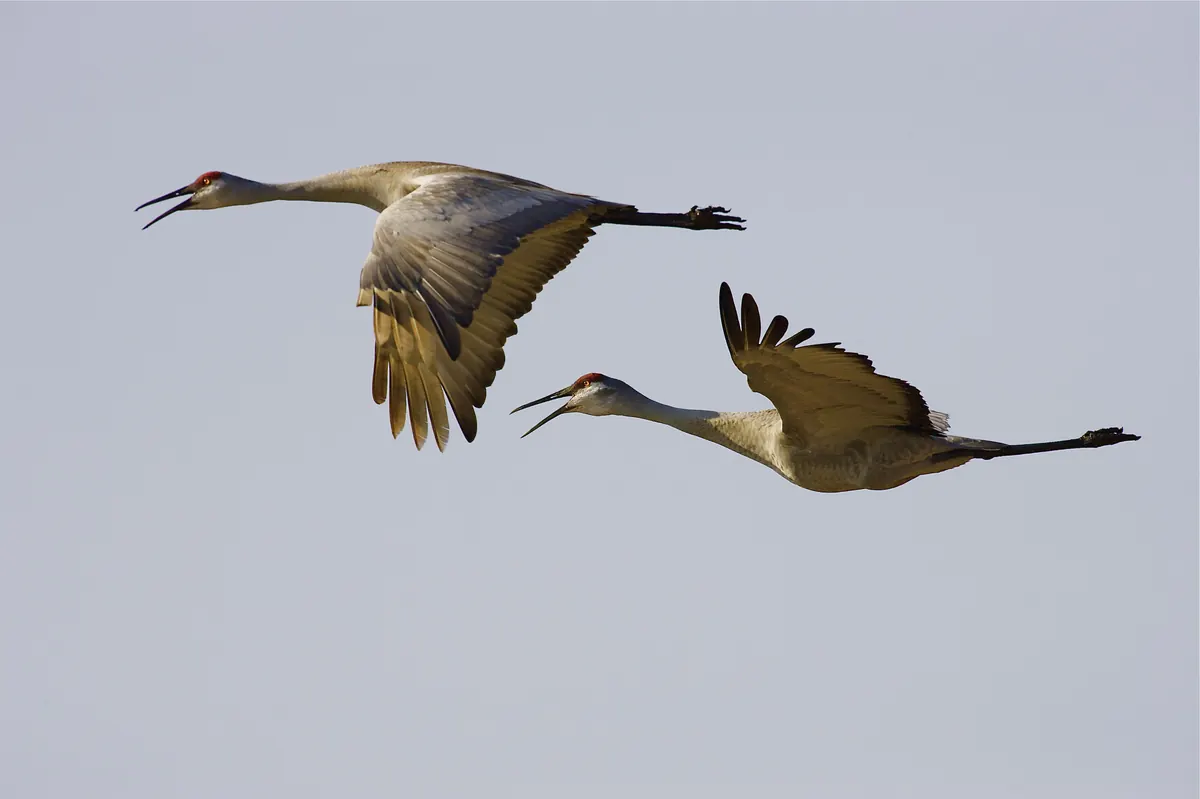
- Listen for cranes overhead. From mid-February on, step outside on a mild afternoon with a south wind and listen for a rolling, bugled call from very high up. Sandhill cranes are usually heard well before anyone spots them; look for long lines and loose V's with legs trailing behind.
- Count birds for the Great Backyard Bird Count. The 2027 count runs Friday, February 12, through Presidents' Day, Monday, February 15. A single quarter hour at a feeder, a forest preserve or a frozen harbor counts, and you can join on as many days as you like.
- Find Jupiter and Mars at their best. Jupiter reaches opposition, directly across the sky from the sun, in the early evening of Wednesday, February 10 (6:21 p.m. CST), and Mars gets there nine days later, on Friday, February 19. Both lift above the eastern horizon around dusk and stay visible until dawn among the stars of Leo; Jupiter is the brilliant cream-colored one, Mars the steady orange one.
For the Naturalist's Field Journal: write the date of your first red-winged blackbird and your first crane flock on birds I have seen, sketch an eagle nest from a respectful distance on nest observed, and visit one skunk cabbage patch or maple grove at the start and end of the month for the same place twice. On a mild evening in the south, add chorus frogs, cranes and blackbirds to a map of sounds, and log the sunset clock time on February 1 and February 28 on the dusk and dawn watch.
Regions used below: Chicago and the Lake Michigan shore; Northern Illinois and the Rock River; Central Illinois and the Illinois River valley; Western Illinois and the Mississippi; Southern Illinois and the Shawnee Hills.
When do bald eagles lay eggs in Illinois?
Wintering eagles still fish below the dams through February, which the state's eagle website pairs with January as prime viewing time, but this month the story shifts to the birds that nest here. When an IDNR natural resources coordinator spoke to Illinois Public Media on February 19, 2026, nesting pairs were already incubating; the station's report noted that the eggs usually hatch in March and April. The IDNR species account gives a clutch of two or three white eggs and puts laying in March or April, so the timing varies from pair to pair and year to year: some birds are on eggs by the third week of February, others not until early spring. In the late 1970s Illinois had a single known eagle nest; today nests are found in most counties.
-
How to spot a nest
Best in February and March, before the trees leaf out · Big rivers, reservoirs and backwaters statewide; usually a tall cottonwood or sycamore near water
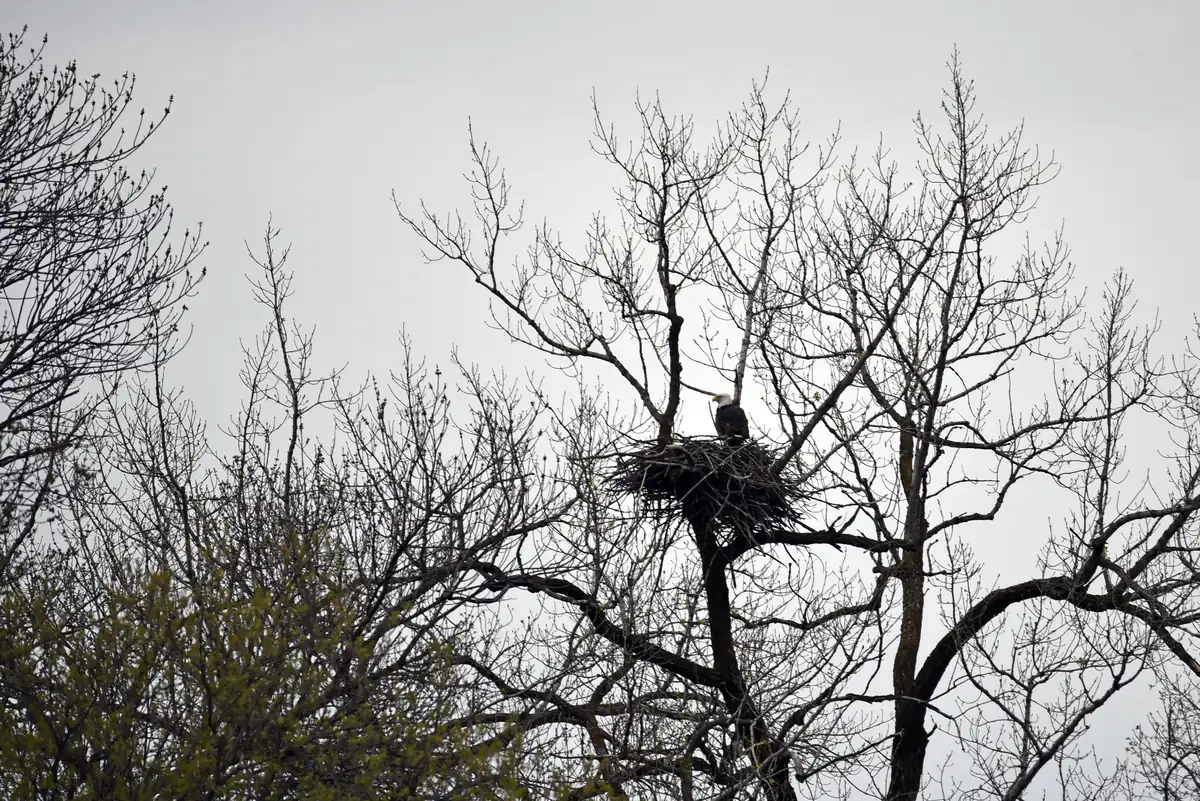
IDNR notes that Illinois eagles build in eastern cottonwoods or sycamores. Look for a huge bowl of sticks near the top of the tallest tree in the stand. An incubating bird may show only a white head above the rim, with its mate perched nearby on guard.
-
Moraine Hills and the McHenry Dam
Through the nesting season · Moraine Hills State Park, on the Fox River near McHenry
The McHenry Dam sits on the park's western border, and a nesting pair has made this park home. The same open-water rule that pulls eagles to the Mississippi locks works here: when the Fox River freezes, the fish are easiest to catch just downstream of the dam.
-
Chautauqua refuge reopens February 1
Refuge land and water open from February 1 to October 15, sunrise to sunset · Chautauqua National Wildlife Refuge, near Havana on the Illinois River
The U.S. Fish and Wildlife Service opens the refuge's land and water to approved public uses from February 1 through October 15, so the start of the month is when the trails and pools fully reopen. Winter is the refuge's eagle season: the Service says visitors may see hundreds of eagles from its viewing platforms. The Eagle Bluff Observation Deck, at the end of a short accessible trail, has a viewing scope trained on the South Pool.
An eagle flushed off its eggs in February leaves them to chill in the cold. Watch nests only from roads, parking areas and established trails, let optics do the work, and back away the moment a sitting bird turns to watch you or starts calling.
When do sandhill cranes come back to Illinois?
Wildlife Illinois says about 20,000 sandhill cranes migrate through the state each spring, between mid-February and mid-April. Most keep going to breeding marshes farther north, but small numbers nest in northern Illinois, especially in McHenry and Lake counties, and the breeding range is spreading: in 2022 a crane chick hatched at Midewin National Tallgrass Prairie in Will County. That is a remarkable turnaround for a bird that, by the 1940s, was nearly gone from the Midwest.
-
The first returns in the north
From about mid-February · Nygren Wetland Preserve, Rockton, and other Rock River and Fox River wetlands
The Natural Land Institute recorded its first returning crane of 2024 at Nygren Wetland Preserve on February 11, early but, as the staff put it, not unheard of; scores and then hundreds followed by the end of the month. The 721-acre preserve is open daily from sunrise to sunset, and the wildlife overlook gives a wide view of the marsh.
-
Flocks over Chicago and Will County
Late February into March · Overhead almost anywhere in the Chicago region
The Forest Preserve District of Will County says late February into March is when cranes start being seen and heard around the region with some regularity. Their call carries for about two and a half miles, so you will usually hear a flock long before you can pick it out against the clouds. On a good tail wind, migrating cranes can cover up to 500 miles in a day.
Write down the date and hour of the first crane flock you hear each year, and the wind direction.
Where can you see snow geese in Illinois in February?
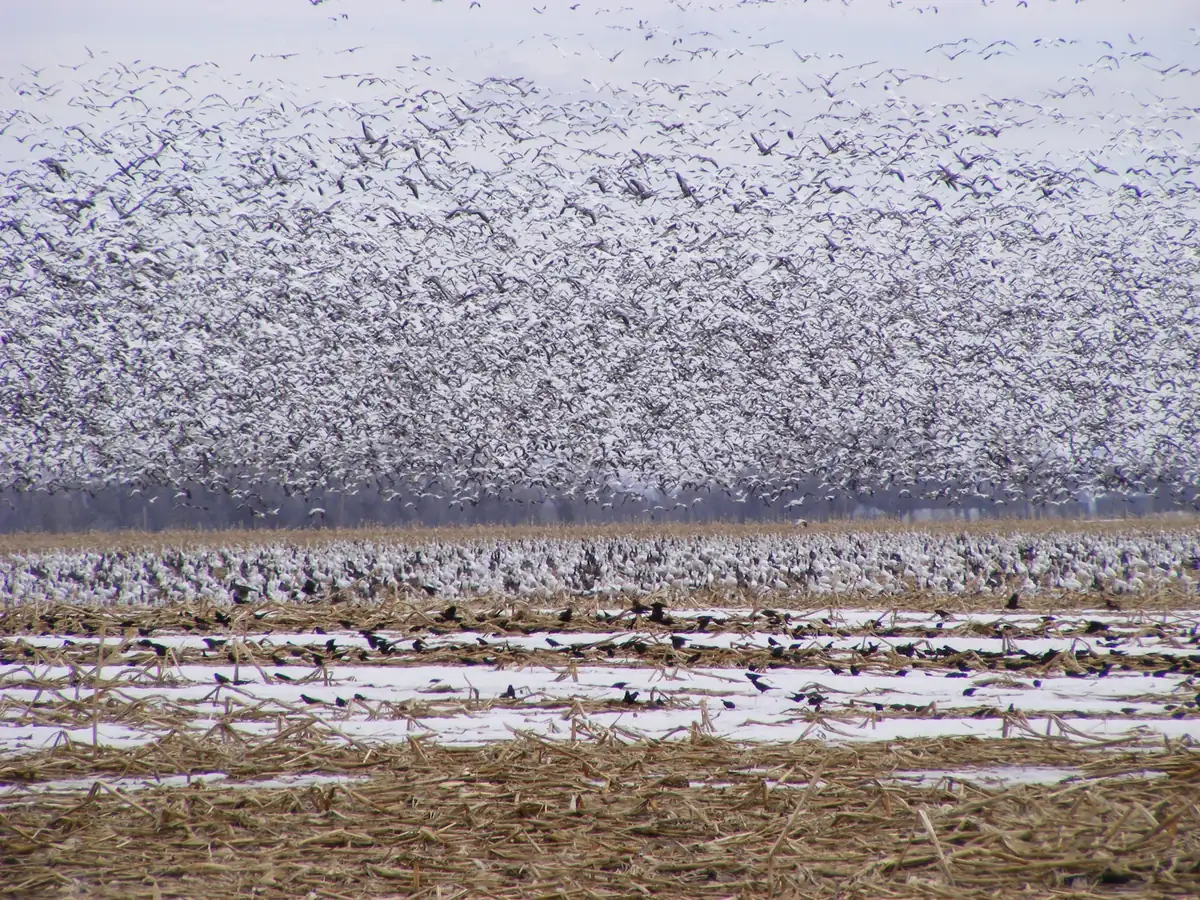
Snow geese are both a common migrant and a common winter resident in Illinois, and IDNR says their spring migration begins in late January and February. As the flocks push north out of the South, they stop on big reservoirs and river bottoms to rest and to glean waste grain from stubble fields. An article in IDNR's Outdoor Illinois Journal notes that snow geese and white-fronted geese have expanded their range and numbers within the state, taking advantage of the big lakes and farmland around them, and that in mild winters they arrive early and linger.
-
The Illinois River valley around Havana
February into March · Chautauqua and Emiquon National Wildlife Refuges and the neighboring Emiquon Preserve, Fulton and Mason counties
The backwater lakes where the Spoon River meets the Illinois rank with the finest goose-watching spots anywhere in Illinois. Emiquon refuge covers 2,631 acres of wetlands at that confluence, beside The Nature Conservancy's Emiquon Preserve, and the Fish and Wildlife Service says more than 100,000 ducks can be on Chautauqua's pools during migration. When a flock of snow geese lifts at once from a field, it looks like a snowstorm blowing upward, and the clamor carries a long way.
-
Blue geese and Ross's geese
Mixed in with the snows · Anywhere the big flocks land
Not every snow goose is white. The dark form, once called the blue goose, has a blue-gray body, a white head and pink bill and feet, and flocks are often a mix of white birds, dark birds and birds in between. Scan the edges of a resting flock for a smaller, rounder white goose with a short, stubby bill: that is a Ross's goose.
-
The Conservation Order
January 27 to April 30, 2027 in the North Zone; February 1 to April 30 in the Central and South zones · Statewide
Under the spring Conservation Order, which some states began in 1999, hunters may take unlimited snow and Ross's geese. Expect hunters in blinds near goose fields in February; give them room.
Snow goose flocks are restless. If you find one, stay in your car on a public road; geese that keep getting flushed burn energy they need for the flight to the Arctic.
When does maple sap run in Illinois?
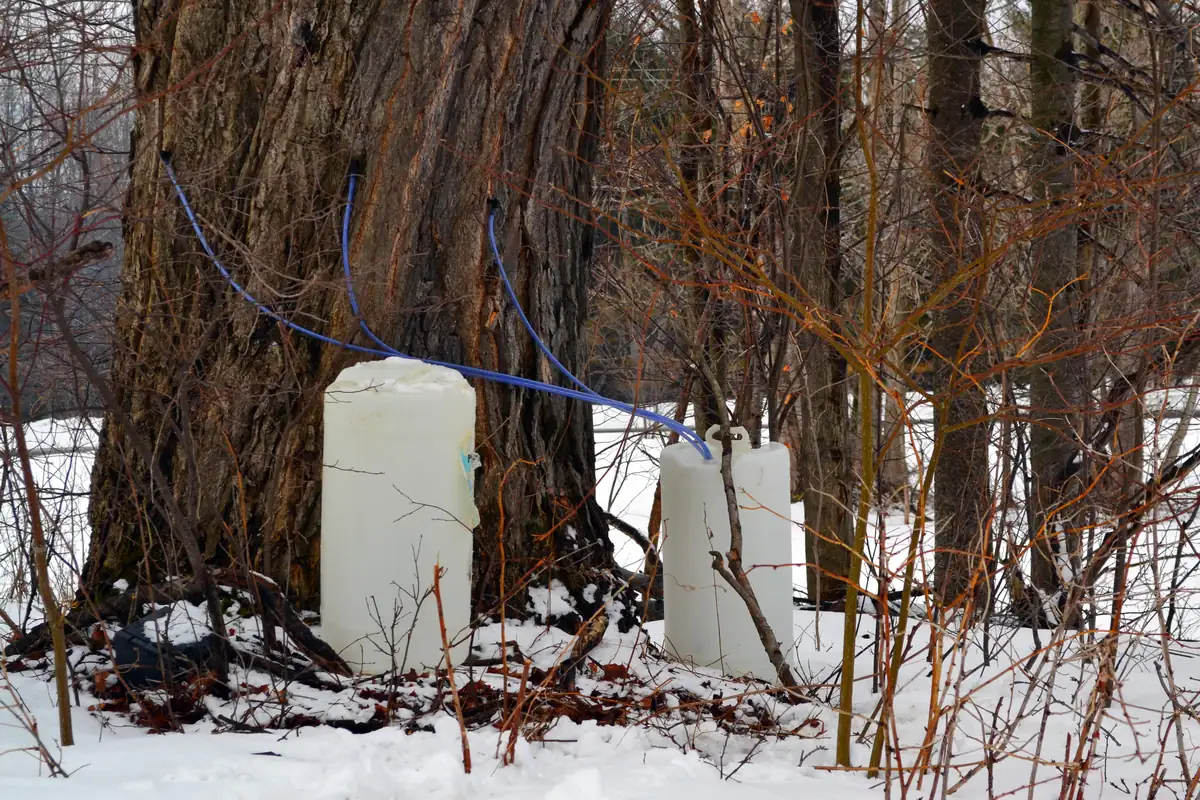
Maple sugaring is not only a New England tradition. Illinois has sugar maples throughout its woods, and the sap starts moving in the late-winter freeze and thaw, with frosty nights followed by afternoons that thaw.
-
Funks Grove on old Route 66
Usually mid to late February into mid-March · Funks Grove Pure Maple Sirup, 5257 Old Route 66, Shirley, south of Bloomington
The Funk family makes sirup (they keep the old spelling) from the sugar maples at Funks Grove, a landmark stop on the old highway. They tap only trees about 40 years old or at least 14 inches across, and it takes 35 to 50 gallons of sap, depending on its sugar content, to boil down to one gallon of sirup. The family says the run in central Illinois usually starts in mid to late February. The shop is open by chance or appointment, and the new season's sirup is normally available from March; check the family's Facebook page before you drive out.
-
Sap to Syrup at Homer Lake
Annual, usually a Saturday in late February, with more sessions in March · Homer Lake Forest Preserve, Champaign County
The Champaign County Forest Preserve District takes groups into the preserve's 200-year-old sugar maple grove to tap trees, see how sap is boiled down and taste the result. The 2026 program ran February 28, and earlier years also fell in late February; registration is required. The 2027 dates were not yet listed as of this writing, so check the district's calendar in January.
A warm spell can stop the run as surely as a long freeze. If you tap a backyard maple, note each day's high and low beside the amount collected, and you will see the freeze-thaw rule for yourself.
What are the first signs of spring in Illinois in February?
Snow can still cover the ground at the end of February, but a few plants and animals start their year anyway. These are the ones worth looking for.
-
Red-winged blackbirds
Late January or early February on; numbers build through the month · Cattail marshes, wet meadows, roadside ditches, field edges
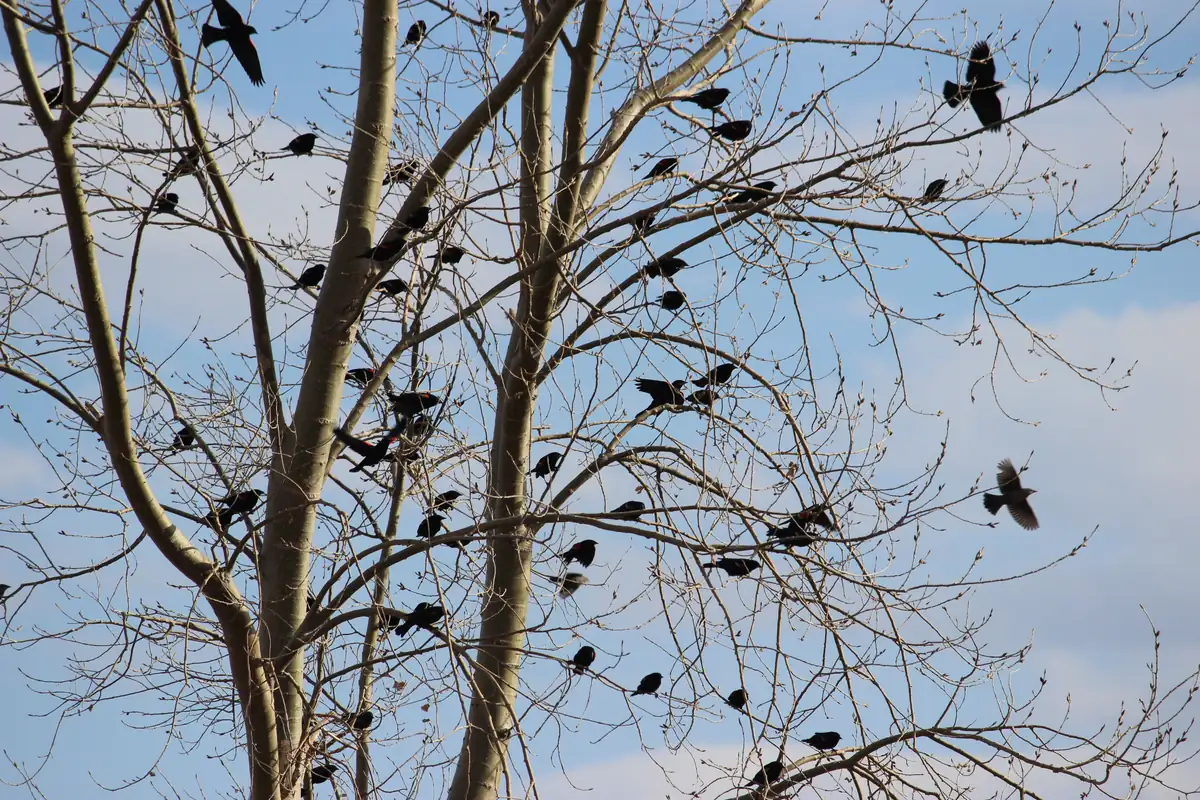
Wildlife Illinois calls the red-wing the first of the songbird migrants to return each spring, arriving in late January or early February. Males come first and claim territories before the females arrive. A male perched on last year's cattail stalk, flaring his red and yellow shoulder patches and calling a gurgling conk-la-ree, is one of the most reliable signs that the season is turning.
-
Skunk cabbage
Flowers may open as early as February · Wet woods, marshes, stream banks and bogs in the northern half of the state, especially the northeast
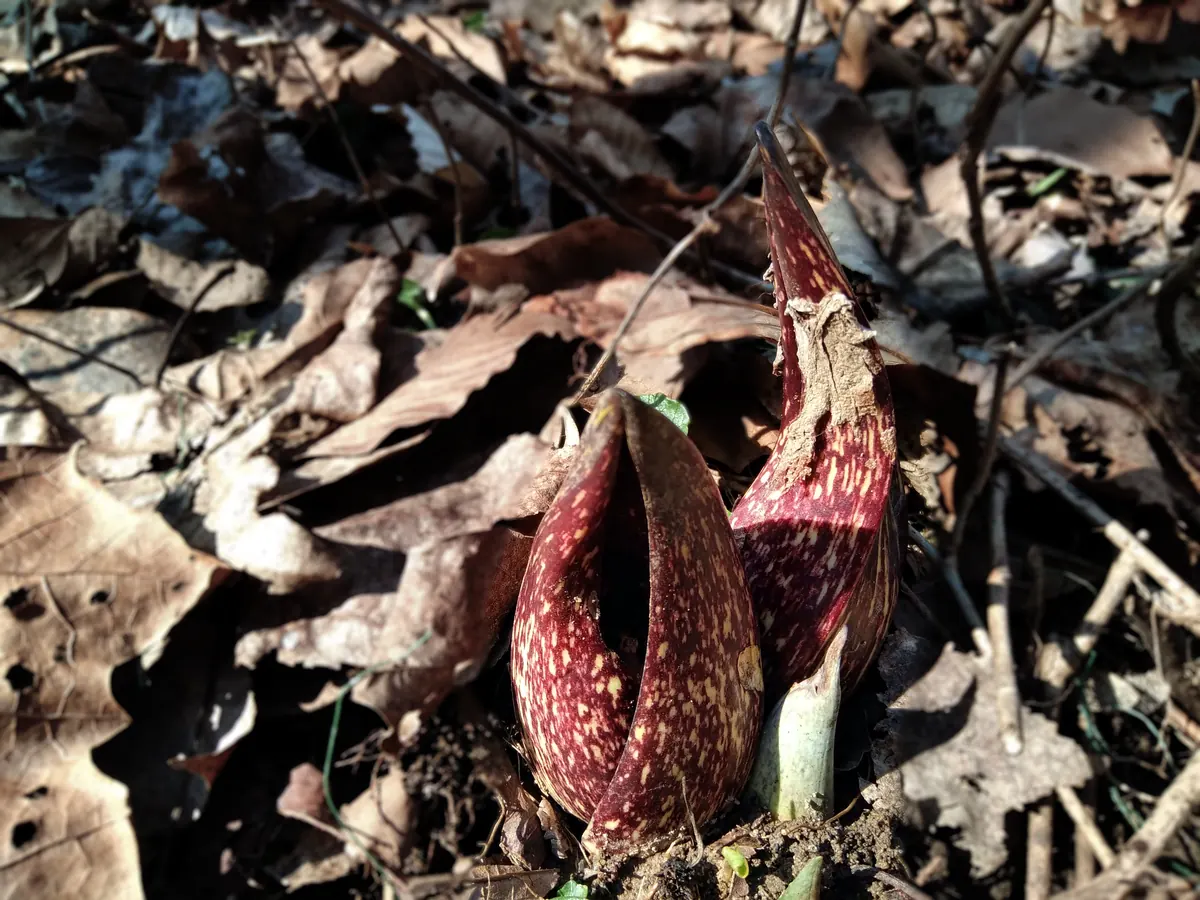
University of Illinois Extension calls skunk cabbage the state's earliest and hottest native plant. Burning starch stored in its roots, it keeps the inside of its hood 15 to 35 °F or more above the air temperature, enough to melt a hole in the snow. Look for a mottled maroon and green hood, a few inches tall, poking out of the mud; inside is a knob covered with tiny flowers. Flies, gnats and beetles drawn by the smell do the pollinating, and spiders sometimes lurk in the hood to catch them.
-
Woodchucks waking up
Mid to late February · Woodland edges, fencerows and roadsides
Most Illinois mammals just sleep through cold snaps, but the woodchuck truly hibernates. Wildlife Illinois says that while it is dormant, a body normally near 97 °F cools to about 34 °F, breathing slows to about one breath in six minutes, and the heart manages just four beats per minute. Woodchucks come out of hibernation in mid to late February and breed in late February or March; the young are born in April or early May.
-
Skunks on the move
Mating season from mid-February to mid-March · Suburbs, farmyards and roadsides
Striped skunks do not truly hibernate, but they sleep through long stretches of cold weather. Their mating season runs from mid-February to mid-March, so a whiff of skunk on a mild February night is often a sign of the breeding season.
Pick one marsh or wet woods and visit it every week or two. The order in which these signs appear, and how it shifts from one year to the next, is exactly the kind of record a field journal is for.
Which frogs call first in Illinois?
Most of the state's frogs wait for March, but two small chorus frogs can start in February, on the first rainy nights when the ground thaws.
-
The Illinois chorus frog
Breeds February through April, after heavy rains · Sandy soils in west-central, southwestern and extreme southern Illinois, including sand prairie country
This stout little frog is listed as threatened in Illinois. The Illinois Natural History Survey says it lives in four separate areas of sandy soil and spends most of its life buried, coming to the surface during heavy rains to breed for only a few weeks in flooded fields, ditches and other temporary ponds. Males call with a series of clear, high whistles, rather like a squeaky wheel heard at a distance. Drainage of breeding ponds and sand mining are the main threats, so listen from the roadside and stay out of the water.
-
The upland chorus frog
From late February through May · Floodplains and moist woods at the southern tip of the state
IDNR describes the male's call as a rising crreek or prreep, a sound you can imitate by running a fingernail along the teeth of a comb. It breeds in almost any standing water.
Spring peepers, found statewide, and the western chorus frog of south-central Illinois usually start calling in March. If you hear frogs in February, jot down the date, how warm it felt and whether rain had fallen that evening.
What happens on Groundhog Day in Woodstock, Illinois?
Woodstock, in McHenry County, is where the movie Groundhog Day was filmed, and the town has turned February 2 into a five-day festival with its own forecaster, Woodstock Willie.
-
Woodstock Groundhog Days 2027
Friday, January 29, through Tuesday, February 2, 2027; the prognostication is 6:30 to 7:30 a.m. on February 2 · The historic Woodstock Square
The organizers list a 5K, film screenings, walking tours of the filming sites, a chili cook-off and a welcoming of the groundhog on the evening of February 1. Early the next morning, Willie emerges on the square to look, or not look, at his shadow.
-
The real middle of winter
February 3 to 4, 2027 · Everywhere
Groundhog Day descends from an old cross-quarter day, a marker set about halfway through the dark half of the year, between solstice and equinox. Measured exactly, the midpoint of astronomical winter in 2027 falls on February 3 or 4, a day or two after Willie's forecast. Meteorologists, who count winter as December through February, are by then two-thirds of the way through.
A real Illinois woodchuck is usually still hibernating on February 2.
Is February snowy in Illinois?
Across Illinois, February normals run a few degrees above January's, yet the month is still firmly winter. NOAA's 1991–2020 normals give O'Hare 10.7 inches of February snow, nearly as much as January's 11.3, and Rockford and Moline both average more than 8 inches. In the far south the pattern flips: Carbondale and Anna both average 4 inches of snow in February, more than their January normals. Average afternoon highs reach the mid-40s at Carbondale and 50 at Anna. For your town's usual last spring frost, look up the Illinois frost dates.
-
Lake Michigan ice at its peak
Mid to late February in most years · The Chicago lakefront, harbors and Illinois Beach State Park
NOAA's Great Lakes Environmental Research Laboratory says the lakes normally reach their greatest ice cover between mid-February and early March, with lower lakes such as Erie peaking first. Lake Michigan's range is enormous: in GLERL's records it froze over completely in 1996 and reached only 8.5 percent at its peak in 2012. Shore ice along the lakefront is worth a look from the beach, never from on top of it.
| Station | Average high | Average low | Precipitation | Snowfall |
|---|---|---|---|---|
| Rockford (Greater Rockford Airport) | 33.4 | 17.8 | 1.63 | 8.5 |
| Moline (Quad City Airport) | 36.6 | 18.8 | 1.83 | 8.6 |
| Chicago O'Hare | 35.7 | 21.8 | 1.97 | 10.7 |
| Peoria (Greater Peoria Airport) | 38.7 | 21.4 | 1.99 | 6.9 |
| Springfield (Capital Airport) | 41.1 | 23.7 | 1.93 | 6.1 |
| Carbondale (sewage plant station) | 46.3 | 26.4 | 3.11 | 4.0 |
| Anna | 50.0 | 29.1 | 3.40 | 4.0 |
What will this February bring? The backdrop is likely to be an unusually powerful El Niño. The Climate Prediction Center's ENSO update of September 10 rated a very strong event for December through February as more than 90 percent likely. The Illinois State Climatologist's office says El Niño winters here tend to be warmer and drier than usual, with below-average snow. Its record of past events backs that up. The strong El Niño winter of 1997–98 ran 5.6 °F above average across Illinois from December to February, and 1982–83 ran 4.6 °F above; when the office ranked them in 2015, they stood third and sixth warmest on record. Research from the Midwestern Climate Center found that strong El Niño winters cut seasonal snowfall in northern Illinois and Indiana by roughly 10 to 20 inches. GLERL also lists El Niño among the patterns that steer the jet stream and so affect how much ice forms on the lakes. Tendencies are not promises, though, and one blizzard can bury a mild February. For NOAA's own forecast, first released October 15 and updated each month after that, see the three-month outlook maps at the Climate Prediction Center; for the next few days in your county, open our weather page.
How much daylight does Illinois gain in February?
February is when the lengthening days become impossible to miss. Chicago's sunrise on February 1 comes at 7:03 a.m., with sunset at 5:05 p.m.; by February 28, the city sees sunrise at 6:27 and sunset at 5:39. Over the month the city's day grows from 10 hours 3 minutes to 11 hours 13 minutes, a gain of 70 minutes, and by the end of February it is gaining close to three minutes a day. The northern cities gain the most, and the far south the least, because the days there were never as short to begin with. Daylight saving time begins March 14 and moves sunset an hour later on the clock.
| City | Feb 1 | Feb 28 | Gained | Per day |
|---|---|---|---|---|
| Rockford | 10 h 01 m | 11 h 12 m | 71 min | 2.6 min |
| Chicago | 10 h 03 m | 11 h 13 m | 70 min | 2.6 min |
| Moline | 10 h 04 m | 11 h 13 m | 69 min | 2.6 min |
| Peoria | 10 h 08 m | 11 h 14 m | 66 min | 2.4 min |
| Champaign | 10 h 10 m | 11 h 15 m | 65 min | 2.4 min |
| Springfield | 10 h 11 m | 11 h 16 m | 65 min | 2.4 min |
| Carbondale | 10 h 19 m | 11 h 19 m | 60 min | 2.2 min |
| Cairo | 10 h 23 m | 11 h 21 m | 58 min | 2.1 min |
To get the times for your own street, plug it into our daylight tool.
What can you see in the Illinois night sky in February 2027?
February 2027 is a planet month. The two bright outer planets both reach opposition, when Earth passes between them and the sun and they shine all night, within nine days of each other, while Mercury gives its finest showing of the season in the evening twilight. All times here are central standard time.
-
Mercury after sunset
Late January to about February 10; greatest elongation around February 2 to 3 · Low in the west-southwest, 30 to 45 minutes after sunset
Mercury swings about 18 degrees from the sun at greatest elongation, near midnight CST on the night of February 2 into February 3. Search just above the skyline for a tiny, unblinking dot as the glow fades; binoculars help, but never sweep them while any part of the sun is still up. A hairline crescent moon, barely a day old, joins Mercury low in the west after sunset on Sunday, February 7.
-
Jupiter at opposition
Evening of Wednesday, February 10 (opposition at 6:21 p.m. CST) · Rising in the east at sunset, high in the south around midnight, in Leo
At about magnitude −2.5, Jupiter outshines every star. Brace binoculars against a post and you may pick out as many as four of its big moons strung out in a row, shuffling places each night. Earth and Jupiter are about 405 million miles apart at closest approach.
-
Mars at opposition
Friday, February 19; closest to Earth February 20 · Rising at sunset in Leo, not far from Jupiter
This opposition is a modest one. The red planet is out near its far swing from the sun, so its closest pass to us is a long 63 million miles or so; even so, Mars will not come nearer again until 2029. At magnitude −1.2 it is still a striking orange-red point, brighter than any star in the evening sky except Sirius.
-
The Snow Moon and a faint eclipse
Full at 5:23 p.m. CST on Saturday, February 20 · Rising in the east around sunset; in Chicago, moonrise is 5:28 p.m.
The full moon is caught in a penumbral lunar eclipse that evening. Greatest eclipse is at 5:13 p.m. CST, just before the moon comes up in Illinois, and the moon leaves Earth's outer shadow at 7:13 p.m. The moon only grazes the pale outer part of Earth's shadow, and here it will be hugging the horizon in a bright sky, so at best a faint smudge of gray may show on one side of the disk just after moonrise; most watchers will notice nothing. A few almanacs label this a supermoon; by other measures it falls short, and it is clearly farther away than January's full moon. Jupiter, the bright star Regulus and Mars all lie near the moon that night.
-
Venus, Saturn and a solar eclipse you can't see
All month · Venus in the southeast before dawn; Saturn low in the west after dusk
Before dawn, dazzling Venus hangs in the southeast; after dusk, Saturn sits low in the west, a little fainter each week. The ring-of-fire solar eclipse on February 6 belongs to the Southern Hemisphere, with its ring path over the southern tip of South America, and can't be seen, even partly, from Illinois or any other state.
| Phase | Date | Time |
|---|---|---|
| New moon | Saturday, Feb 6 | 9:56 a.m. CST (an annular solar eclipse, not visible from the U.S.) |
| First quarter | Sunday, Feb 14 | 1:58 a.m. CST |
| Full moon, the Snow Moon | Saturday, Feb 20 | 5:23 p.m. CST (with a faint penumbral eclipse) |
| Last quarter | Saturday, Feb 27 | 11:16 p.m. CST |
Moonless evenings, ideal for dim stars and star clusters, come in the week following the new moon of February 6. Check our cloud cover forecast before heading out, and our moon phase calendar gives moonrise and moonset for your Illinois town.
What can Illinois families do outside in February?
- January 29 to February 2: Woodstock Groundhog Days. The prognostication on the Woodstock Square runs 6:30 to 7:30 a.m. on Tuesday, February 2.
- Early February: Fulton-Mason Eagle Day. This free annual event, held in past years on the first Saturday of February, spreads across Dickson Mounds State Museum, the Emiquon Preserve, Chautauqua refuge and Havana's riverfront, with raptor shows and scopes on eagles. No 2027 date was posted at press time, so confirm with Dickson Mounds before you go.
- Winter mornings: eagle programs at Pere Marquette State Park. The park offers reservation-only eagle outings in January and February; call the park for 2027 dates.
- February 12 to 15: Great Backyard Bird Count. Audubon gives these as the dates of the 30th annual count. Watch for at least 15 minutes and enter what you see at birdcount.org.
- Late February: Sap to Syrup at Homer Lake. An annual maple-tapping program from the Champaign County Forest Preserve District; registration required, 2027 dates to come.
- Any mild afternoon: a crane and blackbird walk at Nygren Wetland Preserve in Rockton, Moraine Hills State Park or your nearest cattail marsh.
- All month: Project FeederWatch and eBird. FeederWatch counts continue into spring, and eBird turns any outing into data scientists can use.
Last month's eagle festivals and winter ducks are on our January guide for Illinois, and you can reach any other state's month from our nature guide index. Start a first-of-spring list in the Naturalist's Field Journal and add to it every February.
Safety notes for February in Illinois
- Small game and furbearer seasons end mid-month. According to IDNR's 2026–27 season card, squirrel and rabbit hunting close February 15, and the same date ends hunting for raccoon, opossum, bobcat and red fox along with trapping of most furbearers. Crows may be hunted through February 28, while beaver and river otter trapping stays open until the end of March. There is no gray fox season at all now. Keep dogs leashed along creeks and wetland edges, where traps may still be set.
- Blaze orange or pink. IDNR requires rabbit hunters on department sites to wear both a solid orange or pink hat and a top showing 400 square inches or more of that color; on private ground the hat alone is the minimum. Squirrel and crow hunters are exempt unless they are also after rabbits. Hikers on public hunting areas in the first half of the month should wear something bright too.
- Light goose hunting. The Conservation Order is open from January 27 in the North Zone and February 1 in the Central and South zones, and legal hunting hours stretch to a half hour past sunset. Expect gunfire near goose fields and reservoirs at dawn and dusk.
- Late-season ice. By February, much of the ice on Illinois ponds is old ice, and University of Illinois Extension points out that new ice is usually stronger than old, and clear ice stronger than cloudy. Extension's minimum for a single walker is 4 inches of clear, fresh ice, and it warns that one pond can be 12 inches thick in one place and 1 inch thick ten feet away, so check the thickness in several spots. Stay off ice over moving water, near inlets and springs, and on the Lake Michigan shelf ice entirely.
- Cold and wind chill. February mornings still average below 20 °F in the north. The National Weather Service warns that frostbite can strike exposed skin quickly in extreme cold; put kids in several thin layers, keep ears and fingers covered, and head indoors once anyone begins to shiver.
- Late-winter storms and high water. February can bring heavy snow, freezing rain and, in the south, heavy rain on frozen ground. Low roads near the Ohio, Mississippi and Cache rivers can flood; never try to cross a flooded road, and carry a blanket, snacks and a phone charger on winter trips.
Sources
- NOAA NCEI: U.S. Climate Normals 1991–2020, monthly normals for Illinois stations (data API)
- Climate Prediction Center: ENSO diagnostic discussion, September 10, 2026
- Climate Prediction Center: 90-day seasonal outlooks
- Illinois State Climatologist Office: El Niño and La Niña in Illinois
- Illinois State Climatologist Office: impact of El Niño on snowfall
- Illinois State Climatologist: last two big El Niño events, milder winters in Illinois (August 26, 2015)
- NOAA Great Lakes Environmental Research Laboratory: Great Lakes ice cover
- Illinois Public Media: it's eagle nesting season in Illinois, February 19, 2026
- IDNR Wild About Illinois Birds: bald eagle
- IDNR: about Moraine Hills State Park
- U.S. Fish and Wildlife Service: visit Chautauqua National Wildlife Refuge
- U.S. Fish and Wildlife Service: Emiquon National Wildlife Refuge
- State of Illinois, Eagles in Illinois: eagle watching sites and events
- Outdoor Illinois Journal (IDNR): eagles abound at the Fulton-Mason Eagle Day, February 1, 2025
- Wildlife Illinois (IDNR): sandhill crane
- Outdoor Illinois Journal (IDNR): Illinois' cranes, a storied past and a hopeful future
- Natural Land Institute: sandhill cranes return in February
- Forest Preserve District of Will County: sandhill crane migration has begun, March 2, 2026
- IDNR Wild About Illinois Birds: snow goose
- Outdoor Illinois Journal (IDNR): goose migration
- Funks Grove Pure Maple Sirup: the process
- Funks Grove Pure Maple Sirup: home and visitor information
- SJO Daily: Sap to Syrup maple tapping returns to Homer Lake, January 13, 2026
- Champaign County Forest Preserve District: Sap to Syrup, exploring maple tapping in central Illinois
- University of Illinois Extension: skunk cabbage, spring's earliest and hottest native plant, February 6, 2026
- Wildlife Illinois (IDNR): blackbirds
- Wildlife Illinois (IDNR): woodchuck or groundhog
- Wildlife Illinois (IDNR): striped skunk
- Illinois Natural History Survey, herpetology collection: Illinois chorus frog
- IDNR Wild About Illinois Frogs: Illinois chorus frog
- IDNR Wild About Illinois Frogs: upland chorus frog
- IDNR Wild About Illinois Frogs: spring peeper
- IDNR Wild About Illinois Frogs: western chorus frog
- Woodstock Groundhog Days: 2027 events
- National Audubon Society: about the Great Backyard Bird Count (February 12–15, 2027)
- Project FeederWatch: how to participate
- eBird (Cornell Lab of Ornithology): submit checklists
- U.S. Naval Observatory: moon phases (data API)
- U.S. Naval Observatory: sunrise and sunset, Chicago, February 1, 2027 (data API)
- U.S. Naval Observatory: sun and moon, Chicago, February 28, 2027 (data API)
- U.S. Naval Observatory: moonrise, Chicago, February 20, 2027 (data API)
- U.S. Naval Observatory: Earth's seasons, 2027 (data API)
- Fred Espenak, Sky Event Almanac 2027 (GMT)
- NASA Eclipse Web Site: lunar eclipses, 2021–2030
- NASA Eclipse Web Site: solar eclipses, 2021–2030
- Sea and Sky: astronomy calendar of celestial events, 2027
- EarthSky: what is a supermoon?
- IDNR: 2026–27 Illinois Digest of Hunting and Trapping Regulations, season dates card
- Hunt Illinois (IDNR): upland and small game, blaze orange or pink rules
- University of Illinois Extension: don't be fooled by thin ice
- National Weather Service: winter weather safety, cold
- Photos via Wikimedia Commons; licenses and photographers are credited under each picture